Available online:
https://edupediapublications.org/journals/index.php/IJR/
P a g e | 1158
STUDY ON LATERITIC SOIL TREATED WITH A CEMENTITIOUS
STABILIZER FOR USE AS PAVEMENT MATERIAL
Melitia D’mello
Assistant professor, Shree Devi Institute of Technology, Mangaluru
Email id: [email protected]
Abstract:
Road network in rural areas plays an important role in development of agricultural base
country, like India. The life and maintenance of rural road depends on strength of subgrade soil
and traffic intensity. Options for dealing with poor soils include attempting to dry and compact
the subgrade; reinforcing the subgrade with a geo-synthetic material; applying a chemical
stabilizer such as lime, cement, polymer or other amendment and/or designing a very thick and
expensive pavement section. Traditional lime and cement treatment can be very effective, but the
use of lime and cement are limited due to issues with dust control and other handling problems.
Keywords: RBI Grade 81, Heavy Compaction, CBR, Unconfined Compressive Strength.
Introduction
Road infrastructure in India is developing at a very fast pace. The subgrade soil is not uniform throughout the alignment of the road. A good pavement is needed for the safe, comfortable and economical movement of traffic. The soil of the subgrade which satisfies the conditions given by IRC: SP: 72-2007 are suitable as subgrade soil. If the soil has CBR value less than 2%, it must be replaced by good quality material.
Engineers are often faced with the problem of constructing facilities on or with soils, which do not possess sufficient strength to support the loads imposed upon them either during construction or during the service life of the structure. Many areas of India consist of soils with high silt contents, low strength and poor bearing capacities. These negative soil performance characteristics are quite often attributed to the nature and quality of the fines present in the material.
For better performance of structures built on such soils, the performance characteristics of such soils need to be improved. The poor engineering performance of such soils has forced Engineers to attempt to improve the engineering properties of poor quality soils.
Available online:
https://edupediapublications.org/journals/index.php/IJR/
P a g e | 1159
Stabilization of soils is an effective method for improving the properties of soil and pavement system performance. Soil stabilization is the alteration of the property of a locally available soil to improve its engineering performance, such as strength, stiffness, compressibility, permeability, workability, and sensitivity
Soil stabilization is the process of improving the engineering properties of the soil and thus making it more suitable and stable. It is required when the soil available for construction is not suitable for the intended purpose. In its broadest sense, stabilization includes compaction, pre-consolidation, drainage and many other such processes, but more specifically stabilization means chemical modification of soil by mixing soils with various chemicals. The main objective is to increase the strength and stability of soil and to reduce the construction cost by making it best use of the locally available materials. A cementing material or a chemical is added to a natural soil for the purpose of stabilization.
Materials
Proprietary Cementitious Stabilizer
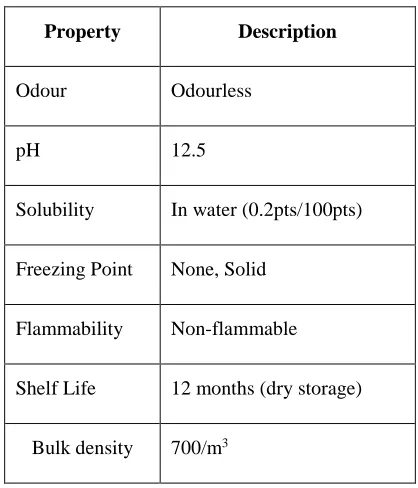
The proprietary Cementitious Stabilizer called Road Building International Grade 81 (RBI Grade 81) is a product that was developed for the stabilization of a wide spectrum of soils in an efficient, least-cost manner. It is an environmental friendly, inorganic, hydration activated powder-based stabilizer that reacts with soil particles to create layers that are interconnected through a complex inter-particle framework. The properties of Proprietary Cementitious Stabilizer are shown in Table 2.1.
Table 1. Physical properties of RBI-81 Stabilizer
Property Description
Odour Odourless
pH 12.5
Solubility In water (0.2pts/100pts)
Freezing Point None, Solid
Flammability Non-flammable
Shelf Life 12 months (dry storage)
Bulk density 700/m3
Available online:
https://edupediapublications.org/journals/index.php/IJR/
P a g e | 1160
cost-effective method by creating a strong and irreversible impermeable layer which is resistant to adverse climatic conditions, from very high temperatures to permafrost conditions, and accommodating all types of roads and load requirements.
RBI Grade-81 is environment friendly and emphasizes the use of recycled material, recognizing the lack of readily available resources. It reduces the Carbon Footprint of any project by reducing transportation requirements and carbon emissions. This makes it eligible for Carbon Credits in the environment friendly sensitive global market place. It is a natural inorganic soil-stabilizer which re-engineers & modifies the properties of soil to strengthen it for roads, paving and roads and pavement.
Lateritic soils
Lateritic soil available in major parts of Dakshina Kannada District, Karnataka state. These soils are encountered over extensive non alluvial tracts of peninsular India and are made up of such acidic rocks as granite, gneiss and schist. They develop in areas in which rainfall leaches soluble minerals out of the ground and results in a loss of chemically basic constituents; a corresponding proportional increase in oxidized iron imparts a reddish hue to many such soils. Hence, these are commonly described as ferralitic soils. In extreme cases, the concentration of oxides of iron leads to formation of a hard crust, in which case they are described as lateritic (for later, the Latin term meaning “brick”) soils.
Lateritic soil contains more amounts of finer particles like medium sand, fine sand, silt and clay. It could be described as a red friable clay surface in a temperature countries, it could also described as a very hard homogenous vescular massive clinker lateritic soils as a group rather than well defined materials are most commonly found in a leached soils of humid tropic which is enriched in iron and aluminium.
The heavily leached red-to-yellow soils are concentrated in the high-rainfall areas of the Western Ghats, the western Kathiawar Peninsula, eastern Rajasthan, the Eastern Ghats, the Chota Nagpur Plateau and other upland tracts of north-eastern India. Less leached red-to-yellow soils occur in areas of low rainfall immediately east of the Western Ghats in the dry interior of the Deccan.
In the present study this soil is collected from Nitte area, near Karkala of Udupi District of Karnataka state.
Mechanism of soil stabilization by Proprietary Cementitious Stabilizer
The reaction mechanism of stabilization with Proprietary Cementitious Stabilizer follows a hydration process, in characteristics to lime and cement. Water or better put moisture initiates the reaction process of Proprietary Cementitious Stabilizer. The initial stages of reaction are very important to the success of soil stabilization; however, the strength of the stabilized layer is achieved over a long- term time frame.
When the stabilizer is mixed with a soil, the soil and stabilizer exchange ions thus creating ionic bonds between the soil and stabilizer particles. The soil voids are then filled with ‘crystalline reaction products’, producing mechanical ties between the soil and stabilizer particles. This chemical process is described as continuing over a period of time, thus improving soil strength over time.
Preparation and casting of test specimens
A.
Compaction Tests
Available online:
https://edupediapublications.org/journals/index.php/IJR/
P a g e | 1161
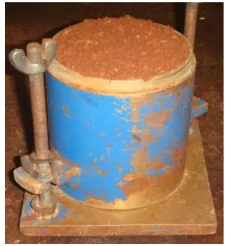
procedure available for compaction test was used in the present work for heavy compaction (IS: 2720 (Part 8) – 1983: Determination of Water content- Dry density relation using Heavy Compaction”).
The heavy compaction test for the treated soils were conducted as per prescribed standards (IS: 4332 (Part 3) – 1967, “Tests for determination of Moisture content- Dry density relationships for stabilized soil mixtures”).
Fig 1. Preparation of sample by IS Heavy Compaction to determine Maximum dry density and Optimum moisture content
B. Unconfined Compressive Strength Test (UCS Test)
Standard test equipment and procedure available for UCS test was used in the present work as per (IS: 2720 (part 10) – 1973, “Determination of Unconfined Compressive Strength”). After treating the soils with commercial stabilizer, the UCS test was carried as per prescribed standards (IS: 4332 (Part 5) – 1970, “Determination of Unconfined Compressive Strength of Stabilized soils”).
The unconfined compression strength (UCS) test was carried out for both soaked and unsoaked conditions for heavy compaction densities. The soils were treated with 2%, 4% and 6% by weight of commercial stabilizer and test was conducted for the following conditions.
Specimen preparation and curing
Available online:
https://edupediapublications.org/journals/index.php/IJR/
P a g e | 1162
Fig 2. Mould assembly compressed under UTM and samples obtained for UCS Testing
Measured quantity of the soil and the water required to satisfy OMC and MDD conditions is thoroughly mixed. The oil is applied to the inner surface of the mould as well as the to the end caps. The mould is kept on the bottom end cap. The mixture is put inside the mould in layers suitably and top end cap is kept. The mix is compacted by keeping the mould assembly under the universal testing machine. Then, the specimen is suitably removed from the mould and weighed.
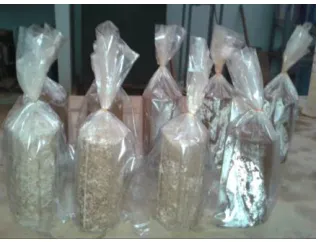
The specimen is protected by wrapping in polyethene bag to maintain it at its specified moisture content. After the curing period and before testing, the specimen shall again be weighed to check whether there is any change in the water content or weight.
Fig 3. Curing of samples prepared for Unconfined Compression Test
1. Specimens cured for 4 hours, 1 day, 3 days, 7 days and 28 days were tested for unsoaked condition. 2. Specimens cured for 4 hours, 1 day and 3 days were soaked for 2 hours and tested for soaked condition. 3. Specimens cured for 7 days and 28 days were soaked for 1 day and tested for soaked condition.
Available online:
https://edupediapublications.org/journals/index.php/IJR/
P a g e | 1163
C. California Bearing Ratio (CBR) Test
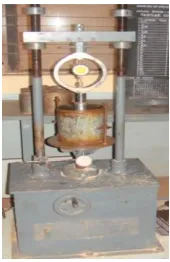
Standard test equipment and procedure available for CBR test was used in the present work (IS: 2720 (Part 16) – 1979, “Laboratory Determination of CBR”). The tests were conducted for soaked and unsoaked condition for samples prepared under IS heavy compaction condition.
Fig 4. California bearing ratio testing machine and the specimen undergoing testing.
Results and Discussions
A.
Compaction Test
Effect of Proprietary Cementitious Stabilizer on Maximm Dry Density and Optimum Moisture Content of
both Shedi Soil and Lateritic soil
Available online:
https://edupediapublications.org/journals/index.php/IJR/
P a g e | 1164
Fig 5. Variation of Maximum Dry Density with different percentages of stabilizer for Lateritic soil
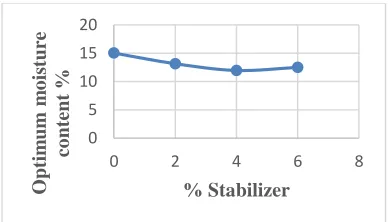
Fig 6. Variation of Optimum Moisture Content with different percentages of stabilizer for Lateritic soil
B.
Unconfined Compressive Strength Test
Effect of Proprietary Cementitious Stabilizer on Unconfined Compressive Strength of Lateritic soil
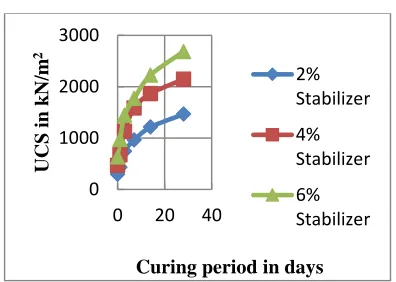
For unsoaked condition, the strength increases steadily with increase in curing period and also with increase in
percentage of stabilizer added. The strength before treating with stabilizer was 140kN/m2 which increased to
1467kN/m2 (increase of 947.86%) for 2% stabilizer, 2147kN/m2 (increase of 1433.57%) for 4% stabilizer and
2683kN/m2 (increase of 1816.43%) for 6% stabilizer at 28 days curing.
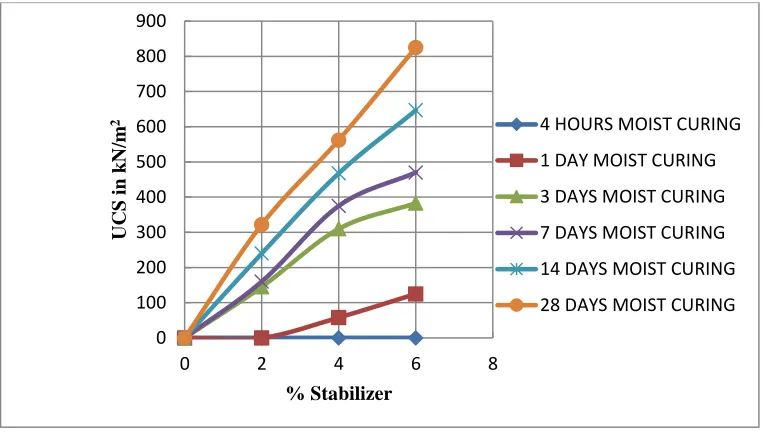
For soaked condition the improvement in strength is appreciable with increase in curing period as well as increase in the percentage of stabilizer. The strength of treated soil in soaked condition increased for 3 days, 7 days, 14 days and 28 days curing but it is zero for 4 hours curing – 1day soaking and 1 day curing – 1day soaking.
The Unconfined compressive strength of Lateritic soil treated with 2% stabilizer is 322kN/m2 which increased to
562kN/m2 (increase of 74.53%) for 4% stabilizer and 825kN/m2 (increase of 156.21%) for 6% stabilizer at 28 days
curing in soaked condition.
18.4 18.6 18.8 19 19.2 19.4 19.6
0 2 4 6 8
M a x im um dry dens it y (g /cm 3) % Stabilizer 0 5 10 15 20
0 2 4 6 8
Available online:
https://edupediapublications.org/journals/index.php/IJR/
P a g e | 1165
Fig 7. Variation of UCS (unsoaked) with curing period for different percentages of stabilizer for Lateritic soil
Fig 8. Variation of UCS (soaked) with curing period for different percentages of stabilizer for Lateritic soil 0
1000 2000 3000
0 20 40
UCS
in
k
N/m
2
Curing period in days 2% Stabilizer 4% Stabilizer 6% Stabilizer
0 200 400 600 800 1000
0 10 20 30
UCS
in
k
N/m
2
Curing period in days
Available online:
https://edupediapublications.org/journals/index.php/IJR/
P a g e | 1166
Fig 9. Variation of UCS (unsoaked) with different percentages of stabilizer for Lateritic soil
Fig 10. Variation of UCS (soaked) with different percentages of stabilizer for Lateritic soil. 0 500 1000 1500 2000 2500 3000
-2 3 8
UCS in k N/m 2 % Stabilizer
4 HOURS MOIST CURING 1 DAY MOIST CURING 3 DAYS MOIST CURING 7 DAYS MOIST CURING 14 DAYS MOIST CURING 28 DAYS MOIST CURING
0 100 200 300 400 500 600 700 800 900
0 2 4 6 8
UCS in k N/m 2 % Stabilizer
Available online:
https://edupediapublications.org/journals/index.php/IJR/
P a g e | 1167
C. CBR Test
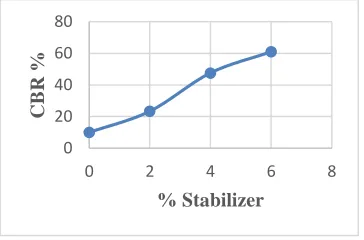
For the two types of soils an increase in soaked CBR is observed with the increase in percentage of stabilizer.
Effect of Proprietary Cementitious Stabilizer on CBR value of Lateritic soil
The CBR value before treating with stabilizer was 10% and after 7 days moist curing and 4 days soaking, at heavy compaction condition (maximum dry density and corresponding optimum moisture content), which increased upto 23.36% (increase of 133.60%) for 2% stabilizer, 47.59% (increase of 375.90%) for 4% stabilizer and 60.97% (increase of 509.70%) for 6% stabilizer.).
Fig 11. Variation of CBR with different percentages of stabilizer for Lateritic soil
Conclusions
From the experimental analysis and obtained results, the following conclusion are drawn.
RBI grade 81 stabilizer gives satisfactory results in terms of strength and CBR value.
From unconfined compressive strength test results, especially under soaked condition, which is the critical
condition for which pavements must be designed; it is observed that Lateritic soil showed better improvement in UCC strength with increase in curing period and also with percentage stabilizer.
Lateritic soils showed good results in Unconfined Compressive strength (good improvement) even under soakedcondition. Strength gain is rather slow, almost negligible upto 1 day curing and then picks up appreciably.
Lateritic soil performed best with the stabilizer under soaked condition. This may be due to the comprehensiveinter particle matrix, due to the complex hydration reaction which irreversibly binds particle into a rigid frame work. This is because the voids in the Lateritic soil are larger.
References
0 20 40 60 80
0 2 4 6 8
CB
R
%
Available online:
https://edupediapublications.org/journals/index.php/IJR/
P a g e | 1168
[1]Atul Dubey, Dr. R. Chandak, Prof. R.K.Yadav “Effect of blast furnace slag powder on compressive strength of concrete” International Journal of Scientific & Engineering Research Volume 3, Issue 8, August-2012 1 ISSN 2229-5518.
[2] A. M. Radwan, E. A. El-Alfi and R. M. Osman “Characteristics of Portland Cement pastes with replacement of slag” ARPN Journal of Engineering and Applied Sciences. ISSN 1819-6608 Volume 7, No. 3, March 2012.
[3]Dilip Kumar Singha Roy, Amitava Sil “Effect Of Partial Replacement Of Cement By SilicaFume On Hardened Concrete”, International Journal of Emerging Techno;ogy and Advanced Engineering, IJETAE, Volume 2, Issue 8, August 2012.
[4]K. Suvarna Latha, M V Seshagiri Rao, Srinivasa Reddy. V International Journal of Engineering and Advanced Technology (IJEAT) ISSN: 2249 – 8958, Volume-2, Issue-2, December 2012.
[5] Mrs. Veena G. Pathan1, Mr. Vishal S. Ghutke2, Mr. Gulfam Pathan “Evaluation of concrete properties using Ground Granulated Blast Furnace Slag” International Journal of Innovative Research in Science, Engineering and Technology Vol. 1, Issue 1, November 2012.
[6] Prof. Dr. Ke. A. Palaniappan, Mrs. S. Vasantha, Mr. S. Siva Prakasan, 4Mr. S. Prabhu, “GGBS as alternative to OPC in concrete as an Environment Pollution Reduction Approach” International Journal of Engineering Research & Technology (IJERT) ISSN: 2278-0181 Vol. 2 Issue 6, June - 2013.