ISSN 2286-4822
www.euacademic.org DRJI Value: 5.9 (B+)
Theorizing Deviant Consumer Socialization:
With Special Reference to Compulsive Buying
Behavior. A Review of Literature
SACHITHRA SOMASIRI Lecturer Department of Marketing Management Faculty of Management Studies and Commerce
University of Sri Jayewardenepura, Sri Lanka Email: [email protected]
KPL CHANDRALAL Senior Lecturer Department of Marketing Management Faculty of Management Studies and Commerce
University of Sri Jayewardenepura, Sri Lanka
Abstract:
consumer socialization. Identification of personality traits is particularly sustained based on the significance of personality differences in consumer decision making process. The study also proposes social media as a new deviant consumer socialization agent in the contemporary marketing environment. By means of identifying the above aspects the proposed conceptual framework intends to elaborate deviant consumer socialization in a more comprehensive and a holistic perspective extending the prevailing body of knowledge related to the phenomenon.
Key words: consumer socialization, deviant consumer socialization, compulsive buying behavior, personality.
INTRODUCTION
Any person who is born to this world evolves step by step in becoming a part of the large society, where this evolution takes place via the acquisition of so called acceptable behavioural patterns by the society that he or she lives in. This process explains the ways that how people tend to understand the societal norms and expectations, to admit the society‟s beliefs and to be attentive about societal values. Hall (2001) cited in Shahzad, Khattak and Khattak (2013) claims that the general process of acquiring a particular culture is socialization. The way of a person‟s behavior and thinking pattern is considered as the final product of socialization where all the persons who are born to this world is moulded into the society in which they are belong to (Crespi n.d.). Even though it is the accepted behavior that is acknowledged to be embraced through the process of socialization, in some of the circumstances it is evident that undesirable behavioral patterns are also acquired through the process of socialization.
which discusses about both interpersonal mass mediated communication agents, playing a crucial role.
Family, mass media, schools and peer groups prove to be dominant socializing agents including both interpersonal and mass media channels (Moschis et.al 1978, Moschis et.al 1979, Leug et.al 2006, Shim et. al 2011, Kamaruddin and Mokhils, 2003, Dotson and Hyatt, 2006, Lee et.al, 2007). When analyzing the studies conducted with related to consumer socialization agents it is evident that most of them are based on the aforesaid traditional socialization agents where considerable gaps can be observed with regard to modern mass communication media. Social media as an agent in the process of consumer socialization has been tested only in very few studies, despite the rapid increase in social media usage. Hence the study identifies the significance of growing trend in social media usage as an important influencing agent in the consumer socialization process of people in Sri Lanka.
It should also be noted that apparently no studies have been conducted in the Sri Lankan context to figure out the role of social media as a consumer socialization agent, despite the fact of rapid growth in social media penetration in the country. In addition to consumer socialization agents, the existing literature proposes some of the interesting insights with related to the involvement of socio structural variables and demographics such as, gender, social class and family size in the consumer socialization process as antecedents. Furthermore, age or life cycle position is also considered as important factors which influence on the consumer socialization process (Moschis et. al, 1978; Lee & Paek 2007;Yang et.al 2013; Huang & Smith 2009).
socialization seems to be highly conventional, where it has not considered about the psychological aspect of a consumer. Hence, apart from the above mentioned demographic and socio structural variables this paper intends to focus on identifying personality as a psychological trait as an antecedent in the socialization process.
The interaction of an individual with socialization agents determines the outcomes of the consumer behavior. It is observed that most of the consumer socialization studies are concerned with positive behavioral outcomes (Leug et.al; Jung 2013, Huang & Smith 2010; Teo, Sidin&Nor 2013; Lee, salmon & Paek 2007).
When looking towards the deeper aspects of consumer socialization it can be identified as a double edged sword, where undesirable behavioral patterns do also exist. Some of these dysfunctional aspects may include product misuse, shoplifting, and coupon misredemption (Moschis 1989).
Even though deviant consumer socialization is being discussed in early studies, the construct has not been adequately empirically studied in the recent past. The deviance of consumer behavior may take variety of perspectives as mentioned above.
CONSUMER SOCIALIZATION
In early studies, consumer socialization is identified as a process where young people engage in developing their consumption related skills, attitudes and knowledge (Moschis et.al 1978). It involves a process where individuals tend to conceptualize their role as a consumer (Huang & Smith (2009). Another aspect is that it is identified as a process where the perceived value and behaviors of a consumer getting changed continuously along the time (Shahzad et al, 2013). Moschis et.al (1978) in summing up the various perspectives of consumer socialization claims that it is a process which incorporates both the socialization agents and the type of learning. Hence, socialization agents together with social structural variables are insists to be instrumental in shaping an individual‟s behavior and attitude (McLeod and O‟Keefe, 1972). The model of consumer socialization which was discovered by Moschis et.al (1978) illustrates how the antecedents, socialization process and behavioural outcomes are linked together in forming a person socialized as a consumer. Accordingly the consumer socialization theory is elaborated with the use of three elements.
1. Consumer Socialization Agents 2. Social Structural Variables 3. Behavioural outcomes
THEORIES OF CONSUMER SOCIALIZATION
theory of cognitive development put forward the stages including; sensorimotor, preoperational, concrete operational and formal operational (John, 1999). Whereas social learning/ development is reflected via moral development, altruism and prosocial development, impression formation and social perspective taking (John 1999). As per Selmen (1980) cited in John (1999) social learning of a person passes number of stages including; egocentric stage, social informational role taking stage, self reflective role taking stage, mutual role taking stage and social and conventional system role taking stage.
Combining the above perspectives together, Moschis et.al (1978) proposes consumer socialization as both cognitive and a social process. Moschis and George (1976) hold the view that socialization is an outcome of environmental forces being applied to the individual. In this context the consumer is considered to be a passive learner rather than active learner that is being found in cognitive learning approach. Hence it speculates that the development of a person‟s beliefs and attitudes takes place as a result of interacting with others (Iqbal and Ismail, 2011). Moschis and Churchil (1978) convince that a consumer‟s (learner) interaction with others may take the form of modeling, reinforcement and social interaction.
Deviant Consumer Socialization
form of customs, manners, rules and regulations, laws and mores (Moschis, 1989). Fullerton &Punj (1993) as cited Wu (2015) at the outset identified the negative customer behavior as “aberrant consumer behavior” in order to refer the behavior that is contradicting to accepted norms and standards and it creates an unpleasant situation between the business and other customers.
According to Wu (2015) descriptions about the negative customer behavior proposes that it consists of two distinguishing features where the behavior displayed by the customer may bring negative outcomes to service employee, organization or other customers including the violation of social norms, violating the interests of others as well as harming the personality of others. The other aspect is implementation of such behavior can be either due to deliberately or unknowingly causing damage to some party.
Another important aspect to be considered in this scenario is making a distinction between what is desirable and what is undesirable? According to Sarason (1972) the distinction between the above mentioned two aspects (i.e. desirable and undesirable) is something that is unique to a particular culture, time or a social setting and it is also subject to change when society imposes new regulations and sanctions. Some examples for this are; driving speed limits, Vehicle emission tests, wearing of seat belts, food habits. prostitution etc. Hence it is clear that it is difficult to claim about universally accepted definitions on deviant consumer socialization as it is a vague concept from the definition itself.
compulsive buying. When looking towards the aspects of literature it is identified that compulsive buying behavior has been in different perspectives including: antecedents, consequences, classifying compulsive consumers (Roberts 1998; Grougiou, Moschis & Kapoutsis 2015; Edwards 1993; Guo & Cai 2011).Hence the study intends to identify the significance of compulsive buying behavior as an aspect of deviant consumer socialization as the particular area has not been adequately examined in the existing body of knowledge with regard to consumer socialization.
Compulsive Buying Behaviour
The terms „„compulsive buying‟‟, „„addictive buying‟‟, or „„pathological buying‟‟ are used interchangeably and are defined as repeated episodes of extensive buying that cannot be controlled, and which are followed by feelings of guilt (Hubert et.al 2012). Compulsive buying is considered as a side effect of materialism and a dark side of consumer behavior, where the concept has been under scrutiny by numerous customer researchers as well as marketers because of its serious impact on the individual and the public (Lin et.al 2013).
markets has increased. These changes might cause an increase in hedonic shopping value in emerging market consumers, which may result in an increase in the prevalence rate of compulsive buying behavior in these countries (Horvath, Adiguzel & Herk 2013).
The early definitions of compulsive buying explain the phenomenon as “chronic, repetitive purchasing that becomes a primary response to negative events or feelings” (O‟Guinn& Faber 1989). The tendency of compulsive buying is triggered primarily because of negative feelings with dismal psychological, societal and financial consequences (Grougiou, Moschis & Kapoutsis 2015). It is also identified as an abnormal form of shopping and spending in which the afflicted consumer has an overpowering, uncontrollable, chronic and repetitive urge to shop and spend. It characteristically functions as a way of alleviating negative feelings of stress and anxiety (Edwards 1993).
Compulsive buyers tend to purchase products which they do not need or cannot afford to buy that may result with unmanageable debt for the consumer (Guo &Cai 2011). Compulsive buying is a behavioral addiction that may increase in prevalence because of shopping availability where the main characteristic of addictive buying is that items bought are rarely used (Lejoyeux & Weinstein 2010).
problems and psychological tension (Edwards 1993; Guo & Cai 2011; Grougiou, Moschis & Kapoutsis 2015).
When looking towards the existing literature on compulsive buying and the empirical findings related to the concept it is evident that most of them are concerned with identifying the characteristics of compulsive buying what triggers the behavior. Even though many reasons are revealed for why customers buy compulsively the particular behavior has not been adequately studies in the context of deviant behavior. Hence the study intends to study compulsive buying behavior as a result of deviant consumer socialization.
DEMOGRAPHICS, SOCIAL STRUCTURAL VARIABLES & PERSONALITY TRAITS
This section attempts to identify the antecedents of the consumer socialization process. The rigorous review of literature acknowledges the conventional antecedents as well as it is also intended to explore personality as a new variable in the context of consumer socialization.
not reflect a statistical significant relationship with consumer learning process.
An individual‟s age or life-cycle position, all of which affect consumer outcomes directly and indirectly through their impact on socialization processes (Shim, Barber &Sherido 2011). Even though socialization process was once confined only during childhood, it is identified that socialization is a continuous learning process where a person may acquire consumer knowledge from different socialization agents at different ages (Moschis & Churchill 1979). Shim, Serido and Barber (2011) studying the millenials consumption motives, contend that consumption is central to an adult‟s experience, which may influence their values and attitudes and finally moulding the path towards adulthood. Consumer socialization is identified as a lifelong, ongoing process which requires the individuals to response in new ways or form attitudes to novel situations and also to undertake new roles or new ways of consumption. People of diverse age groups might be influenced via environmental factors in various degrees (Huang & Smith 2010).
Social structural variables are found in the social setting where the consumers are involved in the learning process. The most commonly identified social structural variables in consumer socialization are gender, social class and family size where they may exert a direct or an indirect impact on the socialization process and they may also act as controlling variables in the process (Moschis & Churchill 1979).
consumer socialization is that girls are more influenced via irrational social influence factors such as peer pressure where in contrast boys are more vulnerable towards information received via TV advertisements. This particular tendency is identified due to the reason of boys do have more objective indices of their potential to which they can turn (Churchill & Morschis, 1979).
With regard to gender differences Yang et.al (2014) in conducting a cross cultural study on parental style and consumer socialization among adolescents finds that gender differences exist in parent – child interactions across countries where Canadian fathers are more demanding on boys than girls and Canadian mothers are more demanding on girls. The same study reveals that Both Chinese mothers and fathers are more receptive towards girls than boys.
Analyzing the effect of social class, it is revealed that social class positively relates with some consumer skills where consumers from higher socio economic status have more chance for consumption and consequently they may socialize quicker and better consumption role (Moschis & Churchill 1978). Social class emerges to be an important predictor of receptivity to in school education. Accordingly a negative relationship is proven between the above two variables (Kamaruddin & Mokhlis 2003).
As it was mentioned in the beginning most of the consumer socialization studies have identified a set of conventional antecedents of the consumer socialization process. Accordingly this paper intends to identify personality traits as a psychological factor that may influence on the socialization process.
consumer is observed since marketing was first recognized, the results derived on linking personality traits and consumer behavior implies to be contradicting with each other (Haugvedt, Petty & Cacioppo 1992). Understanding about the personality of consumers in the formation of consumer preferences has number of potential practical benefits (Haugvedt, Petty & Cacioppo 1992). Personality trait differences may affect the way that consumers respond to marketers‟ promotional efforts, and when and where, and how they consume particular products or services (Schiffman & Kanuk 2007).
Convincing the personality trait differences in television viewing habits, Ismail and Kaleem (2013) propound that the studious – playful personality trait has an association with the intention to own a product seen on television. In addition to the above, rough – gentle, brave – cowardly, silent – chatty and competitive – tolerant personality traits also indicate a significant effect with socialization variables. Kalra and Manani (2013) studying the effect of social networking sites on academic achievement among introverts and extroverts, point out that even with personality differences a significant difference is not found among extroverts and introverts using and not using social networking sites with reference to their academic achievements.
When it comes to the operationalization of a construct like personality which is highly abstract in nature, the existing literature suggests several ways in which it is done. Identification of personality traits dates back to many years where it has been particularly defined and recognized in the context of human psychology.
1996). This Five Factor model of personality, which is also known as the Big Five (Goldberg 1992) includes five broad personality traits namely; Extraversion, Agreeableness, Conscientiousness, Neuroticism (emotional instability) and Intellect/Imagination.
Extravert people display a social, active and a propensity to experience positive emotions and are therefore they carry a positive affect (Costa and Mc Crae 1992). According to Watson and Clark there are seven components of extraversion personality trait: venturesomeness, affiliation, positive affectivity, energy, ascendance, and ambition. People who score low in extraversion can be explained as quiet, reserved, retiring, shy, silent and withdrawn.
Agreeableness displays a sympathetic, trusting and cooperative behavior (Costa and Mc Crae 1992). An agreeable person is essentially altruistic, sympathetic on others and always willing to help them, believing that others will also be equally helpful. In contrast disagreeable/antagonistic people are egocentric, doubtful of others intentions and displays a competitive behavior rather than being co operative (Rothmann & Coetzer 2003).
Conscientious people are well organized and meticulous (Costa and Mc Crae 1992). This trait holds that Conscientious individuals are more self controlled and engage in planning, organizing and carrying out tasks. They demonstrate purposefulness, strong willingness and determination. Conscientiousness is revealed through achievement orientation (hardworking and persistent), dependability (responsible and careful) and orderliness (planful and organized). When considering the bad side of being highly conscientious may result with annoying fastidiousness, compulsive neatness or workaholic behavior (Rothmann & Coetzer 2003).
imaginative (Costa and Mc Crae 1992). This includes traits such as active imagination, aesthetic sensitivity, attentiveness to inner feelings, preference for variety, intellectual curiosity and independence of judgment (Rothmann & Coetzer 2003). A high score on this trait implies to be unconventional, willing to question authority and prepared to entertain new ethical, social and political ideas.
Neuroticism represents a tendency to experience psychological distress and emotional instability (Costa and Mc Crae 1992). People who are high in this particular personality trait experience chronic negative effects and are more vulnerable to the development of various kinds of psychiatric disorders. Characteristics of neuroticism include; The recurrent nervous tension, depression, frustration, guilt, and self-consciousness that such individuals feel is often associated with irrational thinking, low self-esteem, poor control of impulses and cravings, somatic complaints, and ineffective coping (Mc Crae & John ).
CONSUMER SOCIALIZATION AGENTS
interactions taken place with the above parties (agents) propound a significance (Kamaruddin & Mockhill, 2003).
Family
Family is defined as two or more persons related by blood, marriage or adoption who reside together (Schiffman et.al, 2010), where it is identified that family plays a vital role in the context of socializing the family members. They may affect directly or indirectly and parents will put forward their individual values to the behavior of small children (Ali et. al 2012). It generally includes the aspects moral and religious principles, interpersonal skills, dress and grooming standards, appropriate manners and speech and the selection of suitable educational and occupational or career goals.
It is identified that family as an agent of consumer socialization exerts a significant impact on a child‟s acquisition of consumption related skills (in becoming rational consumers) and a strong positive relationship exists between family communication and the adolescent‟s frequency of performing socially desirable consumer acts (Moschis & Churchill 1978).
children what is considered right and wrong within the society and to take responsibility for children‟s misconduct.
With regard to family communication patterns, some studies have examined the link between the communication pattern and how it leads to negative consumer behavioral outcomes such as materialism and compulsive consumption. Accordingly Moschis et.al (2013) confirms that socio oriented family communication style leads to the development of materialistic orientations of consumers. Socio oriented family communication emphasizes confirming to social norms and the importance of making judgments about others as per their consumption habits (Moschis et. al 2013).
Mass Media
Mass media may influence the customer basically with the use of both programs and advertisements, where the latter is identified as the most influential factor when it comes to consumer socialization (Morschis & Churchill, 1978). TV advertising plays a significant role when it comes to attaching social meanings to products and learning of conspicuous consumption. Television advertising remains to be the most influential media in shaping consumer behavior (Macdonald & Sharp, 2003 as cited in Shobri et. al, 2012).
Media, particularly as a an agent of consumer socialization plays a significant role as a way of attaining culture, transmitting values ideas and tastes (Haq & Rehman, 2010). Another important aspect with regard to mass media is that the amount of viewing the television and as a result the number of TV advertisements that adolescents are exposed to predicts the social motivations for consumption and materialistic attitudes or what is refer to as expressive aspects of consumption (Moschis & Churchill,1978).
consumers. Researches have revealed that heavy TV viewers tend to believe that the reality is similar to the world portrayed by the television (Roberts 1998). Television viewing influences compulsive buying behavior through the materialistic values that it promotes (Guo &Cai 2011). Television is considered as highly an expressive audio – visual media because information about a character is expressed via the luxuriousness of the setting, clothing styles or the products/brands that they use (Roberts 1998). People tend to purchase products with the purpose of moving closer to an ideal identity where this may result with a compulsive buying behavior (Guo &Cai 2011).
Peer
Social Media
In the field of marketing, a growing interest can be observed in digital interactivity, specifically in consumer activities taking place in social media platform (Heinonen 2011). Kietzmann et.al (2011) describes that “Social media employ mobile and web-based technologies to create highly interactive platforms via which individuals and communities share, cocreate, discuss, and modify user generated content. Social media is identified as a channel which facilitates the people to be touched with their colleagues, friends and family members. Some of the popular social media sites include; Facebook, Twitter, LinkedIn and Hi5. Face book and twitter are identified as common social media platforms where it requires social media involvement, personal readiness expected benefits and perceived risks (Shahzad, Khattak and Khattak 2013).
Gaps and Limitations
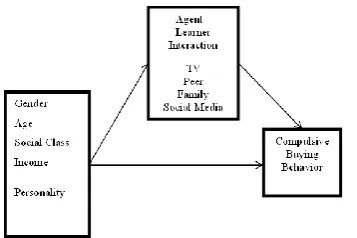
The major gap identified in the field of consumer socialization is even though deviant consumer socialization has been identified as a concept in early studies it has not been adequately empirically tested in the recent studies. Accordingly the review of literature attempts to identify compulsive buying behavior as a deviant consumer behavior. It is also observed that studies on consumer socialization continuously attempt to identify the traditional antecedents in terms of socio structural variables and demographics where „personality‟ of a customer is also an important determinant on how a person is being socialized. Hence this paper intends to incorporate this element into consideration. On the other hand the identified consumer socialization agents in the past studies also seems to be conventional in nature where social media has not been adequately addressed on how it interacts with customers and whether it results with dysfunctional aspects of consumer socialization. Having addressed the above gaps in the existing body of knowledge relating to consumer socialization this paper intends to incorporate personality, social media and compulsive buying behavior as a modification to the existing model of consumer socialization.
Based on the above developed model, the following research propositions are developed by the researchers for empirical investigation.
1. Independent variables (IVs) affect on compulsive buying behaviour.
2. The degree of agent – learner interactions differ according to demographics (gender and age).
3. The degree of agent – learner interactions differ according to social structural variables (social class and income).
4. The degree of agent – learner interactions differ according to psychographics (personality traits).
5. The degree of agent – learner interaction affects on the level of compulsiveness of the consumers.
6. The degree of agent – learner interactions mediate the relationship between IVs and compulsive buying behaviour.
CONCLUSION
With the intention of addressing the above limitations related to the area of consumer socialization, this research paper identifies the significance of studying deviant consumer socialization with special reference to compulsive buying behavior of Sri Lankan consumers. In respect to antecedents of consumer socialization; it is advanced that personality would be an important predictor in the agent – learner interaction process where it is postulated to have significant differences among the socialization agents depending on the personality traits of consumers. Emphasizing on consumer socialization agents, it is proposed that inclusion of social media as an agent in the interaction process will give important insights relating to deviant consumer socialization since social media has become one of the major platforms where many consumer interactions are being taken place.
Conclusively this paper contemplates to provide a more cohesive and a holistic view to the phenomenon of deviant consumer socialization via addressing the limitations and gaps in the prevailing body of knowledge.
ACKNOWLEDGEMENT
I will be bearing my personal funding in order to publish this article.
REFERENCES
1. Ali, A., Batra, D.K., Ravichandran, N., Mustafa, Z. and Rehamn, S.U. (2012). Consumer Socialization of Children: A Conceptual Framework. International Journal of Scientific &
Research. 2 (1), p1-5
2. Churchill, Jr., G., & Moschis, G. (1979).Television and Interpersonal Influences on Adolescent Consumer Learning.
3. Costa, T., & McCrae, R. (1992).Revised NEO Personality Inventory PI-R) and NEO Five-Factor Inventory (NEO-FFI) professional manual. Odessa, FL: Psychological Assessment Resources
4. Crespi., I. (N.d) Socialization And Gender Roles Within The Family:A Study On Adolescents And Their Parents In GreatBritain
5. Degrauwe, K., Brengman, M., Wauters, W., Rossi, G. (N.d) Does Personality Affect Compulsive Buying? An Application of the Big Five Personality Model
6. Dittmar, H. (2005). Compulsive buying - a growing concern? An examination of gender, age, and endorsement of materialistic values as predictors.British Journal Of
Psychology, 96(4), 467-491.
7. Dittmar, H., Beattie, J., & Friese, S. (1995). Gender identity and material symbols: Objects and decision considerations in impulse purchases. Journal Of Economic Psychology, 16(3), 491-511.
8. Dotson, M., & Hyatt, E. (2005). Major influence factors in children's consumer socialization. Journal Of Consumer
Marketing, 22(1), 35-42.
9. Edwards, E., (1993) Development of a New Scale for Measuring Compulsive Buying Behavior. Financial
Counseling and Planning, Volume 4.
10. Goldberg, L. (1992). The development of markers for the Big-Five factor structure.Psychological Assessment, 4(1), 26-42. 11. Grougiou ,V., Moschis ,G.&Kapoutsis ,I., (2015) Compulsive
buying: the role of earlier-in-life events and experiences. Journal of Consumer Marketing, Vol. 32 Iss: 4, pp.278 – 289
12. Guo, Z. &Cai, Y., (2011) Exploring the antecedents of compulsive buying tendency among adolescents in China and Thailand: A consumer socialization perspective. African Journal of Business Management Vol. 5(24), pp. 10198-10209. 13. Haq, M., & Rahman, S. (2015).Role of reality TV as a
14. Haugtvedt, C., Petty, R., & Cacioppo, J. (1992). Need for Cognition and Advertising: Understanding the Role of Personality Variables in Consumer Behavior. Journal Of
Consumer Psychology, 1(3), 239-260.
15. Heinonen, K. (2011). Consumer activity in social media: Managerial approaches to consumers' social media behavior.
Journal Of Consumer Behaviour, 10(6), 356-364.
16. Henke, L. (N.D) Dual Career Households and Consumer Socialization.
17. Horvath, C., Adiguzel, F. & Herk, H., (2013) Cultural Aspects of Compulsive Buying in Emerging and Developed Economies: A Cross Cultural Study in Compulsive Buying Organizations and Markets in Emerging Economies, Vol. 4, No. 2(8)
18. Huang, C., Smith, K. (2011) Consumer Socialization in the Western Quick Service Restaurants International Journal of Business and Social Science Vol. 2 No. 4
19. Hubert, M., Hubert, M., Gwozdz, W., Raab, G. & Reisch, L., (2012) Compulsive buying: an increasing problem? Investigating and comparing trends in Germany and Denmark.
20. Iqbal, S., Ismail, Z. (2011) Buying Behavior: Gender and Socioeconomic Class Differences on Interpersonal Influence Susceptibility
21. Ismail, Z., & Kaleem, J. (2013). Television Viewing and Consumer Behavior: The Effect of Personality Traits and Demographic Variables on Children‟s Consumer Socialization.
JSR, 4(2), 20.
22. John, D. (1999). Consumer Socialization of Children: A Retrospective Look At Twenty•Five Years of Research. J
CONSUM RES, 26(3), 183-213.
23. Johnson, J. (2012) Use of Product Reviews as Influenced by Family, Peers, and Online Social Networking Usage: A Look into Modern Consumer Socialization
24. Kalra, K. & Manani, P., (2013) Effect of Social Networking Sites on Academic Achievement Among Introverts and Extroverts Asian Journal of Science and Humanities
styles: a case study of adolescents in Malaysia. International
Journal Of Consumer Studies, 27(2), 145-156.
26. Kietzmann, J., Hermkens, K., McCarthy, I., & Silvestre, B. (2011).Social media? Get serious! Understanding the functional building blocks of social media.Business Horizons,
54(3), 241-251.
27. Kwon, E., Jung, J. (2013). Product Placement in TV Shows: The Effect of Consumer Socialization Agents on Product Placement Attitude and Purchase Intention. Online Journal of
Communication and Media Technologies.3 (4), p88 - 106.
28. Lee, B., Salmon, C., & Paek, H. (2007). The Effects Of Information Sources On Consumer Reactions To Direct-to-Consumer (DTC) Prescription Drug Advertising: A Direct-to-Consumer Socialization Approach. Journal Of Advertising, 36(1), 107-119.
29. Lejoyeux, M. & Weinstein, A., (2010)The American Journal of Drug and Alcohol Abuse: Encompassing All Addictive Disorders Volume 36, Issue 5
30. Lin, W., Wang, Y., Yang, F. &Sekarini, N.,(2013) The Effect of Credit Card on the Compulsive Buying Behavior Intention.
Journal of Accounting, Finance & Management Strategy, Vol.
8, No. 2, pp 45-74
31. Lueg, J., Ponder, N., Beatty, S., & Capella, M. (2006). Teenagers‟ use of alternative shopping channels: A consumer socialization perspective. Journal Of Retailing, 82(2), 137-153. 32. Mangold, W., & Faulds, D. (2009). Social media: The new hybrid element of the promotion mix. Business Horizons,
52(4), 357-365.
33. McCrae, R., & John, O. (1992).An Introduction to the Five-Factor Model and Its Applications.Journal of Personality,
60(2), 175-215.
34. Moschis, G., & Churchill, G. (1978). Consumer Socialization: A Theoretical and Empirical Analysis. Journal Of Marketing
Research, 15(4), 599.
35. Moschis, G. & Cox, D. (1989) Deviant Consumer Behavior. Advances in Consumer Research Vol. 16
Consumption: A Life Course Study in Brazil.Journal of
Research for ConsumersIssue: 23.
37. Moschis, G., Moore, R. &Smith, R. (1984) The Impact of Family Communication on Adolescent Consumer Socialization. Advances in Consumer Research Volume 11, p. 314 - 319
38. Roberts, J. (1998). Compulsive Buying Among College Students: An Investigation of Its Antedecents, Consequences, and Implications for Public Policy. Journal Of Consumer
Affairs, 32(2), 295-319.
39. Rothmann, S., & Coetzer, E. (2003).The big five personality dimensions and job performance.SA Journal Of Industrial
Psychology, 29(1).
40. Sarason,G. (1972), Abnormal Psychology, New York: Appleton, Century, Crofts.
41. Schiffman, L.G., Kanuk, L.L. and Kumar, S.R (2010).Consumer Behaviour. 10th ed. India: Dorling Kindersly. p232 - 312.
42. Shahzad, F., Khattak, J., Khattak, M., & Shahzad, F. (2015).Impact of consumer socialization on soft drink consumption and mediating role of consumer generational behavior.British Food Journal, 117(3), 1205-1222.
43. Shim, S., Serido, J., & Barber, B. (2011). A Consumer Way of Thinking: Linking Consumer Socialization and Consumption Motivation Perspectives to Adolescent Development. Journal
Of Research On Adolescence, 21(1), 290-299.
44. Shin, W. (2010). The Role of Parental Mediation in Children‟s Consumer Socialization on the Web Asia Pacific Management Review 15(3) (2010) 435-451
45. Shobri, N., Wahab, S., Ahmad, N., & Ain, N. (2012). The Influence of Consumer Socialization on Brand Loyalty: Survey on Malaysian Fast Food Consumer. Procedia - Social And
Behavioral Sciences, 65, 523-529.
46. Teo, C., Sidin, S.& Nor, P. (2013) Exploring Influences of Consumer Socialization Agents on Branded Apparel Purchase among Urban Malaysian Journal of Social Aciences and
47. Wu, J. (2015). Internal Audit and Review of the Negative Customer Behavior. JSSM, 08(04), 578-587.