International Journal of Research
ISSN: 2348-6848 Vol-3, Special Issue-16 (Nov.2016)Special Issue on Recent Research Scenario 2016
A Study of Call-Based Instruction in Improving Listening Skills
among the Engineering Students
M.Anand
Ph.D. Research Scholar Ramco Institute of Technology.
Abstract
In modern years, technology has been used in all parts of our lives from
communication. By means of computers and inevitably the internet, it is getting trouble-free
for people to communicate throughout the world. The advancement of technology has not
stopped and this makes “the world flattened”. As Friedman (2005) claimed “The world is
being levelled”; and this levelling process is continuing every minute. No matter where
someone is, in Turkey, in India, in Australia, or elsewhere, one has the opening to contact
with people around the world without time constraints and this communication occurs
through the computers and the internet. As for the field of education, especially learning
English language and its skills, it is becoming more important to study the integration of
technology.
Key words: Technology, Computer, Communication, English Skills and Listening.
Civilization is often seen as measlyin turn conveyed by language and as split from language. However, Halliday (1990) argues that culture dictates grammar, vocabulary and metaphors. Civilization in language learning is not an expendable fifth option that comes after the four skills of listening, speaking, reading and writing (Kramsch, 1993). Kramsch points out that there are limitations of communicative competence and that just knowing the rules of a language may not be sufficient if the necessary cultural knowledge is absent.
Recent years have revealed a growing interest in using computers for language teaching and learning. A decade ago, only a small number of specialists were concerned with the use of computers in the language classroom (Warschauer& Healey, 1998). However, the role of computers in language instruction has now
become an important issue facing large numbers of language teachers throughout the world. For the teachers, the question now is not of whether but how computers can aid in the language learning process (Hubbard, 1996).
The field of Computer Assisted Language Learning involves the use of a computer in the language learning process. Computer Assisted Language Learning programs aim to teach aspects of the language learning process through the medium of the computer. Computer Assisted Language Learning programs can be developed for the many parts of the language learning process.
International Journal of Research
ISSN: 2348-6848 Vol-3, Special Issue-16 (Nov.2016)Special Issue on Recent Research Scenario 2016
between learning, a conscious process and acquisition, a subconscious process.
Listening plays a vital role in daily lives. People listen for different purposes such as entertainment, academic purposes or obtaining necessary information. As for foreign language learning, listening is of paramount important since it provides the language input (Rost 1994:141-142). Without understanding input appropriately, learning simply cannot get any improvement. In addition, without listening skill, no communication can be achieved (Cross, 1998).Listening is almost ignored in both secondary and high school, where students spend seven years in English language learning. This results in poor listening skill when they become English major. As compared with other language skill, listening is considered the most challenging subject. Therefore low scores in listening are unavoidable. The present study is therefore undertaken to study the above issues.
Objectives
The following are the objectives of the present study;
To study the significant difference between the CALL-based listening instruction and traditional method of teaching in developing listening competency in English among
engineering College students of Madurai and Virudhunagar.
In sampling for study, the institutions of mainstream education were taken into consideration. Since the curriculum and syllabi in the intermediate level are the same which represents the whole country. So, two district and two engineering colleges of the mainstream education under that district were considered as representatives of the system Considering the above argument and convenience in conducting the present study, only Virudhunagar district is chosen for collecting data. It is an area of cluster sampling. Since the study is a comparative study between Madurai students and Virudhunagar students at the engineering college level, the sample was taken from both students. A total of 40 students of Virudhunagar and another total of 40 students of Madurai were selected for the present study. Based on their previous examination scores in English, the sample has been selected. Thus the control group and experimental groups in Madurai as well as in Virudhunagar were formed.
Ho1: There may not be any significant difference between Computer Assisted Language Learning and Traditional Method of Teaching in developing listening skills in English among the engineering students of Madurai.
Table 1
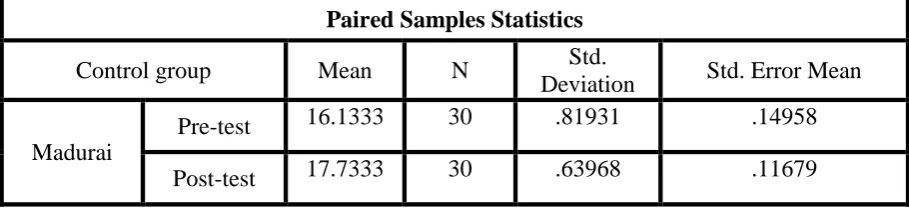
Post Test scores of control group and experimental group of students belonging to Madurai in
developing listening skills in English.
Paired Samples Statistics
Control group Mean N Std.
Deviation Std. Error Mean
Madurai
Pre-test 16.1333 30 .81931 .14958
International Journal of Research
ISSN: 2348-6848 Vol-3, Special Issue-16 (Nov.2016)Special Issue on Recent Research Scenario 2016
From the table 1 the arithmetic mean for Pre-test scores of experimental group students belonging to Madurai is 16.1333 and the arithmetic mean for post-test is 17.7333. The standard deviation for
Pre-test and Post-Test scores has been found to show deviation. The standard deviation for the Pre-test is .81931 and the Post-test is .63968.
Paired Samples Correlations
N Correlation Sig.
30 .202 .285
Total numbers of respondents are 30 from each group and the degree of freedom is 29. The Pearson correlation coefficient value is between +1 and -1,
which shows the strength between variables, the relationships and also the inferences for correlation coefficients in samples are straightforward.
Paired Samples Test
Paired Differences
t df Sig. (2-tailed) Mean Std.
Deviation
Std. Error
Mean
95% Confidence Interval
of the Difference
Lower Upper
-1.60000 .93218 .17019 -1.94808 -1.25192 -9.401 29 .000
The difference of paired mean value is 1.60000 and the difference of the standard deviation is found to be .93218. The t result for Pre-test and Post-test scores of experimental group belonging to Madurai in listening skills in English is 9.401 which is higher than the table value of 2.045 at 0.05 levels.
From the table, it is observed that there exists significant difference between the Pre-test and Post-test scores of
experimental group students belonging to Madurai in listening skills in English. From the above result, it is concluded that the control group is differed in its pre-test and post-test.
International Journal of Research
ISSN: 2348-6848 Vol-3, Special Issue-16 (Nov.2016)Special Issue on Recent Research Scenario 2016
Table 2
Post-test scores of control group and experimental group of students belonging to
Virudhunagar in developing listening skills in English
Paired Samples Statistics
Control group Mean N Std.
Deviation Std. Error Mean
Virudhunagar
Pre-test 15.9000 30 .71197 .12999
Post test 17.9000 30 .80301 .14661
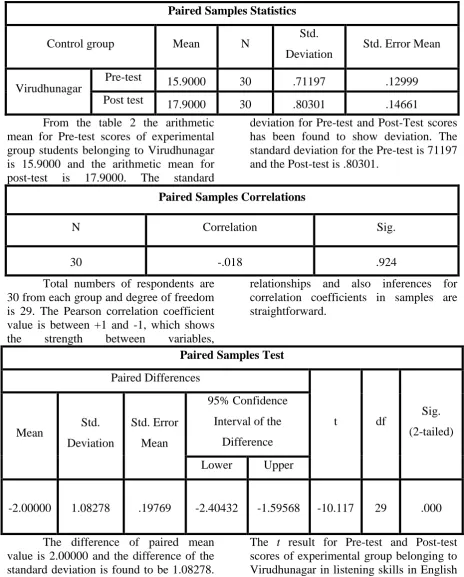
From the table 2 the arithmetic mean for Pre-test scores of experimental group students belonging to Virudhunagar is 15.9000 and the arithmetic mean for post-test is 17.9000. The standard
deviation for Pre-test and Post-Test scores has been found to show deviation. The standard deviation for the Pre-test is 71197 and the Post-test is .80301.
Paired Samples Correlations
N Correlation Sig.
30 -.018 .924
Total numbers of respondents are 30 from each group and degree of freedom is 29. The Pearson correlation coefficient value is between +1 and -1, which shows the strength between variables,
relationships and also inferences for correlation coefficients in samples are straightforward.
Paired Samples Test
Paired Differences
t df Sig. (2-tailed) Mean Std.
Deviation
Std. Error
Mean
95% Confidence
Interval of the
Difference
Lower Upper
-2.00000 1.08278 .19769 -2.40432 -1.59568 -10.117 29 .000
The difference of paired mean value is 2.00000 and the difference of the standard deviation is found to be 1.08278.
International Journal of Research
ISSN: 2348-6848 Vol-3, Special Issue-16 (Nov.2016)Special Issue on Recent Research Scenario 2016
is 10.117 which is higher than the table value of 2.045 at 0.05 levels.
From the table, it is observed that there exists significant difference between the Pre-test and Post-test scores of experimental group students belonging to Virudhunagar in listening skills in English. From the above result, it is concluded that the control group is differed in its pre-test and post-test.
A distinction needs to be made between the impact and the effectiveness of Computer Assisted Language Learning. Impact may be measured quantitatively and qualitatively in terms of the uptake and use of Information and Communication Technology in teaching foreign languages, issues of availability of hardware and software, budgetary considerations, Internet access, teachers’ and learners' attitudes to the use of Computer Assisted Language Learning, changes in the ways in which languages are learnt and taught, and paradigm shifts in teachers’ and learners’ roles. Effectiveness, on the other hand, usually focuses on assessing to what extent Information and Communication Technology is a more effective way of teaching foreign languages compared to use of traditional methods and this is more problematic as so many variables come into play. There is a need for introducing new approaches to develop listening skills in English. In this study, the investigator has made an attempt to find out whether the Computer Assisted Language Learning is effective in developing listening skill in English among engineering college students.
Reference:
Conrad, K.B.CALL- non-English L2 instruction. Annual Review of Applied Linguistics, 16, pp. 158-81.1996
Golden, S. A. R. (2011). Problems and Prospectus of Distance
Learning. Bharathidhasan University, 343, 344.
Golden, S. A. R. (2011). Strategy For Success Of Human Beings:-Time Management. Department Of BBA, St. Joseph’s College, Trichy, 388, 390.
Hubbard, P. Elements of CALL methodology: Development, evaluation, and implementation in Pennington, M.C. (ed.) The power of CALL. Houston, USA: Athelstan, pp. 15-32.1996
Jakobsdottir, S. & Hooper, S. Computer-assisted foreign language learning: Effects of text, context, and gender on listening comprehension and motivation. Educational Technology Research andDevelopment. 432(4), pp. 43-59.1995
Kalaivani, M., & Rajeswari, V. THE ROLE OF ACADEMIC MOTIVATION AND ACADEMIC SELF CONCEPT IN
STUDENT’S ACADEMIC
ACHIEVEMENT.
Krashen, S.D. & Terrell, T.The natural approach: Language acquisition in the classroom. Hayward.CA: Alemany Press. 1983
Ligi, B., & Raja, B. W. D. FLIP TEACHING IN PROMOTING ACTIVE STUDENT LEARNING.
Ramakrishnan, N., & Priya, M. J. J. NET NEWS READING HABIT AMONG ARTS AND SCIENCE COLLEGE STUDENTS.