Determining Patterns in Neural Activity for Reaching
Movements Using Nonnegative Matrix Factorization
Sung-Phil Kim
Department of Electrical and Computer Engineering, University of Florida, Gainesville, FL 32611, USA Email:[email protected]
Yadunandana N. Rao
Motorola Inc., FL, USA Email:[email protected]
Deniz Erdogmus
Department of Computer Science and Biomedical Engineering, Oregon Health & Science University, Beaverton, OR 97006, USA
Email:[email protected]
Justin C. Sanchez
Department of Pediatrics, Division of Neurology, University of Florida, Gainesville, FL 32611, USA Email:[email protected]
Miguel A. L. Nicolelis
Department of Neurobiology, Center for Neuroengineering, Duke University, Durham, NC 27710, USA Emails:[email protected]; [email protected]
Jose C. Principe
Department of Electrical and Computer Engineering, University of Florida, Gainesville, FL 32611, USA Email:[email protected]
Received 31 January 2004; Revised 23 March 2005
We propose the use of nonnegative matrix factorization (NMF) as a model-independent methodology to analyze neural activity. We demonstrate that, using this technique, it is possible to identify local spatiotemporal patterns of neural activity in the form of sparse basis vectors. In addition, the sparseness of these bases can help infer correlations between cortical firing patterns and behavior. We demonstrate the utility of this approach using neural recordings collected in a brain-machine interface (BMI) setting. The results indicate that, using the NMF analysis, it is possible to improve the performance of BMI models through appropriate pruning of inputs.
Keywords and phrases:brain-machine interfaces, nonnegative matrix factorization, spatiotemporal patterns, neural firing activ-ity.
1. INTRODUCTION
Brain-machine interfaces (BMIs) are an emerging field that aims at directly transferring the subject’s intent of move-ment to an external machine. Our goal is to engineer de-vices that are able to interpret neural activity originating in the motor cortex and generate accurate predictions of hand position. In the BMI experimental paradigm, hundreds of microelectrodes are implanted in the premotor, motor, and
can lead to BMIs that effectively predict the hand position and grasping force of primates for different movement tasks [1,2,3,4,5,6,7,8]. The adaptive methods studied thus far include moving average models, time-delay neural networks (TDNNs), Kalman filter and extensions, recursive multilayer perceptrons (RMLPs), and mixture of linear experts gated by hidden Markov models (HMMs).
BMIs open up an important avenue to study the spatio-temporal organization of spike trains and their relationships with behavior. Recently, our laboratory has investigated the sensitivity of neurons and cortical areas based on their role in the mapping learned by the RMLP and the Wiener fil-ter [7]. We examined how each neuron contributes to the output of the models, and found consistent relationships be-tween cortical regions and segments of the hand trajectory in a reaching movement. This analysis indicated that, dur-ing each reachdur-ing action, specific neurons from the posterior parietal, the premotor dorsal, and the primary motor regions sequentially became dominant in controlling the output of the models. However, this approach relies on determining a suitable model, because it explicitly uses the learned model to infer the dependencies.
In this paper, we propose a model-independent method-ology to study spatiotemporal patterns between neuronal spikes and behavior utilizing nonnegative matrix factoriza-tion (NMF) [9,10]. In its original applications, NMF was mainly used to provide an alternative method for determin-ing sparse representations of images to improve recognition performance [10,11]. d’ Avella and Tresch have also pro-posed an extension of NMF to extract time-varying muscle synergies for the analysis of behavior patterns of a frog [12]. The nonnegativity constraints in NMF result in the unsuper-vised selection of sparse bases that can be linearly combined (encoded) to reconstruct the original data. Our hypothesis is that NMF can similarly yield sparse bases for analyzing neu-ral firing activity, because of the intrinsic nonnegativity of the bin counts and the sparseness of spike trains.
The application of NMF to extract local features of neu-ral spike counts follows the method of obtaining sparse bases to describe the local features of face images. The basis vec-tors provided by NMF and their temporal encoding patterns are examined to determine how the activities of specific neu-rons localize to each segment of the reaching trajectory. We will show that the results from this model-independent anal-ysis of the neuronal activity are consistent with the previous observations from the model-based analysis.
2. NONNEGATIVE MATRIX FACTORIZATION
NMF is a procedure to decompose a nonnegative data matrix into the product of two nonnegative matrices: bases and en-coding coefficients. The nonnegativity constraint leads to a parts-based representation, since only additive, not subtrac-tive, combinations of the bases are allowed. Ann×m non-negative data matrixX, where each column is a sample vec-tor, can be approximated by NMF as
X=WH+E, (1)
where Eis the error and WandH have dimensionsn×r
andr×m, respectively.Wconsists of a set ofrbasis vectors, while each column of Hcontains the encoding coefficients for every basis for the corresponding sample. The number of bases is selected to satisfyr(n+m)< nmso that the number of equations exceed that of the unknowns.
This factorization can be described in terms of columns as
xj≈Whj, forj=1,. . .,m, (2)
wherexjis the jth column ofXandhjis thejth column of H. Thus, each sample vector is a linear combination of ba-sis vectors inWweighted byhj. The nonnegative constraints
onWandHallow only additive combination of basis vectors to approximatexj. This constraint allows the visualization of
the basis vectors as “part” of the original sample [10]. This is contrary to factorization by PCA, where negative basis vec-tors are allowed.
The decomposition of X into W and H can be deter-mined by optimizing an error function between the original data matrix and the decomposition. Two possible cost func-tions used in the literature are the Frobenius norm of the er-ror matrixX−WH2
Fand the Kullback-Leibler divergence DKL(XWH). The nonnegativity constraint can be satisfied
by using multiplicative update rules discussed in [10] to min-imize these cost functions. In this paper, we will employ the Frobenius norm measure, for which the multiplicative up-date rules that converge to a local minimum are given below:
Hµ j(k+ 1)=Hµj(k)
WTX µj
WTWH µj
,
Wiµ(k+ 1)=Wiµ(k)
XHTiµ
WHHTiµ.
(3)
Aab denotes the element of a matrix Aatath row and bth
column. It has been proven in [9] that the Frobenius norm cost function is nonincreasing under this update rule.
3. FACTORIZATION OF THE NEURONAL ACTIVITY MATRIX
Table1: Distribution of neurons and cortical regions.
Monkey-1 Monkey-2
Regions PP M1(area 1) PMd M1(area 2) M1 PMd
Neurons 1∼33 34∼54 55∼81 82∼104 1∼37 38∼54
3.1. Data preparation
Synchronous, multichannel neuronal spike trains were col-lected at Duke University using two female owl monkeys (Aotus trivirgatus): Belle 1) and Carmen (monkey-2).1Microwire electrodes were implanted in cortical regions
where motor associations are known [1, 13]. During the neural recording process, up to sixty-four electrodes were implanted in posterior parietal (PP)-area 1, primary motor (M1)-area 2, area 4, and premotor dorsal (PMd)-area 3, each receiving sixteen electrodes. From each electrode, one to four neurons can be discriminated. The firing times of individual neurons were determined using spike detection and sorting algorithms [14] and were recorded while the primate per-formed a 3D reaching task that consists of a reach to food followed by eating. The primate’s hand position was also recorded using multiple fiber optic sensors (with a shared time clock) and digitized with a 200 Hz sampling rate [1]. These sensors were contained in the plastic strip of which bending and twisting modified the transmission of the light through the sensors in order to record positions in 3D space more accurately. The neuronal firing times were binned in nonoverlapping windows of 100 milliseconds, representing the local firing rate for each neuron. In this recording session of approximately 20 minutes (12 000 bins), 104 neurons for monkey-1 and 54 neurons for monkey-2 could be discrimi-nated (whose distribution to cortical regions is provided in
Table 1 from [13]), and there were 71 reaching actions for monkey-1 and 65 for monkey-2, respectively. These reach-ing movements consist of three natural segments shown in
Figure 1.
Based on the analysis of Wessberg et al. [1], the instanta-neous movement is correlated with the current and the past neural data up to 1 second (10 bins). Therefore, for each time instant, we form a bin-count vector by concatenating 10 bins of firing counts (which correspond to 10-tap delay line in a linear filter) from every neuron. Hence, ifxj(i)
rep-resents theith bin of neuron j, wherei∈ {1,. . ., 12 000}, a bin-count vector at time instanceiis represented byx(i)= [x1(i),x1(i−1),. . .,x1(i−9),x2(i),. . .,xn(i−9)]T, wherenis
the number of neurons. Since we are interested in determin-ing repeated spatiotemporal firdetermin-ing patterns durdetermin-ing the reach-ing movements, only the bin counts from time instances where the primate’s arm is moving are considered. There is a possibility that in the selected training set some neurons never fire. The rows corresponding to these neurons must be removed from the bin-count matrix, since they tend to cause
1All experimental procedures conformed to the National Academy Press Guide for the Care and Use of Laboratory Animalsand were approved by the Duke University Animal Care and Use Committee.
0 10 20 30 40 50 60 70
−30
−20
−10
0 10 20 30 40 50 60 70
x y z
Time (ms)
P
o
sition
(mm)
Rest to food Food to mouth Mouth to rest
Figure1: Segmentation of the reaching trajectories: reach from rest to food, reach from food to mouth, and reach from mouth to rest positions (taken from [7]).
instability in the NMF algorithm. In addition, to prevent the error criterion from focusing too much on neurons that sim-ply fire frequently (although the temporal structure of their activity might not be significant for the task), the bin counts in each row (i.e., for each neuron) of the data matrix are nor-malized to have the unit length in its two norms. In general, if nneurons are considered for a total ofmtime instances, the data matrixXhas dimension (10n)×m. Since the entries of the data matrix are bin counts, they are guaranteed to be nonnegative. Accounting for 71 or 65 movements, there are
m = 2143 time instances for monkey-1 andm = 2521 for monkey-2.
3.2. Analysis of factorization process
In the application of NMF to a given neural firing matrix, there are several important issues that must be addressed: the selection of the number of bases, the uniqueness of the NMF solution, and understanding how NMF can find local struc-tures of neural firing activity.
validity [15]. This index has shown consistent performance of selecting the true number of clusters for various experi-mental settings. The indexIis composed of three factors as
I(r)=
1
r · E1 Er ·Dr
p
, (4)
whereEris the approximation error (Frobenius norm) forr
bases, and Dr is the maximum Euclidean distance between
bases such that
Dr=maxr i,j=1
wi−wj. (5)
The optimalris the one that maximizesI(r). We will utilize this index to determine the optimalrfor NMF withp=1.
Donoho and Stodden have shown that a unique solu-tion of NMF is possible under certain condisolu-tions [16]. They have shown through a geometrical interpretation of NMF that if the data are not strictly positive, there can be only one set of nonnegative bases which spans the data in the positive orthant. With an articulated set of images obeying three rules (a generative model, linear independence of gen-erators, and factorial sampling), they showed NMF identi-fies the generators or “parts” of images. If we consider our neuronal bin-count matrix, each row contains many zero en-tries (zero bin counts) even after removing nonfiring neu-rons since most neuneu-rons do not fire continuously once in ev-ery 100-millisecond window during the entire training set. Therefore, our neuronal data are not strictly positive. This implies that the existence of a unique set of nonnegative bases for the neuronal bin-count matrix is warranted. The ques-tion still remains if the NMF basis vectors can find the gen-erative firing patterns for the neural population by meeting the three conditions mentioned above. Here, we discuss the neuronal bin-count data with respect to these conditions.
As stated previously, we have demonstrated through sen-sitivity analysis that the specific neuronal subsets from the PP, PMd, and M1 regions were sequentially involved in de-riving the output of the predictive models during reaching movements [7]. Hence, the bin-count data for the reaching movement will contain increasing firing activity of the spe-cific neuronal subset on local partitions of the trajectory. Due to binning, it is possible that more than one firing pattern is associated with a single data sample. This analysis leads to a generative model for the binned data in which data sam-ples are generated by linear combination of the specific firing patterns with nonnegative coefficients. Also, these firing pat-terns will be linearly independent since the neuronal subset in each firing patterns tends to modulate firing rates only for the local part of trajectory. The third condition of factorial sampling can be approximately satisfied by the repetition of movements in which the variability of a particular firing pat-tern is observed during the entire data set. However, a more rigorous analysis is necessary to support the argument that the set of firing patterns is complete in factorial terms. There-fore, we expect that the NMF solutions may be slightly vari-able reflecting the ambiguity in the completeness of factorial
sampling. This might be overcome by collecting more data for reaching movements, and will be pursued in future stud-ies.
3.3. Case studies
The NMF algorithm is applied to the described neuronal data matrix prepared using ten taps,n=91 neurons for monkey-1 (after eliminating the neurons that do not fire through the entire training set) and n = 52 neurons for monkey-2. The NMF algorithm with 100 independent runs results inr=5 bases for both monkey-1 and monkey-2 datasets for which the index I is maximized. The means and the stan-dard deviations of the normalized cost (Frobenius norm of error between approximation and the given data matrix di-vided by the Frobenius norm of the data only) for 100 runs are 0.8399±0.001 for monkey-1 data and 0.7348±0.002 for monkey-2 data. This implies that the algorithm approx-imately converges to the same solution with different initial conditions (although not sufficient).
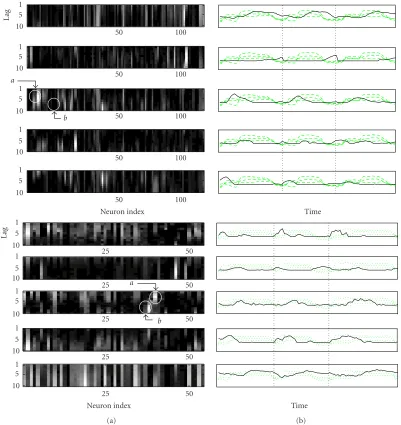
InFigure 2, we show the resulting basis vectors (columns of W) for the bin counts (presented in matrix form where columns are different neurons and rows are different delays), as well as their corresponding time-varying encoding coeffi -cients (rows ofH) superimposed on the reaching trajectory coordinates of three consecutive movements. Based on the assumption that the neuronal bin-count data approximately satisfy the three conditions for the identification of the gener-ators, the NMF basis vectors determine the sequence of spa-tiotemporal firing patterns representing the firing modula-tion of the specific neuronal subsets during the course of the reaching movement. Alternatively, we can say that NMF dis-covers these latent firing patterns of neural population by op-timal linear approximation of the data with few bases [9]. For example, from the two basis vectors each corresponding to two primates in the left panel ofFigure 2, we observe that fir-ings of the neurons in group-bare followed by firings of the neurons in group-a(the bright activity denoted byboccurs earlier in time than the activity denoted bya, since increas-ing values in the vertical axis of each basis indicates goincreas-ing further back in time). Thus, NMF effectively determines and summarizes this sparse firing pattern that involves a group of neurons firing sequentially. Their relative average activity is also indicated by the relative magnitudes of the entries of this particular basis.
Time
50 100
50 100
50 100
50 100
50 100
10 5 1 10 5 1 10 5 1 10 5 1 10 5 1
a
b
Lag
Neuron index
Time (b)
25 50
25 50
25 50
25 50
25 50
10 5 1 10 5 1 10 5 1 10 5 1 10 5 1
a
b
Lag
Neuron index (a)
Figure2: (a) The five bases for monkey-1 (top) and monkey-2 (bottom). (b) Their corresponding encoding signals (thick solid line) overlaid on the 3-dimensional coordinates of the reaching trajectory (dotted lines) for three consecutive representative reaching tasks (separated by the dashed lines). Note that the encoding signals are scaled to be in the same order of the magnitude of the reaching trajectory for the visual purpose.
the third basis varies in every movement, which might in-dicate a change in the role of the corresponding neuronal firing pattern in executing that particular movement. The periodic activation of encodings also indicates the bursting nature of the spatiotemporal repetitive patterns. Hence, the NMF bases tend to encode synchronous and bursting spa-tiotemporal patterns of neural firing activity.
From the NMF decomposition, we observe certain asso-ciations between the activities of neurons from different cor-tical regions and different segments of the reaching trajec-tory. In particular, an analysis of the monkey-1 data based on
Figure 2indicates that neurons in PP and M1 (array 1) repeat similar firing patterns during the reach from rest to food. This assessment is based on the observation that bases three, four, and five, which involve firing activities from neurons
Table2: Comparison of important neurons (examined in the monkey-1 dataset).
Regions PP M1(area 1) PMd M1(area 2)
The high sensitive neurons through RMLP 4, 5, 7, 22, 26, 29 38, 45 None 93, 94
The largest-magnitude neurons in NMF bases 7, 29 45 None 93, 94
Table3: Performance evaluation of the Wiener filter and the mixture of multiple models based on NMF.
CC (x) CC (y) CC (z) MSE (x) MSE (y) MSE (z)
Monkey-1
Wiener filter 0.5772 0.6712 0.7574 0.4855 0.3468 0.2460
NMF mixture 0.7147 0.7078 0.8076 0.2711 0.2786 0.1627
Monkey-2
Wiener filter 0.3737 0.4304 0.6192 0.3050 0.7405 0.2882
NMF mixture 0.4974 0.5041 0.6916 0.2354 0.5400 0.2112
the sensitivity analysis only determines individual important neurons. Finally, we would like to reiterate that the analysis presented here is solely based on the data, which means that this analysis does not need to train a specific model to inves-tigate the neural population organization.
3.4. Modeling improvement for BMI using NMF
We will demonstrate a simple example showing the improved BMIs performance in predicting hand positions by utilizing NMF. We will compare the performance of two systems; the Wiener filter directly applied to the original spike count data and the mixture of multiple linear filters based on the NMF bases and encodings.
The straight Wiener filter is directly applied to the neural firing data to estimate the three coordinates of the primate’s hand position. The Wiener filter has been a standard model for BMIs, and many other approaches have been compared with it [19]. With nine delays, the input dimensionality of the filter is 910 for monkey-1 or 510 for monkey-2 (discarding inactive (no firing) neural channels). Then we add a bias to each input vector to estimate the y-intercept. The weights of the filter are estimated by the Wiener-Hopf equation as
W=R−1P, (6)
whereRis a 911×911 (or 511×511 for monkey-2) input correlation matrix, andPis a 911×3 (or 511×3 for monkey-2) input-output cross-correlation matrix.
The mixture of multiple models employs the NMF en-codings as mixing coefficients. An NMF basis is used as a window function for the corresponding local model. There-fore, each model sees a given input vector through a different window and uses the windowed input vector to produce the output. Then the NMF encodings are used to combine each model’s output to produce the final estimate of the desired hand position vector. This can be described in the following equation:
dc(n)= K
k=1 hk(n)
zk(n)Tgk,c+bk,c
, (7)
wherehk(n) is an NMF encoding coefficient for thekth basis
atnth column (i.e., time index),gk,c is the weight vector of
thekth model for thecth coordinate (c∈[x,y,z]), andbk,cis
the y-intercept of thekth model for thecth coordinate.zk(n)
is the input vector windowed by thekth NMF basis. Itsith element is given by
zk,i(n)=xi(n)·wk,i. (8)
Here,xi(n) is the normalized firing count of the neuroniat
time instancen, andwk,iis theith element of thekth NMF
basis.gk,candbk,ccan be estimated based on the MSE
crite-rion by using of the stochastic gradient algorithm such as the normalized least mean square (NLMS). The weight update rule of the NLMS for each model is then given by
gk,c(n+ 1)=gk,c(n) + η β+zk(n)2
hk(n)ec(n)zk(n),
bk,c(n+ 1)=bk,c(n) + η β+zk(n)2
hk(n)ec(n),
(9)
whereηis the learning rate andβis the normalization factor.
ec(n) is the error between thecth coordinate of the desired
response and the model output.
In the experiment, we divided the data samples into 1771 training samples and 372 test samples for monkey-1 dataset and 1739 and 782, respectively, for monkey-2 dataset. The parameters are set as {η,β,K} = {0.01, 1, 5}. The entire training data set is presented 60 times sufficient enough for the weights to converge. The performance of the model is evaluated on the test set by two measures; the correlation coefficient (CC) between desired hand trajectory and the model output trajectory, and the mean squared error (MSE) normalized by the variance of the desired response.Table 3
presents the evaluation of the performance of two systems for both monkey-1 and monkey-2 datasets. It shows a signif-icant improvement in generalization performance with the mixture of models based on NMF factorization.
dataset. The reasons may come from many experimental variables. One of them may be the number of electrodes and the corresponding cortical areas, as we can see inTable 1that only 32 electrodes were implanted in two areas for monkey-2, while 64 electrodes in four areas for monkey-1.
To quantify the performance difference between the Wiener filter and the mixture of multiple models, we can ap-ply a statistical test based on the mean squared error (MSE) performance metric [17]. By modeling the performance dif-ference in terms of the MSE using short-time windows as a normal random variable, one can apply the t-test to quan-tify significance. This t-test was applied to both modeling outputs for monkey-1 and monkey-2 with α = 0.01 or
α = 0.05. For both datasets, the null hypothesis was re-jected with both significance levels, resulting in the p-values of 0.0023 for monkey-1 and 0.0007 for monkey-2, respec-tively. Therefore, the statistical test of the performance diff er-ence demonstrates that the mixture of multiple models based on NMF improves the performance significantly compared to the standard Wiener filter.
3.5. Discussions
The results presented in the previous case study are a repre-sentative example of a broader set of NMF experiments per-formed on this recording. Selection of the number of taps and the number of bases (r) is dependent on the particu-lar stimulus or behavior associated with the neural data. Al-though we have used a model selection method originally de-veloped for clustering, and did not provide full justification that this index is suitable to NMF, the main motivation is to demonstrate that the problem of selecting the number of bases can be addressed in the context of model selection. This will be pursued in future research.
The number of patterns that can be distinctly represented by NMF is limited by the number of bases. A very small num-ber of bases will lead to the combination of multiple patterns into a single nonsparse basis vector. At the other extreme, a very large number of bases will result in the splitting of a pat-tern into two or more bases, which have similar encoding co-efficient signals in time. In these situations, the bases under consideration can be combined into one basis.
It is intriguing that the mixture of models based on NMF generalizes better than the Wiener filter despite the fact that the mixture contains much more model parameters. How-ever, each model in the mixture receives the inputs processed by the sparse basis vector. Therefore, each model learns the mapping between only a particular subset of neurons and hand trajectories, and the effective number of parameters for each model is much less than the total number of input vari-ables. Moreover, further overfitting is avoided by combining the outputs of local models by the sparse encodings of NMF.
4. CONCLUSIONS
Nonnegative matrix factorization is a novel and relatively new tool for analyzing the data structure when nonnegativ-ity constraints are imposed. In BMIs the neural inputs are processed by grouping the firings into bin counts. Since the bin counts are always positive, we hypothesized that NMF
would be appropriate for analyzing the neural activity. The experimental results and the analysis presented in this paper showed that we could find repeated patterns in neuronal ac-tivity that occurred in synchrony with the reaching behavior and was automatically and efficiently represented in a set of sparse bases. The sparseness of the bases indicates that only a small number of neurons exhibit repeated firing patterns that are influential in reconstructing the original neural ac-tivity matrix.
As presented in [10], NMF provides local bases of the objects, while principal component analysis (PCA) provides global bases. In our preliminary experiments of PCA for the same data, we have observed that PCA only found the most frequently firing neurons, which may not be related to the be-havior. Therefore, NMF can find local representation of the neural firing data, and this property of NMF can be more ef-fective than PCA for BMIs where firing activities of different cortical areas are collected.
Lee and Seung have claimed in their paper that the sta-tistical independence among the encodings of independent component analysis (ICA) forces the basis to be holistic [10]. And, if local parts of the neural activity occur together at the same time, the complicated dependencies between the en-codings would not be captured by the ICA algorithm. How-ever, we have observed that the NMF encodings seem to be uncorrelated over the entire movement. Hence, ICA with some nonnegative constraints (e. g., nonnegative ICA [18], the ICA model with nonnegative basis [19], and nonnegative sparse coding [20]) may yield interesting encodings of the neural firing activities. Further studies will present the com-parison between NMF and these constrained ICA algorithms applied for BMIs.
While NMF is found to be a useful tool for analyzing neural data to find repeatable activity patterns, there are still several issues when using NMF for neural data analysis. Firstly, the method only detects patterns of activity, but it is known that the inactivity of a neuron could often indicate re-sponse to a stimulus or cause a behavior. An analysis based on NMF will fail to identify such neurons. Next, the nontation-ary characteristics of neural activities would make it difficult for NMF to find fixed spatiotemporal firing patterns. Since the neural ensemble function tends to change over neuronal space and time such that different spatio-temporal firing pat-terns may be involved for the same behavioral output, we may have to continuously adapt NMF factors to track those changes. This motivates us to consider a recursive algorithm of NMF, which will enable us to adapt NMF factors online. It will be covered in the future study.
ACKNOWLEDGMENTS
The authors would like to thank Johan Wessberg for collect-ing the data used in this paper. This work was supported by the DARPA project no. N66001-02-C-8022.
REFERENCES
[1] J. Wessberg, C. R. Stambaugh, J. D. Kralik, et al., “Real-time prediction of hand trajectory by ensembles of cortical neurons in primates,”Nature, vol. 408, no. 6810, pp. 361–365, 2000. [2] D. W. Moran and A. B. Schwartz, “Motor cortical activity
during drawing movements: population representation dur-ing spiral tracdur-ing,”Journal of Neurophysiology, vol. 82, no. 5, pp. 2693–2704, 1999.
[3] J. K. Chapin, K. A. Moxon, R. S. Markowitz, and M. A. L. Nicolelis, “Real-time control of a robot arm using simultane-ously recorded neurons in the motor cortex,”Nature Neuro-science, vol. 2, no. 7, pp. 664–670, 1999.
[4] M. D. Serruya, N. G. Hatsopoulos, L. Paninski, M. R. Fellows, and J. P. Donoghue, “Brain-machine interface: instant neural control of a movement signal,”Nature, vol. 416, no. 6877, pp. 141–142, 2002.
[5] J. C. Sanchez, S.-P. Kim, D. Erdogmus, et al., “Input-output mapping performance of linear and nonlinear models for es-timating hand trajectories from cortical neuronal firing pat-terns,” in Proc. 12th IEEE International Workshop on Neu-ral Networks for Signal Processing, pp. 139–148, Martigny, Switzerland, September 2002.
[6] S. Darmanjian, S.-P. Kim, M. C. Nechyba, et al., “Bimodal brain-machine interface for motor control of robotic pros-thetic,” inProc. IEEE/RSJ International Conference on Intelli-gent Robots and Systems (IROS ’03), vol. 4, pp. 3612–3617, Las Vegas, Nev, USA, October 2003.
[7] J. C. Sanchez, D. Erdogmus, Y. N. Rao, et al., “Interpret-ing neural activity through linear and nonlinear models for brain machine interfaces,” inProc. 25th Annual International Conference of the IEEE Engineering in Medicine and Biology Society, vol. 3, pp. 2160–2163, Cancun, Mexico, September 2003.
[8] J. M. Carmena, M. A. Lebedev, R. E. Crist, et al., “Learning to control a brain-machine interface for reaching and grasping by primates,”PLoS Biology, vol. 1, no. 2, pp. 1–16, 2003. [9] D. D. Lee and H. S. Seung, “Algorithms for non-negative
ma-trix factorization,” inAdvances in Neural Information Process-ing Systems 13, T. K. Leen, T. G. Dietterich, and V. Tresp, Eds., pp. 556–562, MIT Press, Cambridge, Mass, USA, 2001. [10] D. D. Lee and H. S. Seung, “Learning the parts of objects by
non-negative matrix factorization,”Nature, vol. 401, no. 6755, pp. 788–791, 1999.
[11] D. Guillamet, M. Bressan, and J. Vitri`a, “A weighted non-negative matrix factorization for local representations,” in Proc. IEEE Computer Society Conference on Computer Vision and Pattern Recognition (CVPR ’01), vol. 1, pp. 942–947, Kauai, Hawaii, USA, December 2001.
[12] A. d’Avella and M. C. Tresch, “Modularity in the motor sys-tem: decomposition of muscle patterns as combinations of time-varying synergies,” in Advances in Neural Information Processing Systems 14, T. G. Dietterich, S. Becker, and Z. Ghahramani, Eds., pp. 629–632, MIT Press, Cambridge, Mass, USA, 2002.
[13] J. C. Sanchez, From cortical neural spike trains to behav-ior: modeling and analysis, Ph.D. dissertation, Department of Biomedical Engineering, University of Florida, Gainesville, Fla, USA, 2004.
[14] M. A. L. Nicolelis, A. A. Ghazanfar, B. M. Faggin, S. Votaw, and L. M. Oliveira, “Reconstructing the engram: simulta-neous, multisite, many single neuron recordings,” Neuron, vol. 18, no. 4, pp. 529–537, 1997.
[15] U. Maulik and S. Bandyopadhyay, “Performance evaluation of some clustering algorithms and validity indices,”IEEE Trans. Pattern Anal. Machine Intell., vol. 24, no. 12, pp. 1650–1654, 2002.
[16] D. Donoho and V. Stodden, “When does non-negative matrix factorization give a correct decomposition into parts?” in Ad-vances in Neural Information Processing Systems 16, S. Thrun, L. K. Saul, and B. Sch¨olkopf, Eds., pp. 1141–1148, MIT Press, Cambridge, Mass, USA, 2004.
[17] S.-P. Kim, J. C. Sanchez, Y. N. Rao, et al., “A Compar-ison of optimal MIMO linear and nonlinear models for brain-machine interfaces,” submitted toNeural Computation, 2004.
[18] M. Plumbley, “Conditions for nonnegative independent com-ponent analysis,”IEEE Signal Processing Lett., vol. 9, no. 6, pp. 177–180, 2002.
[19] L. Parra, C. Spence, P. Sajda, A. Ziehe, and K.-R. M¨uller, “Un-mixing hyperspectral data,” inAdvances in Neural Informa-tion Processing Systems 12, S. A. Solla, T. K. Leen, and K.-R. M¨uller, Eds., pp. 942–948, MIT Press, Cambridge, Mass, USA, 2000.
[20] P. O. Hoyer, “Non-negative sparse coding,” in Proc. 12th IEEE International Workshop on Neural Networks for Signal Processing, pp. 557–565, Martigny, Switzerland, September 2002.
Sung-Phil Kim was born in Seoul, South Korea. He received a B.S. degree from the Department of Nuclear Engineering, Seoul National University, Seoul, South Korea, in 1994. In 1998, he entered the Department of Electrical and Computer Engineering, University of Florida, in pursuit of Mas-ter of Science degree. He joined the Com-putational NeuroEngineering Laboratory as a Research Assistant in 2000. He also
re-ceived an M.S. degree in December 2000 from the Department of Electrical and Computer Engineering, University of Florida. From 2001, he continued to pursue a Ph.D. degree in the De-partment of Electrical and Computer Engineering, University of Florida under supervision of Dr. Jose C. Principe. In the Compu-tational NeuroEngineering Laboratory, he has investigated the de-coding models and the analytical methods for bramachine in-terfaces.
Yadunandana N. Raowas born in Mysore, India. He received his B.E. degree in elec-tronics and communication engineering from the University of Mysore, India, in Au-gust 1997, and the M.S. and Ph.D. degrees in electrical and computer engineering from the University of Florida, Gainesville, Fla, in 2000 and 2004, respectively. From May 2000 to January 2001, he worked as a De-sign Engineer at GE Medical Systems, Wis.
Deniz Erdogmusreceived his B.S. degrees in electrical engineering and mathematics in 1997, and his M.S. degree in electrical engineering, with emphasis on systems and control, in 1999, all from the Middle East Technical University, Turkey. He received his Ph.D. degree in electrical engineering from the University of Florida, Gainesville, in 2002. Since 1999, he has been with the Computational NeuroEngineering
Labora-tory, University of Florida, working with Jose Principe. His current research interests include information-theoretic aspects of adaptive signal processing and machine learning, as well as their applications to problems in communications, biomedical signal processing, and controls. He is the recipient of the IEEE SPS 2003 Young Author Award, and is a Member of IEEE, Tau Beta Pi, and Eta Kappa Nu.
Justin C. Sanchez received a B.S. degree with highest honors in engineering sci-ence along with a minor in biomechan-ics from the University of Florida in 2000. From 1998 to 2000, he spent three years as a Research Assistant in the Department of Anesthesiology, University of Florida. In 2000, he joined the Department of Biomed-ical Engineering and Computational Neu-roEngineering Laboratory, the University of
Florida. In the spring of 2004, he completed both his M.E. and Ph.D. degrees in biomedical signal processing working on the de-velopment of modeling and analysis tools for bramachine in-terfaces. He is currently a Research Assistant Professor in the De-partment of Pediatrics, Division of Neurology, the University of Florida. His neural engineering electrophysiology laboratory is cur-rently developing neuroprosthetics for use in the research and clin-ical settings.
Miguel A. L. Nicolelis was born in Sao Paulo, Brazil, in 1961. He received his M.D. and Ph.D. degrees from the University of Sao Paulo, Brazil, in 1984 and 1988, re-spectively. After postdoctoral work at Hah-nemann University, Philadelphia, he joined Duke University, where he now codirects the Center for Neuroengineering and is a Professor of neurobiology, biomedical en-gineering, and psychological and brain
sci-ences. His laboratory is interested in understanding the general computational principles underlying the dynamic interactions be-tween populations of cortical and subcortical neurons involved in motor control and tactile perception.
Jose C. Principeis a Distinguished Profes-sor of electrical and computer engineering and biomedical engineering at the Univer-sity of Florida where he teaches advanced signal processing, machine learning, and ar-tificial neural networks (ANNs) modeling. He is a BellSouth Professor and the Founder and Director of the University of Florida Computational NeuroEngineering Labora-tory (CNEL). His primary area of interest
is processing of time-varying signals with adaptive neural models. The CNEL has been studying signal and pattern recognition prin-ciples based on information-theoretic criteria (entropy and mutual