Volume 2011, Article ID 284791,14pages doi:10.1155/2011/284791
Research Article
Evolutionary Splines for Cepstral Filterbank Optimization in
Phoneme Classification
Leandro D. Vignolo,
1Hugo L. Rufiner,
1Diego H. Milone,
1and John C. Goddard
21Research Center for Signals, Systems and Computational Intelligence, Department of Informatics, National University of Litoral, CONICET, Santa Fe, 3000, Argentina
2Departamento de Ingenier´ıa El´ectrica, Universidad Aut´onoma Metropolitana, Unidad Iztapalapa, Mexico D.F., 09340, Mexico
Correspondence should be addressed to Leandro D. Vignolo,[email protected]
Received 14 July 2010; Revised 29 October 2010; Accepted 24 December 2010
Academic Editor: Raviraj S. Adve
Copyright © 2011 Leandro D. Vignolo et al. This is an open access article distributed under the Creative Commons Attribution License, which permits unrestricted use, distribution, and reproduction in any medium, provided the original work is properly cited.
Mel-frequency cepstral coefficients have long been the most widely used type of speech representation. They were introduced to incorporate biologically inspired characteristics into artificial speech recognizers. Recently, the introduction of new alternatives to the classic mel-scaled filterbank has led to improvements in the performance of phoneme recognition in adverse conditions. In this work we propose a new bioinspired approach for the optimization of the filterbanks, in order to find a robust speech representation. Our approach—which relies on evolutionary algorithms—reduces the number of parameters to optimize by using spline functions to shape the filterbanks. The success rates of a phoneme classifier based on hidden Markov models are used as the fitness measure, evaluated over the well-known TIMIT database. The results show that the proposed method is able to find optimized filterbanks for phoneme recognition, which significantly increases the robustness in adverse conditions.
1. Introduction
Most current speech recognizers rely on the traditional mel-frequency cepstral coefficients (MFCC) [1] for the feature extraction phase. This representation is biologically motivated and introduces the use of a psychoacoustic scale to mimic the frequency response in the human ear.
However, as the entire auditory system is complex and not yet fully understood, the shape of the true optimal filterbank for automatic recognition is not known. More-over, the recognition performance of automatic systems degrades when speech signals are contaminated with noise. This has motivated the development of alternative speech representations, and many of them consist in modifications to the mel-scaled filterbank, for which the number of filters has been empirically set to different values [2]. For example, Skowronski and Harris [3, 4] proposed a novel scheme for determining filter bandwidth and reported significant recognition improvements compared to those using the MFCC traditional features. Other approaches follow a common strategy which consists in optimizing a
Although these alternative features improve recognition results in controlled experimental conditions, the quest for an optimal speech representation is still incomplete. We continue this search in the present paper using a biologically motivated technique based on evolutionary algorithms (EAs), which have proven to be effective in complex optimization problems [14]. Our approach, called evolutionary splines cepstral coefficients (ESCCs), makes use of an EA to optimize a filterbank, which is used to calculate scaled cepstral coefficients.
This novel approach improves the traditional signal processing technique by the use of an evolutionary optimiza-tion method; therefore, the ESCC can also be considered as a bioinspired signal representation. Moreover, one can think about this strategy as related to the evolution of the animal’s auditory systems. The center frequencies and bandwidths, of the bands by which a signal is decomposed in the ear, are thought to result from the adaptation of cochlear mechanisms to the animal’s auditory environment [15]. From this point of view, the filterbank optimization that we address in this work is inspired by natural evolution. Finally, this novel approach should be seen as a biologically motivated technique that is useful for filterbank design and can be applied in different applications.
In order to reduce the number of parameters, the filterbanks are tuned by smooth functions which are encoded by individuals in the EA population. Nature seems to use “tricks” like this to reduce the number of parameters to be encoded in our genes. It is interesting to note some recent findings that suggest a significant reduction in the estimated number of human genes that encode proteins [16]. Therefore, the idea of using splines in order to codify several optimization parameters with a few genes is also inspired by nature.
A classifier employing a hidden Markov model (HMM) is used to evaluate the individuals, and the fitness is given by the phoneme classification result. The ESCC approach is schematically outlined inFigure 1. The proposed method attempts to find an optimal filterbank, which in turn provides a suitable signal representation that improves on the standard MFCC for phoneme classification.
In a previous work, we proposed a strategy in which different parameters of each filter in the filterbank were optimized, and these parameters were directly coded by the chromosomes [17]. In this way, the size of the chromosomes was proportional to the number of filters and the number of parameters, resulting in a large and complex search space. Although the optimized filterbanks produced some phoneme recognition improvements, the fact that very different filterbanks also gave similar results suggested that the search space should be reduced. That is why our new approach differs from the previous one in that the filter parameters are no longer directly coded by the chromo-somes. More precisely, the filterbanks are defined by spline functions whose parameters are optimized by the EA. In this way, with only a few parameters coded by the chromosomes, we can optimize several filterbank characteristics. This means that the search space is significantly reduced whilst still keeping a wide range of potential solutions.
Feature extraction Evolutionary cepstral
coefficients
Phoneme
classifier Phonemecorpus Evolutionary
filterbank optimization
Figure1: General scheme of the proposed method.
This paper is organized as follows. In the following section, some basic concepts about EAs are given and the steps for computing traditional MFCC are explained. Also, a description of the phoneme corpus used for the experiments is provided. Subsequently, the details of the proposed method and its implementation are described. In the last sections, the results of phoneme recognition experiments are provided and discussed. Finally, some general conclusions and proposals for future work are given.
2. Preliminaries
2.1. Evolutionary Algorithms. Evolutionary algorithms are metaheuristic optimization methods motivated by the pro-cess of natural evolution [18]. A classic EA consists of three kinds of operators: selection, variation, and replacement [19]. Selection mimics the natural advantage of the fittest individuals, giving them more chance to reproduce. The purpose of the variation operators is to combine information from different individuals and also to maintain population diversity, by randomly modifying chromosomes. Whether all the members of the current population are replaced by the offspring is determined by the replacement strategy. The information of a possible solution is coded by the chromosome of an individual in the population, and its fitness is measured by an objective function which is specific to a given problem. Parents, selected from the population, are mated to generate the offspring by means of the variation operators. The population is then replaced and the cycle is repeated until a desired termination criterion is reached. Once the evolution is finished, the best individual in the population is taken as the solution for the problem [20]. Evolutionary algorithms are inherently parallel, and one can benefit from this in a number of ways to increase the computational speed [12].
2.2. Mel-Frequency Cepstral Coefficients. The most popular features for speech recognition are the mel-frequency cep-stral coefficients, which provide greater noise robustness in comparison to the linear-prediction-based feature extraction techniques, but even so they are highly affected by environ-mental noise [21].
0 1000 2000 3000 4000 5000 6000 7000 8000 0
1
Frequency (Hz) Gain 0.5
Figure2: A mel filterbank in which the gain of each filter is scaled by its bandwidth to equalize filter output energies.
the productY(f) = X(f)H(f) of the excitation spectrum
X(f) and the frequency response of the vocal tractH(f). The speech signal spectrum Y(f) can be transformed by computing the logarithm to get an additive combination
C(f)=loge|X(f)|+loge|H(f)|, and the cepstral coefficients
c(n) are obtained by taking the inverse Fourier transform (IFT) ofC(f).
Due to the fact that H(f) varies more slowly than
X(f), in the cepstral domain the information corresponding to the response of the vocal tract is not mixed with the information from the excitation signal and is represented by a few coefficients. This is why the cepstral coefficients are useful for speech recognition, as the information that is useful to distinguish different phonemes is given by the impulse response of the vocal tract.
In order to incorporate findings about the critical bands in the human auditory system into the cepstral features, Davis and Mermelstein [1] proposed decomposing the log magnitude spectrum of the speech signal into bands accord-ing to the mel-scaled filterbank. Mel is a perceptual scale of fundamental frequencies judged by listeners to be equal in distance from one another [22], and the mel filterbank (MFB) consists of triangular overlapping windows. If theM
filters of a filterbank are given byHm(f), then the log-energy
output of each filtermis computed by
S[m]=ln X(f)2Hm
fdf
. (1)
Then, the mel-frequency cepstrum is obtained by applying the discrete cosine transform to the discrete sequence of filter outputs:
c[n]=
M−1
m=0
S[m] cos πn(m−1/2)
M
, 0≤n < M. (2)
These coefficients are the so-called mel-frequency cepstral coefficients (MFCCs) [23].
Figure 2shows an MFB made up of 23 equal-area filters in the frequency range from 0 to 8 kHz. The bandwidth of each filter is determined by the spacing of central frequencies, which is in turn determined by the sampling rate and the number of filters [24]. This means that, given the sampling rate, if the number of filters increases, bandwidths decrease and the number of MFCC increases. For both MFCC and ESCC, every energy coefficient resulting from band integration is scaled, by the inverse of the filter area for MFCC, and by optimized weight parameters in the case of ESCC.
3. Evolutionary Splines Cepstral Coefficients
The search for an optimal filterbank could involve the adjustment of several parameters, such as the number of filters, and the shape, amplitude, position, and width of each filter. The optimization of all these parameters together is extremely complex; so in previous work we decided to maintain some of the parameters fixed [17]. However, when considering triangular filters, each of which was defined by three parameters, the results showed that we were dealing with an ill-conditioned problem.
In order to reduce the chromosome size and the search space, here we propose the codification of the filterbanks by means of spline functions. We chose splines because they allow us to easily restrict the starting and end points of the functions’ domain, and this was necessary because we wanted all possible filterbanks to cover the frequency range of interest. This restriction benefits the regularity of the candidate filterbanks. We denote the curve defined by a spline byy=c(x), where the variablextakesnf equidistant
values in the range (0,1) and these points are mapped to the range [0, 1]. Here, nf stands for the number of filters
in a filterbank; so every value x[i] is assigned to a filter
i, for i = 1,. . .,nf. The frequency positions, determined
in this way, set the frequency values where the triangular filters reach their maximum, which will be in the range from 0 Hz to half the sampling frequency. As can be seen onFigure 3(b), the starting and ending frequencies of each filter are set to the points where its adjacent filters reach their maximum. Therefore, the filter overlapping is restricted. Here we propose the optimization of two splines: the first one to arrange the frequency positions of a fixed number of filters and the second one to set the filters amplitude.
Splines for Optimizing the Frequency Position of the Filters. In this case the splines are monotonically increasing and constrained such that c(0) = 1 and c(1) = 1, while the free parameters are composed of the yvalues for two fixed values of x, and the derivatives at the points x = 0 and
x=1. These four optimization parameters are schematized inFigure 3(a) and called y1 = c(x1), y2 = c(x2),σ andρ, respectively. As the splines are intended to be monotonically increasing, parametery2is restricted to be equal to or greater than y1. Then, parameter y2 is obtained as y2 = y1+δy2,
and the parameters which are coded in the chromosomes are
y1,δy2,σ, andρ. Given a particular chromosome, which sets
the values of these parameters, they[i] corresponding to the
x[i] for alli=1,. . .,nf are obtained by spline interpolation,
using [25]
y[i]=P[i]y1+Q[i]y2+R[i]y1+S[i]y2, (3)
wherey1 andy2are the second derivatives at pointsy1and
y2, respectively.P[i],Q[i],R[i], andS[i] are defined by
P[i]x2−x[i]
x2−x1
, R[i]1 6
(P[i])3−P[i](x2−x1)2,
Q[i]1−P[i], S[i]1 6
x
1
x2 x1
0 0 1
a
ρ y
y1
y2
f
1−a
σ
(a)
x
1
x2 x1
0 1
y
y y1
yy2
yyy4 y3
(b)
Figure3: Schemes illustrating the use of splines to optimize the filterbanks. (a) A spline being optimized to determine the frequency position of filters, and (b) a spline being optimized to determine the amplitude of the filters.
However, the second derivatives y1 and y2, which are generally unknown, are required in order to obtain the interpolated valuesy[i] using (3). In the case of cubic splines the first derivative is required to be continuous across the boundary of two intervals, and this requirement allows to obtain the equations for the second derivatives [25]. The required equations are obtained by setting the first derivative of (3) evaluated forxjin the interval (xj−1,xj) equal to the
same derivative evaluated forxjbut in the interval (xj,xj+1). This way a set of linear equations is obtained, for which it is necesary to set boundary conditions for x = 0 and
x=1 in order to obtain a unique solution. These boundary conditions may be set by fixing the yvalues forx = 0 and
x=1, or the values for the derivativeσandρ.
All the y[i] are then linearly mapped to the frequency range of interest, namely, from 0 Hz to half sampling frequency (fs), in order to adjust the frequency values where
thenf filters reach their maximum, fic:
fc i =
y[i]−ymin
fs
ymax−ymin
, (5)
whereyminandymaxare the spline minimum and maximum values, respectively. As can be seen in Figure 3(a), for segments whereyincreases fast the filters are far from each other, and for segments where yincreases slowly the filters are closer together. ParameterainFigure 3(a) controls the range ofy1andy2(andδy2), and it is set in order to reduce
the number of splines with y values outside of [0, 1]. The chromosomes which produce splines that go beyond the boundaries are penalized, and the corresponding curves are
0 0.1 0.2 0.3 0.4 0.5 0.6 0.7 0.8 0.9 1 0
0.2 0.4 0.6 0.8 1
x y
Mel Splines
Figure4: Mel-scale and spline-scale examples comparison.
modified so thatyvalues lower than 0 are set to 0 while values greater than 1 are set to 1. Figure 4shows some examples of splines that meet the restrictions and they are compared with the classical mel mapping. Note that on thex-axis,nf
equidistant points are considered, and they-axis is mapped to frequency in hertz, from zero to the Nyquist frequency.
Splines for Optimizing the Amplitude of the Filters. The only restriction for these splines is thatyvaries in the range [0, 1], and the values atx =0 andx =1 are not fixed. So, in this case the optimization parameters are the four corresponding values y1,y2,y3, and y4 for the fixed valuesx1,x2,x3, and
x4. These four yjparameters vary in the range [0, 1]. Here,
the interpolated y[i] values directly determine the gain of each of thenf filters. This is outlined inFigure 3(b), where
Thus, it is expected to enhance the frequency bands which are relevant for classification, while disregarding those that are noise-corrupted.
Note that, as will be explained inSection 3.2, using this codification the chromosome size is reduced fromnf to 4.
For instance, for a typical number of filters the chromosome size is reduced from 30 to 4. Moreover, for the complete scheme in which both filter positions and amplitudes are optimized, the chromosome size is reduced from 60 to 8 genes. Indeed, with the splines codification the chromosome size is independent of the number of filters.
3.1. Adaptive Training and Test Subset Selection. In order to avoid the problem of overfitting during the optimiza-tion, we incorporate an adaptation of the training subset selection method similar to the one proposed in [26]. The filterbank parameters are evolved on selected subsets of training and test patterns, which are modified throughout the optimization. In every EA generation, training and test subsets are randomly selected for the fitness calculation, giving more chance to the test cases that were previously misclassified and to those that have not been selected for several generations. This strategy enables us to evolve filterbanks with more variety, giving generalization without increasing computational cost.
This is implemented by assigning a probability to each training/test case. In the first generation, the probabilities are initialized to the same value for all cases. For the training set, the probabilities are fixed during the optimization, while the probabilities for the test cases are updated every generation. In this case, for generationg the probability of selection for test casekis given by
Pk
g= Wk
gS
jWj
g, (6)
where Wk(g) is the weight assigned to test case k in
generation g, and S is the size of the subset selected. The weight for a test casekis obtained by
Wk
g=Dk
g+Ak
g, (7)
whereDk(g) (difficulty of test casek) counts the number of
times that test case k misclassified, and Ak(g) (age of test
casek) counts the number generations since test casekwas selected for the last time. For every generation, the age of every unselected case is incremented by 1, and the age of every selected case is set to 1.
3.2. Description of the Optimization Process. In the EA population, every individual encodes the parameters of the splines that represent the different filterbanks, giving a particular formula for the ESCC. A chromosome is coded as a string of real numbers, its size is given by the number of optimized splines multiplied by the number of spline parameters, and they are initialized by means of a random uniform distribution. In the following section we show optimized filterbanks obtained by means of one and two splines. In the case of one spline we optimized only the
Initialize random EA population InitializePk(g)=1 for allk
Select subsets and updateAk(g)
Evaluate population
UpdateDk(g) based on classification results
repeat
Parent selection (roulette wheel)
Create new population from selected parents Replace population
GivenAk(g) andDk(g) obtainPk(g) using (6) and(7)
Select subsets and updateAk(g)
Evaluate population
UpdateDk(g) based on classification results
untilstopping criteria is met
Algorithm1: Optimization for ESCC.
frequency position of the filters and in the case of two splines we optimized both the frequency position and the filter amplitudes. For these cases, the chromosomes were of size 4 and 8, respectively.
The EA uses the roulette wheel selection method [27], and elitism is incorporated into the search due to its proven capabilities to enforce the algorithm convergence under certain conditions [18]. The elitist strategy consists in maintaining the best individual from one generation to the next. The variation operators used in this EA are mutation and crossover, and they were implemented as follows. Mutation consists in the random modification of a random spline parameter, using a uniform distribution. The classical one-point crossover operator interchanges spline parameters between different chromosomes. The selection process should assign greater probability to the chromo-somes providing the best filterbanks, and these will be the ones that facilitate the classification task. The fitness function consists of a phoneme classifier, and the fitness value of an individual is its success rate.
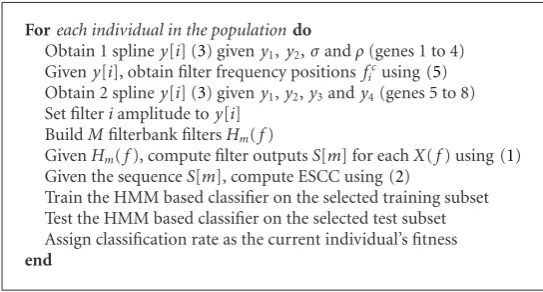
The steps for the filterbank optimization are summarized inAlgorithm 1, and the details for the population evaluation are shown inAlgorithm 2.
4. Results and Discussion
Many different experiments were carried out in order to find an optimal filterbank for the task of phoneme recognition. In this section we discuss the EA runs which produced the most interesting results and compare the obtained ESCC to the classic MFCC on the same classification tasks.
Foreach individual in the populationdo
Obtain 1 spliney[i] (3) giveny1,y2,σandρ(genes 1 to 4) Giveny[i], obtain filter frequency positionsfc
i using (5)
Obtain 2 spliney[i] (3) giveny1,y2,y3andy4(genes 5 to 8) Set filteriamplitude toy[i]
BuildMfilterbank filtersHm(f)
GivenHm(f), compute filter outputsS[m] for eachX(f) using (1)
Given the sequenceS[m], compute ESCC using (2)
Train the HMM based classifier on the selected training subset Test the HMM based classifier on the selected test subset Assign classification rate as the current individual’s fitness end
Algorithm2: Evaluate population.
and a step-size of 200 samples. All possible frames within a phoneme occurrence were extracted and padded with zeros where necessary. The set of English phonemes /b/, /d/, /eh/, /ih/, and /jh/ was considered. Occlusive consonants /b/ and /d/ were included because they are very difficult to distinguish in different contexts. Phoneme /jh/ presents special features of the fricative sounds. Vowels /eh/ and /ih/ are commonly chosen because they are close in the formant space. As a consequence, this phoneme set consists of a group of classes which is difficult for automatic recognition [29].
4.2. Experimental Setup. Our phoneme classifier is based on continuous HMM, using Gaussian mixtures with diagonal covariance matrices for the observation densities [30]. For the experiments, we used a three-state HMM and mixtures of four gaussians. This fitness function uses tools from the HMM Toolkit (HTK) [31] for building and manipulating hidden Markov models. These tools implement the Baum-Welch algorithm [32] which is used to train the HMM parameters, and the Viterbi algorithm [33] which is used to search for the most likely state sequence, given the observed events, in the recognition process.
In all the EA runs the population size was set to 30 individuals, crossover rate was set to 0.9, and the mutation rate was set to 0.07. Parametera, discussed in the previous section, was set to 0.1. For the optimization, a changing set of 1000 signals (phoneme examples) was used for training and a changing set of 400 signals was used for testing. Both sets were class-balanced and resampled every generation. The resampling of the training set was made randomly from a set of 5000 signals, and the resampling of the testing set was made taking into account previous misclassifications and the age of each of 1500 signals. The age of a signal was defined as the number of generations since it was included in the test set. The termination criterion for an EA run was to stop the optimization after 2500 generations. At termination, the filterbanks with the best fitness values were chosen.
Further cross-validation tests with ten different data partitions, consisting of 2500 training signals and 500 test signals each, were conducted with selected filterbanks. Two different validation tests were employed: match training
(MT), where the SNR was the same in both training and test sets, and mismatch training (MMT), which means testing with noisy signals (at different SNR levels) using a classifier that was trained with clean signals. From these validation tests we selected the best filterbanks, discarding those that were overoptimized (i.e., those with higher fitness but with lower validation result). Averaged validation results for the best optimized filterbanks were compared with the results achieved with the standard MFB on the same ten data partitions and training conditions. Note that, in all these experiments, the classifier was evaluated in MT conditions during the evolution.
4.3. Optimization of Central Frequencies. In the first exper-iment only the frequency positions of the filters were opti-mized, with chromosomes of length 4 (as explained in the previous section). The gain of each filter was not optimized; so, as in the case of the MFCC, every filter amplitude was scaled according to its bandwidth. Note that the number of filters in the filterbanks is not related to the size of the chromosomes. We considered filterbanks composed of 30 filters, while the feature vectors consisted of the first 16 cepstral coefficients. In this case, clean signals were used to train and test the classifier during the optimization.
Table1: Averaged validation results for phoneme recognition (shown in percent). Filterbanks are obtained from the optimization of filter center frequency values, while filter gains-scaled according to bandwidths and using clean signals.
FB nf nc
Match training validation Mismatch training validation
0 dB 10 dB 20 dB 30 dB clean 0 dB 10 dB 20 dB 30 dB
EFB-A1 30 16 73.14 78.06 73.54 70.74 70.94 23.86 44.06 69.66 70.54
EFB-A2 30 16 73.36 77.94 73.52 71.60 71.16 22.98 43.14 70.52 71.40
EFB-A3 30 16 73.60 78.08 73.36 71.14 71.00 23.62 44.14 69.94 71.28 EFB-A4 30 16 72.88 78.04 73.56 71.46 71.92 23.68 43.80 70.06 71.28
MFB 30 16 73.44 77.88 71.22 70.20 69.94 23.72 44.74 66.60 70.38
0 1000 2000 3000 4000 5000 6000 7000 8000 Frequency (Hz)
0 0.2 0.4 0.6 0.8 1
Gain
(a)
0 1000 2000 3000 4000 5000 6000 7000 8000 Frequency (Hz)
0 0.2 0.4 0.6 0.8 1
Gain
(b)
0 1000 2000 3000 4000 5000 6000 7000 8000 Frequency (Hz)
0 0.2 0.4 0.6 0.8 1
Gain
(c)
0 1000 2000 3000 4000 5000 6000 7000 8000 Frequency (Hz)
0 0.2 0.4 0.6 0.8 1
Gain
(d)
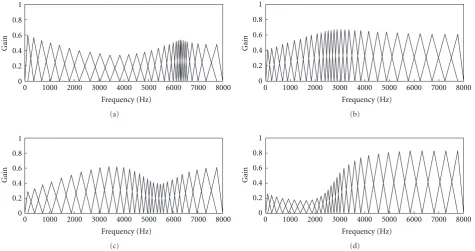
Figure5: Evolved filterbanks obtained in the optimization of filter center positions only (filter gains normalized according to bandwidths) using clean signals. (a) EFB-A1, (b) EFB-A2, (c) EFB-A3 and (d) EFB-A4.
4.4. Optimization of Filter Gain and Center Frequency. The second experiment differs only in that the filters’ amplitude was also optimized, coding the parameters of two splines in each chromosome of length 8. Validation results for EFB-B1, EFB-B2, EFB-B3, and EFB-B4 are shown inTable 2, from which important improvements over the classical filterbank can be appreciated. Each of the optimized filterbanks performs better than MFB in most of the test conditions. For the MT cases of 20 dB, 30 dB, and clean, and for the MMT case of 10 dB the improvements are most significant. These four EFBs, which can be observed in Figure 6, differ from MFB (shown inFigure 2) in the scaling of the filters at higher frequencies. Moreover, these filterbanks emphasize the high-frequency components. As in the case of those inFigure 5, these EFBs show more filter density before 2 kHz, compared to MFB.
In the third experiment both the frequency positions and amplitude of the filters were optimized (as in the previous case). However, in this case noisy signals at 0 dB SNR were used to train and test the classifier during the evolution.
Validation results fromTable 3reveal that for the case of 0 dB SNR, in both MT and MMT conditions, these EFBs improve the ones in Tables1and2. The filterbanks optimized on clean signals perform better for most of the noise contaminated conditions.
Table2: Averaged validation results for phoneme recognition (shown in percent). Filterbanks are obtained from the optimization of filter center frequency and filter gain values and using clean signals.
FB nf nc
Match training validation Mismatch training validation
0 dB 10 dB 20 dB 30 dB clean 0 dB 10 dB 20 dB 30 dB
EFB-B1 30 16 73.06 78.40 78.56 75.52 74.16 22.94 45.70 55.44 71.80
EFB-B2 30 16 73.76 78.38 79.08 76.26 74.84 24.26 50.16 64.84 73.10
EFB-B3 30 16 73.54 77.60 78.04 76.02 74.28 22.56 47.32 63.82 70.60
EFB-B4 30 16 73.74 78.74 79.18 75.66 75.40 23.22 51.46 66.58 72.96
MFB 30 16 73.44 77.88 71.22 70.20 69.94 23.72 44.74 66.60 70.38
Table3: Averaged validation results for phoneme recognition (shown in percent). Filterbanks obtained from the optimization of filter center frequency and filter gain values, and using noisy signals.
FB nf nc
Match training validation Mismatch training validation
0 dB 10 dB 20 dB 30 dB clean 0 dB 10 dB 20 dB 30 dB
EFB-C1 30 16 73.88 76.50 76.24 70.78 69.14 31.76 44.46 49.16 67.20
EFB-C2 30 16 74.66 78.60 78.96 73.78 70.76 25.74 46.68 49.76 66.88
EFB-C3 30 16 74.90 77.18 76.10 70.56 69.48 29.70 44.50 49.40 68.06
EFB-C4 30 16 74.76 78.16 78.54 75.36 71.04 24.80 46.08 52.12 66.36
MFB 30 16 73.44 77.88 71.22 70.20 69.94 23.72 44.74 66.60 70.38
0 1000 2000 3000 4000 5000 6000 7000 8000 Frequency (Hz)
0 0.2 0.4 0.6 0.8 1
Gain
(a)
0 1000 2000 3000 4000 5000 6000 7000 8000 Frequency (Hz)
0 0.2 0.4 0.6 0.8 1
Gain
(b)
0 1000 2000 3000 4000 5000 6000 7000 8000 Frequency (Hz)
0 0.2 0.4 0.6 0.8 1
Gain
(c)
0 1000 2000 3000 4000 5000 6000 7000 8000 Frequency (Hz)
0 0.2 0.4 0.6 0.8 1
Gain
(d)
0 1000 2000 3000 4000 5000 6000 7000 8000 Frequency (Hz)
0 0.2 0.4 0.6 0.8 1
Gain
(a)
0 1000 2000 3000 4000 5000 6000 7000 8000 Frequency (Hz)
0 0.2 0.4 0.6 0.8 1
Gain
(b)
0 1000 2000 3000 4000 5000 6000 7000 8000 Frequency (Hz)
0 0.2 0.4 0.6 0.8 1
Gain
(c)
0 1000 2000 3000 4000 5000 6000 7000 8000 Frequency (Hz)
0 0.2 0.4 0.6 0.8 1
Gain
(d)
Figure7: Evolved filterbanks obtained in the optimization of filter center positions and amplitudes simultaneously and using signals with noise at 0 dB SNR: (a) EFB-C1, (b) EFB-C2, (c) EFB-C3, and (d) EFB-C4.
Clean 30 20 10 0
SNR (dB)
Classification
rat
e
(%)
EFB-A4 EFB-B2
EFB-C4
MFB 64
66 68 70 72 74 76 78 80
(a)
Clean 30 20 10 0
SNR (dB)
Classification
rat
e
(%)
EFB-B2 MFB
0 10 20 30 40 50 60 70 80
EFB-A4 EFB-C4
(b)
Figure8: Averaged validation results for phoneme classification comparing MFB with EFB-A4, EFB-B2, and EFB-C4 at different training conditions. (a) Validation in match training conditions, and (b) validation in mismatch training conditions.
FromFigure 7we can observe that the filterbanks evolved on noisy signals differ widely from MFB and the ones evolved on clean signals. For example, the filter density is greater in different frequency ranges, and these ranges are centered in higher frequencies. Moreover, this amplitude scaling, in contrast to the preceding filterbanks, depreciates the lower-frequency bands. This feature is present in all these filterbanks, giving attention to high frequencies, as opposed to MFB, and taking higher formants into account. However, the noticeable dissimilarities in these four filterbanks suggest that the optimization with noisy signals is much more complex, preventing the EA to converge to similar solutions.
4.5. Analysis and Discussion. Figure 8 summarizes some
results shown in Tables1,2, and3for EFB-A4, EFB-B2, and EFB-C4, and compares them with MFB on different noise and training conditions. From Figure 8(a) we can observe that, in MT conditions, the EFBs outperform MFB in almost all the noise conditions considered.Figure 8(b)shows some improvements of EFB-A4 and EFB-B2, over MFB, in MMT conditions.
Table4: Confusion matrices showing percents of average classification rates from ten data partitions in MT conditions, for both MFB and EFB-B2.
MFB (30/16) EFB-B2
/b/ /d/ /eh/ /ih/ /jh/ /b/ /d/ /eh/ /ih/ /jh/
10 dB
/b/ 80.0 15.1 01.1 02.9 00.9 81.3 15.2 00.5 02.2 00.8
/d/ 20.1 72.2 00.2 02.0 05.5 20.4 71.0 00.6 01.9 06.1
/eh/ 03.0 01.0 78.4 17.6 00.0 02.2 01.2 81.6 15.0 00.0
/ih/ 02.0 03.2 21.3 73.2 00.3 01.5 01.1 23.9 73.1 00.4
/jh/ 00.0 14.3 00.0 00.1 85.6 00.5 14.5 00.0 00.1 84.9
Avg: 77.88 Avg:78.38
20 dB
/b/ 74.1 21.5 02.2 10.7 00.5 79.8 16.7 00.7 02.1 00.7
/d/ 15.0 78.8 00.9 10.4 03.9 17.9 74.8 00.6 02.8 03.9
/eh/ 12.7 04.9 55.6 26.5 00.3 00.7 01.0 76.6 21.7 00.0
/ih/ 06.3 03.9 27.1 62.4 00.3 00.4 00.5 24.0 75.1 00.0
/jh/ 00.7 13.6 00.0 00.5 85.2 00.5 09.9 00.1 00.4 89.1
Avg: 71.22 Avg:79.08
30 dB
/b/ 53.2 32.2 06.9 07.0 00.7 78.9 18.6 01.0 01.0 00.5
/d/ 11.0 77.0 02.7 04.4 04.9 17.1 76.5 00.8 01.3 04.3
/eh/ 01.3 02.3 68.9 27.4 00.1 02.3 01.0 72.1 24.6 00.0
/ih/ 00.9 01.9 30.2 66.9 00.1 01.8 01.3 26.3 70.6 00.0
/jh/ 01.5 12.1 00.5 00.9 85.0 00.7 14.8 00.2 01.1 83.2
Avg: 70.2 Avg:76.26
clean
/b/ 54.4 28.9 07.9 07.8 01.0 74.9 18.9 02.4 03.3 00.5
/d/ 12.2 76.3 01.9 04.8 04.8 15.5 78.1 00.9 01.0 04.5
/eh/ 02.2 02.1 69.4 26.0 00.3 01.4 01.3 67.9 29.3 00.1
/ih/ 02.4 01.5 31.8 64.2 00.1 03.1 01.3 26.7 68.9 00.0
/jh/ 02.1 11.7 00.2 00.6 85.4 01.1 13.2 00.9 00.4 84.4
Avg: 69.94 Avg:74.84
0 0.1 0.2 0.3 0.4 0.5 0.6 0.7 0.8 0.9 1 0
2 4 6 8
Time (s)
×103
F
requency
(Hz)
(a)
0 0.1 0.2 0.3 0.4 0.5 0.6 0.7 0.8 0.9 1 0
2 4 6 8
Time (s)
×103
F
requency
(Hz)
(b)
0 0.1 0.2 0.3 0.4 0.5 0.6 0.7 0.8 0.9 1 0
2 4 6 8
Time (s)
×103
F
requency
(Hz)
(c)
Figure 9: Spectrograms for a fragment of sentenceSI648 from TIMIT corpus with additive white noise at 20 dB SNR. Computed from the original signal (a), reconstructed from MFCC (b) and reconstructed from EFB-B4 (c).
using MFB and they are significantly better classified with EFB-B2. Moreover, with EFB-B2 the variance between the classification rates of individual phonemes is smaller. It can also be noticed that phoneme /b/ is mostly confused with phoneme /d/ and vice versa, and the same happens with vowels /eh/ and /ih/. This occurs with both filterbanks MFB and EFB-B4, though the optimized filterbank reduces these confusions considerably.
MFB
5
10
15
5 10 15
EFB-B1
(a)
MFB
5
10
15
5 10 15
EFB-B2
0.2 0.4 0.6 0.8
(b)
MFB
5
10
15
5 10 15
EFB-B3
(c)
B3 EFB
B2 B1
0.0
0 2 0.04 0.06
(d)
Figure10: Squared Pearson’s correlation between MFCC and ESCC obtained with EFB-B1, EFB-B2, and EFB-B3 ((a), (b) and (c), resp.). Normalized sum of the correlation coefficients outside the diagonal (d).
to note that the five phonemes selected for the filterbank optimization represent only 9.38% (b: 1.49%, d: 2.28%, eh: 2.35%, ih: 2.76%, jh: 0.51%) of the total number of phonemes in the test utterances. That is, from a total of 3956 phonemes in the test utterances, only 371 correspond to the phoneme set considered in the optimization.
In order to understand the information that these filterbanks retain, an estimate of the short-time magnitude spectrum was recovered using the method proposed in [34]. This method scales the spectrogram of a white noise signal by the short-time magnitude spectrum recovered from the cepstral coefficients. The spectrograms for a fragment of sentence SI648 from TIMIT corpus with additive white noise at 20 dB SNR are shown inFigure 9. The spectrogram on top is the one corresponding to the original signal, in the middle the reconstructed spectrogram from MFCC is shown, and the one at the bottom was reconstructed from the ESCC obtained by means of EFB-B4. It can be observed that the spectrogram reconstructed from ESCC is less affected by noise than the other two. Moreover, the information from formant frequencies is enhanced and made easier to detect in the spectrogram corresponding to ESCC, which makes phoneme classification easier. This means that, in comparison to the MFB, the filter distribution and bandwidths of EFB-B4 allow more relevant information to be preserved.
In order to evaluate the relation of the MFCC and the ESCC we compared them using Pearson’s correlation coefficient r.Figure 10shows squared correlation matrices comparing the MFCC with the ESCC (obtained using EFB-B1, EFB-EFB-B1, and EFB-B3) over 17846 phoneme frames with additive noise at 0 dB SNR. We observe that approximately the first half of the coefficients are quite highly correlated between the filterbanks under comparison. Moreover, in the case of EFB-B2 there are more correlation coefficients outside the diagonal which are different from zero. This means that the ESCC are obtained with EFB-B2 are the least related to the MFCC, in the sense that the information is distributed differently between all the cepstral coefficients. This can be better appreciated in the bar plot, giving the normalized sum of all the correlation coefficients outside the diagonal. Note that EFB-B2 is the one which gives the best validation results.
5
10
15
5 10 15
MFB
MFB
(a)
5
10
15
5 10 15 EFB-B1
EFB-B1
(b)
5
10
15
5 1
1
0 15 EFB-B2
EFB-B2
0.5
(c)
5
10
15
5 10 15 EFB-B3
EFB-B3
(d)
EFB-B2 EFB-B3 EFB-B1
0.0
0 2 0.04
MFB
(e)
Figure11: Squared Pearson’s correlation of MFCC and ESCC obtained with EFB-B1, EFB-B2, and EFB-B3 ((a), (b), (c) and (d), resp.). Normalized sum of the correlation coefficients outside the diagonal (e).
from EFB-B2 are less correlated than MFCC. For this reason the ESCCs from EFB-B2 better satisfy the assumptions for HMM-based speech recognizers using GM observation densities with diagonal covariance matrices (a common practice in speech recognition) [30].
Another subject to consider is the computational load of the optimizations detailed in the previous section. An EA run of 2500 generations (which is the number of generations used in this work for the experiments) takes approximately 84 hours (about 2 minutes for each generation) on a computer cluster consisting of eleven processors of 3 GHz clock speed. It is interesting to note that the most expensive computation in the optimization is the fitness evaluation, that is, the training and test of the HMM-based classifier. In comparison to the approach [17] (in which the filterbank parameters were directly coded in the chromosomes), the reduced chromosome size allowed the EA to converge to better solutions taking almost the same processing time. It is important to note that this approach does not imply addi-tional load to the standard speech recognition procedure. The optimization step is previous to the recognition, and the filterbank is fixed during the entire recognition. Moreover, the MFCC and the ESCC feature extraction techniques are similar, and the optimization can be considered as part of the training.
5. Conclusions
In this work an evolutionary method has been proposed for the optimization of a filterbank, in order to obtain a new cepstral representation for phoneme classification. We introduced the use of a spline interpolation which reduces the number of parameters in the optimization, providing an adequate search space. The advantages of evolutionary computation are successfully exploited in the search for an optimal filterbank. The encoding of parameters by means of spline functions significantly reduced the chromosome size and search space, while preserving a broad variety of candidate solutions. Moreover, the suitable variation operators allowed the algorithm to explore a large pool of potential filterbanks.
computational cost, and without modifications in the HMM structure or training algorithm.
Further work will include the utilization of other search methods, such as particle swarm optimization and scatter search [35]. In addition, different variation operators can be evaluated and other filter parameters such as bandwidth could also be optimized. The possibility of replacing the HMM-based classifier by another objective function of lower computational cost, such as a measure of class separability, will also be studied. Finally, future experiments will include the optimization using a bigger set of phonemes and further comparisons of the ESCC to classical features in the continuous speech recognition task.
Acknowledgments
The authors wish to thank their lab colleagues Mar´ıa Eugenia Torres and Leandro Di Persia for sharing their experience through their technical support and excellent advice, from which this work has benefited.
References
[1] S. B. Davis and P. Mermelstein, “Comparison of parametric representations for monosyllabic word recognition in con-tinuously spoken sentences,”IEEE Transactions on Acoustics, Speech, and Signal Processing, vol. 28, no. 4, pp. 357–366, 1980. [2] F. Zheng, G. Zhang, and Z. Song, “Comparison of different implementations of MFCC,”Journal of Computer Science and Technology, vol. 16, no. 6, pp. 582–589, 2001.
[3] M. D. Skowronski and J. G. Harris, “Exploiting independent filter bandwidth of human factor cepstral coefficients in automatic speech recognition,”Journal of the Acoustical Society of America, vol. 116, no. 3, pp. 1774–1780, 2004.
[4] M. D. Skowronski and J. G. Harris, “Improving the filter bank of a classic speech feature extraction algorithm,” inProceedings of the IEEE International Symposium on Circuits and Systems (ISCAS ’03), vol. 4, pp. 281–284, May 2003.
[5] H. Yeganeh, S. M. Ahadi, S. M. Mirrezaie, and A. Ziaei, “Weighting of mel sub-bands based on SNR/entropy for robust ASR,” in Proceedings of the 8th IEEE International Symposium on Signal Processing and Information Technology (ISSPIT ’08), pp. 292–296, December 2008.
[6] B. Nasersharif and A. Akbari, “SNR-dependent compression of enhanced Mel sub-band energies for compensation of noise effects on MFCC features,”Pattern Recognition Letters, vol. 28, no. 11, pp. 1320–1326, 2007.
[7] XI. Zhou, Y. Fu, M. Liu, M. Hasegawa-Johnson, and T. S. Huang, “Robust analysis and weighting on MFCC compo-nents for speech recognition and speaker identification,” in Proceedings of the IEEE International Conference onMultimedia and Expo (ICME ’07), pp. 188–191, July 2007.
[8] H. Boˇril, P. Fousek, and P. Poll´ak, “Data-driven design of front-end filter bank for Lombard speech recognition,” in Proceedings of the 9th International Conference on Spoken Language Processing (ICSLP ’06), pp. 381–384, Pittsburgh, Pa, USA, September 2006.
[9] Z. Wu and Z. Cao, “Improved MFCC-based feature for robust speaker identification,”Tsinghua Science & Technology, vol. 10, no. 2, pp. 158–161, 2005.
[10] L. Burget and H. Heˇrmansk´y, “Data driven design of filter bank for speech recognition,” inText, Speech and Dialogue, vol. 2166 ofLecture Notes in Computer Science, pp. 299–304, Springer, Berlin, Germany, 2001.
[11] C. Charbuillet, B. Gas, M. Chetouani, and J. L. Zarader, “Optimizing feature complementarity by evolution strategy: application to automatic speaker verification,”Speech Commu-nication, vol. 51, no. 9, pp. 724–731, 2009.
[12] L. Vignolo, D. Milone, H. Rufiner, and E. Albornoz, “Parallel implementation for wavelet dictionary optimization applied to pattern recognition,” in Proceedings of the 7th Argentine Symposium on Computing Technology, Mendoza, Argentina, 2006.
[13] C. Charbuillet, B. Gas, M. Chetouani, and J. L. Zarader, “Multi filter bank approach for speaker verification based on genetic algorithm,” inAdvances in Nonlinear Speech Processing, vol. 4885 ofLecture Notes in Computer Science, pp. 105–113, 2007. [14] D. B. Fogel, Evolutionary Computation, John Wiley & Sons,
New York, NY, USA, 3rd edition, 2006.
[15] M. S. Lewicki, “Efficient coding of natural sounds,”Nature Neuroscience, vol. 5, no. 4, pp. 356–363, 2002.
[16] L. D. Stein, “End of the beginning,”Nature, vol. 431, no. 7011, pp. 915–916, 2004.
[17] L. D. Vignolo, H. L. Rufiner, D. H. Milone, and J. C. Goddard, “Genetic optimization of cepstrum filterbank for phoneme classification,” inProceedings of the 2nd International Conference on Bio-Inspired Systems and Signal Processing (BIOSIGNALS ’09), pp. 179–185, Porto, Portugal, January 2009.
[18] T. B¨ack,Evolutionary Algorithms in Theory and Practice: Evolu-tion Strategies, EvoluEvolu-tionary Programming, Genetic Algorithms, Oxford University Press, Oxford, UK, 1996.
[19] T. B¨ack, U. Hammel, and H. P. Schwefel, “Evolutionary computation: comments on the history and current state,” IEEE Transactions on Evolutionary Computation, vol. 1, no. 1, pp. 3–17, 1997.
[20] Z. Michalewicz,Genetic Algorithms + Data Structures = Evolu-tion Programs, Springer, Berlin, Germany, 1992.
[21] C. R. Jankowski Jr., H. D. H. Vo, and R. P. Lippmann, “A comparison of signal processing front ends for automatic word recognition,” IEEE Transactions on Speech and Audio Processing, vol. 3, no. 4, pp. 286–293, 1995.
[22] L. Rabiner and B.-H. Juang,Fundamentals of Speech Recogni-tion, Prentice Hall PTR, Englewood Cliffs, NJ, USA, 1993. [23] J. R. Deller, J. G. Proakis, and J. H. Hansen, Discrete-Time
Processing of Speech Signals, Macmillan, New York, NY, USA, 1993.
[24] M. Slaney, “Auditory Toolbox, version 2,” Tech. Rep. 1998-010, Interval Research Corporation, Apple Computer Inc., 1998. [25] W. H. Press, B. P. Flannery, S. A. Teukolsky, and W. T.
Vetterling, Numerical Recipes in C: The Art of Scientific Computing, Cambridge University Press, Cambridge, UK, 2nd edition, 1992.
[26] C. Gathercole and P. Ross, “Dynamic training subset selection for supervised learning in genetic programming,” inParallel Problem Solving from Nature—PPSN III, vol. 866 ofLecture Notes in Computer Science, pp. 312–321, Springer, Berlin, Germany, 1994.
[27] A. E. Eiben and J. E. Smith, Introduction to Evolutionary Computing, Springer, Berlin, Germany, 2003.
[29] K. N. Stevens,Acoustic Phonetics, Mit Press, Cambrige, Mass, USA, 2000.
[30] K. Demuynck, J. Duchateau, D. van Compernolle, and P. Wambacq, “Improved feature decorrelation for HMM-based speech recognition,” in Proceedings of the 5th International Conference on Spoken Language Processing (ICSLP ’98), Sydney, Australia, 1998.
[31] S. Young, D. Kershaw, J. Odell, D. Ollason, V. Valtchev, and P. Woodland,HMM Toolkit, Cambridge University, 2000,http:// htk.eng.cam.ac.uk/.
[32] F. Jelinek, Statistical Methods for Speech Recognition, MIT Press, Cambrige, Mass, USA, 1999.
[33] X. D. Huang, Y. Ariki, and M. A. Jack,Hidden Markov Models for Speech Recognition, Edinburgh University Press, 1990. [34] D. P. W. Ellis, “PLP and RASTA (and MFCC, and inversion) in
Matlab,” http://www.ee.columbia.edu/∼ dpwe/resources/mat-lab/rastamat/.