Volume 2011, Article ID 725189,16pages doi:10.1155/2011/725189
Research Article
An Efficient Algorithm for Instantaneous Frequency Estimation
of Nonstationary Multicomponent Signals in Low SNR
Jonatan Lerga,
1Victor Sucic (EURASIP Member),
1and Boualem Boashash
2, 31Faculty of Engineering, University of Rijeka, Vukovarska 58, 51000 Rijeka, Croatia 2College of Engineering, Qatar University, P.O. Box 2713, Doha, Qatar
3UQ Centre for Clinical Research, The University of Queensland, Brisbane QLD 4072, Australia
Correspondence should be addressed to Victor Sucic,[email protected]
Received 14 July 2010; Revised 10 November 2010; Accepted 11 January 2011
Academic Editor: Antonio Napolitano
Copyright © 2011 Jonatan Lerga et al. This is an open access article distributed under the Creative Commons Attribution License, which permits unrestricted use, distribution, and reproduction in any medium, provided the original work is properly cited.
A method for components instantaneous frequency (IF) estimation of multicomponent signals in low signal-to-noise ratio (SNR) is proposed. The method combines a new proposed modification of a blind source separation (BSS) algorithm for components separation, with the improved adaptive IF estimation procedure based on the modified sliding pairwise intersection of confidence intervals (ICI) rule. The obtained results are compared to the multicomponent signal ICI-based IF estimation method for various window types and SNRs, showing the estimation accuracy improvement in terms of the mean squared error (MSE) by up to 23%. Furthermore, the highest improvement is achieved for low SNRs values, when many of the existing methods fail.
1. Signal Model and Problem Formulation
Many signals in practice, such as those found in speech processing, biomedical applications, seismology, machine condition monitoring, radar, sonar, telecommunication,
and many other applications are nonstationary [1]. Those
signals can be categorized as either monocomponent or multicomponent signals, where the monocomponent signal, unlike the multicomponent one, is characterized in the time-frequency domain by a single “ridge” corresponding to an
elongated region of energy concentration [1].
For a real signals(t), its analytic equivalentz(t) is defined
as
z(t)=s(t) +jH{s(t)} =a(t)ejφ(t), (1)
whereH{s(t)}is the Hilbert transformation ofs(t),a(t) is
the signal instantaneous amplitude, and φ(t) is the signal
instantaneous phase.
The instantaneous frequency (IF) describes the varia-tions of the signal frequency contents with time; in the case of a frequency-modulated (FM) signal, the IF represents the FM modulation law and is often referred to as simply the IF law
[2,3]. The IF of the monocomponent signalz(t) is the first
derivative of its instantaneous phase, that is,ω(t)=φ(t) [1].
Furthermore, the crest of the “ridge” is often used to estimate
the IF of the signalz(t) as [1]
ω(t)=arg
max f TFDz
t,f
, (2)
where TFDz(t,f) is the signalz(t) time-frequency
distribu-tion [1].
On the other hand, the analytical multicomponent signal
x(t) can be modeled as a sum of two or more
monocom-ponent signals (each with its own IFωm(t))
x(t)= M
m=1
zm(t)= M
m=1
am(t)ejφm(t), (3)
whereM is the number of signal components,am(t) is the
mth component instantaneous amplitude, andφm(t) is its
instantaneous phase.
When calculating the Hilbert transform of the signals(t)
in (1), the conditions of Bedrosian’s theorem need to be
satisfied, that is,a(t) has to be a low frequency function with
the spectrum which does not overlap with theejφ(t)spectrum
To obtain the multicomponent signal IF, a component separation procedure should precede the IF estimation from
the extracted signal components [1]. However, when dealing
with multicomponent signals, their TFDs often contain the cross-terms which significantly disturb signal time-frequency representation, hence making the components
separation procedure more difficult. Thus the proper TFD
selection plays a crucial role in signal components extraction
efficiency. Various reduced interference distributions (RIDs)
have been proposed in order to have a high resolution time-frequency signal representation, such as modified B
distri-bution (MBD) [6] and the RID based on the Bessel kernel
[7], both used in this paper. A measure for time-frequency
resolution and component separation was proposed in [8].
Methods for signal components extraction from a mix-ture containing two or more statistically independent signals are often termed as blind source separation (BSS) methods, where the term “blind” indicates that neither the structure of the mixtures nor the source signals are known in advance
[1]. So, the main problem of BSS is obtaining the original
waveforms of the sources when only their mixture is available
[9]. Due to its broad range of potential applications, BSS
has attracted a great deal of attention, resulting in numerous BSS techniques which can be classified as the time domain
methods (e.g., [10, 11]), the frequency domain methods
(e.g., [12,13]), adaptive (recursive) methods (e.g., [14]), and
nonrecursive methods (e.g., [15]).
Once the components are extracted from the signal, their IF laws (which describe the signal frequency modulation
(FM) variation with time [1]) can be obtained using some
of the existing IF estimation methods. One of the popular IF
estimation methods is the iterative algorithm [16] based on
the spectrogram calculated from the signal analytic associate in the algorithm’s first iteration, followed by the IF and the instantaneous phase estimation. The obtained IF is then used for a new calculation of the spectrogram which is further used for signal demodulation. In the next iteration, the matched spectrogram of the demodulated signal is calculated, followed by a new IF and phase estimation. The procedure is iteratively repeated until the IF estimate convergence is reached (based on the threshold applied to the
difference between consecutive iterations) [16].
The IF estimation methods for noisy signals can be divided into two categories comprising the case of mul-tiplicative noise and the case of additive noise. For a signal in multiplicative noise or a signal with the time-varying amplitude, the use of the Wigner-Ville spectrum or the polynomial Wigner-Ville distribution was proposed in
[17,18].
For polynomial FM signals in additive noise and high signal-to-noise ratio (SNR), the polynomial Wigner-Ville
distribution-based IF estimation method was suggested [19]
while for the low SNR an iterative procedure based on the cross-polynomial Wigner-Ville distribution was proposed
[20]. The signal polynomial phase, and its IF as the derivative
of the obtained phase polynomial, can be also estimated
using the higher-order ambiguity functions [21]. The IF
estimation accuracy can be improved using the adaptive
win-dows and theS-transform (which combines the short-time
Fourier analysis and the wavelet analysis) [22] or the
direc-tionally smoothed pseudo-Wigner-Ville distribution bank
[23]. The IF estimation method based on the maxima of
time-frequency distributions adapted using the intersection of confidence intervals (ICI) rule or its modifications, used in the varying data-driven window width selection, was shown to outperform the IF obtained from the maxima of the TFD calculated using the best fixed-size window width
[24–26]. This paper presents a modification of the sliding
pairwise ICI rule-based method for signal component IF estimation combined with the modified BSS method for components separation and extraction. Unlike the ICI rule based method which was used only for monocomponent signals, this new proposed method based on the improved ICI rule is extended and applied to multicomponent signals IF estimation, resulting into increased estimation accuracy for each component present in the signal.
A simplified flowchart of the new multicomponent IF
estimation method is shown inFigure 1. As it can be seen,
the components IF estimation using the proposed method is preceded by the modified component extraction procedure
described inSection 2.3.
The paper is organized as follows. Section 2 gives an
introduction to the problem of proper TFD selection, fol-lowed by the modified algorithm for components separation and extraction for multicomponent signals in additive noise. Section 3defines the improved sliding pairwise ICI-based IF estimation method from a set of the signal TFDs calculated
for various fixed window widths. Section 4 presents the
results of the multicomponent signal IF estimation using the proposed method, and then compares them with the results obtained with the ICI-based method. The conclusion is given inSection 5.
2. Components Extraction Procedure
2.1. TFD Selection. When dealing with multicomponent signals, the choice of the TFD plays a crucial role due to the presence of the unwanted cross-terms which disturb the
signal representation in the (t,f) domain. The best-known
TFD of a monocomponent linear FM analytic signalz(t) is
the Wigner-Ville distribution (WVD), which may be defined
as [1]
Wz
t,f=
+∞
−∞z t+ τ 2
·z∗ t−τ
2
·e−j2π f τdτ. (4)
The main disadvantage of the WVD of multicomponent signals or monocomponent signals with nonlinear IF is the presence of interferences and loss of frequency resolution
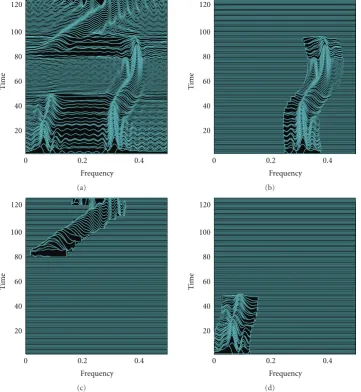
[1], as illustrated inFigure 2. To reduce the cross-terms in
the WVD, the signal instantaneous autocorrelation function
z(t+τ/2)·z∗(t−τ/2) can be windowed in the lagτdirection
before taking its Fourier transform
PWz
t,f=
+∞
−∞h(τ)·z t+ τ 2
·z∗ t−τ
2
·e−j2π f τdτ, (5)
resulting in the pseudo-WVDPWz(t,f) also called
Multicomponent signal
TFDs calculation
Component extraction
No
All components are extracted
Yes
Component IF estimation
No
Yes All components IFs
are estemated
Estimated components IFs
Figure 1: A simplified flowchart of the new IF estimation algorithm.
Narrowing the frequency smoothing windowh(τ) of the
pseudo WVD in order to better localize the signal in time results in higher TFD time resolution, and consequently
lower frequency resolution [1]. Similarly, a narrow window
in the frequency domain results in high frequency resolution,
but simultaneously the time resolution gets disturbed [1,
page 215].
To have independently adjusted time and frequency smoothing of the WVD, the smoothed pseudo WVD was
introduced [1]
SPWz
t,f=
+∞
−∞h(τ) +∞
−∞g(s−t)·z s+ τ 2
·z∗ s−τ
2
ds·e−j2π f τdτ, (6)
whereg(t) is the time smoothing window.
The efficiency of the IF estimation method presented in
this paper is affected by the TFD selection, hence a reduced
interference, high resolution TFD should be used. There are numerous TFDs having such characteristics, some of which
are defined in [27–29]. One RID shown to be superior to
other fixed-kernel TFDs in terms of cross-terms reduction
and resolution enhancement, is the MBD defined as [6]
MBDz
t,f=
+∞
−∞
cosh−2β(t−u)
+∞
−∞cosh−2βξdξ
·z u+τ
2
·z∗ u−τ
2
·e−j2π f τdu dτ, (7)
where the parameterβ, (0< β≤1), controls the distribution
resolution and cross-term elimination [6, 30]. Generally,
there is a compromise between those two TFD features, with the MBD shown to outperform many popular distributions
[6,8]. Furthermore, the MBD was also proven to be a suitable
TFD for robust IF estimation [6].
In this paper, the results obtained using the MBD are compared to those obtained by another RID with the kernel filter based on the Bessel function of the first kind (RIDB)
[7]. This choice of the RID was motivated by its good
performances in terms of time and frequency resolution
preservation due to the independent windowing in theτand
νdomains, as well as its efficient cross-terms suppression [7].
The RIDB is defined as [7]
RIDBz
t,f=
+∞
−∞h(τ)·Rz(t,τ)·e
−j2π f τdτ, (8)
where
Rz(t,τ)=
t+|τ|
t−|τ|
2g(v)
π|τ|
1− v−t
τ 2
·z v+τ
2
·z∗ v−τ
2
dv.
(9)
This distribution has been tested on real-life signals, such as heart sound signal and Doppler blood flow signal, and proven to be superior over some other TFDs in suppressing the cross-terms, while the autoterms were kept with high
resolution [7,31,32].
2.2. Algorithm for Signal Components Extraction. The signal components separation and extraction can be done using the
two algorithms given in [33], classified by their authors as the
BSS algorithms even though they are different from standard
BSS formulation, being ad hoc approaches. The first of those algorithms is applicable to multicomponent signals with intersecting components (assuming that all components have same time supports), while the second one is applicable to multicomponent signals with components which do
not intersect and may have different time supports. The
modifications proposed in this paper can be applied to both of these algorithms. However, in many practical situations that we have dealt with, components belonging to the same signal source do not generally intersect (e.g., newborn EEG
seizure signal analysis [1]), so we have chosen to apply our
modifications to the second algorithm only. Furthermore, the chosen algorithm, unlike some other algorithms for
estimation of multicomponent signals in noise (e.g., [34–
36]) is not limited to the polynomial phase signals and can
also be used in estimation of other nonlinear phase signals, as most real-life signals are (e.g., the echolocation sound emitted by a bat, used in this paper). The components are extracted one by one, until the remaining energy of the TFD
becomes sufficiently small [37].
0 50 100 −2
−1 0 1 2
Time
x1
(
n
)
(a)
0 0.2 0.4
0 20 40 60 80 100 120
Ti
m
e
Frequency
(b)
0 0.2 0.4
0 20 40 60 80 100 120
Ti
m
e
Frequency
(c)
0 0.2 0.4
0 20 40 60 80 100 120
Ti
m
e
Frequency
(d)
Figure2: Example of a multicomponent signal and its representations in the (t,f) domain. (a) Signal in the time domain. (b) Signal components IFs. (c) WVD of the signal. (d) Signal MBD with the time and lag window length ofN/4 + 1.
using the peaks of the TFD. The highest peak at (t0,f0) in
the time-frequency domain is extracted first, and then it is set to zero (in order to avoid it being selected again) along
with the frequency range around it (t0,f) (the size of which
is 2Δf, such that f ∈ [f0−Δf,f0+Δf]). Then the next
highest peak (t0,f0) in the vicinity of the previous one is
selected. That is, (t0,f0) is the maximum in the (t,f) domain
where t ∈ [t0 −1,t0+ 1] and f ∈ [f0 −F/2,f0 +F/2],
whereFis the chosen frequency window width. Next, (t0,f0)
is set to be (t0,f0), and the procedure is repeated until the
boundaries of the TFD are reached or the TFD value at
(t0,f0) is smaller than the preset threshold valuec defined
as the fraction of the TFD value at the first (t0,f0) point. Such
extracted TFD’s peaks constitute one signal component. The next component is found in the same way using the above-described procedure. The algorithm stops once the energy
remaining in the TFD is smaller than the threshold valued
defined as a fraction of the signal total energy.
The second stage of the algorithm often produces a number of components that is larger than the actual number of components present in the analyzed multicomponent signal. In order to fix this, a classification procedure was proposed as the third and final algorithm stage. This com-ponent classification procedure groups the comcom-ponents from the second stage of the algorithm based on the minimum distance between any pair of components. If two components belong to the same actual component, their distance is going to be smaller than the distance between the considered com-ponent and any other comcom-ponent, and they get combined
into a single component [33].
2.3. Modification of the Algorithm for Components Extraction. In order to avoid the components classification procedure
of the algorithm in [33], in this section, we present a
Multicomponent signal
TFDs calculation
Peak (t0,f0) detection
No No
No No
No
Yes Yes
TFD boundaries reached
TFD boundaries reached
Extracted signal components
Yes Yes
Peak (t0,f0) detection in
above selected region
Adding (t0,f0) to signal
component, and seting (t0,f0)=(t0,f0)
Adding (t0,f0) to signal
component, and seting (t0,f0)=(t0,f0)
TFD energy< εd
TFD (t0,f0)< εc TFD (t0,f0)< εc
Selecting (t,f) subregion, such thatt∈[t0−1,t0], and
f ∈[f0−F/2,f0+F/2]
Selecting (t,f) subregion, such thatt∈[t0,t0+ 1], and
f∈[f0−F/2,f0+F/2]
Seting (t0,f) to zero,
wheref∈[f0−Δf,f0+Δf]
Seting (t0,f) to zero,
wheref∈[f0−Δf,f0+Δf]
Adding (t0,f0) to signal
component and setting (t0,f0) to zero, where
f∈[f0−Δf,f0+Δf]
Peak (t0,f0) detection in
above=selected region
Figure3: A detailed flowchart of the modified components extraction algorithm.
The modified algorithm (the flowchart of which is shown inFigure 3) for components separation and extraction starts with the signal RID calculation; the MBD and the RIDB are used in this paper.
As in the original method, the modified algorithm starts
with the detection of the highest peak (t0,f0) in the (t,f)
domain, followed by setting (t0,f) to zero, where f ∈[f0−
Δf,f0+Δf]. Then, the (t0,f0) vicinity is divided in two (t,f)
subregions such that f ∈ [f0−F/2,f0+F/2], wheret ∈
[t0−1,t0] for the first subregion andt∈[t0,t0+ 1] for the
second one. Thus, the two values for (t0,f0) are obtained as
0 0.2 0.4 20
40 60 80 100 120
Frequency
Ti
m
e
(a)
0 0.2 0.4
20 40 60 80 100 120
Frequency
Ti
m
e
(b)
0 0.2 0.4
20 40 60 80 100 120
Frequency
Ti
m
e
(c)
0 0.2 0.4
20 40 60 80 100 120
Frequency
Ti
m
e
(d)
Figure4: Example of components separation and extraction procedure using the algorithm described inSection 2(N =128, the number of frequency binsNf =4N,Δf =F/2 =Nf/4,c =0.2, andd =0.01). (a) The signal RIDB with the rectangular time and frequency windows of lengthN/4 + 1. (b) Extracted first sinusoidal FM signal component. (c) Extracted linear FM signal component. (d) Extracted second sinusoidal FM signal component.
In the next stage of the modified algorithm, the two
(t0,f0) values are set as two (t0,f0), and the above-described
procedure is repeated for each of them as long as the (t0,f0)
value exceeds the thresholdc or until the TFD boundaries
are reached. The extracted (t0, f0) values then form one signal
component. Once the component is detected, it is extracted
from the (t,f) plane and the procedure is repeated for the
next component present in the signal. The algorithm stops once the remaining energy in the TFD becomes smaller than
the preset thresholdd.
The original method, due to its single-direction search, results in components sections or parts (not whole compo-nents), thus the components classification procedure needs also to be employed in order to combine those parts into signal components.
The modified method which applies a double-direction
component search (as shown in Figure 3) enables us
to accurately and efficiently obtain whole components
without having to perform any additional classification procedure based on the minimum distance between the components.
2.4. Example of Multicomponent Signal Components Extrac-tion. In order to illustrate the performance of the modi-fied algorithm for signal components extraction from its RIDB, the signal mixture containing two sinusoidal FM components and a linear FM component was used (see Figure 4). Note that unlike the algorithm in [33], the modified algorithm presented in this paper does not require that all components must have same time supports. The multicomponent signal RIDB calculated with the fixed time and frequency smoothing rectangular windows, the length
of which was set toN/4 + 1 (N being the signal length), is
will be used for the components IF estimation in the rest of
this paper, as described inSection 3.
The extracted components are shown in Figures 4(b),
4(c), and4(d). As it can be seen, the components are well
identified with their time and frequency supports being well preserved, which is necessary for their IF estimation.
3. IF Estimation Method Based on the Improved
Sliding Pairwise ICI Rule
3.1. Review of the IF Estimation Method Based on the ICI Rule. Once the components are extracted from a multicomponent signal TFD, their IFs can be obtained as the component maxima in the time-frequency plane using some of the existing monocomponent IF estimation methods. However, estimating the IF as the TFD maxima results into estimation bias which is caused either by IF higher order derivatives, small noise (which moves the local maxima within the signal component), or high noise (which moves the local maxima
outside the component) [38]. The estimation bias increases
with the window length used for TFD calculation, while
the variance decreases [6, 25]. Hence, due to the tradeoff
between the estimation bias and variance, the estimation error reduction can be obtained using the proper window
length [25].
The adaptive method for selecting the appropriate
win-dow width based on the ICI rule was efficiently applied
to monocomponent signal IF estimation in [24, 25]. The
main advantage of this estimation method is that it does not require the knowledge of estimation bias (unlike some
plugin methods, e.g., [39]), but only the estimation variance
(which can be easily obtained in the case of high sampling rate and white noise). This is very useful in applications such as speech and music processing, biological signals analysis,
radar, sonar, and geophysical applications [25].
For this reason, we have selected this algorithm as a basis and starting point for our new proposed methodology; we briefly review the ICI algorithm below and then show the modifications that are needed in order to apply it to multicomponent signals IF estimation.
Let us now consider a discrete nonstationary multicom-ponent signal in additive noise
y(n)=x(n) +(n), (10)
where
x(n)= M
m=1
zm(n)= M
m=1
am(n)ejφm(n), (11)
whereMis the number of signal components,(n) is white
complex-valued Gaussian noise with mutually independent
real and imaginary zero-mean parts of varianceσ2
/2,am(n)
is themth component instantaneous amplitude, andφm(n)
is its instantaneous phase [1].
The component IF can be estimated from the signal TFD
as [1]
ωm(n,h)=arg
max
k TFDm(n,k,h)
, (12)
where TFDm(n,k,h) is the TFD containing only the mth
component extracted from the multicomponent signal TFD
calculated using the window of lengthh. It was shown in [25]
that for the asymptotic case (small estimation error) the IF
estimation errorΔωm(n,h)=ωm(n)−ωm(n,h) is
Δωm(n,h)≤ |biasm(n,h)|+κσm(h), (13)
with probabilityP(κ), whereκis a quantile of the standard
Gaussian distribution, andσm(h) the component estimation
error standard deviation obtained as
σm(h)=
σ2
2|Am|2
1 + σ
2
2|Am|2
T h3
E
F2, (14)
where E = h
i=1w(i)(i/h) 2
, F = h
i=1[w(i)] 2
(i/h)2, and
w(n) is the real-valued symmetrical window of lengthh[25].
The E andF values depend on the window type used for
TFD calculation. For example, in the case of the rectangular
windowE=F=1/12 [25].
As shown in [25], for
|biasm(n,h)| ≤κσm(h), (15)
Equation (13) becomes
Δωm(n,h)≤2κσm(h). (16)
Equations (13) and (16) imply that ωm(n) belongs to the
confidence intervalDm(n,l)=[Lm(n,l),Um(n,l)] with
pro-babilityP(κ) (the largerκvalue givesP(κ) closer to 1), where
its upperUm(n,l) and lowerLm(n,l) limits are defined as
Um(n,l)=[ωm(n,h) + 2κσm(h)],
Lm(n,l)=[ωm(n,h)−2κσm(h)],
(17)
and l is the sequence number of h in a set of increasing
window widths H = {hl|h1 < h2 < · · · < hJ}. The
IF estimation method proposed in [24, 25] calculates a
sequence of TFDs for each of the window widths from H.
In general, any reasonable choice ofHis acceptable [25]. In
this paper, we have usedH = {hl|hl=hl−1+ 2}, same as in
[26], withh1=N/8 + 1 andhJ =N/2 + 1.
Then, the components separation and extraction
pro-cedure is performed, as described inSection 2, resulting in
mcomponent TFDs (denoted as TFDm(n,k,h)) for eachh
fromH.
Next, the set ofJIFs estimates is obtained using (12) for
each of the signal components followed by the confidence
intervals Dm(n,l) calculation for each time instant nT (T
is the sampling interval) and each window width h. This
adaptive method tracks the intersection of the current
confidence intervalDm(n,l) and the previous oneDm(n,l−
1), giving the best window width for each time instantnTas
the largest one fromHfor which it is true that [24,25]
Dm(n,l−1)∩Dm(n,l)=/0. (18)
instantnT, and each signal component lays in the fact that
for the confidence intervalsDm(n,l−1) andDm(n,l) which
do not intersect, the inequality (16) is not satisfied for at
least one hfromH [25]. This is caused by the estimation
bias being too large when compared to the variance (what
is contrary to the condition in inequality (15)) [25]. Thus,
the largesthfor which (18) is satisfied is considered to give
the optimal bias-to-variance tradeoffresulting in a reduced
estimation error [24].
3.2. IF Estimation Method Based on the Improved Sliding Pairwise ICI Rule. In this section, the above-described algorithm for adaptive frequency smoothing window size selection is improved and modified such that it can be used in multicomponent IF estimation.
The quantile of the standard Gaussian distribution κ
value plays a crucial role in the ICI method in the proper window size calculation, and hence in estimation accuracy
[40]. Various computationally demanding methods for its
selection were proposed, such as the one using
cross-validation [41]. As it was shown in [42], smaller κ values
give too short window widths, while large κ values (for
whichP(κ) → 1) result in oversized window widths, both
disturbing the estimation accuracy.
One of the ways to improve the proper window width selection using the ICI rule is to track the amount of overlap between the consecutive confidence intervals (unlike the ICI method which only requires their overlap). Furthermore, as opposed to the adaptive window size selection procedure
given in [40] (which demands the intersection of current
confidence interval with all previous intervals in order for it to be a candidate for the finally selected window width for
the considered time instantnT), this new proposed method
requires only a pairwise intersection of two consecutive
confidence intervals, same as in [24,25].
Here, we introduce the Cm(n,l) as the amount of overlap
between two consecutive confidence intervals
Cm(n,l)= |Dm(n,l)∩Dm(n,l−1)|. (19)
In order to have a measure of the confidence intervals overlap
belonging to a finite interval, theCm(n,l) can be normalized
with the size of the current confidence interval, defining the
Om(n,l) as the following ratio
Om(n,l)= Cm
(n,l)
|Dm(n,l)|.
(20)
Thus, theOm(n,l) value, unlike theCm(n,l), always belongs
to the interval [0, 1], making it easy to introduce the preset
threshold value Oc as an additional criterion for the most
appropriate window width selection
Om(n,l)≥Oc, (21)
where
Om(n,l)=
⎧ ⎪ ⎪ ⎪ ⎪ ⎨ ⎪ ⎪ ⎪ ⎪ ⎩
0, Cm(n,l)=0
1, Cm(n,l)= |Dm(n,l)|
0, 1 elsewhere.
(22)
Table1: IF estimation MAE and MSE comparison obtained using the MBD for methods based on the ICI and improved ICI rule for the signalx1(n) (β=0.1,κ=1.75,Oc =0.97,c=0.2,d=0.01, adaptive rectangular time, and lag windows).
20 log(A/σ)
2 5 10 15 20
Component 1
MAE
ICI 23.55 20.71 14.76 14.16 13.74
Imp. ICI 22.35 19.31 14.44 14.04 13.75
Imp. [%] 5.11 6.79 2.14 0.80 −0.12
MSE
ICI 6442.9 5635.7 4170.0 4121.6 4043.5 Imp. ICI 6466.5 5639.8 4171.0 4121.3 4043.5 Imp. [%] −0.37 −0.07 −0.02 0.01 0.00
Component 2
MAE
ICI 15.49 11.53 9.35 8.76 8.44
Imp. ICI 15.28 11.36 9.27 8.75 8.44
Imp. [%] 1.37 1.51 0.92 0.17 0.00
MSE
ICI 3352.9 2621.9 2216.8 2113.6 2065.8 Imp. ICI 3344.1 2616.9 2215.9 2113.6 2065.8
Imp. [%] 0.26 0.19 0.04 0.00 0.00
Component 3
MAE
ICI 7.56 6.29 4.90 4.44 4.35
Imp. ICI 7.04 5.71 4.77 4.43 4.34
Imp. [%] 6.89 9.14 2.73 0.39 0.29
MSE
ICI 404.0 284.2 220.4 204.3 203.9
Imp. ICI 394.8 275.9 219.2 204.3 203.9
Imp. [%] 2.26 2.91 0.54 0.00 0.00
This additional criterion defined in (21) sets more strict
requirements for the window width selection (when com-pared to the ICI rule which requires only the intersection of confidence intervals and does not consider the amount of their intersection), reducing the estimation inaccuracy by preventing oversized window widths selection, as it was
shown in [26,42].
Unlike the monocomponent IF estimation methods
in [24–26], the multicomponent IF estimation method
proposed in this paper combines the modified component extraction method with the above-described improved ICI
rule. The method proposed in [6], however, is based on the
original ICI rule and an unmodified component tracking algorithm. Apart from a set of the IF estimates calculated with fixed-size frequency smoothing window widths, this improved adaptive algorithm based on the improved ICI rule was then used to select the best IF estimate for each time instant. The method results in enhanced components IF estimation accuracy in terms of both mean absolute error (MAE) and mean squared error (MSE) for various SNRs and
different window types when compared to the ICI method,
as it is shown in theSection 4.
Table2: IF estimation MAE and MSE comparison obtained using the RIDB for methods based on the ICI and improved ICI rule for the signal x1(n) (κ = 1.75, Oc = 0.97, c = 0.2, d = 0.01, rectangular time smoothing window of sizeN/4 + 1, adaptive rectangular frequency smoothing window).
20 log(A/σ))
2 5 10 15 20
Component 1
MAE
ICI 11.52 10.38 7.36 5.31 4.13
Imp. ICI 8.23 7.80 5.68 4.84 4.10
Imp. [%] 28.60 24.85 22.81 8.77 0.87
MSE
ICI 1586.7 1591.5 882.4 670.0 426.5 Imp. ICI 1512.8 1548.9 863.4 666.6 426.8
Imp. [%] 4.66 2.67 2.15 0.50 −0.07
Component 2
MAE
ICI 7.00 5.82 4.75 4.12 3.90
Imp. ICI 6.05 5.12 4.44 4.08 3.89
Imp. [%] 13.61 11.95 6.50 0.94 0.38
MSE
ICI 210.8 166.3 110.4 85.6 74.6
Imp. ICI 166.7 136.4 103.6 85.2 74.5 Imp. [%] 20.92 18.00 6.20 0.45 0.10
Component 3
MAE
ICI 5.64 5.40 4.22 3.96 3.95
Imp. ICI 4.10 3.91 3.69 3.83 3.93
Imp. [%] 27.29 27.73 12.59 3.16 0.47
MSE
ICI 162.8 185.8 193.8 244.1 265.0
Imp. ICI 136.5 161.5 187.8 242.7 264.8 Imp. [%] 16.17 13.10 3.11 0.56 0.06
the key steps of our newly proposed multicomponent IF estimation method.
Step 1. Calculate a set of RIDs for various frequency smoothing window lengths.
Step 2. Extract the signal components from each RID using
the method described inSection 2.3.
Step 3. For each component, calculate its IF using (12).
Step 4. For each time instant and each component, choose the best IF estimate from the set of estimates calculated
for different frequency smoothing window lengths using
the multicomponent IF estimation method based on the
improved ICI rule presented inSection 3.2.
As it is shown inSection 4, a significant IF estimation
accuracy enhancement has been achieved (especially in low SNRs environments) by combining the proposed compo-nents extraction procedure with the improved ICI rule.
4. Multicomponent IF Estimation
Simulation Results
This section gives the results obtained by the proposed multicomponent IF estimation method for two
multicom-ponent signals of the form in (11): a three component signal
Table3: IF estimation MAE and MSE comparison obtained using the RIDB for methods based on the ICI and improved ICI rule for the signalx1(n) (20log(A/σ) = 10,κ = 1.75,Oc = 0.97,c = 0.2,d = 0.01, time smoothing window of sizeN/4 + 1, adaptive frequency smoothing window).
MAE MSE
ICI Imp. ICI Imp. [%] ICI Imp. ICI Imp. [%] Component 1
Rectangular 7.36 5.68 22.81 882.4 863.4 2.15 Hamming 7.61 6.67 12.39 1060.5 1046.4 1.32 Hanning 8.31 7.59 8.59 1213.7 1198.9 1.22 Triangular 8.24 7.27 11.82 1061.9 1051.9 0.94 Gauss 8.74 9.72 −11.27 1112.8 1110.0 0.24
Component 2
Rectangular 4.75 4.44 6.50 110.4 103.6 6.20 Hamming 4.42 3.81 13.95 104.1 83.9 19.46 Hanning 4.51 3.70 18.00 114.1 87.6 23.23 Triangular 3.97 3.57 10.05 74.3 65.7 11.61
Gauss 4.79 4.36 9.02 163.2 139.4 14.59
Component 3
Rectangular 4.22 3.69 12.59 193.8 187.8 3.11 Hamming 4.36 3.72 14.65 170.2 167.0 1.85 Hanning 4.31 3.70 14.18 148.3 143.7 3.14 Triangular 5.20 4.49 13.72 324.3 314.3 3.09 Gauss 5.32 5.95 −11.85 311.5 332.2 −6.64
with components of equal amplitudes x1(n) = z1(n) +
z2(n) +z3(n), wherezm(n) = Amexp(jφm(n)) (Am = 1),
and the echolocation sound emitted by a bat signal,x2(n),
with components of different amplitudes. The achieved
estimation error reduction in terms of MAE and MSE is compared to the ICI-based IF estimation method for
various window types and different noise levels (defined as
20 log(A/σ) [25]).
The signal x1(n) (of length N = 128) contains two
sinusoidal FM components and one linear FM component
with different time supports (which partially overlap); the IF
law of each component isω1(n) = 0.35 + 0.05 cos(2π(n−
N1/2)/N1−π/2),ω2(n)= 0.05 + 0.3(n−1)/(N2−1), and
ω3(n) = 0.075 + 0.025 cos(2π(n−N3/2)/N3 −π/2). The
component lengths areN1=96,N2=48, andN3=48.
The TFDs we have used are the MBD and the RID defined
in (7) and (8), respectively, calculated and plotted using
the Time-Frequency Signal Analysis Toolbox (see Article 6.5
in [1] for more details), with varying frequency smoothing
window lengths belonging to the set H which contains 25
increasing window lengths, the time smoothing window
length isN/4+1 (found to be, based on extensive simulations,
a suitable choice for broad classes of signals), and the number
of frequency binsNf =4N. The component separation and
extraction procedure was done usingΔf = F/2 = Nf/8,
c = 0.2, and d = 0.01. The parameter κ value used
in both IF estimation methods, based on the ICI and the
0 5 10 15 20 10
15 20 25 30 35
MAE
20 log (A/σ)
ICI Imp. ICI
(a)
0 5 10 15 20
5 10 15 20 25
MAE
20 log (A/σ)
ICI Imp. ICI
(b)
0 5 10 15 20
4 5 6 7 8 9
MAE
20 log (A/σ)
ICI Imp. ICI
(c)
0 5 10 15 20
4 6 8 10 12 14 16
MAE
ICI Imp. ICI
20 log (A/σ)
(d)
0 5 10 15 20
0 5 10 15 20
ICI Imp. ICI
MAE
20 log (A/σ)
(e)
0 5 10 15 20
ICI Imp. ICI
MAE
3 4 5 6 7 8
20 log (A/σ)
(f)
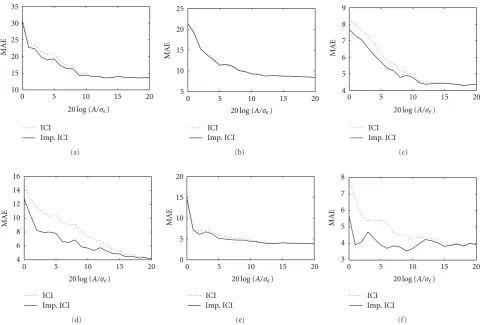
Figure5: IF estimation MAE over a range of noise levels using the methods based on the ICI and the improved ICI rule for the signalx1(n) (κ=1.75,Oc=0.97,c=0.2,d=0.01). (a) First component IF MAE obtained using the MBD. (b) Second component IF MAE obtained using the MBD. (c) Third component IF MAE obtained using the MBD. (d) First component IF MAE obtained using the RIDB. (e) Second component IF MAE obtained using the RIDB. (f) Third component IF MAE obtained using the RIDB.
on numerous simulations performed on various classes of
signals, the thresholdOc =0.97 was shown to result in the
largest estimation error reduction, as shown in [26].
Tables1and2show, respectively, that the IF estimation
MAE and MSE (averaged over 100 Monte Carlo simulations runs) for the ICI and the improved ICI-based method using both the MBD and the RIDB with the rectangular time
and frequency smoothing windows for different noise levels
20 log(A/σ) = [2, 5, 10, 15, 20]. As it can be seen from the
Tables 1 and 2, the RIDB was shown to be more robust
for IF estimation from multicomponent signals in additive noise, outperforming the estimation error reduction results achieved by using the MBD. Furthermore, the largest MAE and MSE improvement for each component was obtained for the low SNR while for the higher SNRs both methods perform almost identically. This MAE improvement using the improved ICI method when compared to the ICI-based method varies from around 1% to 28% while the MSE reduction goes from around 0% to 23%. As the IF estimation of signals for low SNRs is much more complex than in the case of high SNRs, the improvements in estimation error reduction using this new proposed method show the strength
of the method over other similar approaches [43]. The same
conclusion can be drawn fromFigure 5which shows the IF
estimation MAE as a function of the noise intensity for both the ICI-based and the improved ICI-based method.
Table 3 gives the MAE and MSE results obtained using the ICI method and its modification proposed in this
paper for 20 log(A/σ) = 10 and different window types
(rectangular, Hamming, Hanning, triangular, and Gauss). As it can be seen, the improved ICI-based method results in reduced MAEs by up to 22% and MSE reduced by up to 23%.
The noisy three component signal x1(n) in additive
noise (20 log(A/σ) = 10) is shown in Figure 6(a) while
its magnitude and phase spectrum is given inFigure 6(b).
The magnitude and phase spectra give information of the signal frequency content, but not the times when certain frequencies are present in the signal. This information can be obtained from the signal TFD. The signal time-frequency representation using the RIDB with rectangular frequency
smoothing windows of the fixed lengthsh1 =N/8 + 1 and
h25 = N/2 + 1, and its corresponding IFs ωm(n,h1) and
ωm(n,h25) calculated using (12) are shown in Figures6(c),
6(d), 6(e), and 6(f), respectively. The IFs estimated using
the ICI and improved ICI-based methods are, respectively,
−2 −1 0 1 2 x1 ( n
) 0 0.1 0.2 0.3 0.4
0 0.2 0.4
Frequency M ag n itude Phase 20 40 60 80 100 120 MAE MAE MAE 0 50
0 0.1 0.2 0.3 0.4
Frequency Frequency 0 Component 1 W indo w siz e 0 0 20 40 60 0 50 100
−0.5 0 0.5
0 50 100
Time T ime Time T ime
0 0.2 0.4
20 40 60 80 100 120 Frequency
0 0.2 0.4
Frequency 0 50 100 Ti m e
0 0.2 0.4
Frequency 0 50 100 T ime
0 0.2 0.4
Frequency 0 50 100 Ti m e
0 0.2 0.4
Frequency
Ti
m
e
Component 2 Component 2
0 50 100
MAE
Component 1
−0.5 0 0.5
Time
0 50 100
MAE
Component 1 Component 1 Component 1
−0.5 0 0.5
Time
0 50 100
Time
0 50 100
MAE
Component 2
Time
0 50 100
MAE
Component 2 Component 2 Component 2
Time
0 50 100
Time
0 50 100
MAE
Time
0 50 100
MA
E
Time
0 50 100
MAE
Component 1
−0.5 0 0.5
Time
0 50 100
Component 3 Component 3
MAE
Time
0 50 100
MAE
Time
0 50 100
Time
0 50 100
Time
0 50 100
Time
0 50 100
Component 3 Component 3
W indo w siz e 20 40 60 Time
0 50 100
Wi n d o w si ze 20 40 60 W indo w siz e 20 40 60 Time
0 50 100
W indo w siz e 20 40 60 W indo w siz e 20 40 60 Time
0 50 100
Component 3 Component 3
20 40
(a) (b) (c) (d)
(e) (f)
(g) (h) (i) (j)
(k) (l) (m) (n)
−0.2 0.2
0
−0.2 0.2
−0.1 0.1
0
−0.1 0.1
0
0
−0.2 0.2
−0.1 0.1
0
0
−0.2 0.2
−0.1 0.1
(a) (b) (c) (d)
(e) (f) (g) (h)
(i) (j) (k) (l)
0 10 20 30 40 50 Frequency M ag nitude
0 200 400
−0.3 −0.2 −0.1 0 0.1 0.2
Time
0 200 400
Time x2 ( n ) −50 0 50 Phase
0 0.2 0.4
Frequency
0 0.2 0.4
Frequency
0 0.2 0.4
50 100 150 200 250 300 350 Ti me 0 100 200 300 400 20 40 60
0 200 400
Time 20 40 60 W indo w siz e W indo w siz e
0 200 400
Time 20 40 60 W indo w siz e
0 200 400
Time 20 40 60 W indo w siz e
0 200 400
Time 20 40 60 Wi n d o w si ze
0 200 400
Time 20 40 60 W indo w siz e
Improved ICI based method
ICI based method
Improved ICI based method
ICI based method
Improved ICI based method Frequency
0 0.2 0.4
50 100 150 200 250 300 350 Ti m e Frequency
0 0.2 0.4
50 100 150 200 250 300 350 Ti m e Frequency
0 0.2 0.4
Frequency
0 0.2 0.4
50 100 150 200 250 300 350 Ti m e Ti m e 0 100 200 300 400 Frequency
0 0.2 0.4
Ti
me
ICI=based method
Figure7: (a) The bat signalx2(n) in time. (b) The bat signal magnitude spectrum. (c) The bat signal phase spectrum. (d) The RIDB of the bat signal for fixed-size rectangular time smoothing windowh=N/4 + 1. (e) The bat signal first component. (f) The bat signal second component. (g) The bat signal third component. (h) IFs of the bat signal components obtained using the ICI-based method. (i) IFs of the bat signal components obtained using the improved ICI-based method. (j) Window size for the first component (obtained by the ICI-based and improved ICI-based method). (k) Window size for the second component (obtained by the ICI-based and improved ICI-based method). (l) Window size for the third component (obtained by the ICI-based and improved ICI-based method).
of each component is shown in Figures 6(i), 6(j), 6(k),
and 6(l). Finally, the window size used by the ICI and
the improved ICI-based method for each component as a
function of time is given in Figures6(m) and6(n). As it can
be seen, the improved ICI rule, due to its more strict criterion in the window size selection, uses shorter window widths when compared to the ICI rule, resulting in a significant IF estimation accuracy improvement.
Figures7(a), 7(b),7(c), and7(d) show the bat
echolo-cation signal in time, its magnitude spectra, phase spectra, and the RID with the fixed-size rectangular time smoothing
window h = 33, respectively. The extracted signal
com-ponents using the modified method described in Section 4
are shown in Figures7(e),7(f), and7(g), which show that
each component is correctly detected and extracted, followed by the components IF estimation. The estimated IFs using the ICI and the improved ICI-based method are shown in
Figures 7(h) and7(i). The adaptive varying window sizes
used by the two methods are given in Figures7(j),7(k), and
7(l) for each component, respectively.
A comparison of the noisy multicomponent signal
x1(n) MBD, RIDB, and the TFD reconstructed from the
components IFs estimated using the improved ICI-based
method is given in Figure 8. It can be observed, that once
0 20 40 60 80 100 120
0 0.2 0.4
T
ime
Frequency
(a)
T
ime
0 20 40 60 80 100 120
0 0.2 0.4
Frequency
(b)
0 20 40 60 80 100 120
0 0.2 0.4
T
ime
Frequency
(c)
T
ime
0 20 40 60 80 100 120
0
Frequency 0.1 0.05
(d)
Figure8: (a) Noisy multicomponent signalx1(n) MBD with rectangular time and lag window of lengthN/4 + 1 (20 log(A/σ)=10). (b) The signal RIDB with rectangular time and frequency smoothing windows of lengthN/4 + 1. (c) The noisy signal components IFs obtained using the improved ICI-based method. (d) The signal reconstructed TFD from the estimated components IFs obtained using the improved ICI-based method.
free and high time-frequency resolution multicomponent
signal TFD, shown inFigure 8(d).
The bat echolocation signalx2(n) MBD, RIDB, and the
TFD reconstructed from the components IFs estimated using
the method described in Section 3.2 is given in Figure 9.
As for the signalx1(n), a cross-terms free and high resolution
TFD is again obtained from the estimated components IFs.
5. Conclusion
A novel multicomponent signal instantaneous frequency (IF) estimation method has been presented. A modification of the blind (i.e., without a priori information) components separation method for separation and extraction of compo-nents from a noisy signal mixture was combined with the IF estimation method based on the improved intersection of confidence intervals (ICI) rule. This new method was
compared to the ICI-based IF estimation method, demon-strating significant IF estimation quality improvements in terms of the mean absolute error (MAE) and the mean squared error (MSE) reduction in spite of the artifacts present in the time-frequency distribution of the analyzed noisy nonstationary signal. The new method’s performance
was analyzed for different signal-to-noise ratios (SNRs) and
various window types used in the reduced interference distribution calculation, resulting in an estimation error reduction in terms of the MAE by up to 28% and the MSE reduction by up to 23% when compared to the unmodified ICI-based method. Furthermore, the best results have been achieved for low SNRs, making the proposed
method an efficient technique for multicomponent signals IF
0 0.2 0.4 50
100 150 200 250 300 350
Frequency
Ti
m
e
(a)
0 0.2 0.4
50 100 150 200 250 300 350
Frequency
Ti
m
e
(b)
Ti
m
e
0 0.2 0.4
Frequency 0
100 200 300 400
(c)
0 0.2 0.4
50 100 150 200 250 300 350
Frequency
Ti
m
e
(d)
Figure9: (a) The bat echolocation sound signalx2(n) MBD with rectangular time and lag window of lengthN/4 + 1. (b) The signal RIDB with the rectangular time and frequency smoothing windows of lengthN/4 + 1. (c) The signal components IFs obtained using the improved ICI-based method. (d) The signal reconstructed TFD from the estimated components IFs obtained using the improved ICI-based method.
frequency-modulated multicomponent signals in low SNR, as illustrated by the examples presented in this paper.
Acknowledgments
This paper is a part of the research project “Optimization and Design of Time-Frequency Distributions,” no. 069-0362214-1575, which is financially supported by the Ministry of Science, Education, and Sports of the Republic of Croatia. This paper was also partly funded by the Qatar National Research Fund, Grant reference no. NRPR 09-626-2-243, and the Australian Research Council.
References
[1] B. Boashash, Ed.,Time Frequency Signal Analysis and Pro-cessing: Acomprehensive Reference, Elsevier, The Boulevard, Langford Lane, Kidlington, Oxford, UK, 2003.
[2] B. Boashash, “Estimating and interpreting the instantaneous frequencyof a signal. I. Fundamentals,”Proceedings of the IEEE, vol. 80, no. 4, pp. 520–538, 1992.
[3] B. Boashash, “Estimating and interpreting the instantaneous frequency of asignal. II. Algorithms and applications,” Pro-ceedings of the IEEE, vol. 80, no. 4, pp. 540–568, 1992. [4] E. Bedrosian, “A product theorem for Hilbert transforms,”
Proceedingsof the IEEE, vol. 51, no. 5, pp. 868–869, 1963. [5] B. Picinbono, “On instantaneous amplitude and phase of
signals,”IEEE Transactions on Signal Processing, vol. 45, no. 3, pp. 552–560, 1997.
[6] Z. M. Hussain and B. Boashash, “Adaptive instantaneous frequency estimation of multicomponent FM signals using quadratic time-frequency distributions,”IEEE Transactions on Signal Processing, vol. 50, no. 8, pp. 1866–1876, 2002. [7] Z. Guo, L. G. Durand, and H. C. Lee, “Time-frequency
[8] B. Boashash and V. Sucic, “Resolution measure criteria for the objective assessment of the performance of quadratic time-frequency distributions,” IEEE Transactions on Signal Processing, vol. 51, no. 5, pp. 1253–1263, 2003.
[9] A. Belouchrani and M. G. Amin, “Blind source separation based on time-frequency signal representations,”IEEE Trans-actions on Signal Processing, vol. 46, no. 11, pp. 2888–2897, 1998.
[10] Y. Zhou and B. Xu, “Blind source separation in frequency domain,”Signal Processing, vol. 83, no. 9, pp. 2037–2046, 2003. [11] H. L. N. Thi and C. Jutten, “Blind source separation for convolutive mixtures,” Signal Processing, vol. 45, no. 2, pp. 209–229, 1995.
[12] P. Smaragdis, “Blind separation of convolved mixtures in the frequency domain,”Neurocomputing, vol. 22, no. 1-3, pp. 21– 34, 1998.
[13] D. Yellin and E. Weinstein, “Criteria for multichannel signal separation,”IEEE Transactions on Signal Processing, vol. 42, no. 8, pp. 2158–2167, 1994.
[14] N. Delfosse and P. Loubaton, “Adaptive blind separation of independent sources: a deflation approach,”Signal Processing, vol. 45, no. 1, pp. 59–83, 1995.
[15] Y. Inouye and K. Hirano, “Cumulant-based blind identifi-cation of linear multi-input-multi-output systems driven by colored inputs,”IEEE Transactions on Signal Processing, vol. 45, no. 6, pp. 1543–1552, 1997.
[16] M. K. Emresoy and A. El-Jaroudi, “Iterative instantaneous frequency estimation and adaptive matched spectrogram,”
Signal Processing, vol. 64, no. 2, pp. 157–165, 1998.
[17] M. R. Morelande, B. Barkat, and A. M. Zoubir, “Statistical per-formance comparison of a parametric and a non-parametric method for if estimation of random amplitude linear FM signals in additive noise,” inProceedings of the 10th IEEE Signal Processing Workshop on Statistical Signal and Array Processing (SSAP ’00), pp. 262–266, Pennsylvania, Pa, USA, 2000. [18] B. Barkat and B. Boashash, “Instantaneous frequency
estima-tion of polynomial FM signals using the peak of the PWVD: statistical performance in the presence of additive Gaussian noise,”IEEE Transactions on Signal Processing, vol. 47, no. 9, pp. 2480–2490, 1999.
[19] B. Boashash and P. O’Shea, “Polynomial Wigner-Ville distri-butions and their relationship to time-varying higher order spectra,”IEEE Transactions on Signal Processing, vol. 42, no. 1, pp. 216–220, 1994.
[20] B. Ristic and B. Boashash, “Instantaneous frequency esti-mation of quadratic and cubic fm signals using the cross polynomial wigner-ville distribution,” IEEE Transactions on Signal Processing, vol. 44, no. 6, pp. 1549–1553, 1996. [21] B. Porat and B. Friedlander, “Asymptotic statistical analysis of
the highorder ambiguity function for parameter estimation of polynomial-phase signals,”IEEE Transactions on Information Theory, vol. 42, no. 3, pp. 995–1001, 1996.
[22] L. Stankovi´c, M. Dakovi´c, J. Jiang, and E. Sejdic, “Instan-taneous frequency estimation using theS-transform,”IEEE Signal Processing Letters, vol. 15, pp. 309–312, 2008.
[23] P. L. Shui, H. Y. Shang, and Y. B. Zhao, “Instantaneous fre-quency estimation based on directionally smoothed pseudo-Wigner-Ville distribution bank,”IET Radar, Sonar and Navi-gation, vol. 1, no. 4, pp. 317–325, 2007.
[24] L. Stankovi´c and V. Katkovnik, “Algorithm for the instan-taneous frequency estimation using time-frequency distribu-tions with adaptive window width,” IEEE Signal Processing Letters, vol. 5, no. 9, pp. 224–227, 1998.
[25] V. Katkovnik and L. Stankovic, “Instantaneous frequency estimation using the wigner distribution with varying and data-driven window length,” IEEE Transactions on Signal Processing, vol. 46, no. 9, pp. 2315–2325, 1998.
[26] J. Lerga and V. Sucic, “Nonlinear IF estimation based on the pseudo WVD adapted using the improved sliding pairwise ICI rule,”IEEE Signal Processing Letters, vol. 16, no. 11, pp. 953– 956, 2009.
[27] H. I. Choi and W. J. Williams, “Improved time-frequency representation of multicomponent signals using exponential kernels,”IEEE Transactions on Acoustics, Speech, and Signal Processing, vol. 37, no. 6, pp. 862–871, 1989.
[28] M. G. Amin and W. J. Williams, “High spectral resolution time-frequency distribution kernels,” IEEE Transactions on Signal Processing, vol. 46, no. 10, pp. 2796–2804, 1998. [29] L. Stankovi´c, “On the realization of the polynomial
wigner-ville distribution for multicomponent signals,” IEEE Signal Processing Letters, vol. 5, no. 7, pp. 157–159, 1998.
[30] L. Rankine, M. Mesbah, and B. Boashash, “IF estimation for multicomponent signals using image processing techniques in the time-frequency domain,”Signal Processing, vol. 87, no. 6, pp. 1234–1250, 2007.
[31] Z. Guo, L. G. Durand, and H. C. Lee, “Comparison of time-frequency distribution techniques for analysis of simulated Doppler ultrasound signals of the femoral artery,” IEEE Transactions on Biomedical Engineering, vol. 41, no. 4, pp. 332– 342, 1994.
[32] S. Kodituwakku, T. D. Abhayapala, and R. A. Kennedy, “Atrial fibrillation analysis using Bessel kernel based time frequency distribution technique,” inComputers in Cardiology, pp. 837– 840, September 2008.
[33] B. Barkat and K. Abed-Meraim, “Algorithms for blind com-ponents separation and extraction from the time-frequency distribution of their mixture,”EURASIP Journal on Applied Signal Processing, vol. 2004, no. 13, pp. 2025–2033, 2004. [34] S. Barbarossa and V. P´etrone, “Analysis of polynomial-phase
signals by the integrated generalized ambiguity function,”
IEEE Transactions on Signal Processing, vol. 45, no. 2, pp. 316– 327, 1997.
[35] A. Francos and M. Porat, “Analysis and synthesis of multicom-ponent signals using positive time-frequency distributions,”
IEEE Transactions on Signal Processing, vol. 47, no. 2, pp. 493– 504, 1999.
[36] S. Peleg and B. Friedlander, “Multicomponent signal analysis using the polynomial-phase transform,”IEEE Transactions on Aerospace and Electronic Systems, vol. 32, no. 1, pp. 378–387, 1996.
[37] B. Barkat and B. Boashash, “A high-resolution quadratic time-frequency distribution for multicomponent signals analysis,”
IEEE Transactions on Signal Processing, vol. 49, no. 10, pp. 2232–2239, 2001.
[38] I. Djurovi´c and L. J. Stankovi´c, “Modification of the ICI rule-based IF estimator for high noise environments,”IEEE Transactions on Signal Processing, vol. 52, no. 9, pp. 2655–2661, 2004.
[39] D. Ruppert, “Empirical-bias bandwidths for local polynomial nonparametric regression and density estimation,”Journal of the American Statistical Association, vol. 92, no. 439, pp. 1049– 1062, 1997.
[41] R. Kohavi, “A study of cross-validation and bootstrap for accuracy estimation and model selection,” inProceedings of the 14th International Joint Conference on Artificial Intelligence, vol. 2, pp. 1137–1143, Morgan Kaufmann Publishers, San Francisco, Calif, USA, 1995.
[42] J. Lerga, M. Vrankic, and V. Sucic, “A signal denoising method based on the improved ICI rule,”IEEE Signal Processing Letters, vol. 15, pp. 601–604, 2008.