R E S E A R C H
Open Access
Two-description distributed video coding for
robust transmission
Anhong Wang
1*, Zhihong Li
1, Yao Zhao
2, Wubin Wang
3and Huihui Bai
2Abstract
In this article, a two-description distributed video coding (2D-DVC) is proposed to address the robust video transmission of low-power capturers. The odd/even frame-splitting partitions a video into two sub-sequences to produce two descriptions. Each description consists of two parts, where part 1 is a zero-motion based H.264-coded bitstream of a sub-sequence and part 2 is a Wyner-Ziv (WZ)-coded bitstream of the other sub-sequence. As the redundant part, the WZ-coded bitstream guarantees that the lost sub-sequence is recovered when one description is lost. On the other hand, the redundancy degrades the rate-distortion performance as no loss occurs. A residual 2D-DVC is employed to further improve the rate-distortion performance, where the difference of two sub-sequences is WZ encoded to generate part 2 in each description. Furthermore, an optimization method is applied to control an appropriate amount of redundancy and therefore facilitate the tuning of central/side distortion tradeoff. The experimental results show that the proposed schemes achieve better performance than the referenced one especially for low-motion videos. Moreover, our schemes still maintain low-complexity encoding property.
Keywords:distributed video coding, robust video transmission, multiple description coding
1. Introduction
The increasing demand for friendly up-link communica-tion of low-power video captures has generated a lot of research interests in developing video codec of low-complexity encoding. As a new video coding framework, distributed video coding (DVC) [1-3] also called Wyner-Ziv (WZ) video coding makes the low-complexity video encoding a reality, in that DVC shifts the most time-consuming motion estimation to the decoder from the encoder side.
On the other hand, robust DVC methods are desired especially when the video is transmitted over wireless networks. DVC itself takes on inherent robustness because of the error-correcting channel decoding algo-rithm adopted. However, this robustness is achieved at the cost of compression efficiency. Typically, DVC assumes a correlation existing between the source to be encoded and its side information (SI) available at the decoder. The compression comes from the correlation
and the stronger correlation the higher compression efficiency, or vice versa. However, in case of high packet loss rate, such correlation may be destroyed due to poor reconstruction of SI at the decoder, which in turn degrades the coding performance. In some other related studies, WZ coding is used as forward error correction to protect the video transmission. For example, Girod et al. [1,4] provided a systematic lossy error protection (SLEP) method based on WZ coding, which is two-layer scalable in the sense of having one base layer with MPEG encoder and the corresponding WZ bits as the enhancement layer. MPEG stream is firstly decoded and the corrupt data are reconstructed using error conceal-ment, and then the reconstructed signal is used to gen-erate the SI to decode the WZ-encoded data. WZ bits refine the reconstruction thus protecting MPEG stream against the channel packet loss to some degree. How-ever, SLEP scheme still applies motion estimation in its MPEG encoder which sacrifices the desired property of low-complexity. Also, error propagation in the MPEG-encoded stream may negatively impact the quality of SI in WZ coding, which degrades the robustness of the system especially when the packet loss rate is high [5]. * Correspondence: [email protected]
1
School of Electronic Information Engineering, Taiyuan University of Science and Technology, Taiyuan 030024, China
Full list of author information is available at the end of the article
To improve the robustness of SLEP, Crave et al. [5] pro-posed a distributed multiple-description coding (DMDC), which can be seen as a two-description adap-tion of SLEP. Nevertheless, the encoding is still of high complexity due to the motion compensation temporal filtering involved in the encoder. In addition, Rane et al. [6] proposed multiple embedded WZ descriptions cod-ing as an extension of SLEP.
MDC has emerged as an attractive framework for robust transmission over unreliable channels. MDC encodes the source message into several bit streams (called descriptions) carrying different but correlated information which then can be transmitted over different channels. When description loss occurs, the decoder can get acceptable reconstruction from the received descrip-tions. It is the path diversity that makes MDC successful in robust transmission. In view of their desired and com-plementary features, the robustness problem of DVC is addressed here by combining DVC with MDC. In this article, we attempt to design a robust two description DVC (2D-DVC) under the constraint of low-complexity encoding. It is just the emphasizing on both low-com-plexity encoding and better robustness that makes our scheme different from those in [5,6]. In our scheme, the input video is first split into two sub-sequences to create two descriptions with each consisting of two parts, i.e., part 1 is a low-complexity encoding bitstream of the cor-responding sub-sequence, and part 2 is a WZ bitstream of the other sub-sequence. This is just the so-called 2D-DVC where the WZ bitstream controls the amount of redundancy. However, in [7], it is shown that the residual WZ coding can achieve better rate-distortion perfor-mance than the non-residual schemes. This is because that residual WZ technique exploits a second SI accessi-ble at both encoder and decoder. Then, we extend this idea to our 2D-DVC and propose a residual 2D-DVC, where the difference of two sub-sequences is WZ encoded and replaces part 2 of each description. Further-more, an optimization scheme is employed to introduce the appropriate amount of redundancy. The experimental results show that the proposed schemes achieve better or comparatively rate-distortion performance compared
with the referenced scheme; while, they maintain low-complexity encoding property.
This article is organized as follows. Section 2 intro-duces the basic idea and the related techniques, and Section 3 presents the proposed residual 2D-DVC and the optimization scheme in detail. Section 4 provides some experimental results, and Section 5 concludes the article.
2. Basic idea and related techniques
2D-DVC is designed to generate and encode two descriptions with correlation exploited only at the deco-der, which can support low-complexity encoding and robustness against packet loss.
2.1. 2D-DVC scheme
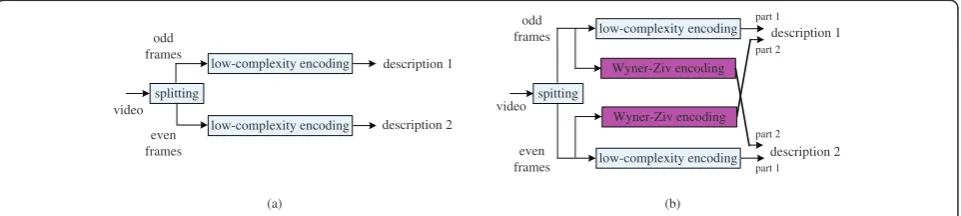
Figure 1 shows the encoding structure of 2D-DVC. Con-sidering a video sequence, its odd and even frames are first split into two sub-sequences. In a conventional MDC scheme of Figure 1a, each sub-sequence produces a description sent to separate channels. When one description is lost, the lost sub-sequence will be esti-mated by the received one. However, the estimation is normally coarse due to the lack of the other part of information, especially for video sequence with large motion. Figure 1b shows the encoding structure of 2D-DVC, where a WZ stream from the other sub-sequence generates part 2 of each description. The coarse estima-tion results can act as the SI for WZ decoding. In case of description loss, the SI is refined by WZ stream to recover a better version of the lost sub-sequence. This encoding framework is a two-description adaption of the SLEP like that in [5] but with low-complexity encoding property. We consider a simple encoding scheme for part 1. WZ encoding supports low-complex-ity encoding because it exploits the correlation of the two sub-sequences only at the decoder. In case of no loss, only part 1 is used to recover the original video, where WZ bitstream is redundant. To further improve the rate-distortion performance, the residual coding and an iterative optimization method are adopted in the scheme.
low-complexity encoding
spitting
Wyner-Ziv encoding
video
low-complexity encoding Wyner-Ziv encoding
description 1
description 2 odd
frames
even frames
part 1
part 2
part 1 part 2 low-complexity encoding
splitting video
low-complexity encoding
description 1
description 2 odd
frames
even frames
(a) (b)
2.2. SW-SPIHT coding
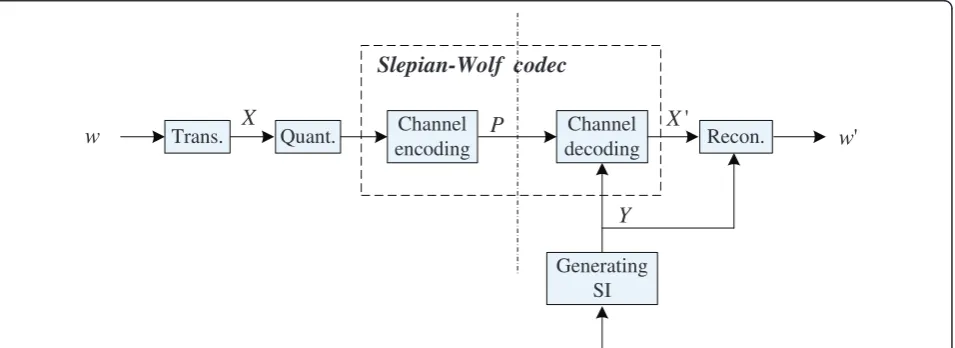
WZ coding [8] refers to lossy compression with SI at the decoder. WZ coding aims to achieve almost the same coding performance by exploiting the correlation only at the decoder as at both the encoder and the decoder. As shown in Figure 2, WZ coding generally consists of the following steps, namely, transform cod-ing, quantization, Slepian-Wolf (SW) codcod-ing, as well as the generation and reconstruction of SI at the decoder side. Transform coding and quantization first compress the source to generate the binary sequence, which is then compressed by SW coding. SW coding [9] is gener-ally realized using channel coding, where the binary sequence of the source is first encoded with channel coding and only the syndrome bits are sent to the deco-der. In general, the sent syndrome bits are less than that of the source so compression is achieved. At the deco-der, SI is also transformed and quantized to generate the SI. The received syndrome bits and the SI are to recover the original source bits by error-correcting channel decoding.
Among some WZ coding schemes, SW set partition-ing in hierarchical tree (SW-SPIHT) codpartition-ing approach [10-12] performs very well in term of its scalability and rate-distortion performance. The process of SW-SPIHT
is shown in Figure 3, assuming the source X and the
correlated SIY. ForX, after discrete wavelet transforma-tion (DWT), the traditransforma-tional SPIHT coding is implemen-ted and we get its binary tree distribution information SD, significant informationSP, sign informationSS, and the refinement information SR. The tree informationSD is sent to the decoder after arithmetic coding.SP,SS,
and SRare encoded by channel coding where the
syn-drome bits are sent to the decoder. At the decoder, the
received SD is first decompressed. Then according to
SD, the side binary sequencesSPy, SSy, andSRyofYare
obtained by SPIHT encoding. Next, SPy, SSy, SRy, and the received syndrome bits are used to recover the main
binary sequence SP, SS, and SR by channel decoding.
Finally, the wavelet coefficients of X will be recon-structed according to
W= ⎧ ⎨ ⎩
Vmax, ifWy>Vmax
Wy, ifVmin≤Wy≤Vmax
Vmin, ifWy<Vmin
(1)
where W’’ is the final wavelet coefficient, Vmax and
Vminare the possible maximal and minimal value ofW’’
if SPIHT decoding is implemented to all bit-planes.
3. Proposed residual 2D-DVC and optimization The proposed residual 2D-DVC scheme is sketched in Figure 4, including encoding and decoding processes. Part 1 of each description is generated by zero-motion based H.264 encoding. Part 2, for example, part 2 of description 1, is from the SW-SPIHT stream of descrip-tion 2. The details are explained as follows.
3.1. Zero-motion-based H.264 coding
Zero-motion-based H.264 denoted as H.264 0-mv is employed in our scheme to meet the demands of low-complexity encoding. Zero-motion-based H.264 means that only the previous frame is used as the referenced frame for the inter-coding with motion searching region set to zero, which is therefore similar to the differential pulse coding modulation (DPCM). Because DPCM exploits the temporal correlation between adjacent frames, zero-motion-based H.264 normally outperforms the intra-frame coding in term of rate-distortion perfor-mance. With no motion estimation at the encoder, its encoding process is greatly simplified. Typically, in our experiments, the encoding time of zero-motion-based
Quant. Channel
encoding
Channel decoding
Slepian-Wolf codec
Recon.
'
X
X
Y
P
w
Trans.w
'
Generating SI
H.264 inter-coding is always shorter than that of the intra-frame in H.264 JM 9.0 program.
3.2. Residual-based encoding
In the single-description-based DVC, it has been shown in [7] that the pixel-domain residual WZ coding achieves better rate-distortion performance than non-residual scheme. Here, we extend this idea to our two-description DVC to further improve the rate-distortion performance efficiently. In residual 2D-DVC encoding, SW-SPIHT encodes the differenceD=X -Xreto
gener-ate part 2, where Xre is a simple estimation to X. In
non-residual 2D-DVC encoding, X is directly input to
SW-SPIHT to produce part 2. Besides, it isDy=Y-Xre
that acts as SI in the residual 2D-DVC, whileYis SI in non-residual 2D-DVC. Residual scheme achieves better performance than the non-residual one mainly due to the use ofXre. In the residual case,Xre can be seen as a
second SI accessible to both encoder and decoder [7].
SinceXreandXare correlated givenY, usingXreat the
encoder and the decoder amounts to adding an excess
condition in encoding X. The rate of X will ideally
approach the conditional entropyH(X|(Y,Xre)) which is
not greater than the condition entropyH(X|Y) like that in non-residual 2D-DVC,H(X|(Y,Xre))≤H(X|Y).
In the scheme shown in Figure 4, for description 1,D1
=X2 - Xre2, Dy1=Y2 -Xre2; for description 2,D2=X1
-Xre1, Dy2 =Y1 - Xre1.Xre1,Xre2, as well asY1 andY2 are
generated in the interpolating process. There are two interpolating methods used, one is the simple average interpolation used both at the encoder and the decoder to generateXre1andXre2, while the other is the complex
motion-compensated interpolation used only at the decoder to generateY1 and Y2 when only one
descrip-tion is received. For example, Xre2,i and Y2,i for ith frame in description 1 are generated according to the following formulae respectively,
Xre2,i=
X1,i−1+X1,i
2 (2)
Y2,i(x,y) = 0.25X1,i−1(x+ 0.5dxf,y+ 0.5dyf) +0.25X1,i(x−0.5dxf,y−0.5dyf)
+0.25X1,i−1(x−0.5dxb,y−0.5dyb) +0.25X1,i(x+ 0.5dxb,y+ 0.5dyb)
(3)
where X1,i−1 and X1,i are the adjacently decoded frames inX1; (x,y) is the coordinates of the interpolated
frame; [dxb, dyb] and [dxf, dyf ] are the backward and forward motion vectors between X1,i−1and X1,i, respec-tively, which may be obtained by the half-pixel motion estimation similar to literature [3].
Significant Tree Sign Refinement channel decoding SPIHT SPIHT-1 entropy encoding SPIHT channel encoding syndrome bits entropy decoding ' SP ' SS' SR y SP y SSy SR SD SR SP SS R Y X SD '' W SW-SPIHT encoder SW-SPIHT decoder
DWT DWT reconstruction '' X DWT-1 W y W
Figure 3Illustration of SW-SPIHT.
H.264 0-mv encoding H.264 0-mv encoding Splitting SW-SPIHT encoding video
-ˇ Central decoding Interpolating & subtracting ' 1 D 1 D H.264 0-mv decoding H.264 0-mv decoding Side decoding1 side decoding 2 SW-SPIHT decoding part 1 part 1 part 2 part 2 Odd frames Even frames part 2 part 1 interpolating & subtracting Encoding Decoding Decoding & interpolating Decoding & interpolating 2 D ' 2 D 1 ' V 2 ' V 0 ' V V Description 1 Description 2 SW-SPIHT encoding -part 1 ˇ Optimization part 2 SW-SPIHT decoding 1 X 2 X 2 X 1 re X 2 re X 1 X 1 ' X 2 ' X 1 re X 2 re X 2 ' X 1 ' X 2 1 1, , y re Y D X1 2 2, , y re Y D X
Optimization
Due to the use ofXre, some correlation between two
descriptions is exploited at the encoder in residual 2D-DVC. However, for the excess encoding complexity over non-residual 2D-DVC, the computation of subtracting and average interpolation operation is very low, which still preserves the low-complexity encoding in the resi-dual 2D-DVC.
In this study, a channel code of low-density parity check with accumulation (LDPCA) [13] is used in SW-SPIHT coding with a feedback. At each bit-plane of SPIHT, the encoder sends a certain amount of syn-drome information stage-by-stage on the demand of feedback. If the receiver cannot decode correctly, the encoder will send additional syndrome information.
3.3. Decoding
If only one description, for example, description 1 is received, its part 1 is first reconstructed by zero-motion-based H.264 decoding and the interpolation will gener-ateXre2andY2 based on Equations 2 and 3. Then,
SW-SPIHT decoding reconstructs the difference D1using the received syndrome and SI Dy1, and we can obtain X2as X2=D1+Xre2. Finally, X1and X2are merged to obtain the videoV1 in side decoding 1.
When both descriptions are received, the central decoding works without motion estimation. Part 1 of each description is first decoded by the zeromotion-based H.264 decoding, and then the resulting X1and X2
are refined by WZ bits received. Concretely,Xre1and
Xre2are interpolated according to (2) by X1andX2. The
difference Dy1 and Dy2 are generated as follows,
Dy2=X2−Xre1, Dy2=X2−Xre1. Then, SW-SPIHT decoding recoversD1(orD2)usingDy1(orDy2) and the
received syndrome bits. The refined version of X1 (orX2) are obtained, i.e., X1=D1+Xre2, X2=D2+Xre1. Finally, X1andX2are merged to recover the videoV’.
3.4. Redundancy optimization
We know that the redundancy will affect the correlation between two descriptions as well as the consequent rate-distortion of central and side coding. In general, when redundancy is more, correlation between two descriptions will be higher thus producing better quality from side decoder, while the central quality drops with the increasing of redundancy. Moreover, too much redundancy may even degrade the side quality. There-fore, optimization is desired to maximize the rate-distor-tion performance of non-residual and residual 2D-DVC proposed.
Let d0(v, N) andd1(v,N)(ord2(v, N)) denote the mean
squared errors (MSE) from the central and side decoder for the input videov, respectively, given the amount of
WZ bits is N. Let R(v, N) be the rate for two
descriptions, whileR1(v, N) andR2(v,N) be the rates for
the two balanced descriptions 1 and 2, respectively. Our goal is to find the optimal parameterN in solving the following optimization problem:
min
N d1(v,N) (4)
subject to condition 1:
R(v,N) = 2R1(v,N) = 2R2(v,N)≤Rbudget (5)
condition 2:
d0(v,N)≤dbudget (6)
whereRbudgetis the available total bit rate to encode
two descriptions and dbudgetis the maximum distortion
acceptable for central decoder reconstruction. The encoding optimization module is based on the above function. With the constrain on the total bit rate and the central distortion,Nis adjusted accordingly to mini-mize the side distortion.
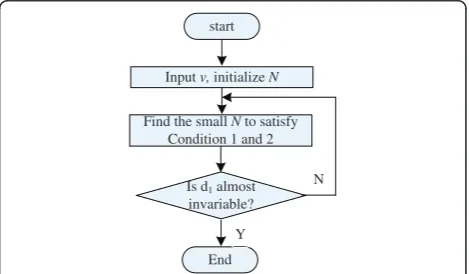
The optimization for the problem is carried out in an iterative way. The basic algorithm shown in Figure 5 is to make use of the monotonicity ofRand das the func-tion ofN. After initialization, a smallestNis searched to minimized1 subject to conditions 1 and 2. Specially, in
this study, SW-SPIHT coding generates the redundancy and its rate will affect the performance of 2D-DVC and residual 2D-DVC. For easy realization, the optimization to the bits of SW-SPIHT is just implemented iteratively based on the number of BP (bit plane), nBP, i.e., we
adjust nBP based on the above function given the QP
(quantization parameter) of H.264 0-mv for part 1. Finally, an optimized combining of nBPand QP is
cho-sen, as shown in the following section.
4. Experimental results
For fair comparison, we use four standard video
sequences to test the performance. They are Foreman,
Is d1almost
invariable? start
Input v,initializeN
End Find the smallN to satisfy
Condition 1 and 2
Y
N
Hall, Carphone, and Mother-daughter QCIF@15 Hz. There are totally four MDC methods included, the DMDC in [5], zero-motion-based H.264 MDC without any extra WZ bits as shown in Figure 1a, the proposed non-residual 2D-DVC and residual 2D-DVC. The bit rate denotes the total of two descriptions. In the pro-posed schemes, we obtain four points, Q1, Q2, Q3, and Q4 according to the above optimization process. The
optimized combinations of QP and nBP are shown in
Table 1. We use the LDPCA codes proposed in [13] for all the simulations. A small amount of feedbacks for additional syndrome bits of the LDPCA code are allowed to achieve the successful LDPCA decoding.
4.1. Performance comparison
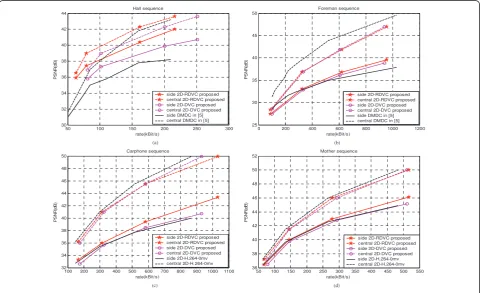
Figure 6 shows the rate-distortion curves, where the
referenced DMDC curves for Foreman and Hall
sequence are the best results of [5]. Experimental results
show that the residual 2D-DVC outperforms the non-residual 2D-DVC confidently because the efficient resi-dual WZ coding reduces the encoding rate. Specifically,
for low motion Hall and Mother-daughter sequences,
residual 2D-DVC achieves 0.5-1.8 dB side-quality and 0.2-1.7 dB central-quality improvement. For high motion Foreman sequence, residual schemes obtain 0.2-1.7 dB side-quality improvement with the comparable central quality. Besides, compared with the best results in [5], residual 2D-DVC achieves about 2-3 dB side-quality and 0.5-2 dB central-quality improvement forHallsequence. The non-residual 2D-DVC achieves about 1-2 dB improvement in side quality with a central-quality decreasing of 0.2-0.7 dB forHallsequence. Residual 2D-DVC has comparable efficiency at high rate for
high-motion Foremansequence. However, non-residual
2D-DVC is not efficient forForeman due to the incapability of zero-motion based H.264 in the high-motion cases.
Table 1 Optimized combinations ofnBPand QP
Foreman Hall Carphone Mother
Q1 Q2 Q3 Q4 Q1 Q2 Q3 Q4 Q1 Q2 Q3 Q4 Q1 Q2 Q3 Q4
QP 38 26 20 14 28 25 20 18 34 28 22 16 34 28 22 16
nBP(non 2D-DVC) 4 4 5 5 4 5 6 6 4 4 5 5 3 3 4 4
nBP(re. 2D-DVC) 1 1 2 2 1 2 2 3 1 1 2 3 1 2 2 3
(a) (b)
0 200 400 600 800 1000 1200
25 30 35 40 45 50
rate(kBit/s)
P
S
NR(
dB
)
Foreman sequence
side 2D-RDVC proposed central 2D-RDVC proposed side 2D-DVC proposed central 2D-DVC proposed side DMDC in [5] central DMDC in [5]
100 200 300 400 500 600 700 800 900 1000 1100
32 34 36 38 40 42 44 46 48 50
rate(kBit/s)
P
S
NR(
dB
)
Carphone sequence
side 2D-RDVC proposed central 2D-RDVC proposed side 2D-DVC proposed central 2D-DVC proposed side 2D-H.264-0mv central 2D-H.264-0mv
50 100 150 200 250 300 350 400 450 500 550
36 38 40 42 44 46 48 50 52
rate(kBit/s)
P
S
NR(
dB
)
Mother sequence
side 2D-RDVC proposed central 2D-RDVC proposed side 2D-DVC proposed central 2D-DVC proposed side 2D-H.264-0mv central 2D-H.264-0mv
(c) (d)
50 100 150 200 250 300
30 32 34 36 38 40 42 44
rate(kBit/s)
P
S
NR(
dB
)
Hall sequence
side 2D-RDVC proposed central 2D-RDVC proposed side 2D-DVC proposed central 2D-DVC proposed side DMDC in [5] central DMDC in [5]
ForCarphoneandMother-daughtersequences, we com-pare our scheme with the MDC with zero-motion-based H.264. It is evident that the proposed scheme has com-parable rate-distortion performance with MDC zero-motion based H.264. However, the advantage of 2D-DVC over zero-motion-based H.264 lies in the quality consistency when loss occurs, which is shown by the following experimental results.
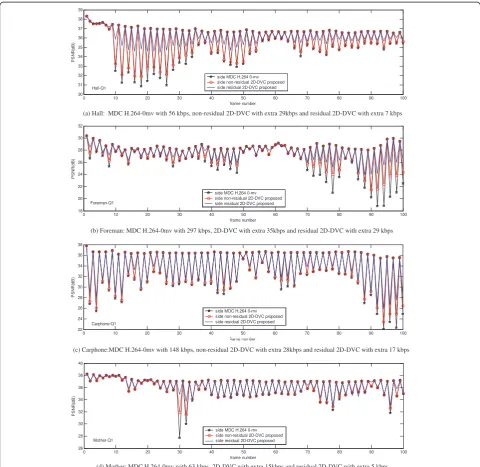
Figure 7 shows the frame side-PSNR comparison at Q1 point of three MDC schemes, MDC zero-motion-based H.264, residual 2D-DVC and non-residual 2D-DVC.
Here, in Figure 7a forHallsequence, MDC H.264 0-mv
is with 56kbps, non-residual 2D-DVC with extra 29kbps and residual 2D-DVC with extra 7 kbps; in Figure 7b for Foremansequence, MDC H.2640-mv with 297 kbps, 2D-DVC with extra 35 kbps and residual 2D-2D-DVC with extra
29 kbps; in Figure 7(c) forCarphone sequence, MDC
H.264 0-mv with 148 kbps, non-residual 2D-DVC with extra 28 kbps and residual 2D-DVC with extra 17 kbps;
Figure 7(d) forMother-daughtersequence, MDC H.264
0-mv with 63 kbps, 2D-DVC with extra 15 kbps and resi-dual 2D-DVC with extra 5 kbps. It is evident that resiresi-dual
0 10 20 30 40 50 60 70 80 90 100
22 24 26 28 30 32 34 36 38
frame number
P
S
NR(
dB
)
side MDC H.264 0-mv side non-residual 2D-DVC proposed side residual 2D-DVC proposed Carphone-Q1
(c) Carphone:MDC H.264-0mv with 148 kbps, non-residual 2D-DVC with extra 28kbps and residual 2D-DVC with extra 17 kbps
0 10 20 30 40 50 60 70 80 90 100
30 31 32 33 34 35 36 37 38 39
frame number
PSN
R
(d
B)
side MDC H.264 0-mv side non-residual 2D-DVC proposed side residual 2D-DVC proposed Hall-Q1
(a) Hall: MDC H.264-0mv with 56 kbps, non-residual 2D-DVC with extra 29kbps and residual 2D-DVC with extra 7 kbps
0 10 20 30 40 50 60 70 80 90 100
18 20 22 24 26 28 30 32
frame number
PS
N
R
(d
B)
side MDC H.264 0-mv side non-residual 2D-DVC proposed side residual 2D-DVC proposed Foreman-Q1
(b) Foreman: MDC H.264-0mv with 297 kbps, 2D-DVC with extra 35kbps and residual 2D-DVC with extra 29 kbps
0 10 20 30 40 50 60 70 80 90 100
26 28 30 32 34 36 38 40
frame number
P
S
NR(
dB
)
side MDC H.264 0-mv side non-residual 2D-DVC proposed side residual 2D-DVC proposed Mother-Q1
(d) Mother: MDC H.264-0mv with 63 kbps, 2D-DVC with extra 15kbps and residual 2D-DVC with extra 5 kbps
Figure 7Frame PSNR comparison for Q1 point (a)Hallsequence; (b)Foremansequence; (c)Carphonesequence; (d)Mother-daughter
2D-DVC and non-residual 2D-DVC get better quality consistency than MDC zero-motion-based H.264 due to the WZ bitstream added. Moreover, the residual 2D-DVC performs the best.
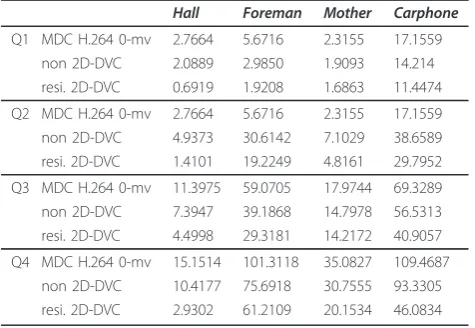
For further comparison, we compute the variance values of frame side-PSNR for each rate-distortion point according to
Var = n i=1
(PSNR(i)−E(PSNR))2 (7)
wherePSNR(i) is the PSNR value ofith frame, andnis
the total frame number. E(PSNR) is the average value of
PSNR on all frames. Table 2 shows the variance value for all rate-distortion points. It can be seen that the resi-dual and non-resiresi-dual 2D-DVC achieve smaller variance value, which means they have better consistency in frame side-PSNR.
4.2. Encoding complexity
The proposed 2D-DVC schemes have lower complexity encoding compared with the scheme in [5]. In our schemes, each description consists of two parts, zero-motion-based H.264 encoding and SW-SPIHT encoding. Since each part has computation less than or similar to intra-frame coding, 2D-DVC’s encoding complexity is similar to the conventional intra-frame model. However, in [5], each description also has two parts, where both of them apply motion compensated temporal filter so the encoding complexity of the system is similar to the conventional inter-frame model.
Finally, the encoding time is measured in millisecond (ms). The hardware used is an HP notebook nx6330, Intel 2 processor at 1.66 GHz with 1.0 GB of RAM. The software condition is Windows XP operative system with VC6.0 released version. The average encoding time of each frame forHall sequence are 162, 175, 183, and 199 ms for Q1, Q2, Q3, and Q4, respectively.
5. Conclusion
This article has proposed two 2D-DVC schemes for robust transmission with low-complexity encoding. The video is first separated into two subsequences by odd/even frame splitting. Then in the first 2D-DVC, each description is composed of two parts, part 1 being a zero-motion-based H.264 stream and part 2 a WZ stream, which maintain some redundancy to pro-duce an acceptable quality reconstruction when one description is lost. In the second scheme, a residual 2D-DVC is proposed to reduce the redundancy, where the difference of the two sub-sequences is WZ encoded and used as part 2 in each description. The amount of redundancy can be controlled using an opti-mization scheme. The experimental results have shown that the proposed schemes can achieve better or com-parable rate-distortion performance compared with the referenced one especially when the motion is low. Moreover, our schemes maintain low-complexity encoding so they are suitable for applications of porta-ble video communication devices with very limited power and storage, such as mobile cameras, wireless low-power surveillance devices.
Acknowledgements
This study was supported in part by the Sino-Singapore JRP(2010DFA11010), the National Natural Science Foundation of China (No. 61073142, No. 60903066), the Doctor Startup Foundation of TYUST (No. 20092011), the International Cooperative Program of Shanxi Province (No. 2011081055), The Shanxi Provincial Foundation for Leaders of Disciplines in Science (20111022), the Beijing Natural Science Foundation (No. 4102049), and the New Teacher Foundation of State Education Ministry (No. 20090009120006).
Author details
1School of Electronic Information Engineering, Taiyuan University of Science
and Technology, Taiyuan 030024, China2Institute of Information Science, Beijing Jiaotong University, Beijing 100044, China3Research Institute of China Ordnance Industry, No. 5 Room No. 207, Taiyuan 030001, China
Competing interests
The authors declare that they have no competing interests.
Received: 18 February 2011 Accepted: 27 September 2011 Published: 27 September 2011
References
1. B Girod, A Aaron, S Rane, D Rebollo-Monedero, Distributed video coding. Proc IEEE.93(1), 71–83 (2005)
2. R Puri, K Ramchandran, PRISM: an uplink-friendly multimedia coding paradigm, inProc International Conference on Acoustics, Speech, and Signal Processing,Hongkong, China, 856–859 (April 2003)
3. X Artigas, J Ascenso, M Dalai, S Klomp, D Kubasoy, M Ouaret, The DISCOVER codec: architecture, techniques and evaluation, inProc Picture Coding Symposium,Lisbon, Portugal, 1950–1953 (November 2007)
4. S Rane, A Aaron, B Girod, Systematic lossy forward error protection for error-resilient digital video broadcasting–a WZ coding approach, inProc International Conference on Image Processing,Singapore, 609–612 (October 2004)
5. O Crave, C Guillemot, B Pesquet-Popescu, C Tillier, Distributed temporal multiple description coding for robust video transmission. EURASIP J Wirel Commun Netw (2008). Article ID 183536
Table 2 Variance value of frame side-PSNR
Hall Foreman Mother Carphone
Q1 MDC H.264 0-mv 2.7664 5.6716 2.3155 17.1559 non 2D-DVC 2.0889 2.9850 1.9093 14.214 resi. 2D-DVC 0.6919 1.9208 1.6863 11.4474
Q2 MDC H.264 0-mv 2.7664 5.6716 2.3155 17.1559 non 2D-DVC 4.9373 30.6142 7.1029 38.6589 resi. 2D-DVC 1.4101 19.2249 4.8161 29.7952
Q3 MDC H.264 0-mv 11.3975 59.0705 17.9744 69.3289 non 2D-DVC 7.3947 39.1868 14.7978 56.5313 resi. 2D-DVC 4.4998 29.3181 14.2172 40.9057
6. S Rane, A Aaron, B Girod, Error-resilient video transmission using multiple embedded Wyner-Ziv descriptions, inIEEE International Conference on Image Processing (ICIP).2, 666–669 (2005)
7. A Aaron, D Varodayan, B Girod, Wyner-Ziv residual coding of video, inProc Picture Coding Symposium,Beijing, China, 28–32 (2006)
8. A Wyner, J Ziv, The rate-distortion function for source coding with side information at the decoder. IEEE Trans Inf Theory.22(1), 1–10 (1976). doi:10.1109/TIT.1976.1055508
9. D Slepian, JK Wolf, Noiseless coding of correlated sources. IEEE Trans Inf Theory.19(4), 471–480 (1973). doi:10.1109/TIT.1973.1055037
10. C Tang, N Cheung, A Ortega, C Raghavendra, Efficient inter-band prediction and wavelet based compression for hyperspectral imagery: a distributed source coding approach, inProc Data Compression Conference, 437–446 (March 2005)
11. X Guo, Y Lu, F Wu, W Gao, S Li, Wyner-Ziv video coding based on set partitioning in hierarchical tree[C], inProceedings of International conference on Image Processing (ICIP), 601–604 (2006)
12. A Wang, Y Zhao, JS Pan, Residual distributed video coding based on LQR-hash. Chin J Electron.18(1), 109–112 (2009)
13. D Varodayan, A Aaron, B Girod, Rate-adaptive distributed source coding using low-density parity-check codes. EURASIP Signal Process.86, 3123–3130 (2006)
doi:10.1186/1687-6180-2011-76
Cite this article as:Wanget al.:Two-description distributed video coding for robust transmission.EURASIP Journal on Advances in Signal Processing20112011:76.
Submit your manuscript to a
journal and benefi t from:
7Convenient online submission
7Rigorous peer review
7Immediate publication on acceptance
7Open access: articles freely available online
7High visibility within the fi eld
7Retaining the copyright to your article