TRANSVERSE VIBRATION ANALYSIS OF A PRESTRESSED THIN CIRCULAR PLATE IN CONTACT WITH AN ACOUSTIC CAVITY
Daniel G Gorman1 ,Chee K Lee and Ian A Craighead Department of Mechanical Engineering, James Weir Building,
University of Strathclyde, Glasgow G1 1XJ
Jaromír Horáček
Institute of Thermomechanics, Academy of Sciences of the Czech Republic, Dolejškova 5,182 00 Prague 8, Czech Republic
ABSTRACT
This paper describes the free transverse vibration analysis of a thin circular plate, subjected to in plane stretching, whilst in interaction with a cylindrical acoustic cavity. An analysis is performed which combines the equations describing the plate and the acoustic cavity to form a matrix equation which, when solved, produces the natural frequencies (latent roots) of the coupled system and associated latent vectors which describe the mode shape coefficients of the plate. After assessing the numerical convergence of the method, results are compared with those from a commercial finite element code (ANSYS). The results analysis is then extended to investigate the effect of stressing upon the free vibration of the coupled system.
Keywords Vibrations, vibro-acoustic interaction, structural/acoustic. 1. INTRODUCTION
Owing to their wide application in mechanical systems ranging from musical instruments to structural elements in industrial and space applications, the transverse vibration of circular plates and membranes has been the subject of many investigations from the end of nineteenth century. Of particular interest has been the effect upon the natural frequencies and associated mode shapes of these structural elements due to the inclusion of in-plane stressing as a result of thermal gradients and more general forms of hydrostatic loading. An excellent and extensive overview of much of this work is presented in reference [1]. In all of these studies it has been demonstrated that the inclusion of in-plane stressing can have a significant effect upon the natural frequencies of light thin plates where the restraining forces and moments due to the in-plane stressing becomes comparable, if not in excess of, the retraining forces and moments due to the inherent flexural rigidity of the plate. Much of the same body of work has shown that although the associated mode shapes are altered by the addition of the in-plane stressing, as compared to the in-plane stress free plate, the change is not so pronounced as the changes in the natural frequencies. However, these significant changes in natural frequencies, and less significant changes in mode shapes will no doubt result in significant changes in vibratory response to general dynamic loading of the plate as compared to the plate in a non pre-stressed state.
1 Corresponding author. Department of Mechanical Engineering, University of
Furthermore, often plates are in contact with enclosed acoustic cavities, obvious examples being musical percussion instruments and pressure vessel bursting discs. Frequency-modal characteristics for incompressible fluid in a rigid cylindrical container covered by a flexible circular membrane have been studied [2] and for interaction of liquid in a rigid cylindrical tank with a circular flexible bottom plate [3]. Coupled plate–liquid natural vibrations for a simply supported rectangular plate carrying liquid with reservoir conditions at its edges were studied in [4] and interaction of a rectangular flexible panel with an acoustic cavity was experimentally investigated in [5]. Recently, strong coupling between a clamped elastic rectangular plate and a quadrilateral (parallelepipedic) water–filled rigid cavity was experimentally studied in [6]. Vibroacoustic couplings and frequency modal characteristics of a rigid rectangular fluid-filled cavity with a flexible plate on one of its faces were theoretically studied [7,8]. Acoustic–structural couplings for an elastic plate in interaction with a cylindrical fluid–filled cavity was investigated [9,10], and similarly for a circular prestressed membrane [11,12].
In this paper we consider the free undamped vibration of a thin circular plate subjected to in-plane pre-stressing and in contact with a cylindrical acoustic cavity . Accordingly, an analytical/numerical treatise, based upon a combination of the Euler-Bernoulli and Helmholtz equations and the Ritz-Galerkin technique, of the system is performed and focuses upon the free vibration of the structure and how this is affected by gas coupling and stressing which can be due to pressure acting on, and/or temperature of, the structure. The analysis is confined to the modal parameters of natural frequencies and associated mode shapes.
2. THEORETICAL ANALYSIS
The equation of motion, describing the free small lateral vibration, = (r, ,t), of a circular disc subjected to constant in-plane load intensity, N, and in interaction with the acoustic cavity, as shown in Figure 1, is
h
2
a
w r , , t
(
)
L
x
r
Figure 1 – Schematic diagram
, (1)
where
, , = r/a and ;
E is Young’s modulus, is Poisson number and d is the plate density; a and h are the radius and thickness of the plate, respectively; L is the length of the cylindrical cavity and p is the pressure inside.
Now writing ,
(2)
where
and , (3)
where is the natural mode shape of the disc in vacuo and ms is a constant for that mode, generally referred to as the mode shape coefficient for the mode consisting of m nodal diameters and s nodal circles. In this particular case, for a stressed disc clamped at the periphery, the mode shapes, , are according to [1]:
, (4)
where and are roots (values of s = 1, 2, 3 etc.) computed from the equation:
(5)
and , (6)
Imand Jm are the Bessel functions.
For particular values of m and s, the natural frequency of free undamped vibration, is then:
. (7)
In the case where the plate is not pre-stressed, i.e., N= 0, then and equations (4), (5) and (7) are altered accordingly. Now for a particular mode of vibration for the disc in vacuo:
. (8)
. .. (9)
We shall now establish the form of the acoustic pressure, p, acting on the disc by reference to the acoustic cavity. Consider the acoustic cavity shown in Figure 1, whose velocity potential, = (x , r , , t) is described by
, (10)
where c is speed of sound. Now writing
,
where (11)
and substituting equation (11) into (10) gives (for a set value of m)
, (12)
where and k is a constant. For the right hand side of equation (12) equal to –k2 we have
,
where , since must be finite when
. At for each value of m
. , (13)
Therefore for a set value of m, the condition (13) has roots mq (q = 1, 2, 3 etc.), which satisfy the equation .
Similarly ,
where .
Therefore equation (11), for a set value of m, becomes:
. (14)
At , the axial component of the velocity of the gas and the lateral velocity of the plate must be equal, i.e.,
Therefore from equations (2), (3) and (14) for a set value of m we have
. (15)
Multiplying both sides of equation (15) by and integrating between according to [13] gives
, (16)
where
(17)
the value of which can be obtained through standard numerical integration. Now the pressure, p, at the surface of the plate is given by:
,
where is the fluid density.
Therefore combining equations (14) and (16) we have:
. (18)
Substituting equation (18) into equation (9) gives:
.
Multiplying both sides by and integrating between we have:
, (19)
where .
Now, since
. (20)
Hence equation (19) can be re-written as
= 0 , (21)
where .
Equation (21) can be represented in matrix form as
, (22)
where
aqs() = . (23)
Hence values of can be obtained (iterated upon) which renders the determinant of matrix (22) equal to zero. Consequently for each of these values (roots) of we can then obtain the corresponding values of mode shape coefficients m1, m2, ………
mn., normalised to m1.
3. RESULTS AND DISCUSSION
In this study, since in all cases we are dealing with some degree of structural/fluid vibration interaction, it would be erroneous to describe any mode of vibration as either purely a structural mode or an acoustic (fluid) mode. Rather we will refer to the modes as either structural/acoustic (st/ac) to denote modes which are predominantly structural with acoustic interference and likewise acoustic/structural (ac/st) to denote modes which are predominantly acoustic but with structural interference.
Also we shall define the parameter , as reported in reference [1], as
3.1 Convergence
As explained earlier, the roots (from which the natural frequencies of the coupled system can be obtained) and the mode shape coefficients ms are obtained by iterating values of which renders the determinant of the matrix equation (22) equal to zero. The determinant of this matrix equation is obtained by performing the LU
decomposition [14], whereupon the value of the determinant is the product of the diagonal terms. Subsequently these root values of which render the determinat zero are substituted back into equation (22) to obtain the corresponding values of the mode shape coefficients, ms, (normalised to m1, ) which describe which structural modes are present and dominate. Of immediate interest therefore is the convergence of the solution with respect to size of the square dimensions of the [A] matrix selected, i.e., the solutions obtained from the first n rows and columns of the matrix. For this convergence analysis, the following parameters were used:
radius of cylinder (a) = 38 mm plate thickness (h) = 0.38 mm length of cylinder (L) = 255 mm density of air (f )= 1.2 kg/m3
density of plate (d) = 7800 kg/m3
Poisson ratio () = 0.3
Young’s modulus (E) = 2.1x 10¹¹ Pa speed of sound in air (c ) = 343 m/s.
m s ω [Hz] ξ2 [eq. (20)]
0 1 0 2 0 3
671.83 2615.5 5859.8
10.216 39.771 89.104
(a)
m q ω [Hz] [eq. (14)]
0 1 0 1 0 1 0 2 0 2 0 2 0 3 0 3 0 3
672.55 1345.1 2017.6 2891.4 3117.2 3461.0 3864.1 4035.8 4306.9
π 2π 3π π 2π 3π π 2π 3π
(b)
Table 1 Calculated natural frequencies: a) for the circular plate invacuo, b) for the acoustic cavity if the disc was rigid.
Table 2 lists natural frequencies and corresponding modal coefficients, qms , for values
n = 2 n = 4 n = 6 n = 8 Comments 636.33
(1, 6.44x10⁻⁴)
636.99
(1, 2.58x10⁻⁴,
2.17x10⁻⁶)
637
(1, 2.49x10⁻⁴,
1.79x10⁻⁶
,---- 4.7x10⁻¹¹)
637
(1, 2.49x10 -4,---1.4x10 -14)
1st st/ac
(s=1, q=1), strong coupling with 1st ac/st
708.19
(1,-7.619x10⁻⁴)
707.59
(1, -3.074x10⁻⁴,
-2.713x10⁻⁶)
707.55
(1, -2.97x10⁻⁴,
--- -3.53x10⁻¹¹)
707.55
(1, -2.94x10⁻⁴,
--- -4x10-14)
1st ac/st
(q=1, s=1), strong coupling with 1st st/ac
1347.1
(1,-2.526x10⁻²)
1347.3
(1, -1.032x10⁻²,
-7.078x10⁻⁵)
1347.3 (1, 1x10⁻²,
--- -1.09x10⁻⁹)
1347.3 (1, 9.9x10⁻³,
--- -1x10-12)
2nd ac/st
(q=1, s=1), weak coupling 2017.5
(1,-0.122)
2018.4
(1, -4.99x10⁻²,
-2.038x10⁻⁴)
2018.4
(1, -4.84x10⁻²,
--- -3.02x10⁻⁹)
2018.4 (1, -4.8x10⁻²,
--- -2x10-12)
3rd ac/st
(q=1, s=1)
2601.1
(1,-13.312)
2607.6 (1, -12.57, -5.189x10⁻⁴)
2607.8 (1, --- -6.8x10⁻⁹)
2607.8 (1, -12.58, --- -4.4x10⁻¹²)
2nd st/ac
(s=2, q=1)
Table 2 Convergence of the natural frequencies [Hz] and the mode shapes coefficients
3.2Comparison with results obtained from ANSYS2
In the construction of the finite element model, the same physical parameters of the disc were selected as that for the convergence test in 3.1 above. However in this case the length of acoustic cavity, L, was set as 350mm.
The three-dimensional model uses 6000 elements (type FLUID30) for the fluid in the cylinder and 300 elements (type SHELL63) for the plate. The cylinder walls were assumed rigid and the plate was fully fixed at the edges. The plate and fluid elements that are in contact are coupled for fluid-structure interaction. The plate is first pre-stressed by heating (or cooling) followed by a modal analysis of the combined system. The Lanczos unsymmetric eigensolver method is used for the mode extraction during the solution process. It is worth noting that, for prestressing to work correctly in ANSYS, it is necessary to select all the elements of the model (not just the plate itself) during the prestressing phase of the solution.
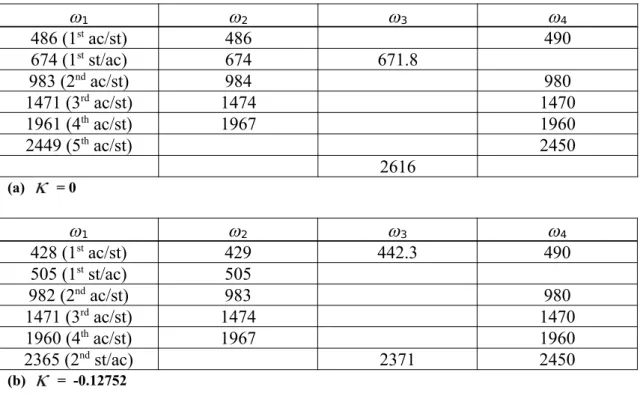
For the particular plate/acoustic cavity configuration the natural frequencies were computed by iteration of the determinant of the first three rows and columns of matrix equation (22) for a value of m = 0 (axisymmetric modes only). Corresponding values of natural frequencies were obtained from the ANSYS analysis described above. Tables 3a and 3b shows these values of natural frequencies. Also included in Tables 3a and 3b are the corresponding values of natural frequency associated with the plate in vacuo, i.e., in the absence of any acoustic coupling effects, and, the acoustic cavity alone if the plate was treated as a rigid boundary. From Table 3a ( =0) one can see that the modes of natural frequencies for the coupled system resemble those for the plate in vacuo and the acoustic cavity alone, in other words the system is fairly
2 ANSYS User’s Manual for Revision 5.4, Swanson Analysis Systems, Inc,
uncoupled. However for the case where = - 0.12752 (Table 3b) the fundamental natural frequency of the plate in vacuo approaches a value close to the acoustic natural frequency giving rise to strong interaction in the values for the coupled system.
1 2 3 4
486 (1st ac/st) 486 490
674 (1st st/ac) 674 671.8
983 (2nd ac/st) 984 980
1471 (3rd ac/st) 1474 1470
1961 (4th ac/st) 1967 1960
2449 (5th ac/st) 2450
2616
(a) = 0
1 2 3 4
428 (1st ac/st) 429 442.3 490
505 (1st st/ac) 505
982 (2nd ac/st) 983 980
1471 (3rd ac/st) 1474 1470
1960 (4th ac/st) 1967 1960
2365 (2nd st/ac) 2371 2450
(b) = -0.12752
Table 3 Calculated natural frequencies: 1 is solution from eq. (22); 2 is ANSYS
solution; 3 is for plate invacuo; 4 is for rigid closed acoustic cavity. All
frequencies are in Hertz.
3.3 General Results
As above we shall only consider results for the axisymmetric modes of vibration, i.e.,
m = 0. At this stage we introduce a coupling factor, F, defined as
,
where is the fundamental natural frequency of the unstressed plate invacuo (for a particular value of m, zero in this case) and is the first and fundamental natural frequency of the gas chamber (for the same value of m) when the plate is assumed rigid.
with these veering regions the modes can safely be described as either predominantly structural or acoustic.
It is seen from the three plots that the introduction of in-plane stressing can result in the plate moving into or away from zones of strong and weak structural/fluid vibration interaction. For example, when F = 0.5 (Figure 2a) meaning that in the unstressed state the plate fundamental natural frequency is half that of the fundamental natural frequency of the gas column, we observe the following;
(a) as the stressing increased positively the natural frequency of the first structural/acoustic mode moves gradually to a point where there would be strong coupling with the first acoustic/structural mode, and
(b) by setting the first structural unstressed natural frequency to half of the first acoustic natural frequency (F = 0.5) it is seen that in the absence of stressing, the second structural/acoustic mode natural frequency is close to the second acoustic/structural mode frequency, Furthermore strong structural/acoustic interaction will manifest itself at moderately low levels of in-plane stressing.
4. CONCLUSIONS
A theoretical - analytical method, based on the Galerkin method, has been developed for the frequency-modal analysis of a coupled vibroacoustic system. The
convergence of the solution is fast and the numerical results are in good agreement with the finite element analysis performed by the ANSYS code. It was shown that strong structural-acoustic couplings can appear in the system, for example, by changing the static in-plane prestress of the disc backed on the top of an acoustic cylindrical cavity. In the region of parameters, where a strong acoustic -structural coupling exists, the differences in the spectral characteristics between the associated coupled and uncoupled systems can be substantial.
5. REFERENCES
1] Leissa, A.W.: Vibration of Plates. NASA SP-160, Washington, 1969. 2] Bauer, H.F., Chiba, M.: Hydroelastic viscous oscillations in a circular
cylindrical container with an elastic cover. J. of Fluids and Structures, 2000, 14: 917-936.
3] Chiba M.: Axisymmetric free hydroelastic vibration of a flexural bottom plate in a cylindrical tank supported on an elastic foundation. J. Sound Vib., 1994, 169(3): 387-394.
4] Soedel, S.M., Sedel, W.: On the free and forced vibration of a plate supporting a freely sloshing surface liquid. J. Sound Vib., 1994, 171(2): 159-171.
5] Pan, J., Bies, D.A.: The effect of fluid-structural coupling on sound waves in an enclosure-Experimental part. J. Acoust. Soc. Am., 1990, 87(2): 708-721. 6] David, J.-M., Menelle, M.: Validation of a medium-frequency computational
method for the coupling between a plate and a water-filled cavity. J. Sound Vib., 2003, 265: 841-861.
8] Bokil, V.B., Shirahatti, U.S.: A technique for the modal analysis of sound-structure interaction problems. J. Sound Vib., 1994, 173(1): 23-41.
9] Lee, M.-R. and Singh, R.: Analytical formulations for annular disk sound radiation using structural modes. J. Acoust. Soc. Am. 1994, 95(6), 3311-3313. 10] Gorman, D.G., Reese, J.M., Horacek, J., and Dedouch, K. : Vibration analysis
of a circular disc backed by a cylindrical cavity. Proceedings of the Institution of Mechanical Engineers, Part C, 2001, 215:1303-1311.
11] Rajalingham, C., Bhat, R.B. and Xistris, G. D.: Vibration of circular
membrane backed by cylindrical cavity. Int. J. Mech. Sci., 1998, 40(8): 723-734.
12] Bhat, R.B.: Acoustics of a cavity-backed membrane: The Indian musical drum. J. Acoust. Soc. Am., 1991, 90 (3): 1469-1474.
13] McLachlan, N.W.: Bessel Functions for Engineers. Oxford Engineering Science Series, 1948 (Oxford University Press, London).
14] Press, W.H, Flannery, B.P., Teukolsky, S.A., and Vetterling, W.T.: Numerical Reciprocating, Cambridge University Press, 1988, 31-38.

![Table 2 Convergence of the natural frequencies [Hz] and the mode shapes coefficients](https://thumb-us.123doks.com/thumbv2/123dok_us/1722253.125627/9.892.108.804.138.516/table-convergence-natural-frequencies-hz-mode-shapes-coefficients.webp)