The Contested Council: The Conflict
Dimensions of an Intergovernmental
Institution
Christina Zimmer
1/Gerald Schneider
2/ Michael Dobbins
3Department of Politics and Management
University of Konstanz
Recent research has tried to uncover the political space in which the Council of Ministers of the
European Union decides. This article shows that a redistributive dimension rather than the left-right
conflict or a cleavage between governments with national and supranational attitudes decisively
shapes the interactions in this most important legislative body of the European Union. In contrast to
extant studies, we employ ex ante rather than ex post preference data and rely on correspondence
analysis as a means to identify the underlying dimensions of contestation. The article concludes with
an empirical investigation of how enlargement will affect the emerging political space within the
European Union. Our quantitative analysis suggests that the gulf between contributors and
net-receivers will further deepen.
Political Studies
(forthcoming)
Keywords
Council of Ministers – European Union – Coalition Building – Dimensionality of Conflict-Correspondence Analysis
1 Graduate in Public Administration, University of Konstanz; Box D 86; D-78457 Konstanz; E-mail:
2 Professor of Political Science and Executive Editor “European Union Politics”; Department of Politics and
Management; University of Konstanz; Box D 86; D-78457 Konstanz; Tel: +49-7531-88-3081/2608; Fax: -2774; E-mail: [email protected]
3 Graduate in Political Science, University of Konstanz; Box D 86; D-78457 Konstanz; E-mail:
A previous version of this paper has been presented at the 2nd Pan-European Conference on EU
The Contested Council: The Conflict Dimensions of an Intergovernmental
Institution
Recent research has tried to uncover the political space in which the Council of Ministers of the
European Union decides. This article shows that a redistributive dimension rather than the left-right
conflict or a cleavage between governments with national and supranational attitudes decisively
shapes the interactions in this most important legislative body of the European Union. In contrast to
extant studies, we employ ex ante rather than ex post preference data and rely on correspondence
analysis as a means to identify the underlying dimensions of contestation. The article concludes with
an empirical investigation of how enlargement will affect the emerging political space within the
European Union. Our quantitative analysis suggests that the gulf between contributors and
net-receivers will further deepen.
***
Many experts have contended that coalition building in the Council of Ministers of the European
Union is unpredictable and time-consuming (Peters and Wright, 2001, p. 160). According to this
adage, member states do not build permanent alliances, but common interests on individual issues bind
them together (Nugent, 1999, p. 474). The secrecy surrounding the negotiations, decisions and
protocols has prevented the public from establishing whether this interpretation of casual coalition
building is accurate (see Hayes-Renshaw and Wallace, 1997). The lack of reliable data has made it
nearly impossible to study the preference and coalition structure within this core intergovernmental
body of the European Union.
The data set “Decision-Making in the European Union” (DEU) (Thomson et al., forthcoming)
enables us to identify the negotiation positions of the member states and the conflict structure within
the Council. This article makes use of this unique resource and attempts to reduce the conflict space to
a few dimensions that reveal the most important cleavages. Our results largely confirm the findings of
Mattila and Lane (2001), Mattila (2004) and Thomson et al. (2004) who have pinpointed the
these results and offer some substantial and methodological innovations to the emerging literature on
the European political space (Marks and Steenbergen, 2004). Firstly, although some conflict
dimensions that we identified cannot be interpreted that easily, some recurrent patterns of contestation
do exist in the intergovernmental council. Our calculations reveal more structure in the interactions of
the member states than the similar recent inquiries by Selck (2004) and Thomson et al. (2004) did.
Secondly, our results suggest that the north-south division encompasses various sub-dimensions, the
most important of which being the conflict between net-receivers and net-contributors to the EU
budget. Although the left-right dimension also explains the alignments of governments to a certain
degree, the “utilitarian” dimension, which we identify in this analysis, shapes the conflict structure in
the Council more decisively. This result considerably differs from the roll call data analysis by Mattila
(2004). He uncovers in line with studies on the European Parliament (e.g. Noury 2002) a political
space in which the divisions between left and right and between independence and
integration-supporting governments are the main dimensions of contestation. Thirdly, we are able to compare the
conflict structure within the Council before and after enlargement. We suspect that redistributive
conflicts will become more virulent and that the EU will become more producer-friendly and
protectionist in the near future (Dobbins et al., 2004). Fourthly, our results are founded upon the
analytical technique of correspondence analysis. Although this method has been previously used in the
attempt to uncover the conflict structure within the European Parliament (Kreppel and Tsebelis, 1999;
Kreppel, 2002), it has not been employed for the analysis of Council interactions. Correspondence
analysis also provides accurate results even in the event that the number of cases is relatively small
and the preference data are quasi-ordinal, as it is the case in our inquiry.
This article is structured as follows: We will first discuss the most recent studies dealing with the
political space (or spaces) of the European Union. Our classification of the empirical literature follows
the theoretical deductions on the relevant conflict dimensions of the most important EU actors. We use
this framework to build a number of hypotheses to be tested after the presentation of the DEU data set
and research design. We conclude by comparing the past with the present conflict structure of the
1. Competing Models of Political Contestation within the European Union
No conclusive evidence has yet been found for the conjecture that five decades of European
integration have led to a unifying political space. The existing literature offers three competing models
to classify and describe the European political space (Marks and Steenbergen, 2002; 2004). The
International Relations Model assumes that European actors disagree along a more or less integration
dimension. This assumption can be traced back to realist contributions to the theory of European
integration (Hoffmann, 1966) and Moravcsik´s (1998) version of intergovernmentalism. This
emphasis on the division between supranationalists and nationalists in the EU can also be found in
neo-functionalist writings (Haas, 1958) as well as some of the first spatial models developed to study
the legislative process of the organisation (e.g. Tsebelis and Garrett, 1996). These cleavages thus do
not coincide with the conflicts surrounding the left-right dimension in domestic policy debates, nor do
they acknowledge the extent of social and economic regulation, for which the EU has been
increasingly granted extensive authority (Majone 1996).
The Hix/Lord-Model (Hix and Lord, 1997; Hix 1999a; 1999b) conversely suggests that there are
two independent conflict dimensions, the left-right and the more vs. less integration dimension, which
can allegedly be placed orthogonally upon each other. This configuration is based on crosscutting
coalitions of interests between functional and territorial groups. The regulation model, on the other
hand, anticipates conflicts over the extent to which the state should regulate the European economy.
The empirical studies on the structure of contestation within the European Union can, by and
large, be attributed to these models. Yet, the overall conclusion that one can gain from these
examinations is that no unifying political space within the European Union exists. It seems as if the
dimensionality depends by and large on the ingenuity of the political actors and the level at which they
become active (Marks and Steenbergen, 2002, p. 888). To start with, strong empirical evidence by
independent researchers bolsters the claim that the Members of the European Parliament can largely
be classified along the left-right continuum (Attiná, 1990; Noury, 2002; Kreppel and Tsebelis, 1999;
Hix et al., 2003). This one-dimensional conflict dominates not only voting within the EP, but also
party competition on European issues at the national level (Gabel and Hix, 2002; Pennings, 2002). As
government parties and their preference on European integration “particularly in cases where there is
not some overriding pan-ideological national interest at stake.” Parties that assume a position in the
centre advocate free trade and international stability, while right-wing and left-wing parties reject
further integration due to fears of losing their national autonomy or welfare state (2002, pp. 86-88).
Other authors detect a direct link between the ideology of parties and their support for European
integration only with respect to economic and regulatory issues (Hooghe and Marks, 1999, pp. 76-78).
In addition to this, a new politics dimension defined by Hooghe, Marks, and Wilson that comprises
issues such as immigration, the environment and democratic transparency has emerged (Hooghe,
Wilson and Marks 2002). As the left/right and the new politics dimension are partly associated with
the support for European integration, Hooghe, Marks, and Wilson (2004:140) conclude: "European
politics is domestic politics by other means."
The large national differences within the European party groups have the consequence that the
competition between the parties at the European level is perceived to take place only along one
dimension. Conflicts on national and territorial issues exist, in other words, only latently, while the
negotiations between parties are reduced to a socio-economic dimension (Hix, 1999b). The integration
dimension, however, plays an important role in the negotiations within the European Council and the
ratification processes of the intergovernmental treaties such as the Maastricht and Amsterdam Treaties
(Hug and König, 2002; Bräuniger et al., 2001). Yet, as governments have the possibility to add less
conflictive issues or to take highly contentious issues from the negotiation agenda, the conflict
structure is not fixed in this intergovernmental arena. The subtraction of controversial topics during
the negotiations eased the way for the Amsterdam Treaty through the ratification process. While
governments and voters disagreed on this treaty only on one dimension in the end, the Maastricht
treaty contained EMU and political union as the main divisive projects.
Despite severe data problems, several recent articles have attempted to map out the conflict
structure in the Council of Ministers. Most of these examinations aim to identify possible coalitions
among the member states. Lane and Mattila (1998) hint at the national dimension as the most
important cleavage and the division between the northern and southern members in the coalition
smaller ones (Mattila and Lane, 2001).1 Because formal voting is rare in the Council of Ministers as a
consequence of early consensus-building, studies that resort to the results of the final votes do not
necessarily mirror the actual conflict structure. Mattila (2004) lists some additional explanations as to
why the final votes taken in the Council do not always correspond to the preferences of the member
states. Countries that hold the EU Presidency oppose majoritarian decisions less frequently than other
member states. The tendency of the larger member states to dissent also reflects the inclination of
smaller member states to behave strategically and go with the majority against their own preferences.
The analyses of the voting protocols find some support in the interview-based studies that
disentangle the patterns of communication within the Council. The nationality of the delegates remains
the best explanatory factor for the coalition patterns; the difference between north and south is also
crucial (Elgström et al., 2001; Beyers and Dierickx, 1998). Yet, these communication patterns could
indeed likely be shaped by a common language and background shared by the national delegations
than the actual policy preferences of the member states.
Hence, to explore the dimensions of contestation within the Council, we need to rely on more
direct preference measures. Interviews that unravel the bargaining positions of the actors before the
final decision is made provide, in our view, more accurate information on actor preferences than roll
call analyses or general surveys on the behaviour of a member state. We will make use of such ex ante
data in our tests of the three competing hypotheses that we will derive from the literature in the
following.
2. Theoretical Foundations of the Conflict Structure in the Council of Ministers
According to the Lipset/Rokkan model of political cleavages (Lipset and Rokkan, 1967, pp. 14f.), the
modern party systems of Europe are moulded by historical conflicts involving the foundations of the
state, as well as religion and social classes, from which stable social identities and institutions
developed. Thus, national political competition is carried out for the most part today along the
left-right dimension (Hix and Lord, 1997, p. 25). This ideological dimension reconciles economic and
socio-political issues such as regulation, redistribution, employment, individual freedom, religion and
means for political parties to react to the emergence of new issues, as both issue-related orientations
that have evolved over a long period of time as well as the allegiance to a certain clientele of voters
entail high sunk costs (Marks and Wilson, 2000, pp. 434-36). Thus for political parties and actors there
is an incentive to interpret new issues within the framework of already existing cleavages and
incorporate them into the given lines of party competition. This, in turn, compels organisations that are
active in national policy making to “re-interpret” issues involving European integration along the
left-right ideological dimension.
The rational choice approach argues, on the other hand, that multi-dimensional decision-making
entails an enormous increase in transaction costs. As stable results are only possible in one or
two-dimensional spaces (Hinich and Munger, 1997), it is in the interest of all actors participating in the
negotiations to limit the dimensionality of the conflict space.If party affiliation and identification are
an equally decisive factor for the formation of the preferences of actors in the Council of Ministers,
then conflicts should be structured by a left-right dimension within this legislative body.
H1: The conflict structure in the Council of Ministers is founded upon an ideological dimension, along
which the member states can be aligned according to the left-right position of their governments.
However, the members of the Council of Ministers are also representatives of their governments and
can still be perceived as the greatest advocates of the interests of their nation-states on the EU-level.
For this reason, conflicts involving matters of national sovereignty and interests tend to emerge much
more frequently in the Council of Ministers than between the EP-representatives who are grouped
along supranational party lines. This is reflected by the initial one-dimensional theoretical studies on
decision-making in the EU (e.g. Tsebelis and Garrett, 1996), according to which the Council,
Commission and the EP held different views on the extent of integration. In the stricter sense, the
more or less-integration dimension would thus span from the further delegation of competences and
the harmonisation of regulatory measures on the European level on to the preservation of national
H2: The conflict structure in the Council of Ministers is based on an integration dimension, along
which pro-integration governments can be distinguished from less integrationist governments.
By comparison, Hix (1999b, pp. 72f.) defines the “integration dimension” in general as a
national/territorial cleavage in the Council. This division determines conflicts involving state and
territorial borders, historical myths, cultures, rights and commitments as well as economic interests
(Smith, 1991, p. 14, quoted in Hix, 1999b). The conflicts emerge when national identity or national
interests are endangered by integration or when one or several member states seem to be profiting at
the costs of others (Hix, 1999b, p. 73).
The agricultural and structural funds of the EU illustrate a particularly striking and blatant form of
redistribution and thus the perceived unequal treatment of member states. Viewed within a
political-exchange model, the poorer states receive a large part of the redistributive transfer payments as
compensation for their approval of certain policies (e.g. economic integration) on the EU-level
(Carrubba, 1997).2To a certain extent, the wealthy member states are willing to buy off the consent of
the poorer nations by means of subsidies. However, since they finance the redistributive programs
alone, while the other member states profit from them or at least offer a smaller contribution, it is in
the interest of the net-contributors to keep the expenses for subsidies at the lowest possible level. This
constellation of interests characterises not only economic matters, but also social and environmental
policy (Hosli, 1996, p. 260).
H3: The conflict structure in the Council of Ministers is based on a North/South-dimension that best
reflects conflicts of interest between net-contributors and net-beneficiaries of subsidies and
redistributive policies.
Our following empirical analysis shall now demonstrate which of the discussed conflict lines
dominates the struggles in the Council. Is the structure of negotiations marked by the polarisation of
left-right interests along party lines? Or are national political or economic interests of greater
3. Research Design
National delegations participating in the negotiations and decision-making process in the Council will
be regarded as unitary actors. For most Commission proposals (70 percent), an agreement is reached
in advance among the working groups or the COREPER (15 to 20 percent) (Hayes-Renshaw and
Wallace, 1997, p. 40). However, as the ministers themselves are still able to open up a debate on all
contested matters (1997, p. 81), we must assume that national positions are agreed on or that the
preferences of the government are anticipated within the working groups and the COREPER.
The centrepiece of the analysis of our research question is the DEU data set (Decision-Making in
the European Union).3 The DEU data set was developed by an international team of researchers from
the Universities of Groningen, Konstanz, Leiden, Ann Arbor (Michigan), Nijmegen and Turku on the
basis of the results of quantitative expert interviews. A total of 125 experts, most of who belonged to
the national delegations (Council of Ministers) in Brussels, were consulted. To figure out the
preferences of the new member states, we also conducted our own interviews with Commission
officials, members of the European Parliament and interest groups in Brussels.
The DEU data set contains the preferences of the decisive institutional actors in the legislative
process: the ideal points of the 15 member states, the European Commission and the EP on 174 issues
from 70 Commission proposals on decrees, directives and decisions. We only measured the
negotiation preferences of the actors, i.e. their preferred policy positions after the proposal was
submitted, but also before the adoption of a common position on the part of the Council of Ministers.4
We agree with Bueno de Mesquita (2004) that the data we obtained reflect sincere negotiation stances
rather than the “true” ideal point of a member state which cannot be deduced from expert interviews.
The ideal point estimates of the member states were standardised on a scale from 0 to 100.5 The nature
of the issues varies considerably. While some issues stand for the qualitative choice between two or
more options, most other scales are quasi-ordinal, rather than nominal.
The data are restricted to the decisional procedures Consultation and Co-decision. Of the 70
proposals, 42 were governed by the Consultation procedure, while 28 entailed the participation of the
policy areas, with the most frequent being common market and agricultural issues. The selection of
cases is restricted to a timeframe between January 1999 and December 2000, while the largest part of
the proposals was presided over between May 1999 and February 2002. By doing so, we aimed to
ensure that the consulted experts were available and could still remember the Commission proposals
well. A further motive was to prevent the interviewees from deriving their preference estimates from
their actual voting behaviour, which would have led to ex post distortions.
Missing scores in the analysis were replaced by the mean score between the reference point and
the position of the Commission. Thus, those member states that could not be attributed a preference
score in the expert interviews were given a neutral position. Issues for which the preference positions
are unknown for more than four member states were discarded from the analysis (cp. Selck and
Steunenberg, 2004, p. 14).
Factor analyses (FA) on the basis of multidimensional scaling are frequently employed tools to
examine the latent conflict structure of multiple variables. Selck (2004) relies on factor-analytical
techniques to uncover the dimensions of contestation in the Council, while Mattila and Lane (2001)
and Thomson et al. (2004) use multidimensional scaling. Factor analysis serves to reduce a multitude
of variables to a few hypothetical constructs (factors), which represent linear combinations of the
observed variables (Kim and Mueller, 1978). However, for the analysis of the DEU data set, a FA has
several disadvantages. For example, the data are to be measured on an interval scale level, because the
FA is based on correlation matrixes and weighted variable sums.6 Furthermore, the sample size of the
DEU data set can be regarded as too small for a FA. Multidimensional scaling (MDS) in return is
mainly a graphical device that allows a researcher to detect the spatial ordering of objects – in our
case: countries – in a one- or two-dimensional space. The technique does, however, not enable us to
trace the positions back to the influence of the issues under contestation.
The drawbacks of FA and MDS can be avoided with an alternative technique. Correspondence
Analysis (CA), which is frequently labelled as a “Principle Components Analysis with Categorical
Data” (Benzécri et al., 1973; Greenacre, 1984), describes, like the FA, the latent characteristics of
manifested variables (Blasius, 2001: 83). A CA traces the latent structure of nominally or ordinally
In a CA the row or column profiles of a frequency table are calculated in order to compare their
similarity with the average profile of the rows and columns.7 For the DEU, the deviations
(Chi-Square-Distances) between the row scores of MS j and the row scores of the average MS are determined
according to (1):
2 =
j ((obsij - expij)2/expij) where (1)
obsij = observed score of member state i on issue j
expij = observed score of member state i on issue j
We have also used the DEU data set and the secondary literature to develop preference profiles for the
most important policy fields in which the Council of Ministers is a co-legislator. Against this
background, we conducted 16 structured interviews with representatives of the accession countries and
Commission representatives dealing with enlargement. We asked the experts to identify the
preferences of the new member states along the preference continua with the old member states.8
4. Results: Conflict Dimensions in the Council of Ministers
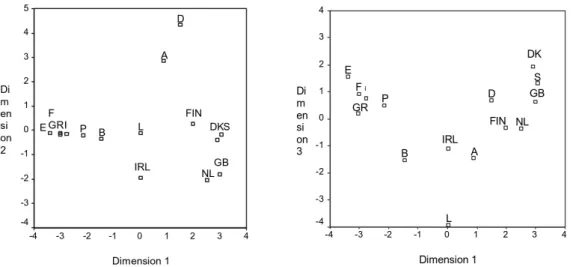
Figure 1 depicts the alignment of the preference profiles of the member states in a three-dimensional
model on the basis of an analysis of the entire data set. Along the first dimension, the southern states
can be clearly distinguished from the northern member states; Ireland and Luxembourg assume a
position in the middle. The second division demonstrates the widest gap between Great Britain, the
Netherlands and Ireland in the lower area and Germany (and to a lesser extent Austria) in the upper
part of the illustration. Along the third dimension, Luxembourg is isolated from the other member
states, while Austria, Ireland and Belgium assume positions in the middle.
In a CA the interpretation of the policy content of the dimensions is founded upon the columns
(issues) with extreme component loadings (i.e. coordinates of the variables in the object space). Since
the Council of Ministers predominantly presides over very detailed topics, the content of the
dimensions is also greatly dependent on the specific issues at hand, making it difficult to draw final
conclusions on the general conflict structure within the Council.
The results listed in Table 2 provide nevertheless a solid framework for the interpretation of the
underlying policy-content. Analyses of the data using principal components analysis, a factor analytic
technique, or multidimensional scaling show similar results to those of the CA.9 The distinction
between interval and ordinal-scaled data evidently does not lead to any notable differences in the
analysis of the DEU. Tests of internal stability (Greenacre, 1993, pp. 171-77) confirm the results. If
we were to leave out the preference scores of Germany – an outlier on the 2nd dimension - , it turns out
that the conflict potential with Germany “covers up” differences in the preference profiles of the
remaining member states.
Table 2: Possible Interpretations of the Dimensions in DEU
D1 D2 Explained variation,
2D-model
D3 Explained variation,
3D-model DEU market
regulation, subsidies
consumer protection,
subsidies
44.81% subsidies, economic interests / protectionism
53.67%
The first dimension is dominated by the regulation of the common market as well as subsidies for
agriculture, culture and external financial support. The alignment of the member states along this axis
high sums of agricultural and structural funds,11 while Great Britain, Germany, Luxembourg, Austria,
Sweden and the Netherlands make large contributions. Although the Danes receive high subsidy
payments, they are not very willing to increase such expenses. The same also holds for the Finns, who
only provide small net-contributions. To explain this peculiarity, scholars have offered an argument
based on the “cultural connectedness”12 of certain groups of member states (Beyers and Dierickx,
1998; Elgström et al., 2001). The behaviour of the Finns can also be interpreted in this case as their
desire to be “good Europeans” and to avoid advocating extreme positions.13 This argument points to a
conflict of interest for the Irish. On the one hand, as receivers of subsidies they are closely attached to
the southern states, while on the other hand they are affiliated with the English language and
Anglo-Saxon constitutional, legal and state traditions.
As a rule, the results confirm the observation that the poorer southern member states demand more
market regulation, protectionism and redistribution than the northern member states, who seek
increased free trade, market liberalisation and the restriction of EU-expenses (e.g. Hamilton, 1991,
quoted in Hosli, 1996). The North, for example, sought to limit or dismantle subsidy programmes for
the production of sugar (n00250i1) and oil (n00358i1 und i2). Conversely, the northern member states
tend to advocate stricter regulations for producers, e.g. fishing restrictions (n96160i1) or measures to
protect laying hens (n98092). Thus, an unambiguous alignment of the member states along a clearly
defined regulation or left-right dimension spanning from greater market regulation to liberal
anti-protectionism is a difficult task,14as the actual preference positions of the member states are dependent
on specific nation-state interest constellations and conflicts. For example, Denmark and Great Britain
are generally regarded as strong advocates of dismantling subsidy programmes in the EU. Denmark,
however, proposes an expansion of subsidies for low-fat milk in schools because consumption of such
milk is high in Denmark (n99246i2).
The second dimension can be defined primarily as conflicts involving the representation of
consumer and producer interests as well as EU-subsidies. However, state preferences often tend to be
inconsistent in particular when core national interests are at stake. Germany assumes the most isolated
position here and is the furthest away from the Netherlands and Great Britain. As in the following
accord with its vital national economic and consumer interests: The German delegation supports, for
instance, an agreement on the length of trucks to the advantage of German industries (d00060i1),
advocates the protectionist position in Internet commerce demanded by trade associations (d98325i2),
and supports the banning of phthalates in children’s toys (d99238) and the continuance of
EU-subsidies for milk and dairy products (n99246i1).
Diverse bureaucratic traditions and the existing national legislation also appear to be of
significance here, e.g. in reaction to the Commission’s proposal to regulate market access for service
providers of electronic signatures by means of a system of self-control (d98191). This coincides much
more with the system of corporatist self-regulation of the economy that Germany is familiar with than
the divergent national traditions in Great Britain and Ireland, for example (cp. Streeck and Schmitter,
1996, p. 143; Scharpf, 1994, p. 150). This clinging to the existing national legislation also explains the
conflicting positions on the manner in which a “fair” price was set for company takeovers (d95341i1).
The third dimension sheds light on further disparities among the member states. Throughout the
entire data set, Luxembourg tends to be in an isolated position, which primarily has to do with its
aversion to the harmonisation of taxes. Unsurprisingly, the third dimension also reflects the tension
between northern and southern member states.
Thus, for the entire data set, conflicts involving economic liberalisation and regulation of the
common market can be distinguished from those involving consumer protection. For the redistributive
issues, though, no isolated conflict line could be identified. Controversial matters of subsidy payments
and decisions on the EU-budget interfere with the conflict structure. The analysis according to policy
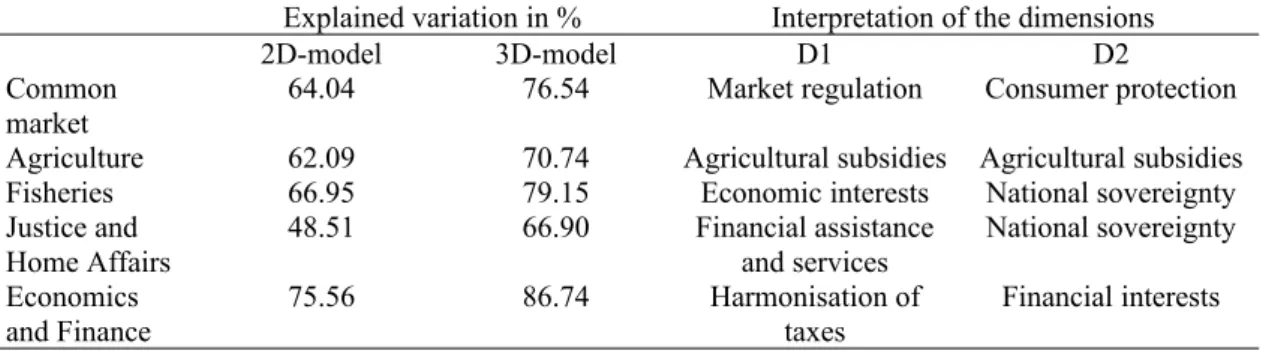
domains provides clearer results. Table 3 illustrates the explained variation and also offers an
interpretation of the first two dimensions15 in terms of underlying policy content.
Table 3 Results by policy area
Explained variation in % Interpretation of the dimensions 2D-model 3D-model D1 D2 Common
market
64.04 76.54 Market regulation Consumer protection Agriculture 62.09 70.74 Agricultural subsidies Agricultural subsidies Fisheries 66.95 79.15 Economic interests National sovereignty Justice and
Home Affairs
48.51 66.90 Financial assistance and services
National sovereignty Economics
and Finance
75.56 86.74 Harmonisation of taxes
In the Common Market Council the conflicts are structured by the diverse preferences of the
member states for protectionist or free trade policies16 and consumer protection.17 Proceedings in the
Council for Agriculture focus nearly exclusively on agricultural subsidies. As for the second
dimension, it is evident that Austria, Germany, Finland and the Netherlands also support certain
subsidies because they profit from the existing price systems.18 Great Britain, Denmark and Sweden,
on the other hand, are characterised by their aversion to further increases in subsidies, even though
some of their national economic sectors often do benefit from current schemes.
From an overall perspective, we have identified a relatively stable conflict line within the Council
of Ministers, namely the conflict between the north and south, around which opposed voting blocks
emerge over matters of subsides and financial contributions, market regulation and protectionism.
1Notes
? The analysis is based on the yearly “Review of the Council’s Work” or the “Monthly Summary of Council
Acts” in a time-frame between 1994 and 1998, published by the General Secretary of the Council of Ministers of the EU.
2 Carruba and Volden (2001) show along these lines that the choice of an institution can be endogenous. 3 The description of the data is based, for the most part, on Thomson et al. (forthcoming) and Selck (2004, pp.
13-15). For a full description of the research project see Thomson et al. (forthcoming) and issue 5/1 of European Union Politics (March 2004).
4 A prerequisite for the selection of the proposals was their “contestedness”. A proposal had to be mentioned in
at least five lines of text in the Bulletin Quotidien,Agence Europe. Thus, the international research team sought to avoid incorporating such Commission proposals that entailed mere technical modifications and did not lead to conflicts between the member states.
5 In the analysis, the value 0 had to be replaced by 1 in all cases, because 0 is an invalid value.
6 However, a factor analysis of ordinal data can be justified pragmatically, because social science variables are
primarily regarded as “continual latent variables with a normal distribution” that can be measured by indicators with minimal measuring errors (Schnell et al., 1999: 142). The data we used were originally conceived as interval scales. Yet, the scales that were obtained through expert interviews often only contain a small number of policy positions and can thus be interpreted as quasi-ordinal scales. See also Selck (2004) on the difficulties associated with ordinal-scale preference measures.
7 The calculation is also possible for preference scores. In order to secure the equal weighting of all scores in the
analysis, a so-called doubling of the data is carried out (Greenacre, 1993, p. 163). In this procedure every row (positive pole) obtains a row with the complementary preference scores (negative pole, difference between 100 and the preference value).
8 A full description of these interviews can be found in http://www.ub.uni-konstanz.de/kops/volltexte/2003/1021 9 The first author has analysed the DEU data set with the help of principal component analysis,
multi-dimensional scaling and cluster analysis. The full report on the different scaling techniques can be found at
http://www.ub.uni-konstanz.de/kops/volltexte/2003/1111/
10 The underlying data on the transfer payments between the EU and the member states have been gathered by
Rodden (2002).
11 Italy, France, and Belgium are not net-receivers, but only provided a small contribution in terms of the
percentage of their GDP from 1995-1999. However, they have profited considerably from structural funds both in this timeframe and beyond, particularly in the agrarian sector.
12 Common language, traditions of cooperation, geographical location
13 Source: Report on DEU, Report on Commission proposal COM (1999)617 / COD 1999/0252
14 The left-right positions of the governments (H1) were gathered from the data of the Comparative Manifestos
Project (Budge et al., 2001). The index score of a governing party was weighted by the number of its cabinet members. In the case of a change in government, the scores were weighted by the number of months in which a government was in office (cp. Mattila, 2004).
Contrary to Thomson et al. (2004), who forecast an overall lack of structure in the positions of the
legislative actors, we were able to associate actors’ preferences and the resulting coalitions with
specific financial, economic and protectionist interests, the influence of national interest groups and
national administrative or legal traditions.19
To put our claims onto a more solid footing, we have conducted bivariate tests. Table 4 depicts the
correlation between the independent variables and the ranking that the countries obtained on the
different dimensions that we identified with the help of CA. We use the Manifesto data by Budge et al.
2001) to measure the positions the member state governments on the left-right and the
integration/anti-integration scale. To measure government support for the EU, we additionally used Ray (1999). Data
assembled by Rodden (2002) was employed to determine the extent to which a country was among the
net-contributors or net-beneficiaries of the EU’s agrarian and structural (cohesion) funds between
1995 and 1999.
Table 4: Bivariate relationships between independent variables and the position of a country on the conflict dimensions
Dimension 1 Dimension 2 Government left-right orientation 0.42 (0.12) -0.24 (0.39) Government EU support (Budge) 0.20 (0.46) -0.25 (0.37) Government EU support (Ray) 0.06 (0.81) 0.05 (0.85) Net transfers as a share of GDP 0.54 (0.04) 0.18 (0.52) Agricultural transfers as share of GDP 0.37 (0.18) 0.06 (0.83) Structural fund transfers as a share GDP 0.67 (0.007) -0.11 (0.70)
Note: The entries are Spearman rank order correlation coefficients; level of significance in parentheses. The number of cases for all coefficients is 15.
The bivariate tests of the three competing hypotheses clearly show that the conflict over the EU
transfer payments exerts the only systematic influence on the interactions in the Council of Ministers.
The status of a member state as a net-contributor or net-beneficiary is thus crucial for our
understanding of the intergovernmental negotiations in the European Union. In the EU of 15 member
states, the redistributive conflict largely coincided with the geographical North-South division of the
countries. We will explore below how the Eastern enlargement will influence this pattern of
contestation. Note that the results are similar for dimensions of conflict that we obtained through other
estimation techniques (principal component analysis, multidimensional scaling). Furthermore, the
The bivariate tests lead to a clear rejection of the international relations model as a convincing
interpretation of the conflicts within the Council of Ministers. While the conflict over the depth of
integration within the European Union often explains the negotiations within the European Council, it
fails to do so for the other intergovernmental body of the organisation. The preferences of the member
states and the resulting conflicts thus appear to be more the product of national interests and regulatory
traditions than their desire for more or less integration (H2). Note that we do not offer a deterministic
explanation of legislative decision making here. Although France and Italy have been net contributors
in the late 1990s and early 2000s, they belong to the subsidy-friendly camp. Denmark, by contrast,
which was a net receiver belongs to the opposing camp.20
The results reported in Table 4 finally only lend very weak support to the hypothesis that party
lines or ideology determine the preference structure in the Council (H1). This result is in considerable
contrast to the roll call analysis by Mattila (2004). According to his analysis, the left-right placement
of governments significantly affects the number of times that a national delegate objects to a
majoritarian decision. We believe that the discrepancies between our findings largely have to do with
varying data sources. As for roll call votes, governments might seem forced to object to a decision by
member states with another ideology to please their supporters back home. Their negotiation position
might, however, not have been that far away from the stances of the other governments. Although
most analyses on the European Parliament also rely on roll call data, they seem to reveal that ideology
is a much more important consideration in the legislature than in the Council.
5. The Consequences of Enlargement
This section switches gears and briefly addresses whether and how enlargement has an impact on the
north-south dimension and its underlying sub-components such as subsidy matters, consumer-friendly
regulation and fisheries restrictions. Kerremans (1998) forecasts the emergence of a North/South/East
conflict structure, which could serve as a further obstacle to the decision-making process in the
Council. However, our empirical analysis of the preferences of the new member states shows that this
Instead of offering nonchalant assumptions on post-enlargement policy making, we opted for a
more systematic approach. As the dimensions defined above (north-south, +/- integration, left-right)
are somewhat too broad to measure the specific policy alignments of the new members, we allocated
issues from the DEU data set to specific policy domains (e.g. agriculture, consumer affairs). As the
scales contained more information than the DEU data, we conducted a factor analysis to extract the
underlying conflict dimensions according to their factor loadings. After calculating the policy
preferences (so-called factor scores) of the EU-15 along these conflict lines on a scale from 0-100,21
we expanded the scope of the analysis with data from secondary literature on policy positions and
conflict lines not documented in the data set. 22 In total, we constructed preference profiles for 6
particularly contested conflict lines: (1) abolishment/preservation of agricultural subsidies, (2)
consumer-friendly vs. producer-friendly regulation, (3) restrictions in fisheries, (4) deregulation vs.
interventionism in the common market, (5) social policy: labour vs. capital, (6) environmental policy:
status quo vs. more regulation. We then carried out 16 semi-structured interviews with high-ranking
EU experts on enlargement and diplomatic representatives of the new members to pinpoint the
aggregate policy positions of the new members along these existing preference continua.23
Using the median on the basis of Council voting weights, we analysed to what extent and in which
direction the majority position will shift in the Council. By and large, the results confirm the
assumption that enlargement exports greater preference heterogeneity to the EU, although the new
members are by no means a homogeneous unit in terms of their policy positions.24 However, the
implications for future policy making are clear: the coalition of subsidy-dependent states will be
fortified, the EU is likely to become more producer-friendly and a shift towards more regulation in
common market policies is expected. To bolster these claims, we present detailed results for two such
policy areas. Figure 2 offers an illustration of how the conflict structure over subsidies has most likely
changed as a consequence of enlargement.
Figure 2: Supranational positions on agricultural subsidies
M CZ A D EP EST SLO LT LV GR
S DK GB NL SK FIN Com SQ L B IRL F I CY H P E PL
24 A great diversity among the accession states can be observed in their positions on fisheries, foreign trade
0 10 20 30 40 50 60 70 80 90 100
abolish all subsidies maintain all subsidies
The data depict even more pronounced variation among the positions of CEECs than among the
EU-15, with a majority of them falling into the group of subsidy-dependent southern states, though. The
spectrum spans from Poland, with nearly one-third of the population employed in agriculture, to
Malta, which is not affected by any of the existing subsidies schemes. Due to the mere size of the
agricultural work force in the new member states, the divide between industrial and agricultural
economies is bound to be sharpened in future legislative games. In the past, though, more wealthy
states have been able to buy the support of the poorer agricultural states by securing them access to
cohesion funds (see Allen 1996; Carubba 1997). However, enlargement will inevitably polarise the
industrial-agrarian or rich-poor divide, limiting the feasibility of this policy making mode. The results
indicate that tensions between burden and benefit sharing will inexorably complicate Council
decision-making.
The north-south dimension also comprises the sub-conflict between consumers and producers,
with the north generally advocating consumer-friendly legislation (Young and Wallace 2000:8-13).
Figure 3 shows the overwhelmingly producer-friendly attitude among the new members, who are
likely to align themselves with the southern states.
16 The northern states mostly take a liberal position, while the south is more protectionist.
17 In consumer affairs, Germany, Austria and the Scandinavian states are juxtaposed to Great Britain, Ireland and
the Netherlands.
18 The subsidies for beef and calf (n98109i2) and for dairy products (n98110) have the highest component
loadings here.
19 This could also be due to the data itself, though, as the DEU contains preferences of member states on very
specific topics, making an unambiguous conceptualisation along general conflict lines difficult.
20 We would like to thank an anonymous reviewer for pointing out this these discrepancies between our findings
and the status of these three states as winners and losers of EU transfers.
21 After pinpointing the preferences of the EU-15, the scores were rescaled so that the EU-15 occupy positions
between 20-80, leaving room for more extreme preferences among the new members.
22 Preferences for environmental policies: Tsebelis, George (1994) 'The Power of the European Parliament as a
Conditional Agenda Setter', American Political Science Review 88: 128-142; Holzinger, Katharina (1997) 'The influence of the new members on EU environmental policy-making. A game-theoretical approach', in Skou Andersen, Michael/Liefferink, Duncan (eds.) The Innovation of European Environmental Policy, Copenhagen: Scandinavian University Press, 59-82; Bomberg, Elizabeth/Peterson, John (1999) Decision Making in the European Union, New York: Palgrave; Young, Alistair/Wallace, Helen (2000) Regulatory Politics in the enlarging European Union. Manchester: Manchester University Press; For social policy: Social expenditure per capita EU-15 for 2000 (Eurostat);
Figure 3 The producer-consumer divide in the EU-25
SLO CY H SK M LV
PLEST LT FIN
E F GR I P CZ B IRL SQ L Com A D EP S DK GB NL
0 10 20 30 40 50 60 70 80 90 100
strongly on the side of producers strongly on the side of consumers
The reasons for this can be traced back to the painstaking process of adopting the acquis
communautaire, which has put the transformation states in a bind. They are required to demonstrate
proof of their capacity to “digest” the strict consumer and environmental legislation in the single
market acquis, even though this legislation is costly and arguably detrimental to their economic
transformation and industrial development. This burden is compounded by the fact that the new
members will most likely not be entitled to the same amount of financial support as the southern states
to overcome the disadvantages of increased external competition. In other words, the accession
countries are expected to endure immediate costs for potential integration benefits in the long run
(Hughes, Sasse and Gordon 2002: 333). By bringing 10 producer-friendly actors on the playing field,
enlargement could fundamentally alter the legislative balance between producer and civic interests.
Our overall forecast for the legislative impact of enlargement is summed up in Table 5, which
illustrates the implications of enlargement for the redistributive dimension we detected for the "old"
EU with 15 member states.
Table 5: Impact of enlargement on existing cleavages in the Council of Ministers
Policy Domain Change in Median Position (weighted by Council votes) Towards (= enlargement winners) Strengthened Coalition
Agricultural Subsidies + 8.6 More subsidies South Producers/Consumers - 20.5 producers’
interests
South
Fisheries 0 - Neutral Effect
Interventionist regulation of the Common Market
+ 15.8 more regulation (intervention)
South
Environmental Policy - 8.3 no new standards South Social Policy Labour
vs. Capital
(Unanimity Rule!)
- 1.7 Employer/capital interests
As for the left-right dimension concerning the degree of market regulation, we also arrive at the
conclusion that southern states who advocate greater regulation of the common market are set to profit
from enlargement. After an unprecedented wave of privatisation and deregulation, centre-left parties
demanding a moderate dosage of state economic regulation and trade protection enjoy great popularity
in the new member states. The preference for a moderate dosage of regulation is rooted in their desire
for a framework of “selective regulatory alignment” (see Sedelmeier 2002: 640; Young and Wallace
2000). This would allow the transition economies greater leverage in setting their own economic
priorities and policies without being overly exposed to external forces of de-regulation and
liberalisation. At least in the early years of membership, most new members express a desire for a
moderately regulated economy to facilitate structural adjustments and prepare firms for European and
international competition. This explains both the aversion to further harmonised consumer legislation
as well as full-scale market liberalisation.
As for our central legislative dimension in the Council, the shifts in the weighted median lead us to
the tentative conclusion that the southern block will be strengthened by enlargement, as most of the
new members fall into the group of subsidy-dependent states. Furthermore, we predict that producers’
and capital interests will be reinforced, with the new members joining the coalition of southern states,
who resist further consumer-friendly legislation and trade liberalisation.
6. Conclusion and Outlook
The evaluation of quantitative preference data on negotiations on Commission proposals in the
Council of Ministers only partially confirms the hypotheses derived from theoretical foundations. We
identified a very stable north/south dimension that illustrates the conflicts over the extent of market
regulation, protectionism and subsidies. The preferences of the member states greatly depend on their
respective status as net-contributors or net-receivers of EU-subsidies. The poorer member states, both
from the south and the east, prefer, for the most part, extensive regulation of the market with low
production costs, while the northern member states tend to advocate greater competition.
Our examination reveals that enlargement will most likely increase the significance of these
predicament as they fortify the already existing SQ bias. The extent to which the EU constitution - if it
ever comes into force - will remedy the tensions over the distributive question remain to be seen. The
increased bargaining complexity and heterogeneity that enlargement entails is regrettably still
juxtaposed to an institutional framework that aggravates underlying tensions and promotes gridlock. In
light of these forecasts, linking enlargement with internal reform of the EU seems to be a more urgent
endeavour than ever, as it may mitigate the negative externalities brought on by the strengthened camp
of subsidy-hunters, protectionists, and advocates of excessive market regulation.
If diverse issue-specific conflict lines were to run parallel to national interest constellations, it
would perhaps alleviate the burden put on the architects of European integration. However, as our
analysis has demonstrated for such conflict dimensions, no general interpretation based on
policy-content is possible. Classifying the member states according to their overall preference patterns fails
due to the inconsistency of the preference profiles. Coinciding preferences can frequently be traced
back to common financial, economic or “cultural” interests, but are by no means consistent. Thus the
conflict structure of the Council of Ministers is different than that of the European Parliament.
Proceedings in the EP are dominated by the left-right-conflict carried out by parties and factions, while
in the Council differences between nation-states prevail. Such crosswise conflict-lines serve to hinder
agreements between the institutions in the European legislative process.
We equally must gain an intuitive grasp of the role of the European Commission in the European
conflict space. Future research could tap into the studies on the supranational vs. intergovernmental
orientations of higher Commission officials (cp. Hooghe, 1999). The gathering and analysis of
preference data would also help us draw conclusions on the predominant cleavages and conflict lines
in the Commission. For example, a quantitative empirical analysis might investigate whether the
nationality of the Commission officials has an influence at all (Page 1997, p. 136). This would
enhance our knowledge of the supranational or intergovernmental character of the Commission
L
ITERATUREAllen, D. (1996)
'
Cohesion and Structural Adjustment'
, in H. Wallace and W. Wallace (eds) Policy Making in the European Union. Oxford: Oxford University Press.Aspinwall, M. (2002) 'Preferring Europe. Ideology and National Preferences on European Integration', European Union Politics 3 (1), 81-111.
Attiná, F. (1990) 'The voting behaviour of the European Parliament members and the problem of the Europarties', European Journal of Political Research 18, 557-79.
Beyers, J., Dierickx, G. (1998) 'The Working Groups of the Council of the European Union: Supranational or Intergovernmental Negotiations?' Journal of Common Market Studies 36 (3), 289-317.
Benzécri, J.-P. et al. (1973) L’analyse des données. L’analyse des correspondances. Dunod: Paris.
Blasius, J. (2001) Korrespondenzanalyse. München: Oldenbourg.
Bräuninger, T., Cornelius, T., König, T., Schuster, T. (2001) 'The dynamics of European integration: a constitutional analysis of the Amsterdam Treaty' in G. Schneider, M. Aspinwall (eds), The rules of integration. Institutionalist approaches to the study of Europe. Manchester: Manchester University Press.
Budge, I., Klingemann, H.-D., Volkens, A., Bara, J., Tanenbaum, E. (2001) Mapping Policy Preferences: Parties, Electors, and Governments, 1945-1998. Oxford: Oxford University Press.
Bueno de Mesquita, B. (2004) 'Decision Making Models, Rigor and New Puzzles' European Union Politics 5, 125-138.
Carubba, C. J. (1997) 'Net Financial Transfers in the European Union: Who Gets What and Why?' Journal of Politics 59 (2), 469-96.
Carruba, C. J., Volden, C. (2001) 'Explaining Institutional Change in the European Union', European Union Politics 2 (1), 5-30.
Dobbins, M., Drüner, D., Schneider, G. (2004) 'Kopenhagener Konsequenzen: Gesetzgebung in der EU vor und nach der Erweiterung', Zeitschrift für Parlamentsfragen 1/2004, 51-67.
Elgström, O., Bjurulf, B., Johansson, J., Sannerstedt, A. (2001) 'Coalitions in European Union Negotiations',
Gabel, M., Hix, S. (2002) 'Defining the EU Political Space. An Empirical Study of the European Elections Manifestos, 1979-1999', Comparative Political Studies 35 (8), 934-64.
Greenacre, M. J. (1984). Theory and Applications of Correspondence Analysis. Academic Press, London.
Greenacre, M. J. (1993) Correspondence Analysis in Practice. London: Academic Press.
Hamilton, C. B. (1991) 'The Nordic EFTA Countries’ Options: Seeking Community Membership or a Permanent EEA-Accord', Discussion Paper 524. London: Centre for Economic Policy Research.
Haas, E. B. (1958) The uniting of Europe. Stanford, CA: Stanford University Press.
Hayes-Renshaw, F., Wallace, H. (1997) The Council of Ministers. London: Macmillan.
Hinich, M. J., Munger, M. C. (1997) Analytical Politics. Cambridge: Cambridge University Press.
Hix, S. (1999a) The Political System of the European Union. London: Macmillan.
Hix, S. (1999b) 'Dimensions and alignments in European Union politics: Cognitive constraints and partisan responses', European Journal of Political Research 35, 69-106.
Hix, S., Lord, C. (1997) Political parties in the European Union. New York: St. Martin’s.
Hix, S., Noury, A., Roland, G. (2003) 'Politics Like Any Other: Dimensions of Conflict in the European Parliament', unpublished Manuscript, presented at the Second Annual Meeting of the European Consortium for Political Research, Marburg, 18-21 September 2003.
Hoffmann, S. (1966) 'Obstinate or obsolete? The fate of the nation-state and the case of Western Europe',
Daedalus 95, 862-914.
Hooghe, L. (1999) 'Supranational Activists or Intergovernmental Agents? Explaining the Orientations of Senior Commission Officials Toward European Integration', Comparative Political Studies 32 (4), 435-463.
Hooghe, L., Marks, G. (1999) 'The Making of a Polity: The Struggle over European Integration' in H. Kitschelt, P. Lange, G. Marks, J. D. Stephens (eds), Continuity and Change in Contemporary Capitalism. Cambridge: Cambridge University Press.
Hooghe, L., Marks, G., Wilson, C. J. (2002) 'Does Left/Right Structure Party Positions on European Integration?'
Hooghe, L., Marks, G., Wilson, C. J. (2004) 'Does Left/Right Structure Party Positions on European Integration?' In European Integration and Political Conflict, G. Marks, M. R. Steenbergen (eds.). Cambridge: Cambridge University Press.
Hosli, M. O. (1996) 'Coalitions and Power: Effects of Qualified Majority Voting in the Council of the European Union', Journal of Common Market Studies 34 (2), 255-73.
Hug, S., König, T. (2002) 'In View of Ratification: Governmental Preferences and Domestic Constraints at the Amsterdam Intergovernmental Conference', International Organization 56 (2), 447-76.
Hughes, J., Sasse, G., Gordon, C. (2002)
'
Saying “Maybe” to the “Return to Europe”. Elites and the Political Space for Euroscepticism in Central and Eastern Europe'
, European Union Politics. 3 (3), 327-355.Kerremans, B. (1998) 'The Political and Institutional Consequences of Widening: Capacity and Control in an Enlarged Council' in P.-H. Laurent, M. Maresceau (eds), The State of the European Union. Vol. 4. Deepening and Widening. Lynne Rienner: Boulder.
Kim, J.-O., Mueller, C. W. (1978) Factor Analysis. Statistical Methods and Practical Issues. Sage, London.
König, T., Hug, S. (2000) 'Ratifying Maastricht. Parliamentary Votes on International Treaties and Theoretical Solution Concepts', European Union Politics 1 (1), 93-124.
Kreppel, A., Tsebelis, G. (1999) 'Coalition Formation in the European Parliament', Comparative Political Studies 32 (8), 933-66.
Kreppel, A. (2002) The European Parliament and Supranational Party System. Cambridge: Cambridge University Press.
Lane, J.-E., Mattila, M. (1998) 'Der Abstimmungsprozess im Ministerrat' in T. König, E. Rieger, H. Schmitt (eds), Europa der Bürger? Voraussetzungen, Alternativen, Konsequenzen. Frankfurt: Campus.
Lipset, S. M., Rokkan, S. (1967) 'Cleavage Structures, Party Systems, and Voter Alignments: An Introduction' in S. M. Lipset, S. Rokkan (eds), Party Systems and Voter Alignments. New York: Free Press.
Majone, G. (1996) 'Regulating Europe'. London: Routledge.
Marks, G., Steenbergen, M. R. (2002) 'Understanding Political Contestation in the European Union'
Comparative Political Studies 35 (8), 879-92.
Marks, G., Wilson, C. J. (2000) 'The Past in the Present: A Cleavage Theory of Party Response to European Integration', British Journal of Political Science 30, 433-59.
Mattila, M. (2004) 'Contested Decisions. Empirical Analysis of Voting in the EU Council of Ministers'.
European Journal of Political Research 43, 29-50.
Mattila, M., Lane, J.-E. (2001) 'Why Unanimity in the Council? A Roll Call Analysis of Council Voting',
European Union Politics 2 (1), 31-52.
Moravcsik, A. (1998) The choice for Europe: Social purpose and state power from Messina to Maastricht. Ithaca, NY: Cornell University Press.
Noury, A. G. (2002) 'Ideology, Nationality and Euro-Parliamentarians', European Union Politics 3 (1), 33-58.
Noury, A. G., Roland, G. (2002) 'More power to the European Parliament?' Economic Policy, 280-319.
Nugent, N. (1999) The Government and Politics of the European Union. London: Macmillan.
Page, E. (1997) People Who Run Europe. Oxford: Clarendon.
Pennings, P. (2002) 'The Dimensionality of the EU Political Space. The European Elections of 1999', European Union Politics 3 (1), 59-80.
Peters, G., Wright, V. (2001) 'The national co-ordination of European policy-making: negotiating the quagmire' in J. Richardson (ed), European Union. Power and policy-making. London: Routledge.
Ray, L. (1999) 'Measuring party orientations towards European integration: Results from an expert survey',
European Journal of Political Research 36, 283-306.
Rodden, J. (2002) 'Strength in Numbers? Representation and Redistribution in the European Union', European Union Politics 3 (2), 151-75.
Scharpf, F. W. (1994) 'Autonomieschonend und gemeinschaftsverträglich: Zur Logik einer europäischen Mehrebenenpolitik' in F. W. Scharpf, Optionen des Föderalismus in Deutschland und Europa. Frankfurt/Main: Campus.
Schnell, R., Hill, P. B., Esser, E. (1999). Methoden der empirischen Sozialforschung. Oldenbourg, München.
Sedelmeier, U. (2002) 'Sectoral Dynamics of EU enlargement: advocacy, access and alliances in a composite policy', Journal of European Public Policy 9 (4), 626-649.
Selck, T. (2004) 'On the Dimensionality of European Union Legislative Decision-Making', Journal of Theoretical Politics 16, 203-223.
Selck, T., Steunenberg, B. (2004) 'Between power and luck: The European Parliament in the EU Legislative Process', European Union Politics 5.
Smith, A. D. (1991) Nations and nationalism. London: Penguin.
Streeck, W., Schmitter, P. C. (1996) 'Gemeinschaft, Markt, Staat - und Verbände? Der mögliche Beitrag von privaten Interessenregierungen zu sozialer Ordnung' in P. Kenis, V. Schneider (eds), Organisation und Netzwerk. Institutionelle Steuerung in Wirtschaft und Politik. Frankfurt/Main: Campus.
Thomson, R., Boerefijn, J., Stokman, F. (2004) 'Actor Alignments in European Union Decision Making',
European Journal of Political Research 43, 237-61.
Thomson, R., Stokman, F., Achen, C., König, T. (Forthcoming) The European Union Decides. Unpublished Book Manuscript.
Tsebelis, G., Garrett, G. (1996) 'An Institutional Critique of Intergovernmentalism', International Organization
50 (2), 269-99.