Coreference Resolution in a Modular, Entity-Centered Model
Aria Haghighi
Computer Science Division University of California, Berkeley
Dan Klein
Computer Science Division University of California, Berkeley
Abstract
Coreference resolution is governed by syntac-tic, semansyntac-tic, and discourse constraints. We present a generative, model-based approach in which each of these factors is modularly en-capsulated and learned in a primarily unsu-pervised manner. Our semantic representation first hypothesizes an underlying set of latent
entity types, which generate specific entities
that in turn render individual mentions. By sharing lexical statistics at the level of abstract entity types, our model is able to substantially reduce semantic compatibility errors, result-ing in the best results to date on the complete end-to-end coreference task.
1 Introduction
Coreference systems exploit a variety of informa-tion sources, ranging from syntactic and discourse constraints, which are highly configurational, to se-mantic constraints, which are highly contingent on lexical meaning and world knowledge. Perhaps be-cause configurational features are inherently easier to learn from small data sets, past work has often emphasized them over semantic knowledge.
Of course, all state-of-the-art coreference systems have needed to capture semantic compatibility to some degree. As an example of nominal headword compatibility, a “president” can be a “leader” but cannot be not an “increase.” Past systems have of-ten computed the compatibility of specific headword pairs, extracted either from lexical resources (Ng, 2007; Bengston and Roth, 2008; Rahman and Ng, 2009), web statistics (Yang et al., 2005), or sur-face syntactic patterns (Haghighi and Klein, 2009). While the pairwise approach has high precision, it is neither realistic nor scalable to explicitly enumerate
all pairs of compatible word pairs. A more compact approach has been to rely on named-entity recog-nition (NER) systems to give coarse-grained entity types for each mention (Soon et al., 1999; Ng and Cardie, 2002). Unfortunately, current systems use small inventories of types and so provide little con-straint. In general, coreference errors in state-of-the-art systems are frequently due to poor models of se-mantic compatibility (Haghighi and Klein, 2009).
In this work, we take a primarily unsupervised ap-proach to coreference resolution, broadly similar to Haghighi and Klein (2007), which addresses this is-sue. Our generative model exploits a large inven-tory of distributional entity types, including standard NER types likePERSON andORG, as well as more refined types likeWEAPONandVEHICLE. For each type, distributions over typical heads, modifiers, and governors are learned from large amounts of unla-beled data, capturing type-level semantic informa-tion (e.g. “spokesman” is a likely head for a PER -SON). Each entity inherits from a type but captures entity-level semantic information (e.g. “giant” may be a likely head for the Microsoft entity but not all ORGs). Separately from the type-entity semantic module, a log-linear discourse model captures con-figurational effects. Finally, a mention model assem-bles each textual mention by selecting semantically appropriate words from the entities and types.
Despite being almost entirely unsupervised, our model yields the best reported end-to-end results on a range of standard coreference data sets.
2 Key Abstractions
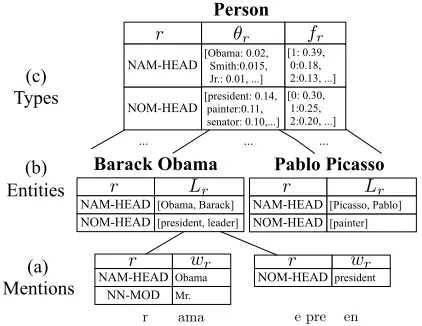
The key abstractions of our model are illustrated in Figure 1 and described here.
Mentions: A mention is an observed textual ref-erence to a latent real-world entity. Mentions are
Person
[0: 0.30, 1:0.25, 2:0.20, ...] NOM-HEAD
[1: 0.39, 0:0.18, 2:0.13, ...] [Obama: 0.02,
Smith:0.015, Jr.: 0.01, ...] [president: 0.14, painter:0.11, senator: 0.10,...] NAM-HEAD
r θr fr
NOM-HEAD[president, leader] NAM-HEAD[Obama, Barack]
r Lr
Barack Obama
NOM-HEAD[painter] NAM-HEAD[Picasso, Pablo]
r Lr
Pablo Picasso
NN-MOD Mr. NAM-HEADr Obama
wr
NOM-HEADr president
wr
Types
Entities
Mentions (c)
(b)
(a)
“Mr. Obama” “the president”
[image:2.612.81.292.60.223.2]... ... ...
Figure 1: The key abstractions of our model (Section 2). (a) Mentions map properties (r) to words (wr). (b)
Enti-ties map properEnti-ties (r) to word lists (Lr). (c) Types map
properties (r) to distributions over property words (θr)
and the fertilities of those distributions (fr). For (b) and
(c), we only illustrate a subset of the properties.
sociated with nodes in a parse tree and are typically realized as NPs. There are three basic forms of men-tions: proper (denotedNAM), nominal (NOM), and pronominal (PRO). We will often describe proper and nominal mentions together as referring men-tions.
We represent each mentionM as a collection of key-value pairs. The keys are calledpropertiesand the values are words. For example, the left mention in Figure 1(a) has a proper head property, denoted NAM-HEAD, with value “Obama.” The set of prop-erties we consider, denotedR, includes several va-rieties of heads, modifiers, and governors (see Sec-tion 5.2 for details). Not every menSec-tion has a value for every property.
Entities: An entity is a specific individual or ob-ject in the world. Entities are always latent in text. Where a mention has a single word for each prop-erty, an entity has a list of signature words. For-mally, entities are mappings from propertiesr ∈ R
to lists Lr of “canonical” words which that entity
uses for that property. For instance in Figure 1(b), the list of nominal heads for the Barack Obama en-tity includes “president.”
Types: Coreference systems often make a men-tion / entity distincmen-tion. We extend this hierarchy to includetypes, which represent classes of entities (PERSON,ORGANIZATION, and so on). Types allow
the sharing of properties across entities and mediate the generation of entities in our model (Section 3.1). See Figure 1(c) for a concrete example.
We represent each typeτ as a mapping between propertiesr and pairs of multinomials(θr, fr).
To-gether, these distributions control the listsLrfor
en-tities of that type. θr is a unigram distribution of
words that are semantically licensed for propertyr. fr is a “fertility” distribution over the integers that
characterizes entity list lengths. For example, for the typePERSON,θrfor proper heads is quite flat (there
are many last names) butfr is peaked at 1 (people
have a single last name).
3 Generative Model
We now describe our generative model. At the pa-rameter level, we have one papa-rameter group for the typesτ = (φ, τ1, . . . , τt), whereφis a multinomial
prior over a fixed numbertof types and the{τi}are
the parameters for each individual type, described in greater detail below. A second group comprises log-linear parametersπover discourse choices, also de-scribed below. Together, these two groups are drawn according toP(τ|λ)P(π|σ2), whereλandσ2are a small number of scalar hyper-parameters described in Section 4.
Conditioned on the parameters (τ,π), a docu-ment is generated as follows: A semantic module
generates a sequence E of entities. E is in prin-ciple infinite, though during inference only a finite number are ever instantiated. Adiscourse module
generates a vector Z which assigns an entity in-dex Zi to each mention position i. Finally, a men-tion generamen-tion module independently renders the sequence of mentions (M) from their underlying en-tities. The syntactic position and structure of men-tions are treated as observed, including the mention forms (pronominal, etc.). We useXto refer to this ungenenerated information. Our model decomposes as follows:
P(E,Z,M|τ,π,X) =
P(E|τ)[Semantic, Section 3.1] P(Z|π,X)[Discourse, Section 3.2] P(M|Z,E,τ)[Mention, Section 3.3]
T
L
rφ
f
rθ
rORG: 0.30 PERS: 0.22
GPE: 0.18 LOC: 0.15 WEA: 0.12 VEH: 0.09
...
T = PERS 0: 0.30 1: 0.25 2: 0.20 3: 0.18 ... PERS
For T = PERS president: 0.14 painter: 0.11 senator: 0.10 minister: 0.09 leader: 0.08 official: 0.06 executive: 0.05
...
president leader official
[image:3.612.91.283.59.285.2]R
E
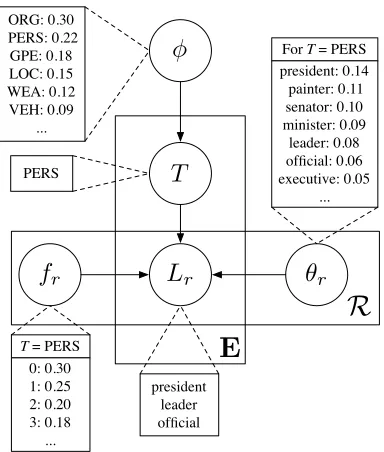
Figure 2: Depiction of the entity generation process (Sec-tion 3.1). Each entity draws a type (T) fromφ, and, for each propertyr∈ R, forms a word list (Lr) by choosing
a length fromT’sfrdistribution and then independently
drawing that many words fromT’sθrdistribution.
Ex-ample values are shown for the person type and the nom-inal head property (NOM-HEAD).
3.1 Semantic Module
The semantic module is responsible for generating a sequence of entities. Each entity E is generated independently and consists of a type indicatorT, as well as a collection{Lr}r∈R of word lists for each property. These elements are generated as follows:
Entity Generation
Draw entity typeT ∼φ
For each mention propertyr∈ R, Fetch{(fr, θr)}for
τ
TDraw word list length|Lr| ∼fr
Draw|Lr|words fromw∼θr
See Figure 2 for an illustration of this process. Each word list Lr is generated by first drawing a list
length from fr and then independently populating
that list from the property’s word distribution θr.1
Past work has employed broadly similar distribu-tional models for unsupervised NER of proper
men-1
There is one exception: the sizes of the proper and nomi-nal head property lists are jointly generated, but their word lists are still independently populated.
tions (Collins and Singer, 1999; Elsner et al., 2009). However, to our knowledge, this is the first work to incorporate such a model into an entity reference process.
3.2 Discourse Module
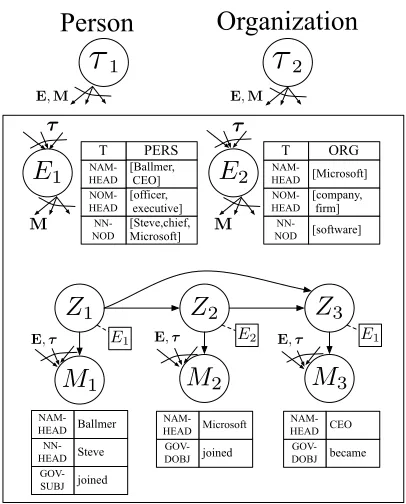
The discourse module is responsible for choosing an entity to evoke at each of the n mention posi-tions. Formally, this module generates an entity as-signment vectorZ = (Z1, . . . , Zn), whereZi
indi-cates the entity index for the ith mention position. Most linguistic inquiry characterizes NP anaphora by the pairwise relations that hold between a men-tion and its antecedent (Hobbs, 1979; Kehler et al., 2008). Our discourse module utilizes this pairwise perspective to define eachZiin terms of an
interme-diate “antecedent” variableAi.Aieither points to a
previous antecedent mention position (Ai < i) and
“steals” its entity assignment or begins a new entity (Ai=i). The choice ofAiis parametrized by
affini-tiessπ(i, j;X)between mention positionsiandj. Formally, this process is described as:
Entity Assignment
For each mention position,i= 1, . . . , n, Draw antecedent positionAi∈ {1, . . . , i}:
P(Ai =j|X)∝sπ(i, j;X)
Zi=
(
ZAi, ifAi < i K+ 1, otherwise
Here,K denotes the number of entities allocated in the firsti-1mention positions. This process is an in-stance of the sequential diin-stance-dependent Chinese Restaurant Process (DD-CRP) of Blei and Frazier (2009). During inference, we variously exploit both theAandZrepresentations (Section 4).
For nominal and pronoun mentions, there are sev-eral well-studied anaphora cues, including centering (Grosz et al., 1995), nearness (Hobbs, 1978), and deterministic constraints, which have all been uti-lized in prior coreference work (Soon et al., 1999; Ng and Cardie, 2002). In order to combine these cues, we take a log-linear, feature-based approach and parametrize sπ(i, j;X) = exp{π>f
X(i, j)},
an-tecedent: tree distance, sentence distance, and the syntactic positions (subject, object, and oblique) of the mention and antecedent. Features for starting a new entity include: a definiteness feature (extracted from the mention’s determiner), the top CFG rule of the mention parse node, its syntactic role, and a bias feature. These features are conjoined with the mention form (nominal or pronoun). Additionally, we restrict pronoun antecedents to the current and last two sentences, and the current and last three sen-tences for nominals. Additionally, we disallow nom-inals from having direct pronoun antecedents.
In addition to the above, if a mention is in a de-terministic coreference configuration, as defined in Haghighi and Klein (2009), we force it to take the required antecedent. In general, antecedent affini-ties learn to prefer close antecedents in prominent syntactic positions. We also learn that new entity nominals are typically indefinite or haveSBAR com-plements (captured by the CFG feature).
In contrast to nominals and pronouns, the choice of entity for a proper mention is governed more by entity frequency than antecedent distance. We cap-ture this by settingsπ(i, j;X)in the proper case to 1 for past positions and to a fixedαotherwise.2
3.3 Mention Module
Once the semantic module has generated entities and the discourse model selects entity assignments, each mentionMi generates word values for a set of
ob-served propertiesRi:
Mention Generation
For each mentionMi,i= 1, . . . , n
Fetch(T,{Lr}r∈R)fromEZi
Fetch{(fr, θr)}r∈Rfrom
τ
TForr ∈Ri :
w∼(1−αr)UNIFORM(Lr) + (αr)θr
For each propertyr, there is a hyper-parameterαr
which interpolates between selecting a word from the entity listLr and drawing from the underlying
type property distribution θr. Intuitively, a small
value ofαr indicates that an entity prefers to re-use
2
As Blei and Frazier (2009) notes, when marginalizing out theAiin this trivial case, the DD-CRP reduces to the traditional
CRP (Pitman, 2002), so our discourse model roughly matches Haghighi and Klein (2007) for proper mentions.
τ
1 [image:4.612.325.528.56.308.2]Person
Organization
[software]
NN-NOD
ORG [Microsoft] [company, firm]
NOM-HEAD NAM-HEAD
T
τ
2E
1E
2Z
1Z
2Z
3M
1M
2M
3[Steve,chief, Microsoft]
NN-NOD
PERS [Ballmer, CEO] [officer, executive]
NOM-HEAD NAM-HEAD
T
joined
GOV-SUBJ
Ballmer
Steve
NN-HEAD NAM-HEAD
joined
GOV-DOBJ
Microsoft
NAM-HEAD
became
GOV-DOBJ
CEO
NAM-HEAD
τ τ
E,τ E,τ E,τ
E,M E,M
E2
E1 E1
M M
Figure 3: Depiction of the discourse module (Sec-tion 3.2); each random variable is annotated with an ex-ample value. For each mention position, an entity as-signment (Zi) is made. Conditioned on entities (EZi), mentions (Mi) are rendered (Section 3.3). The Y
sym-bol denotes that a random variable is the parent of allY
random variables.
a small number of words for propertyr. This is typ-ically the case for proper and nominal heads as well as modifiers. At the other extreme, settingαr to 1
indicates the property isn’t particular to the entity itself, but rather only on its type. We set αr to 1
for pronoun heads as well as for the governor of the head properties.
4 Learning and Inference
Our learning procedure involves finding parame-ters and assignments which are likely under our model’s posterior distributionP(E,Z,τ,π|M,X). The model is modularized in such a way that run-ning EM on all variables simultaneously would be very difficult. Therefore, we adopt a variational ap-proach which optimizes various subgroups of the variables in a round-robin fashion, holding approx-imations to the others fixed. We first describe the variable groups, then the updates which optimize them in turn.
vari-ablesEinto types,T, one for each entity, and word lists,L, one for each entity and property. We decom-pose the mentionsMintoreferringmentions (prop-ers and nominals), Mr, and pronominal mentions,
Mp (with sizes n
r and np respectively). The
en-tity assignmentsZare similarly divided intoZrand
Zp components. For pronouns, rather than useZp,
we instead work with the corresponding antecedent variables, denoted Ap, and marginalize over
an-tecedents to obtainZp.
With these variable groups, we would like to approximation our model posterior P(T,L,Zr,Ap,τ,π|M,X) using a simple
fac-tored representation. Our variational approximation takes the following form:
Q(T,L,Zr,Ap,τ,π) =δr(Zr,L) n
Y
k=1
qk(Tk)
! np Y
i=1
ri(Api)
!
δs(τ)δd(π)
We use a mean field approach to update each of the RHS factors in turn to minimize the KL-divergence between the current variational posterior and the true model posterior. The δr, δs, and δd factors
place point estimates on a single value, just as in hard EM. Updating these factors involves finding the value which maximizes the model (expected) log-likelihood under the other factors. For instance, the δs factor is a point estimate of the type parameters,
and is updated with:3
δs(τ)←argmaxτ EQ−δslnP(E,Z,M,τ,π) (1)
where Q−δs denotes all factors of the variational approximation except for the factor being updated. The ri (pronoun antecedents) and qk (type
indica-tor) factors maintain a soft approximation and so are slightly more complex. For example, the ri factor
update takes the standard mean field form:
ri(Api)∝exp{EQ−ri lnP(E,Z,M,τ,π)} (2)
We briefly describe the update for each additional factor, omitting details for space.
Updating type parameters δs(τ): The type
pa-rameters τ consist of several multinomial distri-butions which can be updated by normalizing ex-pected counts as in the EM algorithm. The prior
3Of course during learning, theargmaxis performed over the entire document collection, rather than a single document.
P(τ|λ)consists of several finite Dirichlet draws for each multinomial, which are incorporated as pseu-docounts.4 Given the entity type variational poste-riors {qk(·)}, as well as the point estimates of the
LandZrelements, we obtain expected counts from
each entity’s attribute word lists and referring men-tion usages.
Updating discourse parameters δd(π): The
learned parameters for the discourse module rely on pairwise antecedent counts for assignments to nom-inal and pronomnom-inal mentions.5 Given these ex-pected counts, which can be easily obtained from other factors, the update reduces to a weighted max-imum entropy problem, which we optimize using LBFGS. The priorP(π|σ2)is a zero-centered nor-mal distribution with shared diagonal variance σ2, which is incorporated via L2 regularization during optimization.
Updating referring assignments and word lists
δr(Zr,L): The word lists are usually
concatena-tions of the words used in nominal and proper mentions and so are updated together with the assignments for those mentions. Updating the δr(Zr,L)factor involves finding the referring
men-tion entity assignments, Zr, and property word
lists L for instantiated entities which maximize EQ−δr lnP(T,L,Z
r,Ap,M,τ,π). We actually
only need to optimize overZr, since for anyZr, we
can compute the optimal set of property word lists L. Essentially, for each entity we can compute the Lr which optimizes the probability of the referring
mentions assigned to the entity (indicated byZr). In
practice, the optimal Lr is just the set of property
words in the assigned mentions. Of course enumer-ating and scoring all Zr hypotheses is intractable,
so we instead utilize a left-to-right sequential beam search. Each partial hypothesis is an assignment to a prefix of mention positions and is scored as though it were a complete hypothesis. Hypotheses are ex-tended via adding a new mention to an existing en-tity or creating a new one. For our experiments, we limited the number of hypotheses on the beam to the top fifty and did not notice an improvement in model score from increasing beam size.
4
See software release for full hyper-parameter details. 5
Updating pronominal antecedentsri(Api)and en-tity types qk(Tk): These updates are
straightfor-ward instantiations of the mean-field update (2). To produce our final coreference partitions, we as-sign each referring mention to the entity given by the δr factor and each pronoun to the most likely entity
given by theri.
4.1 Factor Staging
In order to facilitate learning, some factors are ini-tially set to fixed heuristic values and only learned in later iterations. Initially, the assignment factors δr and {ri} are fixed. For δr, we use a
determin-istic entity assignmentZr, similar to the Haghighi
and Klein (2009)’sSYN-CONSTRsetting: each re-ferring mention is coreferent with any past men-tion with the same head or in a deterministic syn-tactic configuration (appositives or predicative nom-inatives constructions).6The{ri}factors are
heuris-tically set to place most of their mass on the closest antecedent by tree distance. During training, we pro-ceed in stages, each consisting of 5 iterations:
Stage Learned Fixed B3All
1 δs, δd,{qk} {ri},δr 74.6
2 δs, δd,{qk}, δr {ri} 76.3
3 δs, δd,{qk}, δr,{ri} – 78.0
We evaluate our system at the end of stage using the B3All metric on the A05CU development set (see Section 5 for details).
5 Experiments
We considered the challenging end-to-end system mention setting, where in addition to predicting mention partitions, a system must identify the men-tions themselves and their boundaries automati-cally. Our system deterministically extracts mention boundaries from parse trees (Section 5.2). We uti-lized no coreference annotation during training, but did use minimal prototype information to prime the learning of entity types (Section 5.3).
5.1 Datasets
For evaluation, we used standard coreference data sets derived from the ACE corpora:
6Forcing appositive coreference is essential for tying proper and nominal entity type vocabulary.
• A04CU: Train/dev/test split of the newswire portion of the ACE 2004 training set7 utilized in Culotta et al. (2007), Bengston and Roth (2008) and Stoyanov et al. (2009). Consists of 90/68/38 documents respectively.
• A05ST: Train/test split of the newswire portion of the ACE 2005 training set utilized in Stoy-anov et al. (2009). Consists of 57/24 docu-ments respectively.
• A05RA: Train/test split of the ACE 2005 train-ing set utilized in Rahman and Ng (2009). Con-sists of 482/117 documents respectively.
For all experiments, we evaluated on the dev and test sets above. To train, we included the text of all doc-uments above, though of course not looking at ei-ther their mention boundaries or reference annota-tions in any way. We also trained on the following much larger unlabeled datasets utilized in Haghighi and Klein (2009):
• BLLIP: 5k articles of newswire parsed with the Charniak (2000) parser.
• WIKI: 8k abstracts of English Wikipedia arti-cles parsed by the Berkeley parser (Petrov et al., 2006). Articles were selected to have sub-jects amongst the frequent proper nouns in the evaluation datasets.
5.2 Mention Detection and Properties
Mention boundaries were automatically detected as follows: For each noun or pronoun (determined by parser POS tag), we associated a mention with the maximal NP projection of that head or that word it-self if no NP can be found. This procedure recovers over 90% of annotated mentions on theA05CUdev set, but also extracts many unannotated “spurious” mentions (for instance events, times, dates, or ab-stract nouns) which are not deemed to be of interest by the ACE annotation conventions.
Mention properties were obtained from parse trees using the the Stanford typed dependency ex-tractor (de Marneffe et al., 2006). The mention prop-erties we considered are the mention head (anno-tated with mention type), the typed modifiers of the head, and the governor of the head (conjoined with
MUC B3All B3N one Pairwise F 1
System P R F1 P R F1 P R F1 P R F1
ACE2004-STOYANOV-TEST
Stoyanov et al. (2009) - - 62.0 - - 76.5 - - 75.4 - - -Haghighi and Klein (2009) 67.5 61.6 64.4 77.4 69.4 73.2 77.4 67.1 71.3 58.3 44.5 50.5
THIS WORK 67.4 66.6 67.0 81.2 73.3 77.0 80.6 75.2 77.3 59.2 50.3 54.4
ACE2005-STOYANOV-TEST
Stoyanov et al. (2009) - - 67.4 - - 73.7 - - 72.5 - - -Haghighi and Klein (2009) 73.1 58.8 65.2 82.1 63.9 71.8 81.2 61.6 70.1 66.1 37.9 48.1
THIS WORK 74.6 62.7 68.1 83.2 68.4 75.1 82.7 66.3 73.6 64.3 41.4 50.4 ACE2005-RAHMAN-TEST
Rahman and Ng (2009) 75.4 64.1 69.3 - - - 54.4 70.5 61.4 - - -Haghighi and Klein (2009) 72.9 60.2 67.0 53.2 73.1 61.6 52.0 72.6 60.6 57.0 44.6 50.0
[image:7.612.114.500.59.209.2]THIS WORK 77.0 66.9 71.6 55.4 74.8 63.8 54.0 74.7 62.7 60.1 47.7 53.0
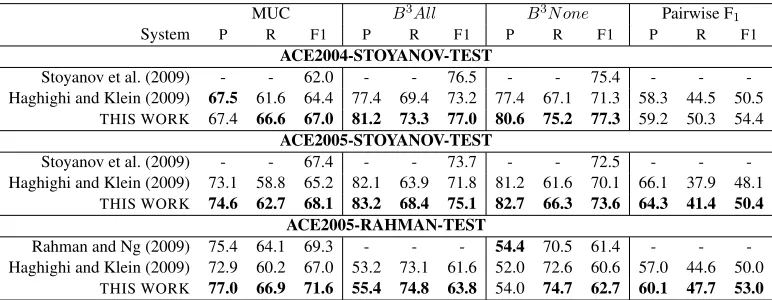
Table 1: Experimental results with system mentions. All systems except Haghighi and Klein (2009) and current work are fully supervised. The current work outperforms all other systems, supervised or unsupervised. For comparison pur-poses, theB3N onevariant used onA05RAis calculated slightly differently than otherB3N oneresults; see Rahman and Ng (2009).
the mention’s syntactic position). We discard deter-miners, but make use of them in the discourse com-ponent (Section 3.2) for NP definiteness.
5.3 Prototyping Entity Types
While it is possible to learn type distributions in a completely unsupervised fashion, we found it use-ful to prime the system with a handuse-ful of important types. Rather than relying on fully supervised data, we took the approach of Haghighi and Klein (2006). For each type of interest, we provided a (possibly-empty) prototype list of proper and nominal head words, as well as a list of allowed pronouns. For instance, for thePERSONtype we might provide:
NAM Bush, Gore, Hussein NOM president, minister, official
PRO he, his, she, him, her, you, ...
The prototypes were used as follows: Any entity with a prototype on any proper or nominal head word attribute list (Section 3.1) was constrained to have the specified type; i.e. theqkfactor (Section 4)
places probability one on that single type. Simi-larly to Haghighi and Klein (2007) and Elsner et al. (2009), we biased these types’ pronoun distributions to the allowed set of pronouns.
In general, the choice of entity types to prime with prototypes is a domain-specific question. For experiments here, we utilized the types which are annotated in the ACE coreference data: person (PERS), organization (ORG), geo-political entity (GPE), weapon (WEA), vehicle (VEH), location
(LOC), and facility (FAC). Since the person type in ACE conflates individual persons with groups of people (e.g., soldier vs. soldiers), we added the group (GROUP) type and generated a prototype specification.
We obtained our prototype list by extracting at most four common proper and nominal head words from the newswire portions of the 2004 and 2005 ACE training sets (A04CU and A05ST); we chose prototype words to be minimally ambiguous with respect to type.8 When there are not at least three proper heads for a type (WEA for instance), we did not provide any proper prototypes and instead strongly biased the type fertility parameters to gen-erate emptyNAM-HEADlists.
Because only certain semantic types were anno-tated under the arbitrary ACE guidelines, there are many mentions which do not fall into those limited categories. We therefore prototype (refinements of) the ACE types and then add an equal number of un-constrained “other” types which are automatically induced. A nice consequence of this approach is that we can simply run our model onall mentions, discarding at evaluation time any which are of non-prototyped types.
5.4 Evaluation
We evaluated on multiple coreference resolution metrics, as no single one is clearly superior,
ularly in dealing with the system mention setting. We utilized MUC (Vilain et al., 1995),B3All (Stoy-anov et al., 2009),B3N one(Stoyanov et al., 2009), and Pairwise F1. TheB3All andB3N one areB3 variants (Bagga and Baldwin, 1998) that differ in their treatment of spurious mentions. For Pairwise F1, precision measures how often pairs of predicted coreferent mentions are in the same annotated entity. We eliminated any mention pair from this calcula-tion where both mencalcula-tions were spurious.9
5.5 Results
Table 1 shows our results. We compared to two state-of-the-art supervised coreference systems. The Stoyanov et al. (2009) numbers represent their
THRESHOLD ESTIMATIONsetting and the Rahman
and Ng (2009) numbers represent their highest-performing cluster ranking model. We also com-pared to the strong deterministic system of Haghighi and Klein (2009).10 Across all data sets, our model, despite being largely unsupervised, consistently out-performs these systems, which are the best previ-ously reported results on end-to-end coreference res-olution (i.e. including mention detection). Perfor-mance on theA05RAdataset is generally lower be-cause it includes articles from blogs and web forums where parser quality is significantly degraded.
While Bengston and Roth (2008) do not report on the full system mention task, they do report on the more optimistic setting where mention detection is performed but non-gold mentions are removed for evaluation using an oracle. On this more lenient set-ting, they report 78.4B3on theA04CUtest set. Our model yields 80.3.
6 Analysis
We now discuss errors and improvements made by our system. One frequent source of error is the merging of mentions with explicitly contrasting modifiers, such asnew presidentandold president. While it is not unusual for a single entity to admit multiple modifiers, the particular modifiersnewand
oldare incompatible in a way thatnewandpopular
9Note that we are still penalized for marking a spurious mention coreferent with an annotated one.
10Haghighi and Klein (2009) reports on true mentions; here, we report performance on automatically detected mentions.
are not. Our model does not represent the negative covariance between these modifiers.
We compared our output to the deterministic sys-tem of Haghighi and Klein (2009). Many improve-ments arise from correctly identifying mentions which are semantically compatible but which do not explicitly appear in an appositive or predicate-nominative configuration in the data. For example,
analystandit cannot corefer in our system because
itis not a likely pronoun for the typePERSON. While the focus of our model is coreference res-olution, we can also isolate and evaluate the type component of our model as an NER system. We test this component by presenting our learned model with boundary-annotated non-pronominal entities from theA05STdev set and querying their predicted type variable T. Doing so yields 83.2 entity clas-sification accuracy under the mapping between our prototyped types and the coarse ACE types. Note that this task is substantially more difficult than the unsupervised NER in Elsner et al. (2009) because the inventory of named entities is larger (7 vs. 3) and because we predict types over nominal mentions that are more difficult to judge from surface forms. In this task, the plurality of errors are confusions be-tween the GPE (geo-political entity) and ORG entity types, which have very similar distributions.
7 Conclusion
Our model is able to acquire and exploit knowledge at either the level of individual entities (“Obama” is a “president”) and entity types (“company” can refer to a corporation). As a result, it leverages semantic constraints more effectively than systems operating at either level alone. In conjunction with reasonable, but simple, factors capturing discourse and syntac-tic configurational preferences, our entity-centric se-mantic model lowers coreference error rate substan-tially, particularly on semantically disambiguated references, giving a sizable improvement over the state-of-the-art.11
Acknowledgements: This project is funded in part by the Office of Naval Research under MURI Grant No. N000140911081.
11See
References
A Bagga and B Baldwin. 1998. Algorithms for scoring coreference chains. InLinguistic Coreference
Work-shop (LREC).
Eric Bengston and Dan Roth. 2008. Understanding the Value of Features for Corefernce Resolution. In
Empirical Methods in Natural Language Processing
(EMNLP).
David Blei and Peter I. Frazier. 2009.
Dis-tance Dependent Chinese Restaurant Processes. http://arxiv.org/abs/0910.1022/.
Eugene Charniak. 2000. Maximum Entropy Inspired Parser. InNorth American Chapter of the Association
of Computational Linguistics (NAACL).
Michael Collins and Yoram Singer. 1999. Unsupervised Models for Named Entity Classification. InEmpirical
Methods in Natural Language Processing (EMNLP).
Mike Collins. 1999. Head-Driven Statistical Models for
Natural Language Parsing. Ph.D. thesis, University of
Pennsylvania.
A Culotta, M Wick, R Hall, and A McCallum. 2007. First-order Probabilistic Models for Coreference Res-olution. InProceedings of the conference on Human Language Technology and Empirical Methods in
Nat-ural Language Processing (NAACL-HLT).
M. C. de Marneffe, B. Maccartney, and C. D. Manning. 2006. Generating Typed Dependency Parses from Phrase Structure Parses. InLREC.
M Elsner, E Charniak, and M Johnson. 2009. Structured generative models for unsupervised named-entity clus-tering. InProceedings of Human Language Technolo-gies: The 2009 Annual Conference of the North Ameri-can Chapter of the Association for Computational
Lin-guistics, pages 164–172.
Barbara J. Grosz, Aravind K. Joshi, and Scott Weinstein. 1995. Centering: A Framework for Modeling the Lo-cal Coherence of Discourse. Computational Linguis-tics, 21(2):203–225.
Aria Haghighi and Dan Klein. 2006. Prototype-Driven Learning for Sequence Models. In HLT-NAACL. As-sociation for Computational Linguistics.
Aria Haghighi and Dan Klein. 2007. Unsupervised Coreference Resolution in a Nonparametric Bayesian Model. InProceedings of the 45th Annual Meeting of
the Association of Computational Linguistics.
Associ-ation for ComputAssoci-ational Linguistics.
Aria Haghighi and Dan Klein. 2009. Simple Coreference Resolution with Rich Syntactic and Semantic Features.
In Proceedings of the 2009 Conference on Empirical
Conference in Natural Language Processing.
J. R. Hobbs. 1978. Resolving Pronoun References. Lin-gua, 44.
J. R. Hobbs. 1979. Coherence and Coreference.
Cogni-tive Science, 3:67–90.
Andrew Kehler, Laura Kertz, Hannah Rohde, and Jeffrey Elman. 2008. Coherence and Coreference Revisited.
Vincent Ng and Claire Cardie. 2002. Improving
Machine Learning Approaches to Coreference Res-olution. In Association of Computational Linguists
(ACL).
Vincent Ng. 2005. Machine Learning for Corefer-ence Resolution: From Local Classification to Global Ranking. InAssociation of Computational Linguists
(ACL).
Vincent Ng. 2007. Shallow semantics for coreference resolution. InIJCAI’07: Proceedings of the 20th
in-ternational joint conference on Artifical intelligence,
pages 1689–1694.
Slav Petrov, Leon Barrett, Romain Thibaux, and Dan Klein. 2006. Learning Accurate, Compact, and Inter-pretable Tree Annotation. InProceedings of the 21st International Conference on Computational Linguis-tics and 44th Annual Meeting of the Association for
Computational Linguistics, pages 433–440, Sydney,
Australia, July. Association for Computational Lin-guistics.
J. Pitman. 2002. Combinatorial Stochastic Processes. In
Lecture Notes for St. Flour Summer School.
A Rahman and V Ng. 2009. Supervised models for
coreference resolution. In Proceedings of the 2009 Conference on Empirical Conference in Natural
Lan-guage Processing.
W.H. Soon, H. T. Ng, and D. C. Y. Lim. 1999. A Ma-chine Learning Approach to Coreference Resolution of Noun Phrases.
V Stoyanov, N Gilbert, C Cardie, and E Riloff. 2009. Conundrums in Noun Phrase Coreference Resolution: Making Sense of the State-of-the-art. InAssociate of
Computational Linguistics (ACL).
Marc Vilain, John Burger, John Aberdeen, Dennis
Con-nolly, and Lynette Hirschman. 1995. A
model-theoretic coreference scoring scheme. InMUC-6. X Yang, J Su, and CL Tan. 2005. Improving pronoun
resolution using statistics-based semantic compatibil-ity information. InAssociation of Computational