Unsupervised Model Adaptation using Information-Theoretic Criterion
Ariya Rastrow1, Frederick Jelinek1, Abhinav Sethy2 and Bhuvana Ramabhadran2 1Human Language Technology Center of Excellence, and
Center for Language and Speech Processing, Johns Hopkins University {ariya, jelinek}@jhu.edu
2IBM T.J. Watson Research Center, Yorktown Heights, NY, USA
{asethy, bhuvana}@us.ibm.com
Abstract
In this paper we propose a novel general framework for unsupervised model adapta-tion. Our method is based on entropy which has been used previously as a regularizer in semi-supervised learning. This technique in-cludes another term which measures the sta-bility of posteriors w.r.t model parameters, in addition to conditional entropy. The idea is to use parameters which result in both low con-ditional entropy and also stable decision rules. As an application, we demonstrate how this framework can be used for adjusting language model interpolation weight for speech recog-nition task to adapt from Broadcast news data to MIT lecture data. We show how the new technique can obtain comparable performance to completely supervised estimation of inter-polation parameters.
1 Introduction
All statistical and machine learning techniques for classification, in principle, work under the assump-tion that
1. A reasonable amount of training data is avail-able.
2. Training data and test data are drawn from the same underlying distribution.
In fact, the success of statistical models is cru-cially dependent on training data. Unfortunately, the latter assumption is not fulfilled in many appli-cations. Therefore, model adaptation is necessary when training data is not matched (not drawn from
same distribution) with test data. It is often the case where we have plenty of labeled data for one specific domain/genre (source domain) and little amount of labeled data (or no labeled data at all) for the de-sired domain/genre (target domain). Model adapta-tion techniques are commonly used to address this problem. Model adaptation starts with trained mod-els (trained on source domain with rich amount of la-beled data) and then modify them using the available labeled data from target domain (or instead unla-beled data). A survey on different methods of model adaptation can be found in (Jiang, 2008).
Information regularization framework has been previously proposed in literature to control the la-bel conditional probabilities via input distribution (Szummer and Jaakkola, 2003). The idea is that la-bels should not change too much in dense regions of the input distribution. The authors use the mu-tual information between input features and labels as a measure of label complexity. Another framework previously suggested is to use label entropy (condi-tional entropy) on unlabeled data as a regularizer to Maximum Likelihood (ML) training on labeled data (Grandvalet and Bengio, 2004).
Availability of resources for the target domain
cat-egorizes these techniques into either supervised or
unsupervised. In this paper we propose a general framework for unsupervised adaptation using Shan-non entropy and stability of entropy. The assump-tion is that in-domain and out-of-domain distribu-tions are not too different such that one can improve the performance of initial models on in-domain data by little adjustment of initial decision boundaries (learned on out-of-domain data).
2 Conditional Entropy based Adaptation
In this section, conditional entropy and its relation to classifier performance are first described. Next, we introduce our proposed objective function for do-main adaptation.
2.1 Conditional Entropy
Considering the classification problem whereXand
Yare the input features and the corresponding class
labels respectively, the conditional entropy is a mea-sure of the class overlap and is calculated as follows
H(Y|X) =EX[H(Y|X=x)] =
− Z
p(x) X
y
p(y|x) logp(y|x)
!
dx (1)
Through Fano’s Inequalitytheorem, one can see
how conditional entropy is related to classification performance.
Theorem 1 (Fano’s Inequality) Suppose
Pe = P{Yˆ 6= Y} where Yˆ = g(X) are the
assigned labels for the data points, based on the classification rule. Then
Pe≥
H(Y|X)−1
log(|Y| −1)
where Y is the number of possible classes and
H(Y|X) is the conditional entropy with respect to true distibution.
The proof to this theorem can be found in (Cover and
Thomas, 2006). This inequality indicates thatYcan
be estimated with low probability of error only if the
conditional entropyH(Y|X)is small.
Although the above theorem is useful in a sense that it connects the classification problem to Shan-non entropy, the true distributions are almost never
known to us1. In most classification methods, a
spe-cific model structure for the distributions is assumed and the task is to estimate the model parameters within the assumed model space. Given the model
1
In fact, Theorem 1 shows how relevant the input features are for the classification task by putting a lower bound on the best possible classifier performance. As the overlap between features from different classes increases, conditional entropy in-creases as well, thus lowering the performance of the best pos-sible classifier.
structure and parameters, one can modifyFano’s
In-equalityas follows,
Corollary 1
Pe(θ) =P{Yˆ 6=Y|θ} ≥
Hθ(Y|X)−1 log(|Y| −1)
(2)
where Pe(θ) is the classifier probability of error
given model parameters,θand
Hθ(Y|X) =
− Z
p(x) X
y
pθ(y|x) logpθ(y|x) !
dx
Here,Hθ(Y|X)is the conditional entropy imposed
by model parameters.
Eqn. 2 indicates the fact that models with low
conditional entropy are preferable. However, a low entropy model does not necessarily have good
per-formance (this will be reviewed later on)2
2.2 Objective Function
Minimization of conditional entropy as a framework in the classification task is not a new concept and has been tried by researchers. In fact, (Grandvalet and Bengio, 2004) use this along with the maxi-mum likelihood criterion in a semi-supervised set up such that parameters with both maximum like-lihood on labeled data and minimum conditional en-tropy on unlabeled data are chosen. By minimiz-ing the entropy, the method assumes a prior which prefers minimal class overlap. Entropy minimiza-tion is used in (Li et al., 2004) as an unsupervised non-parametric clustering method and is shown to
result in significant improvement overk-mean,
hier-archical clustering and etc.
These methods are all based on the fact that mod-els with low conditional entropy have their decision boundaries passing through low-density regions of
the input distribution,P(X). This is consistent with
the assumption that classes are well separated so that one can expect to take advantage of unlabeled exam-ples (Grandvalet and Bengio, 2004).
In many cases shifting from one domain to an-other domain, initial trained decision boundaries (on
out-of-domain data) result in high conditional en-tropy for the new domain, due to mismatch be-tween distributions. Therefore, there is a need to adjust model parameters such that decision bound-aries goes through low-density regions of the distri-bution. This motivates the idea of using minimum conditional entropy criterion for adapting to a new domain. At the same time, two domains are often close enough that one would expect that the optimal parameters for the new domain should not deviate too much from initial parameters. In order to formu-late the technique mentioned in the above paragraph,
let us define Θinit to be the initial model
parame-ters estimated on out-of-domain data (using labeled data). Assuming the availability of enough amount of unlabeled data for in-domain task, we try to min-imize the following objective function w.r.t the pa-rameters,
θnew = argmin
θ
Hθ(Y|X) +λ||θ−θinit||p
(3)
where||θ−θinit||p is anLpregularizer and tries to
prevent parameters from deviating too much from
their initial values3.
Once again the idea here is to adjust the param-eters (using unlabeled data) such that low-density separation between the classes is achieved. In the following section we will discuss the drawback of this objective function for adaptation in realistic sce-narios.
3 Issues with Minimum Entropy Criterion
It is discussed in Section 2.2 that the model param-eters are adapted such that a minimum conditional entropy is achieved. It was also discussed how this is related to finding decision boundaries through low-density regions of input distribution. However, the obvious assumption here is that the classes are well separated and there in fact exists low-density regions between classes which can be treated as boundaries. Although this is a suitable/ideal assumption for clas-sification, in most practical problems this assump-tion is not satisfied and often classes overlap. There-fore, we can not expect the conditional entropy to be
3The other reason for using a regularizer is to prevent trivial solutions of minimum entropy criterion
convex in this situation and to achieve minimization w.r.t parameters (other than the trivial solutions).
Let us clarify this through an example. Consider
X to be generated by mixture of two 2-D
Gaus-sians (each with a particular mean and covariance matrix) where each Gaussian corresponds to a par-ticular class ( binary class situation) . Also in order to have linear decision boundaries, let the Gaussians have same covariance matrix and let the parameter
being estimated be the prior for class 1,P(Y = 1).
Fig. 1 shows two different situations with
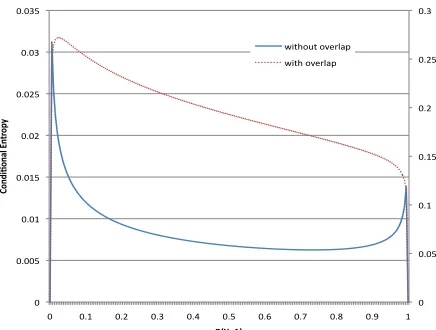
over-lapping classes and non-overover-lapping classes. The left panel shows a distribution in which classes are well separated whereas the right panel corresponds to the situation where there is considerable overlap between classes. Clearly, in the later case there is no low-density region separating the classes. There-fore, as we change the parameter (here, the prior on
the classY = 1), there will not be any well defined
point with minimum entropy. This can be seen from Fig. 2 where model conditional entropy is plotted vs. class prior parameter for both cases. In the case of no-overlap between classes, entropy is a convex function w.r.t the parameter (excluding trivial
solu-tions which happens at P(Y = 1) = 0,1) and is
minimum atP(Y = 1) = 0.7which is the true prior
with which the data was generated.
We summarize issues with minimum entropy cri-terion and our proposed solutions as follows:
• Trivial solution: this happens when we put
de-cision boundaries such that both classes are considered as one class (this can be avoided us-ing the regularizer in Eqn. 3 and the assump-tion that initial models have a reasonable solu-tion, e.g. close to the optimal solution for new domain )
• Overlapped Classes: As it was discussed in
this section, if the overlap is considerable then the entropy will not be convex w.r.t to model
parameters. We will address this issue in
the next section by introducing the entropy-stability concept.
4 Entropy-Stability
ï3 ï2 ï1 0 1 2 3 4 5 6 7 ï4 ï2 0 2 4 6 8 10 X1 X2
ï3 ï2 ï1 0 1 2 3 4 5 6 7
[image:4.612.82.546.61.240.2]ï3 ï2 ï1 0 1 2 3 4 5 6 7 X1 X2
Figure 1: Mixture of two Gaussians and the corresponding Bayes decision boundary: (left) with no class overlap (right) with class overlap
0 0.05 0.1 0.15 0.2 0.25 0.3
0 0.005 0.01 0.015 0.02 0.025 0.03 0.035
0 0.1 0.2 0.3 0.4 0.5 0.6 0.7 0.8 0.9 1
Co
nd
i&o
na
l E
nt
ro
py
P(Y=1)
without overlap with overlap
Figure 2: Condtional entropy vs. prior parameter,P(Y =
1)
situations where there is a considerable amount of overlap among classes. Assuming that class bound-aries happen in the regions close to the tail of class
distributions, we introduce the concept of
Entropy-Stability and show how it can be used to detect
boundary regions. DefineEntropy-Stabilityto be the
reciprocal of the following
∂Hθ(Y|X)
∂θ p = Z
p(x) ∂P
ypθ(y|x) logpθ(y|x) ∂θ dx p (4)
Recall: sinceθis a vector of parameters, ∂Hθ(Y|X)
∂θ
will be a vector and by using Lp norm
Entropy-stability will be a scalar.
The introduced concept basically measures the stability of label entropies w.r.t the model parame-ters. The idea is that we prefer models which not only have low-conditional entropy but also have sta-ble decision rules imposed by the model. Next, we show through the following theorem how Entropy-Stability measures the stability over posterior prob-abilities (decision rules) of the model.
Theorem 2
∂Hθ(Y|X)
∂θ p = Z
p(x) X
y
∂pθ(y|x)
∂θ logpθ(y|x)
! dx p
where the term inside the parenthesis is the weighted sum (by log-likelihood) over the gradient of poste-rior probabilities of labels for a given samplex
Proof The proof is straight forward and uses the fact
thatP∂pθ(y|x)
∂θ =
∂(P pθ(y|x))
∂θ = 0.
Using Theorem 2 and Eqn. 4, it should be clear how Entropy-Stability measures the expected sta-bility over the posterior probabilities of the model. A high value of
∂Hθ(Y|X)
∂θ
p implies models with
[image:4.612.76.294.296.461.2]regions) we once again refer back to our mixture of Gaussians’ example. As the decision boundary moves from class specific regions to overlapped re-gions (by changing the parameter which is here class prior probability) we expect the entropy to continu-ously decrease (due to the assumption that the over-laps occur at the tail of class distributions). How-ever, as we get close to the overlapping regions the added data points from other class(es) will resist changes in the entropy. resulting in stability over the entropy until we enter the regions specific to other class(es).
In the following subsection we use this idea to propose a new objective function which can be used as an unsupervised adaptation method even for the case of input distribution with overlapping classes.
4.1 Better Objective Function
The idea here is to use the Entropy-Stability con-cept to accon-cept only regions which are close to the overlapped parts of the distribution (based on our assumption, these are valid regions for decision boundaries) and then using the minimum entropy criterion we find optimum solutions for our parame-ters inside these regions. Therefore, we modify Eqn. 3 such that it also includes the Entropy-Stability term
θnew = argmin
θ
Hθ(Y|X) +γ
∂Hθ(Y|X)
∂θ
p0
+ λ||θ−θinit||p
(5)
The parameter γ and λ can be tuned using small
amount of labeled data (Dev set).
5 Speech Recognition Task
In this section we will discuss how the proposed framework can be used in a speech recognition task.
In the speech recognition task, Y is the sequence
of words and X is the input speech signal. For a
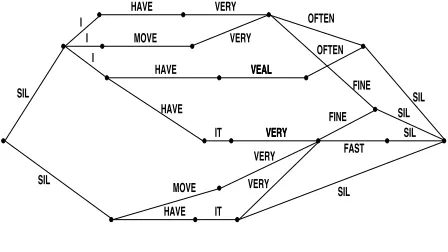
given speech signal, almost every word sequence is a possible output and therefore there is a need for a compact representation of output labels (words). For this, word graphs (Lattices) are generated dur-ing the recognition process. In fact, each lattice is an acyclic directed graph whose nodes correspond
to particular instants of time, and arcs (edges con-necting nodes) represent possible word hypotheses. Associated with each arc is an acoustic likelihood and language model likelihood scores. Fig. 3 shows
an example of recognition lattice4(for the purpose
of demonstration likelihood scores are not shown).L. Manguet al.: Finding Consensus in Speech Recognition 6
(a) Input lattice (“SIL” marks pauses)
SIL
SIL
SIL
SIL SIL
SIL VEAL
VERY HAVE
MOVE
HAVE
HAVE
IT
MOVE
HAVE IT
VERY
VERY
VEAL
VERY
VERY
VERY OFTEN
OFTEN
FINE
FINE
FAST I
I
I
(b) Multiple alignment (“-” marks deletions)
-
-I
MOVE
HAVE IT VEAL
VERY FINE
OFTEN
FAST
Figure 1:Sample recognition lattice and corresponding multiple alignment represented as confusion network.
alignment (which gives rise to the standard string edit distanceWE(W, R)) with a modified, multiple string alignment. The new approach incorporates all lattice hypotheses7into a single alignment, and word error between any two hypotheses
is then computed according to that one alignment. The multiple alignment thus defines a new string edit distance, which we will callMWE(W, R). While the new alignment may in some cases overestimate the word error between two hypotheses, as we will show in Section 5 it gives very similar results in practice. The main benefit of the multiple alignment is that it allows us to extract the hypothesis with the smallest expected (modified) word error very efficiently. To see this, consider an example. Figure 1 shows a word lattice and the corre-sponding hypothesis alignment. Each word hypothesis is mapped to a position in the alignment (with deletions marked by “-”). The alignment also supports the computation ofword posterior probabilities. The posterior probability of a word hypothesis is the sum of the posterior probabilities of all lattice paths of which the word is a part. Given an alignment and posterior probabilities, it is easy to see that the hypothesis with the lowest expected word error is obtained by picking the word with the highest posterior at each position in the alignment. We call this theconsensus hypothesis.
7In practice we apply some pruning of the lattice to remove low probability word hypotheses
[image:5.612.314.538.164.290.2](see Section 3.4).
Figure 3: Lattice Example
Since lattices contain all the likely hypotheses (unlikely hypotheses are pruned during recognition and will not be included in the lattice), conditional
entropy for any given input speech signal,x, can be
approximated by the conditional entropy of the lat-tice. That is,
Hθ(Y|X=xi) =Hθ(Y|Li)
whereLiis the corresponding decoded lattice (given
speech recognizer parameters) of utterancexi.
For the calculation of entropy we need to
know the distribution of X because Hθ(Y|X) =
EX[Hθ(Y|X=x)]and since this distribution is not
known to us, we useLaw of Large Numbersto
ap-proximate it by the empirical average
Hθ(Y|X)≈ − 1 N
N X
i=1 X
y∈Li
pθ(y|Li) logpθ(y|Li) (6)
Here N indicates the number of unlabeled
utter-ances for which we calculate the empirical value of conditional entropy. Similarly, expectation w.r.t in-put distribution in entropy-stability term is also ap-proximated by the empirical average of samples.
Since the number of paths (hypotheses) in the lat-tice is very large, it would be computationally infea-sible to compute the conditional entropy by enumer-ating all possible paths in the lattice and calculenumer-ating
4
Element hp, ri hp1, r1i⊗hp2, r2i hp1p2, p1r2+p2r1i hp1, r1i⊕hp2, r2i hp1+p2, r1+r2i
0 h0,0i
[image:6.612.84.287.60.133.2]1 h1,0i
Table 1:First-Order (Expectation) semiring: Defining
multiplicationand sumoperations for first-order
semir-ings.
their corresponding posterior probabilities. Instead we use Finite-State Transducers (FST) to represent the hypothesis space (lattice). To calculate entropy and the gradient of entropy, the weights for the FST
are defined to be First- and Second-Ordersemirings
(Li and Eisner, 2009). The idea is to usesemirings
and their corresponding operations along with the forward-backward algorithm to calculate first- and second-order statistics to compute entropy and the gradient of entropy respectively. Assume we are in-terested in calculating the entropy of the lattice,
H(p) = −X d∈Li
p(d) Z log(
p(d) Z )
= logZ− 1
Z
X
d∈Li
p(d) logp(d)
= logZ− r¯
Z (7)
where Z is the total probability of all the paths in
the lattice (normalization factor). In order to do so,
we need to compute hZ,r¯i on the lattice. It can
be proved that if we define the first-order
semir-inghpe, pelogpei(peis the non-normalized score of
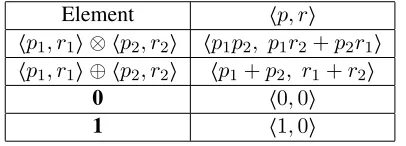
each arc in the lattice) as our FST weights and define semiring operations as in Table. 1, then applying the forward algorithm will result in the calculation of
hZ,r¯ias the weight (semiring weight) for the final
node.
The details for using Second-Ordersemiringsfor
calculating the gradient of entropy can be found
in (Li and Eisner, 2009). The same paper
de-scribes how to use the forward-backward algorithm to speed-up the this procedure.
6 Language Model Adaptation
Language Model Adaptation is crucial when the training data does not match the test data being de-coded. This is a frequent scenario for all Automatic
Speech Recognition (ASR) systems. The applica-tion domain very often contains named entities and N-gram sequences that are unique to the domain of
interest. For example, conversational speech has
a very different structure than class-room lectures. Linear Interpolation based methods are most com-monly used to adapt LMs to a new domain. As explained in (Bacchiani et al., 2003), linear inter-polation is a special case of Maximum A Posterior (MAP) estimation, where an N-gram LM is built on the adaptation data from the new domain and the two LMs are combined using:
p(wi|h) =λpB(wi|h) + (1−λ)pA(wi|h) 0≤λ≤1
where pB refers to out-of-domain (background)
models and pA is the adaptation (in-domain)
mod-els. Hereλis the interpolation weight.
Conventionally,λis calculated by optimizing
per-plexity (P P L) or Word Error Rate (W ER) on some
held-out data from target domain. Instead using
our proposed framework, we estimateλon enough
amount of unlabeled data from target domain. The idea is that resources on the new domain have al-ready been used to build domain specific models and it does not make sense to again use in-domain resources for estimating the interpolation weight. Since we are trying to just estimate one parameter and the performance of the interpolated model is bound by in-domain/out-of-domain models, there is no need to include a regularization term in Eqn. 5. Also
∂Hθ(Y|X)
∂θ
p =|
∂Hλ(Y|X)
∂λ |because we only
have one parameter. Therefore, interpolation weight will be chosen by the following criterion
ˆ
λ= argmin
0≤λ≤1
Hλ(Y|X) +γ|
∂Hλ(Y|X)
∂λ | (8)
For the purpose of estimating one parameterλ, we
useγ = 1in the above equation
7 Experimental Setup
are state-of-the-art discriminatively trained models and are the same ones used for all experiments pre-sented in this paper.
For LM adaptation experiments, the
out-of-domain LM (pB, Broadcast News LM) training
text consists of 335M words from the follow-ing broadcast news (BN) data sources (Chen et
al., 2006): 1996 CSR Hub4 Language Model
data, EARS BN03 closed captions, GALE Phase 2 Distillation GNG Evaluation Supplemental Mul-tilingual data, Hub4 acoustic model training tran-scripts, TDT4 closed captions, TDT4 newswire, and GALE Broadcast Conversations and GALE Broad-cast News. This language model is of order 4-gram
with Kneser-Ney smoothing and contains4.6M
n-grams based on a lexicon size of84K.
The second source of data is the MIT lectures data set (J. Glass, T. Hazen, S. Cyphers, I. Malioutov, D. Huynh, and R. Barzilay, 2007) . This serves as the target domain (in-domain) set for language model
adaptation experiments. This set is split into8hours
for in-domain LM building, another8hours served
as unlabeled data for interpolation weight estimation using criterion in Eqn. 8 (we refer to this as
unsuper-vised training data) and finally2.5hours Dev set for
estimating the interpolation weight w.r.tW ER
(su-pervised tuning) . The lattice entropy and gradient
of entropy w.r.tλare calculated on the unsupervised
training data set. The results are discussed in the next section.
8 Results
In order to optimize the interpolation weightλbased
on criterion in Eqn. 8, we devide[0,1]to 20
differ-ent points and evaluate the objective function (Eqn. 8) on those points. For this, we need to calculate entropy and gradient of the entropy on the decoded
lattices of the ASR system on8hours of MIT lecture
set which is used as an unlabeled training data. Fig. 4 shows the value of the objective function against different values of model parameters (interpolation
weight λ). As it can be seen from this figure just
considering the conditional entropy will result in a non-convex objective function whereas adding the entropy-stability term will make the objective func-tion convex. For the purpose of the evaluafunc-tion, we
show the results for estimatingλdirectly on the
tran-0 0.1 0.2 0.3 0.4 0.5 0.6 0.7 0.8 0.9 1
Model Entropy
Model Entropy+Entropy-Stability
[image:7.612.315.538.58.208.2]BN-LM λ MIT-LM
Figure 4: Objective function with and without including Entropy-Stability term vs. interpolation weight λon 8 hours MIT lecture unlabeled data
scription of the8hour MIT lecture data and compare
it to estimated value using our framework. The
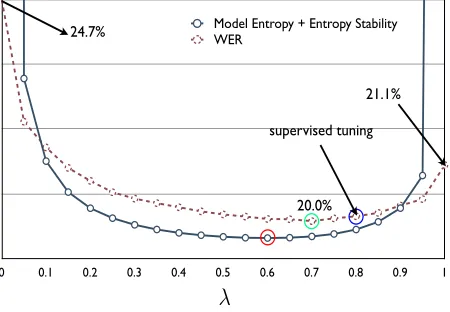
re-sults are shown in Fig. 5. Usingλ= 0andλ= 1
theW ERs are24.7%and21.1%respectively.
Us-ing the new proposed objective function, the optimal
λis estimated to be0.6withW ERof20.1%(Red
circle on the figure). Estimatingλw.r.t8hour
train-ing data transcription (supervised adaptation) will
result inλ= 0.7(green circle) andW ERof20.0%.
Insteadλ= 0.8will be chosen by tuning the
inter-polation weight on2.5hour Dev set with
compara-bleW ERof20.1%. Also it is clear from the figure
that the new objective function can be used to
pre-dict theW ER trend w.r.t the interpolation weight
parameter.
0 0.1 0.2 0.3 0.4 0.5 0.6 0.7 0.8 0.9 1
Model Entropy + Entropy Stability WER
24.7%
20.0%
21.1%
supervised tuning
λ
Figure 5: Estimating λ based on W ER vs. the
information-theoretic criterion
[image:7.612.315.540.495.651.2]unsuper-vised method results in the same performance as su-pervised adaptation in speech recognition task.
9 Conclusion and Future Work
In this paper we introduced the notion of entropy stability and presented a new criterion for unsu-pervised adaptation which combines conditional tropy minimization with entropy stability. The en-tropy stability criterion helps in selecting parameter settings which correspond to stable decision bound-aries. Entropy minimization on the other hand tends to push decision boundaries into sparse regions of the input distributions. We show that combining the two criterion helps to improve unsupervised pa-rameter adaptation in real world scenario where class conditional distributions show significant over-lap. Although conditional entropy has been previ-ously proposed as a regularizer, to our knowledge, the gradient of entropy (entropy-stability) has not been used previously in the literature. We presented experimental results where the proposed criterion clearly outperforms entropy minimization. For the speech recognition task presented in this paper, the proposed unsupervised scheme results in the same performance as the supervised technique.
As a future work, we plan to use the proposed criterion for adapting log-linear models used in Machine Translation, Conditional Random Fields (CRF) and other applications. We also plan to ex-pand linear interpolation Language Model scheme to include history specific (context dependent) weights.
Acknowledgments
The Authors want to thank Markus Dreyer and Zhifei Li for their insightful discussions and sugges-tions.
References
M. Bacchiani, B. Roark, and M. Saraclar. 2003.
Un-supervised language model adaptation. In Proc.
ICASSP, pages 224–227.
S. Chen, B. Kingsbury, L. Mangu, D. Povey, G. Saon, H. Soltau, and G. Zweig. 2006. Advances in speech transcription at IBM under the DARPA EARS pro-gram. IEEE Transactions on Audio, Speech and
Lan-guage Processing, pages 1596–1608.
Thomas M. Cover and Joy A. Thomas. 2006. Elements
of information theory. Wiley-Interscience, 3rd edition.
Yves Grandvalet and Yoshua Bengio. 2004.
Semi-supervised learning by entropy minimization. In
Advances in neural information processing systems
(NIPS), volume 17, pages 529–536.
J. Glass, T. Hazen, S. Cyphers, I. Malioutov, D. Huynh, and R. Barzilay. 2007. Recent progress in MIT spo-ken lecture processing project. InProc. Interspeech. Jing Jiang. 2008. A literature survey on domain
adapta-tion of statistical classifiers, March.
Zhifei Li and Jason Eisner. 2009. First- and second-order expectation semirings with applications to minimum-risk training on translation forests. InEMNLP. Haifeng Li, Keshu Zhang, and Tao Jiang. 2004.
Min-imum entropy clustering and applications to gene ex-pression analysis. InProceedings of IEEE
Computa-tional Systems Bioinformatics Conference, pages 142–
151.
Lidia Mangu, Eric Brill, and Andreas Stolcke. 1999. Finding consensus among words: Lattice-based word error minimization. InSixth European Conference on
Speech Communication and Technology.
M. Szummer and T. Jaakkola. 2003. Information regu-larization with partially labeled data. InAdvances in
Neural Information Processing Systems, pages 1049–