Volume 2006, Article ID 91797, Pages1–19 DOI 10.1155/ASP/2006/91797
Optimized H.264/AVC-Based Bit Stream Switching
for Mobile Video Streaming
Thomas Stockhammer,1G ¨unther Liebl,2and Michael Walter2
1Nomor Research GmbH, Tannenweg 25, 83346 Bergen, Germany
2Institute for Communications Engineering (LNT), Munich University of Technology (TUM), 80290 Munich, Germany
Received 12 August 2005; Revised 17 February 2006; Accepted 30 April 2006
In this work we show the suitability of H.264/MPEG-4 AVC extended profile for wireless video streaming applications. In partic-ular, we exploit the advanced bit stream switching capabilities using SP/SI pictures defined in the H.264/MPEG-4 AVC standard. For both types of switching pictures, optimized encoders are developed. We introduce a framework for dynamic switching and frame scheduling. For this purpose we define an appropriate abstract representation for media encoded for video streaming, as well as for the characteristics of wireless variable bit rate channels. The achievable performance gains over H.264/MPEG-4 AVC with constant bit rate (CBR) encoding are shown for wireless video streaming over enhanced GPRS (EGPRS).
Copyright © 2006 Hindawi Publishing Corporation. All rights reserved.
1. INTRODUCTION
High-quality video streaming is becoming a killer applica-tion in wireless systems. For this type of systems, compres-sion efficiency, as well as adaptivity, are the most important features when selecting appropriate video codecs. The re-cently standardized H.264/MPEG-4 AVC codec (denoted as H.264/AVC in the following) provides both features, but es-pecially the latter has not been discussed in too much detail up to now. Adaptivity allows reacting to dynamics in the sys-tem resulting from bursty traffic patterns, variable receiving conditions, as well as handovers and random user activity. Due to the commonly used error control features on wire-less links, these variations mainly result in varying bit rates. However, it is important to understand that the variability cannot be attributed to a single effect and also underlies dif-ferent time scales: typical variations are within a few millisec-onds due to short-term fading and interference, within a few hundred seconds due to shadowing effects, within a few sec-onds due to changes in the receiver position, as well as within larger scales due to handover and changes in the overall sys-tem load. In case of online encoding, if the encoder has suffi -cient feedback, control strategies for variable bit rate (VBR) channels can be applied [1]. Hence, the encoder rate control dynamically adapts to changing bit rates [2].
For preencoded sequences, however, other means are necessary: in case of short-term channel bit rate variations, play out buffering at the receiver can compensate for bit rate fluctuations such that the display timeline is maintained.
For example, in [3] it has been shown that for UMTS-like channels the bit rate variations due to link layer re-transmissions can be well compensated by receiver buff er-ing without adder-ing significant additional delay. In addi-tion, in case of anticipated buffer underrun, techniques such as adaptive media play out [4] enable a streaming media client, without the involvement of the server, to control the rate at which data is consumed by the play out pro-cess.
Video sequence
Video encoder
Streaming server scheduling
Wireless network
Data Bit rate adaptivity by (i) stream switching (ii) temporal scalability
Video presentation
Video decoder
Streaming client Setup,
information, control Figure1: System overview.
resilience—features included in H.264/AVC for this purpose are discussed, for example, in [7].
In this work we assume that our rate adaptation entity— referred to asscheduler—has sufficient information and in-telligence to be able to drop packets with respect to their rela-tive importance. A formalized framework under the acronym rate-distortion optimized packet scheduling has been intro-duced [8] and serves as the basis for several subsequent pub-lications. Obviously, this strategy requires a regular syntax, that is, by defining more and less important packets in a stream. Hence, if bit rate variations on the transmission path are expected, it is wise to preencode media streams with ap-propriate packet dependencies, such that the importance of the packets in the stream can be easily differentiated by the network components. The H.264/AVC standard already of-fers some options to support packets with different impor-tance for bit rate adaptivity. However, a scalable extension, which will also include classical SNR-scalability, is still under discussion [9] and will not be considered here. Our proposed streaming system will thus rely on three different means for bit rate adaptivity, namely, (i) play out buffering, (ii) tempo-ral scalability, and (iii) advanced bit stream switching.
The remainder of this paper is structured as follows: we will start with a brief overview of an end-to-end wireless video streaming system inSection 2. Next, we will introduce the various features available in H.264/AVC to support tem-poral scalability and bit stream switching inSection 3. We will present suitable encoding solutions for these features and develop an abstract framework for describing video stream-ing over arbitrary VBR channels.Section 4then deals with a specific class of VBR channels, which result from includ-ing a wireless link in the end-to-end transmission chain. We will discuss several mathematically tractable models of diff er-ent complexity to describe the influence of wireless links on packet transmission. For the system considered in this work, namely EGPRS, we will propose a relatively simple, yet suf-ficiently accurate description of the channel characteristics. InSection 5, we will integrate the previously developed con-cepts into an optimized decision making strategy for the
se-lection of frames and versions in a wireless streaming sce-nario. Experimental results for H.264/AVC video streaming over EGPRS links will demonstrate the applicability of our strategy inSection 6. The paper concludes with some general remarks and a summary of future work topics.
2. SYSTEM OVERVIEW
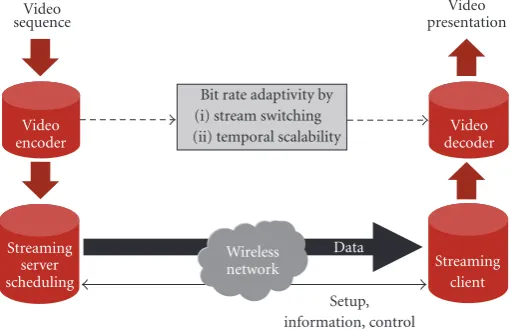
Figure 1shows a simplified wireless streaming system, which usually consists of an end-to-end connection between a me-dia streaming server and a client. The latter requests preen-coded data stored at the server to be streamed to the end user. The client buffers the incoming data and starts with decoding and presentation of the reconstructed video sequence after some initial delay. Once playback has started, a continuous presentation of the sequence should be guaranteed. For CBR channels with constant delay successful play out can be guar-anteed by encoding and streaming of the video sequence such that the resulting bit stream contains a leaky bucket [10].
However, in our investigated system neither the bit rate nor the delay is constant, and some data units are not even available at the decoder. Therefore, the media streams stored at the server have to be not only compression efficient, it should also be possible to flexibly adapt their bit rate to vary-ing conditions on the wireless link.
Version 1 0 I P1
2 P
3 P
4 P
5 P
6 P
SSP
Version 2
SP SP
(a)
Version 1 0 I 1P
2 P
3 P
4 P
5 P
6 P
SI
Version 2
SP SP
(b)
Figure2: Bit stream switching with SP- and SI-pictures in H.264.
this respect, it has been recognized that the bit rate on wire-less links is a precious resource, especially when compared to storage on servers. Finally, most applications provide suf-ficient buffer feedback, as well as channel state information, such that the streaming server has at least an estimate of the supported bit rate. Under these common premises bit stream switching provides a simple, yet powerful, means to support bit rate adaptivity in wireless streaming environments. In this case the streaming server stores the same content encoded with different versions in terms of rate and quality. Each of these versions must include means to randomly switch into it. Instantaneous decoder refresh (IDR) pictures provide this feature, but they are also costly in terms of compression effi -ciency (for an analysis of bit stream switching for streaming, see [12]).
The switching predictive (SP) picture concept in H.264/ AVC [13], however, is more adequate for this purpose: in this case the streaming server not only stores different versions of the same content, but also secondary SP-pictures, as well as SI-pictures. As long as the bit rate does not change, efficient primary SP-pictures are transmitted at the pre-selected pos-sible switching points. If switching becomes necessary, one can rely on secondary SP- or SI-pictures. Some preliminary work on bit stream switching using the SP-picture concept for congested links has been presented in [14].
InFigure 2, a simplified switching scenario is depicted with only two preencoded versions 1 and 2. An extension to more than two versions is straightforward, but is omitted
here for the sake of clarity. These two versions result from en-coding of the same original video sequence with two diff er-ent quantization parameters. Primary SP-pictures have been used periodically at identical positions in both sequences. Thus, at every “SP-position” either the primary is transmit-ted, if no switching happens, or the secondary (either SSP or SI) is transmitted in case of switching.
In this work we will consider a wireless video streaming environment which employs a central unit at the transmitter, referred to asscheduler. The latter has access to information about all source data to be transmitted next, as well as to in-formation on current expected transmission conditions. The scheduler attempts to optimize its decision which packets, as well as which versions, are to be transmitted next. The ac-cessible source and channel information will be specified in more detail in the following two sections, and the proposed scheduler is presented inSection 5.
3. A FRAMEWORK FOR VBR STREAMING OF H.264/AVC VIDEO
3.1. Preliminaries of the SP-picture concept
The SP-picture concept allows applying predictive coding even in case of different reference signals by performing the motion-compensated prediction (MCP) process in the trans-form domain rather than in the spatial domain. The ref-erence frame is quantized—usually with a finer quantizer than that used for the original frame—before it is forwarded to the reference frame buffer. The resulting so-called pri-mary SP-pictures are placed in the encoded bit stream at the pre-selected possible switching points. In general, they are slightly less compression-efficient than regular P-pictures, but significantly more efficient than regular IDR-pictures. The major benefit results from the fact that the quantized ref-erence signal can be generated mismatch-free using any other prediction signal. In case that this reference signal is gener-ated by predictive coding, the picture is referred to as sec-ondary SP (SSP) picture. They are usually significantly less efficient than P-pictures, as an exact reconstruction is nec-essary. To generate the reference signal without any previ-ous dependencies, the so-called switching-intra (SI) pictures can also be used, which are only slightly less inefficient than common I-pictures, but can also be used for adaptive error resilience purposes. For more details on this unique feature within H.264/AVC the interested reader is referred to [13].
3.2. An optimized encoder for SSP/SI-pictures
lerr
Inv. quant QPSP
Lerr
+ Lrec Quant QPSP2
lrec
Inv. quant QPSP2
L¼
rec
Decoding of source stream 1
Inv. trans Frec
Decoded frame
Frame memory Trans
Lpred
Inter-prediction
Reference frame(s) Fref,1
Ent
rop
y
d
ec
oding
and
d
em
ultiple
Optimized prediction & mode decision
Lpred,1
Quant QPSP2
lpred,1
+ +
lerr,1-2
Frec,2
lrec,2
Encoding of switching stream 1-2
Bit stream SSP1-2
Ent
rop
y
enc
oding
Modes, motion data
lerr
Inv. quant QPSP
Lerr
+ Lrec Quant QPSP2
lrec
Inv. quant QPSP2
L¼
rec
Decoding of target stream 2
Inv. trans Frec
Decoded frame
Frame memory Trans
Lpred
Inter-prediction Motion vectors
and mode info
Ent
rop
y
d
ec
oding
and
d
em
ultiple
“f.” The individual meaning of a signal (e.g., pred for “pre-dicted”) can be derived from its index.
According to Figure 3 we obtain the SSP-picture for switching from source stream 1 to target stream 2 by extract-ing and combinextract-ing information from both runs. The encod-ing process for the secondary representations depends on the signallrec,2 that is generated in the encoding and decoding
process of the primary target SP-picture. We decided to use the decoding process of target stream 2 for exporting lrec,2
as shown inFigure 3. SSP-encoding also requires the predic-tion signalLpred,1. In our implementation,Lpred,1is generated
using all reference framesFref ,1, which are available by
de-coding source stream 1. For SI-pictures the same concept ap-plies with the only difference that the prediction signal can be computed without any signals exported from stream 1.
It is also worth mentioning that the straightforward ap-proach to simply use the prediction signal, motion vec-tors, and modes from encoding/decoding the primary source stream 1 is not efficient: the partition modes and the motion vectors chosen for encoding the source primary SP-picture do not necessarily fit well for encoding the SSP and result in a suboptimal prediction signal with a large prediction er-rorlerr,1 2. This implies that coding efficiency is low, as the
residual has to be encoded without any further quantization. Hence, a prediction signalLpred,1is required which minimizes
the residual. Since no restrictions apply onLpred,1, we can
op-timize it by using all available reference framesFref ,1.
Classi-cal rate-distortion optimization [15], as used in the JM test model, is applied. However, the encoded SSP will be iden-tical to the primary SP-reconstruction of the target stream. The goal of the motion estimation and compensation must therefore be to match the reconstructed primary target frame
Frec,2, rather than the original frameForig. With this modified
mode selection we save up to 10% in bits for SSP-picture cod-ing compared to the case when we use the prediction signal optimized toForig. The gains compared to the nonoptimized
approach using the prediction signal Lpred,1, for which the
frame sizes often exceed or equal those for SI-pictures, are in the order of 100–400%. For details on encoding results, the exact encoder implementation, as well as on guidelines for the selection of quantization parameters for primary and secondary representations, we refer to [14,16].
3.3. General abstraction of the encoding, transmission,
and decoding processes
Efficient streaming media algorithms require a formalized description of the encoded multimedia data to be able to make good decisions during the transmission process [8]. Assume thatsourceunits fn,n=1,. . .,N(i.e., video frames),
are encoded and mapped one-to-one ontodata unitsPn(i.e.,
packets). Any advanced packetization modes, such as flexible macroblock ordering, slice structured coding, or packet in-terleaving schemes, are not considered here. Note, however, that our framework is general enough to include such con-cepts. In addition, we assume that for each source unit fnwe
generate several versionsv=1,. . .,V, which are represented by individual data unitsPn,v. The reconstructed version of
each source unit is denoted as fn,v. Furthermore, we define
a quality measureQ(f,f) reflecting the rewards/costs when representing f by f.
Each source unit (and hence each data unit) has assigned a decoding time stamp (DTS)Tnrepresenting the latest time
instant the data unitPnmust be decoded to be useful. The
decoding time is relative toT1, which is assumed to be 0
with-out loss of generality. Data unit indices are ordered with in-creasing DTSTn. According to [8], video encoding and
pack-etization can then be represented as a directed acyclic graph. However, note that this only holds for the data units within one version. An extended framework for different versions is not addressed in [8]. We restrict ourselves in the following to the practical case where the graph for each version is of iden-tical structure. Again, generalization to different structures for each version is straightforward, but the benefit in terms of encoding efficiency needs to be carefully considered. To specify decoding dependencies among data units, we write
n
nifPn¼is necessary to decodePn.
When transmitting a stream to a client, a server may se-lect an appropriate version vectorv = vn
N
n=1, withvnthe
version chosen for each fn. Hence, with this definition any
arbitrary stream-switching strategy is possible, since diff er-ent versions may be transmitted for each successive data unit. However, for our strategy we apply restrictions on version vector elements to avoid the problem of reference frame mis-matches: since switching is only allowed at I- or SP-picture positions, versions can only change at these positions as well. Assume now that we operate in an environment where not necessarily all data units are received at the media de-coder. In this case, concealment has to be done for any rep-resentation of a missing data unit. In the remainder we ap-ply the common “freeze-picture” concealment, that is, miss-ing data units are represented by the timely nearest available source unit. Note that while the encoder only considers this type of error concealment in the optimization process, our decoder does actually apply this strategy. The index of the first candidate to conceal source unit fn is denoted by the
concealment indexc(n). If there is no preceding source unit, for example, I-pictures, we assume that the lost source unit is concealed with a standard representation, for example, a grey image (denoted asc(n)=0).
In case of consecutive data unit loss, concealment is ap-plied recursively. Assume thatc(n)=i. If data unitPiis also
lost, the algorithm uses source unit fjto conceal fi, that is,
c(i)= j. To avoid any lengthy recursive notation we simply usejnto express the fact that source unit fnis eventually concealed with unitfj. The resulting concealment
dependen-cies can also be expressed by a directed graph.Figure 4shows an example of possible frame dependencies and the corre-sponding concealment graph.
3.4. Importance definition
I1 P2 P5 I8
B3 B4 B6 B7 B9 B10
(a)
G
I1 P2 P5 I8
B3 B4 B6 B7 B9 B10
(b)
Figure4: Frame dependencies and concealment graph.
the encoding, transmission, and decoding processes lead to the definition of the so-calledimportanceof each data unit
Pn,v: the latter reflects the amount by which the quality at the
receiver increases if the data unit is correctly decoded and can be written as
In,v
1
N ⎛ ⎜ ⎜
⎝Qfn,fn,v
Q
fn,fc(n),v
+
N
i=n+1
ni
Qfi,fn,v
Q
fi,fc(n),v
⎞ ⎟ ⎟ ⎠.
(1)
The importance definition takes into consideration the quality of data unitPn,v, the chosen concealment strategy,
as well as the dependency and concealment graph. In other words, the importance quantifies the improvement in quality if the source unit contained inPn,v is displayed instead of
the concealment source unit fc(n),v for this unit, as well as
for all other source units for which fnis eventually used for
concealment.
3.5. Received and expected quality
The end-to-end performance of a streaming media system strongly depends on the versions chosen (expressed by the version vectorv) and the amount and importance of packets not available at the decoder. To be more specific, we define the observed channel behavior at a streaming client for data unitPn,vascn1{data unitPn,vavailable}. Here,1A de-notes the indicator function being 1, ifAis true, and 0 oth-erwise. Hence, the combination of a certain observed chan-nel sequencec=c1,. . .,cNwith (1) and the concealment strategy as introduced above yields the following expression for the (actual) received quality:
Q(c,v)Q0+
N
n=1 In,vncn
n1
m=1
mn
cm. (2)
Here, Q0 (1/N)
N
n=1Q(fn,f0) denotes the minimum
quality, if instead of the original sequence all pictures are presented as grey. The latter is obviously quite hypothetical, but it is necessary to have a comprehensive framework. In summary, in order to benefit from data unitPn, it is
neces-sary that all data unitsPm it depends on are also available
at the receiver. For a proof that (2) actually corresponds to the received quality given the above assumptions, we refer to
Appendix A.
The importance of each data unit and version is quite eas-ily computed during the encoding process. As a consequence, (2) significantly simplifies the simulation of video stream-ing systems, as the achievable quality at the simulated me-dia clients can be determined via linear combination of the channel vector and the importance of the selected versions of each data unit. Any decoding of erroneous video streams is thus not necessary.
The practical importance of (2) for system optimization, however, is rather limited, since in wireless transmission sys-tems, the channel behavior is in general not deterministic. Nevertheless, the notion of importance can be used quite ef-fectively at the transmitter for simple computation of the ex-pected quality (at the receiver), as will be shown in the fol-lowing: a certain data unit might be lost entirely or might arrive too late at the receiver such that the decoding of the data unit is no more useful due to expired deadlines (we as-sume here that the client does not use any advanced strate-gies, such as rebuffering). The channel behavior sequence
CC1,. . .,CNis in general random, withCn0, 1the random variable indicating whether data unitnis received successfully (Cn=1) or lost (Cn=0). Therefore, not only the
channel is random, but also the received quality, denoted as
Q(C): for certain channel realizations we obtain a good qual-ity, whereas for others the received quality is much worse.
In the following we are interested in a single measure to compare the different transmission strategies. The most ob-vious and suitable measure is the expected qualityEQ(C). The following equation provides a definition of the expected received quality, as well as a simplified method to derive it:
EQ(C) c0,1N
Q(c) PrC=c
=Q0+
N
n=1 InPr
Cn=1k
nCk=1
n1
m=1
mn
PrCm=1k
mCk=1
=Q0+
N
n=1 InPr
Cn=1k
nΔk=1
.
(3)
3.6. Summary: media abstraction for video streaming over VBR channels
With these preliminaries we are able to develop an effective abstraction of streamed media data. For channels which ex-hibit data unit loss (as will be considered in the remainder of this work), it is sufficient to know the number of encoded source versionsV, the initial qualityQ0, and the following
metrics for each data unit n = 1,. . .,N and each version
v=1,. . .,V:
(i) the importanceIn,v,
(ii) the data unit sizeRn,vin bytes,
(iii) the decoding time stampTn, and
(iv) the dependencies expressed by the index of the directly preceding data unit(s) ofPn.
Furthermore, for each SP-picture in each versionv, the data unit sizeRn,v v¼ of the SSP-picture when switching to ver-sionv
and the SI-picture size are required [16]. As already mentioned, this abstract description can be used on the one hand to effectively simulate video streaming over lossy chan-nels (via (2)). On the other hand, (3) or one of its variants provides a means to optimize the transmission schedule, as will be shown inSection 5.
4. A FRAMEWORK FOR THE DESCRIPTION OF WIRELESS LINKS
4.1. General characteristics and modeling aspects
Wireless channels are becoming increasingly important as a transport medium for various types of multimedia in-formation. While the appeal of tetherless mobility is great, numerous issues need to be resolved in order for wireless transport of real-time multimedia data to become reality (including communications issues, low-power implementa-tions, etc.). In this work we consider a scenario where due to the user’s mobility the channel behavior will be inherently time-varying, with periods of higher data rates alternating with periods of lower rates.
In general, the available bandwidth and, therefore, the bit rate over the radio link are limited. In addition, the mobile environment is characterized by harsh transmission conditions in terms of attenuation, shadowing, fading, and multiuser interference, which result in time- and location-dependent channel conditions. New directions in the design of wireless systems do not necessarily attempt to minimize the error rates in the system, but to maximize the system throughput. This is especially attractive for services with re-laxed delay constraints, such as file downloads and stream-ing applications. The nonergodic behavior of the channel is exploited such that in case of good channel states a signif-icantly higher data rate is supported than in bad channel states. This behavior is typically achieved by rate adaptation via adaptive modulation and coding (AMC). In addition, liable link layer protocols with persistent automatic repeat re-quest (ARQ) are often used to guarantee error-free delivery. This concept is, for example, applied in EGPRS and further extended in high-speed downlink packet access (HSDPA). In
the following we will focus on EGPRS, since both appro-priate descriptions and models are available. However, most concepts discussed and presented here are also applicable in other wireless systems with slight modifications and param-eter adjustments.
In order to emulate time-varying EDGE-(enhanced data rates for GSM evolution) based radio channels in real time, a model has been developed and proposed in [17], which al-lows describing both short-term and long-term effects. This simulation model consists of three levels, which reflect typi-cal physitypi-cal layer and system properties [17].
(i) The top level of the simulation model considers the overall cellular layout. Users are distinguished in two groups, one in good locations, and one with poorer receiving conditions.
(ii) The second level characterizes system configurations, such as the applied power control, the velocity of the user, the interference conditions, and other system dy-namics. This is reflected in the model by defining sev-eral states, which basically correspond to the coding schemes defined for EGPRS.
(iii) Finally, the lowest level specifies the transmission con-ditions in a certain state. Throughout this work we as-sume a static resource allocation in terms of a constant number of assigned radio slotsα. Independent of the current state, link layer packets are sent out periodi-cally according to the fixed transmission time interval (TTI)τI. The payload sizeCξof the packets differs for
each stateξ, as different channel code rates and modu-lation schemes are applied to adapt to changing trans-mission conditions. Furthermore, since we assume op-eration in persistent acknowledged mode (i.e., lost link layer packets are retransmitted until they are received correctly), we extend the channel model to incorporate the transmission mode.
We summarize the description of the channel model in-cluding persistent acknowledged mode for a certain stateξ
asWξ W(Cξ,τI,pξ,Nτ), withpξ the loss probability, and
Nτ the number of transmissions in stateξ. In case of
mul-tislot transmission and noise-limited scenarios, the payload is multiplied withα, such thatCξ αCξ. In interference-limited scenarios, the TTI can be divided by the number of slots, that is,τIτI/α.
Figure 5depicts the statistical EDGE radio link model specified by a two-group, five-state Markov chain according to [17]. The radio system is completely characterized by the payload sizeCξfor each state, the link layer packet error rate1
pξ = p, the state transition probabilitiesλ,μ1, andμ2, and
finally, the group probabilitiespG,1andpG,2. All of these
pa-rameters depend on the actual radio system configuration, such as frequency reuse pattern, power control option, num-ber of users per sector, and so forth. An exemplary set of
Group 1
S0
1 λ
μ1
λ
1 μ1 λ
S1
μ1
λ
S2
1 μ1 (a)
Group 2
S3
1 λ
μ2
λ
S4
1 μ2 (b)
Figure5: Two-group, five-state Markov channel model.
Table1: Radio system parameters for EGPRS with frequency hop-ping, frequency reuse 1/3, and radio aware power control.
Users/sector pG,2 λ μ1 μ2 p 2 0.93 0.3 0.055 0.05 0.11 8 0.64 0.3 0.094 0.3 0.20 15 0.28 0.3 0.27 0.59 0.27
parameters [17] for the EDGE radio system used in this work is presented inTable 1.
4.2. Abstract channel representation
An accurate model as presented inSection 4.1is definitely helpful to obtain representative results. However, it is ob-vious that such a model is never comprehensive, nor can it be assumed that the parameters are known in advance. Nev-ertheless, it is always advantageous to include channel state information into decisions at the transmitter. Therefore, an abstraction of the previously introduced channel character-istics to some meaningful but also measurable and simple in-formation at the sender unit is highly desired.
Sufficient information for our scheduling entity (speci-fied in more detail inSection 5) is some a priori information on the probability that the channel supports a certain data rate over a certain time interval. More precisely, we ask how likely it is that a certain amount of data has left the sender buffer by some time measured as delta from the actual time
τa. Note that in our case the sender and the receiver buffers
are each other’s complement and we assume the propagation delay to be negligible. Hence, without loss of generality, the time the data leaves the sender buffer is equivalent to the time it is available at the receiver. To formalize this notion, we de-fine the event that the channel is able to support some rate
r (in bits) within a time intervaltasR(r,t). However, it is
not only sufficient to receive a certain rate by some time for the data to be useful at the receiver: due to the dependency graph it might be necessary that also some preceding data is sent out at some earlier time. Therefore, we generally require a joint probability distribution Pr
iR(ri,ti)ξ, which de-pends on the probability of the joint events, as well as on the current channel stateξat timeτa.
Whereas access to an estimate of the single event success probability PrR(r,t)is feasible, as will be shown later, es-timation of the joint probability function is rather complex. However, if we only have access to the single event success probabilities, the joint event success probability can at least be bounded by the product of the single success probabilities and the minimum of the single success probabilities, that is,
i
PrRri,ti
Pr
i
Rri,ti
min
i
PrRri,ti
.
(4)
4.3. Simplified description for EGPRS
The exact derivation of the single event success probability distribution for complex channel models is still too com-plicated and likely without practical relevance, as discussed previously. Therefore, we attempt to obtain a simplified de-scription for the single event success probability PrR(r,t) in case of an EGPRS channel. Despite being verified only for this specific system, it can be conjectured that the proposed model is relatively generic and can also be adapted for other wireless systems.
Recall that transmission within each single state is repre-sented byW(Cξ,τ,pξ,Nτ). Then, letXξbe a random variable
which describes the amount of data transmitted with a single link layer packet in stateξ, withXξ 0;Cξ. Furthermore, let 1 p be the probability of successful packet reception (Xξ = Cξ), andpthe probability of a packet loss (Xξ =0).
The mean and variance of this process aremξ =Cξ(1pξ) andσξ2=C2ξ(1pξ)pξ, respectively.
As, in general, provision of feedback and retransmission at the link layer happen quite fast, the respective delay can be neglected. This is especially the case for scenarios where the channel propagation time of one packet is sufficiently smaller than the time interval between two consecutive higher-layer data units. Moreover, in delayed feedback systems packet la-beling allows reordering of received packets. Therefore, we can assume that the lost packet will immediately be retrans-mitted at time instantk+ 1. Then, for some channel state sequenceξK =ξ1,. . .,ξK, the random sum rateS(ξK) can be defined as
SξK
K
k=1 Xξk=
Nξ
ξ=1
ωξXξ, (5)
withωξthe frequency of stateξin the sequenceξK. For suffi
-ciently largeK, it can be assumed that the sum rateS(ξK)
sufficiently large, the distribution of the normalized sum rate can be characterized as a normal distribution,2that is,
SξK
Km
ξK
σξK
K N(0, 1), (6)
with normalized mean
mξK
= 1
K
Nξ
ξ=1
ωξmξ (7)
and normalized variance
σ2ξ
K
= 1
K
Nξ
ξ=1
ωξσξ2 (8)
due to the central limit theorem and some extensions [18]. However, in general the state sequence is also random and follows the underlying Markov model. Assuming that the actual stateξ is known, we are interested in the distri-bution of the sum rateSKξ after the transmission attempt of
Klink layer packets, that is,
SKξ K
k=1
Xξkξ. (9)
ForKsufficiently large, a normal distribution of the sum rate is still justified. However, the derivation of the mean and the variance is not straightforward. Therefore, it is recom-mended to estimate those parametersmKξandσK2ξ
depend-ing on the number of link layer packetsKand the initial state
ξ. If the channel state, however, is not accessible, we denote the mean asmK and the variance asσK2.Figure 6shows the
normalized meansmKξ/KandmK/K, as well as the
normal-ized variancesσ2
Kξ/K andσK2/K for the EGPRS parameters
given in Table 1. When comparing the different curves for the two parameters, it is obvious that additional simplifica-tions and modeling might be performed. In a practical sys-tem, these parameters might be estimated in advance or are constantly updated during the transmission. In the following we will assume that the parametersmKξandσK2 ξ, or at least
some estimates, are available to the transmitter.
With knowledge of the mean and the variance for eachK
(and each initial stateξ), the probability of a certain sum rate is readily expressed as
PrSK =s
= 1
2πσK2
e(smK) 2/2σ2
K. (10)
Hence, the single event success probability in case of knowl-edge of the channel state can be written as
PrR(r,t)=PrSt/τ3 r
=1 2erfc
rm
t/τ3 2σt/τ3
. (11)
For ease of exposition, we will in the following only present the case where the channel state is not known. The
exten-2Throughout this work,N(m,σ2) will denote the normal distribution with meanmand varianceσ2.
0 50 100 150 200 250 300
K 100
200 300 400 500 600 700 800 900
mK
(
ξ
)
/K
mK(ξ=1) mK(ξ=2) mK(ξ=3) mK,1
mK(ξ=4) mK(ξ=5) mK,2
(a)
0 50 100 150 200 250 300
K 100
200 300 400 500 600 700 800 900
σ
2(K
ξ
)
/K
σK2(ξ=1) σ2
K(ξ=2)
σK2(ξ=3) σ2
½
(b)
Figure6: NormalizedmK ξ/KandmK/Kas well as normalized vari-ancesσ2
K ξ/KandσK2/Kversus number of link layer packetsK.
sion to the case when the channel state is known, however, is straightforward.
5. OPTIMIZED TRANSMISSION SCHEDULING AND BIT STREAM SWITCHING
5.1. Transmitter assumptions
which data unit to transmit next out of the set of available ones Pn,v, withN = 1,. . .,N andv = 1,. . .,V, on the streaming server. To achieve good user experience, some ob-vious principles for the selection of data units are as follows.
(1) The algorithm should be able to react to varying chan-nel conditions by bit stream switching. Only if the channel conditions change too fast, additional reduc-tion of the temporal resolureduc-tion should be allowed. (2) Data units should be transmitted as close as possible to
the time instant they are due at the receiver. Otherwise, bandwidth is wasted, which might result in expiration and consequently dropping of other earlier data units. (3) Nevertheless, it should be possible to transmit impor-tant data units earlier to guarantee their delivery even in bad channel conditions.
(4) Version switching should preferably be accomplished with SP-frames rather than with SI-frames.
Previous work on this subject has for example been per-formed in [6], which is an extension to the well-known early deadline first (EDF) scheduling [5]. In [6] the EDF schedul-ing is extended takschedul-ing into account frame dependencies. In this work we formalize the concept of frame dependencies and frame importance, extend it to stream switching, and in-troduce schedulers which try to optimize sending order. Be-fore we present our proposed algorithm for optimized trans-mission scheduling and bit stream switching, we want to dis-cuss some reasonable constraints. The latter will be helpful for significantly reducing the amount of possible data units to be considered in the optimization process.
(i) Each data unitPn,vis only transmitted once from
end-to-end, since we assume that the lower link layer re-transmission protocol clears out all errors. Hence, a loss in our system only happens due to late-arrival at the media client.
(ii) If the transmission of data unitPn,v in versionvhas
been attempted, all data units at the same positionnin the video sequence, which resemble different versions
v
=v, are removed from the set of data units consid-ered for future transmissions.
(iii) It is also assumed that the information on the success-ful reception or loss of a single data unit is immedi-ately available at the transmitter. As a consequence, a status3 γ
n can be assigned at the transmitter to each
positionnin the video sequence. If any data unitPn,v
(v=1,. . .,V) has already been transmitted, the status takes on one of the following two (final) values:
– γn=ACK, if the data unit is known to have been
received correctly and
– γn=NAK, if the data unit is known to be lost.
(iv) Positions at which no data unitPn,v(of any version)
has been transmitted yet are assigned one of the re-maining two (intermediate) status values:
3Note that the status is only indexed with the positionn, but not with the versionv.
– γn=R(for READY), if transmission is possible
in general, since all ancestorsPn¼,v
n¼ are available at the receiver (i.e., haveγn¼=ACK),
– γn = P (for PENDING) if transmission is not
recommended yet, since there are still some miss-ing ancestors at the receiver (i.e., which have
γn¼=P).
(v) As a consequence, only data units with statusγn=R
are considered for transmission.
(vi) Any data unitsPn,vwith expired deadlineTn+Δ> τa
(withΔthe initial play out delay andτathe actual time
at the transmitter) are not transmitted and, together with all of their dependants, are assignedγn = NAK.
Note that this procedure is already quite intelligent, as in this case the channel is not blocked with no more useful data.
(vii) Switching positions in the video sequence are assigned two status values: one for SI-framesγnand one for
SP-framesγn. For SP-frames to be decodable, it is assumed
that it is necessary and sufficient that the previous P-frame of any version is available.
5.2. Periodic update of side information at
the transmitter
Any optimal scheduling strategy requires up-to-date side in-formation on the state of the system in the decision process. Therefore, we will explain the various update steps next that are performed before each scheduling process starts. Upon initialization, the first positionn=1 in the video sequence, as well as all other switching positions which have an SI-frame available, are assignedγn =R. All other positions are
initialized withγn=P. After each successful or nonsuccessful
completion of the transmission of a data unitPn,vn at actual
timeτa, the status values at other data unit positions in the
transmitter are updated as follows.
(1) All data unit positions n
for which the deadline has expired, that is, whereTn¼+Δ> τa, are assignedγn¼ = NAK.
(2) If the previous transmission of data unitPn,vnwas
suc-cessful, the corresponding status value is changed to
γn=ACK.
(3) If the previous transmission, however, was not suc-cessful, the corresponding status value is changed to
γn=NAK.
(4) All data unit positionsnfor which at least one ancestor
n n
has statusγn¼ =NAK are also assigned status γn=NAK.
(5) All data unit positions with statusγn¼=Pfor which all ancestors haveγn=ACKare switched to statusγn¼ = R.
(6) At switching positions for which all ancestors of the SP-frame are now available at the receiver, the status is changed toγn=ACK. In this case, either the SI-frame
After this update procedure has been performed, a new data unit withγn=Rmust be selected for transmission by
the scheduler as described in the next section.
5.3. The scheduling process
The task of the scheduler is to determine an optimal trans-mission order and version of the sent data units, which maxi-mizes the expected overall system performance. In particular, the scheduler decides at each transmission opportunity
(i) which data unit to transmit next, possibly out of de-coding order,
(ii) and in case of an SP-, SI-, or I-picture, which version to transmit next.
During this decision process the scheduler should take into account as much side information as possible: the cur-rently expected channel behavior, the actual timeτa, as well
as the deadlines, the importance, the different versions, and the updated status of different data units.
As already mentioned, the scheduler might decide to transmit more “important” data units earlier to guarantee their timely delivery with high probability, whereas other data units with very low importance might not be trans-mitted at all. Hence, we express the actual delivery order by the transmission scheduleπ = (π1,π2,. . .), whereπk holds
the index of the data unit (i.e., the position in the video se-quence) to be transmitted at (temporal) positionk. Further-more, for each element in the transmission schedule, a ver-sionvπkis also selected.
4
We propose to select the next data unit for transmission based on some utility function, for which we use the expected quality at the receiverQ(π,v). This metric generally depends on all relevant source and channel information, such as rates, deadlines, importance vector, and so forth. More specifically, the optimal scheduleπoptand the optimal version vectorvopt
satisfy
πopt,vopt
=arg max
(π,v)Q(π,v), (12)
with
Q(π,v)=Q0+
N
n=1
γn=ACK In,vn+
N
n=1
γn=NAK
0
+
N
n=1
γnR,P
In,vnPn(π,v)
n1
m=1
mn Pm(π,v).
(13)
Here,Pn(π,v) expresses the probability that data unit
Pn,vn will be received in time for this selection ofπ andv.
Note that for data units with γn = ACK, this probability
is equal to 1, while for γn = NAK it is equal to 0. In case
4Note that the version vectorv= vn
N
n=1is ordered with respect to the position of the data units in the video sequence.
γnR,P, the probability depends on the sum rate of the scheduled data units, the delivery deadlineTn+Δ, the actual
timeτa, and the channel statisticsR(r,t), and can be written
as
Pn(π,v)=Pr
R
ρn
k=1
Rπk,vπkTn+Δτa
mn
γmR,P
R
ρm
k=1
Rπk,vπkTm+Δτa
,π,v
,
(14)
whereρndefines the (temporal) position of data unitPn,vnin
the scheduleπ.
Hence, when determining the expected quality according to (14), we acknowledge the fact that due to the dependencies in the video sequence not only the actual data unit must have been received, but also all of its predecessors. The above nota-tion can be simplified by using the joint probabilityPn(π,v)
instead of the conditional probabilityPn(π,v), that is,
Pn(π,v)=Pr
⎧ ⎪ ⎪ ⎨ ⎪ ⎪ ⎩
mn
γmR,P
R
ρm
k=1
Rπk,vπkTm+Δτa
π,v ⎫ ⎪ ⎪ ⎬ ⎪ ⎪ ⎭.
(15)
The optimal transmission schedule and version vector now have to satisfy
πopt,vopt
=arg max
(π,v)Q(π,v), (16)
with
Q(π,v)
N
n=1
γnR,P
In,vnPn(π,v). (17)
Note that in (17), we have already considered the fact that only data units with statusγn=Rorγn=Pmust be part of
the scheduleπ. The version vectorvremains identical to the previous definition.
With these preliminaries, the scheduler repeats the fol-lowing operations, until there are no more ready or pending data units at the transmitter.
(1) After successful or nonsuccessful completion of the transmission of a data unit, the status of the data units in the transmission set is updated according to
Section 5.2.
(2) Then, by combining this updated status information with (possibly new) channel state information, the scheduler determines (πopt,vopt) according to (16).
(3) Finally, transmission of data unitPπopt,1,vopt,πopt,1 is
initi-ated.
5.4. Implementation aspects and complexity reduction
inπeven at some later position generally influences the ex-pected quality and thus the selection of the next data unit. To find the optimal schedule and version vector, in principle, a brute-force search is necessary. Since this is far from being practically feasible, complexity reduction is essential. In the following we will discuss some simplifications first before we present our optimized scheduling algorithm.
5.4.1. Weighted cumulative importance
A major problem in the computation of the expected quality for a certain combinationπ,voriginates from the fact that all later parts in the transmission schedule can be reordered in many ways. However, only the (typically few) data units with statusγn =Rare candidates for transmission, and we
want to find the best transmission order and version for them at the actual scheduling opportunity. While the aforemen-tioned later parts are not used, any modifications there usu-ally affect the decision of the data unit to transmit next (i.e., the one we are actually interested in). Hence, we still have to consider the influence of the transmission of current data units on later frames: it is definitely not sufficient to replace the entire set of possible transmission schedules and version vectors in (16) by a set which only includes data units with
γn=R.
We take these dependencies into account by introducing the weighted cumulative importance of a certain data unit
Pn,vn. For a given transmission scheduleπand version vector
vthe weighted cumulative importanceIn(π,v) is recursively
defined as
In
π,vIn,vn+
kγk=Pnk wkIk
π,vPk(π,v). (18)
Here,n kmeans direct dependency (i.e.,nis a direct an-cestor ofk), andwndenotes the weight of a data unit at
po-sitionnin the video sequence. In case of P-frames and B-frames we define for the sake of simplicity
wn ⎧ ⎪ ⎪ ⎪ ⎨ ⎪ ⎪ ⎪ ⎩
1 ifnis a P-frame or SP-frame,
1
2 ifnis a B-frame.
(19)
This weighted cumulative importance has to be recomputed at each scheduling opportunity for all data units in the trans-mission set withγnR,P.
Assume now that the version vectorvis fixed. LetS =
nγn=Rbe the set containing all data unit positions with statusγn=R. Correspondingly,S=nγn=Pcontains all remaining data unit positions withγn=P, which are still
waiting for transmission. In the following we will only inves-tigate schedules, which only have elements fromSin the first positions, before any remaining ones fromSare added. Such a schedule is denoted asπ(S),π(S). Furthermore, let us define the sum rate of all data units inSas
RS
nS
Rn,vn. (20)
Thus, the weighted cumulative importance according to (18) can be approximated by
In
S,π(S),v=In,vn+
kS
nk wkIk,vk
Pr ⎧ ⎪ ⎪ ⎪ ⎪ ⎨ ⎪ ⎪ ⎪ ⎪ ⎩
jS
jk
R
⎛ ⎜ ⎝RS+
ρj(S)
i=1
Rπi,Tj+Δτa ⎞ ⎟ ⎠ ⎫ ⎪ ⎪ ⎪ ⎪ ⎬ ⎪ ⎪ ⎪ ⎪ ⎭ , (21)
withρj(S) the (temporal) position of data unitPj,vjinπ(S).
To simplify the computation of the weighted cumulative importance, we apply the upper and lower bounds according to (4). Let us define
Pj
r,π(S)Pr
⎧ ⎨ ⎩R
⎛ ⎝r+ρj(S)
i=1
Rπi,Tj+Δτa ⎞ ⎠ ⎫ ⎬
⎭. (22)
Hence, a lower bound on the weighted cumulative impor-tance in (18) is obtained as
In
S,π(S),v=In,vn+
kS
nk wkIk
S,π(S)Pk
RS,π(S),
(23)
which results in the following lower bound on the expected quality in (17):
Qπ(S),π(S),v=
nS In
S,π(S),vPn
0,π(S).
(24)
To obtain an upper bound on the expected quality in (17) let us recursively define a local success probability for allk
Sas
Pkmin
Pk
RS,π(S)m Smk
Pm
. (25)
Hence, an upper bound on the cumulative weighted impor-tance in (18) can be given for anykS
Ik
S,π(S),v=Ik,vkPk+
mS
km Im
S,π(S),v, (26)
which results in the following upper bound on the expected quality in (17):
Qπ(S),π(S),v
=
nS ⎡ ⎢ ⎢ ⎣In,vnPn
0,π(S)+
kS
nk Ik
S,π(S),v
⎤ ⎥ ⎥ ⎦.
(27)
channel events. The corresponding estimate of the weighted cumulative importance results for allnSin
In
S,π(S),v
kS
nk Ik,vkPk
RS,π(S), (28)
which yields the following estimate on the expected quality in (17):
Qπ(S),π(S),v=
nS In,vnPn
0,π(S)+In
S,π(S),v.
(29)
The advantage of using a fixed later scheduleπ(S) and the notion of cumulative weighted importance is that the lat-ter can be precomputed before different transmission sched-ules π(S) are tested. The specific implementation of this computation is not discussed in further detail here, but basi-cally in most cases the computation starts in the leaves of the dependency graph and moves backwards to the data unit po-sitions with statusγn = R. Although none of the proposed
modifications is optimal anymore due to the fixing of the later data unit positions inπ(S), they significantly reduce the complexity, especially, if the setSis kept small.
The number of selected data units for the setSis referred to aslook-ahead unitsand is denoted byNP in the follow-ing. For the selection procedure, we have used two different modes: in the first mode, calledready selection, we choose the firstNP data unit positions with statusγn=R. In the second
mode, calledsequential selection, we choose the nextNP data unit positions, regardless of whether their status isγn = R
orγn = P. In this case, the presented algorithm has to be
modified slightly, as the status of data units changes due to scheduling. It is necessary to introduce an internal variable which keeps track of the status during the scheduling pro-cess. Nevertheless, for both selection modes, the fixed part of the scheduleπ(S) is sequentially filled with the remaining data units in the order of their indexn.
These definitions and simplifications can be combined in order to develop a multistage scheduling algorithm for video streaming over VBR links. The respective flow diagram is de-picted inFigure 7, and the various elements will be explained in the next sections.
5.4.2. Separation of transmission order and
version selection
Based on one of the quality metrics in (24), (27), and (29) we select the best transmission orderπ(S) for each scheduling opportunity. During this process we always operate within the same version, that is, if a switching point is included in π(S), the same version as used for the previous group-of-pictures (GoP) is selected after the point. The case of version switching is discussed separately below.
Note that despite fixing the scheduleπ(S) and only using a single version vector, all data unit positions up to the end
N would need to be considered for the computation of the weighted cumulative importance. However, for IDR-frame switching it is easily shown that it is sufficient to only
con-Init source
Transmission order selection Switching
point ?
Yes
No
Yes
SI-frame ? No No Exchange
with SP better ?
Yes selectionVersion
Transmit Update source Still
data units ? End
Figure7: Flow diagram of the scheduling algorithm.
sider all data unit positions up to the next nontransmitted IDR-frame position. Though this is not completely accurate in case of SP/SI-frames for switching, we neglect this and use the same strategy for transmission order selection.
5.4.3. Data unit selection
In case a nonswitching positionnis selected, the versionvn
of the data unit is unambiguous, as exactly for one version the predecessors that are available at the decoder. The corre-sponding data unitPn,vnis then transmitted. In case a
switch-ing position is selected, the correspondswitch-ing data unit, how-ever, is not immediately transmitted. If the switching posi-tion requires an SP-frame or an IDR-frame, the version se-lection procedure as presented below is immediately invoked. If the switching position requires an SI-frame, an alternative proposal is made: the selected SI-frame is replaced with the corresponding SP-frame. If this proposal yields a better met-ric than the SI-frame, the alternative is selected. If this is not the case, the version selection below is invoked.
5.4.4. Version selection
fixing the version vectorv, we evaluate the quality for all pos-sible versions at this position. Our proposed algorithm al-lows taking into account not only the version selection of the next switching point, but a total ofNsswitching points. Note
that between two switching points the version is fixed for all data units to the version of the preceding switching point. Recursive computation of the quality in (24), (27), or (29) is then applied using the weighted cumulative importance. The number of considered switching pointsNsis also referred to
aslook-ahead switching points.
Obviously, the more switching pointsNs we take into
consideration, the more complex the algorithm gets, but the performance also increases as more future data is taken into account for the decisions. In the next section, we will eval-uate the performance of different system parameters and scheduling options for our proposed scenario and optimiza-tion strategy.
6. EXPERIMENTAL RESULTS
6.1. Simulation parameters
An exemplary set of simulations has been carried out using the following parameters: we have encodedV =4 versions of a QCIF sequence of length N = 2698 with alternating speakers and sport scenes using H.264/AVC test model soft-ware JM8.2. The sequence has a length of about 90 seconds and contains sufficiently diverse content to yield representa-tive results. We used a single QP for each version, namely QP = 28, 32, 36, 40, and a common frame rate of 30 fps, without any additional rate control algorithm. A group-of-picture (GoP) structure with IBBPBBP. . .SP has been applied with SP-picture distance of 1 second. The SP-pictures have “IDR” property in the sense that referencing over SP-pictures is not permitted. In addition, both SSP- and SI-pictures are possible. The initial play out delay at the streaming client is
Δ=1.5 seconds.
The wireless link is modeled using the EGPRS channel model according to [17]. We restrict ourselves to the more challenging scenarios with 8 and 15 users per cell according toTable 1. Changes among the two groups of channel states may happen statistically independent every 20 seconds. Each simulation point represents the algebraic mean over 200 in-dependent channel realizations.
As reference system, we also encoded the same video se-quence with the rate control provided in JM8.2 to obtain two single-rate bit streams, one with 69 kbps and one with 96 kbps. The same GoP structure was used, but I-pictures have been applied instead of SP-pictures. We also investigate the case where we only apply SI-frames, such that the perfor-mance is actually similar to IDR-picture switching.
In the following we will compare the achievable perfor-mance for different scheduler settings (i.e., in terms of dif-ferent number of look ahead units and look ahead GoPS), different selection modes (i.e., sequential and ready selection mode), and different methods to compute the weighted im-portance (i.e., lower bound, upper bound, and linear combi-nation).
0 1 2 3 4 5 6
Look-ahead units 34
34.05 34.1 34.15 34.2 34.25 34.3 34.35 34.4 34.45 34.5
PSNR
(dB)
LAG=1, seq. sel., up. bound LAG=1, seq. sel., lo. bound LAG=1, seq. sel., lin. comb. LAG=1, rea. sel., up. bound LAG=1, rea. sel., lo. bound LAG=1, rea. sel., lin. comb.
Figure8: PSNR versus look-ahead unitsNP for one look-ahead GoP and all selection modes and combining methods.
6.2. Local decisions: temporal scalability
First, we will investigate the performance of the scheduling algorithm when making local decisions on the actual trans-mission order, as well as on which frames are to be dropped (temporal scalability).Figure 8shows the average PSNR ver-sus number of look-ahead unitsNP for one look-ahead GoP and all selection modes and combining methods. It can be observed in general that the achievable quality increases with larger scheduling sets. Note that the scheduling set size of one is identical to EDF [5,19]. However, note that the PSNR vari-ations are in a range of at most 0.3 dB and are therefore rather marginal.
The inconsistencies for the ready selection mode can be explained by the following additional observation of the au-thors: this method tends to use too often not the next ready data unit, but the second next one in the set, which has locally higher weighted cumulative importance. This locally opti-mum decision, however, leads to higher data unit drop rates in the long term.
Since larger values ofNP also increase the complexity of the algorithm, we can conclude fromFigure 8thatNP =3 seems to be a good compromise for all scheduler options considered. We apply this setting in the remainder of this work unless mentioned otherwise.
6.3. Influence of selection mode and combining
method on bit stream switching
0 1 2 3 4 5 6 Look-ahead switching pointsNs
33 33.2 33.4 33.6 33.8 34 34.2 34.4 34.6 34.8 35
PSNR
(dB)
SP, seq. sel., up. bound, 8, str. switch SP, seq. sel., lo. bound, 8, str. switch SP, seq. sel., lin. comb., 8, str. switch SP, rea. sel., up. bound, 8, str. switch SP, rea. sel., lo. bound, 8, str. switch SP, rea. sel., lin. comb., 8, str. switch
Figure9: PSNR versus look-ahead switching pointsNsand all se-lection modes and combining methods.
when stream switching is enabled.Figure 9shows the PSNR versus number of look-ahead switching pointsNsfor diff
er-ent selection modes and combining methods and an EGPRS channel with 8 users. Obviously, if more switching points are taken into account, the performance increases for all strate-gies. Compared to not looking ahead (i.e., streaming the data as is and only allowing local decisions), a gain of up to 1.4 dB is now achievable.
While all strategies yield some gain, we have found out in a long series of tests that a scheduler using sequential se-lection with upper bound combining achieves the best and most consistent results.
6.4. System performance
Now we will compare the systems which use different stream-ing technologies, that is, constant bit rate (CBR) streamstream-ing (our reference system), streaming with optional bit stream switching using SI-pictures, and streaming with optional bit stream switching using SP-pictures. In all cases, we add smart dropping in the sense that the transmitter is aware of ex-pired deadlines at the receiver and does not attempt to trans-mit this data. We believe that this setup is quite suitable to show the potential performance gains achievable with stream switching.
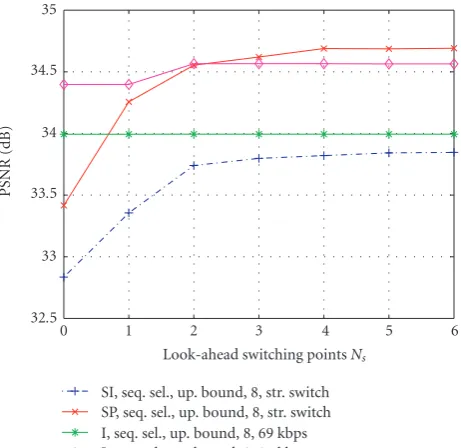
Figure 10shows the PSNR versus look-ahead switching points Ns for different encoding strategies and an EGPRS
channel with 8 users. As can be observed, SP-picture switch-ing clearly outperforms SI-picture switchswitch-ing by about 0.8 dB. The gains are similar if IDR-pictures are used instead of SI-pictures (not shown here for the sake of conciseness). It is in-teresting to note that even in case of constant bit rate
stream-0 1 2 3 4 5 6
Look-ahead switching pointsNs 32.5
33 33.5 34 34.5 35
PSNR
(dB)
SI, seq. sel., up. bound, 8, str. switch SP, seq. sel., up. bound, 8, str. switch I, seq. sel., up. bound, 8, 69 kbps I, seq. sel., up. bound, 8, 96 kbps
Figure10: PSNR versus look-ahead switching pointsNsfor diff er-ent encoding strategies and a channel with 8 users.
ing, the use of a scheduler at the transmitter provides some gains due to better local decisions, which result in temporal scalability. Furthermore, for the chosen scenario with only 8 users, bit stream switching only outperforms CBR stream-ing, if at the scheduler more than two look-ahead switching points are considered.
If we increase the system load at the transmitter by chang-ing to a scenario with 15 users, the situation is different as shown inFigure 11: in this case the CBR stream with 96 kbps does not lead to an acceptable quality any more, and the 69 kbps stream seems more appropriate. The system which allows switching among 4 different streams, however, yields constant good quality and the overall degradation compared to the previous system with 8 users is only about 1 dB.
To better understand what happens exactly in the system,
Figure 12depicts the respective data unit drop rates. If we al-low a reasonable amount of look-ahead switching points for transmission planning, the data unit drop rates significantly decrease in case of bit stream switching. As a consequence, the objective performance (in terms of PSNR) and also the subjective performance (in terms of viewer satisfaction) are largely enhanced.
7. CONCLUSIONS