A Cornput.ationally Efficient Appr-oximat.ion
Algorithm for Analyzing
Open Queueing Networks with Blocking
by
H.G. Perras
P.M.
SnyderCenter for Communications and Signal Processing Cornp uter Science Depar-tment
North Carolina State University
Sept.ernber 1986
Abstract
A computationally efficient algorithm for analyzing approximately open queue-ing networks with blockqueue-ing is presented. This algorithm is based on an earlier pro-cedure proposed by Altiok and Perros [3"]. However, unlike this earlier propro-cedure, the proposed new algorithm has minimal time and space requirements. It permits, therefore, the analysis of large and complicated networks. It also makes implemen-tation easy, and software development feasible. Numerical experience with this algorithm shows that the approximate results seem to have an acceptable error level.
Kev words: queueing networks, finite queues, blocking, decomposition
Introduction
Queueing networks with finite queue capacities are useful in modelling com-puter systems, distributed systems, telecommunication systems and also
manufac-turing systems. A queueing network with finite queue capacities can be thought of
as a set of arbitrarily linked finite queues. Blocking arises due to limitations imposed on queue capacities. The flow of units through one queue may be blocked when the capacity limitation of another quell.e is reached. Several types of blocking
mechanisms have been considered in the literature so far. These blocking
mechan-isms arose out of various studies of real-life systems.
Onvural and Perras [16] have classified the most commonly used blocking
methods as follows:
Type 1: A customer upon completion of its service at queue i choses to enter desti-nation queue j. If at that moment queue j is full, then the customer is forced to wait in front of server i until it enters destination queue j.
Type 2: A customer in queue i declares its destination queue (queue j) before it starts its service. If queue j is full, then its server becomes blocked and it cannot serve the customer. When a departure occurs from destination queue
i.
then its server becomes unblocked and the customer begins its service.Under this blocking type one can distinguish two sub-categories depending upon whether the customer is allowed to occupy the position in front of the blocked
Type 3: A customer upon service completion at queue i attempts to join destination qlleue j. If queue j is ittll, then the customer receives another service at queue i. This is repeated until the customer completes a service at queue i at a moment that
the destination node is not full.
Within this category, we distinguish two types:
Type 3.1: Once the customer's destination is determined it cannot be altered.
Type 3.2: A new destination node is chosen at each service completion independent of the destination previously chosen.
A comparison between these blocking mechanisms can be found in Onvural and Perras [16].
Queueing networks with blocking are in general difficult to treat. In particular, closed-form solutions for steady-state distributions are not generally attainable. Therefore, approximations, numerical techniques and simulation are used for the analysis of such queueing networks. Certain queueing networks with blocking, however, have been reported as having a product-form solution. These networks operate under a 3.2 type of blocking, and require assumptions so that they can satisfy reversibility. (For results see Kelly [12], Hordijk and Van Dijk [II], Yao and Buzacott [24], and Le Ny [15].)
Approximate studies of some particular configurations of open queueing net-works wit.. blocking have also been reported in the literature. A well-known confi-guration is the tandem conficonfi-guration consisting of finite queues in series. Approxi-mate studies of such configurations have been reported by Hillier and Boling [10], Caseau and Pujolle [7], Altiok [1], Perros and Altiok [18], Gershwin [8], Suri and Diehl [21], Bocharov and Rokhas [4], Brandwajn and [ow [6], Kelly [13], Pollock and Birge [20], and Goto, Takahashi and Hasegawa [9]. Other configurations that have been considered in the literature are split and merge configurations. Approximate studies of such configurations have been reported by Perros [17] and Altiok and Perros [2].
con-figurations. Labetoulle and Pujolle [14] analyzed arbitrary configurations of open networks with blocking under blocking mechanism type 3.1. They employed an algorithm similar to the one reported in Caseau and Pujolle [7]. Further validation of this algorithm is needed. Yao and Buzacott [24] reported on an approximation algorithm for analyzing closed queueing networks under blocking mechanism type 3.2 assuming Coxian service times and reversible routing. The algorithm gives the marginal queue-length probability distributions.
In this paper, we present a computationally efficient approximation algorithm for analyzing arbitrary configurations of open exponential queueing networks under type 1 blocking mechanism. This algorithm is based on an earlier algorithm pro-posed by Altiok and Perros [3]. Unlike the Altiok and Perros algorithm, however, the proposed algorithm has minimal time and space requirements. It permits, there-fore, the analysis of large and complicated networks, The class of queueing net-works to which this algorithm is applicable is described in the next section.
2. Arbitrary Configuration of Open Queueing Networks with Blocking
one queue. For simplicity, we have assumed in this paper that they all occur to one
particular queue (cf. Altiok and Perros [2]).
Figure 1: the three node configuration
Certain restrictions apply as to how' arbitrary' a configuration under study may be. In particular, a finite queue may not accept both external arrivals and input from other (upstream) queues. This restriction is necessary due to the fact that the
blocking mechanism considered in this paper is not consistent with the external arrival process, whereby a customer is lost (as opposed to being blocked) if it arrives
at a time that the queue is full. The topology of the queueing networks considered
then this graph may not contain directed cycles. This restriction is necessitated by the fact that the approximation algorithm does not take into account the problem of deadlock.
Blocking occurs due to the finite capacity of the queues. Type 1 blocking mechanism is assumed. In particular, a customer upon service completion at queue i attempts to join destination queue j. Blocking will occur ifat that instance queue j
is full. The blocking customer is forced to wait at queue i until it enters queue j. During this time the ith server is blocked and it cannot serve
any
other customers that might be waiting in its queue. Now, let us assume that there are k queues directly linked to queue j. Then, it is likely that at any instance there might be more than one blocking customer (each associated with one of these k queues). Obvi-ously, the total number of blocking customers at any instance may not exceed k. All blocking customers may be thought of as forming an imaginary blocking queue (although in effect they are waiting in front of their respective servers). When a customer at one of the k queues gets blocked by queue j it is placed at the end of the blocking queue. When a departure occurs from queue j, the unit at the top of the blocking queue is allowed to enter queue j. At that moment its associated server becomes unblocked. Thus, blocking customers are allowed to join queue j on a "first blocked-first-enter" basis.each individual solution obtained is assumed to approximate the solution of that queue when it is part of the '-iueueing network. The parameters of each queue are revised as follows:
a) The arrival process at each queue is approximated by a Poisson distribution.
b) The original service mechanism of any queue that may become blocked is replaced by a process which uses Coxian-2 distributions to represent the delay a unit experiences at the queue because of blocking.
c) The capacity of each finite queue is augmented by as many positions as the number of upstream queues directly linked to it, i.e., queues from which it can receive units to be serviced. The capacity revision is necessary because the blocking mechanism considered in this paper allows a blocked server to act as an additional storage space for the blocking queue. This capacity revision does not apply to queues to which only external arrivals occurs.
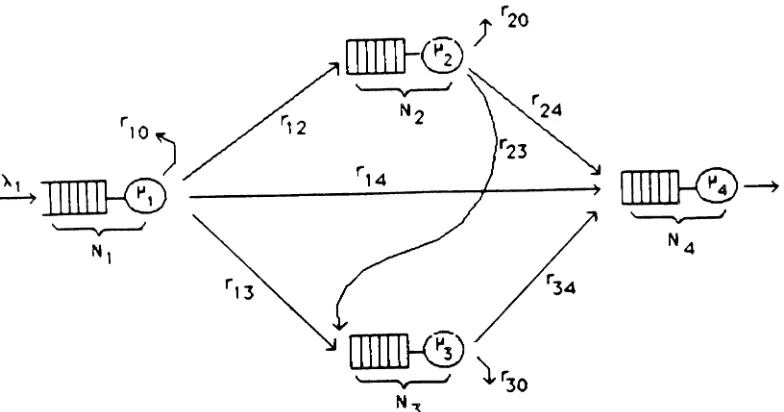
Figure 2: The four node configuration
The time that a blocked unit at queue 2 must wait in order to enter queue 3 depends not only on whether there is a unit from queue 1 waiting to enter queue 3, but also on the blocking experienced by units processed at queue 3 which require service at queue 4. Altiok and Perras [3] construct for each queue a very complicated phase-type structure which represents all possible blocking delays a unit may experience after it completes its service at this queue. This method has two shortcomings : first, a great deal of experience is required for the accurate construe-tion of the phase-type structure; second, the size of these structures gives rise to CPU complexity problems. As a result, it was only possible to analyze queueing networks of up to four queues.
representing all blocking delays a unit may experience upon service completion at a queue has a very simple structure. It can be written down very quickly a.id it is concise and consistent from queue to queue, thus making implementation easy and software development feasible. Also, the solution of each individual queue can be obtained very efficiently, seeing that the size of the matrix: which must be inverted is limited to one plus two times the number of possible destination queues.
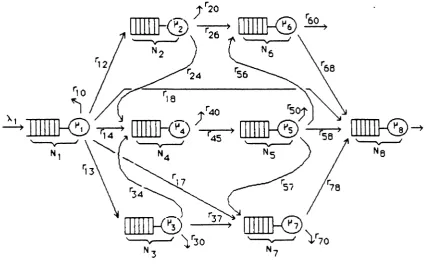
Figure 3: The eight node network
The approximation algorithm has been implemented for three, four and eight
this algorithm.
3. The approximation algorithm applied to the four node network
Consider a queueing network with blocking consisting of four single server queues linked as shown in figure 2. Customers arrive at the first queue only, according to a Poisson process with rate At. Service times are exponentially distri-buted with parameter ~i at queue i. Let N, denote the capacity ( including the one in service) of the ith node. N2, N3, N4are assumed to be finite and N, is allowed to be finite or infinite.
Customers enter the network by joining the first queue. If Nl is assumed to be finite, units arriving when the buffer at queue 1 is full are lost. Upon service com-pletion at queue 1, a unit is sent to queue 2, 3, 4 with probability f12,f13,f14 respec-tively or the unit may depart from the network with probability flO . When a unit completes service at queue 2, it may be sent to queue 3 or queue 4, or it may leave the network, with probability r23,r24,rZO respectively. Frem queue 3, units proceed to queue 4 with probability r34 or depart from the network with probability r30 . All units completing service at queue 4 depart from the network with probability 1.
Blocking occurs in this network due to the finite capacity of queues 2, 3, and 4. Queue 4 may block qlleues I, 2 and 3; queue 3 may block quelles 1and 2 and queue 2 may block queue 1. Moreover, a unit being sent from quetle 3 to qtleUe 4 may find
enter at queue 3. Blocking is resolved on a " first-blocked-first-enter " basis.
Let Pi(n) be the probability that there are n units ( including the one in service) at queue i under equilibrium conditions and let 7rij(n) be the conditional probability that upon service completion at server i, there are n units at server j (including the one in service ).
3.1 The approximation algorithm for the case N1=00
We first describe the algorithm assuming that the first queue, to which all external arrivals occur, has an infinite capacity. The modifications necessary when the first queue has a finite capacity are described in section 3.2.
The algorithm begins with the analysis of queue 4. Because of the network topology, queue 4 cannot become blocked. Since queues 1, 2 and 3 may send units to queue 4, the capacity of queue 4 is increased by 3 units and queue 4 is considered to be an MlM!1/N4
+
3 queue. The equilibrium queue length distribution can be obtained from the classical MlM/l/N formulae once the overall arrival rate A4' is known. If queues 1, 2, and 3 are stable and never blocked, the input stream to queue 4 is Poisson with parameter ~4=
1\1(r14+
r12r24+
r12r23r34+r13r34)· The relation-ship between"4
and '\4' the rate at which units actually enter queue 4, is given bythe fixed-point expression
Once the equilibrium probability distribution of queue 4 is obtained, the
block-ing delay experienced by units at queues 1, 2, and 3 because queue 4 is at capacity
is represented by a Coxian-2 distribution. This distribution is constructed using the
phase-type structure developed by Altiok and Perros [3] and illustrated in figure 4.
This phase-type structure ret1ects all the possible delays a unit at queue i, i= 1,2,3,
may undergo, if at the moment it completes its service, its destination node, queue 4, is full. In particular a
. - - - \ '" 4 J I - - - o I l...
Figure 4: A phase-type representation of the blocking delay at queue 4.
unit entering this phase-type structure has already received service at queue i,
i= 1,2,3 and has selected queue 4 as its destination. With probability
event corresponds to the upper path in figure 4 . The other paths in figure 4 represent the event that ..l unit from queue i. i=1, 2, 3 , whose destination is queue 4 finds the buffer full. If no other units are already waiting for a buffer space, the
unit from queue i will be forced to wait at qlleue i until a service completion occurs
at queue 4. This time has an exponential distribution with parameter JL4. The path
in figure 4 corresponding to this event is the second one. If a unit arriving from queue i finds n units already awaiting a buffer space, the arriving unit will be blocked at queue i for n + 1 consecutive time periods, each exponentially
distri-buted with parameter J..L4. This situation corresponds to the two bottom branches in figure 4.
We determine the 1l"i4(.) using Little's relation. Let 1T4(n) be the conditional
pro-bability that a customer arriving at queue 4 sees n customers in the queue. Then
~41T4(N4)/~4=P4(N4+1) ~<!1T-t(Nef
+
1)/J..L4=
P4(N4+
2)~47T4(N4
+
2)/~4= P4(N4+
3) ·Since we have obtained the equilibrium queue length distribution at queue 4, all
quantities are known except for the 11"4(.). Next, we estimate the 11"i4(·) using
h distribution illustrated in figure 4 are known, we can construct a
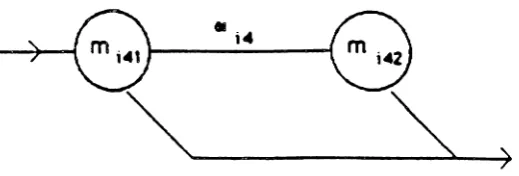
Coxian-2 representation of this phase-type distribution by determining its first three moments aid then fitting a Coxian-2 distribution, with parameters ffii41, mi42, (li4 to them. This Coxian-2 distribution, shown in figure 5, reflects the blocking delay at
queue 4.
·i~
)
Figure 5: Coxian-2 representation of the blocking delay at queue 4.
The third queue is now considered in isolation. The capacity of queue 3 is increased by two units since both queue 1 and queue 2 may be blocked by queue 3. The arrival process at queue 3 is assumed to be Poisson with parameter A31 where .\3
is determined from the fixed point problem
r 34
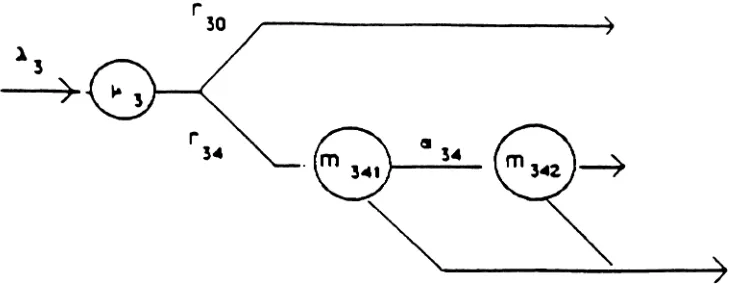
Figure 6: Service mechanism at queue 3
)
A three phase server of this type has a transition rate matrix with departure rate blocks having rank 1. This property allows the equilibrium queue length distribution to be written immediately in terms of the queue parameters, i.e.,
P3 (1)T
=
A3P3(O)[ 1 0 0 ]RP3 (n)T=A3P3 (n-l)TR with
0 -1
J..L3 - r34J..L3
R=
-A3 "'3+m~l - Ci34ffi341-A3 0 "'3+ ffi342
and P3(n)=P3 (n)Te) where e3 is a column vector of all ones.
In the analysis of quelle 3, our method requires the construction of two Coxian-2 representations. This is done so that the solution of each node in isolation is both simple and consistent from node to node. First, the representation of the
augmented service mechanism at queue 3, which is shown in figure 6, is condensed
to a two phase Cox ian distribution with parameters m31,ffi32,(l). This Coxian-2 distri-bution incorporates the service delay at queue 3 and also delays due to blocking by
queue 4. This distribution is then used to construct a repr~sentation of the delay
experienced by units at queues 1 and 2 because queue 3 is at capacity. This
block-ing delay is represented in the form of a phase-type distribution shown below. It is constructed in a manner analogous to the one shown in figure 4.
1c \l ,s(Ns) - • ,5(NS . , )
r
'5
)
"'
&
_-_5_
m12Figure 7: The phase-type representation of the blocking delay at queue 3.
The conditional throughputs, 1T'){.), are obtained in the same way as in the case of queue 4. In particular, using Little's relation, we have
~37r3(N3)/~1= P~(~ ~+1)
~37T3(NJ+ 1)/J.L~= P3(:'\1+2)
1T23(N3)= r12 r2J1T3(N3)/ r
1T13(N3+1)=r131T3(N3+ l)/r 'IT23(N 3
+
1)=
r12r231T3(N3+
l)/rwith r= r12rn
+
rn The first three moments of the phase-type structure shown infig-ure 7 are then used to fit a Coxian - 2 distribution, with parameters ffii311 mi32' Cli3, to this phase-type distribution.
The arrival process at queue 2 is assumed to be Poisson with parameter ~2 where A.2 is calculated from the fixed point problem
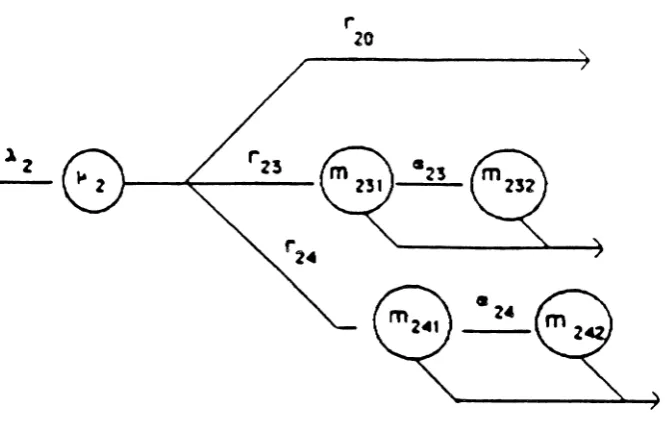
with P2(N2+ 1) a function of A2 and ~2=filAl. Figure 8 represents the augmented service mechanism at queue 2. It consists of the regular service given at queue 2
plus two Coxian-2 delays with parameters ffi231I m2321 CtD and ffi241, ffi242I Cl24
r 20
Figure 8: Service mechanism at queue 20
Queue 2 can be analyzed in isolation as an MIPH/l/N2+1 queue. Its equilibrium
pro-bability distribution is given by
P2
(l)T="2p2 (0)[ 1 0 0 0 0 ]R P2 (n)T=A2P2 (n-l)TR withfl.~ - f.L2r23 0 - J..L2f24 0 -1
-A2 A~+ffi231 - u23ffi231 0 0
R=
-A! 0 "2+m232 0 0-/\..., 0 0 A2+m2~1 - a~-+rn241
-A,- 0 0 0 "2+ ffi242
anti P2(n)
=
P2
(n) Ie 2' where e2 is a column vector of all ones.--Once tile equilibrium queue length distribution has been calculated we may
compute the conditional probability 1T12(N:!) using Little's relation in the same
manner as in quetle 2. The blocking delay experienced by units at queue 1 because queue 2 is at capacity is shown in figure 9. Using the first three moments of this
phase-type structure, we fit a Coxian-2 distribution with parameters ffi1211 ml221 (112·
1- ft12 (N2 )
r
20
Figure 9: A phase-type representation of the blocking delay at queue 2
Queue 1 can then be analyzed in isolation as an MlPH/l queue with the service
r
10
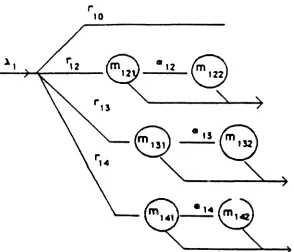
Figure 10: Service mechanism at queue 1 )
This service mechanism consists of the regular service plus 3 Coxian-2 distributions. Each of these Coxian-2 distributions reflects a blocking delay at a destination node. The equilibrium queue length distribution at queue 1 is then given by
Pl (l)T=~lPl (0)[ 10 0 0 0 0 O]R
PI (n)T==~lPl (n-l)TR
J..Ll - J..Ll r12 0 - f..L1r13 0 - f.11 rI 4 0
-AI Al+m121 - cx12ffi121 0 0 0 0
-AI 0 Al+m122 0 0 0 0
R=
-AI 0 0 Al+m 131 - Cl13ffi131 0 0- Al 0 0 0 Al+m132 0 0
-AI 0 0 0 0 Al + ffi141 - Cl14ffi141
-AI 0 0 0 0 0 Al+mI42
where PI (n)
=
PI (n)Tel and eI is a column vector of all ones. We note thesimi-larity in figures 6, 8, and 10 which greatly increases the ease of implementation for this algorithm.
3.2 The approximation algorithm for the case NI<00
Now suppose that the capacity of the first queue is finite. In this case, the rate
~I at which units actually enter the first queue is not known. This means we do not
have available the ~i which we require in order to analyze the other queues in the network. This problem is circumvented by imbedding the approximation algorithm described above into an iterative scheme in which the value of ~1 is successively approximated. In particular, we select a starting value for ~l I call it ~lO, and make
one pass through the network, applying our algorithm. After computing the equili-brium queue length distribution at queue 1 we calculate ~ll
=
Al(l-P1(N1» ·
If
I
~lO-~ll!<E,
we stop. Otherwise, we set ~lU=X:lland repeat the procedure.a) In order to analyze a queue in isolation, we concatenate all the different arrival streams into a combined arrival rate. This approach works well if the arrival streams are more or less balanced. If the arrival streams into a queue are extremely unbalanced, a more accurate approximation may be obtained by con-sidering the input streams as separate arrival processes. Tosee why this is true, suppose that r13» r12r23 in our four node example and that the buffer at queue 3 is full. If an arrival occurs, it will most likely be a unit from queue 1; queue 1 therefore will be blocked even though queue 3 has not reached its increased capacity of N3
+
2 units. Queue 1 I of course, will also be blocked when thereare N3
+
2 units at queue 3. This observation leads to a slightly different fixed point problem for the determination of the overall arrival rate A3. If rI3»r12f23 thenThis approximation permits the algorithm to give accurate results in cases where a branching probability becomes very small. The Altiok and Perras [3] algorithm was found not to work well in such cases.
b) In some cases, the constraint necessary for the construction of a t\VO phase Cox-ian distribution based on tile first three moments is violated, i.e.,
c) The convergence ot the iterative scheme described in section 3.2 cannot be
guaranteed. We note, however, that we did not observe any non-converging cases in our numerical experiments. Altiok and Perros [3] observed empirically
that the algorithm in certain cases did not converge.
d) Altiok and Perras [3] observed that their algorithm performs better when the
first quetle is finite but they do not discuss why this should be true. Table 1
suggests a possible explanation. On any given pass through the network, each
queue is analyzed in isolation without regard for the congestion occurring at its
upstream quetleS, (i.e., queues directly linked to this queue). Specifically, it
assumes that the output rate of an upstream queue i is a function of AI.
How-ever, it is sometimes J..Li because queue i is saturated. When the algorithm is
incorporated into an iterative scheme, this congestion appears implicitly in the
augmented service mechanism at queue 1 which in turn affects the value of ~1
in subsequent iterations.
5. Numerical examples
The approximation algorithm was implemented on a VAX 11/780. It was used
to obtain the approximate equilibrium queue length distribution at each node in the
three, four and eight node networks. The approximate results obtained using this
algorithm were compared with the results obtained by Altiok and Perros [3] and
with exact data for the three and four node networks and with results from a
with exact data for the three and four node networks and with results from a simu-lation program written using QN AP [23] for the eight node network.
The numerical examples are summarized in tables 2 to 24. Tables 2 to 10 are related to the three node configuration, tables 11 to 14 are related to the four node network and tables 15 to 24 correspond to the eight node network example. Each table gives relative errors and CPU times used by the approximation procedure.
All the numerical examples which include a finite capacity buffer at the first node have an acceptable error level. When our algorithm is applied to the three and four node examples (first queue buffer finite or infinite) our algorithm has an
accu-racy" comparable with the algorithm developed by Altiok and Perros but our rithm has a computation time between 1/4 and 1/80 that of Altiok and Perras' algo-rithm.
The complexity of Altiok and Perras' algorithm prohibited them from solving a network containing as many as eight nodes. The accuracy of our algorithm is accept-able for the case of a finite buffer at node 1 in the eight node network. The CPU time averaged .37 seconds with a maximum of 1.24 seconds. Each simulation took more than 20 minutes of CPU time. When our algorithm was applied to the
eight node network whose first node has unlimited capacity, the results were not as good. A reason for the poor performance was suggested in section 4, item (d):
pass implementation.
Conclusions
Queue 1 Queue 2 Queue3 f.L := (1,1,1)
P(O) 0.119425 0.562449 0.402892
p(l) 0.880575 0.437551 0.597108
L 0.881 0.438 0.597
~ = (1,2,1)
-p(O) 0.125905 0.692344 0.370420 p(l) 0.874095 0.307657 0.629581
L 0.874 0.308 0.630
~ = (1,3,1)
-p(O) 0.127451 0.742596 0.362730 p(l) 0.872550 0.257405 0.637271
L 0.873 0.257 0.687
~= (1,5,1)
p(O) 0.128415 0.784822 0.357770 p(l) 0.871587 0.215180 0.692231
L 0.872 0.215 0.692
Altiok Perras
Perras rei error Snyder reI error exact
PI(0) 0.1722 0.104 0.1702 0.091
0.1560
Pl(1) 0.1420 0.095 0.1440 0.110 0.1297 pl(2) 0.1175 0.083 0.1178 0.086 0.1085
pl(3) 0.0973 0.065 0.0967 0.058 0.0914
PI(4) 0.0806 0.044 0.0797 0.032 0.0772
Pl(S) 0.0668 0.021 0.0659 0.008 0.0654
L
I 4.8348 0.138 5.7497 0.025 5.6100P2(0) 0.6744 0.029 0.6745 0.019 0.6557
p2(1) 0.2246 0.044 0.2259 0.038 0.2349
p2(2) 0.1010 0.077 0.0997 0.089 0.1094
L
2 0.4266 0.059 0.4252 0.063 0.4537P3(O) 0.4900 0.000 0.4900 0.000 0.4901
p3(1) 0.2600 0.025 0.2600 0.025 0.2667 p3(2) 0.2500 0.028 0.2500 0.028 0.2431
L3 0.7600 0.009 0.7599 0.009
I
0.7529I I
Table 2: A = 1.5; J.L
=
(2, 2, 2); iV=
(00, 2, 2);-
-rIO = 0.2, rI2 = 0.4, r 13 = 0.4,
Altiok Perras
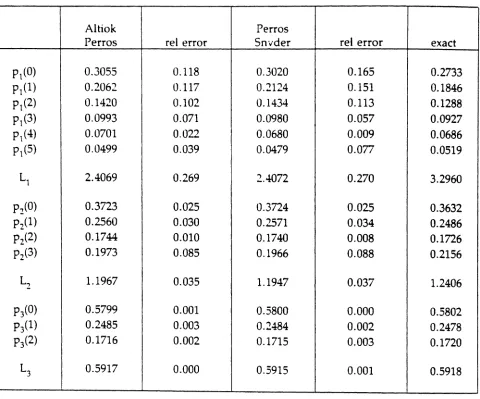
Perros rei error Snvder rei error exact
PI(0) 0.3055 0.118 0.3020 0.165 0.2733
PI(1) 0.2062 0.117 0.2124 0.151 0.1846
Pt(2) 0.1420 0.102 0.1434 0.113 0.1288
pl(3) 0.0993 0.071 0.0980 0.057 0.0927
pI(4) 0.0701 0.022 0.0680 0.009 0.0686
Pl(S) 0.0499 0.039 0.0479 0.077 0.0519
L
1 2.4069 0.269 2.4072 0.270 3.2960P2(0) 0.3723 0.025 0.3724 0.025 0.3632 p2(1) 0.2560 0.030 0.2571 0.034 0.2486 p2(2) 0.1744 0.010 0.1740 0.008 0.1726
p2(3) 0.1973 0.085 0.1966 0.088 0.2156
L2 1.1967 0.035 1.1947 0.037 1.2406 P3(0) 0.5799 0.001 0.5800 0.000 0.5802 p3(1) 0.2485 0.003 0.2484 0.002 0.2478 p3(2) 0.1716 0.002 0.1715 0.003 0.1720
L3 0.5917 0.000 0.5915 0.001 0.5918
Table 3: 1\
=
1.20; ~=
(2, 1, 2);!!
=
(00 3, 2);Altiok Perros
Perros reI error Snyder rei error exact
P1(O) 0.1261 0.170 0.1248 0.158 0.1078
Pl (1) 0.1096 0.158 0.1111 0.174 0.0946
pl(2) 0.0956 0.144 0.0961 0.150 0.0836
pl(3) 0.0835 0.124 0.0833 0.121 0.0743
PI(4) 0.0731 0.104 0.0724 0.094 0.0662
PI(5) 0.0639 0.079 0.0632 0.068 0.0592
L
1 6.9948 0.188 6.9683 0.191 8.6170P2(O) 0.6489 0.041 0.6490 0.042 0.6231
p2(1) 0.2294 0.045 0.2311 0.037 0.2401
p2(2) 0.0818 0.110 0.0805 0.124 0.0919
p2(3) 0.0399 0.111 0.0395 0.120 0.0449
L2 0.5127 0.082 0.5104 0.086 0.5586
P3(0) 0.4560 0.000 0.4561 0.000 0.4563
p3(l) 0.2608 0.028 0.2608 0.028 0.2684 p3(2) 0.2832 0.029 0.2831 0.028 0.2753
L3 0.8272 0.010 0.8271 0.010 0.8190
I
Table s: X. = 0.8; ~ =(1,1,1); N = (00 3,2);
-
-rIO = 0.2, r 12 = 0.4, '13 = 0.4, '20
=
0.3, r23 = 0.7;Altiok Perras
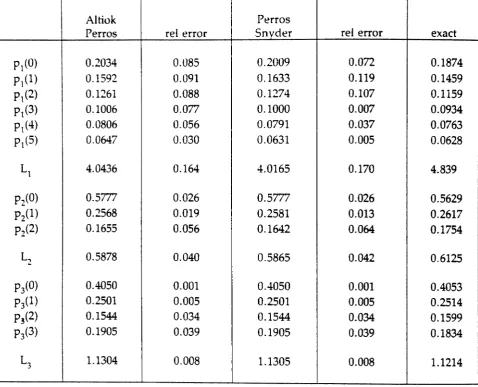
Perros rei error Snyder reI error exact
Pt(O) 0.2034 0.085 0.2009 0.072 0.1874
PI(1) 0.1592 0.091 0.1633 0.119 0.1459 pl(2) 0.1261 0.088 0.1274 0.107 0.1159 Pt(3) 0.1006 0.077 0.1000 0.007 0.0934 pl(4) 0.0806 0.056 0.0791 0.037 0.0763
P1(S) 0.0647 0.030 0.0631 0.005 0.0628
L1 400436 0.164 4.0165 0.170 4.839
P2(0) 0.5777 0.026 0.5777 0.026 0.5629 p2(1) 0.2568 0.019 0.2581 0.013 0.2617
p2(2) 0.1655 0.056 0.1642 0.064 0.1754
L2 0.5878 00040 0.5865 0.042 0.6125 P3(0) 0.4050 0.001 0.4050 0.001 0.4053 p3(1) 0.2501 0.005 0.2501 0.005 0.2514
p3(2) 001544 0.034 001544 0.034 0.1599
p3(3) 0.1905 0.039 0.1905 0.039 0.1834
L3 1.1304 0.008 1.1305 0.008 1.1214
Table 5: A = 0.7; J.L =(1, .7, .8); LV
=
(00,2,3);-
Altiok Perras
Perras reI error Snyder rei error exact
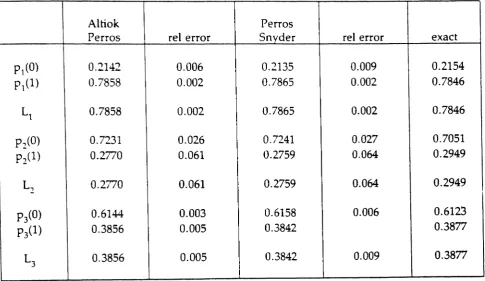
Pl(0) 0.2142 0.006 0.2135 0.009 0.2154
Pl(1) 0.7858 0.002 0.7865 0.002 0.7846
L1 0.7858 0.002 0.7865 0.002 0.7846
pz(O) 0.7231 0.026 0.7241 0.027 0.7051
p2(1) 0.2770 0.061 0.2759 0.064 0.2949
L., 0.2770 0.061 0.2759 0.064 0.2949
P3(O) 0.6144 0.003 0.6158 0.006 0.6123
p3(1) 0.3856 0.005 0.3842 0.3877
L3 0.3856 0.005 0.3842 0.009 0.3877
Table 6: A
=
3.0; ~=(1, 1, 1); N=
(1 , 1, 1);-
-rIO = 0.2, r 12
=
0.4, r13=
0.4, r20=
0.5, r23=
0.5;Altiok Perros
Perros reI error Snvder reI error exact
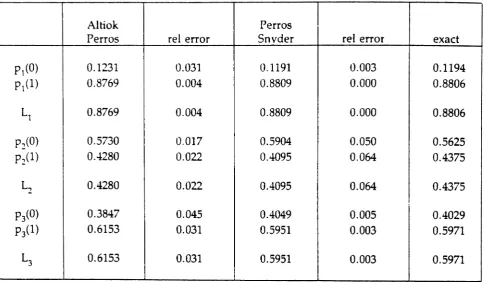
Pl(O) 0.1231 0.031 0.1191 0.003 0.1194
PI(1) 0.8769 0.004 0.8809 0.000 0.8806
L
1 0.8769 0.004 0.8809 0.000 0.8806p~(O) 0.5730 0.017 0.5904 0.050 0.5625
p2(1) 0.4280 0.022 0.4095 0.064 0.4375
L
2 0.4280 0.022 0.4095 0.064 0.4375P3(0) 0.3847 0.045 0.4049 0.005 0.4029
p3(1) 0.6153 0.031 0.5951 0.003 0.5971
L
3 0.6153 0.031 0.5951 0.003 0.5971Table 7: A
=
500; ~=(1, 1, 1); N=
(1, 1, 1);-
-rIO = 0, r 12
=
0.5, r 13=
0.5, r 20=
0, r23=
1;Altiok Perros
Perros rei error Snyder reI error exact
Pl(O) 0.2262 0.126 0.2134 0.022
0.2088 PI (1) 0.2081 0.052 0.2140 0.081 0.1979
P1(2) 0.1948 0.024 0.1999 0.002 0.1996
PI(3) 0.1841 0.089 0.1878 0.014 0.2021 PI(4) 0.1868 0.064 0.1849 0.074 0.1996
LI 1.8972 0.052 1.9168 0.042 2.0018
P2(O) 0.3257 0.056 0.3239 0.050 0.3084
p2(1) 0.2491 0.034 0.2510 0.026 0.2578
pz(2) 0.1868 0.052 0.1866 0.053 0.1970
p2(3) 0.2384 0.007 0.2385 0.007 0.2368
L2 1.3379 0.018 1.3397 0.062 1.3622 P3(O) 0.3900 0.023 0.3887 0.026 0.3990
P3(1) 0.2567 0.025 0.2565 0.026 0.2633
p3(2) 0.3533 0.046 0.3548 0.051 0.3377
L
3 0.9633 0.026 0.9661 0.029 0.9387Table 8: A= 1.5; 1-1=(2,1,2); N = (4, 3.2);
-
-rIO = 0, r12
=
0.5, r 13 = 0.5, r20 = 0, r23 = 1.0;Altiok Perras
Perras rei error Snvder rei error exact
Pl(O) 0.0000 0.000 0.0000 0.000 0.0000 PI (1) 0.0001 0.000 0.0000 0.000 0.0001 pI(2) 0.0003 0.182 0.0006 0.455 0.0011
pl(3) 0.0110 0.078 0.0080 0.216 0.0102
pl(4) 0.0966 0.004 0.1002 0.042 0.0962 PI(5) 0.9810 0.002 0.8911 0.001 0.8924
L1 4.8777 0.000 -i.8816 0.000 4.8797 P2(0) 0.2800 0.001 0.2815 0.041 0.2705 p2(1) 0.2211 0.002 0.2225 0.009 0.2206
p2(2) 0.1737 0.016 0.1735 0.018 0.1766
p2(3) 0.1361 0.025 0.1353 0.031 0.1396
P2(4) 0.1821 0.055 0.1872 0.027 0.1924
L2 1.7052 0.033 01.7242 0.022 1.7634
P3(0) 0.4068 0.017 0.4080 0.014 004139 p3(1) 0.2502 0.002 002504 0.003 0.2496 p3(2) 0.1540 0.025 0.1537 0.028 0.1581
p3(3) 0.1890 0.059 0.1879 0.053 0.1784
L3 1.1252 0.022 1.1215 0.019 1.101
Table 9: 'A = 8.0; ~=(1, .5, 1); N= (5,4,3);
-
Altiok Perros
Perros rei error Snyder reI error exact
P1(0) 0.0233 0.387 0.0194 0.155 0.0168
PI
(1) 0.0425 0.225 0.0389 0.124 0.0347pl(2) 0.0773 0.087 0.0739 0.039 0.0711
pl(3) 0.1407 0.013 0.1400 0.018 0.1425
Pi (4) 0.2558 0.062 0.2655 0.027 0.2728
Pl(S) 0.4604 0.004 0.-1622 0.000 0.4621
L
1 3.9444 0.015 3.9800 0.007 4.0061P2(O) 0.6881 0.017 0.6456 0.019 0.6336
p2(1) 0.3559 0.029 0.3544 0.023 0.3664
L2 0.3559 0.029 0.3544 0.033 0.3664
P3(0) 0.4496 0.004 0.4516 0.000 0.4516
p3(1) 0.2607 0.056 0.2607 0.056 0.2761
p3(2) 0.2897 0.064 0.2877 0.056 0.2724
L3 0.8401 0.019 0.8361 0.015 0.8209
Table 10: A = 3.0~ J.L=(2,2,2); N
=
(5, 1,2);-
-rIO = 0.2, r12
=
0.4, r13 = 0.4, '20 = 0.3, '23 = .7;Altiok Perros
Pcrros rei error Snyder rei error exact
Pl(0) 0.1321 0.047 0.1261 0.001 0.1260
Pl(1) 0.8679 0.007 0.8739 0.000 0.8739
L1 0.8679 0.007 0.8739 0.000 0.8739
p~(O) 0.6978 0.037 0.7154 0.065 0.6727
p:!(I) 0.3022 0.077 0.2846 0.130 0.3273
L., 0.3022 0.077 0.2846 0.130 0.3773
P3(0) 0.7254 0.037 0.7273 0.039 0.6998
p3(1) 0.2746 0.085 0.2727 0.092 0.3002
L3 0.2746 0.085 0.2727 0.092 0.3002
P4(0) 0.3947 0.065 0.4219 0.001 004221
p4(1) 006053 0.047 0.5781 0.000 0.5779
I
Ly 0.6053 0.047 0.5781 0.000 0.5779Table 11: A = .5; f.L=(1,1, 1, 1); N = (1,1,1,1);
-
--r10
=
0.05, r12 = 0.35, r13=
0030, r14=
0.30, r20 = 0.05, r23=
.05; r24 = 0.90,'30
=
0.05, r34 = 0.95:Altiok Perras
Perras rei error Snvder rei error exact
PI(0) 0.3513 0.016 0.3439 0.005 0.3457
PI (1) 0.6487 0.009 0.6560 0.003 0.6543
L1 0.6487 0.009 0.6560 0.003 0.6543 Pl(O) 0.7737 0.024 0.7795 0.032 0.7553
pz(l) 0.2263 0.075 0.2205 0.099 0.2447
L2 0.2263 0.075 0.2205 0.099 0.2447
P3(0) 0.7945 0.024 0.7931 0.022 0.7759
p3(1) 0.2056 0.083 0.2069 0.077 0.2241
L) 0.2056 0.083 0.2069 0.077 0.2241
P4(O) O.SliO 0.015 0.5271 0.005 0.5246
P4(1) 0.4830 0.016 0.4729 0.005 0.4754
Ly 0.4830 0.016 0.4729 0.005 0.4554
Table 12: A
=
3; ....=
(2, 2, 2, 2); LV=
(1, 1, 1, 1);--
--rIO = 0.05, r 12 = 0.35, r 13 = 0.30. r 14
=
0.30, r20=
0.05, '23 = .05; r24=
0.90,r30 = 0.05, r34 = 0.9,5;
Altiok Perros
Perros reI error Snyder rei error exact
Pl (0) 0.0246 00183 000174 00163 000208
Pl(1) 001405 00026 0.1448 00057 0.1370
pl(2) 008349 0.009 0.8379 00005 0.8422
L
1 108103 0.006 1.8205 0.001 1.8214P2(O) 0.6266 0.044 0.6371 0.062 0.6001
p2(1) 0.2391 0.093 0.2405 0.088 002636
p2(2) 0.1363 00000 0.1225 0.101 0.1363
L., 005117 0.046 0.4854 0.095 0.5362
P3(0) 0.6605 0.047 0.6618 0.049 0.6311
p3(1) 0.2228 0.120 0.2267 0.105 0.2533
p3(2) 0.1167 00010 0.1115 0.035 0.1156
L3 004562 0.058 004497 00072 0.4845
P4(0) 0.2429 0.121 002570 00070 002764
p
4(1) 002056 0.156 0.2114 0.132 0.2436
p4(2) 0.5515 0.149 005316 0.108 0.4800
Ly 103086 0.105 1.2746 0.059 1.2036
Table 13: A
=
5; f.L=(1, 1,1, 1); J.V=
(2,2,2,2);-
-rIO
=
0.05, r12=
0.3.5, r13=
0.30, r14=
0.30, r 20=
0.0.5, r23=
.05; r24=
0.90,r30
=
0.05, r34 = 0095;Altiok Perras
Perras rei error Snvcier reI error exact
Pl(O) 0.0232 0.326 0.0151 0.137 0.0175
PI(1) 0.1359 0.057 0.1395 0.085 0.1286 pl(2) 0.8409 0.015 0.8454 0.010 0.8539
L
1 1.8177 0.010 1.8303 0.003 1.8364P2(O) 0.6097 0.075 0.6254 0.102 0.5673 P2(1) 0.2447 0.118 0.2453 0.115 0.2773
p2(2) 0.1456 0.063 0.1294 0.167 0.1554
L2 0.5359 0.089 0.5040 0.143 0.5881
P3(O) 0.6450 0.078 0.6499 0.086 0.5983 p3(1) 0.2283 0.151 0.2316 0.138 0.2688 p3(2) 0.1267 0.047 0.1185 0.108 0.1329
L
3 0.4817 0.099 0.4686 0.123 0.5346P4(O) 0.2705 0.179 0.2914 0.116 0.3298
P4(1) 0.7295 0.088 0.7086 0.159 0.6702
Ly 0.7295 0.088 0.7086 0.057 0.6702
I
Table 14: A. = 5; J..L=(1, 1, 1, 1); N = (2,2,2,1);
-
-rIO = 0.05, r12
=
0.30, r 13=
0.30, r20=
0.05, r30 = 0.05, r34 = 0.95;AP CPU = 0.87 min, PS CPU == O. 82 sec.
1
Pcrros ;
Snyder rei error simulation
Pt(O) O.~Q2 0.002 n.-tlJ3 p,(I) 0.250 0.000 0.250
P t(2) 0.127 0.008 0.128
p,(3) 0.064 0.000 U.064
p,(4) 0.033 0.000 0.033
pt(5) O.Oli 0.000 O.Oli
Lt 1.019 0.079 1.027
P2(0) 0.899 0.001 0.898
p:!(l) 0.091 0.000 0.091 P2(2) 0.010 0.091 0.011
L.. 0.111 0.027 0.114
p)(O) 0.899 0.002 0.897 p)(l) 0.091 0.022 0.093 p3(2) 0.010 0.000 0.010
L) 0.111 0.018 0.113
p-\(O) 0.793 0.005 0.797
p-\(l) 0.164- 0.012 0.162
p-\(2) 0.043 0.024 0.042 L-\ 0.249 0.016 0.245
p,(O) 0.798 0.004 0.795 p,{l) 0.162 0.018 0.165 p,(2) 0.040 0.000 0.040 L_~ 0.242 0.012 0.245
Pb(O) 0.889 0.003 0.886
p6(1) 0.099 0.020 0.101
p6(2) 0.012 0.077 0.013 L6 0.123 0.031 0.127
P;(O) 0.i86 0.004 0.i89
p.tl) 0.168 0.006 0.169 p;(2) 0.045 o.on 0.042 L_ 0.259 0.024- 0.2.53
P8(O) 0.750 0.001 O.iSl
P9(1) 0.188 0.005 0.187
p~(2) 0.062 0.000 0.062
L~ 0.312 0.007 II 0.310
Table 15:
A = 1.0; J.L = (:rJ, 2,2,2,2,2,2,2,4); N =(~,2,2,2,2,2,2,2);
-
-rIO = 0, r12 =0.2, r13 = 0.2, r14 = 0.2, r 17 = 0.2, r18 =0.2,
r20 = 0, r24 = 0.5, r26 =0.5,
r30 =0, r34 = 0.5, '37 = 0.3,
r40 =0, r45 = 1.0,
r60 = 0, r56 =0.3, r57 = 0.3, r58 .= O...J.,
r60 = 0, r68 = 1.0,
r70 = 0, r78 = 1.0,
r80 = 1.0, PS Cf'U .= .05 sec
I Perros
I Snyder rei error simulation PI(O) I 0.403 0.189 0.339 PI( 1) 0.239 0.172 0.204 p,(2) 0.135 0.047 0.129 pl(3) 0.079 0.092 0.087 PI(4) 0.047 0.230 0.061 Pl(5) 0.030 0.333 0.045
L1 2.194 0.107 2.458
P2(0) 0.788 0.033 0.763 p2(1) 0.168 0.067 0.180 p:!(2) 0.044 0.228 0.057
L2 0.256 0.129 0.294
p)(O) 0.782 0.043 0.750
pJ{l) 0.172 0.090 0.189
p3(2) 0.046 0.025 0.061
LJ 0.264 0.154 0.312
P4(0) 0.547 0.036 0.528
p,,(I) 0.254 0.004 0.253
p,,(2) 0.200 0.005 0.219
L" 0.653 0.056 0.692
P5(0) 0.579 0.079 0.535 Ps(1) 0.258 0.019 0.263 Ps(2) 0.164 0.188 0.202
Ls 0.585 0.124 0.668
P6(0)
o.no
0.039 0.741p6(1) 0.178 0.082 0.194 p6(2) 0.052 0.200 0.065
Lo 0.282 0.127 0.323
P7(0) 0.543 0.034 0.525 p;(l ) 0.253 0.035 0.261 p;(2) 0.204 0.047 0.215 L_ 0.661 0.042 0.690
pg(O) 0.500 0.006 0.497 Ps(l) 0.252 0.109 0.257
p~(2) 0.248 0.012 0.245
Lq 0.i48 0.000 0.i48
Table 16:
k=2.0; J..L= ,(4,2,2,2,2,2,2,4);
N=(x,2,2,2,2,2,2,2);
! Pcrros ! !
I
Snvdcr rei error I -rrnularion
P,(O) 0.487 0.002 O.4R6 p,(l) O.:!30 0.012 O.:!47 p,(2) 0.127 U.ooo 0.127 p,(3) 0.063 0.000 0.063 p,(4) 0.0..."4 U.030 'l.033
pt(5) 0.017 0.105 0.019
t, I.U55 0.030 1.088
p:(O) 0.799 0.005 n.i95 p:(l ) 0.161 0.006 0.162
p~(2) 0.032 0.059 0.034 p:(3) 0.008 0.111 0.009
L 0.149 0.027
! 0.236
P3(0) 0.797 0.009 i 0.790
I
p)(l) 0.162 0.024 I 0.166
PJ(2) 0.033 0.000 0.033
P3(3) 0.008 0.272 0.011
~ 0.252 0.049 0.165
P4(0) 0.798 0.000 0.798 p4(1) 0.161 0.000 0.161
P4(2) 0.032 0.000 0.032 P4(3) 0.008 0.000 0.008
L-1 0.251 0.000 0.231
Ps(O) 0.796 0.009 0.789
Ps(l) 0.163 0.018 0.166
ps(2) 0.033 0.083 0.036
Pc;(3) 0.009 0.100 0.010 Ls o .,--.~~ 0.049 0.268
P6(0) 0.780 0.006 0.n5 P&(1 ) 0.172 0.006 0.173 p,,(2) 0.038 0.050 0.040 p,,(3) 0.011 0.083 0.012
L6 0.279 0.035 0.289
I
p_(O)
I 0.379 0.010 0.385
P;(1) 0.245 0.000 i 0.245
p,(2) 0.103 0.010 0.102 p;(3) O.Oi3 0.072 0.069
L 0.670 0.023 0.634
p~(O) 0.750 0.004 0.75) p~(l) 0.188 I o.oi- 0.183 I
p~(2) 0.047 0.022 0.046 P3(3) o.or- 0.067 0.015
L~ 0.328 0.013 o~23
Table 17'
>"=1.0; ~=(3,1,1,2,2,1,1,~,; lV=(~,3,3,3,3,J,3..3l;
-
-routing as in table 15; PS CPU 0.09 sec
I
Perros ,
i Snyder rei error simulation
Pt(O)
I
0.262 1.647 0.099PI(1 ) 0.191 1.690 0.071
Pt(2) 0.129 1.304 0.056
pt(3) 0.090 0.875 0.048 p,(4) 0.065 0.585 0.041
PI(S) 0.048 0.297 0.037 i, 14.39 0.162 17.17
P,(U) O.tJ56 0.068 0.614
p~(l) 0.233 0.009 0.235 p:(2) 0.110 0.272 0.151
i, 0.454 0.155 0.537
p)(O) 0.656 0.081 0.607
p:;(l) 0.233 0.045 0.244
pJ(2) 0.111 0.255 0.149 LJ 0.455 0.161 0.542
P4(0) 0.618 0.092 0.566
P..(1) 0.239 0.004 0.240
P.{Z) 0.143 0.267 0.195
LJ 0.526 0.164 0.629
p~(O) 0.600 0.302 0.461
Ps(1) 0.250 0.046 0.262
p:;(2) 0.150 0.440 0.277 L5 0.550 0.327 0.817
P6(0) 0.595 0.207 0.493
P6(1) 0.249 0.117 0.282
prt(2) 0.156 0.304 0.224
L6 0.561 0.233 0.731
P;(O) 0.471 0.163 0.405
pi(l) 0.273 0.000 0.273 p;(2) 0.256 0.205 0.322
L 0.785 0.144- 0.917
p~(O) 0.200 0.010 0.202 p,(l) O.ln 0.063 0.189 p,(2) 0.623 0.023 0.609
t, 1.423 I 0.011 1.407 Table18:
A=1.6; J.L=(3,1,1,2.2,1,2,2); N=(x,2,2,2,2,2,2,2);
-
Perras
Snvder rei error simulation
pt(O) 0.386 0.008 0.383
p,(l) 0.327 0.058 0.309
pt(2) 0.288 0.065 0.308
L, 0.902 0.025 0.925
p:!(O) 0.704 0.000 0.704
p2(1) 0.213 0.009 O.:!15
p2(2) 0.088 0.086 0.081
~ 0.379 0.005 0.377
PJ(O) 0.b92 0.030 0.672
PJ{1) 0.218 0.056 0.231
p3(2) 0.090 0.072 0.097
L3 0.398 0.064 0.425
p~(O) 0.681 0.004 0.684
p..(l) 0.218 0.018 0.222
p4(2) 0.101 0.075 0.094
L~ 0.420 0.024 0.410
Ps(O) 0.674 0.043 0.646
Ps(1) 0.224 0.043 0.234
Ps(2) 0.103 0.134 0.119
Ls 0.429 0.093 0.473
P6(0) 0.683 0.004 0.686
p6(1) 0.218 0.009 0.220
P6(2) 0.098 0.043 0.094
Lo 0.4:15 0.017 0.408
p:-(O) 0.390 0.042 0.407
p;(l) 0.249 0.095 0.275
p_(2) 0.361 0.132 0.319
L 0.971 0.065 0.912
p~(O) 0.644 0.012 0.652
P8(1) 0.230 0.013 0.233
p~(2) 0.127 0.95 0.116
L~ 0.483 0.041 0.464
Table 19:
A=2.0; ~=(3, 1,1,2,2, 1,1,.t); N=(2,2,2,2,2,2,2,2);
-
-routing same as in table 15; PS CPU 0.22 sec
Perros I
Snyder rei error simulation I
Pl(O) 0.362 0.014 0.357
!
pl(l) 0.334 0.031 0.324
i
p,(2) 0.304 0.044 0.318 I
I
L] 0.942 0.020 0.961 I
I
i
P2(O) 0.777 0.010 0.769
p2(1) 0.175 0.044 0.183
p2(2) 0.049 0.043 0.047
~ 0.272 0.022 0.278
P3(O) 0.770 0.016 0.758
!
p)(1) 0.179 0.058 0.190 I
p)(2) 0.051 0.019 0.052
L) 0.281 0.044 0.294
P4(0) 0.521 0.017 0.530
p4(1) 0.257 0.059 0.273
p4(2) 0.222 0.127 0.197
L-1 0.701 0.051 0.667
Ps(O) 0.557 0.047 0.532
ps(l) 0.263 0.040 0.274
Ps(2) 0.180 0.072 0.194
Ls 0.623 0.059 0.662
P6(O) 0.759 0.017 0.746
p6(l) 0.184 0.061 0.196
p6(2) 0.057 0.017 0.058
L6 0.297 0.048 0.312
I
I
pj(O) 0.519 0.006 0.516
p,(l) 0.256 0.069 0.275
P7(2) 0.226 0.087 0.208
L, 0.707 0.022 0.692
P8(0) 0.478 0.020 0.488
p8(1) 0.252 0.056 0.267
p8(2) 0.270 0.102 0.245
L~ 0.i92 0.045 0.758
Table 20:
A==3.0; J.L=(4,2,2,2,2,2,2,4); N = (2,2,2,2,2,2,2,2);
-
Pcrros I
Snvdcr rei error simulation p,(O) 0.323 0.006 0.321 p,(1 ) 0.335 0.073 0.313 p,(2) 0.342 0.066 0.366
L, 1.019 0.024 1.044
P2(O) 0.593 0.013 0.601 P2(1) 0.254 0.000 0.254
P2(2) 0.153 0.048 0.146
L2 0.560 0.028 0.545
P3(O) 0.587 0.005 0.584 p)(l) 0.256 0.019 0.261
p3(2) 0.157 0.013 0.155
L) 0.5i1 0.000 0.571
P4(0) 0.551 0.023 0.564 p.,(l) 0.253 0.019 0.258 p4(2) 0.196 0.101 0.178
L4 0.645 0.050 0.614
Ps(O) 0.579 0.039 0.557 Ps(l) 0.258 0.030 0.266 Ps(2) 0.163 0.Oi9 0.177
L_~ 0.585 0.057 0.620
P6(0) 0.768 0.024 0.750 P6(1 ) 0.180 0.077 0.195 p6(2) 0.053 0.054 0.056
L6 0.286 0.065 0.6206
p;(O) 0.529 0.019 0.539 p;(l ) 0.254 0.059 0.270
p;(2) 0.216 0.131 0.191
L_ 0.687 0.052 0.306 I
I
I
I
0.436 0.046 0.-i5i
p~(O)
Ps(l) 0.250 0.046 0.262
p~(2) 0.314 0.125
I
0.281
L8 0.878 0.824 0.066
Table 21: ~=3.0; J.L =(4,1,1,2,2,2,2,3.5);
N = (2,2,2,2,2,2,2,2);
r~utingsame as in table 15; PS CPU =5.49 sec.
I Petros
ISnvdcr rei error simulation
I •
I
P,(O) 0.334 0.004 0.352
p,(l) 0.446 0.005 0.448 L, 0.446 0.005 0.448
P2(O) O.fthA 0.009 0.6fiO
p=(1 ) 0.124 0.056 0.237
P2(2) 0.075 0.014 O.Oi4
P2(3) 0.034 0.133 0.030
L~ 0.4n 0.006 0.474
p)(O) I 0.663 0.002 0.666
p)(l) 0.225 0.039 0.234
pJ(2) 0.076 0.041 0.073
p)(3) 0.034 0.214 0.028
L) 0.479 0.O3~ 0.463
P.•(O) 0.659 0.003 0.661
p,,(1) 0.225 0.043 0.235
P4(2) 0.077 0.041 0.074
p~(3) 0.038 0.267 0.030
L4 0.497 0.049 0.474
Ps(O) 0.663 0.008 0.658
P3(1) 0.225 0.034 0.233
p3(2) 0.076 0.013 0.077 Ps(3) 0.035 0.094 0.032
L3 0.483 0.000 0.483
P~(O) 0.813 0.007 0.807 p,,{l) 0.152 0.044 0.139
pP)
I
0.028 0.000 0.028p,,(3) 0.007 0.167 0.006
L" 0.228 0.026 0.234
P7(0) 0.637 0.000 0.637
p;(1 ) 0.232 0.040 0.242
Pi(2) 0.084 0.000 0.084 p:-(3l 0.047 0.132 0.038
L 0.342 0.036 0.323
P~(O) 0.325 0.000 0.325
p~(1) 0.250 0.046 0.262
p~(2) O.11Q 0.033 0.123
p~(3l 0.106 0.191 0.OR9
L~ 0.803 0.037 0.776
Table 22: A=3.0; f..l=(-i,1,1,2,2,2,2,3.5);
Petros
Snyder reierror simulation
P,(O) 0.283 O.OOi 0.281 p, (1) 0.263 0.Oh5 0.247 p,(2) 0.229 0.013 0.226 p,(3) 0.224 0.089 0.246
L, 1.394 0.025 1.~3i
p~(O) 0.52i 0.015 0.535
P2(1) 0.258 0.012 0.261
P2(2) 0.125 0.025 0.122
P2(3) 0.090 0.098 0.082
L~ 0.7i9 0.036 0.752
p)tO) 0.520 0.004 0.522 p3(1) 0.259 0.008 0.261 p)(2) 0.127 0.008 0.128
P3(3) 0.093 0.045 0.089
L) 0.795 0.014 0.784
P4(0) 0.499 0.014 0.506
p~(l) 0.254 0.004 0.255
p~(2) 0.127 0.031 0.131
p_~(3) 0.121 0.120 0.108
L-t 0.869 0.032 0.842
p,(O) 0.511 0.041 0.491 Ps(l) 0.260 0.008 0.262 p,(2) 0.130 0.044 0.136 p=;(3) 0.110 0.009 0.111 L_J 0.818 0.055 0.866
Pb(O) 0.727 0.028 0.707
P6(1) 0.200 0.061 0.213 P6(2) 0.054 0.115 0.061
p~(3) 0.020 0.000 0.020
Lr, 0.367 0.069 0.394
1 p_(O) 0.-148 0.013
! 0.4:54
I '
0.252 0.042
: p.tl) 0.263
p;(2) 0.140 0.054- 0.148 p_(3) 0.160 0.185 0.135 L_ 1.012 0.051 0.963
pg(O) 0.335 0.056 0.355
pg(1) 0.228 0.050 0.240
p~(2) 0.155 0.055 n.lM
p~(3) 0.282
o.trs
0.240L~ 1.384 0.074 1.289
:
Table 2.3: ".=3.0; J.L=(4,1,1,2,2,2,2,J.5);
~
Perros
! Snyder rei error simulation
P,(O) II 0.355 0.020 0.348
P.(1) 0.334 0.030 0.324 p,(2) 0.311 0.055 0.328
L, 0.956 0.025 0.980
P2(0) O.n8 0.004 0.775
P2(1) 0.174 0.033 0.180 p:!(2) 0.048 0.066 0.045
L2 0.270 0.000 0.270
P3(O) 0.710 0.017 0.757 P3(1) 0.178 0.076 0.191 p)(2) 0.051 0.020 0.052
L) 0.281 0.047 0.295
p~(O) 0.523 0.032 0.540
p,,(l) 0.257 0.041 0.268
p,,(2) 0.220 0.146 0.192
L. 0.697 0.069 0.652
P5{O) 0.555 0.051 0.528 Ps(l) 0.264 0.040 0.275 p;(2) 0.182 0.076 0.197
L_, 0.669
P&(O) 0.755 0.029 0.734 P&(l) 0.186 0.084 0.203 P6(2) 0.059 0.Oi8 0.064
Lb 0.304 0.079 0.330
P;(O) 0.500 0.002 0.499
p;(l) 0.256 0.086 0.280
p;(2) 0.243 0.100 0.221
L I 0.743 0.026 0.722
P8(0) 0.409 0.038 0.425 Ps(l) 0.247 0.078 0.268
pg(2) 0.344 0.121 0.307 L~ I 0.935 0.059 0.883
Table 24: ~.. =3.0; fJ..=(4,2,2,2,2,2,2,3.5);
1'1=(2,2,2,2,2,2,2,2);
REFERENCES
(1) Altiok, T., "Approximate analysis of exponential tandem queues with blocking,"
Europ, /. Opere Res. 11 (1982) 390-398.
(2) Altiok, T., and H.G. Perros, "Open networks of queues with blocking: split and merge configurations," to appear in it\lIS Trans.
(3) Altiok, T., and H.G. Perras, "Approximate analysis of arbitrary configurations of open queueing networks with blocking," to appear in the Annals of OR.
(4) Bocharov, P.P. and G.P. Rokhas, "On an exponential queueing system in series with blocking," Problems of Control and Information Theory, 9 (1980), 441-455.
(5) Boxma, O.J. and A.G. Konheim, "Approximate analysis of exponential queue-ing systems with blockqueue-ing," Actalnlormaticai'» (1981) 19-66.
(6) Brandwajn, A. and Y.L. [ow "An approximate method for tandem queues with blocking,It manuscript, Amdahl Corp. (1985).
(7) Caseau, P. and G. Pujolle, 'Throughput capacity of a sequence of queues with blocking due to finite waiting room," IEEE Trans. Soft. Eng. 5£-5 (1979) 631-642. (8) Gershwin, S. B. "An efficient decomposition method for the approximate
evalua-tion of tandem queues with finite storage and blocking," manuscript, Lab. for
Information and Decision Sciences, MIT, (1983).
(9) Goto, K., Y. Takahashi, and
J.
Hasegawa, "An approximate analysis on con-trolled tandem queues," Proc. Modelling Techniques and Tools for Performance Analysis, June 1985, Cannes France.(10) Hillier, F.S., and R. Boling, ''Finite queues in series with exponential or Erlang service times-A numerical approach," Opere Res. 15 (1967) 286-303.
(11) Hordijk, A. and N. Van Dijk, 'Networks of queues with blocking," Performance
'81, F.]. Kylstra (ed.) , North-Holland, New York (1981).
(12) Kelly, F.P., Reversibility and Stochastic Networks, New York, Wiley, 1979.
(13) Kelly, F.P. 'The throughput of a series of buffers," Adv. Appl. Prob., 14 (1982) 633-653.
(14) Labetoulle,
J.
and G. Pujolle, "Modelling of packet switching communication networks with finite buffer size at each node," Computer Periormance, Chandyand Reiser (eds), North Holand (1977), 515-535.
(15) Le Ny. L.-M, "Etude analytique de reseaux de files d'attente multiclasses a routage variable," RAIRO Recherche Operaiionel!e. 14 (1980) 331-347.
(16) Onvural. R.O. and H.G. Perras, "On equivalencies of blocking mechanisms in queueing networks with bocking," to appear in Letters ofOR.
(18) Perras, H.G. and T. Altiok, "Approximate analysis of open networks of queues
with blocking: Tandem configurations,"
IEEE Trans. on
so«.
Eng.,
Vol. SE-12 (1986) 45-461.(19) Perras, H.G. "A Survey of Queueing ~etworks with Blocking-Part I,"
Com-puter Science Report, N.C. State University 1986.
(20) Pollock, S.Nt., ].R. Birge and
1.M.
Alden, "Approximation analysis for open tan-dem queues with blocking: Exponential and general service distributions," manuscript, I. and OR Dept. 83-16, Michigan Univ. (1985).(21) Suri, R. and G. W. Diehl, "A variable buffer-size model and its use in analytic closed queueing networks with blocking," Proc. ACM SIGMETRICS on Measure-mentand Modellingof Computer Systems, (1984), 134-142.
(22) Takahashi, Yo H. Miyahara and T. Hasegawa, "An approximation method for open restricted queueing networks,"
J.
Oper. Res. 28 (1980),594-602.(23) Veran, M. and D. Potier, "QNAP2: A portable environment for queueing sys-tems modelling," INRIA Rep. 314 (1984).
(24) Yao, D. and J.A. Buzacott, "Modelling a class of flexible manufacturing systems