Optimizing
Citrix Technology for Operation over
Wireless Wide Area Networks
R
Recommended Best Practices
Notice
R
The information in this publication is subject to change without notice.
THIS PUBLICATION IS PROVIDED “AS IS” WITHOUT WARRANTIES OF ANY KIND, EXPRESS OR IMPLIED, INCLUDING ANY
WARRANTIES OF MERCHANTABILITY, FITNESS FOR A PARTICULAR PURPOSE OR NON-INFRINGEMENT. CITRIX SYSTEMS, INC.
(“CITRIX”), SHALL NOT BE LIABLE FOR TECHNICAL OR EDITORIAL ERRORS OR OMISSIONS CONTAINED HEREIN, NOR FOR DIRECT, INCIDENTAL, CONSEQUENTIAL OR ANY OTHER DAMAGES RESULTING FROM THE FURNISHING, PERFORMANCE, OR USE OF THIS PUBLICATION, EVEN IF CITRIX HAS BEEN ADVISED OF THE POSSIBILITY OF SUCH DAMAGES IN ADVANCE.
This publication contains information protected by copyright. Except for internal distribution, no part of this publication may be photocopied or reproduced in any form without prior written consent from Citrix.
The exclusive warranty for any Citrix products discussed in this publication, if any, is stated in the product documentation accompanying such products. Citrix does not warrant products other than its own.
Product names mentioned herein may be trademarks and/or registered trademarks of their respective companies.
Table of Contents
R
INTRODUCTION 1
OVERVIEW 2
The Challenge Of Using MetaFrame Over wWANS 2
Goals Of Citrix Optimizations For wWAN 2
OPTIMIZING THE METAFRAME SERVER FOR wWAN CONNECTIONS 4
Introduction 4
Recommendations 4
USING *WEB INTERFACE FOR METAFRAME XP™TO OPTIMIZE ICA®CLIENTS FOR wWAN 6
Recommended Modifications For Template.ica 6
CITRIX ICA CLIENT NOTES 8
Win32 Citrix Ica Client 8
WinCE Citrix Ica Client 8
wWAN COMPRESSION UTILITIES 9
OPTIMIZING INTERNET INFORMATION SERVICES FOR wWAN 9
Caching Web Interface Images 9
Using The “cache-control” Http Header In IIS 10
Controlling Web Page Expiry In Apache 11
CONCLUSION 12
APPENDIX 1: SAMPLE TEMPLATE.ICA FILE FOR WEB INTERFACE 13
APPENDIX 2: SERVER CONFIGURATION CHANGES FOR METAFRAME XP FR1 15
Introduction
R
In today’s fast-moving, global business
environment, having access to the right
information at the right time and place is
essential to success. Organizations are looking
for better ways to provide business-critical
information to an increasingly mobile and
dispersed workforce. Many have adopted Citrix
server-based computing solutions to centrally
manage and deploy applications to remote and
mobile users on any type of device or connection
over wired networks. With the increasing focus
on wireless access, Citrix customers are looking
to add wireless devices and networks to the
options they can offer users.
Overview
R
The challenge of using MetaFrame over wWANs
Millions of MetaFrame users today access their applications over a Local Area Network (LAN). Thanks to the low latency and high bandwidth afforded by the LAN, the users experience is normally indistinguishable from having the applications running locally on the client device. Both wired and wireless WANs, however, present the challenge of lower bandwidth and higher latency. These issues are even more pronounced on wireless WANs, where the user experience may be degraded to the point of being unacceptable.
Throughput and latency are the two elements that define the speed of a network. Throughput is the quantity of data that can pass from source to destination in a specific time. Round-trip latency is the time it takes for a single data transaction to occur (i.e., the time between requesting data and receiving it).
Latency has a critical impact on the MetaFrame user experience since every user action must travel across the network from the client to the server, and the server response must return to the client before the user sees an update. On a LAN, latency is typically very low at less than 10ms. Latencies on wired WANs, however, are typically in the 100 - 500ms range, while wireless WANs are usually in the 300ms – 3000ms range. Not only is ICA®
traffic affected by latency, but other traffic that is traversing the link is likewise impacted.
Wireless WANs typically connect the user to the Internet and from there the user can access the desired MetaFrame server. The Internet is based on the Transmission Control Protocol (TCP). TCP requires the recipient node of a packet to acknowledge its receipt. If the sender does not receive a receipt in a specific time, then TCP assumes that the connection is congested and slows down the rate at which it sends packets and/or retransmits packets. TCP is very effective in dealing with congestion on the wired Internet.
Wireless WANs have greater latency than wired WANs and also demonstrate jitter (variable latency). The underlying wireless networks are based on circuit-switched voice architectures, which do not contain efficient mechanisms for sending data link layer acknowledgements. To improve data efficiency, the networks typically wait for multiple frames to arrive before replying with an acknowledgement. This delay is directly reflected in the packet latency.
Latency normally increases with a corresponding increase in the size of the TCP packet. On a LAN, this increase is barely noticeable since ample bandwidth is generally available. On a wired WAN, it typically has a minor impact. On a wireless WAN, for example, the latency for a 32-byte packet may be 400ms, while the latency for a 1460-byte packet may be significantly more at 1800ms. This high (and variable) latency on a wWAN can significantly interfere with a MetaFrame session to the point where the user may find the experience unacceptable.
In this document, Citrix presents several configuration options that can mitigate many of the effects of latency and provide the user with an acceptable experience using MetaFrame across wWANs. The purpose of this paper is to provide guidance in setting up these options correctly for the user’s environment.
Goals of Citrix Optimizations for wWAN
The aim in optimizing Citrix technology for wWAN connections is to improve the user experience when connecting to a MetaFrame server. This can be further broken down into the following goals:
• Reducing the perceived user latency.
• Reducing the login time.
Overview
R
These aims are achieved in part through the following mechanisms:
Reducing the Maximum Packet Size Used by Citrix
Increases in wWAN connection latency correspond to increases in packet size. The maximum packet size used by Citrix over TCP/IP networks is typically 1460 bytes. Citrix has tested a variety of maximum packet sizes on wireless WANs from several carriers. The results of those tests show that to maintain latency at a manageable level, a packet size of 512 bytes is recommended. Reducing the packet size further than this will impact throughput. In normal operation the lower packet size should not significantly increase the overall packet count (taking into account the average size of ICA packets).
Reducing the Number of Very Small Packets Transmitted
The latency perceived by the user increases with the number of very small packets that are transmitted, i.e., those less than 64 bytes in size. The reason is that each packet transmission has a fixed overhead, provided that the packet size is less than the Maximum Transmission Unit (MTU) for the network. Sending a large number of small packets increases the radio overhead. The recommendations provided by this paper aim to reduce the number of very small packets by aiding packet coalescence.
Using SpeedScreen3 to Reduce Perceived Latency
SpeedScreen™3 is a very important component in the
Citrix wWAN solution. The features in SpeedScreen3 remove the perceived latency felt by the user, since all typing is echoed locally.
Using Caching and Compression to Optimize Bandwidth Usage
Optimizing the MetaFrame Server for wWAN Connections
R
Introduction
This section of the document covers MetaFrame XP server-side optimizations, and deals with the following settings:
• Using SpeedScreen3 Latency Reduction features.
• Reducing the number of small packets sent to the client
• Optimizing the Windows user interface for wWAN connections.
The following section describes additional settings
that must be made using Web Interface for MetaFrame XP™
(previously known as NFuse Classic). The two sections together detail all of the settings required for optimal wWAN connections.
Recommendations
Feature Release 2
MetaFrame XP FR2 contains several improvements designed to improve the usage of wireless WANs.
• Several settings that previously needed manual configuration for wireless WANs were automated to simplify the setup process.
• Improved compression reduced the data transferred over the network.
• Given available data, packets are filled as near to the maximum chosen packet size as possible.
• Improved performance of bulk transfer data channels (e.g. client drive mapping), with improved interactive response when both bulk and screen traffic occur concurrently.
Citrix strongly recommends using the FR2 or later releases for wWAN connections, as well as the corresponding ICA client versions. Implementing a more recent version on the server without upgrading the client or vice versa will result in a system that cannot take advantage of improved features.
If wWAN access is required for servers running the FR1 release then manual configuration changes are required. These are described in Appendix 2.
Enable SpeedScreen3 Latency Reduction
There are two components to SpeedScreen3 Latency Reduction:
1. Local Text Echo.
2. Mouse Click Feedback.
The Local Text Echo feature echoes keystrokes locally on the client device as they are typed. The characters appear immediately, and are later over-written seamlessly by the server image as it becomes available. This instant visual feedback removes the latency perceived when typing.
Mouse click feedback changes the mouse cursor on the client to the “busy working” state when the user clicks a mouse button. When the server has acknowledged the mouse click, the mouse cursor on the client device reverts to the default pointer. Thus, the user is presented with instant feedback to the mouse click.
On the server, the SpeedScreen3 Latency Reduction Manager is used to set the options for both components. By default, Mouse Click Feedback is enabled for the server, while Local Text Echo is disabled.
Optimizing the MetaFrame Server for wWAN Connections
R
Increase the Menu Show Delay
This is an optimization to the Microsoft®Windows®user interface. Although this optimization does provide positive benefits to users connecting over wWAN, it will also take effect when those same users connect on a high-speed link, and hence this change may not be suitable for all users.
The Menu Show Delay is the length of time that the mouse pointer needs to be held above a parent menu entry before the sub menu below that entry is displayed. By increasing this timeout, navigating both the Start menu and application menus becomes easier over wWAN. This is because the user will be able to move the mouse to the required shortcut, and then launch that shortcut without having to wait for each submenu that the mouse passes over to be displayed. The submenu can still be opened quickly by clicking on the parent menu entry.
The menu show delay is controlled by the registry value
HKCU\Control Panel\Desktop\MenuShowDelay.
It is recommended to set this value to 1500 although you may alter this to get best results for your environment. The unit of measurement is milliseconds. Caution must always be exercised when making manual changes to the registry. Backup of the registry prior to the change is recommended.
Future Feature Releases
Citrix understands the potential growth in wWAN access and has committed development efforts in this area. Future feature releases will likely include further enhancements and configuration options to support wWAN access.
Using Citrix Web Interface to Optimize ICA Clients for wWAN
Citrix Web Interface is the preferred configuration method for ICA clients connecting to MetaFrame servers over a wWAN. Users visit the Web Interface logon page and follow the link for a published application. Web Interface generates an ICA file that contains all of the settings needed to optimize the client for wWAN, and the client makes use of these settings.
The Citrix Program Neighborhood (PN) Agent ICA client also uses Web Interface technology, but some of the configuration for the PN Agent is separate from the general Web Interface settings. For more details of the setup, please refer to the Web Interface for MetaFrame XP™Administrator’s Guide.
The settings described in this section can be applied to a generic client-side ICA file. Settings for specific client platforms are discussed in the Citrix ICA Client Notes section.
Citrix recommends that you create two separate Web Interface web sites to front-end your MetaFrame servers: one to serve wireless users and the other to serve LAN users. Each site should have settings appropriate to the connection technique.
Using Citrix Web Interface for MetaFrame XP To Optimize ICA Clients For wWAN
R
Recommended Modifications for Template.ica
This section contains recommended changes to the Template.ica file for the Web Interface wireless access site. These changes optimize the ICA session for wWAN connections. A sample Template.ica file listing is included in Appendix 1.
Disable Client Device Mapping
Disabling client device mapping minimizes client/server negotiation at logon, making logon faster. Application performance is also improved because the operating system does not have to discover client drives and devices, which typically occurs when a URL is entered into Internet Explorer, when a Save Asor File Opendialog box is displayed by a Windows application, or when you press the Startbutton.
Note that if the facilities offered by one of the bulk data transfer channels (e.g. Client Drive mapping) is required, then significant performance improvements over wWAN are offered by the MetaFrame XP FR2 release over previous releases.
The following ICA file settings need to be made to disable client device mapping.
ICA FILE ENTRY VALUE DESCRIPTION
COMAllowed Off Controls the use of the COM port
mapping virtual channel
CPMAllowed Off Controls the use of the Client Printer
Mapping virtual channel
VSLAllowed Off Controls the use of the print spooler
virtual channel
CDMAllowed Off Controls the use of the Client Drive
mapping virtual channel
ClientAudio Off Controls the use of the audio
virtual channel
Disable Client Update
Disabling client update also reduces the logon time. Also note that the same capabilities can be achieved using the client deployment tools in Web Interface for many ICA client devices. The following file setting disables client update from the MetaFrame XP servers.
ICA FILE ENTRY VALUE
Updates Allowed Off
Restrict the Maximum Packet Size Used by ICA
As previously explained, the maximum packet size used by ICA over TCP/IP networks is typically 1460 bytes. This packet size leads to an increase in latency. By reducing the
maximum packet size, latency is decreased.
These settings reduce the maximum packet size used by ICA. The following file entries control the maximum packet size used by the client.
ICA FILE ENTRY VALUE NOTES
OutBufCountHost 118 This setting affects the max amount
of server to client data that the connection will try and keep active at any point. Raising it above this value is not recommended.
OutBufCountClient 118 This setting affects the max amount
of client to server data that the connection will try and keep active at any point. Raising it above this value is not recommended.
OutBufLength 512 This setting aligns with the
Using Citrix Web Interface for MetaFrame XP To Optimize ICA Clients For wWAN
R
Turn On SpeedScreen3 Latency Reduction
The parameters that control the two SpeedScreen3 Latency Reduction components are ZLMouseMode and ZLKeyboardMode, which need to be set to the following values. For information the valid values are:
0 – disabled, 1 – Enabled and 2 – auto.
ICA FILE ENTRY VALUE
ZLMouseMode 1
ZLKeyboardMode 1
Enable Maximum Data Compression
Data compression increases the bandwidth efficiency of the ICA client. Furthermore, using maximum data compression maximizes this efficiency, though at a cost of slightly more memory resource used on the MetaFrame server. Maximum data compression is enabled through the following ICA file entry.
ICA FILE ENTRY VALUE
Compress On
MaximumCompression On
Note that the MaximumCompression setting is not recognized by the ICA client for Windows CE. Setting “Compress=on” has the same effect as setting both of the above values to On for the ICA client for 32-bit Windows desktop operating systems.
Enable Mouse Movement and Keystroke Queuing
Enabling these parameters reduces the number of small mouse and keyboard packets sent to the server.
ICA FILE ENTRY VALUE NOTES
MouseTimer 200 Setting can be varied but increasing
this value too much could degrade interactive response regardless of Speedscreen3 being enabled.
KeyboardTimer 50 Setting can be varied but increasing
this value too much could degrade interactive response regardless of Speedscreen3 being enabled
Enable the Persistent Cache
Enabling the persistent cache decreases logon time and improves the performance of graphics operations during an ICA session. Persistent cache is not supported in all ICA clients. For example, the ICA client for Windows CE version does not support this due to typical resource constraints on the devices limiting memory allocation available for caching. To enable use of the persistent cache, set
PersistentCacheEnabled=On.
ICA FILE ENTRY VALUE
PersistentCacheEnabled On
Increase the Size of the Thinwire Cache to 8192KB
Citrix ICA Client Notes
R
The easiest way to ensure all connections are optimized for wireless WAN use is to add the parameters discussed in the previous section into the template.ica file and make all connections through the Web Interface or the Program Neighborhood Agent.
If, however, you wish to use custom ICA connections or static .ica files, you will need to add the parameters to the appropriate files as noted in the sections below for each client type.
Win32 Citrix ICA Client
Add the following parameters to the [Wfclient] section of appsrv.ini. On Windows NT and XP systems this file is found in the user’s ICA Client Application Data directory. (Eg: C:\Documents and Settings\[username]\Application Data\ICAClient). The gray text below is existing text in the file.
[WFClient} Version=2
COMAllowed=Off CPMAllowed=Off VSLAllowed=Off CDMAllowed=Off ClientAudio=Off UpdatesAllowed=Off
OutBufCountHost=118 OutBufCountClient=118 OutBufLength=512
PersistentCacheEnabled=On MouseTimer=200
KeyboardTimer=50
Additionally, add the following parameters to the
“Connection” section of appsrv.ini (e.g. [Microsoft Outlook]):
[Microsoft Outlook]
ZLKeyboardMode=1 ZLMouseMode=1
MaximumCompression=On Compress=On
WinCE Citrix ICA Client
wWAN Compression Utilities
R
Optimizing Internet Information
Services for wWAN
R
Many wWANs offer compression utilities in their software package to improve network performance. An example is the Venturi software provided by Verizon Wireless. Since the data stream is already intelligently compressed by Citrix, these utilities are unlikely to be able to further compress the stream. In some instances, they have caused problems when using ICA. So while these utilities may perform well for general Web browsing, Citrix does not recommend their use for ICA traffic.
Internet Information Services (IIS) can be configured to improve the browsing experience of wWAN users. These configurations are based on client-side caching of the Web Interface images. By using technology introduced with IIS 5.0, administrators can decrease the time required to display the Web Interface logon page and the list of available published applications.
Caching Web Interface Images
You can reduce the display time for Web Interface pages by caching images that are typically not cached. These images include both the icons for published applications and generic logo and branding images.
The following folders need to be marked as cachable:
• The NFuseIcons folder. This is usually located in the root of the Web site. This folder contains the images for the applications published on the farm.
• The Media subfolder. This is a subfolder in the Citrix\MetaFrame folder. It contains all the bitmaps associated with Web Interface.
• The Default.htm file.
To mark a folder or file as cachable in IIS, use the following procedure:
1. Start theInternet Information Services applet located under Administrative Tools.
2. Expand the default Web site entry and navigate to each of the above folders and files.
3. Right-click the entity and select Propertiesfrom the
Optimizing Internet Information Services for wWAN
R
Using the “Cache-Control” HTTP Header in IIS
Internet Explorer Version 5.0 and later offers support for the Cache-Control HTTP header. This header defines browser behavior with respect to cached objects. The Cache-Control header consists of two parameters: the post-check time and the pre-check time.
The post-check time is an interval in seconds after which an entity must be checked for freshness. The check can occur after the user is shown the entity; this ensures that on the next round trip, the user will be shown the most up-to-date copy. (Note that you can check the cached object “post” display.)
The pre-check time defines a time interval in seconds after which an entity must be checked for freshness before being displayed to the user. (Note that the cached object is checked “pre” display.)
Figure 1 below, (reproduced from http://
msdn.microsoft.com/workshop/Author/perf/perftips.asp), illustrates how Internet Explorer uses these values.
Figure 1: Cache-Control HTTP Header Usage by Internet Explorer
By choosing appropriate post-check and pre-check times, the user will typically be shown cached copies of images for published applications and Web Interface. This occurs quickly. If the post-check timeout expires, the browser performs a check, in the background, to determine if the image is updated. It is only when the pre-check timeout expires that the browser checks the cached object for updates (and then only if no update to the cached object was made during the post-check timeout phase).
Because changes to published applications are relatively infrequent, sensible values for these parameters are:
• Post-check = 1200
• Pre-check = 360000
These values correspond to 20 minutes and 4.2 days respectively. This means that:
• In the first 20 minutes, the user will see cached images displayed; no check is done.
• After 20 minutes, the user will see cached images displayed; a background check is made for an up-to-date image.
• After 4.2 days, if a new image has not been downloaded from the server, a check is made for an up-to-date image before that image is displayed.
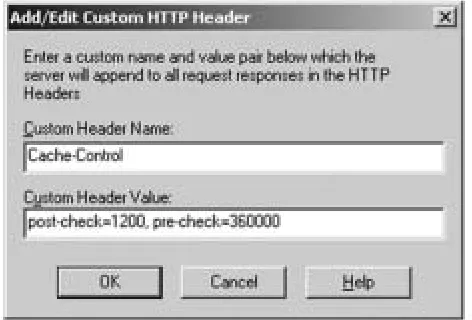
To set these headers, click Add… on the HTTP Headerstab of the dialog box described previously. This displays a dialog box where you can add the HTTP headers. The entries required are shown in Figure 2 on the following page.
Cache Control post check = 50, pre-check = 100
No-Check: Clients shows cached copy, no update is performed Post-Check: Client shows user cached copy, update in background Pre-Check: Client updates in foreground, then shows document
A request at this time results in an immediate view without any update
Initial request, object is retrieved from server at time 0
Post-Check time interval expires A request at this time results in an immediate view with a background update
A request at this time results in an update prior to any view. This behaves like an expired document
Pre-Check time interval expires
Optimizing Internet Information Services for wWAN
R
Figure 2: Adding the Cache-Control HTTP Header using IIS
Click OKto enforce the headers for the selected entity.
Controlling web page expiry in Apache
Equivalent functionality to the above is available in Apache (1.2 or above) via the mod_expires module. Check for mod_expires in the Apache httpd.conf file or by running the httpd –l command.
Expiry of web page content can be set for different document realms. Virtual Host and Directory containers are controlled by settings placed within the httpd.conf file. Alternatively, Expires directives can be placed within a .htaccess file in the relevant directory. In the latter case, the AllowOverride Indexes header must be set within httpd.conf for the relevant directory.
Deploying appropriate Expiry settings for Web Interface images can reduce display time for the users. See the
The syntax for Expiry control is divided into 3 parts:
• ExpiresActivecontrols whether expiry headers are generated. Set it to ON.
• ExpiresDefaultcontrols the default expiry time for every object in this realm. It takes a single time parameter.
• ExpiresByTypecontrols expiry for a given object type. It takes two arguments: the MIME type to control and a time parameter.
The following example gives an idea of the syntax used to set up page expiry. For more details see:
http://httpd.apache.org/docs/mod/mod_expires.html
<Directory /directory/path/required>
# if using .htaccess scope, set AllowOverride # AllowOverride Indexes
# Everything else you want to add to this section ExpiresActive on
ExpiresDefault "access plus 2 months" ExpiresByType image/gif "access plus 1 year" ExpiresByType text/html "modification plus 5 days" </Directory>
Apache also supports Cache-Control meta files deployed to mirror web page directory layout.
For more details see:
Conclusion
R
The Citrix server-based computing model offers an excellent approach for providing wireless access to applications. End users benefit from the flexibility to choose their device and connection, while administrators gain the efficiency of centralized application management and deployment, making it far easier to support mobile workers who may not have local technical resources.
Appendix 1: Sample Template.ica File for Web Interface for MetaFrame XP
R
; Wireless wWAN ICA file template for the Citrix ICA Client ; Copyright 2000-2002 Citrix Systems, Inc. All rights reserved.
<[NFuse_IFSESSIONFIELD sessionfield="NFUSE_LANGUAGECODE" value="ja"]> [Encoding]
InputEncoding=SJIS <[/NFuse_IFSESSIONFIELD]>
<[NFuse_IFSESSIONFIELD sessionfield="NFUSE_LANGUAGECODE" value="de"]> [Encoding]
InputEncoding=ISO8859_1 <[/NFuse_IFSESSIONFIELD]>
<[NFuse_IFSESSIONFIELD sessionfield="NFUSE_LANGUAGECODE" value="en"]> [Encoding]
InputEncoding=ISO8859_1 <[/NFuse_IFSESSIONFIELD]>
<[NFuse_IFSESSIONFIELD sessionfield="NFUSE_LANGUAGECODE" value="fr"]> [Encoding]
InputEncoding=ISO8859_1 <[/NFuse_IFSESSIONFIELD]>
<[NFuse_IFSESSIONFIELD sessionfield="NFUSE_LANGUAGECODE" value="es"]> [Encoding]
InputEncoding=ISO8859_1 <[/NFuse_IFSESSIONFIELD]>
<[NFuse_setSessionField NFuse_ContentType=application/x-ica]>
[WFClient] Version=2
ClientName=[NFuse_ClientName]
;---;The following are recommended settings for wWAN connections
;---COMAllowed=Off CPMAllowed=Off VSLAllowed=Off CDMAllowed=Off ClientAudio=Off
Appendix 1: Sample Template.ica File for Web Interface for MetaFrame XP
R
<[NFuse_IfSessionField sessionfield="NFuse_CSG_Enable" value="On"]> TransportReconnectEnabled=Off
<[/NFuse_IfSessionField]> RemoveICAFile=yes [NFuse_SOCKSSettings]
[ApplicationServers] [NFuse_AppName]=
[[NFuse_AppName]]
Address=[NFuse_AppServerAddress] InitialProgram=#[NFuse_AppName]
LongCommandLine="[NFuse_AppCommandLine]" DesiredColor=[NFuse_WindowColors]
TransportDriver=TCP/IP WinStationDriver=ICA 3.0
;---;The following are recommended settings for wWAN connections
;---ZLKeyboardMode=1 ZLMouseMode=1
MaximumCompression=On Compress=On
;---[NFuse_ClientLogon]
[NFuse_SOCKSSettings]
AutologonAllowed=ON [NFuse_Ticket]
[NFuse_IcaWindow]
[NFuse_IcaEncryption]
SessionsharingKey=[NFuse_SessionSharingKey]
[EncRC5-0]
DriverNameWin16=pdc0w.dll DriverNameWin32=pdc0n.dll
[EncRC5-40]
DriverNameWin16=pdc40w.dll DriverNameWin32=pdc40n.dll
[EncRC5-56]
DriverNameWin16=pdc56w.dll DriverNameWin32=pdc56n.dll
[EncRC5-128]
DriverNameWin16=pdc128w.dll DriverNameWin32=pdc128n.dll
[Compress]
Appendix 2: Server Configuration Changes for MetaFrame XP FR1
R
Note that none of the following changes are required for MetaFrame XP FR2 or above releases; these modifications are only required if FR1 is deployed.
Create a New ICA Listener Entry for wWAN Connections
By creating a second ICA listener dedicated to serve users connecting through wWAN, customizations specific to wWAN users are made without affecting LAN users. By creating a new ICA listener and routing all wWAN connections to that listener, a Citrix server(s) can serve applications to users connecting on high-latency wWAN links as well as on low-latency LAN links.
This second listener is used in combination with Web Interface. A second Web Interface Web site is created for wireless access and Web Interface routes users to the correct ICA listener by selection of the new port number.
The following discussion assumes a single-homed server.
To create a new ICA listener:
1. Use Regedit.exe to open the following registry key:
HKLM\System\CurrentControlSet\Terminal Server\WinStations
2. Expand and select the ICA-tcp key.
3. Export the ICA-tcp key to a registry file.
4. Rename the ICA-tcp key to ICA-tcp-wWAN.
5. Import the previously exported registry file back into the WinStations key. This recreates the ICA-tcp key.
6. Set the PortNumber value in the ICA-tcp-wWAN key. This registry setting defines the port number for the listener.
Increase the Interactive Timer Delay on the wWAN ICA®
Listener
The interactive timer is used on the server to ensure session interactivity. The timer flushes any pending buffers when interactive (mouse or keyboard) input is detected when the timer fires.
By increasing the interactive timer delay, buffers that are sent to the client will contain more data when they are flushed. This will reduce the number of small packets that are sent to the client. This reduces the perceived latency due to the lower radio overhead.
It is paradoxical that by increasing the interactive timeout, the perceived session interactive response actually decreases. On LAN and low latency connections, increasing this timeout results in a degradation of interactive response because on wWAN connections, an extra 90ms on the interactive timeout is relatively small when compared to a session latency of around 1600ms. However, on LAN connections, an extra 90ms is a relatively large slice of time when compared with the overall session latency (in fact it exceeds the session latency).
Appendix 2: Server Configuration Changes for MetaFrame XP FR1
R
Enable SpeedScreen3 Latency Reduction Channel Buffering
Channel buffering connotes that server data is buffered prior to being transmitted to the client. This has the
effect of coalescing many small packets into a larger packet, which on wWAN connections reduces the number of radio transactions required for the same amount of data. This benefits the session latency.
The server/client communication on the SpeedScreen Latency Reduction Channel typically consists of a large number of small packets and is an ideal candidate for buffering. The small packets are typically ack(acknowledge) packets for previously typed keystrokes.
Virtual Channel Buffering is controlled through the Buffering registry value located in the registry key.
HKLM\System\CurrentControlSet\Control\Terminal Server\WDs\icawd
The format of this value is a multistring. Each entry in the multistring corresponds to a virtual channel name that will be buffered. Use the regedt32.exe application to edit multistrings (not regedit.exe). The name of the SpeedScreen Latency Reduction channel is “CTXZLC ”. The trailing space must be added. Making this change enables buffering for the channel. The ICA listener must be restarted for this to take effect.
References
1. GSM Phase 2+ General Packet Radio Service GPRS: Architecture, Protocols,and Air Interface
Christian Bettstetter et. al. Technishe Universitat Munchen (TUM) Published by IEEE Communications Society.
2. History Repeating Itself?