The effectiveness of physical activity interventions in improving wellbeing across office based workplace settings: A Systematic Review
Keywords: Physical acti vity, review, interventi on, employee, workplace, worksite
Abstract
Objectives: Although the benefits of regular physical activity are widely accepted, most of the population fail to meet the recommended levels of activity. Public health bodies such as the World Health Organisation (WHO), emphasise promoting physical activity within workplaces as key intervention setting to reach the health and wellbeing of the working population. Given the importance of wellbeing in workplace settings, it seems worthwhile to explore the evidence of effectiveness in the literature. This systematic review aims to assess the effectiveness of physical activity (PA) interventions for improving wellbeing in working adults. It provides a review of current evidence, assesses the quality of the research into this topic area and identifies issues and recommendations for future research.
Study Design: A systematic review, guided by the Cochrane Handbook was conducted. Methods: PsycINFO, PubMed, ScienceDirect, Web of Science, EMBASE, MEDLINE and Cochrane Library literature searches were conducted from 2007 to April 2017. Using the key words ‘Physical Activity’; ‘Exercise’, ‘Wellbeing’; ‘Employee’ and ‘Workplace’ 5 articles were obtained that fit for the inclusion criteria. Inclusion criteria were: - a workplace setting, an intervention including a physical activity intervention and an outcome measure including wellbeing. Extraction of articles and quality assessment of the papers were performed independently by two authors using the Cochrane’s data extraction form and the Cochrane’s risk of bias. Due to heterogeneity in population characteristics, intervention components, outcomes measures and the durations of interventions, a narrative synthesis was conducted.
did not include a placebo control group and therefore a form of PA intervention regardless of the type may be better than no intervention at all.
Conclusion: This review found mixed evidence that PA interventions can be effective in improving wellbeing across workplace settings. Although, the findings are promising, due to methodological failings there is no conclusive evidence. Current evidence indicates that employees can improve their wellbeing by participating in any form of physical activity interventions in the workplace.
Introduction
Workplaces have been established as one of the priority settings for health promotion in the 21st century1. They have been shown to directly influence the physical, mental, economic and
social wellbeing of employees and as a result the health of their families. Regrettably the concept that the workplace is an important area for health campaigns of many kinds, as well as basic occupational health and safety programmes may not yet be widely accepted2. The concept of promoting health in the workplace is becoming increasingly relevant as more organisations recognise the importance of a healthy workforce to obtain success across their organisation. There are several benefits for employers in investing in the health of their employee such as reduced sickness absence, increased productivity and better staff retention3.
Physical activity interventions have been shown to be cost effective across workplaces 4, 5, 6. Numerous studies have conveyed the importance of physical activity in improving health and wellbeing 7,8,9,10. According to the Department of Health11, terminology around wellbeing is
often used interchangeably and sometimes incorrectly. Wellbeing refers to an individual realising their own capabilities and able to feel good and function well with the normal stresses of life whilst working12. The World Health Organisation (WHO) recognises that
wellbeing is an important marker of health and plays an important role in employee and employer relations as well as job satisfaction and productivity13, 14.
It has been widely emphasised that workplace physical activity strategies to improve mental wellbeing and employee productivity should focus on reducing sitting time by increasing physical activity across workplaces 14. However; a systematic review examined workplace
review aims to provide clarity on the effectiveness of physical activity interventions across workplaces.
Although the benefits of physical activity in promoting wellbeing are widely accepted, links between physical activity interventions and wellbeing across workplace settings remain unclear and often anecdotal. This is the first review to the authors’ knowledge where the effectiveness of physical activity in improving wellbeing is synthesised. Given the
importance of wellbeing in workplace settings, it seems worthwhile to explore this emerging area. This systematic review aims to assess the effectiveness of PA interventions for
improving wellbeing in working adults. It provides a review of current evidence, assesses the quality of the research into this topic area and identifies issues and recommendations for future research.
Methods
This systematic review guided by the Cochrane Handbook was conducted to assess the effectiveness of physical activity (PA) interventions for improving psychological wellbeing in working adults in an office setting. This review was registered prospectively to the PROSPERO register. Registration number CRD42017068826.
Data sources
A systematic literature search was performed for English Language articles from 2007 to April 2017 in PsycINFO, PubMed, Science Direct, Web of Science, EMBASE, MEDLINE and the Cochrane library using the following search terms and keywords: ‘Physical activity’; ‘exercise’; ‘wellbeing’; ‘work’; ‘workplace’; ‘worksite’; ‘employees’ and ‘employee’. Additional reference lists of included studies and related systematic reviews were manually checked for further relevant articles.
Study selection
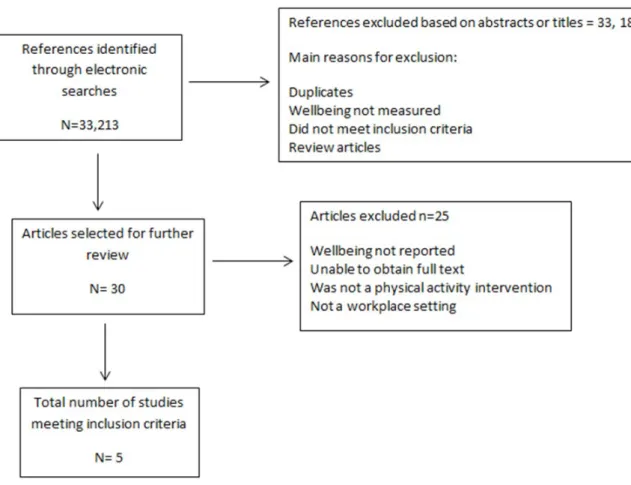
The approach of this systematic review was based on the Cochrane handbook for systematic reviews of interventions 15and PRISMA flow chart shown in figure 1. This approach ensured
two authors (SA and RW) and it was planned that the third author (JBD) would assess should there be no agreement in discussions between the two authors.
Types of studies
Study designs of all types were eligible if they met the criteria of inclusion. Studies were limited to published, peer reviewed articles written in English language.
Types of participant
Studies had to represent adults in a office-based workplace environment.
Types of intervention
Any studies focusing on face-to-face physical activity or exercise interventions were
included. Non-behavioural interventions were excluded such as educational and counselling. All included studies measured the effects of the intervention on psychological wellbeing levels as a primary outcome. Psychological wellbeing was reported through various outcomes such as stress, life purpose, life satisfaction and subjective wellbeing. Some studies reported physical activity outcomes using step counts.
Quality assessment of included studies
The quality of the included studies was assessed using the Cochrane’s risk of bias tool 15. The
tool covers six domains of bias: selection bias, performance bias, detection bias, attrition bias, reporting bias and other biases. The validated tool provided a conclusion of risk of bias using low risk, high risk and unclear risk for each study. A methodologically weak strong quality paper will have a low risk for each domain.15 Each study was assessed independently by the
first two authors to limit bias. The quality of the studies was used in combination with the evidence of effect throughout the synthesis.
Figure 1 PRISMA Flowchart
Five studies with a total of 1326 participants met the inclusion criteria. Of these, three were randomised control trials 16, 17, 18, one was an experimental design19 and one uncontrolled
feasibility trial 20. Due to heterogeneity in population characteristics, intervention components
outcomes measures and the durations of interventions, a meta-analysis was not feasible 21. A
narrative synthesis was conducted for this review. Interventions
The mode of physical activity interventions across the studies included one exercise study, one yoga study and five walking studies. The length of studies ranged from a minimum of 9 weeks 17 to two years20. All the included studies measured wellbeing differently using a range
of questionnaires and scales. Two high quality studies 18, 20 did not report physical activity
outcomes.
Three studies were conducted in University settings 17,18,20, one study was conducted amongst
small to medium sized organisations16 and one study did not report the type of workplace
setting 19 however it was mentioned that 10 worksites were involved. Four studies were
undertaken across Europe 16, 17,18, 20and one was conducted in Australia19. Four studies were
According to the quality assessment, three studies 17, 18, 20 were of high quality. Two studies 16,
19 were of low quality. None of the included studies used a theoretical base in their
interventions.
Evidence of effectiveness
Table 1 show the main outcomes of all included studies. The outcomes are described by grouping the included studies as type of interventions.
Yoga
Hartfiel, Havenhand, Khalsa, Clarke and Krayer 18 found good quality evidence that yoga was
statistically significant in increasing wellbeing compared to controls. The yoga participants felt significantly less anxious (p<0.0005), less confused (p<0.0005), less depressed (p<0.01), tired (p<0.002) and less unsure (p<0.010). Moreover, yoga participants had a greater sense of life purpose and satisfaction (p<0.0.009) and were more confident during stressful situations (p<0.001). Although, participants in the yoga group reported feeling less hostile than the control group, this was not significantly evident (p>0.189). However, as there was no placebo control group high quality study can only conclude that a form of intervention is better than none.
Walking
Three walking interventions studies showed mixed evidence of statistically significant increases in improving wellbeing 17, 19,20. However, one of the studies 19 was of low quality
and as a result the quality of the three studies compromises the strength of the findings that walking interventions are effective in improving workplace health.
Thogersen-Ntoumani et al 20found significant improvement (P<0.001) in health perceptions,
subjective vitality, work performance and fatigue. These changes were sustained at four months follow up. However, this high quality study highlighted that there were no changes identified for enthusiasm, nervousness and relaxation at work.
A low-quality study 19 found that after the four month intervention, subjective wellbeing
Puig-Ribera, McKenna, Gilson & Brown17 found good evidence that individuals who
reported low activity at baseline, showed the greatest increase in step counts, improved quality of life and wellbeing and work productivity (p<0.01).However, the findings of this high quality study demonstrated no significant group differences in changes to work day step counts. Although, participants in the intervention groups maintained their step counts, control step counts decreased with the approach of winter. This study implies that this walking intervention works best with sedentary employees compared to a control group.
Exercise
Kettunen, Vuorimaa & Vasankari 16, conducted a 12 month exercise programme found low
quality evidence that statistically significant decreases of stress symptoms and improved mental resources and cardiorespiratory fitness and these positive changes were retained after 1 year follow up compared to control group.
The findings evidence that exercise, yoga and walking interventions improve wellbeing as measured across workplace settings compared to no intervention. Some studies did not include a placebo control group and therefore a form of PA intervention regardless of the type may be better than no intervention at all. Two studies 17, 20 did not follow participants for
Table 1 –physical activity Interventions to promote wellbeing across office employees
Study Sample and Setting Design and
Intervention
Measures Findings Quality
Assessment
Kettunen et al (2015)
Finland
Aim: To investigate the effect of an exercise-training programme with a moderate volume and low intensity on stress symptoms, mental resources and cardiorespiratory fitness of healthy working adults.
Study Length:2 years
Sample: 371 employees from small and medium-sized companies.
Intervention group:
N = 338 , mean age 45± 8.8, Women = 212, Male – 126
Control Group: n=33, mean age = 41±6.9. Women= 17, Male = 16
RCT, 1 year
intervention with 1 year follow up., data collections occurred at baseline, 4 month, 8 month, 12 month and 24 months.
Intervention Group: 12 month exercise programme which contained 2 days training camps at a sport institute. Individuals were put into groups and each group had the same coach for the duration of the intervention. Every participant had an
Physical Activity
The weekly leisure time physical activity (LTPA) questionnaire. Cardiorespiratory fitness Maximal oxygen uptake Wellbeing The Occupational stress questionnaire (OSQ) measured the characteristics and stress factors of work and stress reactions of employees. Mental resource index (MRI)
Stress symptoms of the exercise group decreased by 16% (p<0.0001)and mental resources, leisure time physical activity as well as
cardiorespiratory fitness improved during the 12 month intervention and these positive changes remained after the follow up year.
individualised exercise programme. Control group: received no supervised exercise or programme
Hartfiel et al (2011)
United Kingdom
Aim: To examine the effectiveness of yoga in enhancing
emotional wellbeing and resilience to stress amongst university employees.
Study Length: 1 Year
Sample: 48
employees from a British University.
Intervention Group : N = 20
N= 17 Female, Mean age: 40.6
Control Group: N=20, Women: n=19, Mean Age: 38.0
RCT
Intervention Group: Attended at least 1 of 3 60 minute
lunchtime classes per week for six weeks with a yoga
instructor. Each participant received a Yoga CD which included a guided 35 minute home
practice session.
Control Group: No
Physical Activity:
Wellbeing:
Profile of Mood States Bipolar (POMS-Bi)
Inventory of positive psychological attitudes (IPPA)
The yoga participants at the end of the program felt significantly less anxious (p<0.0005), confused, (p<0.0005), depressed (P<0.01), tired (P<0.002) and unsure (P < 0.010) and had a greater sense of life purpose and satisfaction (P<0.009) and were more confident during stressful situations (p<0.001).
Although the yoga group reported feeling less hostile than the control group, this difference was not statistically significant (p>0.189).
Freak-Poli et al (2014)
Australia
Aim: To evaluate whether the
participation in a four month, team based pedometer based workplace health program known to improve biomedical risk factors is associated with improved wellbeing.
Study length: 4 Months
Sample: 762 adults from 10 Australian worksites.
Data was collected at baseline, four
months, and eight months after completion of the programme.
Intervention: The Global Corporate Challenge (GCC) consisted of a team-based, visible step count pedometer challenge. The target is for teams to
Physical Activity: Reported as part of self-reported questionnaire incorporating demographic information and behavioural measures including meeting physical activity guidelines. Wellbeing: WHO-Five Wellbeing Index (WHO-5) to assess subjective
Wellbeing improved immediately after the health program (P<0.001) and was sustained eight months later
achieve 10,000 steps per day to virtually walk around a world map. Weekly
encourage emails were sent. A website was used for logging daily steps, access to additional heath information such as the number of steps required to burn off food item were offered.
wellbeing.
Thogersen-ntoumani et al (2014)
United Kingdom
Aim: To examine well-being and work performance changes accompanying
participation in a 16 weeks lunchtime
Sample: 75 physically inactive
non-academic employees from a large British university.
92% female, mean age= 47.68.
All individuals had
Uncontrolled feasibility trial.
Intervention: first 10 weeks consisted of 3 groups led 30 minute lunchtime walks and 2 self-initiated week end walks per week. In the following 6 weeks, all walks were
Physical Activity:
Wellbeing:
MOS Health Survey
Subjective Vitality Scale
The job Affect Scale (JAS)
Increases in
perceptions of health, subjective vitality and work performance and decreases in fatigue at work were observed.
Changes were
sustained four months
Study length: 4 months
desk based jobs.
Participants were eligible to take part in the intervention if they reported engaging in less than the recommended levels of physical activity and worked full time. Participants were provided with unsealed pedometers. World Health Organisation Health and Work Performance Questionnaire (WHO HPQ)
Positive and Negative Affect Scale (PANAS)
changes were identified for enthusiasm, nervousness and relaxation at work.
Puig-Ribera et al (2008)
Spain
Aim: To examine the impact of two walking interventions on quality of life and job performance of University employees.
Study length: 9 Weeks
Sample: 70 university employees
RCT
Intervention Group 1: n= 19 Walking Route
Intervention Group 2:n= 25
Walking while working
Control: n= 26
Physical Activity: Step Count Wellbeing: SF-12 Questionnaire Work limitations Questionnaire
Low active participants showed the greatest increase in step counts and improved quality of life and work productivity.
Discussion
The five studies included in this review found mixed evidence that physical activity interventions can be effective in improving wellbeing in adults, with evidence of
improvement being maintained for up to 2 years after intervention. Inconsistency of measures and outcomes meant it was not possible to pool the data of the included studies in to a meta-analysis. All intervention types were able to elicit some improvement in wellbeing versus control group with no active placebo, therefore the evidence can only conclude that
something is better than nothing. One RCT found no significant group differences in quality of life and step counts 17. However, when data from the two intervention groups were pooled,
positive changes were found compared to controls. Therefore, suggesting that some form of physical activityis better at improving the wellbeing of individuals than partaking in no physical activity. . Although the findings demonstrated positive results, due to the differences in quality assessment of the included studies, the results should be taken with caution. Out of the 5 studies, three studies included a sample size of fewer than 100 participants 17, 18,20 .
Furthermore, due to the heterogeneity of the difference in settings definitive conclusions cannot be drawn. All five studies varied in their outcome measures of wellbeing and physical activity, with two studies opting to not report physical activity in their studies.
Recommendations for future research and limitations
The evidence around the benefits of physical activity in promoting wellbeing are widely accepted however the link between PA interventions and wellbeing across workplace settings is poorly evidenced, highlighting a gap in the literature. Out of the five included studies, three high quality studies demonstrated promising results however due to the lack of placebo controls, the findings do not highlight a direct link to effectiveness.
Therefore, future studies should use rigorous designs and methods to provide conclusive evidence around workplace interventions and wellbeing.
Interventions should incorporate a theoretical framework and use behavioural change techniques22 to implement interventions across the targeted workforce population. A recent
systematic review1 investigated a review of behaviour change techniques within workplace
Moreover, the type of PA intervention in workplace settings may influence employee wellbeing. As yoga includes an element of mindfulness, this type of physical activity may influence wellbeing differently to traditional PA interventions such as exercise and walking. Regular exercise is intended to tone and strengthen body, whist yoga focuses on physical and mental fitness. Therefore future reviews such focus on one type of PA to conclude the
effectiveness on employee wellbeing.
A key improvement issue evidence from this review indicates that further work is required to define and measure wellbeing. A limitation of this review is that the keywords used during the search strategy may not have yielded all published articles. However, the comprehensive search that was conducted explored the relationship between PA, wellbeing and workplace. It is recommended that more physical activity interventions in promoting wellbeing are
conducted across workplaces using similar measures and consistent operationalisation of terms. This would enable reviews to examine the explanations for heterogeneity across different PA workplace interventions.
The review was limited to academic studies published in English Language, therefore may have missed some relevant studies published in other language or in grey literature sources. Furthermore, despite a comprehensive search of the literature across a wide range of
databases, this review identified only five studies in improving wellbeing through PA interventions. The limited number of studies causes difficulty in establishing a link between the effectiveness of PA interventions in promoting wellbeing. Moreover, this review
investigated all types of PA interventions in workplaces, with only one study focusing on yoga, one on exercise and three on walking. The differentiation across types of PA interventions make it difficult to reach a straightforward conclusion on the topic.
Two of the included studies were carried out in the United Kingdom, one in Spain, one study in Australia and the other in Finland. The vast difference amongst study settings raises the question of generalisability to other countries. The feasibility and the effectiveness of these interventions are potentially limited due to differences across the globe in infrastructure, workplace settings, policies and social norms.
Due to the nature of a systematic review, there remains a risk of publication bias as
interventions yielding a negative or insignificant outcome are less likely to be published 23.
The heterogeneity within the studies identified makes it challenging to provide
gathered in this review offers promising individual studies highlighting that a form of PA intervention regardless of the type of physical activity may be better than no intervention at all.
Conclusions
This review found mixed evidence that PA interventions can be effective in improving wellbeing across workplace settings. The findings are promising however due to
methodological failings there is no conclusive evidence. Current evidence indicates that employees can improve their wellbeing by participating in any form of physical activity interventions in the workplace. However, the evidence base on the most effective intervention type is inconclusive and lacks depth or theory around the range of behavioural underpinnings such as motivation and intentions. The current review has identified a need for better future research to investigate this topic further to draw well founded conclusions relating to this area of workplace health.
Author statement
Funding
This research did not receive any specific grant from funding agencies in the public, commercial, or not-for-profit sectors.
Ethical Approval None Sought
References
1. Malik S, Blake H, Suggs S. A systematic review of workplace health promotion interventions for increasing physical activity. British Journal of Health Psychology, 2014: 149-180.
2. Aked J, Marks N, Cordon C, Thompson S. Five ways to well-being: the evidence, a report presented to the foresight project on communicating the evidence base for improving people's well-being.2008;London: Nef.
3. Excellence N. I. f. H. a. C. Workplace Health. 2012. London: NICE.
4. Aittasalo M. et al. Moving to business- Changes in physical activity and sedentary behaviour after multilevel intervention in small and medium size workplaces. BMC Public Health. 2017;17.
5. Roux L. et al. Cost effectiveness of community-based physical activity interventions. American journal of preventive medicine. 2008. 35:578-588.
6. Hagberg L, Lindholm L. Cost-effectiveness of healthcare-based interventions aimed at improving physical activity. Scandinavian Journal of Public Health, 2006; 34: 641-653. 7. Ivandic I. et al. A sytematic review of brief mental health and wellbeing interventions in organisational settings. Scandinavian Journal of work, environment & health. 2017. 43: 99-108.
8. Brown H, Gilson N, Burton N, Brown, W. Does physical activity impact on presenteeism and other indicators in sedentary workers. Sports Medicine. 2011; 41: 249-262.
9. Paluska S, Schwenk T. Physical Activity and Mental Health. Sports Medicine. 2000; 29:197-180.
10. Penedo F, Dahn J. 2005. Exercise and well-being: A review of Mental and Physical Health Benefits associated with phyiscal activity. Current Opinion in Psychiatry, 18:189-193. 11. Department of Health. Wellbeing and why it matters. 2014; London.
12. Keeman A, Naswall K, Malinen S, Kuntz J. Employee Wellbeing : evaluating a wellbeing intervention in two settings. Frontiers in Psychology. 2017; 8.
13. Hemp P. Presenteeism: At work but out of it. Harvard Business review. 2004; 82: 48-59. 14. Puig-Ribera A. et al. Self-reported sitting time and physical activity: Interactive
associations with mental wellbeing and productivity in office employees. BMC Public Health. 2015; 15:11-16.
16. Kettunen O, Vuorimaa T, Vasankari T. A 12 month exercise intervention decreased stress symptoms and increased mental resources among working adults - Results perceived after a 12 month follow up. International Journal of Occupational Medicine and Environmental Health.2015; 28:157-168.
17. Puig-Ribera A, McKenna J, Gilson N, Brown W. Change in work day step counts, wellbeing and job performance in Catalan University employees: a randomised controlled trial. Promotion and Education. 2008; 15:11-16.
18. Hartfiel N. et al. The effectiveness of yoga for the improvement of wellbeing and resilience to stress in the workplace. Scandinavian Journal of Work, Environment and Health. 2011; 37: 70-76.
19. Freak-Poli R, Wolfe R, Wong E, Peeters A. Change in wellbeing amongst participants in a four month pedometer based workplace health program. BMC Public Health.2014; 14. 20. Thogersen-ntoumani C. et al. A step in the right direction? change in mental wellbeing and self-reported work performance among physically inactive university employees during a walking intervention. Mental Health and Physical Activity. 2014; 7: 89-94.
21. Popay J. et al. Guidance on the conduct of narrative synthesis in systematic reviews.2006 [Online] Available at: http://www.lancaster.ac.uk/shm/research/nssr/research/dissemination/ publications/NS_Synthesis_Guidance_v1.pdf. [Accessed 3 June 2017].
22. Abraham C, Michie S. A taxonomy of behavior change techniques used in interventions. Health Psychology, 2008; 27: 379-387.