Reflections on the one-minute paper
Damian Whittard
*Department of Accounting, Economics and Finance, UWE, Bristol, Coldharbour Lane, Bristol, BS16 1QY, United Kingdom.
Abstract
This paper captures the perceptions of both a new academic and his students on the use of the one-minute paper (OMP). Much of the originality of this paper derives from the multi-layered qualitative approach which provides a deeper insight into the direct and indirect mechanism through which the OMP is perceived to work. This paper argues, more than the prevailing literature suggests, that in order to increase the benefits of using the OMP then considerable investment in time is required. The findings show that the academic’s cost in terms of time is greatest when asking ‘lecturer effectiveness’ type questions, but the benefits derived are
potentially longer term than standard ‘lecture content’ based question. Students value the use of the OMP, principally because it demonstrates respect for them; this helps to create an atmosphere of trust which can encourage engagement and an active approach to student learning. The
research informs a discussion on how practical implementation techniques can be used to maximise the benefits and limit the costs.
JEL Classifications: A12; A20; A22
Keywords: one-minute paper1, economics lecture, students’ perception, lecturer effectiveness.
Highlights
The OMP is perceived to be beneficial by both the lecturer and the students. The use of the OMP is perceived to positively influence the lecturer and student
relationship.
Questions focussed on the content of the lecture help students link ideas and construct knowledge.
The benefits of using the OMP increase if the lecturer invests sufficient time to reflect and develop new materials in response to it.
The OMP can be developed and administered to meet and fit in with the lecturer’s needs and constraints.
* Corresponding author: [email protected] Tel: 0117 3287140
1 Introduction
The effectiveness of the ‘traditional lecture’ as a vehicle for student learning has been questioned with educationalists espousing the value of a more dialogic approach (Cannon and Newble, 2000). At the same time, academia in the UK is entering a transformative period as it embeds itself in a market-based system where costs are weighed against the quality of the learning experience (Exley and Dennick, 2009). Traditional economics lectures are an efficient mechanism to ‘transmit’ information but it is less clear how effective they are at enabling
students to construct deep and transformative knowledge. In response to these criticisms, various innovations have been implemented in an attempt to improve the student learning experience. This paper analyses one such innovation, the one-minute paper (OMP), by examining both lecturer and students’ reflections on using the OMP in the economics lecture.
The OMP - also known as the one-minute wonder or the half page paper - is a diagnostic and formative classroom assessment technique which has become aligned with the philosophy of continuous quality improvement (Soetaert, 1998). The OMP is a valuable tool, not only to engage students and provide the lecturer with early feedback on classroom learning, but also to provide the lecturer with an insight into the perceived effectiveness of their teaching practices
(Vonderwell, 2004).
To use the OMP, the lecturer typically brings the lecture to a close a minute or so before the end of the timeslot and asks the students to answer two questions; these are usually based on student understanding of content. For example the lecturer can gauge student comprehension by asking “What was the most important concept you learned in the lesson today?” and “What concepts were less clear in the lecture today?” Students reply to these questions either by filling in a pre-prepared response slip, or by using a ‘half page’ scrap of paper. These responses are generally collected anonymously at the end of the lecture.
Prior research suggests there are many potential benefits and limited costs of using the OMP, yet it is still not widely used in the economics lecture. The reasons suggested include a lack of knowledge of the technique itself; lecturers being unconvinced about the benefits and concerned about the costs; and instructors preferring to use other means of collecting feedback - such as asking student questions in lectures or using remote polling devices. This paper in itself raises awareness of the technique, albeit only to those educators already engaged with the teaching methods literature; provides new insights into the benefit and costs; and argues that OMP should supplement, not supplant, other progressive lecturing techniques.
2 Literature review
Sloman and Mitchell (2002) recognise that there are many inherent problems with the traditional (economics) lecture, but emphasise its resilience and longevity in academic practice. They promote a progressive approach to lecturing, suggesting ways in which the economics lecture can be shaped to better meet student learning needs and achieve a deep, as opposed to surface or strategic, learning experience (Marton and Säljö, 1976; Ramsden 1992). Sloman and Mitchell (2002) suggest that a deep learning experience is encouraged when students have a choice over content and study methods, knowledge is built on previous experience, and students are actively involved in their learning. Lecturing then becomes a mechanism for increasing engagement, comprehension and encouraging cognitive reflection – a skill linked with positive effects on exam performance in economics classes (Orlov and Roufagalas, 2012). This learner-centric approach is embraced by others who believes that the main role of the lecturer is to inspire, influence and engage (Birdi, 2013; Gunderman, 2013).
The OMP is based on a two-way flow of information which has the potential to encourage engagement and reflection, leading to a more active approach to learning (Biggs, 2003; Gibbs and Habershaw, 1989; Kolb, 1984). In part, this is because the OMP can help build relationships between the student and lecturer, which Brockhand and McGill (2007, p.54) report as an important factor for deep learning to occur:
“the facilitation of significant learning rests upon…qualities that exist in the personal relationship between the facilitator and learner”.
However, despite this theoretical argument, Harwood (1996, p. 230) acknowledges that the evidence for the effectiveness of the OMP is weak:
“rarely, however, have I seen any evidence that students are actively engaged because of this exercise”.
This partly reflects the fact that the operationalisation of approach is subject to much debate (Anderson and Burns, 2013). For example, instead of feedback to the whole class, Lucas (2010) gave personalised feedback to students using email. The benefits of this approach were gauging individual misunderstanding and establishing personal contact, but the effectiveness of this approach was questioned due to its lack of anonymity. Ludwig (1995, p18) used the OMP to enhance discussion in a multicultural seminar and reported that “anonymity of responses encourages honesty and is better received than if it came from an identifiable individual”. Meagher and Whelan (2001) reviewed student evaluations by economics and business students and concluded that lack of anonymity influenced any assessment.
Quantitative approaches have provided support to the claims that the OMP are effective at improving student learning outcomes. For example, Chizmar and Ostrosky (1998) conducted an experiment to empirically estimate the effect of using an OMP in an introductory economics course. They concluded that OMP enhances economic knowledge and that this effect was independent of instructor or students’ ability level.
The OMP is not without costs. For example, Sloman and Mitchell (2007) question whether face-to-face contact time is the most efficient way to clarify student understandings. In order to release face-to-face contact time, they suggested using other solutions such as discussion boards and student self-support groups. Format and content of the OMP have been subject to numerous variations. In this tradition, this paper presents the findings from using two different types of questions - lecturer effectiveness and lecture content questions – to assess the costs and benefits associated with each.
Stead (2005) also raised concerns that the OMP can be used to excess and cited evidence of declining response rates as an indication of this. Harwood (1996) on the other-hand offers an alternative perspective; he reported that as response rates dropped, engagement in the lectures increased, suggesting that the OMP raised student confidence to a level where they are willing to ask questions during the lecture, rather than just waiting till the end to fill in the OMP. Falling response rates are a reoccurring theme in the OMP literature but there is little clear evidence as to what drives this. The qualitative approach used in this paper provides further insight into this issue.
Although the OMP “has become rather ubiquitous in higher education” (Chizmar and Ostrosky, 1998, p3) there is less evidence of its adoption in economics. Becker and Watts (2001) in a survey of US academic economists reported a zero value for the median percentage of classes using self-assessment techniques. Stead (2005) undertook two surveys; results from a survey of economists from the University of York reported fewer than four per cent of respondents used the OMP. Results from users of an on-line discussion forum for teachers of economic history were substantially higher although the author recognised the potential of sample bias for this active on-line user group. More recently, a review of teaching methods in undergraduate economics concluded that alternative classroom assessment techniques, such as the OMP, are relatively infrequently used in undergraduate economics courses (Watts and Becker, 2010).
Overall, the literature suggests there are many potential benefits and limited costs of using the OMP. If the benefits identified equally apply to teaching economics then there is potentially a real opportunity to improve the students’ learning experience with a relatively simple innovation.
This paper builds on the above literature in several ways. The multi-layered qualitative approach allows for a broader assessment of both lecturer and student perspectives of the OMP; it provides new insight into both direct and indirect benefits of the OMP and identifies the mechanisms through which they work; and it discusses the implications of using two different types of question. This knowledge provides the background for a discussion on practical implementation which is aimed at maximising the gains whilst limiting any burden.
This paper explores these issues using a qualitative approach. Qualitative research is well
established in social science but is sometimes eschewed for producing biased results. However, it is preferable in this study. Principally this is because the chosen theoretical framework for analysis (below) is not amenable to quantitative operationalisation. Further, as this paper’s focus is on exploring perceptions of the OMP, the traditional quasi-experimental approach, which typically limits its analysis to the effect of the OMP on student examination, is not suitable for this type of analysis. Consequently, this paper combines data from OMP responses, a lecturer’s RL, and reflections from a student FG.
3.1 Benefits and costs framework
The author develops a framework adapted from Angelo and Cross’s (1993) step-by-step
procedure guide. In their paper benefits and costs lacked supporting evidence and there was limit attempt to distinguish between the recipients; this paper addresses these limitations.
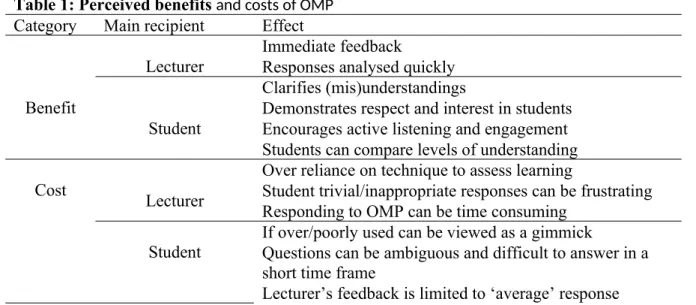
This adapted framework – see table 1 - enables both the main recipient and effect to be
distinguished. This is important when evaluating the effects of two question types since they may impact differently on the recipients. For example, content-based questions may mainly be
beneficial to the specific short-term cohort need, whereas lecture effectiveness type questions can deliver longer-term benefits in structuring of the lecture and improving lecturer technique.
Although it may be possible to assess the effects of the two question types simultaneously, here it was decided to assess each separately. Consequently, two groups were set up, sequentially. The groups were sampled due to convenience. Group 1 consisted of 28 Year 3 Business and
Economics students (23 males and 5 females) taught in the spring semester 2013. Group 2 was made up of 56 Year 1 Business with Economics and Accounting and Finance Students (41 males and 15 females) taught in the autumn semester 2013.
In each case the OMP was distributed at the start of the lecture and students were given two minutes at the end of the lecture to fill in the pre-printed answer slip. In line with the standard approach (Chizmar and Ostrosky, 1998; Harwood, 1996; Stead, 2005) the same two questions were posed each week and collected by the instructor at the end of the lecture. All responses were analysed and the main findings reported back to the students at the beginning of the next lecture.
Table 1: Perceived benefits and costs of OMP
Category Main recipient Effect
Benefit
Lecturer
Immediate feedback
Responses analysed quickly
Student
Clarifies (mis)understandings
Demonstrates respect and interest in students Encourages active listening and engagement Students can compare levels of understanding
Cost
Lecturer
Over reliance on technique to assess learning
Student trivial/inappropriate responses can be frustrating Responding to OMP can be time consuming
Student
If over/poorly used can be viewed as a gimmick
Questions can be ambiguous and difficult to answer in a short time frame
The OMP uses up valuable lecturing time
(Source: Author’s creation based on Angelo and Cross, 1993)
The questions asked to Group 1 were:
1. What did the lecturer do today that was effective and enhanced my learning? 2. What could the lecturer do to improve his effectiveness and therefore my learning?
After each lecture, the lecturer recorded a RL; the RL was initially written prior to the lecturer reading the students’ OMPs. The rationale for this was to assess if the lecturer could understand and empathise with the students’ perception of the lecture. Empathy is valued “for further learning … [with] its importance constantly recognised in the transformative learning literature” (Jarvis, 2012, p745). An empathic lecturer may be more able to design and deliver a session to better meet the students’ needs.
The questions asked to Group 2 were:
1. What concepts did you clearly understand in the lecture today? 2. What concepts were less clear in the lecture today?
The responses from these types of questions relate to the understanding of content by a particular cohort; this allows the lecturer to re-address any areas which are less well understood. Student reflections on the usefulness of the OMP were formally captured at the end of semester via a student FG.
3.2 Focus group
The FG approach was chosen as it is thought to be “most useful and suitable when the aim is to investigate a problem or case that needs to be analysed objectively or thoroughly” (Guler 2013, p718). In line with recommendations on optimal group size (Gates and Statham, 2013), the FG was limited to six level one students – they were all from Group 2. The group consisted of three female and three male. The FG was undertaken directly after the final lecture. Sample selection bias is potentially an issue as all individuals were self-selecting and females were
over-represented; females made up approximately a quarter of the lecture group.
The FG lasted approximately 50 minutes and was audio recorded with prior consent of all attendees. FG attendees were informed that the discussion would be transcribed, but that their anonymity would be maintained.
The role of the researcher in FGs is as “a moderator, listener, observer and analyst who must pay equal attention to the content of participants’ comments and the dynamics of the conversation” (Hirsch et al., 2013, p23). The researcher was aware of his responsibilities and attempted to limit response bias by making sure all members of the FG were made aware of the group ‘herding effect’, and by providing everyone with an opportunity to participate:
“Often in FGs…one person says something and everyone else goes along with that.”
“I am conscious you have not had much opportunity to contribute.”
In qualitative research, the researcher is an integral component of the research, being an
instrument for data collection and analysis (Patterson and Heller-Levitt, 2012); this increases the likelihood of moderator and confirmation bias. In order to militate against this risk, the author identified and bracketing the following a priori assumptions that could skew both the data collection process and subsequent analysis.
1) The students would value the use on the OMW
2) The effects of the OMW would be positive
As the focus group moderator was also the lecturer, this increased the potential for bias, as students may be unwilling to be too critical to the lecturer. However, when collecting the data, in order to limit the effects of any bias, the moderator began by asking an open question, inviting the students to discuss their experience of the lecture series. Students were only asked follow up questions directly relating the OMP once the focus group had independently introduced the subject into the discussion.
While recognising the findings reported here are particular to the specific sample, and potentially subject to bias, the findings provide a novel insight into the perception of the OMP and the mechanisms through which it is deemed to work.
4 Findings
4.1 Response rates
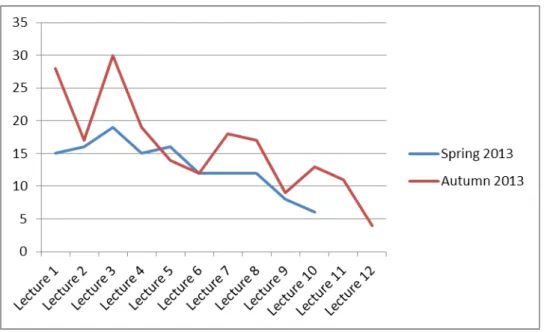
The OMP was issued to two separate groups. No record of attendance was taken during the lectures, so response rates are omitted. The number of responses recorded for both modules are recorded in Figure 1. Due to the differences in the module and semester structure, there are 10 and 12 observations in the spring (Group 1) and autumn (Group 2) terms respectively.
The number of responses received from both groups reduced over the course of the semester. For both groups, in the first four weeks response numbers were highest, but after week five numbers generally fell week by week. This general decline mirrors that from other OMP studies
(Harwood, 1996; Stead, 2005).
Part of the fall was due to a drop off in attendance over the course of the semester, particularly during periods of intense assessment, but on reflection the instructor’s intuition is this factor only accounted for a limited proportion of the fall off.
“Today was the day that the students had to hand in their dissertation. Numbers were down on the normal attendance although approximately 50% of students attended.”
(RL – Lecture 9)
Although it is difficult to identify a precise reason for the decline, there was indicative evidence that falling student response (SR) numbers were driven by students becoming:
1) Fatigued of answering the surveys
“[a student] responded by saying why are you still doing this [the OMPs]… you know the feedback will be good”
(RL – Lecture 7)
2) Contented with the lecture structure
“I have no outstanding criticisms – I think it was brilliant”
(SR004 – Lecture 6, Group 1)
3) Comfortable with the content
“Thank you - great informative lecture, well explained”
(SR005 – Lecture 10, Group 1)
4) More engaged in the lecture itself
“The class seem to really appreciate the level of discussion… [students] feel comfortable to ask questions and also provide answers when questioned”
(RL – Lecture 9)
4.2 Lecturer benefit
4.2.1 Immediate feedback
The OMP is a democratic mechanism that allows for immediate feedback from all members of the group and, depending on the question set, can have important beneficial effects for the lecturer and the student alike.
A review of the evidence from this study suggests that of all the benefits to the lecturer (see table 1), potentially the greatest benefit was the immediate feedback. The main mechanisms through which this works are 1) assessing the level of understanding, 2) informing the structure and content of the lecture and 3) generally acting as a guide to improve lecturer effectiveness.
The first benefit is a short-term benefit and can be indirectly informed by asking lecturer effectiveness type questions (asked to Group 1) but more directly through asking content based questions (asked to Group 2). The second and third benefits have both short and long-term implications which are more appropriately realised through asking lecturer effectiveness type questions.
The OMPs used in this research directly collected information on students’ knowledge and learning and was therefore useful in assessing students’ understanding, or lack of it. An example of assessing the level of understanding was illustrated by a student’s OMP at the end of Group 1’s first lecture:
“For me there was too much information too quickly using terminology that we haven’t used before.”
(SR009 – Lecture 1, Group 1)
This immediate feedback is only of real value if it is reflected on and responded to. The log entry below indicates that initially there were differences between the lecturer and students’ perception.
“Extremely useful to see the students’ perspectives after making my reflections as they do not necessarily align…I have started to think that I am teaching in a style and format that interest me… I need to consider teaching models in a number of ways.”
(RL – Lecture 2)
The feedback and subsequent reflection was pivotal in shaping how future lectures were delivered. The OMP responses acted as the catalyst that drove lecturer innovations. The overall effect is summed up by the quote from the lecturer’s RL; this was the lecturer’s first semester in academia.
(RL – Lecture 9)
The inference here is that for the benefit to be maximised then the lecturer has to be prepared to invest sufficient time to reflect and to implement iterative changes. The benefits are likely to be amplified for new lecturers.
4.2.2 Responses analysed quickly
Regardless of question type, the OMP can be analysed relatively quickly, but without sufficient personal reflection and investment in time to develop new materials the benefits of the overall exercise will be limited. The extent to which the responses are processed and analysed should be informed by the objectives. For Group 1 the objective was to improve lecturer effectiveness and enhance student learning. As such, the lecturer felt it was important to formally record the original OMP responses and to systematically reflect on the comments - this was done through the use of a formal RL. This added to the time of the overall process, but this was a central element to improving lecture effectiveness.
“I put a lot of this learning down to the reflective practice which has allowed me to align my understanding of their [the students] needs much quicker than if I had to learn from a less formal feedback mechanism.”
(RL – Lecture 4)
In terms of feeding back to the students this was straightforward but time consuming as new methods and materials were developed. This approach was appreciated by the students:
“Other lecturers do the slides teach it and go, whereas you go away see what everyone thought of it and put it all together for us, it’s more personal”
(FG – Female 1)
“Like you edited the slides each lecture so it fits in.”
(FG – Female 2)
It is possible to invest only a very limited amount of time to administer and analyse the OMP, but this will limit its value. The main benefit to the lecturer is the instant feedback, but this benefit is only realised if significant investment in time is made each week to reflect on the responses and elicit change.
4.3 Student benefit
4.3.1 Clarifies (mis)understanding
The OMP gives the student an immediate opportunity to raise awareness of issues they have not fully understood. The findings from the case studies suggest that this was a considerable benefit to the students. Indirectly lecture effectiveness type questions can help to identify
“Shifts in demand and supply curve”
(SR015, – Lecture 3, Group 2)
Whereas in lecture four some were:
“Unsure about the practicality of deadweight”
(SR001, – Lecture 4, Group 2)
Comments from the student FG revealed that they valued the benefit of clarifying understanding:
“Someone might have struggled or the entire class might have struggled with what was in the last lecture… it’s good to have that feedback.”
(FG - Male 1)
Potentially a bigger problem than not knowing is misunderstanding the ideas. Student
misconceptions of economic concepts can often go undiscovered and will only reveal themselves at the end of the course when reading exam scripts. This is too late but without any knowledge of these misconceptions the lecturer is unable to address them.
The OMP gives the lecturer an opportunity to identify misunderstandings and correct them before they become embedded. An example of a student misconception can be seen in the confusion of money supply.
“Difference between money and M4”
(SR008, – Lecture 11, Group 2)
The OMPs in this study revealed only limited evidence of student misunderstanding. This was perhaps due to the direct nature of the questions asked which generally elicited short responses. Rather than relying on students to subjectively identify areas of confusion, misconceptions may be easier to identify if students are encouraged to construct questions, rather than just answer them.
4.3.2 Respect for and interest in the students
Independent of question, the use of the OMP helps to demonstrate respect for the students, their thoughts and ideas. It opens up a formal channel of communication which is particularly useful when teaching large numbers of students. This explicit demonstration of respect can act as a catalyst to developing stronger relations between the lecturer and the student. This can be beneficial as relationships are often cited as an important factor in the facilitation of learning (Brockhand and McGill, 2007).
Indicative evidence from this study suggests a significant benefit of using the OMP is that it can lead to positive impacts on the student/lecturer relationship. The value the students and the lecturer placed on this can be inferred from the FG discussions and lecturer’s RL:
(FG – Male 1)
“built a rapport with the students...I feel much better placed to understand how the students are viewing things”
(RL – Lecture 4)
A benefit of building a relationship with the student group is that this can provide the foundation from which the lecturer can innovate and experiment. The lecturer’s reflection from week seven captures this:
“The relationship with the class seems to be good. As they seem to trust what I am doing… I should really consider experimenting with them in terms of ratcheting up the interactivity.”
(RL – Lecture 7)
4.3.3 Active listening and engagement
It is reported that the OMP allows students to construct knowledge by moving the student away from passive note taking towards active listening and engagement (Stead, 2005). This approach can empower students and help them take control of their own learning.
The student FG provided evidence that the students valued the OMP’s ability to connect key ideas:
“It’s like a follow on of each lecture…everything led on to one another, building on stuff we’ve learnt.”
(FG - Female 2)
“I think it relates the topic one to the other, it relates it rather than just put it block by block, really connects the two.”
(FG - Female 1)
There was also one example of when the OMP directly empowered a student to make a specific suggestion for change:
“Maybe encourage students recapping the lecture.”
(SR011 – Lecture 3, Group 1)
This suggestion was influential in changing the lecturer’s approach to student engagement in the lecture:
“In order to encourage active listening I will instigate a version of the “Socratic method” where I will pick on students to summarise another student’s answer.”
A student comment from the FG also provided support to the fact that the OMP encourages active listening and engagement:
“You know what the questions are on the piece of paper, so when you’re in the lecture you think!”
(FG - Female 3)
In addition to the direct effect of active listening and engagement, there is also some indicative evidence of second round effects. The mechanism through which second round effects takes place is via the OMP acting as a catalyst to improve relations which builds student confidence and can lead to active engagement in the lecture itself (Harwood, 1996). Building confidence is particularly important when dealing with mixed ability groups where lower performing students can initially feel intimidated by higher ability peers (Contreras et al., 2012).
Second round effects could be deduced from the discussions at the FG and the lecturer’s RL.
“I think with the feedback you show that you actually care about the students and that makes it easier to ask you questions.”
(FG - Male 1)
“The level of engagement was excellent; students, including usually quieter students, posed many questions and provided insightful comments.”
(RL – Lecture 4)
Although there was only limited direct evidence from the OMP responses that students moved from a passive to an active learning approach, the FG and RL provided indicative contextual support. This broader view indicates that the OMP helped to create an atmosphere of trust which acted as a catalyst to encourage active engagement.
4.4 Summary of benefits
The evidence from this study suggests that in terms of overall benefit that the students place considerable value on the use of the OMP. The students attach importance to the formal
communication channel as it demonstrated respect and made the lecturer more approachable. The OMP helped to build a positive relationship, which the lecturer felt contributed to higher levels of engagement in the lecture itself. The students also appreciated the feedback loop which provided them the opportunity to highlight content areas which they did not fully understand, while also providing a mechanism to link the lectures allowing the students to construct knowledge. The value of the feedback mechanism increased because the lecturer invested time in developing new material in response to the feedback.
4.5 Cost to lecturer
Regardless of the type of question asked, due to the time and the effort involved in setting up, analysing and responding to the OMP, the evidence here was that the lecturer placed a heavy reliance on it as a tool. The OMP itself, however, has an in-built mechanism which helps to militate against this effect. The instant and direct feedback from students can act as a spur for further innovation. For example, when students were presented with alternative classroom assessment techniques, their OMP responses reinforced the value the students placed on these:
“Quiz things at the start were fun and made me engage more.”
(SR002, – Lecture 4, Group 1)
“The questions about the video were very useful.”
(SR001, – Lecture 5, Group 1)
The evidence here suggests that due to the investment in time there is a potential risk that the lecturer may over rely on it. The OMP, therefore, should be used as just one of a number of useful tools that can complement each other in a progressive approach to lecturing. The implication, however, is that the OMP itself can act as a catalyst to broaden, rather than limit, lecturer technique. The OMP empowers the students to take control of their own learning and provides them with a platform to make suggestions to improve their lecture experience.
4.5.2 Frustrating responses
Frustrating responses can come in many forms irrespective of question type, for example students can 1) confuse trivial details with important themes, 2) demonstrate extremely low levels of understanding, and 3) provide untactful feedback.
Throughout the project the lecturer received responses in all three categories.
1) “[didn’t understand] the bat and ball exercise”
(SR015, - Lecture 7, Group 2) 2) “[didn’t understand] most [of the lecture]”
(SR001- Lecture 5, Group 2) 3) “Use [Mr X’s] slides – hands down the best at UWE ever”
(SR019, – lecture 3, Group 1)
The RL shows how the lecturer used a potentially frustrating response to benefit the students:
“I will review [Mr X’s] slides to assess what the students like.”
(RL – Lecture 2)
4.5.3 Time consuming
Potentially the greatest cost to the lecturer is the time involved in developing, administering and responding to the OMP. Proponents, however, suggest the lecturer can still extract value from the exercise while limiting their time commitment. An advantage of the OMP is that it can be developed to meet and fit in with the lecturer’s needs and constraints.
For both groups the time involved in planning and administering the OMP was limited, although time was invested in preparing the answer sheets and analysing the student responses. The time commitment for reflecting on responses from Group 1 was lengthened due to the formal log. The lecturer’s reflections, however, show the value he placed on this investment:
“Overall this process [reflecting on the OMPs] has been extremely beneficial in improving my effectiveness as a lecturer.”
(RL – Lecture 9)
Although this reflective process is likely to benefit all instructors, the gains are expected to be greatest for those less experienced.
4.6 Cost to student
This section is limited to an assessment of the loss of time as the research revealed very limited evidence of any other perceived costs to the students - for a full list of the hypothesised costs please refer to table 1.
4.6.1 The OMP uses up valuable lecturing time
Regardless of question, time needs to be set aside to 1) allow students to fill in the OMP at the end of the lecture and 2) feedback to the students.
There are also potential difficulties with the administration of the OMP which can reduce the time of the lecture; this was captured in the RL from week four:
“I was giving the questionnaire out to individuals as they walked in late, this disrupted the lecture somewhat.”
(RL – Lecture 4)
This reflection highlights that careful consideration needs to be put into the efficient administration of the OMP; this is particularly important when lecturing to large numbers.
In the two case studies presented here the feedback to the students took place in the first five to ten minutes of the following lecture. The effectiveness of this feedback mechanism has been questioned and a number of alternative approaches suggested. These include addressing the issues in small group settings where issues can potentially be discussed in more depth, and/or
Even though it was recognised that there is a cost implication of feeding back at the next lecture, the response from the student FG was that they felt this was a good investment of their time.
“I think as long as you’ve done reading around the subject as well beforehand, it doesn’t really matter too much those ten minutes.”
(FG - Male 2)
In fact, the students’ perception was that they did not lose time feeding back at the start of the lecture, it was just a transfer of time from one week to the next.
“I think you always get that [time] back, cause you recap”
(FG - Female 3)
There was also some evidence that there is a limit to the investment in time that the students are prepared to make.
“I am not going to waste good time…if there are too many [questions], you think I can’t be bothered to do this.”
When the students were asked about extending the use of the OMP and delivering it in real time via an on-line media platform, such as twitter, the response to this was unanimously discouraging. The FG felt that students could become distracted by their phones and they may lose the thread of the lecture. They also questioned the lecturer’s ability to manage the on-line feed while lecturing in real time.
“While you’re saying what you didn’t understand, your missing what is currently going on as well.”
(FG - Female 1)
“It’s distracting [to the lecturer]…you’ll be there looking at the phone while giving the lecture and I think you can’t do two things at once.”
(FG - Female 3)
4.7 Summary of costs
5 Discussion
The findings from the qualitatively mixed approach reveal that the OMP is perceived to deliver real benefits to the economics lecture. Given the prior evidence that the OMP is relatively underused in the economics lecture, there is considerable potential to improve the learning experience with a relatively simple and low-tech innovation.
The case studies reveal that there are a number of direct benefits of using the OMP, but potentially of greatest significance is developing the relationship between student and lecturer. This improved relationship can then provide the foundation to an active approach to learning.
This study provides some evidence that the benefits and costs involved with operationalising the OMP depend to some extent on the type of question asked. If the focus of the lecturer is to clarify student understanding then the lecturer is better severed by content based questions; if the lecturer is attempting to make improvements to the structure and presentation of the lecture then they should ask lecturer effectiveness type questions. What the findings from the FG and the lecturer’s RL reveal is that the students’ themselves valued the process irrespective of the type of question posed.
Those that are relatively new to lecturing may benefit most from asking ‘lecturer effectiveness’ type of questions. This is because they have most to learn and by receiving instant feedback they are able to accelerate through the learning curve. More experienced lecturers can also benefit from periodic student feedback on their effectiveness as they may underplay some of their strengths, or perhaps have picked up some ‘bad habits’ along the way. In order to benchmark performance for experienced lecturers it may be worthwhile asking these types of questions only every couple of years. An alternative benchmarking strategy could be to ask the effectiveness questions interchangeably with other questions. For example, effectiveness questions could be asked just twice a year, at the start and at end of the module.
The effectiveness of whether the ‘lecture content’ based OMP helps students to understand is difficult to accurately assess in a qualitative framework. The OMP process results in the lecturer going back over content, but does not ensure that the students understand this material when presented with it for a second time, particularly if the material is just repeated. To increase the likelihood of success, the lecturer needs to factor in an important additional cost in terms of investing time to develop new material.
In a departure from the literature the case study approach reveals little evidence of any other costs apart from time. It does suggest, however, that the time commitment can be greater than implied by other authors. The OMP is often promoted as a low cost solution to improving student learning outcomes. The evidence from this paper contradicts this, as the time commitment to reflect on and design new material can be substantial. The implication from the case study is that rather than being promoted as a low cost solution, the OMP should be marketed as offering substantial benefits, but only if sufficient investment in time is made to reflect and develop new material.
really occur if those already engaged with the teaching methods literature promote this technique to colleagues within their departments.
An additional barrier to the increased use of the OMP in the economics lecture is the time
commitment needed. This paper argues, more than the prevailing literature suggests, that in order to maximise the benefits of using the OMP then sufficient investment in time is required. It is worth acknowledging, however, that there are ways to limit the time commitment while still maintaining considerable benefits. Some possible suggestions are listed in table 2:
Table 2: Potential time savers
Category Actions
Paper based approach Electronic based approach
Before
Create a database of previously tested questions
Set up an electronic distribution and collection system (e.g. via remote polling devices)
During
Repeat the same content based questions each week Ask lecture effectiveness type questions only occasionally
Selectively administer one-minute papers – e.g. monthly rather than weekly, or when more difficult topics are covered
Students to provide answers using their own notepads
Administer the OMP electronically
After
Analyse student responses and lecturer reflections informally
Restrict feedback to the group level
Analyse only a sample of student responses
Feedback on the OMPs outside of lecture, possibly through a virtual learning environment
Although the OMP does deliver considerable benefits to the economics lecture, it should not be over relied on; it should be seen as only one of a number of tools to be used in a progressive approach to lecturing. Due to the investment in time needed, particularly when first implementing the OMP, lecturers could find themselves overburden if trying to include too many other
complimentary innovations. Therefore it may well be sufficient to primarily rely on the OMP in the first year, but bring in other progressive elements over time. This iterative progressive approach to improving the economics lecture is advocated by Sloman and Mitchell (2002).
supported by the fact that a number of the core findings from this research are reflected in the prevailing literature.
An underlying assumption of this paper is that the OMP is underused in teaching economics, but the evidence on which this is founded is now outdated. An updated evidence base is therefore needed to establish if this is still the case. As this is a small scale investigation, further research is required to confirm the benefits and costs identified in these studies. The evidence base would also benefit from a quantitative analysis of the effect of using the OMP in economic lectures on learning outcomes. Further research is also needed into improving the efficiency of using the OMP. Technology could offer a solution although this is not without its challenges as anonymity may be lost and students can potentially be excluded.
6 Conclusion
The lecture has been cited as an efficient mechanism for transmitting knowledge but its effectiveness as an instrument of deep learning is subject to much debate. The challenge that many lecturers face is to reinvigorate the lecture and take the historically ‘passive’ event and transform it into an engaging and active learning experience. To do this, lecturers have furnished their toolbox with many progressive mechanisms, one of which is the OMP.
The benefits of the OMP have been widely documented in the literature and yet the take-up rate with economics lecturers is believed to be relatively low. Prior research suggests that the most likely causes of this are a lack of knowledge of the technique and the disincentive of adding to an already burgeoning academic workload.
This paper uses a benefit and costs framework to analyse findings from:
Student’s responses to two one-minute papers (OMP) Student focus group (FG)
Lecturers reflective log (RL)
The analysis concludes that the main benefit of the OMP is that it creates a formal channel of communication which helps to build a stronger student and lecturer relationship. The OMP can be planned and administered at very little cost to the academic, but to generate any real benefit from the process the lecturer must commit sufficient time to reflect and implement changes.
The findings points to a strong positive effect for both the lecturer and student. The lecturer can gain immediate feedback enabling them to improve their lecture structure and delivery, while students gain from the setting up of a formal communication channel and the subsequent feedback loop. This paper also provides indicative evidence that the OMP helps to improve relationships between the lecturer and students which can act a catalyst for heightened levels of active engagement.
groups for years to come. Content based questions are also beneficial but relate more specifically to the particular student cohort.
There are costs involved in this approach, the main one being the time commitment of the lecturer; this in turn heightens the risk of over reliance on the technique. When viewed overall, however, the findings in this paper suggests that the benefits outweigh any costs, but in order to maximise these benefit the lecturer needs to factor in sufficient time to reflect and develop new materials in response to the OMP.
7 Acknowledgements
8 References
Anderson, D. and Burns, S. (2013) One-Minute Paper: Student Perception of Learning Gains.
College Student Journal. 47 (1), pp.219-227.
Angelo, T. and Cross, P. (1993) Classroom Assessment Techniques: a Handbook for College
Teachers, 2nd Edition San Francisco: Jossey-Bass Publishers
Becker, W. and Watts, M. (2001) Teaching Methods in US Undergraduate Economics Course.
Journal of Economic Education. 32 (3), pp.269-80.
Biggs, J.B. (2003) Teaching for Quality Learning at University: What the Student does. Buckingham: Open University Press.
Birdi, A. (unpublished results) Lecturing. Bristol, 2nd March 2013. Economics Network.
Brockbank, A. and McGill, I. (2007) Facilitating Reflective Learning in Higher Education. 2nd ed. GB: Open University Press.
Cannon, R. and Newble, D. (2000) A Handbook for Teachers in Universities and Colleges. Fourth ed. London: Kogan Page Limited.
Chizmar, J.F. and Ostrosky, A.L. (1998) The One-Minute Paper: Some Empirical Findings.
Journal of Economic Education. 29 (1), pp.3-10.
Contreras, S., Badua, F. and Adrian, M. (2012) Peer Effects on Undergraduate Business Student Performance. International Review of Economic Education. 11 (1), pp.57-66.
Exley, K. and Dennick, R. (2009) Giving a lecture: from presenting to teaching. New York: Routledge
Gates, B. and Statham, M. (2013) Lecturers and Students as Stakeholders for Education
Commissioning for Learning Disability Nursing: Focus Group Findings from a Multiple Method Study. Nurse Education Today. 33 (10), pp.1119-1123.
Gibbs, G. and Habeshaw, T. (1989) Preparing to Teach: An Introduction to Effective Teaching in
Higher Education. First ed. Bristol: Technical and Educational Services Ltd.
Guler, M. (2013) Success and Failure in Science Education: A Focus Group Study on Turkish Students. Journal of Baltic Science Education 12 (6) pp.716-729.
Gunderman, R. (2013) Is the Lecture Dead? Available from:
http://www.theatlantic.com/health/archive/2013/01/is-the-lecture-dead/272578/ [Accessed March 5th 2013].
Hirsch, S.F., Wisler, A., Lazarus, N., Minde, J. and Cerasani, G. (2013) Pursuing Research Through Focus Groups: A Capstone Experience Meets Disciplinary, General Education Goals. Council on Undergraduate Research Quarterly. 33 (4), pp.23-27.
Jarvis, C. (2012) Fiction, Empathy and Lifelong Learning. International Journal of Lifelong
Education. 31 (6), pp.743-758.
Kolb, D. A. (1984) Experiential learning: Experience as the source of learning and development. New Jersey: Prentice-Hall.
Lucas, G.M. (2010) Initiating Student-Teacher Contact Via Personalized Responses to One-Minute Papers. College Teaching. 58 (2), pp.39-42.
Ludwig, J. (1995) The One-Minute Paper. Liberal Education. 81 (4), pp.12.
Marton, F. and Säljö, R. (1976) On Qualitative Differences in Learning: I—Outcome and process*. British Journal of Educational Psychology. 46 (1), pp.4-11.
Meagher, K. and Whelan, S. (2001) Confidentiality is Not Enough: Framing Effects in Student Evaluation of Economics Teaching. International Review of Economics Education. 10 (1), pp.70-82.
Orlov, A. and Roufagalas, J. (2012) Performance Determinants in Undergraduate Economics Classes: The Effect of Cognitive Reflection. International Review of Economic
Education. 11 (2), pp.28-45.
Ramsden, P. (1992) Thoeries of Teaching in Higher Education. London: Routledge.
Patterson, C.A. and Levitt, D.H. (2012) Student-Counselor Development During the First Year: A Qualitative Exploration. Journal of Counselor Preparation & Supervision. 4 (1), pp.6-19.
Sloman, J. and Mitchell, C. (2002) Lectures. In: Davies, S., eds .(2007) The Handbook for
Economics Lecturers. The Economics Network. Available from
http://www.economicsnetwork.ac.uk/handbook/lectures/ [Accessed 03 June 2014].
Soetaert, E. (1998) Quality in the Classroom: Classroom Assessment Techniques as TQM. New
Directions for Teaching and Learning. 75. p.47-55.
Stead, D.R. (2005) A Review of the One-Minute Paper. Active Learning in Higher Education. 6 (2), pp.118-131.
Vonderwell, S. (2004) Assessing Online Learning and Teaching: Adapting the Minute Paper.
TechTrends: Linking Research & Practice to Improve Learning. 48 (4), pp.29-31.
Watts, M. and Becker, W. (2010) A Little More than Chalk and Talk: Results from a Third National Survey of Teaching Methods in Undergraduate Economics Courses. The Journal