Volume 2007, Article ID 89170,9pages doi:10.1155/2007/89170
Research Article
A Fast Mellin and Scale Transform
Antonio De Sena1and Davide Rocchesso2
1Dipartimento di Informatica, Universit`a di Verona, Strada Le Grazie, 15-37134 Verona, Italy
2Dipartimento di Arti e Disegno Industriale, Universit`a Iuav di Venezia, Dorsoduro 2206, 30123 Venezia, Italy
Received 24 August 2006; Revised 30 December 2006; Accepted 5 March 2007
Recommended by Jar-Ferr Kevin Yang
A fast algorithm for the discrete-scale (andβ-Mellin) transform is proposed. It performs a discrete-time discrete-scale approx-imation of the continuous-time transform, with subquadratic asymptotic complexity. The algorithm is based on a well-known relation between the Mellin and Fourier transforms, and it is practical and accurate. The paper gives some theoretical background on the Mellin,β-Mellin, and scale transforms. Then the algorithm is presented and analyzed in terms of computational complexity and precision. The effects of different interpolation procedures used in the algorithm are discussed.
Copyright © 2007 A. De Sena and D. Rocchesso. This is an open access article distributed under the Creative Commons Attribution License, which permits unrestricted use, distribution, and reproduction in any medium, provided the original work is properly cited.
1. INTRODUCTION
The Mellin transform, and the particular version called scale transform, can represent a signal in terms of scale. The scale can be interpreted, similarly to frequency, as a physical at-tribute of signals. The proposed fast (subquadratic) imple-mentation allows this transform to be used in practical ap-plications. The algorithm can compute the Mellin transform
Mf(p)= ∞
0 f(t)t
p−1dt, (1)
in the complex variable p= −jc+β, withβ∈Rfixed pa-rameter andc∈Rindependent variable. We call this family of transforms theβ-Mellin transform. It is indeed a restric-tion of the Mellin transform, as the real part of the complex variable pis parameterized. The βparameter allows to se-lect among: (i) a scale-invariant transform (β = 1/2, scale transform); (ii) a compression/expansion invariant trans-form (β=0); (iii) a shape-invariant transform (β= −1, the ratio between the maximum of the function and its extension is a constant).
The proposed algorithm is based on the well-known re-lation between the Mellin and Fourier transforms. While methods that exploit such relation have been proposed long ago [1,2], efficiency and practicality are still remarkable ob-jectives to be achieved.
Mellin and scale transforms are important in vision and image processing. In particular, a so-called Fourier-Mellin transform can be used for pattern recognition for its
in-variance to shift, scale, and rotation. In [3], various tech-niques have been presented for the implementation of the Fourier-Mellin transform, including a polar-log coordinates remapping. In [4], the problem of estimation of scale and orientation differences between objects in images has been approached using the analytical Fourier-Mellin transform [3].
Other approaches to the Mellin transform implementa-tion have been taken by J. Bertrand et al. [5–7]. In their studies, the authors tackled the transform in the frequency domain by considering analytic signals. An implementation based on exponential resampling in the time domain should give a solution to a few practical problems. Namely, a starting point near 0 implies an impossible exponential resampling, and if the signal support in time is very small compared to the starting point of the signal, the exponential sampling becomes a quasiuniform sampling. An implementation that follows this idea has been made by Gonc¸alv´es and Lemoine (http://gdr-isis.org/tftb/refguide/node32.html), but the algo-rithm appears to be quadratic in complexity. The authors have searched for other implementation of J. Bertrand et al. fast Mellin transform idea, but no sub-quadratic implemen-tation has been found.
is no prebuilt exponential grid, and the exponential warping is adapted to the signal under analysis.
We are mainly interested in applications of the scale transform in the realm of speech and audio processing, where it can be used for various purposes, like scale normal-ization, signal analysis in the scale domain [8] (scale can be considered as a joint time-frequency attribute), audio ma-nipulation in scale domain [9], and vowel recognition [10].
In Section 2, an introduction to the Mellin and scale transforms will be given along with the definitions ofscale pe-riodicityand an interpretation of the scale transform. Analo-gies and relations with the Fourier transform will also be pro-vided. An exponential sampling theorem (an extension of the one provided in [11]) will be presented. This section is the collection of known concepts and new definitions and ex-tensions useful as support for theβ-Mellin transform imple-mentation. InSection 3, the base theory for the implemen-tation of the fast Mellin transform will be provided. Expo-nential sampling will be introduced and sinc, cardinal spline, and spline interpolations will be discussed. InSection 4, the implemented algorithm, its computational cost, and an error analysis will be described.
2. THE MELLIN TRANSFORM
Originally developed by Robert Hjalmar Mellin (1854–1933) for the study of the gamma function, hypergeometric func-tions, Dirichlet series, the Riemann zeta function and for the solution of partial differential equations, the Mellin trans-form was also used in electrical engineering, for example for studying motor control systems [12]. In [8], Cohen in-troduced the “scale transform.” This transform is said to be scale-invariant (the Fourier transform is shift-invariant), thus meaning that the signals differing just by a scale trans-formation (compression or expansion with energy preserva-tion) have the same transform magnitude distribution. Co-hen showed that the scale transform is a restriction of the Mellin transform on the vertical line p = −jc+ 1/2, with c∈R.
2.1. Definition and existence of Mellin transform
The Mellin transform of a function f is defined as in (1), wherep∈Cis the Mellin variable.
The existence of the Mellin transform (1) depends on convergence of the transform integral,
∞
0
f(t)tp−1dt <∞. (2)
This is a general sufficient condition for the existence of the transform. Further considerations [5] can be made using the fact thatp= −jc+β, and different or simpler forms of (2) can be derived.
2.2. Definition of scale transform
The scale transform [8] is a particular restriction of the Mellin transform on the vertical line p = −jc+ 1/2, with
c∈R, just as the Fourier transform can be seen as a restric-tion of the Laplace transform on the imaginary axis. Thus, the scale transform is defined1as
Df(c)= √1 2π
∞
0 f(t)e
(−jc−1/2) lntdt. (3)
The scale inverse transform is given by
f(t)=√1 2π
∞
−∞Df(c)e
(jc−1/2) lntdc. (4)
The key property of the scale transform is its scale in-variance. This means that if f is a function andg is a scaled version of f, the transform magnitude of both functions is the same. A scale modification is a compression or expan-sion of the time axis of the original function that preserves signal energy. Thus, a functiong(t) can be obtained with a scale modification from a function f(t) ifg(t)=√α f(αt), withα∈ R+. Whenα < 1, we get a scale expansion, when α >1 we get a scale compression. Given a scale modification with parameterα, the scale transforms of the original and scaled signals are related by
Dg(c)=αjcDf(c). (5)
This property derives from a similar property of the Mellin transform. In fact, ifh(t)= f(αt), then
Mh(p)=α−pMf(p). (6)
In both (5) and (6), scaling is reflected by a multiplicative factor for the transforms, and for (5) such factor reduces to a pure phase contribution. So, the scale transform magnitudes of the original and scaled signals are the same,
Dg(c)=Df(c). (7)
2.3. Relation with the Fourier transform
From its definition and interpretation, the Mellin transform provides a tight correspondence with the Fourier transform [10]. More precisely, the Mellin transform with parameter p = −jccan be interpreted as a logarithmic-time Fourier transform:
Mf(c)= ∞
−∞ f(t)e
−jc(lnt)d(lnt). (8)
Similarly, we can define the scale transform of a functionf(t) using the Fourier transform of a functiong(t) [8] withg(t) obtained from f(t) by time-warping (g(t)= f(et)):
Mf(c)= ∞
−∞g(t)e
−jctdt. (9)
This result can be generalized for anypdefined asp= −jc+ β, withβ∈R, by usingg(t)=f(et)eβt.
2.4. Scale periodicity and scale transform interpretation
A parallel can be drawn between the properties of the Fourier and scale transforms. In particular, we can definescale pe-riodicity[11] as follows: a function f(t) is said to be scale periodic with periodτ if it satisfies f(t)=√τ f(tτ), where τ =b/a, withaandbstarting and ending points of the scale period.C0 =2π/ln
τ
is the “fundamental scale” associated with the scale periodic function. By analogy with the Fourier theory, we can define a “scale series” and Parseval theorem. Of particular importance is the “exponential sampling the-orem” [11] that, like the Nyquist-Shannon theorem, allows the reconstruction of a scale-band limited signal from its samples. These samples must be distributed exponentially in time according to positionspk=τ
sk, withk∈Z,τ
s=eπ/Cm,andCmis the signal maximum scale.
A more general theorem can be formulated by working onβ-Mellin (rather than scale) band-limited signals.
2.5. Exponential sampling theorem
Starting from what has been done for the scale transform [11], an extension/generalization of the exponential sam-pling theorem can be provided for all types ofβ-Mellin trans-forms.
Definition 1. Theβ-Mellin band of a functionf(t) is the sup-port ofF(c), whereF(c) is theβ-Mellin transform off(t).
Definition 2. A function f(t) isβ-Mellin band-limited toC0 whenF(c) = 0 for allc /∈ (−C0,C0), whereF(c) is theβ -Mellin transform of f(t).
Now the exponential sampling theorem for β-Mellin band-limited functions can be stated.
Theorem 1. A functionf(t)∈L2(R),β-Mellin band-limited2 toC0, can be exactly reconstructed from its samples in the time domain if the samples are spaced exponentially along the time axis as in{τn}∞
−∞, whereτ=e2π/2C0.
A quick outline of proof can be given. The proof is similar to the one shown in [11] for the scale transform. We need to rebuild the equation chains using theβ-Mellin related equa-tions. Letψ(t) be the following function:
ψ(t)=√2 2π
sinC0lnt
lnt t
−β. (10)
The β-Mellin transform ofγα(t) = αβψ(αt) (i.e.,γ is aβ
-scaled version ofψ), whereα=τm,τ =e2π/2C0andm∈Z,
2Obviously, the theorem assumes that theβ-Mellin transform of f(t)
ex-ists.
is
Γ(c)=
⎧ ⎨ ⎩
ejclnα, |c| ≤C0,
0 elsewhere. (11)
The β-Mellin transform of f(t), indicated with Mβf(c), is a support-limited function by assumption. Then an expan-sion ofMβf(c) using Fourier series representation can be
per-formed. The period (in the Fourier sense) ofMβf(c) is
sup-posed to beT = 2C0(the whole support ofMβf(c), i.e., the bandwidth inβ-Mellin domain of f(t)),
Mβf(c)= ∞
m=−∞
amejclnτm, (12)
withamdefined as
am=√1
2πln(τ)e
βlnτ−mfτ−m. (13)
Now, starting from the definition of inverseβ-Mellin trans-form, and using (10)–(13), the reconstruction equation for exponential sampling can be obtained:
f(t)= √1 2π
C0
−C0
Mβf(c)e(jc−β) lntdc
=lnτ√1 2π
∞
m=−∞
fτmψtτ−m.
(14)
Equation (14) allows a perfect (in the Nyquist-Shannon sense) reconstruction of the signal starting from its (expo-nentially spaced) samples. Furthermore, (14) can be shown to be very close to the Nyquist-Shannon interpolation for-mula, in fact it can be rewritten as
f(t)= ∞
m=−∞
fτmtτ−m−β
sincC0lntτ−m. (15)
The reconstruction function (tτ−m)−βsinc(C0ln (tτ−m)) is composed by a logarithmic-time sine cardinal function mod-ulated by a power function. The summation (15) is made by summingβ-dilatocyclic3versions of the reconstruction func-tion weighted by each sample taken exponentially in time.
3. THE FAST MELLIN TRANSFORM
Computing a discrete Mellin transform is relatively straight-forward. For example, we can do an approximation of the transform integral using the Riemann sum. Unfortunately, doing this would give us algorithms exhibiting quadratic complexity, thus meaning that they are not usable in most
3Similar to the definition given in [5], aβ-dilatocyclic signal is a
f(t)
Exponential time warping
Exponential multiplication
Fourier transform
Mf(c)
(a)
x(n)
Spline interpolation and exponential resampling
Point-by-point exponential multiplication
FFT algorithm
Mx(c)
(b)
Figure1: Block diagram of the fast Mellin transform idea (a) and the relative implementation blocks (b).
practical applications. The basic idea of the fast Mellin trans-form (FMT) algorithm comes from (9), in particular when β = 1/2 (scale transform). While presented in prior works (i.e., [1,2,13]), this idea is here used to build a practical and efficient computer program (in particular a Matlab toolbox). The algorithm approximates
Mf(c)= ∞
−∞f
eteβte−jctdt (16)
by taking a uniformly sampled function, warping it exponen-tially, multiplying it by an exponential, and performing a fast Fourier transform (seeFigure 1). Naturally, all the problems come from the warping operation. Once digitized, the signal must be resampled from a uniform to an exponential sam-pling grid. A resamsam-pling-based approach has been already studied in vision and image processing. In particular in [3], an implementation of the Fourier-Mellin transform of im-ages has been presented, based on the idea of log warping, which can be dated back to [1,2]. Conversely, in the imple-mentation of the fractional Mellin transform [14], warping is done logarithmically instead of exponentially.
3.1. Sampled signal
In practical applications, the original analog signal is hardly available, because a uniform-sampling stage is inherent in the acquiring process. So, the raw material is the Shannon-sampled version of a Fourier band-limited signal. The Nyquist-Shannon theorem tells us that in this condition, we can reconstruct the original (analog) signal from the sampled version. This implies that we can resample the original (ana-log) signal in a different way. In particular, after resampling the signal exponentially (seeSection 3.2), two interpretations can be used. The first interpretation is based on an
exponen-tially sampled signal view in which we know that the signal must be considered along a warped time axis. In that view, the signal is a Mellin (more preciselyβ-Mellin) band-limited signal. In this case, for example, a single-cycle sinusoid can still be plotted with the same shape as the original, but with a higher sample density near the signal start. The other inter-pretation is the time-warped uniformly sampled signal view. In that view, the warped signal is Fourier band-limited. In this case, for example, the shape of a single-cycle sinusoid will be heavily distorted. The assumptions underlying our imple-mentation are that the signal is (i) time-limited because it is saved in a finite-dimensional storage system; (ii) Fourier band-limited because it results from uniform sampling un-der Nyquist-Shannon conditions; (iii)β-Mellin band-limited to have a finite number of points in the Mellin transform rep-resentation. These conditions are possible only if the original signal is thought as a single period of an infinitely long pe-riodic signal (to have a Fourier band-limited signal) or as a single scale-period of a infinitely longβ-dilatocyclic signal.
3.2. Exponential resampling
Several problems arise when making an exponential resam-pling starting from an unknown uniformly sampled signal: how many samples are needed, how they should be dis-tributed over time, how the signal start time alters this in-formation, how can we reconstruct the signal, and so forth. While being aware of prior answers [11,13], we address these questions in this section.
First of all, we must fulfill the Nyquist-Shannon sampling condition, so the distance between two adjacent samples in the exponential resampling cannot exceed the distance of the original uniform sampling step. This means that the sam-pling periodTsis the upper limit for the distance between the last two contiguous samples in exponential resampling. The second constraint is that the resampling process must cover the entire signal, from its starting point to its ending point. The two constraints force us to have more samples in the exponential resampled signal. The original signal starting pointt0is very important: in fact, the moret0is close to zero, the more samples are needed in the exponential resampling process. Thus, if we lett0 =0, we need an infinite number of exponential samples. So, for using this algorithm we need a starting point strictly greater than zero. We can write the exponential sampling like a sequence:
τ
sk∞k=−∞, (17)
wherekis the sample index and
τ
scan be called the exponen-tial base step. So, using the first4constraint (τ
kes −
τ
ske−1 = Ts), we can findτ
s= t0 t0+nTs+ (n−1)Ts, (18)
4In theory, we should write
τ
kewherenis the number of samples of the uniformly sampled signal. Now, using the second constraint (
τ
k0s =t0∧
τ
ske = t0+nTs=te), the number of needed exponential samples iseN= ln
t0+nTs/t0
lnt0+nTst0+ (n−1)Ts+ 1. (19)
If we useTsas the starting point (i.e.,t0=Ts), we can obtain the lighter approximate expression
eN= ln (n+ 1)
ln(n+ 1)n. (20)
Furthermore, if we use a high number of samples (in prac-tice, e.g., a number greater than 16 is sufficient) we can ap-proximate (20) in a very simple form [13] using a known important limit (limx→∞(1 + 1/x)x=e):
eN=nlnn. (21)
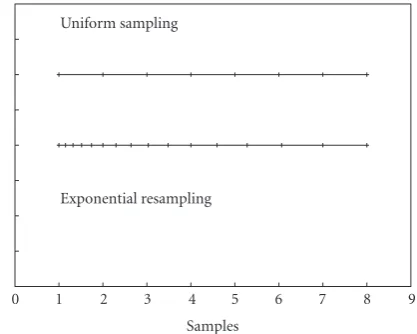
Now we have the exponential sampling step and the number of samples needed, so we can proceed with resampling (see Figure 2).
3.3. Sinc, cardinal spline, and spline interpolation
Resampling (in a nonuniform way) an already sampled sig-nal is not trivial. In theory, the Nyquist-Shannon sampling theorem tells that a signal, under well-known conditions, can be reconstructed from its samples using a sinc interpolation. Unfortunately, fast sinc interpolation on an exponential grid is cumbersome, even using lookup table [15]. In [16] (but also [17,18] are important for more stable algorithms), an idea for reducing the theoretically infinite computation of a sinc interpolation to a finite summation has been presented, but the computation still requires a quadratic algorithm. A fast interpolation technique that can approximate sinc inter-polation iscardinal splineinterpolation [19]. This interpo-lation is a modified version of the cubic Hermite spline in-terpolation. The Hermite spline is a third-degree spline with each polynomial of the spline in Hermite form. The Hermite form consists of two control points and two control tangents for each polynomial. On each subinterval, the interpolating polynomial depends on the starting point piand an ending
pointpi+1, with starting and ending tangentsmiandmi+1, re-spectively. A cardinal spline is a cubic Hermite spline whose tangents are defined by the points and a tension parame-ter c. The tension allows the computation of the tangents. A general-purpose tension value can be 0.5 and the cardinal spline using this value is called Catmull-Rom spline. In the FMT algorithm, various values of tension have been tested along with other types of spline interpolation, in particular, natural cubic spline interpolation [19]. A natural cubic spline is a spline constructed of piecewise third-order polynomials which pass through a set ofm control points. The second derivative of each polynomial is set to zero at the endpoints, and this provides a boundary condition that completes the system ofm−1 equations. This interpolation is simpler than cardinal spline, yet offering the same goodness of approxi-mation.
0 1 2 3 4 5 6 7 8 9
Samples Uniform sampling
Exponential resampling
Figure2: Uniform sampling and (critical) exponential resampling.
The use of cardinal spline interpolation is, from a the-oretical point of view, a good choice. In fact, the cardinal spline, generated by cardinal B-spline [19], has a behavior similar to the sinc function. Like the sinc function, each car-dinal spline vanishes at all integers except the origin, and the value at 0 is 1. Furthermore, at limit, the cardinal spline con-verges to the sinc function.
Eventually, it is an experimental analysis of errors that guides the choice of the interpolation method, as presented inSection 4.2, for different oversampling factors.
4. IMPLEMENTATION AND EXPERIMENTS
Using the ideas presented inSection 3, a fast Mellin trans-form has been developed. The algorithm takes a signal uni-formly sampled and performs an exponential resampling. The signal is considered to be sampled at Nyquist frequency and, to obtain a good tradeoffbetween accuracy and speed, the number of new (exponential) samples used is 2eN. Here, the starting point of the signal is considered to beTs(the
10−20
10−15
10−10
10−5
100
Er
ro
r
0 0.1 0.2 0.3 0.4 0.5 0.6 0.7 0.8
Time (s)
2eNsamples; maximum absolute error: 3.19e-002
Figure 3: Reconstruction error for a white noise using twice as many samples as strictly needed (2eN).
4.1. Assumptions and approximations
The algorithm works using the assumptions and approxima-tions presented in the previous secapproxima-tions and are summarized here.
First, there are errors due to quantization and finite-precision arithmetics. Then we can mention all the approxi-mations bound to the algorithmic realization. Namely, spline interpolation introduces errors; (21) is a limit approxima-tion; signals are supposed to start at t0 = Ts, where Ts is
the sampling period of the uniformly sampled signal; no in-formation on Mellin bandwidth is typically available before-hand.5
4.2. Errors and reversibility
The algorithm is clearly based on subblocks: the interpola-tion block, the FFT block, and the multiplicainterpola-tion and nor-malization blocks. In the case of complexity analysis, all the focus was on the FFT and on the relation between the num-ber of uniform samples and the numnum-ber of exponential sam-ples. The error analysis, instead, is all focused on the interpo-lation block. Other computational errors are negligible. As it was explained inSection 3.3, the exponential distribution of samples and the need of a fast interpolation algorithm force us to choose an approximation for the sinc interpolation and this introduces errors.6Alternative distributions of interpo-lation nodes have been tried to reduce error, like Chebyshev or Leja nodes, but although the interpolation error becomes
5Indeed, the unknown Mellin bandwidth can be approximately computed
after exponential warping.
6Actually, true sinc interpolation would also introduce errors, due to the
intrinsic problem of the noninfiniteness of the computer-computed sinc function.
10−15
10−10
10−5
100
105
Er
ro
r
0 0.1 0.2 0.3 0.4 0.5 0.6 0.7 0.8 Time (s)
0.5eNsamples; maximum absolute error: 1.83e+000 1eNsamples; maximum absolute error: 6.01e-001 2eNsamples; maximum absolute error: 3.19e-002 3eNsamples; maximum absolute error: 1.15e-002
Figure4: Error trend (in time) for a white noise. When taking twice as many samples as required (2eN), the maximum error of these sig-nals goes towards 10−2. Each curve is derived from piecewise-linear
regression of the actual error curve, as the one shown inFigure 3.
smaller, the displacement of the samples on the exponential grid is dramatically less accurate and this introduces an even larger error in the computation of the transform.
So, the preferred solution for error reduction is oversam-pling. Using more samples than those strictly required by the sampling theory allows the implemented transform to be more precise. This oversampling can be tuned with respect to the user needs. A good choice is to use twice as many samples as those required by theory. In this way, the maximum inter-polation error goes towards 10−2 on amplitude-normalized signals. The “worst-case scenario” (shown in Figure 4) is when using signals that, in the final part of them, have fre-quency components near the Nyquist limit. Violet noise and white noise are simple examples that maximize the error, but it is sufficient that only the final part of the signal has high frequency components. In fact, at the end of the resampling grid, the samples are spaced as in the original uniformly sam-pled signal. So, in that region of the signal the exponential sampling is very close to the uniform and then you do not have the benefit of the oversampling and errors can be big-ger. In the final part of the signal, the interpolator is an ap-proximation of the theoretical sinc interpolator. The closer the frequencies are to the Nyquist limit, the more the dif-ference between spline and sinc interpolators is noticeable (see Figures6and7). InFigure 3, the reconstruction error is shown, while inFigure 4the curves show the trends of the reconstruction errors as obtained from piecewise linear re-gression on log-scale plots. From a computational point of view, the oversampling introduces a multiplication by a con-stant to the number of exponential sampling points, so the asymptotic complexity remainsO(nln2n).
0 50 100 150 200 250 300 350
Shor
t-time
SNR
(dB)
(siz
e
=
1024
samples)
0 0.1 0.2 0.3 0.4 0.5 0.6 0.7 0.8 Time (s)
3eNsamples; overall SNR: 123, last SNR: 105 2eNsamples; overall SNR: 100, last SNR: 84 1eNsamples; overall SNR: 49, last SNR: 28 0.5eNsamples; overall SNR: 15, last SNR: 3
Figure5: SNR over time for four different oversampling factors. Test signal: white noise, 16 bits, 44100 Hz, 65536 samples.
Table1: Elapsed times in seconds. Times for complete operation (including loading file from disk).
Number of samples Oversampling
3eN 2eN 1eN 0.5eN
218 306.594 56.703 45.297 8.297
216 9.953 6.735 3.531 2.328
214 2.218 1.312 0.656 0.359
212 0.782 0.297 0.140 0.110
210 0.515 0.094 0.047 0.046
208 0.453 0.047 0.031 0.031
Table2: Elapsed times in seconds. Times for FMT algorithm only.
Number of samples Oversampling
3eN 2eN 1eN 0.5eN
218 167.735 39.625 17.157 6.890
216 7.172 4.985 2.640 1.640
214 1.890 1.078 0.547 0.390
212 0.484 0.203 0.093 0.062
210 0.250 0.047 0.032 0.016
208 0.219 0.015 0.016 0.016
signal. In this example, the overall SNR for three-times over-sampling (3eN) is 123 dB, for 2eNis 100 dB, for 1eNis 49 dB, and for 0.5eNis 15 dB.
Tables1and2give a short snapshot of the algorithm per-formance. Data of the first table are recorded elapsed times for entire operations (from loading a wave file to the end of the transform computation, including separation of phase and magnitude, etc.), while data from the second table are
10−7
10−6
10−5
10−4
10−3
10−2
Er
ro
r
0 0.02 0.04 0.06 0.08 0.1 0.12 0.14 Time (s)
Sinc interpolator; maximum absolute error: 5.86e-004 1eNsamples; maximum absolute error: 7.87e-003 2eNsamples; maximum absolute error: 1.05e-003 3eNsamples; maximum absolute error: 5.62e-004
Figure6: Error trend over time for three different oversampling factors and a sinc interpolator. Test signal: sparrow chirp, 16 bits, 16000 Hz, 2048 samples.
recorded elapsed times only for the FMT algorithm without any other operation. The first and the last rows of each table are affected by machine limitations. In fact forn= 218, the machine begins to paginate memory to disk so the perfor-mance is heavily affected. Forn=28, secondary operations unbound to the algorithm result to be heavier than the algo-rithm itself. The machine that has been used for the tests was a notebook with 3 Ghz Pentium 4 processor, with 512 Mb of RAM running Matlab 7R14 for WindowsXP.
Theoretically, the most accurate interpolation is sinc in-terpolation. So, we compared cardinal spline interpolation and sinc interpolation. Results can be viewed in Figures6and 7, computed using real recording (sparrow chirp) containing frequencies near Nyquist limit (signal sampled at 16 kHz). The experiments showed that in every case, a non-efficient interpolation (i.e., O(n2) complexity) is too slow and not practical. For example, analyzing 8192 samples required 202 minutes. Conversely, the factor-3 oversampling with spline interpolation is almost as accurate as sinc interpolation.
50 60 70 80 90 100 110 120 130 140
S
h
or
t
ti
m
e
S
N
R
(d
B
)
(s
iz
e
=
512
sa
m
p
le
s)
0 0.02 0.04 0.06 0.08 0.1 0.12 0.14 Time (s)
3eNsamples; overall SNR: 117, last SNR: 128 2eNsamples; overall SNR: 113, last SNR: 117 1eNsamples; overall SNR: 84, last SNR: 79 Sinc interpolator; overall SNR: 117, last SNR: 130
Figure7: SNR over time for three different oversampling factors and a sinc interpolator. Test signal: sparrow chirp, 16 bits, 16000 Hz, 2048 samples.
4.3. Scale shifting and hybrid transform
The FMT works under the assumption that the signal starts fromTs, whereTsis the uniform sampling interval. The im-pact of this hypothesis can be important, especially when the transform is used for scale analysis. In fact, the starting point of the signal changes the associated Mellin distribution, be-cause the Mellin is not shift-invariant. If the objective is to analyze just the Mellin magnitude, a simplescale shiftingcan be done. This means that the signal in the original domain must be shifted and scaled according to its scale period. The scale period, in the case of an unknown finite-length signal, is the ratio between the ending instant and the starting in-stant. When shifting the signal to a new starting point (Ts
for our purposes), the ratio must be still the same, so the signal must be scaled, that is, compressed or expanded pre-serving the total energy of the signal. However, this solution presents problems if phase analysis is needed or if the orig-inal signal starts near zero, as in the limiting zero case, the scale-periodicity is not computable. To avoid these problems, the scale shift must be done with a granularity computed according to the scale period (seeFigure 8), thus implying that zero padding will be necessary to compensate the dif-ferences between the obtained point and the wanted starting point. Moreover, if the starting point is far fromTs, the re-quired sampled frequency becomes too high, thus becoming unpractical.
If the signal starts exactly at zero, a hybrid approach can be pursued: the part of signal from 0 to Ts can be
trans-formed directly. For example, we can consider the signal con-stant in the one-sample interval between 0 andTs, and pro-ceed by explicit area computation. This initial contribution can be summed with the FMT of the remaining part of the
−1 −0.8 −0.6 −0.4 −0.2 0 0.2 0.4 0.6 0.8 1
Amp
li
tu
d
e
1 4 16 64
Time (s)
Figure8: Scale shifts tuned with the scale period of the original signal (the original signal starts at 1 second and ends at 4 seconds). One scale-compressed version with the same scale period has been reproduced from 0.25 second to 1 second, and two scale-expanded versions with the same scale period are reproduced from 4 seconds to 16 seconds, and from 16 seconds to 64 seconds.
signal starting fromTs. In conclusion, the algorithm can be extended to afford the choice of the starting point, possi-bly setting it to multiples of Ts. Nevertheless, if the
trans-form is used only for scale normalization or for filtering or recognition applications, the starting point looses impor-tance.
4.4. Availability of the code
A matlab implementation of the FMT and some process-ing examples are freely available athttp://profs.sci.univr.it/. ˜desena/FMT.
5. CONCLUSIONS
This paper proposed a fast algorithm for the discrete-scale (and β-Mellin) transform. The idea is based on the well-known relation between the Mellin and Fourier transforms, and has been developed to be practical and accurate. As op-posed to other implementations, this work tries to solve the problem entirely in the time domain by choosing an efficient, yet accurate, exponential resampling process. The proposed algorithm has been analyzed in terms of computational com-plexity and precision. In particular, the fast algorithm has been compared with a nonapproximated interpolation solu-tion.
ACKNOWLEDGMENTS
REFERENCES
[1] D. Casasent and D. Psaltis, “Position, rotation, and scale in-variant optical correlation,”Applied Optics, vol. 15, no. 7, pp. 1795–1799, 1976.
[2] D. Casasent and D. Psaltis, “New optical transforms for pattern recognition,”Proceedings of the IEEE, vol. 65, no. 1, pp. 77–84, 1977.
[3] S. Derrode and F. Ghorbel, “Robust and efficient Fourier-Mellin transform approximations for gray-level image recon-struction and complete invariant description,”Computer Vi-sion and Image Understanding, vol. 83, no. 1, pp. 57–78, 2001. [4] S. Derrode and F. Ghorbel, “Shape analysis and symmetry
detection in gray-level objects using the analytical Fourier-Mellin representation,”Signal Processing, vol. 84, no. 1, pp. 25– 39, 2004.
[5] J. Bertand, P. Bertrand, and J. P. Ovarlez, “The Mellin trans-form,” inThe Transforms and Applications Handbook, A. D. Poularikas, Ed., The Electrical Engineering Handbook, pp. 11-1–11-68, CRC Press LLC, Boca Raton, Fla, USA, 1995. [6] J. Bertrand, P. Bertrand, and J. P. Ovarlez, “Discrete Mellin
transform for signal analysis,” inProceedings of IEEE Interna-tional Conference on Acoustics, Speech, and Signal Processing (ICASSP ’90), vol. 3, pp. 1603–1606, Albuquerque, NM, USA, April 1990.
[7] J. P. Ovarlez, J. Bertrand, and P. Bertrand, “Computation of affine time-frequency distributions using the fast Mellin transform,” inProceedings of IEEE International Conference on Acoustics, Speech, and Signal Processing (ICASSP ’92), vol. 5, pp. 117–120, San Francisco, Calif, USA, March 1992. [8] L. Cohen, “The scale representation,”IEEE Transactions on
Signal Processing, vol. 41, no. 12, pp. 3275–3292, 1993. [9] A. De Sena and D. Rocchesso, “A fast Mellin transform with
applications in DAFx,” inProceedings of the 7th International Conference on Digital Audio Effects (DAFx ’04), pp. 65–69, Napoli, Italy, October 2004.
[10] T. Irino and R. D. Patterson, “Segregating information about the size and shape of the vocal tract using a time-domain au-ditory model: the stabilised wavelet-Mellin transform,”Speech Communication, vol. 36, no. 3-4, pp. 181–203, 2002.
[11] H. Sundaram, S. D. Joshi, and R. K. P. Bhatt, “Scale period-icity and its sampling theorem,”IEEE Transactions on Signal Processing, vol. 45, no. 7, pp. 1862–1865, 1997.
[12] F. Gerardi, “Application of Mellin and Hankel transforms to networks with time-varying parameters,”IRE Transactions on Circuit Theory, vol. 6, no. 2, pp. 197–208, 1959.
[13] E. J. Zalubas and W. J. Williams, “Discrete scale transform for signal analysis,” inProceedings of the 20th IEEE Interna-tional Conference on Acoustics, Speech, and Signal Processing (ICASSP ’95), vol. 3, pp. 1557–1560, Detroit, Mich, USA, May 1995.
[14] E. Biner and O. Akay, “Digital computation of the fractional Mellin transform,” inProceedings of the 13th European Sig-nal Processing Conference (EUSIPCO ’05), Antalya, Turkey, September 2005.
[15] J. O. Smith, Digital Audio Resampling Home Page, January 2002.
[16] T. Schanze, “Sinc interpolation of discrete periodic signals,” IEEE Transactions on Signal Processing, vol. 43, no. 6, pp. 1502– 1503, 1995.
[17] F. Candocia and J. C. Principe, “Comments on “sine interpola-tion of discrete periodic signals”,”IEEE Transactions on Signal Processing, vol. 46, no. 7, pp. 2044–2047, 1998.
[18] S. R. Dooley and A. K. Nandi, “Notes on the interpolation of discrete periodic signals using sinc function related ap-proaches,” IEEE Transactions on Signal Processing, vol. 48, no. 4, pp. 1201–1203, 2000.
[19] M. Unser, “Splines: a perfect fit for signal and image process-ing,”IEEE Signal Processing Magazine, vol. 16, no. 6, pp. 22–38, 1999.
Antonio De Senareceived the Laurea de-gree in computer science in 2004 from the University of Verona, Department of Com-puter Science, where he is now a Ph.D. student. He worked at the University of Verona under a research contract between May 2004 and December 2004. In 2007, he has been visiting the Hunter College, City University of New York, for several months of studies. His works are related to sound
processing and analysis. In particular, he is interested in the Mellin transform and the scale transform applied to digital audio filtering and effects, speech recognition, and time-frequency analysis.
Davide Rocchessoreceived the Laurea de-gree in electrical engineering and the Ph.D. degree from the University of Padova, Italy, in 1992 and 1996, respectively. In 1994 and 1995, he was a Visiting Scholar at the Center for Computer Research in Music and Acoustics (CCRMA), Stanford Univer-sity. Since 1991, he has been collaborating with the Center of Computational Sonol-ogy (CCS), University of Padova, as a