)Jr
~~
I' ";1"
;tl
. ••. 1:1: '''',
;..::,:,:~.
)\
I.r. .'/. /
~
.
I.
,~
1
.
l
"':',~.
;: .' ~
;l.~.:
',,~~
II";"
f;
'
~.
·
)
f.T
.
~I
..
:
{~::;'
tl
}
~
.
. ~."!. ..!l :~:
'):
:~1l:
<
·r
'
;ii
'
:
"I
~
l
-;'¥.~.,
t.:,.,., ..
1\-;','
",'\i.
,.~ .
1:'~
;
)
:~
.:~
"
1
:!1
. ~
.
;
:
,:
~
]
.
~
j
.
,
>
1
Froml JOCN)V Sub) : Vlrtu6. Ser,nenta Article
.
(
Since
I
wrote the S/W for VersionI.S,
I have dlacovered how to get It wo r kin 9 0 n Ve r II ('0 n I I I • 0 (9 n d I V •n
Iss I m I I a r t 0 I I I •n
I nth I s r e q a r d ) •On the Mlcroenglne version IV.O there are no lIer,nent tahles to load, so I played wIth the Seoment InformAtion Alocks (SIRs). These are described In the IV.O manual on page 34, and the format for the Mlcroenqlne Is qlven bel OWl
518
=
record Seqbase ISeqlenq I xxx Segaddr r
SeQunlt Segref SeQSP end,
"Integeq integer; Inteqer; Intefler; Inteqer, Inteqer; Integer,
There· Is a p-machlne regIster on the Mlcroenqlne which III a pointer to 9n "arrayrseqranqel of ·SIA", and the value of thIs register may be loaded Into the variable "ptr" with
~INE("ptr,(-2),LPRfSTO)
where LPR
=
157 and 5TO = 196. One can then mess with the SIA forseqnent ' I ' with ptr·rll.fleldn~e, and this Is how I mede Virtual Segments work on the Mlcroenglne; I ass~e that ~klng It work under IV.O would be s Imll sr •
Here Is the article
Virtual Seqment Procedures' under UCSD.Pascal
Virtual Se~nt Procedures under UCSD Pascal hy
Jon Rondy
Rox 14A, Ardnore, Pa, 19003
Thl& article Is copyrighted hy Mlcrosystems (Aox 1192,
~untalnslde, NJ, 070Q2) and Is . reprinted with their
permission.
Page 1
One of the nl~e features of UCSD Pascal Is Its support of seqnent procedures. A seqment procedure Is I Ike any other Poscal orocedure except that whenever It Is called (except for recursive calls) It Is loaded from disk Into memory prior to being e)(ecuted, and after It exits, the mernory Is reclaimed. In fact, the seqnent procedure Is loarled onto the stack, since the pattern of memory use Is nested In 8 very 'stack-like' mAnner.
Seqnent procerlures al low the proqr~er to manaqe m~nory resources explicitly and conveniently, and really 8re a form of overloy. In IRroe programs, It is not uncomnon to dedicate a seqment procedlJrp. to Initialization, since that code need not reslrle in memory after the proqr~
starts. Seqment procedures ~y have Internal procerlures anrl functions, All of which are loaded with the seqnent procedure code, allowlno functional groups of routines to be hrouqht Into mfflnory In A slnfJle operation, anrl executed.
:v
i-*
~
Un for tun 8 tel y,
u:(
Pas cal a I I ow s the pro q r emne r a c c e s s ·t 0 0 n I y s I x S f! (fne n tprocedurea under nvrmal clrcunstances. This Is fine for small proQroms (under )000 linea), but when one starts to get serlous About an application, one really needs more segment procedures. On~ reason for this Is that tHe UCSD Pascal sepArate compilation construct {lNIT:d uses one of these alx s8cp'nent procedure 'slots' "ven If It Is not loaded Into memory dynamically, wasting this scarce resource. Thla situation should lmorove very soon (perhaps by thB time .thls article Is printed) becRusf! Softech Is plannlnq to announce features In UCSD Pascal Version IV.O to solve some of these problems.
I work for a companv (Energy Data Systems) which has heen trylnQ to do some fairly complex applicatIons In UCSD Pascal, and we ran Into the ·se~nt
barrier' In the spring of this year. We considered modlfylnq the lCSr> operating system, since we had source for It, hut decided to try to sLick to solutions which required as few modifications to operatlnQ syst~ code
8S possible. After s~ thouQht I c~e up with an Interim meRna of ame I lor a tin 9 the pro b I em, wh I chI . w I I Ide & c rib e I nth I SAt tic Ie.
When a segment procedure Is called by the UCSD Pascal p-machlne, R soeclal op-code la used to do so. This op-code flrlt looka In an operatlnq syst~
'segment table' to see If the Indicated procedure has been called more than zero times (reference count, In case It Is a .recurslve call .and thp. codp. need not' be reloaded). If It Is already In memory (reference count) n), It Is executed like any other procedurel If not, the op-code loo'<s In the seqnent table for the block n~ber on the disk where It can find the codp
Copyrlqht 1981 by Mlcrosystens
V I r t u a I 5 e gne n t Pro c e d II res un d e r LCSD P a II c a I PAqe 7
for the segment procedure, and the n~ber of bytes In the code. It thp.n loads the code onto the stack and cal Is the procedure, Incr~entln~ th~
reference count to one. Upon exit, the seqnent procedure return on-corie decrements the reference count by one, and clears the atAck hAck un to where It was prior to the call If the count has hec~ zero.
The Idea which I had was to somehow write data Into the sp.qnent tAhlps p r lor t o e a c 1'1 s e!JYl6 n t pro c e d u r e c a I I Ins u c h a wa y t hAt wh e nth eo A h 0 V t'
op-code was Invoked It would find data descrlblnQ different st'fJ'TlPnt procedures each time; It would In fact be faked Into loadlnqdlffprent corle se9'flents Into memory for each call, even thouqh the same seO'Tlent nrocf'rillre was being called each time.
In order to do this, I first had to find where the Beqnent tRhles wer" located In memory. The first fllobal variable declared In the lrc;O PASCfll operating system code III a pointer to R special recorc1, callec1 the syst~
c~nlC8tlon record, or SYSonMREC, And the seqnent tahles Are a nRrt of t h I II r e cor d . The rei s asp e c I R I ' s wit c 1'1' I nth P. I CSO P R S C a I c omn I I P. r ( t 1'1 f'
'U' switch), end when Its value Is ' - ' , proqrAms function very c1lffp.rpntly than usual. The 'main proqram' does not execute at all. hut rAther thE! fir 8 t 9 e qme n t pro c e d u r e d e c I are d i n the 0 roC) r Aln e l( e c II t e s . I nil t p a c1 • A Iso,
the variable definitions are 'al lased' on too of thp. definitions for the operatlnq system (like an EaIIVALF:N':f: In rffiTRAN), allowln,! the nrol)rAm to read and write those varlahles. Usually, one uses exactly the SWTle
varlahle definitions as were ulled when the operatlnll sy't~n was compllpc1. In order that one's proQrAm aqree with the operatlnll systrm rlerlnltlons. In this CAse, however, I simply made my own definitions. since All I wanterl was to determine the VAlue of the oolnter to SYSonMRfr.. Slnr~ l.S stores pointers AS Rctual fllP.fYIory addrellscs. hv prlntlnll the VAlue of ttlf' pointer I
~
N
(
1 wrote the following proqr9m and was able to locate SYSOOVREC. It was
part trial and error, since after I thought I had 'found' SYSCOMREC the
first time, I was forced to I,ook through dtmps to flqure out why I had been
wrong ••• Anyway, the program below wll I tell you where In memory any
SYSCOMREC 19 under Version 1.5 (It Is at location 718 rdeclmall for my Z-AO
verllon of 1.5), and probably under Version 11.01 I have not tried It with
l i t . O.
f
su-I
progr9m find; var
I 1 I n t e 9 e r;
f
a I I as edt 0 ~ s Y B C omr e cscqnent procedure flndsyscom; begin
wrlteln('Syscomrec Is located at address ',1,' decimal.');
end; beqln end.
then needed to flqure out how far from the start of SYSOOMREC the Begment
lAhles started. fortunately, the UCSD Pascal operating ByBten variable
definitions, found In 8 file called GLOAALS.TEXT, were distributed with
lCSO Pascal Versions 1.4 and 1.5, so t had th~ at my disposal. fThe
Copyright 1981 by Mlcrosystens
Virtual Segment Procedures under UCSO Pascal Page J
n_OMl.S.TEXT file, along with all other UCSD Pascal source code, 'Is
cooyrlght by the University of California at. San Olegol some of the
(".LOMLS.TEXT file Is presented In this article (the portions of Pascal
!lource In capltel letter9) with the permission of Softech Mlcrosysterns Inc,
their licensee. 1 I om Infor~d that the SYSOOMREC data layout has not
chanqed with the varlou9 UCSD Pascal Versions, so you should be able to
locate the se~nt tables at 96 bytes past the slart of your SYSCOMREC.
ThIs ~ans that If one were to write to location RlA tn my memory, one
would b, wrltlnq on the first byte of the selJl1ent tables,
The se~nt tables are defined as followsr
type
seQdesc
=
recordabsolute block number on disk
I
In bytes 1
dlskaddr inteqerJ
codelenq Integerl
endl
seqtab
=
array rse9ranqel of recordunit: unltnum; , disk unit number (an Integer) I
codedesc : segdesc; f 8S above
l
.
end;
where 'seQrange' Is the numher of seqnent procedures defined for the UCSO
system belnQ used ('0 .. 15' In the case of Version 1.,). If one declared a
pointer 'segptr",whlch oolnted to a record of type 'scqtab", one could
refer to that record as 'seqptr", to the unit (disk drive) on which the
code for the third seqrnent procedure was loc8tnd a9 'setlplr"r11.unlt', and
to the nU'llber of hytes In the code for that oror.erfllre fill
~~l
!l t: Y J.ll '" I > I • t.: u u t: u t: II C • C U U tl I u I I l J . UII C C IJ U I U c:; L II U I I
lJ"
L II '" LUI I "l. ~that pointer with the fol lowing record definition:
\lit"'''\'''; til
var
alias: record case boolean of
true: (I Integer);
falser (p : "segtab);
end;
This record definition states that one will either use the
record 'alias' a8 an Inteqer (denoted 'allss.I') or as a
variable of type 'segtab' (denoted 'allas.p'). Since the
used for both values, If one were to write Into the Inteqer
then use that value as a pointer; one could 'fake' Pascal
that a variable of type 'segtype' waB being pointed to.
storaqe for the
pointer to a
same storaqe Is part, one could
Into thlnklnq
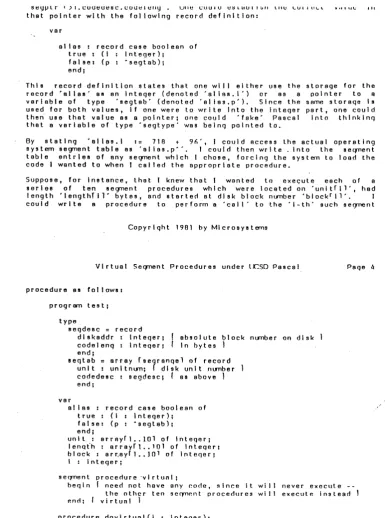
By stating 'aIl8s.1 1= 710 + 9(;', I could access the actual operating
system segment table es 'allas.p"'. I could then write .Into the 8eqTIent
table entries of any se~nt which I chose, forcing the syst~n to load the
code I wanted to when I called the appropriate procedure.
Suppose, for Instance, that I knew that I wanted to exeGute each of a
sorlos of ten segment procedures which were located on 'unltr\l', had
length 'Iengthrll' bytes, and otarted at disk block nunber 'blockf \ l ' .
could write a procedure to perform a 'call' to the 'I_th' such segnent
Copyrlqht 1981 by Mlcrosyatens
Virtual 5eqTIent Procedures under lCSD Pascal
procedure as folloW81 program test;
type
eeqdesc
=
recorddlskaddr Inteqerl absolute block ntmber on disk I
codelenq : InteQor; In bytes
1
end;
seqtab = array fsegranqel of record
unit: unltnun; I disk unIt number
codedeec : segdesc,
f
00 above1
end; var
al Iss: record csse boolean of true: (I : InteQer); falsel (p : Aaegtab); end;
unit. : arrayfl •. lOl of Inteqer;
lenQ(h : arrayfl .• 101 of Inteqerl
hlock I ar~ayrl •• JOl of lnteqer;
I : Inteqer;
sef1T1ent procecfure 'vl rtual;
PaQe 4
beQin f need not have any code, since It wi I I never exccute
--the o--ther ten scr,nr.nt procedurcs will execute Instead'
enOl f virtUAl
1
procedure rlovlrtunl(i intetler);
~ . .j}~-.."
~., (,
I ..
1'" ' ..•.I." ",'
f.,I, ',ler·~.i.'.\.'
Ifr
I
r •.. ' •. ' ...•....,"· .'
II'; r.' .I
l~:il
•i:' . I • • • .
" 'I ".
,', .. : ... '
~
:,1 : :
~~';:~,:,
I· ,
!+:::.'
~~ .
~\
~;
i
~.If;
fh
III ~" <'".
~
!W;;.' .
.. · .. (ri.,,·
~r
..
!f
r,.:f
jj
,
,~ " ,
ii~
~y
.. , .
,;,'
"~; ~.
[i'i;'.~
.. "
~ t
,
r:; ..
~,;
.' .
~f.
i .•. • ' ... l.
':~Q,,:::
'
j?',
rr
:;'
..
'j
.~~
""~'
....•."~ ."~~"".'
';1
"'~
:.1
'~
.,~
":~
,
'.'
;'·~;l
. ". ··1
" "~~
.. J
~fo"~
'.,,~ ~
begin
r
set up to call vi rluat segment 1allas.p~rlO1.codeunit := unitfilj
alias.p~r101.codedesc.codelenq := lengthrilj
alias.p~r101.codedesc.diskaddr := blockf'ilj
f call virtual seqment loaded above'l vi rtual;
endj
r
dovirtualbegin
f ~ e t up poi n t e r t o r e a I s e qrne n t t a hie al ias. i := 718 + 9f>j
f call the ten vi rtual procedures for i := 1 to 10 do dovirtuat(i); end.
r
test l(
The above program will actually work, but it has a few problems which make it a bit awkward to use. First off, procedure cal Is which previously looked I ike a nice nrune now are reduced to a cryptic statement I ike 'dovirtual(:n< This can be taken care of by cre~tinq constants at the start of the program with values from 1. to 10, and callinq 'dovirtual' with those constant values; a pro~edure to clear the screen mlqht then be cal led as 'dovirtual(clrscreen)', a significant improvement.
The other problem is that it is I\OT EASY to find out some of the information which I so casually stated would be found in the 'length' and
Copyright 1981 by Microsystems
Virtual Seqrnent Procedures under LCSo Pascal Page 5
'block' arrays. To do so involves reading the 'segnent tahle' of the code f i I e I n wh I c h 0 n e 0 f the v I r t u a I s e cpne n t sex i s t s , ' I nor de r t a d e term i n e t hat in forma t ion. Un for tun ate I y, the dis k add res s i n forma t Ion s tor e d i n the segment tables of a code file is slightly different than that stored in the operatinq system's seqrnent tables. The normal code file disk a~dresses
are relative to the start of the entire code file; the system addresses are the a b sol ute dis k b I 0 c k mmb e r • T his me an s t hat i nor de r t 0 can v e r t the data In the code file's seqment table into 'useful' Information, we must also know the absolute address of the start of the code file. And in order to determine this, we must read (and understand) the directory of the disk.
Whew!... .
T a kin q i t a s t epa t a t i me, the forma t 0 f a l.£So Pas c a I dis k d ire c tor y i s given below. It is a Dortion of the UCSO GLoAAlS.TEXT file mentioned earlier (and is copyrlqht by UCSo).
V,:)
c..:>
;:
Virtual Segment Procedures under LCSO Pascal
CO\!ST
/V1I\XLN IT = 1 2 i
/V1I\XO I R
= 77;
YIDLEI'-G=
7;TIDLEI'G
=
15; FRlKSIZE=
512; OIR8LK 2; /V1I\XSEG=
lS;TYPE
(lI-/V1I\XIIVLM PHYS I CAL LNI T 1/ Fffi LREAIJ*)
(*/V1I\?< N...MAER
q:
ENTRIES IN A DIRECTffiY*) (1IN..Mf3ER CF Q-ll\RS I N A VOLUv£ 10*) (*N...MRER CF OHARS IN TITLE ID*) (*STANJARD 01 SI< AUXJ.< LEf'.GTH*) (*01 SK ACCR CF oIRECTffiY*) (*M4X a::I)E SEOvF.NT N..MAER*)oATEREC
=
PACKED RECORDM:NTH: 0 ... \2; (*0 IMJL IES DATE !\oT MEANIWFUL'*) (*oAY CF M)\,JTHIt)
DAY: 0 •• 31 j
YEAR: 0 .. 100 EI'D (lIoATEREC*)
LN ITN...M
= 0 •• Mo.XLN IT ;
Vlo= STRIf'.GfVIDLEf'.Gl;
olru~E
=
O .. ~IR;TID
= STRIf'.GfTIDLEl'-Glj
(*100 IS TEMP DISK FLAr,*)
FILEKII'D
=
(LNTYPEDFllE,XDSKFILE,OOO£FILE,TEXTFILE. INFOFILE,DATAFILE,GRAFFILE,FOTOFILE,SECUREoIR);Paqe h
oIRENTRY = RECORD DFIRSTALK: INTEGER; DLASTALK: INTECERj
(*F IRST PI-fYS leAL 01 SI< AfXH*) (*POlNTS AT RLCXJ< FQLON I I'D * )
var
CASE DFKII'D: FILEKIN) OF SEaREoIR,
LNTYPEDFILE: (OVID: Vlo;
DEOVAU<: INTEGER; CN.JvF I LE S: 0 I RRJ\I'-GE ; OLOADTIME: INTEGER; DLASTACDT: oATEREC) j
XOSKFllE,COOEFILE,TEXTFILE,INFOFILE, DATAFILE,GRAFFILE,FOTOFILE:
(oTlo: TID;
DLASTBYTE: 1., FAU<S I7.E; oACCESS: OATEREC) EI'D (*01 RENTRY*) ;
directory arrayfdlrranqel of direntry;
(*CNL Y IN OIRr 01, . . VOLUVE I!'FO*) (IINASvE Cf" 0 I SK VOUJvE II )
(*LASTALK (F VOU M-':*) (*"LfYl FILES IN om,*) (*TIME (F LAST ACCESS*) (w/VOST REr:ENT DATE SETT II\.G*)
( * TITLE OF F I LE* )
(*N..M AYTES IN LAST RLcn<II) (-lAST M"DIF ICAT IrN DATE*)
Given the above definitions, after a bit of studyinq we can see that each directory entry always contains the disk address (in blocks) of the first and last blocks of the file for which it is an entry. If the entry is a v 0 I ume IDe n try, i t a I soc 0 n t a ins the v 0 I ume (d i s k e t l e) name, the n lJmb e r 0 f b I 0 c k son the v 0 I ume ( , d e 0 v b I k . ) , the n umh e r 0 f f i I e s o n the v 0 I lJme ('dnumfiles') and the time (date) when it was last accessed. Normally one fin d s t his en try as the fir s t e n try i n t he d ire c tor y .( or • d ire c tor y
r
0 1 . ) • 1 f t he en try i s a n a rmn I f i l e e n try. i t e o n t a ins the f i I elf) (n ame ), the n IImh e r 0 f b Y l e s i n the I a s t b I 0 c k wh i c h rea I lye ant a i n d a t a, and the cf ateropyriCJht. 1I'J01 hy Mic['osvstems
":i...
'~
At
I
'~t :1:'1'1:.{ .. : ~
I
·~~
.~:
";i
!,~ ~
t;,
~
I
~
'"
~ ~
"
~
~
Virtual Seqnent Procedures under UCSO Pascal Page 7
of the last modification to the file. The ahove definitions also tell us
where to find the directory, n~ely at 'dlrblk', or block two.
We can read the directory Into memory with the statenent unltread(unitnun,dlrectory,slzeof{dlrectory),dlrblk);
This statement uses two UCSO Intrlnslcs, the 'slzeof' function and the
'"nltread' procedure. The former returns the ntrnber of bytes In a Qlven
data structure; In our case, It Is the nunber of bytes In the 'directory'.
The 'unltread' procedure reads from unit (disk drive) 'unltnun' Into ~ry
At the address of the 'directory' structure for 'slzeof(dlrectory)' bytes
slartlng at absolute disk block '~Irblk'
VI I t h t h I II I n forma t Ion I n memo r y, we can sea r c h the d \ r e c tor y for an en try
for a given file. Suppose that we wanted to see If the file 's~ple.code'
were In the directory. We could say
nlrnflles 1= dlrectoryrOl.dnuniTI~B; f nunber of valid entries
I := 0; , will Index Into directory 1
done := false;
f
will become 'true' when we are done1
while (I
<
nunflles) and not done do beqlnI : = I + 1;
If (dlrectoryfll.dtld = 's9mple.code') then done := truel
end;
If we COllie out of this loop with 'done' having a value of 'true',' then we
have Indeed found an entry for the required fllel If not, the file was not
present. If It was found, then the absolute address of the first block of
the file on disk Is simply 'dlrectoryrll.dflratblk', We have then found
the first thing we needed. the Absolute disk address of' the code file. We
now nee d tog e t the cod e len g tho n d rei a t I ve dis ked d r e as I n forma t Ion from
the code file's seqnent tables.
The format of the first bloc~ of a code file Is as shown below. where the
previous type definitions hold a8 before.
segtable arrayfseqranqel of aegdesc;
If we
~9nted
to find the necessary Information about a particular code1\ Ie, we could use the UCSD Pasca' syst~ Intrinsic orocedure 'unltread' to
road the segment table oata from that file Into the above data structure.
The n • If we wan ted the I n forma tl 0 nab 0 u t the ten t h 8 e gne n t pro c e d u rei n a
code file, we could sl~ly use the tenth el~ent of that array. For
ex~le. to determine the 'length' and 'block' data for segnent procedure
n IInb e r ten I n a f I lee a II ed's amp Ie. cod e' 0 nun I t f I v e. one c 0 u I d d o t h e
followlnq:
~I
(
Virtual Segnent Procedures under UCSO Pascal Paqe A
progr~ find; var
codeflle I fllel .
gegteble : arrayfsegranqel of seqde9cr , 'seqdeac' defined as hefore 1
I ! Integer;
begin
un I t :
= s;
r
read In segnent table -- AS9t.rne 'olrectory' read In as ahove first,And 'dlrectoryr 11'. Is data for file which Is of Interest to U9 1
unltread(unlt. segtable, slzeof(seqtalJle), dlrectorfll.dflrstblk);
length 1= seqtablefl01.codelenq;
block := seqtableflOl.dlskaddr; , relative block nunher I
block 1= block + dlrectoryfll.dflrstblk; f absolute block ntrober I
end.
f
find1
So, we finally have the entire ball of wax. We can r.ead a l.cSD disk
directory to find out where on disk a file Is storedl we can read and
understand lhe Information In the seqnent table of a code file; we ca~
convert the relative block nunhers In the code, file seO'l1ent tahles to
absolute block ntrobers; and we can use that InformatIon to Invoke virtual
s e gne n t pro c e d u res • Tot lee v e r y t h I n 9 t 0 q e the r , you w \ \I fin d he I OW 8
sin g Ie' pro gram wh I c h doe s i t B I I. The pro c e d u r e 'v I r tin I t i n I t I 9 I I z e san
I n t ern a I tab J e 0 fun 1 t, len 9 t h, and b lac kln.f 0 rma t Ion be for e the 0 r 0 Q r am
really gets going. It does this by readlnq In the disk directory and
c a II I n g , v I r t II n k' for e 8 c h v I r t u a I s e erne n t pro c e d u r e wh I c h i t w I II c a I I
later. The 'vlrtllnk' procedure looks In the directory for the code file
requested and puts the required Information In the Internal table. The
main program then Invokes the virtual seqnents as 8 teat. Following thIs
program Ie 8 sample of one of the programs which defines a virtual eeqnent
pro c e d u r e • No t e t hat I n bot h the p r oq r am wh I c h c a I 1st h e v I r t u a I s e qne n t s
and the program which defines one of th~. the virtual seQments Are defIned
08 the first executable code In the file. This Is necessary. alnce the
technique which I have shown requires that both seqnent procedures have the Bame 'segnent nunbers'.
CopyrlQht lqnl hy Mlcrosyst~n9
~;i~~.
t
r·
i' ~.t·
~
~l •
':,'1"
[
J"'./ ..
t·:····
r:··
I•
, "'j
, I,
I
••••••••. :.:.:;:'·,
•. : •.•••.•• :~
t2t··
~, -; ,,! ,
.,' ~ 1~
,.~;/
i
·
1".J .. ;'.: ' ... "
Wij ".
i\'i~'
i;~ ..'\l~.';.
:,.!:'
I·.
:''''·~··!-·i:'.
::,~!·Il~r~l
' : .;~. .'
t!l~'
.-;."
, '1_I
'~'·-·'
~!}.:
';~
, .... ) .
.
~'.
'....
;:f
~
~.,
.':,~:[d~
.\~ ':~~f ;
~~
~'I'
,~~
~
a
j,~
\ ';I
II
,
~~
rt
;i
]
.,~
~
1
i
"~~,'
:'~
1
"'If,
',';:'
~
.
' ,~
1
:1
J
.j
'~f
, '
'~
1
: i ~~
""~
1
',',~"M
~!I~
"1
~Ij
"~
;3
1,1:
\':'
.~
d
',:.~
(
VI rlua) Sec,nent Procenures under U::::SO Pascal
proqrwn vlJeqleatl
aNST
tv1t\><t.NtT = J7.t
tv1t\XO I R = 77 1
VIOLEN) = 71
-T IOLEI'G = 1 S i
FALKSIZE
=
S12;01R8U< 2;
tv1t\XSEG
=
1 5 ;TYPE
( *Jv1o;X IM.M PHYS I CAL LN I T
n FCR tREAD*)
(*Jv1o;X NUMAER OF ENTRIES IN A DIRECTORY*)
(*N.1v1RtR (F CJ-VlR5 IN A VOJ.Jv£ to·)
, (·N..Jv1RER OF Q-lARS IN TITLE ID*)
("STANJARJ) 01 SK BLeD< LEN)TH*)
( "0 I SK .AIX:R OF 01 RECTCRY. )
(·tv1t\X CXDE 5EOv£NT NNflER-)
DATEREC
=
PACKED REOQRDM)\ITH: 0 •• l1.; (*0 IfvPLlES DATE I'DT JvEANIf\CFu... *)
(*DAY OF M:NTH*)
DAY: Cl •• J];
YEAR. : 0 •• 1 0 ()
Ef\D (·OATEREC·)
LN ITN...M
=
0 •• Ml\><LN IT IVID
=
5TRII'Gr
VIDLEI'G1r
D ! RRMCE
= 0 ••
Jv1o;XD I R ITID
=
STRIl'GrTIDLEN)ll(*100 IS TEMP DISK FLAG*)
FILEKINO = (LNTYPEOFILE,XOSKFILE,CODEFILE,TEXTFILE,
INFOFILE,DATAFILE,GRAFFILE,FOTOFILE,SECUREDIR);
OlRENTRY
=
RECORDPaqe 9
OFIRSTRU<: INTEGER;
OLASTALK: I NT ECERI (*FIRST
PHY~ICAL DISK AOQR*)
(*POINTS AT Ft..CO< FQLONIN1·)
CASE DF"KIN): F ILEKIf\D OF SECLREDIR,
LNTYPEOFILE: (DVIO: VlOj
OEOVRlK: INTEG8R1 CN..M='ILES: DIRRAW...E;
OLOADT 1M:: I INTEGER j
OLASTACOT: DATEREC);
)<J')SKF I LE ,a:DF.:F I LE , TEXTF I LE , I NFOF I LE, DATAFILE,ORAFFILE,FOTOFILE:
(OTIO: TID;
DLASTBYTE: t .• FALKSIZE;
OAOCESSI DATEREC) EN) (·OIRENTRY-) j
SEm.Af\r£
=
o ..
MO,XSEG;~E())€ SC
=
REa::RO(·ONLY IN OIRrOl ..• VOLUME INFO*)
(.N/lIVE OF DISK vQUME·) (*LASTAlK OF VOLUME*)
(*N...M FILES IN DIR*) (*TIM:: OF LAST ACCESS*)
("M15T RECENT DATE SETTlI'C*)
(*TITLE OF FILE*)
(*N....M F3YTES IN LAST f.'_eD<*) (*LAST MODIFICATION DATE*)
01 SKM:::Cn I -INTEGER I
CODELEN]: INTEGER END; (*SEGDESC*)
(* REL ALK IN
noD€ ...
AAS IN SYSCOM·)(IOn RYTES TO REAO IN*)
vseqranqe 0 .. IS; virtual seqnent ntroher
1
r
seqnent table In syscrnnrec and In this pro~rwnaegtobtype
=
array rseqranoel of recrirdCopyright 1901 by Micro9yst~ns
i;
..
Virtual Se~nt Procedures under L£SO Pascal Paqe 10
var
~odeunlt
codedesc end;
I un I t numj
segdescj
al las: record case boolean of I allow manual setun of 'sysc~rec I
true: (I I Integer);
falsel
Cp
I 'seqtablype);end;
disk: file; ( file to read directory and seq tables fron ,
f
global In whIch to store processed seq tabie for later usevseqs I segtabtype;
'seqnent procedure virtual;
begIn wrlteln('( am the REAL seqrnent procedure 10.');
end;
r
vi rtual -- dtmny lprocedure dovlrtual (vseqnt.,.." : vseQranqe); t:>egln
If (vsegsfvaegnuml.codeunlt
=
0) then beginw r I tel n ( • A t t emp t toe l( e cut e un I Ink e d v I r t u a I 8 e g numb e r " v 9 e (J n tro, ' . ' );
exlt(dovlrtual)j
r
not linked Iend;
load segment register 10 with secrnent data fron I'th sec,nent proceciure 1
allas.p'rIOl := vaegsfvseqnt.rolj
vIrtual;
end;
r
dovlrtualprocedure vlrtlnlt;
r
Initialize tables for call1nq v seqnent procedures \const
unum
= 5;
I unit number where v segnent proca are foundvar
I : Integer;
r
temp vardIrectory I array rdlrrangel of dlrentry; f holds disk directory
numflles I dlrrange;
f
number of flies In dIsk dlr ,procedure vlrtllnk(fname atrlng; vseqnum vseoranQe);
var
I I Integeq
clone I b~olean;
fir 8 t b I k I I n t e 9 e r;
r
b I k numb e r 0 fr
Irs t b I k 0 f f a k e s e 0 cod e f I I e IIsegtable I array rseqranqel of seqdescl f holds sPq th\ fr~ disk I
begin
f
find file In directory1
I := 0; done := false:
wh I I e (I
<::
n lro f I I e s) 8 n dna t don e dab e q I nI ; = I + 1;
If (dlrectoryfll.dtld:: fnwne) then done:= true:
end;
If not done then heqln
wrlteln('unable to find flle ',fnRffiE'!,'.'); exlt(vlrtllnk};
endj
w r I tel n ( . F lie " f nAme " f 0 un (1. • );
Copyrloht l<)nl hy MicrosystP.rl1S
v.:>
reo
~?
t
. ;~.
V-'
C1.)
Virtual Seqment Procedures under t.x:::SD Pascal
f
read in seqnent table1
flrstblk != directo ry fi 1.dfirstblk;
un i tread (unum, I s eqt ab Ie, s I z eo f ( I s eqt ah Ie) , fir s l b 11< ) ;
Paqe 11
f enter data' from seqment 10 In found fi Ie into v seq table
vsegsrvsegnuml.codeunit := unum;
vsegsfvsegnum1.codeclesc.codelenq := IseqtableflOl.codelenq;
vseqsrvsegnuml~codedesc.diskaddr := Iseqtable r l0 1 .diskaddr + firstblk; wrlteln('Finished with association of file ',fname,'.');
end; f virtllnk ~
begin
f initialize vseq table so that all units are zero (vseg undefined)
for i := n to J) do vseqsfil.codeunit :=0;
f set up pointer to syscomrec's seq table located by 'find' program
al ias. I := 71.A + 9';; I 9(' bytes in syscom ree before seq tables 1
f read directory into memory 1
unitread(unllm,dlrectory,slzeof(directory),dirblk,O);
nlmfiles := directoryrnl.d n umfiles;
writeln('Dlrectory of unit ',unum,' read in.');
, lin k f i len ame s wit h v s e g numb e r s 1
vir t lin k ( , F AI<E 0 . fXOE ' ,0) ;
v I r t link ( 'FAKE].aJJE' ,1.);
virtl ink('FAKE2.000E' ,2); virtl ink( 'FN<E3.CQ)E' ,3); vlrtl ink('FAKE4.COOE',4); vi r t link ( TAKES.a:DE' , ) ; vir t lin k ( , F AI<E 6 . CCf)E , ,6 ) ; vlrtlink('FAKE7,OODE',7);
end; f virtinit 1
begin
f
mainvirtinit; dovirtual (0);
dov'i rtual (I);
dovirtual
en;
dovlrtual (}); dovirtual(4); dovirtual(5); dovirtual(6);
dovirtual (7);
end.
proqram fakeO;
seqnent orocedure fakeOalso; begin
~rlteln('1 think that I am virtual seqTIent procedure 0.'); end;
begin end.
main
~
(
They looked for rrre.
The wondered where I was,
Was operating a syst~,
Was processing a micro,
Was wearing hard;
They wondered where I was,
Was listing to one side,
Was seeking to the end,
Was tracking down a bug;
They wondered where I was,
Was terminally I II 1
Was caught In a calm pi Ie,
Was filing it away;
They wondered where was,
Was desIgning a principle,
Was comparIng a language,
Was analyzing an algorlthim;
They wondered where I was,
And they checked out all their sums, They ordered high and low,
They searched down al I their nodes; And St III:
They wondered where I was,
They looked in all their tables, They opened all thei r. ports, They raised up al\ their flags,
All their searchinq failed, Their scanning ran' to end,
I wasn't in their banks,
I'd slipped off all their discs; They decided that I wasn't, They qave up all thei r hope, They dried out all their hoots, And cleaned out all their hins;
wasn't ~rked upon their tapes,
was deleted in their files, had no sectors on their disc, wasn't on their heap;
F r e e t 0 sme I I the f lowe r , Free to see the beach, Free with al I the power,
Of a wet-core security breach.
lo'J!lf 1/?O/7Rl
,:1 ~; •. , '~.;.,:, __ "V"'?
&'
l;.·:;.'·""·;
r
t';' I;I
~,., '
r
,';
~;
f
~.
~
fii, :
F:'
f'
k
'~1, .. ~
~.~f
,+,
i
~'·:'."'····f.·;',,:
!.~:'\, ~;.",,'
"
.. .
j
.~'~'~
.t·~,... ':
"
~'~'.,
i~.
'" ~.'
I
~:!f'.{
... _., .. ;.';. ~
:;.:;
I
,,~~
.;
~'. \' t
::h· ..
~1
•l
i~t;
1;;
. ,~,.' "
~: •• : ••.• j •
~1;. ;'t
~1 f;
I
·I~.;.'!.'
~~\ :'1 :!l'. ;.'