Volume 2009, Article ID 103483,12pages doi:10.1155/2009/103483
Research Article
Code Combination for Blind Channel Estimation in
General MIMO-STBC Systems
Javier V´ıa (EURASIP Member), Ignacio Santamar´ıa (EURASIP Member), and Jes ´us P´erez
Department of Communications Engineering, University of Cantabria, 39005 Santander, Cantabria, Spain
Correspondence should be addressed to Javier V´ıa,[email protected]
Received 30 June 2008; Revised 4 November 2008; Accepted 21 January 2009
Recommended by Azzedine Zerguine
The problem of blind channel estimation under space-time block coded (STBC) transmissions is addressed. Firstly, a blind channel estimation criterion that generalizes previous works is proposed. The technique is solely based on second-order statistics (SOS) and if the channel is identifiable, the estimate is obtained as the main eigenvector of a generalized eigenvalue problem (GEV). Secondly, a new transmission technique is proposed to solve the indeterminacies associated to the blind channel estimation problem. The technique is based on the combination of different STBCs, and it can be reduced to a nonredundant precoding consisting in the rotation or permutation of the transmit antennas. Unlike other previous approaches, the proposed technique does not imply a penalty in the transmission rate or capacity of the STBC system, while it is able to avoid the ambiguities in many practical cases, which is illustrated by means of some simulation examples.
Copyright © 2009 Javier V´ıa et al. This is an open access article distributed under the Creative Commons Attribution License, which permits unrestricted use, distribution, and reproduction in any medium, provided the original work is properly cited.
1. Introduction
In the last ten years, since the well-known work of Alamouti [1] and the later generalization by Tarokh et al. [2], several families of space-time block codes (STBCs) have been proposed to exploit the spatial diversity in multiple-input multiple-output (MIMO) systems. Some examples are as follows.
(i) Orthogonal STBCs (OSTBCs) [2], which achieve full diversity with a low decoding complexity at expense of a loss in the transmission rate for more than two transmit antennas [3].
(ii) Quasiorthogonal STBCs (QOSTBCs) [3–5], which can achieve full diversity and rate one with a slight increase in the complexity of the maximum likeli-hood (ML) decoder.
(iii) Trace-orthogonal codes (TOSTBCs) [6,7], which are information lossless codes with full rate and diversity and also provide minimum bit error rate (BER) when the suboptimal linear minimum mean square error (LMMSE) decoder is employed.
(iv) Perfect STBCs [8], which are rate and full-diversity codes and also ensure energy efficiency and a nonzero lower bound in the coding gain.
A common assumption for most of the STBCs is that perfect channel state information (CSI) is available at the receiver, which has motivated an increasing interest on blind channel estimation algorithms [9–15]. The main advantage of blind techniques resides in their ability to avoid the penalty in bandwidth efficiency or signal-to-noise ratio (SNR) associated, respectively, to training-based approaches [16, 17], or differential techniques [18–20]. Among blind channel estimation techniques, those solely based on second-order statistics (SOS) [12,14,15,21] are specially appealing due to their reduced computational complexity and their independence of the specific signal constellation.
[21], the existing approaches fail to extract the channel in a completely blind manner, which is due to two different reasons. On one hand, the problem of blind STBC channel estimation is usually affected by a set of ambiguities provoked by the special structure of the codes. On the other hand, most of the proposed methods do not exploit the improperty (or noncircularity) of the STBC data model [26–28], which creates additional indeterminacies to those associated to the blind channel estimation problem. Several techniques for solving these ambiguities have been proposed in literature, including the transmission of a short training sequence [9,
15,21,24,25], linear precoding approaches [12,22,23,29], and schemes based on a slight reduction of the transmission rate [30–32]. Nevertheless, most of these techniques are specific for OSTBCs, and all of them incur in a penalty in terms of transmission rate or capacity of the overall MIMO-STBC system.
The main contributions of this paper are twofold. Firstly, in Section 3 we propose a new blind channel estimation algorithm for a general class of STBCs. The proposed technique is inspired by the relaxed blind ML decoder and it is solely based on the SOS of the observations. The computational complexity of the proposed technique reduces to the extraction of the principal eigenvector of a generalized eigenvalue problem (GEV). Furthermore, it exploits the improperty induced by the STBC data model and does not introduce additional ambiguities to those inherent to the problem.
Secondly, inSection 5 we propose a new transmission technique to avoid the indeterminacies associated to the blind channel estimation problem. The technique is based on combining different STBCs, but it can be reduced to a nonredundant precoding consisting of a single rotation or permutation of the transmit antennas, which comes at virtually no computational expense at the transmitter. Finally, we show by means of some numerical examples that this technique allows the unambiguous channel estimation in most of the practical situations.
The structure of the paper is as follows. The STBC data model is introduced in Section 2, and the blind channel estimation technique is presented inSection 3. InSection 4
we present a brief analysis of the indeterminacies associated to the blind channel estimation problem, which is used in
Section 5 to introduce a transmission technique to avoid the ambiguity problems. Finally, the performance of the proposed technique is evaluated by means of some numerical examples in Section 6, and the concluding remarks are pointed out inSection 7.
2. Notation and Space-Time
Block Coding Data Model
Throughout this paper we will use bold-faced uppercase letters to denote matrices, bold-faced lowercase letters for column vector, and light-faced lowercase letters for scalar quantities. Superscript (·) denotes estimated matrices, vec-tors or scalars, and superscripts (·)T, (·)H denote transpose and Hermitian, respectively. Ip is the identity matrix of
dimension p,0will denote the zero matrix of the required dimensions, andE[·] will denote the expectation operator. Finally, the trace, range (or column space), and Frobenius norm of a matrixAwill be denoted as Tr(A), range(A), and A, respectively.
In this paper we consider a linear space-time block code (STBC) transmittingMsymbols duringLchannel uses with
nT antennas at the transmitter side. The transmission rate is defined asR = M/L, and the number of real symbols M
transmitted in each block is
M=
M for real codes,
2M for complex codes. (1)
Let us assume an nT ×nR flat fading MIMO channel H and additive white Gaussian noise with variance σ2 at the
receiver. Thus, using the notation in [29,31], the received signal associated to thenth data block can be written as
y[n]=W(h)s[n] +n[n], (2) where s[n] is a real vector with the M real information symbols,y[n] ∈ R2LnR×1 contains the real and imaginary parts of the observations, n[n] ∈ R2LnR×1 is the real i.i.d. Gaussian noise with varianceσ2/2, and
W(h)=D1h · · · DMh
2LnR×M
, (3)
is the equivalent channel matrix, which represents the effect of both the STBC and the MIMO channel. Finally, the matricesDk∈R2LnR×2nTnRare easily obtained from the STBC code matrices [29,31], andh∈R2nTnR×1represents the real and vectorized version ofH.
3. Proposed Blind Channel Estimation Method
In this section we propose a general blind channel estimation technique inspired by the relaxed (or unconstrained) blind ML receiver. Let us start by introducing the main assump-tions of the proposed technique.
3.1. Main Assumptions
Assumption 1 (Number of available blocks). The MIMO channel is flat fading and constant during a period ofN≥M
transmission blocks.
Assumption 2 (Input signals). The input is persistently exciting, that is, the matrix [s[0]· · ·s[N−1]] is full row-rank.
Assumption 3(Equivalent channel). The equivalent channel
W(h) is full column-rank.
correlation matrixE[s[n]sT[n]]. On the other hand, ifW(h) is not full column-rank, any information vector s[n] +
z[n], with z[n] belonging to the null subspace of W(h), provides the same observations y[n] as s[n]. Therefore,
Assumption 3is a desirable property for any STBC and, for the most common codes, the MIMO channels providing rank deficient matricesW(h) form a set of measure zero.
3.2. Proposed Criterion. The proposed criterion is inspired by the blind maximum likelihood (BML) receiver, which is formulated as
hBML,sBML[n]
=arg min
h,s[n]∈S N−1
n=0
y[n]−W(h)s[n]2. (4)
Unfortunately, this is a fairly difficult problem due to the constraint that the elements of s[n] belong to the symbol constellationS. A direct simplification is obtained by relaxing the finite alphabet constraint
hRML,sRML[n]
=arg min
h,s[n]
N−1
n=0
y[n]−W(h)s[n]2. (5)
Now, considering the singular value decomposition (SVD) of the equivalent channelW(h) =U(h)Λ(h)VT(h), the solution of (5) with respect tos[n] yields
sRML[n]=V(h)Λ −1
(h)UT(h)y[n], (6)
whereU(h)∈R2LnR×MandV(h)∈RM×Mare orthogonal (i.e., real and unitary) matrices, and Λ(h) is a diagonal matrix containing the singular values. Thus, the criterion in (5) can be rewritten in terms ofhas
hRML=arg max
h
Tr UT(h)RyU(h)
, (7)
where
Ry= 1
N
N−1
n=0
y[n]yT[n] (8)
is an estimate of the correlation matrix of the observations. Unfortunately, in a general situation the dependence of
U(h) withhis not trivial, and (7) cannot be easily solved. (An exception is the OSTBC case, for whichW(h) = hU(h) and (7) can be directly solved [12].) However, (7) can be interpreted as the problem of finding a channelhmaximizing the projection of the observations y[n] onto the signal subspace defined by the equivalent channelW(h). Thus, we propose the following alternative criterion:
h=arg max
h
TrWT(h)Φ
yW(h)
, subject toW(h)2=1,
(9)
whereΦy = UyUTy is the projection matrix onto the signal subspace ofRy,Uy∈R2LnR×M
is a matrix containing theM
principal eigenvectors ofRy, and the constraintW(h)2=1 is introduced in order to avoid trivial solutions. In other words, we propose to maximize the correlation between the equivalent channel W(h) and the whitened and rank-reduced version of the observationsy[n].
3.3. Algorithm Implementation. UnlikeU(h), the equivalent channelW(h) can be easily obtained fromhand the matrices
Dk,k=1,. . .,M. This allows us to rewrite
TrWT(h)ΦyW(h)
=hTΘh (10)
andW(h)2=hTΨh, where
Θ=
M
k=1
DTkΦyDk (11)
can be seen as a modified correlation matrix, and
Ψ=
M
k=1
DTkDk. (12)
Finally, (9) can be rewritten as
h=arg max
h
hTΘh, subject tohTΨh=1, (13)
and the solutionhis given by the eigenvector associated to the largest eigenvalueβof the following GEV:
Θh=βΨh. (14)
3.4. Main Properties and Further Discussion. As we have shown, the solution of the proposed criterion can be obtained in closed-form by means of (14). However, we must note that the proposed method is a suboptimal approximation to the blind ML decoder.
(i) Firstly, the relaxation of the finite alphabet constraint translates into less accurate estimates than that of the optimal blind receiver. Additionally, this relaxation introduces a real scalar ambiguity in the channel esti-mate. However, the scale factor is a minor problem that can be easily solved in a latter step and, as it will be shown in the simulations section, in the absence of additional indeterminacies, the performance of the proposed method is very close to that of the receiver with perfect channel knowledge. (In the OSTBC case, the identifiability properties before and after this relaxation can be found in [32] and [31], resp.)
(ii) The second approximation consists in the substitu-tion of (7) by (9). Although this leads to different
Lemma 1. In the absence of noise, or in the asymptotic case of N → ∞, the solutions of the proposed criterion are those of the relaxed blind ML decoder.
Proof. Let us start by pointing out that, forσ → 0 orN → ∞, the value ofΦyis
Φy=UyUTy =U(h)UT(h), (15)
which is the projection matrix onto the subspace spanned by the columns of W(h). Thus, taking into account the assumptions inSection 3.1, the theoretical value of the term Tr(WT(h)Φ
yW(h)) in (9) can be upper-bounded by TrWT(h)Φ
yW(h)
≤W(h)2, (16)
where the equality is satisfied if and only if
range(W(h))=range(W(h)). (17) Finally, the above equation is equivalent to the following ambiguity condition:
W(h)s[n]=W(h)s[n]⇐⇒S(s[n])H=S(s[n])H, ∀s[n], (18)
where S(s[n]) ∈ CL×nT is the transmission matrix for the information vector s[n] [29,31]. In other words, the pro-posed method does not introduce additional ambiguities to those associated to the problem of blind channel estimation
from SOS, that is, the estimated channelhand signals[n]=
V(h)Λ−1(h)UT(h)y[n] are congruent with the data model in (2).
As a direct consequence of the above lemma, we can see that the proposed technique is a deterministic (or self-noise-free) estimator, that is, in the absence of noise it exactly recovers the channel, up to a real scalar, within a finite number of observations. Furthermore, it can be interpreted as a subspace method based on maximizing the energy of the
projection ofW(h) onto the signal subspace ofRy. Finally, we must point out that the upper-bound in (16) justifies the use of the constraintW(h)2=1 instead of the more common
h2=1 [12,15,21,22].
4. Identifiability Analysis
As previously pointed out, the problem of blind STBC chan-nel estimation is usually affected by a set of indeterminacies which preclude the completely blind recovery of the channel. In general, these ambiguities can be due to two different reasons. On one hand, they can be the result of a lack of redundancy in the STBC. On the other hand, even in the case of STBCs introducing enough redundancy in the transmitted signals, the indeterminacies can appear as the result of the special structure, or symmetries, of the specific STBC. Although the exhaustive study of the identifiability
conditions for a wide class of STBCs is a difficult task beyond the scope of this paper, in this section we introduce an intuitive necessary identifiability condition, and the effect of the ambiguity problems is illustrated by means of some practical examples.
4.1. Necessary Identifiability Condition. In this subsection we show that, in order to blindly identify the MIMO channel from SOS, the following necessary condition must be satisfied.
Condition 1 (Rate and number of antennas). Consider a STBC with transmission rateR=M/L, and anT×nRMIMO channel. If the system parameters do not satisfy
min(nT,nR)>
⎧ ⎪ ⎨ ⎪ ⎩
R for complex codes,
R
2 for real codes,
(19)
then, the channel cannot be unambiguously identified from SOS.
This condition can be seen as the combination of two different requirements. Firstly, taking (17) into account, it is clear that the unambiguous channel recovery is only possible if there exists a nonempty noise subspace, that is, the equivalent channel matrixW(h)∈R2LnR×Mmust be tall, or equivalently
nR>M
2L =
⎧ ⎪ ⎨ ⎪ ⎩
R for complex codes,
R
2 for real codes.
(20)
Additionally, whenM = 2LnR, we haveΦy =I2LnR, which impliesΘ=Ψ, and the multiplicity of the largest eigenvalue of (14) isP = 2nTnR, that is, all the MIMO channels are congruent with the data model.
Secondly, let us consider that the ambiguity condition
S(s[n])H=S(s[n])H, ∀s[n], (21)
with H=/ cH (c ∈ R), is satisfied for some full row-rank MIMO channelH. Then, definingA =HH H(HHH)−1, the above equation can be rewritten as
S(s[n])=S(s[n])A, ∀s[n], (22) which ensures the nonidentifiability of any MIMO channel regardless of the number of receive antennas. In other words, from an identifiability point of view and considering a full-rank MIMO channel withnR = nT, the addition of more receive antennas does not provide any additional infor-mation about the channel. As a consequence, a necessary identifiability condition states that all the full-rank MIMO channels withnR=nTmust be identifiable.
such as the trace-orthogonal STBCs (TOSTBCs) [6,7] or the recently proposed perfect STBCs [8]. (In this paper we refer to STBCs withR = nT as full-rate codes. The reader must note the difference with most of the OSTBC literature, where the term full-rate is used for OSTBCs withR=1.)
4.2. Practical Examples. Unfortunately, the identifiability condition presented in the previous subsection is not sufficient for the unambiguous channel estimation. From a practical point of view, the existence of indeterminacies translates into a multiplicityP > 1 of the largest eigenvalue of the GEV problem in (14).
In this subsection the ambiguity problems are illustrated by means of some numerical examples. In particular, all the examples have been repeated for random Rayleigh distributed channels H and, as pointed out in [12], we have found that the multiplicityP of the largest eigenvalue is an almost-deterministic parameter, that is, in all the experiments with the same STBC and number of receive antennasnR, the multiplicityP was the same. Although it is clear that the multiplicity also depends on the specific channel realization (consider, e.g.,H=0), this suggests that the channels inducing different multiplicities form a set of measure zero.
The first set of examples is illustrated inTable 1, which is a partial reproduction of the table presented in [12]. Here, we can see that, for most of the common OSTBCs andnR > 1, the multiplicity of the largest eigenvalue of (14) isP=1, that is, the MIMO channel can be recovered, up to a real scalar, by means of the proposed method. An identifiability analysis for OSTBCs, which sheds some light into these results, can be found in [31].
In the second set of examples, the rate one QOSTBCs introduced in [3–5] have been analyzed. The codes have been recursively obtained using the Alamouti code [1] as a basic block (see [3]), which provides designs for a number of transmit antennasnT power of two. For differentnT values, the codes have been obtained by removing some of the transmit antennas from the design for the smallest power of two greater thannT.Table 2shows the multiplicityPin this case, which in general decreases withnRup to a certain value (the rightmost multiplicity shown in the table). As can be seen, the QOSTBCs do not allow the unambiguous recovery of the channel, and as predicted in the previous subsection, in the case ofnR=R=1 the multiplicity isP=2nT.
To summarize, a direct application of the method proposed so far is restricted to those OSTBCs withP = 1 in Table 1. Obviously, this is a very small subset of all the STBCs. In the next section we propose a simple technique that notably enlarges the set of STBCs that can be blindly identified from SOS.
5. Code Combination
In this section, a transmission technique for the resolution of the ambiguities is presented. The proposed method is based on the combination of different STBCs, and it can be reduced to a nonredundant precoding consisting of a single rotation
or permutation of the transmit antennas. Unlike previously proposed approaches [9, 10,12,29,31], the transmission technique is able to resolve many of the ambiguity problems without reducing neither the transmission rate nor the capacity of the MIMO-STBC system. The aim of this section is presenting the new ideas behind the proposed transmission technique, whose performance is illustrated by means of numerical examples in Section 6. The theoretical analysis of the identifiability conditions associated to the proposed scheme is beyond the scope of this paper, and it will be a topic for future research.
Let us consider the noise-free case and define the matrix
G(H,C) ∈ R2nTnR×P(C)as a basis for the subspace spanned by theP(C) eigenvectors associated to the largest eigenvalue of the GEV in (14), where we have explicitly included the dependency on the channel Hand the code C. Then, it is clear that the true MIMO channelhbelongs to that subspace, that is,
h∈range(G(H,C)). (23)
Considering nowKdifferent codesCk,k=1,. . .,K, with
nT transmit antennas and transmittingM(Ck) information symbols inL(Ck) uses of the channel, we can ensure
h∈range(G(H,C1))∩ · · · ∩range(G(H,CK))
, (24)
that is, the true channel belongs to the intersection of the
Kdifferent subspaces, of sizeP(Ck), defined by the matrices
G(H,Ck). However, in a general case, there is no reason to think that the rank of such intersection will be larger than 1, that is, the spurious solutions to the blind channel estimation problem for codeCkdo not necessarily maximize the criterion (9) when a different codeCl (l /=k) is used.
The proposed technique is based on this idea. Assuming that the MIMO channel remains constant during a large enough interval, the first M(C1) information symbols are
transmitted during the first L(C1) time slots using C1. In
the followingL(C2) channel uses, M(C2) new information
symbols are transmitted by means of C2, and the same
procedure is used with the K STBCs. Thus, with obvious definitions of W(h,Ck), y[n,k], n[n,k], and s[n,k], the data model in (2) remains valid, where now y[n] = [yT[n, 1],. . .,yT[n,K]]T,n[n] = [nT[n, 1],. . .,nT[n,K]]T,
s[n]=[sT[n, 1],. . .,sT[n,K]]T, and
W(h)=
⎡ ⎢ ⎢ ⎢ ⎣
W(h,C1) · · · 0
..
. . .. ...
0 · · · W(h,CK)
⎤ ⎥ ⎥ ⎥
⎦. (25)
Following a similar derivation to that of Section 3, the final channel estimation criterion amounts to maximize
h=arg max
h K
k=1
hTΘ(Ck)h, subject to K
k=1
Table1: Identifiability characteristics for some of the most common OSTBCs.
Constellation nT M L R=M/L Design PnR=1 PnR>1
Real 2 2 2 1 Alamouti 2 2
Real 3 4 4 1 Gen. ort 2 1
Real 4 4 4 1 Gen. ort 4 4
Real 5 8 8 1 Gen. ort 2 1
Real 6 8 8 1 Gen. ort 2 1
Real 7 8 8 1 Gen. ort 2 1
Real 8 8 8 1 Gen. ort 2 1
Complex 2 2 2 1 Alamouti 4 4
Complex 3 4 8 1/2 Gen. ort 2 1
Complex 4 4 8 1/2 Gen. ort 4 4
Complex 5 8 16 1/2 Gen. ort 2 1
Complex 6 8 16 1/2 Gen. ort 2 1
Complex 7 8 16 1/2 Gen. ort 2 1
Complex 8 8 16 1/2 Gen. ort 2 1
Complex 3 3 4 3/4 Amicable 2 1
Complex 4 3 4 3/4 Amicable 2 1
Complex 5 4 8 1/2 Amicable 1 1
Complex 6 4 8 1/2 Amicable 1 1
Complex 7 4 8 1/2 Amicable 1 1
Complex 8 4 8 1/2 Amicable 1 1
Table2: Identifiability characteristics for QOSTBCs. Empty spaces indicate that the rightmost multiplicity in the row is repeated.
nT PnR=1 PnR=2 PnR=3 PnR=4 PnR=5 PnR=6 PnR=7 · · · PnR=15
2 4
3 6 4 2
4 8
5 10 4 2
6 12 8 4
7 14 12 10 8 6 4 2
8 16
9 18 4 2
10 20 8 4
11 22 12 2
12 24 16 8
13 26 20 14 8 2
14 28 24 20 16 12 8 4
15 30 28 26 24 22 20 18 32−2nR 2
16 32
where
Θ(Ck)=
M(Ck)
l=1
DT
l(Ck)Φy(Ck)Dl(Ck),
Ψ(Ck)=
M(Ck)
l=1
DT
l(Ck)Dl(Ck),
(27)
Φy(Ck) is the rank-M(Ck) and whitened version of
Ry(Ck)= N/K−1
n=0
y[n,k]yT[n,k], (28)
andDl(Ck) are the code-dependent matrices forCk.
From (26), we can conclude that the channel estimateh
can be obtained as the eigenvector associated to the largest eigenvalueβof the following GEV:
Θh=βΨh, (29)
where
Θ=
K
k=1
Θ(Ck), Ψ=
K
k=1
Furthermore, since the true channel h maximizes the K
factors hTΘ(Ck)h simultaneously, it is clear that all the solutions to (26) belong to the intersection of the subspaces spanned byG(H,Ck), fork=1,. . .,K.
Interestingly, the set of K code matrices can be inter-preted as a composite STBC with a larger delay L =
K
k=1L(Ck), which resembles the idea of designing codes with LnTin order to improve the bit error rate (BER) [33,34]. However, we must note the following.
(i) Although the consecutive STBC blocks can be seen as a longer code, the decoding of the K blocks is still uncoupled. Therefore, the complexity of the proposed scheme is lower than that of a hypothetical longer STBC with the desired identifiability proper-ties.
(ii) Analogously, if we consider the set of K blocks as a longer code, the direct application of the method proposed in Section 3 would require the eigenvalue decomposition of the overall matrix Ry of size 2LnR. On the other hand, (26) is based on the eigenvalue decomposition of the smaller matricesRy(Ck) (k=1,. . .,K), which translates into a lower computational complexity and more accurate channel estimates.
Finally, we must take into account that the total number of time slots used in the blind channel estimation process has to be distributed among the K different STBCs. This
implies a reduction of the effective number of blocks for the estimation of theK correlation matricesRy(Ck). Therefore, there exists a tradeoffbetween the identifiability properties of the composite code, which are improved by increasingK, and the accuracy of the estimatesRy(Ck), which is degraded with increasingK.
5.1. A Particular Solution: Nonredundant Precoding. The proposed technique for the solution of the ambiguities raises a great number of questions related to the analysis of the identifiability conditions, or the best combination of codes. Here, we propose a particular code combination strategy, which uses a single STBC and a nonredundant precoding consisting in the rotation of the transmit antennas.
Let us consider K different unitary matrices Qk, k = 1,. . .,K, and one STBC code C with transmission matrix
S(s[n],C) ∈ CL×nT. Then, we can introduce the following transmission matrices:
S(s[n],Ck)=S(s[n],C)Qk, k=1,. . .,K, (31)
which define K virtually different codes Ck. Thus, the code combination is obtained by rotating the transmission matrix of one STBC and if the matrices Qk are chosen as permutation matrices, the proposed technique reduces to a virtual permutation of the transmit antennas, which does not increase the complexity of the transmitter and preserves the power properties associated to each transmit antenna. Furthermore, since the effect of the rotations can
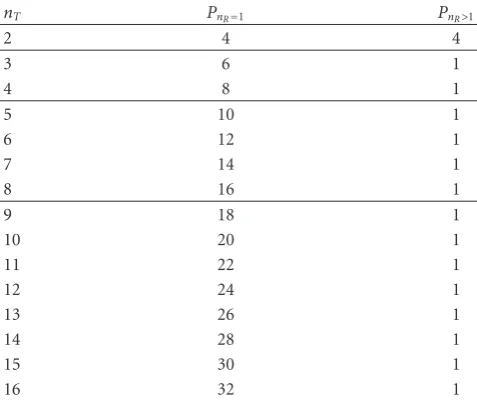
Table3: Application of the nonredundant precoding technique. QOSTBC codes andK=4 random rotations.
nT PnR=1 PnR>1
2 4 4
3 6 1
4 8 1
5 10 1
6 12 1
7 14 1
8 16 1
9 18 1
10 20 1
11 22 1
12 24 1
13 26 1
14 28 1
15 30 1
16 32 1
be considered as part of the channel, the proposed strategy preserves the code properties.
Finally, it is interesting to point out that the rotation of the transmitted signals has been previously proposed in other contexts. On one hand, the rotation or randomization of a given STBC has also been employed for distributed space-time block coding in relay networks [35,36]. On the other hand, in [37–39] the authors have proven that the rotation of the transmitted signals improves the frame error rate and increases the outage capacity of the MIMO system. Therefore, the proposed nonredundant precoding technique is not only able to solve the blind channel estimation indeterminacies in many practical cases, but also to increase the outage capacity and helps to reduce the frame error rate.
5.2. Practical Examples. Let us illustrate the performance of the proposed nonredundant precoding technique by means of a numerical example. Table 3 shows the identifiability properties for QOSTBCs when the nonredundant precoding technique is applied. The results have been obtained by random generations ofK=4 unitary matrices, and Rayleigh MIMO channels. As can be seen, most of the ambiguities in
Table 2have been resolved, with the only exceptions of the MISO cases (nR =1) and the Alamouti code (nT =2) [1]. The ambiguity in the MISO cases is explained by the result in
6. Simulation Results
In this section, the performance of the proposed technique is illustrated by means of some simulation examples. All the results have been obtained by averaging 5000 independent experiments, where the MIMO channel H has been gen-erated as a Rayleigh channel with unit-variance elements. The i.i.d information symbols belong to a quadrature phase shift keying (QPSK) constellation and the receivers have been designed based on the linear minimum mean square error (LMMSE) criterion and a hard decision decoder. In the case of OSTBC transmissions this is equivalent to the ML receiver. In order to avoid the ambiguity problems, the nonre-dundant precoding technique withK =4 permutations has been applied. Specifically, the permutations of the transmit antennas are based on the following matrices:
Q(4)1 =
⎡ ⎢ ⎢ ⎢ ⎣
1 0 0 0 0 1 0 0 0 0 1 0 0 0 0 1
⎤ ⎥ ⎥ ⎥
⎦, Q(4)2 =
⎡ ⎢ ⎢ ⎢ ⎣
0 0 0 1 1 0 0 0 0 0 1 0 0 1 0 0
⎤ ⎥ ⎥ ⎥ ⎦,
Q(4)3 =
⎡ ⎢ ⎢ ⎢ ⎣
0 0 0 1 0 0 1 0 0 1 0 0 1 0 0 0
⎤ ⎥ ⎥ ⎥
⎦, Q(4)4 =
⎡ ⎢ ⎢ ⎢ ⎣
0 0 0 1 1 0 0 0 0 1 0 0 0 0 1 0
⎤ ⎥ ⎥ ⎥ ⎦. (32)
Finally, the proposed blind channel estimation technique has been compared with the following schemes.
(i) A receiver with perfect channel state information (CSI), which we refer to as coherent receiver. (ii) A training-based approach consisting of the
trans-mission, over NtrL channel uses, of nT orthogonal training signals, which are used in the receiver to obtain the channel estimate by means of the least squares (LS) technique.
(iii) The subspace blind method proposed in [12] and its extension to nonorthogonal codes [15]. In this case, we have considered a transmission scheme without nonredundant precoding (referred to as SS), as well as transmissions with nonredundant precoding and a receiver considering theK consecutive blocks as a longer STBC (referred to as SS + NRP).
In the first set of examples, the real OSTBC design with
nT = M = L = 4 [2] andnR = 4 receive antennas has been evaluated. As shown in Table 1 (see also [12]), this code does not allow the direct blind channel recovery for any number of receive antennas. The nonredundant precoding technique has been applied with the permutation matrices
Q(4)1 ,. . .,Q(4)4 , that is, the precoding technique is limited
to a single set of permutations of the transmit antennas, which comes at virtually no computational expense at the transmitter. Figures1 and2show the MSE in the channel estimate and the bit error rate (BER) after decoding for different numbersN of available blocks at the receiver. As can be seen, the SS method is not able to unambiguously recover the channel, whereas the SS + NRP technique is not
10 8 6 4 2 0 −2 −4 −6 −8 −10 SNR (dB) SS (N=200)
SS + NRP (N=50) SS + NRP (N=100) SS + NRP (N=200) Proposed (N=50)
Proposed (N=200) Training (Ntr=50) Training (Ntr=100) Training (Ntr=200) Proposed (N=100)
−35 −30 −25 −20 −15 −10 −5 0 MSE (dB)
Figure1: MSE in the channel estimate.K=4 code permutations. Real OSTBC design withnT=nR=M=L=4.
8 6 4 2 0 −2 −4 −6 −8 −10 SNR (dB) SS (N=200)
Proposed (N=50) Proposed (N=100)
Proposed (N=200) Coherent ML 10−6
10−5 10−4 10−3 10−2 10−1 100
BER
Figure2: Bit error rate (BER) for the ML receiver with perfect and estimated CSI. Real OSTBC design withnT =nR =M=L =4.
K=4 code permutations.
as accurate as the proposed technique, whose performance loss with respect to the coherent receiver is much lower than the 3-dB loss associated to the differential receivers [18–20].
200 150 100 50 0
N
Proposed technique Coherent ML 10−6
10−5 10−4 10−3 10−2 10−1 100
BER
SNR=−5 dB
SNR=0 dB
SNR=5 dB
(a)
10 8 6 4 2 0
Ntr
Training approach Coherent ML 10−6
10−5 10−4 10−3 10−2 10−1 100
BER
SNR=−5 dB
SNR=0 dB SNR=5 dB
(b)
Figure3: (a) Bit error rate (BER) versus numberN of observation blocks for the proposed method or (b) numberNtrof training blocks. Real OSTBC design withnT=nR=M=L=4.K=4 code permutations.
10 8 6 4 2 0
−2
−4
−6
−8
−10
SNR (dB) SS (N=200)
SS + NRP (N=50) SS + NRP (N=100) SS + NRP (N=200) Proposed (N=50)
Proposed (N=200) Training (Ntr=50) Training (Ntr=100) Training (Ntr=200) Proposed (N=100)
−30
−25
−20
−15
−10
−5 0
MSE
(dB)
Figure4: MSE in the channel estimate.K=4 code permutations. QOSTBC withnT=M=L=8 andnR=4.
the BER performance obtained by the proposed method is equivalent to that obtained with a training-based approach and some number Ntr < N of training blocks. However,
the blind channel estimation technique avoids the loss in bandwidth efficiency. Furthermore, we can see that forN =
10 8 6 4 2 0
−2
−4
−6
−8
−10
SNR (dB) SS (N=200)
SS + NRP (N=50) SS + NRP (N=100) SS + NRP (N=200)
Proposed (N=50) Proposed (N=100) Proposed (N=200) Coherent LMMSE 10−6
10−5 10−4 10−3 10−2 10−1 100
BER
Figure5: Bit error rate (BER) for the LMMSE receiver with perfect and estimated CSI. QOSTBC withnT =M =L=8 andnR =4.
K=4 code permutations.
100 available blocks at the receiver, the proposed method outperforms the training-based approach withNtr=10, not
only in bandwidth efficiency, but also in terms of BER. In the second set of examples, the QOSTBC design for
200 150 100 50 0
N
Proposed technique Coherent LMMSE 10−4
10−3 10−2 10−1 100
BER
SNR=−5 dB
SNR=0 dB SNR=5 dB
(a)
10 8 6 4 2 0
Ntr
Training approach Coherent LMMSE 10−4
10−3 10−2 10−1 100
BER
SNR=−5 dB
SNR=0 dB
SNR=5 dB
(b)
Figure6: (a) Bit error rate (BER) versus numberN of observation blocks for the proposed method or (b) numberNtrof training blocks. QOSTBC withnT=M=L=8 andnR=4.K=4 code permutations.
Analogously to the previous example, this code does not allow the direct blind channel identification based only on SOS (see Table 2). The K = 4 permutation matrices have been defined as
Q(8)1 =
Q(4)1 0 0 Q(4)2
, Q(8)2 =
Q(4)3 0 0 Q(4)4
,
Q(8)3 =
Q(4)1 0 0 Q(4)3
, Q(8)4 =
Q(4)2 0 0 Q(4)4
, (33)
and the simulation results are shown in Figures 4,5, and
6. As can be seen, the results are not as accurate as in the OSTBC examples, which is due to the fact that we are trying to solve a more complicated problem (nonorthogonal transmissions, highernTand transmission rate), that is, with a lower degree of redundancy. However, for a sufficiently largeN, the proposed technique outperforms the pilot-based approach, and its performance degradation with respect to the coherent receiver is lower than the minimal loss (3-dB) associated to the QOSTBC differential technique proposed in [20]. Furthermore, we can see that in this case, the proposed method clearly outperforms the SS + NRP method. This is due to the fact that the SS + NRP is based on the eigenvalue decomposition of a matrixRy of size 2LnRK = 256, whereas the proposed method requiresK=4 eigenvalue decompositions of size 2LnR = 64, which translates into a lower computational complexity and an increased robustness to noise.
7. Conclusions
In this paper, a blind channel estimation technique for multiple-input multiple-output (MIMO) space-time block coded (STBC) systems has been proposed. The technique is solely based on second-order statistics (SOS), and its computational complexity reduces to the extraction of the principal eigenvector of a generalized eigenvalue problem (GEV). In the absence of noise it exactly recovers the channel, up to a real scalar, within a finite number of observations, that is, it is a deterministic technique. Additionally, it has been shown that the ambiguity problems associated to certain STBCs are due to the code structure, and not to the proposed channel estimation algorithm. Furthermore, we have proposed a general method to avoid the ambiguities, which is based on the idea of code combination. As a partic-ular case, this technique can be reduced to a nonredundant precoding of the transmitted signals, consisting of a single rotation or permutation of the transmit antennas. Finally, the proposed technique has been evaluated by means of numerical examples, showing that, for a sufficiently large number of observations, its performance is close to that of the coherent receivers.
Acknowledgment
References
[1] S. M. Alamouti, “A simple transmit diversity technique for wireless communications,”IEEE Journal on Selected Areas in Communications, vol. 16, no. 8, pp. 1451–1458, 1998. [2] V. Tarokh, H. Jafarkhani, and A. R. Calderbank, “Space-time
block codes from orthogonal designs,”IEEE Transactions on Information Theory, vol. 45, no. 5, pp. 1456–1467, 1999. [3] A. Sezgin and T. J. Oechtering, “Complete characterization
of the equivalent MIMO channel for quasi-orthogonal space-time codes,”IEEE Transactions on Information Theory, vol. 54, no. 7, pp. 3315–3327, 2008.
[4] H. Jafarkhani,Space-Time Coding: Theory and Practice, Cam-bridge University Press, CamCam-bridge, UK, 2005.
[5] N. Sharma and C. B. Papadias, “Full-rate full-diversity linear quasi-orthogonal space-time codes for any number of trans-mit antennas,”EURASIP Journal on Applied Signal Processing, vol. 2004, no. 9, pp. 1246–1256, 2004.
[6] J. K. Zhang, J. Liu, and K. M. Wong, “Trace-orthogonal full diversity cyclotomic space-time codes,” in Space-Time Processing for MIMO Communications, pp. 169–174, John Wiley & Sons, New York, NY, USA, 2005.
[7] S. Barbarossa,Multiantenna Wireless Communication Systems, Artech House, Boston, Mass, USA, 2005.
[8] F. Oggier, G. Rekaya, J.-C. Belfiore, and E. Viterbo, “Perfect space-time block codes,” IEEE Transactions on Information Theory, vol. 52, no. 9, pp. 3885–3902, 2006.
[9] A. L. Swindlehurst and G. Leus, “Blind and semi-blind equalization for generalized space-time block codes,” IEEE Transactions on Signal Processing, vol. 50, no. 10, pp. 2489– 2498, 2002.
[10] P. Stoica and G. Ganesan, “Space-time block codes: trained, blind, and semi-blind detection,”Digital Signal Processing, vol. 13, no. 1, pp. 93–105, 2003.
[11] E. G. Larsson, P. Stoica, and J. Li, “Orthogonal space-time block codes: maximum likelihood detection for unknown channels and unstructured interferences,”IEEE Transactions on Signal Processing, vol. 51, no. 2, pp. 362–373, 2003. [12] S. Shahbazpanahi, A. B. Gershman, and J. H. Manton,
“Closed-form blind MIMO channel estimation for orthogonal space-time block codes,”IEEE Transactions on Signal Process-ing, vol. 53, no. 12, pp. 4506–4517, 2005.
[13] W.-K. Ma, B.-N. Vo, T. N. Davidson, and P.-C. Ching, “Blind ML detection of orthogonal space-time block codes: efficient high-performance implementations,” IEEE Transactions on Signal Processing, vol. 54, no. 2, pp. 738–751, 2006.
[14] N. Ammar and Z. Ding, “Channel identifiability under orthogonal space-time coded modulations without training,” IEEE Transactions on Wireless Communications, vol. 5, no. 5, pp. 1003–1013, 2006.
[15] S. Shahbazpanahi, A. B. Gershman, and G. B. Giannakis, “Semiblind multiuser MIMO channel estimation using capon and MUSIC techniques,”IEEE Transactions on Signal Process-ing, vol. 54, no. 9, pp. 3581–3591, 2006.
[16] A. F. Naguib, V. Tarokh, N. Seshadri, and A. R. Calderbank, “A space-time coding modem for high-data-rate wireless communications,”IEEE Journal on Selected Areas in Commu-nications, vol. 16, no. 8, pp. 1459–1478, 1998.
[17] B. Hassibi and B. M. Hochwald, “How much training is needed in multiple-antenna wireless links?”IEEE Transactions on Information Theory, vol. 49, no. 4, pp. 951–963, 2003. [18] V. Tarokh and H. Jafarkhani, “A differential detection scheme
for transmit diversity,” IEEE Journal on Selected Areas in Communications, vol. 18, no. 7, pp. 1169–1174, 2000.
[19] B. L. Hughes, “Differential space-time modulation,” IEEE Transactions on Information Theory, vol. 46, no. 7, pp. 2567– 2578, 2000.
[20] Y. Zhu and H. Jafarkhani, “Differential modulation based on quasi-orthogonal codes,” IEEE Transactions on Wireless Communications, vol. 4, no. 6, pp. 3005–3017, 2005.
[21] N. Ammar and Z. Ding, “Blind channel identifiability for generic linear space-time block codes,”IEEE Transactions on Signal Processing, vol. 55, no. 1, pp. 202–217, 2007.
[22] Z. Liu, G. B. Giannakis, S. Zhou, and B. Muquet, “Space-time coding for broadband wireless communications,” Wireless Communications and Mobile Computing, vol. 1, no. 1, pp. 35– 53, 2001.
[23] Z. Liu, G. Giannakis, S. Barbarossa, and A. Scaglione, “Transmit-antenna space-time block coding for generalized OFDMin the presence of unknownmultipath,”IEEE Journal on Selected Areas in Communications, vol. 19, no. 7, pp. 1352– 1364, 2001.
[24] Z. Ding and D. B. Ward, “Subspace approach to blind and semi-blind channel estimation for space-time block codes,” IEEE Transactions on Wireless Communications, vol. 4, no. 2, pp. 357–362, 2005.
[25] Z. Ding and D. B. Ward, “Direct semi-blind MMSE equaliza-tion for STBC,”IEEE Signal Processing Letters, vol. 12, no. 5, pp. 380–383, 2005.
[26] W. H. Gerstacker, F. Obernosterer, R. Schober, A. T. Lehmann, A. Lampe, and P. Gunreben, “Equalization concepts for Alamouti’s space-time block code,” IEEE Transactions on Communications, vol. 52, no. 7, pp. 1178–1190, 2004. [27] B. Picinbono, “On circularity,” IEEE Transactions on Signal
Processing, vol. 42, no. 12, pp. 3473–3482, 1994.
[28] P. J. Schreier, L. L. Scharf, and C. T. Mullis, “Detection and estimation of improper complex random signals,”IEEE Transactions on Information Theory, vol. 51, no. 1, pp. 306– 312, 2005.
[29] J. V´ıa and I. Santamar´ıa, “Correlation matching approaches for blind OSTBC channel estimation,”IEEE Transactions on Signal Processing, vol. 56, no. 12, pp. 5950–5961, 2008. [30] J. V´ıa, I. Santamar´ıa, and J. P´erez, “A sufficient condition
for blind identifiability of MIMO-OSTBC channels based on second order statistics,” inProceedings of the 7th IEEE Work-shop on Signal Processing Advances in Wireless Communications (SPAWC ’06), Cannes, France, July 2006.
[31] J. V´ıa and I. Santamar´ıa, “On the blind identifiability of orthogonal space-time block codes from second-order statis-tics,”IEEE Transactions on Information Theory, vol. 54, no. 2, pp. 709–722, 2008.
[32] W.-K. Ma, “Blind ML detection of orthogonal space-time block codes: identifiability and code construction,” IEEE Transactions on Signal Processing, vol. 55, no. 7, part 1, pp. 3312–3324, 2007.
[33] O. Henkel, “Sphere-packing bounds in the Grassmann and Stiefel manifolds,”IEEE Transactions on Information Theory, vol. 51, no. 10, pp. 3445–3456, 2005.
[34] A. Fasano and S. Barbarossa, “Information lossless full-rate full-diversity trace-orthogonal space-time codes,” in Proceed-ings of the 7th IEEE Workshop on Signal Processing Advances in Wireless Communications (SPAWC ’06), Cannes, France, July 2006.
[36] B. Sirkeci-Mergen and A. Scaglione, “Randomized space-time coding for distributed cooperative communication,” IEEE Transactions on Signal Processing, vol. 55, no. 10, pp. 5003– 5017, 2007.
[37] E. G. Larsson, “Improving the frame-error-rate of spatial multiplexing in block fading by randomly rotating the signal constellation,”IEEE Communications Letters, vol. 8, no. 8, pp. 514–516, 2004.
[38] E. G. Larsson, “Constellation randomization (CoRa) for outage performance improvement on MIMO channels,” in Proceedings of IEEE Global Telecommunications Conference (GLOBECOM ’04), vol. 1, pp. 386–390, Dallas, Tex, USA, November 2004.