Problem Comprehensive service delivery models for providing post-rape care are largely from resource-rich countries and do not translate easily to resource-limited settings such as Kenya, despite an identified need and high rates of sexual violence and HIV. Approach Starting in 2002, we undertook to work through existing governmental structures to establish and sustain health sector services for survivors of sexual violence.
Local setting In 2003 there was a lack of policy, coordination and service delivery mechanisms for post-rape care services in Kenya. Post-exposure prophylaxis against HIV infection was not offered.
Relevant changes A standard of care and a simple post-rape care systems algorithm were designed. A counselling protocol was developed. Targeted training that was knowledge-, skills- and values-based was provided to clinicians, laboratory personnel and trauma counsellors. The standard of care included clinical evaluation and documentation, clinical management, counselling and referral mechanisms. Between early 2004 and the end of 2007, a total of 784 survivors were seen in the three centres at an average cost of US$ 27, with numbers increasing each year. Almost half (43%) of these were children less than 15 years of age.
Lessons learned This paper describes how multisectoral teams at district level in Kenya agreed that they would provide post-exposure prophylaxis, physical examination, sexually transmitted infection and pregnancy prevention services. These services were provided at casualty departments as well as through voluntary HIV counselling and testing sites. The paper outlines which considerations they took into account, who accessed the services and how the lessons learned were translated into national policy and the scale-up of post-rape care services through the key involvement of the Division of Reproductive Health.
Une traduction en français de ce résumé figure à la fin de l’article. Al final del artículo se facilita una traducción al español.
Delivering post-rape care services: Kenya’s experience in
developing integrated services
N Kilonzo,
aSJ Theobald,
bE Nyamato,
aC Ajema,
aH Muchela,
aJ Kibaru,
cE Rogena
d& M Taegtmeyer
a.ةلاقلما هذهل لماكلا صنلا ةياهن في ةصلاخلا هذهل ةيبرعلا ةمجترلا
a Liverpool VCT, Care & Treatment, PO Box 19835-00202, Nairobi, Kenya. b Liverpool School of Tropical Medicine, Liverpool, England.
c Division of Reproductive Health, Ministry of Health, Nairobi, Kenya. d University of Nairobi/Kenyatta National Referral Hospital, Nairobi, Kenya.
Correspondence to N Kilonzo (e-mail: [email protected]).
(Submitted: 22 February 2008 – Revised version received: 29 August 2008 – Accepted: 29 August 2008 – Published online: 16 April 2009)
Introduction
Sexual violence is increasingly documented in Kenya but only limited post-rape care services exist.1,2 Survivors of sexual
violence experience complex needs3 and many countries have
developed one-stop facilities that enable survivors to access medical, legal and social support services.4–6 These do not
translate easily to the resource-poor Kenyan setting.7 This
paper summarizes the context of the Kenyan health system, presents findings from a situation analysis on post-rape care conducted in 2002 and outlines the lessons learned from the subsequent implementation of services in three district hos-pitals in Kenya between 2003 and 2007.
Kenyan context
The Kenyan government health system operates an integrated (sometimes termed “horizontal”) approach to primary care.8
The over-arching responsibility for policy and capacity devel-opment in the delivery of post-rape care services lies centrally with the government’s Division of Reproductive Health. It functions through provincial and district systems, where the District Health Management Teams are the primary unit of planning and managing post-rape care in health facilties.9
Alongside this, programmes for sexually transmitted infec-tions (STIs) and HIV testing are supervised and managed
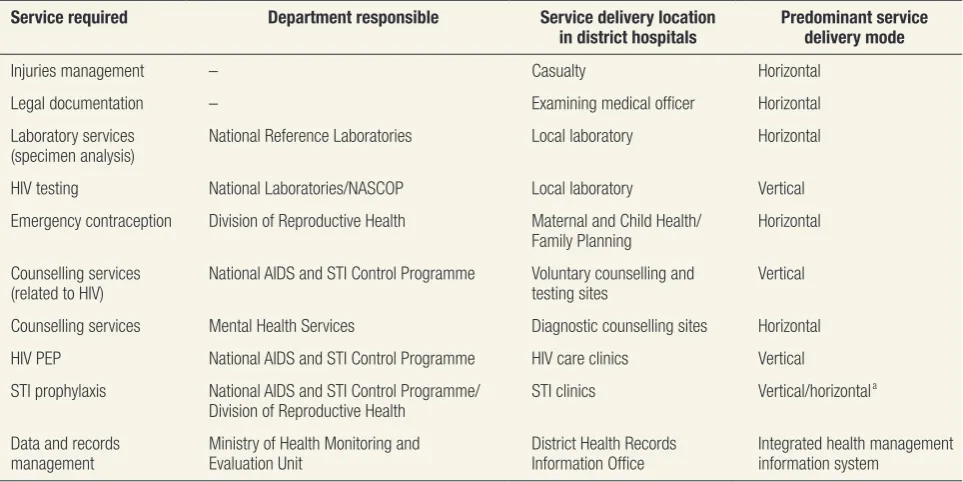
na-tionally (a “vertical” approach). If survivors of sexual violence are to access the range of basic services they require, existing links between vertical and horizontal programmes involved in post-rape care require strengthening (Table 1).10,11 Links
with the judiciary in Kenya are weaker still, compounding dif-ficulties faced by the health sector in the collection, analysis and delivery of evidence to the justice system.
A situation analysis in 2003 revealed limited post-rape services, lack of policy and tensions between HIV and repro-ductive health staff at service delivery points.12 Facilities lacked
protocols and confidential spaces for treatment. Beyond a requirement that examinations be undertaken by a doctor, there were no reporting requirements and an absence of moni-toring and evaluation of services. Furthermore, survivors were required to pay for drugs and services in public institutions. Where HIV-test counselling existed, it was delivered in the context of voluntary counselling and testing (VCT). Formal counselling for sexual trauma, where it existed, did not give consideration to HIV testing.
System development process
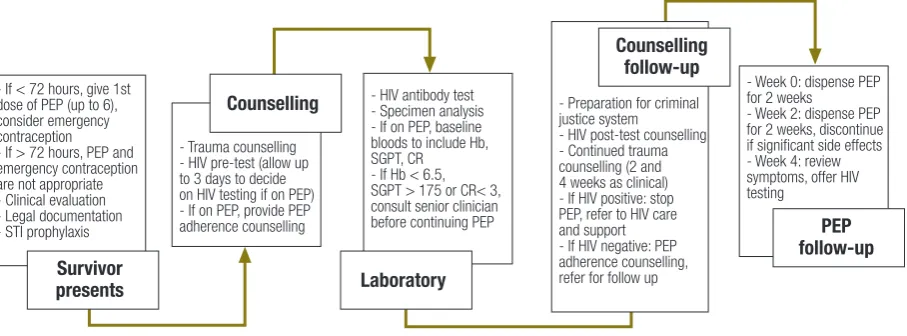
2003 (Thika, Malindi and Rachuonyo) with the aim of informing national policy directly with experiences from the field. Consultation workshops were hosted with the District Health Man-agement Teams to develop consensus and create ownership. Each team as-signed the coordination of post-rape care services to an individual member, who then liaised with the local police to ensure immediate referral of survi-vors to health facilities. The services were advertised through existing public health systems and wider staff train-ing. A standard of care was agreed for the selected districts and protocols for physical examination, legal documen-tation and clinical management were drawn from this. A simple algorithm and clearly defined client flow pathway summarized in a job aide, improved tri-age and facilitated access to the range of service delivery points (Fig. 1).
The first port of call for survivors was the casualty (emergency) depart-ment, open 24 hours a day, where physical examination was conducted by a doctor, records kept and further refer-rals made. Emergency contraception, empirical STI treatment and starter packs of a two-drug HIV post-exposure prophylaxis (PEP) regimen13 were kept
in casualty as part of essential drugs and offered routinely to survivors on presentation. To facilitate the collection
of evidence, a locally assembled “post-rape” kit was supplied by the district’s sterilizing and surgical department. It included gloves, swabs and plastic bags, glass slides for preparing specimen mounts, sanitary pads and a speculum. Police signed for any specimens they removed from casualty thus initiating a chain of custody of evidence. Data was captured by registers on the history of the alleged assault, therapies provided and specimens collected. After referral from casualty, post-rape counselling ser-vices were provided in the VCT sites; laboratory staff documented the results of HIV and other testing; and HIV care clinic staff prescribed and documented on-going PEP.
Two separate peer-reviewed train-ing programmes were piloted in the districts and are available for use in other settings.13 A core element of
both was the exploration of attitudes around gender, abuse and sexuality. A 3-day training course aimed at all types of frontline clinicians involved in post-rape care included skills for clini-cal evaluation, risk assessment13 and
legal documentation. The other longer course targeted practicing HIV counsel-lors from the facilities and focused on skills and observed practice for trauma counselling, HIV testing after rape, PEP adherence and legal information.
Table 1. Location and service delivery module for post-rape care services in Kenya
Service required Department responsible Service delivery location
in district hospitals Predominant service delivery mode
Injuries management – Casualty Horizontal
Legal documentation – Examining medical officer Horizontal
Laboratory services
(specimen analysis) National Reference Laboratories Local laboratory Horizontal
HIV testing National Laboratories/NASCOP Local laboratory Vertical
Emergency contraception Division of Reproductive Health Maternal and Child Health/
Family Planning Horizontal
Counselling services
(related to HIV) National AIDS and STI Control Programme Voluntary counselling and testing sites Vertical
Counselling services Mental Health Services Diagnostic counselling sites Horizontal
HIV PEP National AIDS and STI Control Programme HIV care clinics Vertical
STI prophylaxis National AIDS and STI Control Programme/
Division of Reproductive Health STI clinics Vertical/horizontal
a
Data and records
management Ministry of Health Monitoring and Evaluation Unit District Health Records Information Office Integrated health management information system
NASCOP, National AIDS/STI Control Programme; PEP, post-exposure prophylaxis; STI, sexually transmitted infection.
a Since 2006 STI treatment has been conducted through a horizontal approach.
Initial challenges
All three districts experienced signifi-cant challenges in implementing the new services, many of which related to the lack of coordination between verti-cal and horizontal systems. For example, Thika and Rachuonyo district hospitals were unable to prescribe empirical STI treatment from existing stocks until new systems for reporting were devel-oped that did not directly link drug supply to screening results. The major-ity of clinicians felt that they were not ready to deliver evidence in court and were reluctant note-takers. Poor refer-ral mechanisms from the smaller health facilities to the three district hospitals and within the hospitals themselves were associated with losses to follow up, out-of-pocket costs to survivors and poor coordination of services.
Fig. 1. Post-rape care services algorithm developed for health facilities in Kenya
- If < 72 hours, give 1st dose of PEP (up to 6), consider emergency contraception - If > 72 hours, PEP and emergency contraception are not appropriate - Clinical evaluation - Legal documentation - STI prophylaxis
- Trauma counselling - HIV pre-test (allow up to 3 days to decide on HIV testing if on PEP) - If on PEP, provide PEP adherence counselling
- HIV antibody test - Specimen analysis - If on PEP, baseline bloods to include Hb, SGPT, CR - If Hb < 6.5, SGPT > 175 or CR< 3, consult senior clinician before continuing PEP
- Preparation for criminal justice system
- HIV post-test counselling - Continued trauma counselling (2 and 4 weeks as clinical) - If HIV positive: stop PEP, refer to HIV care and support - If HIV negative: PEP adherence counselling, refer for follow up
- Week 0: dispense PEP for 2 weeks
- Week 2: dispense PEP for 2 weeks, discontinue if significant side effects - Week 4: review symptoms, offer HIV testing Survivor presents Counselling follow-up PEP follow-up Counselling Laboratory
CR, creatinine; Hb, haemoglobin; PEP, post-exposure prophylaxis; SGPT, serum glutamic pyruvic transaminase; STI, sexually transmitted infection.
attrition rates and inconsistent service delivery that challenge the investment in capacity building described in this paper.
Uptake and client satisfaction
By the end of 2007 a total of 784 survi-vors of sexual violence had been seen in the three sites, with 43% of them young people (predominantly girls) aged less than 15. Of these 84% arrived in time to be eligible for PEP. There was one known seroconversion of a previously HIV-negative girl, who had reported repeated abuse by an uncle. Client exit interviews conducted with survivors or their guardians in 2005 indicate a high level of satisfaction with the services. No information on prosecution and conviction rates of perpetrators is avail-able but anecdotally these are very low.
Using lessons to inform
policy
In mid 2004, the Kenyan Division of Reproductive Health disseminated the findings of the situation analysis12
and the interventions and challenges described above, including the high numbers of paediatric presentations. The high paediatric uptake is likely to represent a reflection of the social constructs around rape in Kenya, which may cause the blame for sexual violence to be put on the adult survivors but sees children as victims.12 A committee
was constituted and national guidelines for the medical management of rape and sexual violence14 approved and
dis-seminated in 2005, with the Division of Reproductive Health recommending user-fees be waived. A universal data form, agreed and approved by the Min-istry of Health, became the first clinical form acceptable for legal presentation of sexual violence in a Kenyan court. The training curricula were peer-reviewed and approved as the national manuals in 2006. Since 2006, indicators for post-rape care, including the number of health-care workers trained, the num-ber of health facilities offering services, percentage of police officers trained and the percentage of antiretroviral treat-ment sites offering post-rape care, have been incorporated in national planning. This has ensured annual reporting and appropriate assignment of resources for purchase of emergency contraception and PEP. By June 2007, there were 13 health facilities providing post-rape care services in Kenya including the national referral and teaching hospital. Between them they had delivered ser-vices to over 2000 adults and children with 96% of those eligible initiating PEP at presentation.
A formal costing of the services, undertaken between June 2005 and July 2006, revealed that laboratory tests (28%), antiretroviral drugs for PEP (25.7%), cost of staff (23%) and
hepa-titis B toxoid (6.9%) were the main expenditures. The cost of providing post-rape care services for females or males at the district hospital level were estimated at US$ 27 per patient, in line with other new services such as HIV counselling and testing.15
The potential to improve relation-ships between the health sector and justice systems has not been realized in Kenya. Specimen collection of suf-ficient standard to provide evidence in court was undermined by the lack of commercial specimen collection kits or availability of additional requirements such as tamper evidence seals, replace-ment clothing and specula suitable for children. In addition there was a lack of DNA profile testing. We were unable to determine how many of the survivors received legal support or the role played by the evidence that was collected. This remains a practical and policy gap in the provision of post-rape care.
Conclusion
Kenya has seen a rapid policy response to the documented need for post-rape care services among both adult and child survivors. Key lessons learned (Box 1) were: the importance of a par-ticipatory policy development process;
Box 1. Summary of lessons learned
• The importance of a participatory policy development process
• The central role of political commitment in overcoming tensions between vertical and horizontal programmes
Résumé
Délivrance des soins après un viol : expérience du Kenya dans le développement de services intégrés Problématique La plupart des modèles pour la prestation d’une
gamme complète de soins de santé après un viol ont été développés pour des pays riches et ne se transposent pas facilement aux pays à ressources limitées comme le Kenya, malgré les besoins identifiés et les taux élevés de violence sexuelle et d’incidence du VIH dans ce pays.
Démarche Depuis 2002, nous avons entrepris, par le biais des structures publiques existantes, d’établir et de maintenir des services sectoriels de santé pour les personnes ayant survécu à des violences sexuelles.
Contexte local En 2003, on relevait un manque de politiques, de coordination et de mécanismes de prestation de soins pour prendre en charge les victimes de viol au Kenya. La prophylaxie post-exposition au VIH n’était pas proposée.
Modifications pertinentes Une norme de soins et un algorithme simple pour représenter les dispositifs de soins après un viol ont été conçus. Un protocole de conseil a également été mis au point. Une formation ciblée reposant sur l’acquisition de connaissances, de compétences et de valeurs a été fournie aux cliniciens, au personnel de laboratoire et aux conseillers en gestion des
traumatismes. La norme de soins couvrait l’évaluation clinique et les mécanismes de documentation, de prise en charge clinique, de conseil et d’orientation vers un spécialiste. Entre début 2004 et fin 2007, 784 survivants de violences sexuelles au total ont été soignés dans les trois centres, pour un coût moyen de US $ 27, ce nombre augmentant chaque année. Près de la moitié d’entre eux (43 %) étaient des enfants de moins de 15 ans.
Enseignements tirés Le présent article décrit comment les équipes multisectorielles de district au Kenya sont convenues de fournir une prophylaxie post-exposition, un examen physique et des services de prévention des infections sexuellement transmissibles et des grossesses. Ces présentations ont été délivrées dans les services d’urgence, ainsi que dans les centres de conseil et de dépistage volontaire du VIH. L’article indique les considérations prises en compte par ces équipes, les personnes ayant accès à ces services, la façon dont les enseignements tirés ont été transposés en politiques nationales et le développement à plus grande échelle des services de soins après un viol grâce à l’implication clé de la Division de la santé génésique.
Resumen
Servicios de atención a víctimas de violación: experiencia de Kenya en el desarrollo de servicios integrados Problema Los modelos de prestación de servicios integrados a
las víctimas recientes de una violación proceden en su mayoría de países con abundantes recursos y no pueden exportarse fácilmente a otros entornos con recursos limitados, como por ejemplo Kenya, aunque se reconozca la necesidad de tales servicios y pese a registrarse unas altas tasas de violencia sexual e infección por VIH. Enfoque En 2002 empezamos a trabajar a través de las estructuras públicas existentes a fin de establecer y mantener servicios de salud para las personas que habían sobrevivido a episodios de violencia sexual.
Contexto local En 2003 se carecía de políticas y de mecanismos de coordinación y dispensación de servicios para atender a las víctimas de violación en Kenya. Por ejemplo, no se ofrecía profilaxis postexposición contra la infección por VIH.
Cambios destacables Se diseñaron unas normas de atención y un algoritmo simple de atención posviolación, y se elaboró un protocolo de asesoramiento. Se impartió formación focalizada - basada en conocimientos, aptitudes y valores - a médicos, personal de laboratorio y consejeros para víctimas de traumas
psicológicos. Las normas asistenciales comprendían la evaluación y documentación de los casos, el tratamiento médico, el apoyo psicológico y mecanismos de derivación. Entre comienzos de 2004 y el final de 2007 se atendió a 784 supervivientes en los tres centros, con un costo medio de US$ 27 y en número creciente cada año. Casi la mitad (43%) eran menores de 15 años.
Enseñanzas extraídas El artículo describe cómo una serie de equipos multisectoriales que actuaban a nivel de distrito se pusieron de acuerdo en Kenya para ofrecer servicios de profilaxis postexposición, exploración física, atención contra las infecciones de transmisión sexual y prevención del embarazo. Esa asistencia se proporcionó en servicios de urgencias, así como a través de centros de asesoramiento y pruebas voluntarias del VIH. Se explica en el texto el tipo de consideraciones que se tuvieron en cuenta, quiénes accedieron a los servicios, y de qué manera las lecciones extraídas se reflejaron en las políticas nacionales y la expansión de los servicios de atención a las víctimas de violación gracias a la decisiva implicación de División de Salud Reproductiva.
the central role of political commit-ment in overcoming tensions between vertical and horizontal programmes; and the flexibility to develop creative solutions at local level where paediatric uptake is high. The processes described in this paper are replicable in other
set-tings and we look forward to further sharing our experience in this neglected area. ■
Acknowledgements
We thank all the health-care providers that participated in this intervention.
Funding: Liverpool VCT, Care & Treat-ment, Kenya, through core funding support from Trocaire and DfID, funded all aspects of the study. The researchers were independent from funders.
References
1. Mensch BS, Hewett P, Erulkar A. The reporting of sensitive behaviour among adolescents: a methodological experiment in Kenya. Demography
2003;40:247-68. PMID:12846131 doi:10.1353/dem.2003.0017 2. Speight CG, Klufio A, Kilonzo SN, Mbugua C, Kuria E, Bunn JE, et al.
Piloting post-exposure prophylaxis in Kenya raises specific concerns for the management of childhood rape. Trans R Soc Trop Med Hyg 2006;100:14-8. PMID:16225898 doi:10.1016/j.trstmh.2005.06.026
3. Guidelines for medico-legal care of victims of sexual violence. Geneva: World Health Organization; 2003.
4. Kerr E, Cottee C, Chowdhury R, Jawad R, Welch J. The Haven: a pilot referral centre in London for cases of serious sexual assault. BJOG 2003;110:267-71. PMID:12628265 doi:10.1046/j.1471-0528.2003.02233.x
5. Kim JC, Martin LJ, Denny L. Rape and HIV post-exposure prophylaxis: addressing the dual epidemics in South Africa. Reprod Health Matters
2003;11:101-12. PMID:14708401 doi:10.1016/S0968-8080(03)02285-7 6. Goldberg AP, Duffy SJ. Medical care for the sexual assault victim. Med Health
R I 2003;86:390-4. PMID:14983541
7. Garcia-Moreno C. Dilemmas and opportunities for an appropriate health-service response to violence against women. Lancet 2002;359:1509-14. PMID:11988263 doi:10.1016/S0140-6736(02)08417-9
8. Smith DL, Bryant JH. Building the infrastructure for primary health care: an overview of vertical and integrated approaches. Soc Sci Med 1988; 26:909-17. PMID:3388071 doi:10.1016/0277-9536(88)90411-X 9. Oyaya CO, Rifkin SB. Health sector reforms in Kenya: an examination of
district level planning. Health Policy 2003;64:113-27. PMID:12644333 doi:10.1016/S0168-8510(02)00164-1
10. Watts C, Mayhew S. Reproductive health services and intimate partner violence: shaping a pragmatic response in sub-Saharan Africa. Int Fam Plan Perspect 2004;30:207-13. PMID:15590387
11. Oliveira-Cruz V, Kurowski C, Mills A. Delivery of priority health services: Searching for synergies within the vertical versus horizontal debate. J Int Dev
2003;15:67-86. doi:10.1002/jid.966
12. Kilonzo N, Taegtmeyer M, Molyneux S, Kibaru J, Kamonji V, Theobald S. Engendering health sector responses to sexual violence and HIV in Kenya: Results of a qualitative study. AIDS Care 2008;20:188-90. PMID:18293127 doi:10.1080/09540120701473849
13. Garcia MT, Figueiredo RM, Moretti ML, Resende MR, Bedoni AJ, Papaiordanou PM. Postexposure prophylaxis after sexual assaults: a prospective cohort study. Sex Transm Dis 2005;32:214-9. PMID:15788918 doi:10.1097/01.olq.0000149785.48574.3e
14. Ministry of Health/Division of Reproductive Health. National guidelines on the medical management of rape/sexual violence. Nairobi: Tonaz Agencies; 2004. Available from: http://www.drh.go.ke/html/guidelines_Gender.asp [accessed on 20 February 2009].
15. Forsythe S, Arthur G, Ngatia G, Mutemi R, Gilks C. Assessing the cost of voluntary counselling and testing in Kenya. Health Policy Plan 2002; 17:187-95. PMID:12000779 doi:10.1093/heapol/17.2.187