R E S E A R C H
Open Access
Expander chunked codes
Bin Tang
1*, Shenghao Yang
2, Baoliu Ye
1, Yitong Yin
1and Sanglu Lu
1Abstract
Chunked codes are efficient random linear network coding (RLNC) schemes with low computational cost, where the input packets are encoded into small chunks (i.e., subsets of the coded packets). During the network transmission, RLNC is performed within each chunk. In this paper, we first introduce a simple transfer matrix model to characterize the transmission of chunks and derive some basic properties of the model to facilitate the performance analysis. We then focus on the design of overlapped chunked codes, a class of chunked codes whose chunks are non-disjoint subsets of input packets, which are of special interest since they can be encoded with negligible computational cost and in a causal fashion. We propose expander chunked (EC) codes, the first class of overlapped chunked codes that have an analyzable performance, where the construction of the chunks makes use of regular graphs. Numerical and simulation results show that in some practical settings, EC codes can achieve rates within 91 to 97 % of the optimum and outperform the state-of-the-art overlapped chunked codes significantly.
Keywords: Random linear network coding, Chunked codes, Iterative decoding, Random regular graph
1 Introduction
Random linear network coding (RLNC) has great poten-tial for data dissemination over communication networks [1–4]. RLNC can be implemented in a distributed fashion due to its random nature and is shown to be asymptoti-cally capacity-achieving for networks with packet loss in a wide range of scenarios [5–7]. In this paper, we propose a low-complexity RLNC scheme called expander chunked (EC) codes and analyze the achievable rates of EC codes.
1.1 Background
For ordinary RLNC studied in literature [3–7], all par-ticipating nodes forward coded packets formed by ran-dom linear combinations of all the packets received so far. Major issues in applying ordinary RLNC include the computational cost and the coefficient vector overhead. Consider the dissemination ofkinput packets, each con-sisting of L symbols from a finite field. For encoding, RLNC requiresO(kL)finite field operations to generate a coded packet, and for decoding, a destination node takes O(k2+kL)finite field operations per packet if Gaussian elimination is employed. Moreover, to recover the trans-fer matrices of network coding at the destination node, a
*Correspondence: [email protected]
1National Key Laboratory for Novel Software Technology, Nanjing University, Nanjing, China
Full list of author information is available at the end of the article
coefficient vector ofksymbols is usually included in each of the transmitted packets [3]. Since the packet lengthL
has an upper bound in real-world communication net-works,1 using large values ofkreduces the transmission efficiency. When there are hundreds of input packets, the computational cost and the coefficient vector overhead would make RLNC difficult for real-world implementa-tion.
To resolve these issues, chunked (network) codes have been proposed [8], where the input packets are encoded into multiple small chunks (also called generations, classes, etc.), each of which is a subset of the coded pack-ets. When using chunked codes, an intermediate network node can only combine the packets of the same chunk. The encoding and decoding complexities per packet of chunked codes are usually O(mL) and O(mL + m2), respectively, where mis thechunk size, i.e., the number of packets in each chunk. The coefficient vector overhead also reduces tomsymbols per packet since only the trans-fer matrices of the chunks are required at the destination nodes. Even so, the chunk size should be a small value (e.g., 16 or 32) for the purpose of practical implementation, as demonstrated in [9].
Existing chunked codes are in two categories: over-lapped chunked codesandcoded chunked codes. In over-lapped chunked codes, the chunks are subsets of the input packets with possibly non-empty intersections. The
first several designs of chunked codes all belong to this category. However, the existing designs of overlapped chunks are mostly based on heuristics, and no rigorous performance analysis is available for the existing designs [10–12]. In coded chunked codes, chunks are generated by combining multiple input packets. By generalizing foun-tain codes and LDPC codes, nearly throughput optimal chunked codes have been designed, including BATS code [13, 14], Gamma code [15, 16], and L-chunked (LC) code [17]. Overlapped chunks can be viewed as a degraded class of coded chunks where chunks are generated using certain repetition codes.
Overlapped chunked codes, however, can have lower encoding complexity and latency than general coded chunked codes. First, as no new packets are necessarily generated during the encoding, the encoding complexity is dominated by generating the indices for the packets in each chunk, which does not incur any finite field opera-tion or depend on the packet lengthL. In contrast, coded chunked codes incur a computational cost that is linear of
Lto generate a coded packet. For instance, BATS codes require on average¯mLfinite field operations for encod-ing a chunk, where ¯ 3m. Therefore, compared to general coded chunked codes, the computational cost of overlapped chunked codes is usually negligible.
Second, overlapped chunks can be encoded in acausal fashion. Suppose that the input packets arrive at the encoder gradually. The first chunk can be generated after collecting minput packets, and for everyminput pack-ets collected in the following, at least one new chunk can be formed. Therefore, the generation as well as the transmission of chunks can be performed in parallel with the collection of the input packets, reducing the total transmission latency. In contrast, how to achieve causal encoding for general coded chunked codes is not clear: BATS codes and Gamma codes usually require a large fraction of the input packets for encoding chunks.
These advantages motivate us to study overlapped chunked codes, which are especially suitable for delay sen-sitive applications and networks where the source node has limited computation and storage power, e.g., wireless sensors and satellites.
1.2 Our contribution
We proposeexpander chunked (EC) codes, the first class of overlapped chunked codes that has analyzable perfor-mance. In an EC code, the overlapping between chunks is generated using a regular graph: each chunk corre-sponds to a node in the graph and two adjacent chunks share an input packet. EC codes can be encoded causally and share the same belief propagation (BP) decoding of general overlapped chunked codes.
We analyze the BP decoding performance of EC codes generated based on random regular graphs. By exploring
the locally tree-like property of random regular graphs and then conducting a tree-based analysis similar to that of LT/LDPC code, we obtain a lower bound on the achiev-able rate depending only on the chunk size, the degree of the regular graph, and the rank distribution of the transfer matrices.
The achievable rates of EC codes are evaluated and com-pared with other chunked codes in two scenarios. We first compare the achievable rates of EC codes with represen-tative coded chunked codes for randomly sampled rank distributions of the transfer matrices, where the purpose is to understand the general performance of EC codes. We find that the performance of EC codes highly depends on the rank distributions: when the expected rank is rel-atively large, the average achievable rate (over the rank distributions sampled) of EC codes is close to 90 % of the representative coded chunked codes, as well as a theoret-ical upper bound. But for relatively small expected ranks, the achievable rate of EC codes varies significantly for different rank distributions.
To further see the real-world potential of EC codes, we then evaluate the performance for a near-optimal chunk transmission scheme over line-topology (line) net-works [18]. As most practical routing schemes are single-path based, line networks have attracted a lot of interest [19–21]. Also, the chunked code scheme for line networks can be extended to general network scenarios, including general unicast networks [14, 18], two-way relay networks [22], and wireless broadcast networks [23]. For a wide range of the packet loss rates, with proper optimization of the transmission scheme, EC codes achieve rates very close to those of the coded chunked codes and about 91 % ∼ 97 % of the theoretical upper bounds. Besides, we show by simulation that EC codes perform much bet-ter than the existing overlapped chunked codes in line networks.
Table 1 gives a brief comparison between EC codes, BATS codes, and LC codes.
As another contribution, a simple transfer matrix model is proposed to characterize the transmission of chunks over networks with packet loss. Compared with a similar model proposed in [14], which is more suitable for BATS codes, our model incorporates some more practical fea-tures of network operations for general chunked codes, making the design of efficient network transmission pro-tocols easier. Therefore, our model is of independent interest for chunked codes. We derive some properties of this transfer matrix model for the performance analysis, which can apply to general chunked codes.
1.3 Related work
Table 1Comparison among EC/BATS/LC codes where achievable rates are evaluated over line networks with chunk transmission scheme given in [18]
Design Causal encoding Encoding complexity Decoding complexity Achievable rates
EC Support O(n) O(nL) 91 %∼97 % of opt.
BATS Unknown O(nL) O(nL) >99 % of opt.
LC Unknown O(nL) O(nL) >98 % of opt.
decode a chunk, the transfer matrix of the chunk must have full rank ofm; otherwise, none of the packets in the chunk could be recovered with high probability. However, it is not always a simple task to guarantee the success of decoding a chunk at the destination node. One approach is to use feedback-based chunk transmission mechanism [24]. While some efficient feedback protocols for spe-cific applications have been developed [25, 26], in general, such feedback incurs an inevitable delay and also con-sumes network resources, resulting in degraded system performance. Besides, for some scenarios such as satel-lite and deep-space communications, feedbacks are not even available. Another approach is to employ a random scheduling-based chunk transmission scheme [27], where every network node always randomly selects a chunk for transmission. But this scheme has poor performance for small chunk sizes [10, 11].
Instead of using disjoint chunks of input packets, chunks with overlaps, i.e., different chunks share some input packets in common, have been proposed by several groups independently [10–12]. It is shown via simulations that overlapped chunked codes have much better performance than disjoint chunks [10, 11]. The random annex codes proposed by Li et al. [12] demonstrate better performance in simulation than the overlapped chunked codes in [10, 11], but only heuristic analysis of the design is provided. BATS code [13, 14] is the first class of chunked codes that uses coded chunks. Each chunk in a BATS code is generated as linear combinations of a random subset of the input packets. BATS codes can be regarded as a matrix generalization of fountain codes [28, 29] and preserve the ratelessness of fountain codes.
Another kind of coded chunked codes consists of chunks that satisfy some parity-check constraints, simi-lar to those of LDPC codes. The first class of such codes is Gamma codes [15, 16, 30], where the parity-check constraints are applied on the whole chunk [15] or on the individual packets in chunks [30]. Another class of such codes is L-chunked codes [17] which consider more general parity-check constraints and show better perfor-mance. Note that the original Gamma code [15] paper is published in parallel with the conference version of this paper [31], while the refined Gamma codes [30] and L-chunked codes are published later than that of our conference version.
Various chunked code-based transmission schemes have been designed and implemented recently [18, 22, 32], which are consistent with our transfer matrix model.
2 Overlapped chunked codes
In this section, we give a general formulation of over-lapped chunked codes, including causal encoding and belief propagation (BP) decoding. We also provide a trans-fer matrix model for general chunked codes.
2.1 Encoding of chunks
Consider transmitting a set ofkinput packetsb1,b2,. . ., bk from a source node to a destination node over a
net-work with packet loss. Each input packet composes of
L symbols from the finite field Fq and is regarded as a
column vector inFLqhenceforth.
Definition 1(Chunked codes).Achunkis a set of pack-ets each of which is a linear combination of the input packets, and a chunked code is a collection of chunks. A chunked code is said to be overlapped if its chunks are subsets of the input packets with possibly non-empty overlapping.
In this paper, we focus on the design of overlapped chunked codes. Evidently, an overlapped chunked code can be generated by repeating some input packets. Same as most related works, we assume that all the chunks in a chunked code have the same cardinality m, which is called thechunk size. As the chunk size is related to the encoding/decoding computational complexities and the coefficient vector overhead, for the sake of the applicabil-ity in common networks, we regard the chunk sizemas a fixed constant which does not change with the number of input packets.
An overlapped chunked code can be more concisely rep-resented by a collection of index sets of sizem. For any integern, let I1,I2,. . .,In be subsets of{1,. . .,k} with
size m. Let Bj = {bi : i ∈ Ij}. We call either Ij or Bj a chunk and the subscript j the chunk ID. An
over-lapped chunked code ofnchunks can be given by either {Ij:j=1,. . .,n}or{Bj:j=1,. . .,n}.
memory of each packet in a chunk needs to be recorded. Furthermore, every overlapped chunked code can be encoded causally, which is explained in the following.
Definition 2(Causal encoding).We say that a chunked code can be encoded causally if for any positive integer
i≤k, there exist at leastmichunks in the chunked code such that
• these chunks are formed by the firsti input packets, and
• each of the firstm× miinput packets is used for generating these chunks at least once.
It is worth mentioning that, when m = 1, systematic encoding of a linear code is a special case of causal encod-ing. For any overlapped chunked code where each input packet is included by at least one chunk, we can always apply some proper permutation of the indices such that, for anyj ≤ n, the indices of the packets among the first
j chunks are 1, 2,. . .,kj, where kj ≤ mj. In this sense,
every overlapped chunked code can be encoded causally. One example is given when introducing our EC codes in Section 3. Now, consider a scenario where the input pack-ets arrive at the source node sequentially (e.g., the source node is a sensor which keeps on collecting data and encap-sulating data into packets). Then, for anyminput packets collected consecutively, the source node can generate one new chunk for transmission. Hence, the source node does not necessarily collect all the input packets before encod-ing and the chunks can be transmitted in parallel with the collection of succeeding input packets. Therefore, by applying an overlapped chunked code, the end-to-end transmission latency could be significantly reduced.
2.2 Transmission of chunks
Each transmitted packet in the network is of the form (j,c,b), wherejspecifies a chunk ID,c∈Fmq is the coeffi-cient vector, andb=Bjc, a linear combination of packets
inBj, is the payload. Here, with some abuse of notation,Bj
is also treated as a matrix formed by juxtaposing the pack-ets inBj. For convenience, we refer to a packet with chunk
IDjas ajpacket.
Now, we describe a chunk transmission model through a network employing linear network coding, which is consistent with the recent design and implementation of chunked code-based network protocols [18, 22, 32]. Con-sider thejth chunk of packetsbj1,bj2,. . .,bjm. The source node first attaches a coefficient vector to each packet and generatesb˜ji = (ei,bji),i = 1,. . .,m, whereei is theith
column of the m×midentity matrix. The source node then generatesMjrandom linear combinations ofb˜jiand
transmits these linear combinations after attaching the chunk ID, whereMjis an integer-valued random variable.
At an intermediate network node, suppose thath j pack-ets have been received, denoted by(j,ci,bi),i = 1,. . .,h. The network node can transmitjpacket(j,c,b)generated by
c= h
i=1
φici, andb= h
i=1
φibi, (1)
whereφi,i = 1, 2,. . .,h, are chosen fromFq. A network
node does not transmit combinations of packets of differ-ent IDs. Note that in (1), we only need to combine thej
packets with linearly independent coefficient vectors. For the scheduling issue, i.e., how to choose a chunkBjby each
intermediate node for each transmission, please refer to some recent proposed network protocols [18, 22, 32].
At the destination node, letTjbe the matrix formed by
the coefficient vectors of all thejpackets received, and let Yjbe the matrix formed by the payloads of all thejpackets
received. We have
Yj=BjTj, (2)
where Tj is called the transfer matrix of Bj. Without
affecting the decoding performance, we can remove some received j packets so that the remaining set of j pack-ets have linearly independent coefficient vectors. So, we assume thatTjhas a full-column rank. According to the
transmission scheme we described, we can further write Tj=SjHj
whereSjis anm×Mjrandom matrix corresponding to the
linear combinations performed by the source node, and Hjis a random matrix withMjrows corresponding to the
linear operations performed by intermediate nodes as well as the random packet losses over the network links. Here, for a given value ofMj,Sjis atotally randommatrix, i.e.,
every entry ofSj is chosen fromFquniformly and
inde-pendently at random. Also, we assume thatHjandSjare
independent conditionings onMjand rk(Sj), which holds
for all the recent chunked code-based network protocols [18, 22, 32].
The proposed chunk transmission model does not depend on a particular chunked code and hence can be used for the analysis of other chunked codes. A similar model has been used for BATS codes [14]. Our model, however, explicitly incorporates a parameter Mj indicat-ing the number of packets transmitted of a chunk, which has a clear operation meaning in chunked code-based net-work protocols. Intuitively, when the netnet-work has a higher packet loss rate, we intend to use a larger value ofMj to
gain the benefit of network coding. Readers can find more discussion about this parameter in [18].
with a fixed dimension is uniformly distributed over all the subspaces with the same dimension.
Lemma 1.For any two subspacesW, UofFmq with the same dimension,
Pr{Tj =W} =Pr{Tj =U},
whereTjdenotes the column space of matrixTj.
Proof.For matrixAand subspaceU, define AU= {Az:z∈U}.
It can be checked thatAZ = AZ. SinceUandWhave the same dimension, there exists a full-rankm×mmatrix Asuch that
where the first step follows by the invertibility ofA. For anysandrsuch thats≥r, denote the eventMj=s
Using the assumption thatSj and Hj are independent
conditionings onMjand rk(Sj), we have
The proof is completed by combining the above equality with (3).
2.3 BP decoding
The destination node tries to decode the input packets by solving the local linear systemsYj =BjTj,j=1, 2,. . .,n.
These local linear systems for chunks jointly give a global linear system of equations on thekinput packets, but solv-ing the global linear system without considersolv-ing the chunk structure usually has high computational cost. Therefore, we consider the following BP decoding of overlapped chunked codes.
The BP decoding includes multiple iterations. Initially, each chunkBjis associated with a linear system given in
(2). We say chunkBj isdecodableif its linear system is
uniquely solvable. Each iteration consists of two phases: • in the first phase, decode every decodable chunk that
has not been decoded by solving its associated linear system using, e.g., Gaussian elimination, and
• in the second phase, for each input packetbinBjthat is decoded in the last phase and each chunkBi=Bj that includesb, substitute the value ofbinto the linear system ofBi, reducing the number of unknown input packets in this linear system.
The BP decoding stops when all the chunks have been decoded or all the chunks that have not been decoded are not decodable.
Now, we analyze the time cost of the BP decoding algo-rithm measured in finite field operations. Solving the linear system of a chunk can be done by first inverting the coefficient matrix, which costsO(m3)and then using the inverse to recover all the unknown input packets, which costsO(m2L). As there arenchunks, all the first phases cost O((m3 + m2L)n) in total. The substitution of an input packet into a linear system costs O(mL) and can happen at mostmntimes, so all the second phases cost O(m2Ln)in total. Therefore, the BP decoding algorithm costsO((m3+m2L)n)finite field operations.
Assume that rk(Tj) follows the probability
distribu-tion t = (t0,t1,. . .,tm), i.e., Pr{rk(Tj) = i} = ti for i = 0, 1,. . .,m. We have the following theorem, which is the footstone for the analysis of the above BP decoding algorithm.
Proof. The proof is based on the uniformity property of transfer matrices given in Lemma 1 together with count-ing. For a subspaceU, denote its dimension by dim(U).
i] be the probability that a chunk Bjis decodable given that rk(Tj) = iandwout of them
packets inBj have been decoded due to the decoding of
other chunks. We can easily show thatζi
wis an increasing
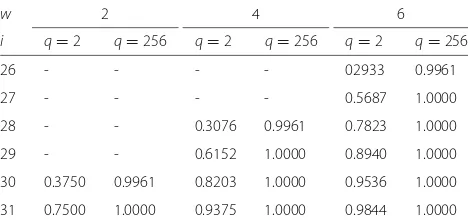
function of the finite field sizeq. Here, we give some val-ues ofζi
wwith differentiandwforq = 2 andq = 256
in Table 2. From this table, we can see that the value of ζw
i could be much larger when q = 256. In particular,
for all the instances such thati+w = m, the probabil-ity thatBjis decodable is close to 1 whenq = 256, while
it is less than 0.4 when q = 2. Therefore, the chunked codes could perform better when larger finite field is used
Table 2Some values ofζiwfor differentiandw
w 2 4 6
i q=2 q=256 q=2 q=256 q=2 q=256
26 - - - - 02933 0.9961
27 - - - - 0.5687 1.0000
28 - - 0.3076 0.9961 0.7823 1.0000
29 - - 0.6152 1.0000 0.8940 1.0000
30 0.3750 0.9961 0.8203 1.0000 0.9536 1.0000
31 0.7500 1.0000 0.9375 1.0000 0.9844 1.0000
(also see Section 4). On the other hand, using larger finite field would incur more computation cost as well as more coefficient vector overhead. How to choose the proper parameters such as the chunk size and the size of finite field depends on the application scenario, which is beyond the scope of the paper.
2.4 Achievable rate
Definition 3(Achievable rate).We say that a rateRis
achievableby chunked codes using BP decoding if for any constant > 0, there exists a chunked code with k ≥
(R−)mninput packets andnchunks for all sufficiently largensuch that with probability at least 1−, when the BP decoding stops, at least(R−)mninput packets are recovered.
Remark 1.It is not necessary that the chunked code recovers all the input packets. When all the input pack-ets are required to be recovered by the destination node, we can either retransmit the input packets that are not recovered or use the precode technique as in Raptor codes [29].
Our objective is to design an efficient class of overlapped chunked codes according to the given rank distribution. A natural upper bound on the achievable rates of chunked codes is established as follows.
Proposition 3.The achievable rate of chunked codes for transfer matrices with rank distribution t=(t0,t1,. . .,tm) chunked codes. Fix = δ/2, by the definition of achiev-able rates, there exists a chunked code withnchunks for all sufficiently largensuch that at least(λ−)mninput packets are recovered with probability at least 1−.
Note that in the decoding of a chunked code, only received packets of a chunk with linearly independent coefficient vectors are useful. Therefore, the number of decodable input packets is upper bounded bynj=1rk(Tj).
Then, we have the decoding error probability
where the last inequality follows from the Chernoff bound. For a sufficiently large n, we have Perr > , a contradiction!
3 Expander chunked codes
In this section, we introduce a family of overlapped chun-ked codes, namedEC codes.2
3.1 Code description
An EC code has three parameters: the number of chunks
n, chunk sizem, and degreed(3≤d≤m). Without loss of generality, in the following, we assume thatdnis even.3 Letk = n(m−d/2). An EC code is generated by ad -regular graphG(V,E), called thegenerator (graph), where
V = {1, 2,. . .,n}is the node set andEis the edge set. We will discuss the design ofGlater in this paper. The chunks in the EC code are constructed by the following steps.
1. Label each edgee∈Ewith a distinct integer in {1,. . .,k}, and denote the integer byie. Label the rest k−nd/2=(m−d)nintegers in{1,. . .,k}evenly to then nodes in V, and denote the set of integers labelled to nodev byIv.
2. Formn chunks{Iv, 1≤v≤n}, where Iv=Iv∪ {ie:eis incident to nodev}.
Due to the one-to-one correspondence between nodes in Gand the chunks, we equate a node with its corre-sponding chunk henceforth in the discussion. We callIv
chunkvandiean overlapping packet of chunkv.
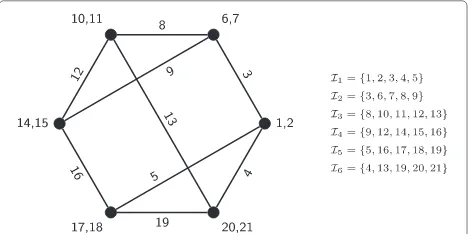
As discussed in the previous section, EC code can be encoded causally. Specifically, the first step of the con-struction can be done as follows, where each index in {1, 2,. . .,k}is used in an increasing order. First, label node 1 with the firstm−dindices and label thededges incident to node 1 in an arbitrary order with the next dindices. Then, label node 2 with the nextm−dindices and label each of the edges incident to node 2 but unlabelled with a next index, and so on. Clearly, for any chunkv, the largest index in Iv is less than or equal to mv. See Fig. 1 for
Fig. 1An EC code withn=6,m=5 andd=3. The generator graph of the code is a 3-regular graph with 6 nodes
an illustration of this assignment of indices such that the chunks are suitable for causal encoding.
3.2 Achievable rates
The performance of EC code with a particular generator graph is difficult to analyze. Instead, we analyze the per-formance of an EC code with arandom d-regular graph
as the generator. There are various probability models for randomd-regular graphs. We adopt the uniform model,
i.e.,Gis uniformly chosen from alld-regular graphs with node set V. One can obtain the similar result for the permutation model, the perfect matching model [35], etc. The details of the performance analysis are provided in the next subsection; here, we first characterize the achiev-able rates of EC codes under BP decoding. To state the main result, we need to introduce some notations. For any 3≤d≤m, define a functionαd(y)over the interval [0, 1]
as
αd(y)= d−1
w=0
d−1
w
yw(1−y)d−1−wβw, (4)
whereβwis defined in Theorem 2. Note that
αd(0)=β0=tm>0, (5)
and
αd(y)≤1, y∈[ 0, 1] . (6)
We can further check that αd(y) is monotonically
increasing in y. With function αd(y) and its functional powers, we introduce a sequence
αd(0),αd2(0),α3d(0),. . ., (7)
whereαdi+1(0) = αdαi d(0)
for alli > 0. This sequence is well defined since the range ofαd is in [0, 1]. Further, sinceαd(0) > 0 and αd(y) is monotonically increasing,
we can check inductively that the sequence in (7) is also monotonically increasing. Since the sequence is bounded above, it must converge. Denote
α∗
d=ilim→∞αdi(0).
We further define τd=αd+1(α∗d),
and
λd=1−(1−αd∗)2.
Theorem 4.EC codes with the degree d and chunk size m can achieve a rate at leastτd(1−d/m)+λdd/(2m).
3.3 Performance analysis
We provide an analysis of the BP decoding of the EC code with a randomd-regular graph as the generator and prove Theorem 4.
Definition 4. For any generator graphG = (V,E), the
lneighborhood of a nodev∈ V, denoted byGl(v), is the
subgraph ofGinduced by all the nodesuwith distance at mostltov.
After l+1 iterations of the BP decoding, whether all the input packets in chunkvare recovered is determined byGl(v). Hence, we study the BP decoding performance Gl(v).
Definition 5. For any generator graphG = (V,E), a nodev∈ Vis said to beldecodable if all the input pack-ets in chunkvcan be decoded when the decoding process is applied onGl(v).
In the following, we set
l=
1
3logd−1n
.
We first show that a random regular graph has the
locally tree-like property, i.e., almost all the nodes in G
have theirlneighborhoods being trees.
Lemma 5. For a random d-regular graph G with n nodes, let T be the number of nodes with their l neighbor-hoods being trees. Then, for any constant >0,
Pr{T > (1−)n} ≥1−On−1/3/.
Proof. LetXr be the number of cycles of lengthrinG.
One important fact is that a node whoselneighborhood is not a tree must belong to a cycle with length less than or equal to 2l+1. Therefore,
n−T≤ 2l+1
r=3
rXr. (8)
Since(d−1)2l+1= o(n), it was shown in [36] that, for
any 3≤r≤2l+1,
E[Xr] = (d−1)
r
2r
1+O
r(r+d) n
= (d−1)r
2r (1+o(1)). (9)
Taking expectation on both sides of (8) and substituting (9) gives
E[n−T] ≤ 2l+1
r=3 rE[Xr]
= 2l+1
r=3
(d−1)r
2 (1+o(1)) = O(d−1)2l+1 = On2/3. Finally, by Markov’s inequality, we get
Pr{T ≤(1−)n} =Pr{n−T≥n} ≤ E[n−T]
n ≤ On−1/3/.
Now, we show the probability that a nodevisl decod-able given thatGl(v) is a tree. Note that the tree-based
analysis of EC codes can be viewed as a variation of the and-or-tree analysis used for LT and LDPC codes.
Lemma 6.Let v∈V be a node such that Gl(v)is a tree. Then, for any constant >0and sufficiently large n,
• the probability that chunk v is l decodable is at least (1−)τd, and
• the probability that an overlapping packet in chunk v can be recovered by BP decoding onGl(v)is at least
(1−)λd.
Proof. We first prove the first part. Consider the tree
Gl(v)rooted atv. Clearly, the rootvhasdchildren nodes
and all other internal nodes have d− 1 children nodes. Lethibe the probability that a nodeuat leveli(here, we
assume that the nodevis at levelland the leaves are at level 0) is decodable when the decoding process of uis restricted within the subtree ofGl(v)rooted atu. In the
following, we calculatehiin a bottom-up fashion. For a leaf nodeu, since it cannot get any help from other chunks inGl(v),
h0=Pr{rk(Tu)=m} =tm=β0.
For any nodeuat leveli, 1≤i≤l−1, suppose thatwout of thed−1 children nodesvof nodeuare decodable when the decoding process of v is restricted within the sub-tree ofGl(v)rooted atv. Note that each of these children
probability thatuis decodable isβw. Since the local
decod-ing processes of all the children nodes of node u are mutually independent, we have
Similarly, since the nodevin the levellhasdchildren nodes,
Next, we prove the second part. Letube an arbitrary children of nodev. According to the above analysis, we know that node uis decodable with probabilityhl−1 =
αl
d(0). Meanwhile, under the condition that chunkuis not
decodable, we can consider a new tree obtained by delet-ing the subtree rooted atufromGl(v). Similarly, we can
show that nodevcan be decoded on the new tree with probabilityαd(hl−1) = αdl+1(0). Therefore, the common
packet of chunkuand chunkvcan be decoded with proba-bility at least 1−(1−αld(0))(1−αdl+1(0)), which approaches λdwhenngoes to infinity. The proof is accomplished.
Lemma 5 and Lemma 6 together give a bound on the expected number of packets that can be recovered by BP decoding. Finally, we complete the proof of Theorem 4 by showing that the number of recovered packets is sharply concentrated to its expectation.
Proof of Theorem 4.LetZbe the number of input pack-ets recovered when the decoding process of every chunk is restricted within its l neighborhoods, and let T be the number of nodes whose l neighborhood is a tree. According to Lemma 6 and noting that each chunk has
m−dnon-overlapping packets and each of thed overlap-ping packets only appear in two chunks, we have that for sufficiently largen,
E[Z|T]≥(1−/4)(τd(m−d)+λdd/2)T. (10)
Now, consider an exposure martingale onGas follows. Let
Z0=E[Z|T] , (11)
and fori=1, 2,. . .,n, let
Zi=E[Z|T1,T2,. . .,Ti,T] ,
where Ti denotes the transfer matrix of chunk Bi. The
sequenceZ0,Z1,. . .,Zngives a standard Doob martingale [37]. Recall that the decoding process of each nodevis restricted within thelneighborhoodGl(v). Therefore, the
exposure ofTvaffects the expected number of recovered
packets by at most the number of nodes inGl(v)times the
Applying the Azuma-Hoeffding inequality [37], we have
PrZn≤Z0− to Lemma 5, andZis a natural lower bound on the num-ber of packets that can be decoded by the BP decoding algorithm, we complete the proof of Theorem 4.
3.4 Generator graph design
The above performance analysis implies that most d -regular graphs have the locally tree-like structure and hence the corresponding EC codes have the desired BP decoding performance. Therefore, the generator graphG
can be designed randomly. That is, we randomly gener-ated ad-regular graph as the generator graph, which can be done in expectedO(n) time by the McKay-Wormald algorithm [38]. We will use this approach in our perfor-mance evaluation.
save the seed of the pseudorandom generator used for generating thed-regular graph.
Structured d-regular graphs can further simplify the generation and/or preservation of the EC code. When d = 8, Margulis’ method [39] gives a struc-tured 8-regular graph. However, currently, we do not have an efficient algorithm for generating structured reg-ular graphs with any parametersd and n. Construction of structured regular graphs is of independent inter-est in mathematics and computer sciences, and many researches have been conducted on developing new approaches [40].
4 Performance evaluation
In this section, we evaluate the performance of EC codes with comparison against the state-of-the-art overlapped chunked codes (H2T codes [11] and random annex codes (RAC) [12]) and coded chunked codes (BATS codes [14] and L-chunked (LC) codes [17]). In all the evaluations, unless specified, we use m = 32 and q = 256, which gives a good balance between the achievable rates and the encoding/decoding cost.
4.1 Random transfer rank distributions
The performance of EC codes, as well as of BATS codes and LC codes, depends on the rank distribution
t = (t0,t1,. . .,tm). So, we first evaluate the perfor-mance of EC codes for general rank distributions, which may provide some guidance on the application of EC codes.
Recall that the achievable rate of chunked codes is upper bounded by¯t/m(see Proposition 3). For each fixed value ¯
t/m = 0.5, 0.6, 0.7, 0.8, we sample a number of rank dis-tributions4and derive the corresponding achievable rates of EC codes, BATS codes, and LC codes numerically. For BATS and LC codes, the achievable rate is obtained by solving the corresponding degree distribution optimiza-tion problem. For EC codes, the achievable rate is given by Theorem 4 with an optimizedd. In particular, in order to see how the finite field sizeqaffects the performance of EC codes, the achievable rate of EC codes forq=2 is also evaluated.
The results are summarized in Table 3. From the table, we see that EC codes with q = 256 can achieve higher
rates than withq=2, which is consistent with the analy-sis given in Section 2. Also, when¯t/m= 0.5, the average achievable rate of EC codes is much lower than the upper bound 0.5. (Actually, EC codes perform worse whent¯/mis lower.) The reason is roughly as follows: each input packet in an EC code is duplicated at most once, so the total number of packets in an EC codenmis no more than 2k, wherekis the number of input packets. When¯t/m=0.5, the effective number of received packets (removing the packets in each chunk that have linearly dependent coeffi-cient vectors) is aboutnm/2≤k. We see that EC codes in this case may not have enough redundancy for recovering a significant fraction of the input packets.
When the value of¯t/mbecomes larger, the achievable rate of EC codes consistently becomes more close tot¯/m. Whent¯/m=0.8, for example, the average achievable rate of EC codes is nearly 90 % of¯t/m. It is not surprising to see that both BATS codes and LC codes outperform EC codes due to the much more complicated encoding process and degree distribution optimization in the former codes.
By comparing the maximum and minimum achievable rates, we notice that the performance of EC codes varies significantly for different rank distributions, especially when¯t/mis relatively small. When¯t/m = 0.5, for some rank distributions, EC codes achieve more than 80 % of ¯
t/m; while for some other rank distributions, EC codes can only achieve less than half of the rate of BATS/LC codes.
In many potential applications of chunked codes, the rank distributions of the transfer matrices have cer-tain features, instead of occurring purely randomly. For instance, the number of packets in a chunk received by the destination node is a summation of multiple binomial random variables, which can be roughly approximated by a Poisson random variable. Also, in an optimized trans-mission scheme, if the average packet loss rate over the network is higher, the number Mj of packets
transmit-ted for each chunk usually also becomes larger, so that the average rank ¯t has a relatively large value [18]. In practice, EC codes can benefit from these features of rank distributions and achieve much higher rates than a rank distribution randomly generated. Therefore, in the remainder of this section, we focus on the performance of EC codes in a practical scenario.
Table 3Achievable rates of EC/BATS/LC codes with 10 random rank distributions
¯
t/m=0.5 ¯t/m=0.6 ¯t/m=0.7 ¯t/m=0.8 Average Min. Max. Average Min. Max. Average Min. Max. Average Min. Max.
EC (q=2) 0.103 0.015 0.172 0.500 0.487 0.511 0.569 0.547 0.589 0.677 0.645 0.691
EC 0.294 0.184 0.411 0.523 0.508 0.532 0.591 0.569 0.619 0.719 0.694 0.740
BATS 0.497 0.495 0.498 0.598 0.598 0.598 0.698 0.696 0.699 0.798 0.798 0.759
Fig. 2Line network with length three. Nodes: source node, nodet: destination node
4.2 Line networks
We consider a line network formed by tandem homo-geneous links, each of which has the same packet loss probability. Figure 2 illustrates a line network of length three. Line networks are generic building blocks of more complicated communication networks and have attracted a lot of research interests [19–21]. The chunk transmis-sion schemes of line networks can be extended to general unicast networks and some multicast networks [14, 18], preserving the optimality. In order to compare with the line network capacity directly, we instead evaluate the
achievable network transmission rate, i.e., the number of packets that are transmitted on average by one use of the network reliably.
We use the near-optimal chunk transmission scheme described in [18] over the line network. In this scheme, the chunks are transmitted in a sequential manner, and every node v, except for the destination node, trans-mits M(jv) packets of each chunk Bj, where M(jv) is an
integer-valued random variable. For the source node s,
Mj(s) is just the variable Mj defined in Section 2.2. For
all the network nodes and chunks, M(js) has the same mean value M¯. For a fixed M¯, the distribution of Mj(v)
is optimized hop-by-hop according to the number of j
packets received/possessed by nodev. The value ofM¯ is chosen such thatt¯/M¯ is maximized, which is an upper bound on the network transmission rate that can be achieved by any chunked code under this transmission scheme.
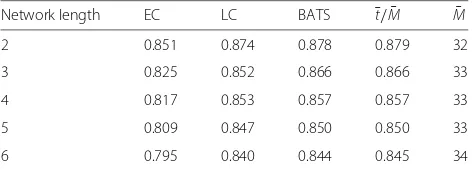
We evaluate the performance of EC, BATS, and LC codes in line networks with different network lengths and packet loss probabilities. The results as well as some important parameters are summarized in Tables 4, 5 and 6. From these tables, we can see that when the network length or packet loss probability is larger, the optimized
Table 4Achievable network transmission rates of chunked codes in line networks with=0.1
Network length EC LC BATS ¯t/M¯ M¯
2 0.851 0.874 0.878 0.879 32
3 0.825 0.852 0.866 0.866 33
4 0.817 0.853 0.857 0.857 33
5 0.809 0.847 0.850 0.850 33
6 0.795 0.840 0.844 0.845 34
Table 5Achievable network transmission rates of chunked codes in line networks with=0.2
Network length EC LC BATS ¯t/M¯ M¯
2 0.743 0.764 0.772 0.773 35
3 0.718 0.752 0.756 0.757 36
4 0.702 0.741 0.745 0.746 36.5
5 0.691 0.732 0.737 0.738 37
6 0.682 0.727 0.731 0.731 37.5
¯
M is also larger, keeping ¯t/M¯ at a high value, close to the network capacity (note that if the computational cost and/or buffer size of intermediate nodes is restricted to beO(1), the network capacity is smaller than 1− and decreases when the network length grows [20, 21]). More-over, EC codes can achieve a network transmission rate that is about 91 % ∼ 97 % of the bound ¯t/M¯ and is about 80 % ∼ 94.5 % of the network capacity 1 − . This demonstrates the great real-world potential of EC codes.
4.3 Comparison with overlapped chunked codes
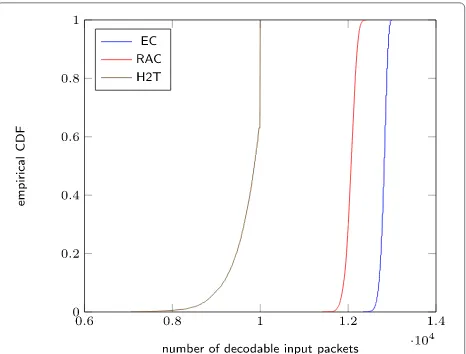
We then compare EC codes with two overlapped chun-ked codes: the chunchun-ked code with a head-to-tail type of overlapping (H2T) [11] and random annex codes (RAC) [12]. Since we do not have the analytical results to calcu-late the achievable rates of these two codes, we conduct simulations in line networks with = 0.2 and lengths four and ten for the performance comparison. For each code and each length, we perform 10,000 runs of the sim-ulation. In all the runs, the number of chunks in each code is set to be 500, which thus fixes the same transmis-sion cost. The parameters involved in H2T and RAC are chosen optimally in the sense that the average number of decodable input packets is maximized. Note that given the parameters of a chunked code, the number of input pack-ets is then determined, which varies over different classes of chunked codes. The empirical cumulative distribution functions (eCDFs) of the number of decodable input pack-ets for each code in line networks with lengths four and ten are plotted in Figs. 3 and 4, respectively. From these
Table 6Achievable network transmission rates of chunked codes in line networks with=0.4
Network length EC LC BATS ¯t/M¯ M¯
2 0.533 0.559 0.569 0.570 44
3 0.523 0.543 0.553 0.554 46
4 0.504 0.539 0.542 0.543 48
5 0.493 0.523 0.534 0.534 49
Fig. 3The eCDF of the number of decodable input packets in a line network with length four. Here,M¯ =36.5
figures, we can see that EC codes outperform both H2T and RAC significantly in both line networks.
5 Conclusions
In this paper, we studied the performance of overlapped chunked codes with constant chunk sizes. We proposed and analyzed EC codes, a novel class of random regular graph-based chunked codes, which outperform state-of-the-art overlapped chunked codes. Compared with coded chunked codes, EC codes can achieve a rate very close to that of BATS codes and L-chunked codes in line networks with a proper optimization of the transmission scheme, but EC codes can support causal encoding and have lower encoding complexity.
Fig. 4The eCDF of the number of decodable input packets in a line network with length ten. Here,M¯ =39
Endnotes
1For example, network protocols usually have a maximum transmission unit (MTU) ranging from hundred to thousand bytes.
2EC codes were motivated by the expander graphs, and the expansion property was applied in the first analysis of EC codes to obtain a lower bound on the achievable rates [31]. In this paper, we provide a better bound on the achievable rate without an explicit application of the expansion property, but the name of the code is preserved.
3If bothdandnare odd, then an EC code withn chunks and degreedcan be generated by attaching an arbitrary chunk to an EC code withn−1 chunks and degreedusing the described method, which does not affect the asymptotic performance of EC codes.
4To the best of our knowledge, no efficient algorithms have been developed for uniformly sampling a rank distribution with a given mean value. Here, we use the following method for randomly sampling rank distributions. For a fixed¯t, denotea= ¯t. We first sample a distribution(t0,t1,. . .,ta)over the set {0, 1,. . .,a}and a distribution(ta+1,ta+2,. . .,tm)over
the set{a+1,a+2,. . .,m}using the method in [41], which gives almost uniform sampling of distributions over the corresponding set. Letη=(mi=a+1iti− ¯t)/
(m
i=a+1iti−ai=0iti) >0. Then, we get a distribution
(ηt0,ηt1,. . .,ηta,(1−η)ta+1,(1−η)ta+2,. . .,(1−η)tm),
whose expectation is equal tot¯.
Competing interests
The authors declare that they have no competing interests.
Acknowledgements
This work was partially supported by NSFC Grants (Nos. 61501221, 61170069, 61373014, 91218302, 61321491, and 61471215); Natural Science Foundation of Jiangsu Province Grant (No. BK20150588), Science and Technology Pillar Program (Industry) of Jiangsu Province Grant (No. BE2013116); Collaborative Innovation Center of Novel Software Technology and Industrialization; EU FP7 IRSES MobileCloud Project Grant (No. 612212); and a grant from the University Grants Committee of the Hong Kong Special Administrative Region (Project No. AoE/E-02/08). The authors would like to thank the anonymous reviewers for their valuable comments and suggestions to improve the quality of the paper.
Author details
1National Key Laboratory for Novel Software Technology, Nanjing University,
Nanjing, China.2School of Science and Engineering, The Chinese University of Hong Kong, Shenzhen, China.
Received: 28 June 2015 Accepted: 7 December 2015
References
1. R Ahlswede, N Cai, S-YR Li, RW Yeung, Network information flow. IEEE Trans. Inf. Theory.46(4), 1204–1216 (2000)
2. S-YR Li, RW Yeung, N Cai, Linear network coding. IEEE Trans. Inf. Theory.
49(2), 371–381 (2003)
3. T Ho, R Koetter, M Medard, DR Karger, M Effros, inProc. IEEE International
Symposium on Information Theory. The benefits of coding over routing in
4. T Ho, M Medard, R Koetter, DR Karger, M Effros, J Shi, B Leong, A random linear network coding approach to multicast. IEEE Trans. Inf. Theory.
52(10), 4413–4430 (2006)
5. Y Wu, inProc. International Symposium on Information Theory. A trellis connectivity analysis of random linear network coding with buffering, (2006), pp. 768–772
6. AF Dana, R Gowaikar, R Palanki, B Hassibi, M Effros, Capacity of wireless erasure networks. IEEE Trans. Inf. Theory.52(3), 789–804 (2006). doi:10.1109/TIT.2005.864424
7. DS Lun, M Medard, R Koetter, M Effros, On coding for reliable communication over packet networks. Phys. Commun.1(1), 3–20 (2008)
8. PA Chou, Y Wu, K Jain, inProc. 41st Allerton Conference on Communication,
Control, and Computing. Practical network coding, (2003), pp. 40–49
9. Z Liu, C Wu, B Li, S Zhao, inProc. IEEE International Conference on Computer
Communications. UUSee: Large-scale operational on-demand streaming
with random network coding, (2010), pp. 1–9
10. D Silva, W Zeng, FR Kschischang, inProc. Workshop on Network Coding. Sparse network coding with overlapping classes, (2009), pp. 74–79 11. A Heidarzadeh, AH Banihashemi, inProc. IEEE Information Theory
Workshop. Overlapped chunked network coding, (2010), pp. 1–5
12. Y Li, E Soljanin, P Spasojevic, Effects of the generation size and overlap on throughput and complexity in randomized linear network coding. IEEE Trans. Inf. Theory.57(2), 1111–1123 (2011)
13. S Yang, RW Yeung, inProc. IEEE International Symposium on Information
Theory. Coding for a network coded fountain, (Saint Petersburg, Russia,
2011), pp. 2647–2651
14. S Yang, RW Yeung, Batched sparse codes. IEEE Trans. Inf. Theory.60(9), 5322–5346 (2014)
15. K Mahdaviani, M Ardakani, H Bagheri, C Tellambura, inProc. International
Symposium on Network Coding. Gamma codes: a low-overhead
linear-complexity network coding solution, (2012), pp. 125–130 16. K Mahdaviani, R Yazdani, M Ardakani, inProc. International Symposium on
Network Coding. Overhead-optimized gamma network codes, (2013),
poster
17. S Yang, B Tang, inProc. IEEE Information Theory Workshop. From LDPC to chunked network codes, (2014), pp. 406–410
18. B Tang, S Yang, B Ye, S Lu, S Guo, Near-optimal one-sided scheduling for coded segmented network coding. IEEE Trans. Comput. (2015), to appear
19. P Pakzad, C Fragouli, A Shokrollahi, inProc. IEEE International Symposium
on Information Theory. Coding schemes for line networks, (2005),
pp. 1853–1857. doi:10.1109/ISIT.2005.1523666
20. U Niesen, C Fragouli, D Tuninetti, On capacity of line networks. IEEE Trans. Inf. Theory.53(11), 4039–4058 (2007)
21. BN Vellambi, N Torabkhani, F Fekri, Throughput and latency in
finite-buffer line networks. IEEE Trans. Inf. Theory.57(6), 3622–3643 (2011). doi:10.1109/TIT.2011.2137070
22. Q Huang, K Sun, X Li, D Wu, inProc. ACM International Symposium on
Mobile Ad Hoc Networking and Computing. Just fun: a joint fountain
coding and network coding approach to loss-tolerant information spreading, (Philadelphia, PA, USA, 2014), pp. 83–92
23. X Xu, PKM Gandhi, YL Guan, PHJ Chong,Two-phase cooperative
broadcasting based on batched network code.arXiv preprint
arXiv:1504.04464, (2015). http://arxiv.org/abs/1504.04464 24. S Chachulski, M Jennings, S Katti, D Katabi, Trading structure for
randomness in wireless opportunistic routing. SIGCOMM Comput. Commun. Rev.37(4), 169–180 (2007)
25. Y Lin, B Li, B Liang, inProc. IEEE International Conference on Network
Protocols. CodeOR: Opportunistic routing in wireless mesh networks with
segmented network coding, (2008), pp. 13–22
26. D Koutsonikolas, C-C Wang, YC Hu, Efficient network-coding-based opportunistic routing through cumulative coded acknowledgments. IEEE/ACM Trans. Netw.19(5), 1368–1381 (2011)
27. P Maymounkov, NJA Harvey, DS Lun, inProc. 44th Allerton Conference on
Communication, Control, and Computing. Methods for efficient network
coding, (2006)
28. M Luby, inProc. 43rd Annual IEEE Symposium on Foundations of Computer
Science. LT codes, (2002), pp. 271–282
29. A Shokrollahi, Raptor codes. IEEE Trans. Inf. Theory.52(6), 2551–2567 (2006)
30. K Mahdaviani, R Yazdani, M Ardakani, Linear-complexity overhead-optimized random linear network codes. arXiv preprint arXiv:1311.2123 (2013). http://arxiv.org/abs/1311.2123
31. B Tang, S Yang, Y Yin, B Ye, S Lu, inProc. IEEE International Symposium on
Information Theory. Expander graph based overlapped chunked codes,
(Cambridge, MA, USA, 2012), pp. 2451–2455
32. S Yang, RW Yeung, HF Cheung, HHF Yin, inProc. 52nd Allerton Conference
on Communication, Control, and Computing. BATS: Network coding in
action, (2014), pp. 1204–1211
33. GE Andrews,The Theory of Partitions vol. 2. (Cambridge University Press, New York, NY, USA, 1998)
34. M Gadouleau, Z Yan, Packing and covering properties of subspace codes for error control in random linear network coding. IEEE Trans. Inf. Theory.
56(5), 2097–2108 (2010)
35. L Shi, N Wormald, inSurveys in combinatorics. Models of random regular graphs (LMS Lecture Note Series 267, 1999), pp. 239–298
36. BD McKay, NC Wormald, B Wysocka, Short cycles in random regular graphs. Electron. J. Comb.11(1), 1–12 (2004)
37. M Mitzenmacher, E Upfal,Probability and Computing: Randomized
Algorithms and Probabilistic Analysis. (Cambridge University Press, New
York, NY, USA, 2004)
38. BD McKay, NC Wormald, Uniform generation of random regular graphs of moderate degree. J. Algoritm.11(1), 52–67 (1990)
39. G Margulis, Explicit construction of concentrators. Probl. Peredachi Inf.
9(4), 325–332 (1973)
40. S Hoory, N Linial, A Wigderson, Expander graphs and their applications. Bull. Amer. Math. Soc.43(4), 439–561 (2006)
41. NA Smith, RW Tromble, Sampling uniformly from the unit simplex. http://www.cs.cmu.edu/~nasmith/papers/smith+tromble.tr04.pdf
Submit your manuscript to a
journal and benefi t from:
7Convenient online submission
7Rigorous peer review
7Immediate publication on acceptance
7Open access: articles freely available online
7High visibility within the fi eld
7Retaining the copyright to your article
![Table 1 Comparison among EC/BATS/LC codes where achievable rates are evaluated over line networks with chunk transmissionscheme given in [18]](https://thumb-us.123doks.com/thumbv2/123dok_us/890581.1107137/3.595.58.540.109.166/table-comparison-bats-codes-achievable-evaluated-networks-transmissionscheme.webp)