R E S E A R C H
Open Access
Power allocation for maximizing the MAC
capacity via majorization
Jisheng Dai
1,2,3and Chunqi Chang
4*Abstract
Optimal power allocation for maximizing the sum capacity of multiple access channel (MAC) with quality-of-service (QoS) constraints is investigated in this paper. Majorization theory is the underlying mathematical theory on which our method hinges. It is shown that the optimal structure of the solution can be easily obtained via majorization theory. Furthermore, based on our new approach, an efficient searching method for power allocation is developed by restricting the attention to a new searching variable. Our new method requires less than half of the computational cost of the existing method in the worst case and is even much faster in general. Simulation results demonstrate the effectiveness of our method.
Keywords: Multiple access channel (MAC); Power allocation; Capacity; Quality-of-service (QoS)
1 Introduction
In order to interface to broadband networks of the future, wireless system will be required to support real-time and non-real-time multi-rate services [1,2]. For the real-time services having little tolerance for delay, such as voice and low-rate video, rate adaptation is not desirable, while for the non-real-time services, such as data communication (paging, electronic mail, etc.), rate adaptation is allowed since they are tolerant to latencies though sensitive to transmission errors. It is well known that the radio spec-trum can be utilized more efficiently if the delay-tolerant traffic users are managed with an optimal resource alloca-tion policy [3-6].
In this paper, we are more interested in the optimal power allocation policy that maximizes sum capacity of non-real-time users in multiple access channel (MAC). It has captured considerable attention during the past years. Maximizing the reverse link (uplink) sum capacity of non-real-time users has been studied in [2]. How-ever, the maximum sum capacity is usually achieved via unfair resource allocation that ignores the throughput from users with poor channel conditions. To avoid this sit-uation, additional quality-of-service (QoS) requirements are introduced to practical systems. A method to obtain
*Correspondence: [email protected]
4School of Electronic and Information Engineering, Soochow University, Suzhou 215006, China
Full list of author information is available at the end of the article
the maximal reverse link sum capacity, under some QoS constraints, is proposed in [3,4]. It is shown that the opti-mal solution can be obtained by a numerical search over a finite number of one-dimensional search spaces. In order to reduce the computational cost, an improved method is developed to eliminate the numerical search [5]. With the introduction of some specific hyperplanes, it is shown that the candidate solutions can be determined in a closed form so that the search space is reduced into a finite set of points. However, the main theorem in [5] is explained by graphical visualization only, instead of strict mathemati-cal proof. Consequently, some important relationships are not revealed properly.
Inspired by the treatment proposed in [6], we try to refine the results in [3-5] via majorization theory, where the proof procedure can be adapted to a great number of design criteria, as long as their objective functions are Schur-concave or Schur-convex [7-9]. It turns out from our new derivation that the size of the search space in the original method can be further reduced if we change the search variable and rearrange the constraints. Compared to the existing method, less than half of the computational cost is required in the worst case.
2 Preliminaries
In this section, we introduce the basic notations and a lemma of majorization, which will be used in Section 4.
For a detailed description of majorization, the readers are referred to [8] and [9].
Definition 1. For any vectorx=[x1,x2,· · ·,xn]T∈Rn, let x[1] ≥ x[2] ≥ · · · ≥ x[n]denote its components in a non-increasing order, and let
x↓=x[1],x[2],· · ·,x[n]T
denote the decreasing rearrangement ofx.
Definition 2.For any two vectorsx,y∈Rn, we sayxis majorized byyif
k
i=1
x[i]≤ k
i=1
y[i], 1≤k≤n−1,
n
i=1
x[i]= n
i=1
y[i].
and we represent it byx≺y.
Definition 3.A real-valued functionφdefined on a set A⊆Rnis said to be Schur-convex onAif
x≺yonA ⇒ φ (x)≤φ (y).
Similarly,φis said to be Schur-concave onAif
x≺yonA ⇒ φ (x)≥φ (y).
Lemma 1.f(x) = ixiis Schur-concave on the set of
{x|∀i,xi≥0}.
Proof. Assumex1,x2 ∈ Rn withx1 ≺x2. According to B.1. Lemma in [8],x1can be derived fromx2by successive applications of a finite number ofTtransforms, e.g.,
x1=T1T2· · ·Tmx2 (1)
wheremis a positive integer andTis,i= 1, 2,. . .,m, are the T-transform matrices. Each T-transform matrix has the form ofλI+(1−λ)Q, where 0≤λ≤1 andQis a per-mutation matrix that just interchanges two coordinates. Obviously, if f(Tx) ≥ f(x) holds for any T-transform matrixT, we will achieve the desired resultf(x1)≥f(x2). The reason is given as follows:
f(x2)≤f(Tmx2)≤f(Tm−1Tmx2)≤ · · ·
≤f(T1T2· · ·Tmx2)=f(x1).
(2)
What remains is to prove f(Tx) ≥ f(x). Without loss of generality, assume that the permutation matrix inter-changes thejth andkth coordinates. Then, we have
[Tx]i= ⎧ ⎨ ⎩
xi i=j,k
λxj+(1−λ)xk, i=j
λxk+(1−λ)xj, i=k
(3)
where [·]istands for theith element of a vector. With (3), we obtain:
f(Tx)=
⎛
⎝
i=j,k
xi ⎞
⎠·λxj+(1−λ)xk λxk+(1−λ)xj
= ⎛
⎝
i=j,k
xi ⎞
⎠λ(1−λ)xj−xj 2+
xjxk
= ⎛
⎝
i=j,k
xi ⎞
⎠λ(1−λ)xj−xj 2
+
i
xi
≥f(x).
3 Problem formulation
Consider a MAC wireless network supporting M data mobile stations (MS), whose link gains areg1,g2,· · ·,gM. Without loss of generality, assumeg1≥g2≥ · · · ≥gM ≥ 0. Definingpias theith MS’s transmit power, the signal-to-interference-plus-noise ratio (SINR) for theith MS at the base station is given by
SINRi =
pigi
I+Mj=1,j=ipjgj
, i=1, 2,· · ·,M (4)
whereI is the power of the background noise and inter-ferences from other traffic-type users. Note that the BS is assumed to independently decode different users, i.e., it is not using a successive cancelation scheme at the receiver. From Shannon formula, the sum capacity of data users in MAC becomes:
C=log2
I+Mj=1pjgj M
M i=1
I+Mj=1,j=ipjgj
(5)
Our goal is to derive an optimal power allocation that maximizes the sum capacity of the data users. There are generally three constraints that must be satisfied. First, the transmission power at nodei must not exceed a certain maximum powerpmax, which is set by the hardware. Sec-ond, the SINR of linkimust be above a certain minimum SINRγ, which is determined by QoS requirements. The third constraint is that the summation of interferences generated from Mdata users is limited byMi=1pigi ≤
received power from the data users is an interference to other classes of users, like the voice users in the same cell [3-5]. Note that the way to obtainPmaxR is described in [10]. Thus, the classical QoS-constrained optimization problem is formulated as
max
4 Maximizing the sum capacity with QoS constraints
In this section, we first try to review the optimal structure of the power allocation via majorization theory. Then, we present a fast algorithm by restricting the attention to a new searching variable, and we show that our new method requires less than half of the computational cost of the existing method in the worst case and is even much faster in general.
4.1 Review of the optimal structure of the power allocation via majorization theory
Let xi pigi/I and T part is dropped because of its monotonicity. This opti-mization problem is rather difficult to solve directly, due to its non-convexity. However, if the value ofTis fixed, it is possible to solve the optimization problem via majoriza-tion theory in a specific hyperplane described by a linear equationMj=1xj = T. After that, we are able to find the optimal solution by performing a one-dimensional search onT. Definingyi 1+1T+−Txi, the corresponding problem Therefore, solving the optimization problem (8) for fixed T is equivalent to finding the optimal vectory∗such that y∗ y for any feasibley. The correspondingy∗can be explicitly determined as follows.
Theorem 1.For any fixed T, the optimaly∗among the constraints of problem (8) must be structured as
y∗=
Proof.In order to simplify the presentation, we rewrite the constraints in (8) as
1. IfQ=Mi=1qi,∀i,y∗i =qimust be satisfied.
The proof of this result is trivial, and is omitted for brevity.
the most majorityy∗is
y∗i =qi, i=1, 2,· · ·,k−1,
Now, it is clear that the optimaly∗is related to the value ofQ, and is structured as
where the value of k is determined by the following inequality
Consequently, the optimal solution may be rewritten as
y∗= desired results in Theorem 1. Additionally, we know that for the case of˜li <0 or, equivalently,li > T+1, if there exists any feasible solution it must be [w,w,· · ·,w]T.
Drawn from above discussions, the following theorem can be obtained.
Theorem 2.If there is any solution to problem (7), it is structured as
4.2 Our improved method
Although the solution structure (18) has been addressed in [5], the relationship among k, xk, and T is not well revealed due to the limitation of the proof procedure therein. According to the results in [5], a triplet(k,xk,T) can be determined by any two of its elements, for exam-ple k and xk. Our new derivation shows that (k,xk,T) in fact can be simply determined by a single elementT, while k andxk can be obtained by (11) and (19) given T. Therefore, the candidate solution of (18) can be evalu-ated over different values ofTinstead of(k,xk). As will be shown later, this plays an important role in reducing the computational complexity of our improved method.
A numerical search for different values ofkis used in [3] to find the optimalxk, and the search is reduced to a finite number of one-dimensional spaces. The search is further reduced in [5] from a set of one-dimensional spaces to a finite set of points by employing the following lemma.
Lemma 2. In the optimal solution to problem (7), xk
⎧ ⎨ ⎩
xk≤min !
lk, (Xmax+1)[1−(M−k)ϕ]−L−1, lM1−(Mϕ−k)ϕ −L−1
"
xk≥ 1−(ϕ(ML−+k1+)1)ϕ
(20)
where Lki=−11li(see Theorem 3 and Theorem 4 in [5]).
Applying Lemma 2, it is clear that the process of find-ing all the possible power allocations requires checkfind-ingk, 1 ≤ k ≤ M, while trying two marginal values given in (20). Therefore, almost 2Mcandidate points need to be searched in the algorithm proposed in [5]. However, we note that if the constraints in Lemma 2 are rearranged, a more efficient method can be derived. The key obser-vations for the development of our improved method are:
1. xkis a monotonic increasing function ofTand vice
versa (see (19)).
2. If the optimalxkaccepts one of the marginal values
given in (20),xkmust be one of the values among !
lk, (Xmax+1)[1−(M−k)ϕ]−L−1,lM1−(Mϕ−k)ϕ
−L−1,1−(ϕ(ML−+k1+)1)ϕ "
.
3. GivenT, the values ofkandxkare uniquely
determined and vice versa (the relationship amongk, xk, andTis given in Theorem 2). Therefore,
searching candidate values ofT instead ofkandxk
does not result in any loss of optimality.
Keeping these observations in mind, we now proceed to derive our efficient method based on the following theorem.
Theorem 3.In the optimal solution to problem (7), T must accept one of the candidate values given by
Tk|Tk<
Xmax,
lM
ϕ −1
,k=0, 1,· · ·,M #
min
Xmax,
lM
ϕ −1
(21)
where Tk k
i=1li+(M−k)ϕ
1−(M−k)ϕ and Tk<Tk+1.
Proof.Relying on Observation 2 and 3, it is clear that proving the above theorem is equivalent to specifying the values of T corresponding to the candidate values of k and xk, where xk ∈
!
lk, (Xmax+1)[1−(M−k)
ϕ−L−1] ,lM1−(Mϕ−k)ϕ −L−1,
ϕ(L+1) 1−(M−k+1)ϕ
"
and 1 ≤ k≤M. To gain some insight, we now discuss the possible values ofxk, respectively.
1. For the case ofxk =lk, based on (19), the
correspondingTis given by
T = L+xk+(M−k)ϕ 1−(M−k)ϕ
= k
i=1li+(M−k)ϕ
1−(M−k)ϕ Tk (22)
where1≤k≤M. Thus, the candidate values ofTin this case are given by
T1= {Tk|k=1,· · ·,M}. (23)
2. For the case of
xk =(Xmax+1)[1−(M−k)ϕ]−L−1, using the
expression forxkin (19), we obtain
(Xmax+1)[1−(M−k)ϕ]−L−1=(1+T)
(1−(M−k)ϕ)−L−1
(24)
or, equivalently,T =Xmax. Hence, in this case, the
candidate set ofTis
T2= {Xmax}. (25)
3. For the case ofxk =lM1−(Mϕ−k)ϕ −L−1, similarly,
we get
lM=ϕ(1+T). (26)
Consequently, the candidate set is given as
T3=
lM
ϕ −1
. (27)
4. For the case ofxk = 1−(ϕ(ML−+k1+)1)ϕ, we have
T = L+xk+(M−k)ϕ 1−(M−k)ϕ
= k−1
i=1li+(M−(k−1))ϕ
1−(M−k+1)ϕ (28)
where1≤k≤M. Therefore, the candidate set ofTis
Putting all the possibleTtogether and using the fact that any feasibleTsatisfiesT <XmaxandT < lMϕ −1, we are
able to derive the whole candidate set ofT as
T= !T1
Further, we note thatxkcan be written as
xk =
In this form, it is easy to see that the structures of (32) and (33) are equivalent and ϕ(1 + Tk) ≤ lk+1 (which follows from the first constraint of (7)). So, according to Observation 1 and
which means the structure of solution for the case ofT = min
!
Xmax,lMϕ −1 "
has been determined by the value ofj.
Obviously, the candidate set of T contains less than M+2 points that need to be searched to find the opti-mal solution. Based on these conclusions, our improved algorithm is outlined as follows. Compared with the orig-inal 2Msearch points, less than half of the computational calculations are required by our method in the worst casea.
and go to step 3, else continue (go to step 2a).
3. Find the smallestφk, denoted asφ∗, and retrieve the to our method, very few points need to be searched. In particular, ifT0≤min
needs to be searched.
However, ifmin
constraint in (6) does not affect the final solution and can be removed from the optimization problem.
5 Simulation result
The simulation results in this section illustrate the perfor-mance of our method. The computer codes are developed in MATLAB 7.8.0 and are run on a PC with an Intel Core2 2.66GHz CPU and 4GB of RAM. We will compare the proposed method to the original methods in [5] (the origi-nal method 1 considers the same optimization problem as our method, while the original method 2 considers a new optimization problem which includes an additional capac-ity upper bound for each MS) and the max-min method in [6].
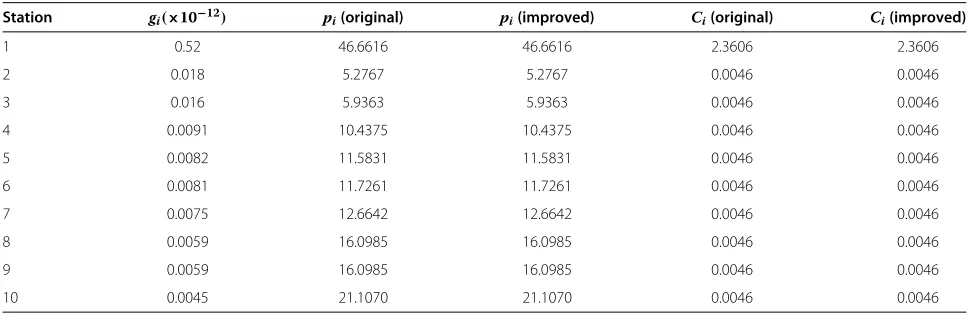
Table 1 Comparison of optimal solutions between our method and the original method 1
Station gi(×10−12) pi(original) pi(improved) Ci(original) Ci(improved)
1 0.52 46.6616 46.6616 2.3606 2.3606
2 0.018 5.2767 5.2767 0.0046 0.0046
3 0.016 5.9363 5.9363 0.0046 0.0046
4 0.0091 10.4375 10.4375 0.0046 0.0046
5 0.0082 11.5831 11.5831 0.0046 0.0046
6 0.0081 11.7261 11.7261 0.0046 0.0046
7 0.0075 12.6642 12.6642 0.0046 0.0046
8 0.0059 16.0985 16.0985 0.0046 0.0046
9 0.0059 16.0985 16.0985 0.0046 0.0046
10 0.0045 21.1070 21.1070 0.0046 0.0046
[5], whereγ= −50 dB,I= −113 dBm,PRmax=−106 dBm and pmax = 23 dBm (η dBm 10
η
10 × 10−3). M data MSs are randomly dropped with a uniform distribu-tion over a hexagonal cell. Assume that there is a sam-ple where M = 10, and the values of gi are 10−12× [0.52, 0.018, 0.016, 0.0091, 0.0082, 0.0081, 0.0075, 0.0059, 0.0059, 0.0045] [5]. Table 1 shows the optimal solutions for our method and the original method 1, including the power allocation pi and capacity Ci, i = 1, 2,· · ·,M. The results illustrate that two methods achieve the same results.
To testify the performance of an algorithm, we should prove that the algorithm can work for a wide variety of scenarios, which mainly depend on the number of MSs, their locations, and the services they want to use. In sim-ulation 2, we run some Monte Carlo simsim-ulations to show the sum capacity achieved by our proposed method. We work on a practical scenario from 3GPP2 [11], where the configurations used in this simulation are summarized in Table 2.M MSs are randomly dropped with a uniform distribution over a hexagonal cell, and the base station is located at the center of the cell. A set ofMdropped users is said to be valid if the minimum QoS requirements are achievable. When the set is invalid, the entire users are re-dropped. Each path gain,gi, takes into account distance loss and log-normal shadowing. However, fast fading and power control aspects are not considered in the simula-tion because the optimizasimula-tion problem does not consider the time-varying condition. The rise-over-thermal (ROT) limiting the total received power at the base station is defined as PmaxR +σth2/σth2, where σth2 is the thermal noise variance at the base station. Figures 1 and 2 show the sum capacity achieved by transmission strategies ver-sus the number of MSs with ROT being 7 and 10 dB, respectively. All the results are obtained by averaging the sum capacity over 10,000 channel realizations, and the optimal power allocations are optimized for each chan-nel realization. As can be seen from the figures, the sum
capacity curves for our method and the original method 1 coincide, which again illustrates that our method always achieves the same solution as the original method 1. These two methods always outperform the original method 2, as well as the max-min method, in terms of the sum capacity. The reasons are (1) the feasible region of the new optimization problem, which includes an additional capacity upper bound for each MS (Ci<0.3), is less than the feasible region of (6) and (2) the max-min method is designed to maximize the minimum rate rather than the sum capacity. Moreover, we observe some similar results about inconsistent reduction of the system capacity as in [3,4]. Without a QoS requirement, the sum capacity increases asMincreases because of the multi-user diver-sity. In contrary, if there is a QoS requirement (e.g.,−21 dB or−18 dB), the sum capacity decreases by increasing M. The reason is that the statistics of the poor channel gets worse asMincreases. Hence, meeting the QoS of the poor channel users will drag the system capacity. Note that QoS requirements of−21 dB and −18 dB are related to the typical SINR level for 9.6 Kbps traffic channel through-put maintenance and reverse pilot channel maintenance, respectively [4,12].
Table 2 Configurations for simulation 2
Configurations Value
Cell structure Single hexagonal cell
Cell Radius 1.0 km
Antenna radiation Omni-directional
Distance loss (propagation) model 28.6+35 log10(d)dB Log-normal shadowing standard deviation 8.9 dB Maximum transmit power (pmax) 0.2 Watt
Implementation loss 0 dB
Thermal noise variance 1.547×10⁻¹⁴
Figure 1Sum capacity for different QoS constraints with ROT being 7 dB.
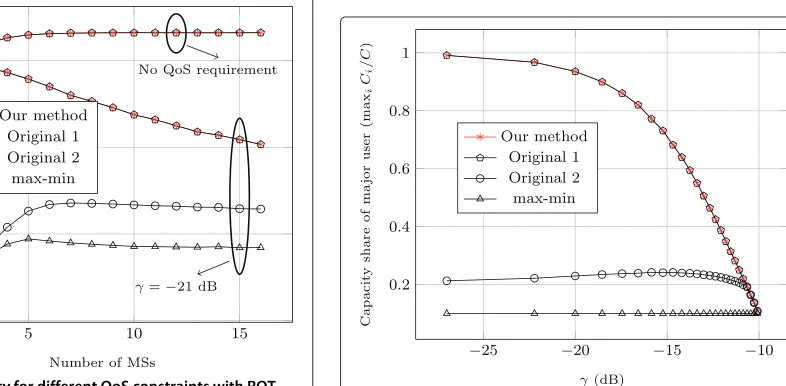
Simulation 3 illustrates capacity shares for the major user, where the same scenario is considered as in simula-tion 2. Figures 3 and 4 show the capacity share of the major user achieved by transmission strategies versus the QoS requirementγ with ROT being 7 and 10 dB, respectively. All the results are obtained by averaging maxiCi/Cover 10,000 channel realizations, and the optimal power allo-cations are optimized for each channel realization. From the figures, we observe that: (1) the optimization problem (6) produces an unfair solution that is dominantly depen-dent on the major user, if the QoS requirementγ is low, (2) the new optimization problem that includes an additional capacity upper bound for each MS (Ci<0.3) will improve the fairness, (3) the max-min method achieves the most
Figure 2Sum capacity for different QoS constraints with ROT being 10 dB.
Figure 3Capacity share of the major user with ROT being 7 dB.
fair solution because it is designed for this purpose, and (4) the gap of capacity shares among our method, the orig-inal method 2 and the max-min method trend to close in higher QoS requirement regime.
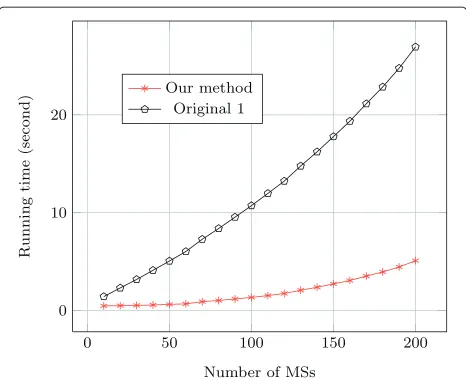
In simulation 4, we run another Monte Carlo simu-lation to evaluate the exact computational cost of our proposed method. Consider the same scenario in simula-tion 2, except that the QoS requirement is set to−21 dB and the number of MSs changes from 10 to 200. Figure 5 gives the running time of our method and the method in [5] versus the number of MSs with ROT being 10 dB. All the results are obtained by summing the running time over 10,000 channel realizations, and the optimal power allocations are optimized for each channel realization. The simulation results demonstrate that our proposed
Figure 5Comparison of the running time between our method and the original method 1.
method has a much lower computational complexity than the state-of-art method under comparison.
6 Conclusions
Optimal power allocation for maximizing the MAC capacity of non-real-time users with QoS constraints has been investigated in this paper. Based on majorization theory, we show that the optimal structure of the solu-tion can be easily obtained. Addisolu-tionally, by rearranging the constraints in Lemma 2 and restricting the attention to searching candidate values of T instead ofk and xk, a more efficient method is derived. Compared with the original method, less than half of the computational cost is required by our method in the worst case. Simulation results demonstrate the effectiveness of our method. For future work, it will be interesting to see if one can extend the method to the case of joint power constraints [13,14].
Endnote
aThe computational cost of the existing method is of
O(M2)with 8M2flops in the worst case [5]. The computational cost of our method is of the same order but with 1.5M2flops in the worst case. Step 2a and step 2b totally require 0.5M2andM2flops, respectively. As Step 2c is executed once, its computational cost is neglectable.
Competing interests
The authors declare that they have no competing interests. Acknowledgements
This work was supported in part by the National Natural Science Foundation of China (61102054), the Open Research Fund of National Mobile
Communications Research Laboratory, Southeast University (No. 2013D08), the Jiangsu Planned Projects for Postdoctoral Research Funds (No. 1302004A), the Project funded by China Postdoctoral Science Foundation, and the Project Foundation for Priority Academic Program Development (PAPD) of Jiangsu Higher Education Institutions.
Author details
1School of Electrical and Information Engineering, Jiangsu University, Zhenjiang 212013, China.2National Mobile Communications Research Laboratory, Southeast University, Nanjing 210096, China.3Nettech Technology (Suzhou) Co., Ltd., Suzhou 215131, China.4School of Electronic and
Information Engineering, Soochow University, Suzhou 215006, China.
Received: 27 December 2013 Accepted: 4 July 2014 Published: 15 July 2014
References
1. A Muqattash, M Krunz, S Tao, Performance enhancement of adaptive orthogonal modulation in wireless CDMA systems. IEEE J. Selec. Areas Commun.24(3), 565–578 (2006)
2. SA Jafar, A Goldsmith, Adaptive multirate CDMA for uplink throughput maximization. IEEE Trans. Wireless Commun.2(2), 218–228 (2003) 3. SJ Oh, ACK Soong, QoS-constrained information-theoretic sum capacity of
reverse link CDMA systems. IEEE Trans. Wireless Commun.5(1), 3–7 (2006) 4. D Zhang, SJ Oh, N Bhushan, Optimal resource allocation for data service in CDMA reverse link. IEEE Trans. Wireless Commun.6(10), 3648–3656 (2007) 5. A Abadpour, AS Alfa, ACK Soong, Closed form solution for maximizing the
sum capacity of reverse-link CDMA system with rate constraints. IEEE Trans. Wireless Commun.7(4), 1179–1183 (2008)
6. J Dai, Z Ye, X Xu, Power allocation for maximizing the minimum rate with QoS constraints. IEEE Trans. Vehic. Technol.58(9), 4989–4996 (2009) 7. DP Palomar, JM Cioffi, MA Lagunas, Joint Tx-Rx beamforming design for
multicarrier MIMO channels: a unified framework for convex optimization. IEEE Trans. Signal Process.51(9), 2381–2401 (2003)
8. AW Marshall, I Olkin,Inequalities: Theory of Majorization and Its Applications. (Academic, New York, 1979)
9. DP Palomar, Y Jiang, MIMO Transceiver Design via Majorization theory. Foundations and trends in communications and information theory. 3(4–5), 331–551 (2006)
10. SJ Oh, Resource allocation in wireless networks. Ph. D. dissertation, Univ. of Michigan (2000)
11. Working Group 5 Evaluation Ad-Hoc Group, 1xEV-DV evaluation methodology - Addendum (V6). Third Generation Partnership Project 2 (3GPP2), Contribution C50-20010820-026 (2001)
12. S Chakravarty, R Pankaj, E Esteves, An algorithm for reverse traffic channel rate control for CDMA2000 high rate packet data systems, inProc. IEEE Globecom, (2001), pp. 3733–3737
13. J Dai, C Chang, X Xu, Z Ye, Linear precoder optimization for MIMO systems with joint power constraints. IEEE Trans. Commun. 60(8), 2240–2254 (2012)
14. J Dai, X Bao, Homotopy algorithm for energy-efficient MIMO systems with joint power constraints. IEEE Wireless Commun. Lett.3(2), 121–124 (2014)
doi:10.1186/1687-6180-2014-113
Cite this article as:Dai and Chang:Power allocation for maximizing the MAC capacity via majorization.EURASIP Journal on Advances in Signal Processing20142014:113.
Submit your manuscript to a
journal and benefi t from:
7 Convenient online submission 7 Rigorous peer review
7 Immediate publication on acceptance 7 Open access: articles freely available online 7 High visibility within the fi eld
7 Retaining the copyright to your article