P R O C E E D I N G S
Open Access
Local structural alignment of RNA with affine gap
model
Thomas King-Fung Wong
*, Brenda Wing-Yan Cheung, Tak-Wah Lam, Siu-Ming Yiu
*From
6th International Symposium on Bioinformatics Research and Applications (ISBRA
’
10)
Storrs, CT, USA. 23-26 May 2010
Abstract
Background:Predicting new non-coding RNAs (ncRNAs) of a family can be done by aligning the potential
candidate with a member of the family with known sequence and secondary structure. Existing tools either only consider the sequence similarity or cannot handle local alignment with gaps.
Results:In this paper, we consider the problem of finding the optimal local structural alignment between a query RNA sequence (with known secondary structure) and a target sequence (with unknown secondary structure) with the affine gap penalty model. We provide the algorithm to solve the problem.
Conclusions:Based on an experiment, we show that there are ncRNA families in which considering local structural alignment with gap penalty model can identify real hits more effectively than using global alignment or local alignment without gap penalty model.
Background
A non-coding RNA (ncRNA) is a RNA molecule that does not translate into proteins. It has been shown to be involved in many biological processes [1-4]. The number of ncRNAs within the human genome was underestimated before, but recently some databases reveal over 212,000 ncRNAs [5] and more than 1,300 ncRNA families [6]. Large discoveries of ncRNAs and their families show the possibilities that ncRNAs may be as diverse as protein molecules [7]. Identifying ncRNAs is an important problem in biological study. However, it is time consuming and there is no effective method to identify ncRNAs in a laboratory, predicting ncRNAs based on known ncRNAs using comparative computa-tional approach is one of the promising directions to identify potential candidates for further verification.
Most of the computational approaches are based on the observation that if two different ncRNA molecules are in the same family (with similar biological func-tions), they usually exhibit similar sequences as well as secondary structures. One common approach [8-10] is
as follows. We pick an ncRNA member of a family with known sequence and secondary structure (referred as the query), scan along a genomic sequence and for each possible region (referred as the target), perform an alignment between the query and the target to obtain a similarity measure to decide if the region is a potential ncRNA candidate for that family. The similarity measure may only base on the sequence or both the sequence and secondary structure (the latter case is referred as structural alignment). Along this direction, there are some approaches [11-14] that make use of secondary structure prediction tools to predict the secondary struc-ture to be formed by the target assuming that it is an ncRNA before performing the alignment. The accuracy may, however, depend on the accuracy of the secondary structure prediction tools.
Instead of using one member of a family, some other approaches [15] use a set of ncRNAs from the same family to train a model (e.g. covariance model). Then, using this model to scan a genomic sequence to identify potential regions that are ncRNA candidates of that family. What information (sequence similarity and/or secondary structure) to be captured from the known ncRNAs depends on how we define the model. * Correspondence: [email protected]; [email protected]
Department of Computer Science, The University of Hong Kong, Hong Kong Full list of author information is available at the end of the article
However, in some cases, we may not have enough known members in a family to train a model. In this paper, we focus on the problem that uses one known member as the query and align it with a target sequence. We remark that there are also other computa-tional methods that identify ncRNAs without using known members in a family. For example, some try to identify ncRNAs by considering the stability of second-ary structures formed by the substrings of a given gen-ome [16]. This method may not be very effective because a random sequence with high GC composition also allows an energetically favorable secondary struc-ture [17]. So, the comparative approach we described in the above is still one of the most popular approaches.
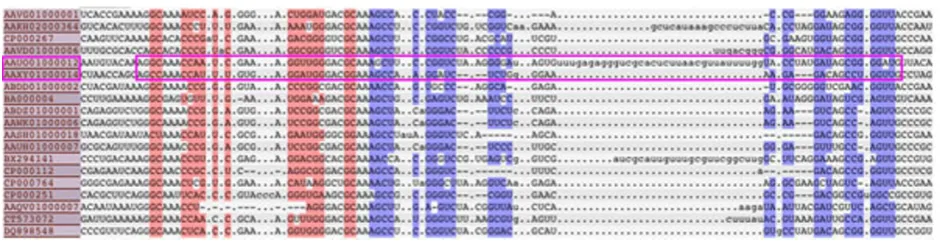
The core idea behind all comparative approaches is to compute the similarity between the query (known mem-ber(s)) and the target (each possible region in the geno-mic sequence to be investigated). Some only consider sequence similarity which may not work well for families in which members do not have high sequence similarity (e.g. members of RF00017 in Rfam 9.1 [6] only have 39% sequence similarity). For example, Gotohscan [8] considers semi-global alignment with affine gap penalty according to the sequence similarity only. For those also consider the similarity of secondary structure, they usually require the whole sequence of the query to be aligned with the whole sequence of the target (referred asglobalalignment in the community) [10]. However, similar to the protein sequence, the ncRNAs in the same family may not have similar sequence or structure for the whole sequence but only for the substrings of them (those supposed to be the functional parts), especially when they belong to species with long evolutionary distance apart. Figure 1 shows one of these examples. It shows the multiple sequence alignment between some members of the family RF01051 in Rfam 9.1 database. The two circled mem-bers (i.e. AAUO01000012 and AAXYO1000014) are not
quite similar if we consider the global alignment. Also, for the subregions that they look similar (i.e. the circled region), there exist large insertion/deletion (gaps). There are also evidences that gaps may be common in ncRNA homologs [18]. Considering local structural alignment with gap model seems to be more appropriate for pre-dicting new members for some ncRNA families. [9] con-sider some restricted cases of local alignment according to the query structure. Another work that also consider local alignment is [11], but they cannot handle gaps.
We consider the following problem. Given a query sequence together with its secondary structure, we try to identify the substring in the given target sequence (with unknown secondary structure) that can align to a substring in the query sequence with the highest struc-tural similarity score based on the affine gap model (see next section for formal definitions). We assume that the secondary structures of the ncRNAs are regular, that is, they do not have pseudoknots (no two base pairs cross-ing each other). This type of ncRNAs is found to be the most abundant in existing databases. We consider all possible substrings of the query sequence, even for those substrings that cover only one of the end points of some base pairs in the structure.
Our result
We propose a local structural alignment algorithm with affine gap model which assumes the secondary structure of the query is known while that of the target sequence is unknown. The time complexity of our algorithm isO (mn3) which is the same as the best algorithm for global alignment for this problem where m,n are the lengths of the query and the target, respectively. We evaluated our algorithm using real data from Rfam database. According to the preliminary experiment, it shows that there are ncRNA families in which considering local structural alignment algorithm with affine gap model can distinguish real members from false hits more
Figure 1Long gap may exist in conserved local region.Multiple sequence alignment of some seed members of the family RF01051 from
effectively than using global alignment or local align-ment without affine gap model.
Preliminaries
An ncRNA molecule can be regarded as a sequence of four characters {A, C, G,U}, each character is referred as a base. Some of these bases may form pairs (linked up by a hydrogen bond) with some restrictions such as each base can only pair up with at most one other base and only complementary bases can form a pair (e.g. (A, U), (C,G), (U,G)). The set of base pairs formed by the molecule is referred as itssecondary structure.
Formally speaking, let S=s1s2 …smbe a length-m
ncRNA sequence wheresiÎ{A,C,G,U} for 1≤i≤m
andMbe the secondary structure ofS.Mis represented as a set of base pair positions. i.e.M= {(i,j)|1≤i<j≤m, (si,sj) is a base pair}. If (si,sj) is base pair, then (si,sj)Î
{(A,U), (C,G), (G,C), (G,U), (U,A), (U,G)}. LetMx,y⊆
Mbe the set of base pairs within the subsequence sxsx
+1…sy, 1≤x<y≤m, i.e.,Mx,y= {(i,j)Î M|x≤i<j≤y}.
Note that if (i,j)ÎMand onlyior jinside the region [x…y], then (i,j)∉Mx,y. We assume that there is no two
base pairs sharing the same position, i.e., for any (i1,j1), (i2,j2)ÎM,i1≠j2,i2≠j1, andi1=i2if and only ifj1=j2.
A regular structure is the structure in which there does not exist any two base pairs crossing each other. The formal definition is as follows:
Definition 1Mx,y is a regular structure if there does
not exist two base pairs(i,j), (k,l)Î Mx,ysuch that i<k
<j<lor k<i<l<j.
Note that an empty set is also considered as a regular structure.
Problem definition
Structural alignment with affine gap model
LetS[1…m] be a query sequence with known secondary structure M, and T[1…n] be a target sequence with
unknown secondary structure. S and T are both
sequences of {A,C,G,U}. A structural alignment between S and T is a pair of sequences S′[1…r] and T′[1…r] wherer ≥m,n,S′is obtained fromSandT′is obtained from T with spaces inserted to make both of the same length. A space cannot appear in the same position ofS′ andT′. A maximal consecutive set ofℓ spaces in either S′orT′is referred as a gap of lengthℓ. The score of the alignment (with affine gap penalty model), which deter-mines the sequence and structural similarity betweenS′ andT′, is defined asscore=
( [ ], [ ]) ( [ ], [ ], [ ], [ ]) ( ( ) ( )) ,
′ ′ + ′ ′ ′ ′ − +
S i T i S i S j T i T j h k s l
i j s..t.
s.t. ( ), ( ) ,
[ ], [ ], [ ], [ ] ’_’
i j M S i S j T i T j i r s ∈ ′ ′ ′ ′ ≠
≤ ≤ ′
∑
1
∑
[[ ], [ ] ’_’i T i′ ≠whereh(i) is the corresponding position inS accord-ing to the positioni in S′;g(u1,u2) and δ(u1, u2, v1,v2)
whereu1,u2, v1, v2 Î {A,C, G, U}, are scores for char-acter similarity and for base pair similarity respectively; kandlis the number of gaps and the total length of all gaps;handsis the gap starting and extending penalty.
Definition 2 An optimal global structural alignment between S and T is a structural alignment of S and T such that the alignment score is maximum.
Let S[x…y] where 1 ≤ x, y ≤ m be a substring of S with secondary structure Mx,y (where S[x…y] is an
empty string with empty structure ifx>y). Similarly, let T[x′…y′] where 1 ≤x′,y′≤ nbe a substring ofT (where T[x′…y′] is an empty string ifx′>y′).
Definition 3 An optimal local structural alignment between S and T is a global structural alignment between two sub stings of S and T, S[x…y]and T[x′…y′] where 1 ≤ x, y ≤ mand 1 ≤ x′, y′ ≤ n of S and T such that the alignment score between them is maximum over all possible substrings.
GivenS(with known secondary structure) andT(with unknown structure), we want to compute an optimal local structural alignment with affine gap penalty betweenSand T.
Results and discussion
The details of the algorithm for solving the problem will be given in Method Section. In this section, we evaluate the resulting algorithm and show that considering local structural alignment with affine gap model can improve the effectiveness of locating ncRNAs for the families in which members may have variable size of hairpins, loops or stems when compared to using global alignment [10], local alignment without gap penalty model and Gotohscan [8]. Note that the differences in size of hairpins, loops or stems represent gaps in the corresponding sequences.
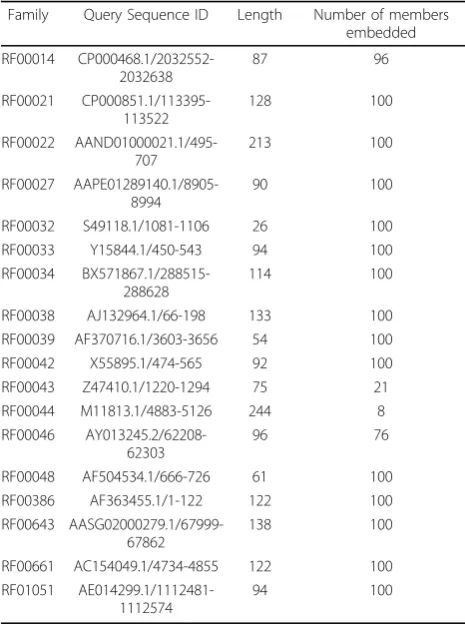
Letl be the the maximum length of all the members of the family. For every region inT with lengthl+20, we compute the structural alignment score of the region and the query sequence. We use the same scoring scheme as in [9] and set the gap starting penalty (h) and gap extension penalty (s) to be 5 and 0.1, respectively. The details of the families including the sequence selected as the query, the length of the sequence, and the number of members embedded in each family are given in Table 1.
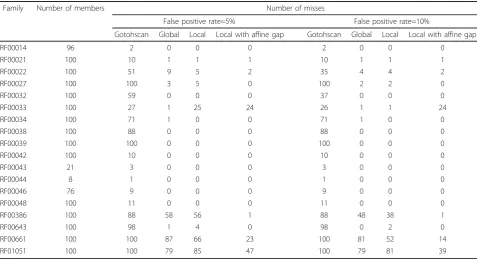
We compare our algorithm with the global structural alignment [10], local structural alignment without affine gap model and Gotohscan [8]. Gotohscan was used to locate ncRNAs candidates on Trichoplax adhaerens by using single real ncRNA as query. It was designed to check only sequence similarity with affine gap model. Since the global structural alignment software is not available, we implemented both global and local without affine gap algorithms. For Gotohscan, we downloaded the version 1.3 from the website. We assume that regions other than the members of the family are false hits as they are likely not to be members of the family. To compute the effectiveness of our method, we use the
smallest threshold with no false positive and the thresh-olds of allowing 5% or 10% false positive rate. We assume that the method finds a real hit if the score of the region is larger than this threshold. Thus a real hit will be missed if the computed score is smaller than or equal to this threshold. Table 2 and Table 3 summarize the result when using different algorithms to locate the other ncRNA members along the genome. When the smallest threshold with no false positive is used, the average percentage of misses when using Gotohscan is 53.9%; global alignment is 18.4%; local alignment with-out affine gap model is 17.9%; local alignment with affine gap model is 7.2%. When the threshold of allow-ing 5% or 10% false positive rate is used, the results show that the local structural alignment algorithm with affine gap model also works satisfactory except for the family RF00033. Table 4 also lists the area under the ROC curve when considering the false positive rate ≤ 10%. Note that the area is normalized to the range between 0 and 1.
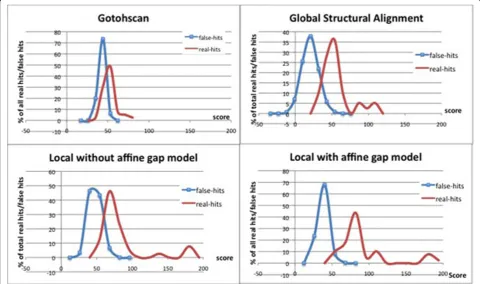
We also use RF00661 as an example and show the score distribution between the real hits and the false hits when using different algorithms in Figure 2. As one can see, the local structural alignment algorithm with affine gap penalty can increase the difference between the scores of real hits and the scores of false hits com-pared with the other methods, and so it has a higher distinguishing power to identify the real ncRNA mem-bers along the long genome sequence for these families.
Our program take around 15 seconds for performing local structural alignment with affine gap model between query and target of around 150 bases long, and around 30 seconds for 200 bases long. We tested the program on a machine with 2.4GHz dual-core CPU and 8G memory.
Conclusions
In the paper, we provided an algorithm to handle local structural alignment with affine gap model of RNA with regular structure that compute the optimal alignment. Our experiments show that the solution is effective for some ncRNA families in which members may have vary-ing sizes on hairpins, loops or stems (contributvary-ing to large gaps) when compared to using only global align-ment or local alignalign-ment without gap model. And also we have not yet studied different types of gap penalty model and the effect of setting different gap penalty parameters. Other interesting directions include speed-ing up the algorithm and considerspeed-ing other more
com-plicated structures (e.g. the structures with
pseudoknots). In the mean time, we have completed the algorithm of computing local structural alignment for simple pseudoknots structure, and we are now in the progress of performing experiments.
Table 1 The details of the ncRNA families used in the experiments.
Family Query Sequence ID Length Number of members embedded
RF00014 CP000468.1/2032552-2032638
87 96
RF00021 CP000851.1/113395-113522
128 100
RF00022 AAND01000021.1/495-707
213 100
RF00027 AAPE01289140.1/8905-8994
90 100
RF00032 S49118.1/1081-1106 26 100
RF00033 Y15844.1/450-543 94 100
RF00034 BX571867.1/288515-288628
114 100
RF00038 AJ132964.1/66-198 133 100
RF00039 AF370716.1/3603-3656 54 100
RF00042 X55895.1/474-565 92 100
RF00043 Z47410.1/1220-1294 75 21
RF00044 M11813.1/4883-5126 244 8
RF00046 AY013245.2/62208-62303
96 76
RF00048 AF504534.1/666-726 61 100
RF00386 AF363455.1/1-122 122 100
RF00643 AASG02000279.1/67999-67862
138 100
RF00661 AC154049.1/4734-4855 122 100
RF01051 AE014299.1/1112481-1112574
Methods
We develop a dynamic programming algorithm to solve the problem. Before we describe the method, we would like to define some variations of alignments which will be used in our algorithm. Let S[1…m] be the query
sequence with known structure M and T[1…n] be the target sequence with unknown structure.
Definition 4Optimal prefix-global structural alignment between S[1…m]and T[1…n]is to find a prefix S[1…y] where0≤y≤m(i.e. S is an empty string when y= 0) such
Table 2 Summary of comparison on results between global alignment, local alignment without gap penalty and local alignment with affine gap penalty when using the smallest threshold such that there is no false positive.
Family Number of members Number of misses
Gotohscan [8] % Global [10] % Local % Local with affine gap %
RF00014 96 2 2.1% 0 0% 0 0% 0 0%
RF00021 100 10 10% 5 5% 5 5% 2 2%
RF00022 100 59 59% 20 20% 19 19% 4 4%
RF00027 100 100 100% 15 15% 9 9% 2 2%
RF00032 100 59 59% 4 4% 1 1% 0 0%
RF00033 100 29 29% 27 27% 27 27% 25 25%
RF00034 100 71 71% 11 11% 22 22% 7 7%
RF00038 100 88 88% 0 0% 0 0% 0 0%
RF00039 100 100 100% 1 1% 1 1% 1 1%
RF00042 100 10 10% 0 0% 0 0% 0 0%
RF00043 21 3 14.3% 0 0% 0 0% 0 0%
RF00044 8 1 12.5% 0 0% 0 0% 0 0%
RF00046 76 9 11.8% 2 2.6% 1 1.3% 0 0%
RF00048 100 17 17% 0 0% 0 0% 0 0%
RF00386 100 88 88% 63 63% 62 62% 6 6%
RF00643 100 98 98% 4 4% 13 13% 0 0%
RF00661 100 100 100% 87 87% 77 77% 30 30%
RF01051 100 100 100% 91 91% 85 85% 52 52%
average 53.9% 18.4% 17.9% 7.2%
Table 3 Summary of comparison on results between global alignment, local alignment without gap penalty and local alignment with affine gap penalty when setting the threshold which allows 5% or 10% of false positives.
Family Number of members Number of misses
False positive rate=5% False positive rate=10%
Gotohscan Global Local Local with affine gap Gotohscan Global Local Local with affine gap
RF00014 96 2 0 0 0 2 0 0 0
RF00021 100 10 1 1 1 10 1 1 1
RF00022 100 51 9 5 2 35 4 4 2
RF00027 100 100 3 5 0 100 2 2 0
RF00032 100 59 0 0 0 37 0 0 0
RF00033 100 27 1 25 24 26 1 1 24
RF00034 100 71 1 0 0 71 1 0 0
RF00038 100 88 0 0 0 88 0 0 0
RF00039 100 100 0 0 0 100 0 0 0
RF00042 100 10 0 0 0 10 0 0 0
RF00043 21 3 0 0 0 3 0 0 0
RF00044 8 1 0 0 0 1 0 0 0
RF00046 76 9 0 0 0 9 0 0 0
RF00048 100 11 0 0 0 11 0 0 0
RF00386 100 88 58 56 1 88 48 38 1
RF00643 100 98 1 4 0 98 0 2 0
RF00661 100 100 87 66 23 100 81 52 14
that the score of the optimal global structural alignment between the prefix S[1…y]and T[1…n]is maximum.
Definition 5 Optimal suffix-global structural align-ment between S[1…m] and T[1…n] is to find S[x…m] where1 ≤x≤m + 1 (i.e. S is an empty string when x= m + 1) such that the score of the optimal global struc-tural alignment between the suffix S[x…m]and T[1…n] is maximum.
Definition 6Optimal semi-global structural alignment between S[1…m]and T[1…n]is to find a substring S[x… y]where1≤x, y≤ m such that the score of the optimal global structural alignment between the substring S[x…y] and T[1…n]is maximum.
Let the affine gap model beh+sL, wherehis the gap opening penalty, s represents a gap extension penalty, and Ldenotes the length of gap. Our method consists of two steps. In the first step, we compute the optimal semi-global structural alignment betweenS and all pos-sible substrings of T. In the second step, we obtain the optimal local structural alignment between S andT resulted in the first step. Define A(p, q,e, f) to be the score of the optimal semi-global structural alignment betweenS[p…q] andT [e…f]. The score of the optimal
Table 4 Summary of the area (normalized) under ROC curve for false positive rate≤10%
Family Area (normalized) under ROC curve
Gotohscan Global Local Local with affine gap
RF00014 0.98 1.0 1.0 1.0
RF00021 0.9 0.99 0.99 0.99
RF00022 0.53 0.92 0.93 0.98
RF00027 0.0 0.96 0.96 1.0
RF00032 0.61 0.99 1.0 1.0
RF00033 0.73 0.93 0.79 0.76
RF00034 0.29 0.98 0.99 0.99
RF00038 0.12 1.0 1.0 1.0
RF00039 0.0 1.0 1.0 1.0
RF00042 0.9 1.0 1.0 1.0
RF00043 0.86 1.0 1.0 1.0
RF00044 0.88 1.0 1.0 1.0
RF00046 0.88 1.0 1.0 1.0
RF00048 0.89 1.0 1.0 1.0
RF00386 0.12 0.42 0.49 0.98
RF00643 0.02 0.99 0.96 1.0
RF00661 0.0 0.14 0.36 0.79
RF01051 0.0 0.18 0.17 0.56
Figure 2Score distribution between the real hits and the false hits when using different algorithms for the family RF00661.The figure
local structural alignment between S and T can be obtained from the entry maxe≤f+1A(1, m, e, f). We first show how to compute A, then show how to use the structure of S to guide the computation of Awithout considering all possible combinations ofp,q.
When considering any substringS′=S[x′…y′] ofS[x… y], there are four possible cases: (1)S′is equal toS (i.e. x′=x,y′=y); (2)S′is a proper prefix inS(i.e.x′=x,y′ <y); (3)S′is a proper suffix inS(i.e.x′>x,y′=y); (4)S′ is a substring ofS[x+ 1…y–1] (i.e.x′>x,y′<y); There-fore, we can consider each case one by one when com-puting the value ofA. and it is the maximum value of four cases: (1) whenS′ =S[p,q] (i.e.A1(p,q,e,f)); (2) whenS′is a proper prefix
The following subsections describe how to compute A1,A2,A3,A4.
Calculation ofA1
When considering the optimal global structural align-ment (with affine gap model) between S[p…q] and T with space. Hence, we can consider each case one by one when computing the value ofA1.
DefineA1x(p, q,e,f), where 1≤x ≤9, to be the score
of the optimalglobalstructural alignment betweenS[p… q] andT[e…f] where the above casexis satisfied. (i.e. if x= 1, thenS[p] is aligned withT[e] andS[q] withT[f]).
The value ofA1(p, q,e,f) can be computed recursively and it is the maximum value of nine cases. Lemma 2 summarizes these cases.
We will describe the calculation of A12. Similar skill can be applied for the others (i.e.A11,A13, …,A19).
Calculation of A12
Calculation ofA2
When considering the optimal prefix-global structural alignment (with affine gap model) between S[p…q] and T[e…f], there are four possible cases: (1) S[p] is aligned withT[e]; (2) S[p] with space; (3) T[f] with space; and (4) an empty string ofSwithT.
DefineA2x(p, q,e,f), where 1≤x ≤3, to be the score
of the optimal prefix-global structural alignment between S[p…q] and T[e…f] where the above casex is satisfied. (i.e. if x = 1, thenS[p] is aligned with T[e]). Note that we do not need to define function for the case 4 because the corresponding score is –h– s(f– e + 1). The value of A2(p,q,e, f) can be computed recur-sively and it is the maximum value of four cases. Lemma 4 summarizes these cases.
Lemma 4
A2(p,q,e,f) = max{A21[p,q,e,f],A22[p,q,e,f],A23[p, q,e,f],–h–s(f–e+ 1)}
We will describe the calculation of A22. Similar skill can be applied to calculateA21andA23.
Calculation of A22
The following lemma lists out the computation ofA22.
Lemma 5 where S[p] is aligned with space. Similar to A12, there are also the same three situations. Situation I: when (p, q) is a base pair - aligning the base pair S[p] with space. – 1] is considered, there are two possibilities: (1) the whole sequenceS[p,q′] is aligned withT[e,k] (i.e. global alignment) and a prefix ofS[q′ + 1,q] is aligned with T [k + 1, f] (i.e. semi-global); (2) a prefix of S[p, q′] is aligned withT[e,k] (i.e. semi-global) only. Situation III:
whenpdoes not form base pair with any base q′ Î [p, q] - we align baseS[p] with space. For each possibility of situation I & III, there are also two conditions: ifS[p + 1] is aligned with T[e] orT[e] is aligned with space, the penalty scoreh+sshould be considered. Otherwise, ifS[p+ 1] is aligned with space, then the penalty scores should be considered. The lemma 5 summarizes these cases.
The calculations forA3andA4 are similar. In the fol-lowing subsection, we will describe the time complexity of the algorithm.
Time complexity
To fill the dynamic programming table, not all entries for all possible subrange ofSneeds to be filled. Accord-ing to the design of the dynamic programmAccord-ing, there are three cases:
Therefore, we define a functionζ(p, q) to determine for which set of subregions inS, we need to fill the cor-responding entires in all the tables.
( , )
We only need to fill in the entries for all the tables provided (p,q) can be obtained from (1,m) by applying
ζfunction repeatedly. Considering the ζfunction, each time the total size of the subregions outputted cannot be greater than the size of the input region and each of the subregions outputted is smaller than the input region. Therefore, in total there are onlyO(m) such (p, q) values. Also, there areO(n2) values of different (e,f) values, and for each entry, it takesO(n) because of the consideration ofe–1≤k≤fin the case that∃q′ <qs.t.
Acknowledgements
The project is partially supported by the Seed Funding Programme for Basic Research (Project number: 200911159065) of the University of Hong Kong. This article has been published as part ofBMC ProceedingsVolume 5 Supplement 2, 2011: Proceedings of the 6th International Symposium on Bioinformatics Research and Applications (ISBRA’10). The full contents of the supplement are available online at http://www.biomedcentral.com/1753-6561/5?issue=S2.
Authors’contributions
TW and SY conceived the study. All authors refined the study. TW and BC came up the algorithm and BC implemented it. All authors contributed to the analysis. TW, SY and TL participated in drafting the manuscript. All authors read and approved the final version.
Competing interests
The authors declare that they have no competing interests.
Published: 28 April 2011
References
1. Frank DN, Pace NR:Ribonuclease P: unity and diversity in a tRNA processing ribozyme.Annu. Rev. Biochem1998,67:153-180.
2. Nguyen VT, Kiss T, Michels AA, Bensaude O:7SK small nuclear RNA blinds to and inhibits the activity of CDK9/cyclin T complexes.Nature2001,
414:322-325.
3. Wadler CS, Vanderpool CK:A dual function for a bacterial small RNA: SgrS performs base pairing-dependent regulation and encodes a functional polypeptide.Proc Natl Acad Sci USA2007,104(51):20454-9.
4. Yang Z, Zhu Q, Luo K, Zhou Q:The 7SK small nuclear RNA inhibits the CDK9/cyclin T1 kinase to control transcription.Nature2001,414:317-322. 5. Liu C, Bai B, Skogerbo G, Cai L, Deng W, Zhang Y, Bu D, Zhao Y, Chen R:
NONCODE: an integrated knowledge database of non-coding RNAs.NAR
2005,33(Database issue):D112-D115.
6. Griffiths-Jones S, Bateman A, Marshall M, Khann A, Eddy SR:Rfam: an RNA family database.NAR2003,31:439-441[Http://www.sanger.ac.uk/Software/ Rfam/].
7. Eddy SR:Non-coding RNA genes and the modern RNA world.Nat Rev Genet.2001,2(12):919-929.
8. Hertel J, de Jong D, Marz M, Rose D, Tafer H, Tanzer A, Schierwater B, Stadler PF:Non-coding RNA annotation of the genome of Trichoplax adhaerens.Nucleic Acids Research2009,37(5):1602-1615.
9. Klein RJ, Eddy SR:RSEARCH: Finding homologs of single structured RNA sequences.BMC Bioinformatics2003,4:44.
10. Zhang S, Haas B, Eskin E, Bafna V:Searching genomes for noncoding RNA using FastR.IEEE/ACM TCBB2005,2:4.
11. Tabei Y, Asai K:A local multiple alignment method for detection of non-coding RNA sequences.Bioinformatics2009, [Doi:10.1093/bioinformatics/ btp261].
12. Will S, Reiche K, Hofacker IL, Stadler PF, Backofen R:Inferring noncoding RNA families and classes by means of genome-scale structure-based clustering.PLOS Computational Biology2007,3(4):e65.
13. Jiang T, Lin G, Ma B, Zhang K:A general edit distance between RNA structures.Journal of Computational Biology2002,9(2):371-388. 14. Lin GH, Chen ZZ, Jiang T, Wen J:The longest common subsequence
problem for sequences with nested arc annotations.Journal of Computer and System Sciences2002,65(3):465-480.
15. Nawrocki EP, Eddy SR:Query-Dependent Banding (QDB) for faster RNA similarity searches.PLoS Comput Biol. 2007,3(3):e56.
16. Le S, Chen J, Maizel J:Efficient searches for unusual folding regions in RNA sequences.InStructure and Methods: Human Genome Initiative and DNA Recombination. Volume 1.Adenine Pr; 1990:127-130.
17. Rivas E, Eddy SR:Secondary structure alone is generally not statistically significant for the detection of noncoding RNAs.Bioinformatics2000,
16(7):583-605.
18. Mosig A, Zhu L, Stadler PF:Customized strategies for discovering distant ncRNA homologs.Briefings in Functional Genomics and Proteomics2009, [To appear].
doi:10.1186/1753-6561-5-S2-S2
Cite this article as:King-Fung Wonget al.:Local structural alignment of RNA with affine gap model.BMC Proceedings20115(Suppl 2):S2.
Submit your next manuscript to BioMed Central and take full advantage of:
• Convenient online submission
• Thorough peer review
• No space constraints or color figure charges
• Immediate publication on acceptance
• Inclusion in PubMed, CAS, Scopus and Google Scholar
• Research which is freely available for redistribution