A Novel Evaluation Method for Morphological Segmentation
Javad Nouri, Roman Yangarber
Department of Computer ScienceUniversity of Helsinki, Finland [email protected]
Abstract
Unsupervised learning of morphological segmentation of words in a language, based only on a large corpus of words, is a challenging task. Evaluation of the learned segmentations is a challenge in itself, due to the inherent ambiguity of the segmentation task. There is no way to posit unique “correct” segmentation for a set of data in an objective way. Two models may arrive at different ways of segmenting the data, which may nonetheless both be valid. Several evaluation methods have been proposed to date, but they do not insist onconsistencyof the evaluated model. We introduce a new evaluation methodology, which enforces correctness of segmentation boundaries while also assuring consistency of segmentation decisions across the corpus.
Keywords:Morphology, unsupervised learning, segmentation, evaluation, consistency.
1.
Introduction
Over the last 15 years, a number of algorithms have been proposed for learning of the morphological structure of lan-guages from raw data—large lists of words in the language (the corpus). This paper addresses the problem of evaluat-ing the performance of such algorithms. Morphology learn-ing is especially interestlearn-ing for morphologically rich lan-guages, where words can consist of many morphs, which are surface realizations of morphemes; a morpheme is a minimal unit, which carries meaning or syntactic function. Ultimately, the problem of morphological analysis includes several aspects. One is identifying the structure of each word—which segments it consists of, and the types of seg-ments. In many languages segments can be stems and af-fixes; affixes can be prefixes, suffixes, etc. Another aspect is identifyingallomorphy, which involves linking different variants (allomorphs) of a given morpheme, which appear in different words, and typically depend on phonological context. For example, it is not trivial to discover that in Englishtry-ingandtri-edhave the same stem morpheme. It is well understood how one can build morphological an-alyzers for many languages. This is typically done by writ-ing morphological grammars, based on dictionaries of mor-phemes for stems and affixes, and writing rules for combin-ing the morphemes into words, e.g., (Koskenniemi, 1983). The morphological analyzer is then used to analyze any word in text, and is an essential low-level component in many tasks in natural language processing (NLP), such as parsing, machine translation, etc.
Unsupervised learning of morphology is the inverse prob-lem: to infer the morphology of all words in the language, given only a large number of words—given no dictionar-ies, rules, etc. A number of algorithms have been proposed and their performance has been compared, e.g., in a series of shared-task competitions, the Morpho-Challenges, (Ku-rimo et al., 2010). The competitions provided annotated data, and tools for evaluation of performance.
The majority of algorithms for unsupervised learning of morphology (that we have reviewed), treat the segmenta-tion of words into morphs either as the ultimate goal or as a first step on the way toward learning the “deeper” as-pects of morphology, viz., allomorphy. Allomorphy (when
it is treated) is seen by most as a second step, after a seg-mentation has been obtained. At the same time, some pa-pers observe the difficulty ofevaluatingsegmentations di-rectly(Virpioja et al., 2011); we review some of these prob-lems in this paper.
We agree that the ultimate goal of unsupervised learning of morphology is to learn everythingabout the morphologi-cal system. Our view is that segmentation is an interesting problem—whether as an end in itself, or as a first step to-ward learning deeper morphology—and as such it should be and can be evaluateddirectly.
The paper will present the details of new gold-standard an-notation guidelines, and an algorithm to evaluate morpho-logical segmentation of words based on this gold standard, focusing on theconsistencyof the segmentation.1
The paper is organized as follows: in Section 2. we define the problem of evaluation of morphological segmentation, in Section 3. we review methods for evaluation of morphol-ogy learning algorithms, in Section 4. the motivation for a new evaluation method is presented, followed by our ap-proach to the evaluation in Section 5.. Experimental results are presented in Section 6. and we conclude in Section 7. with discussions and possible improvements.
2.
Problem Definition
Our goal is to define a quantitativemeasure of goodnessof a segmentation produced by a model, compared to a gold-standard(reference) segmentation. Several methods have been designed to evaluate segmentation algorithms, either
directlyusing the resulting segmentations, or indirectly— by using the segmentation algorithm to perform another NLP task, such as speech recognition or information re-trieval (Virpioja et al., 2011). While using the algorithm in a NLP task is useful for predicting the quality of the al-gorithm as used inside that application, our goal here is to devise a method to evaluate the segmentationdirectly. It is important to mention that we address only the task of
unsupervisedwordsegmentation, i.e., decomposing words into their surface morphs, using a large corpus of words
1The evaluation software along with experimental data is
in the language; we do not address full morphological analysis which would produce a list ofmorphemesand/or morpheme classes for each word. The two problems are related, but not identical. We focus on evaluating al-gorithms that produce a segmentation for each word in the corpus, e.g., (Bernhard, 2008), Morfessor Categories-MAP (Creutz and Lagus, 2007), ParaMor (Monson et al., 2009), RALI-ANA (Lavall´ee and Langlais, 2010), MetaMorph (Tchoukalov et al., 2010), Morfessor Base-line (Creutz and Lagus, 2005), and others. As a conse-quence, we assume that if we concatenate the segmenta-tions, the result is identical to the input word.
The problem can be viewed as evaluating how correctly the morpheme boundaries are placed within the word— compared to the gold-standard reference. For example, in English, dogsmust be segmented asdog+s where+ de-notes a morph boundary between stem and suffix. Note that some languages (Arabic, German, etc.) use non-concatenative (e.g., ablaut) processes for inflection and derivation, which cannot be described by segmentation. We deal primarily with languages for which segmentation provides a good approximation to morphology—which in-cludes many Indo-European languages, agglutinative lan-guages from the Uralic family, Turkic, and many others.
3.
Prior Work
We review methods for evaluating algorithms for automatic learning of morphology. These methods can be categorized as eitherdirectapproaches, which assign scores to models by examining the output of the model; or indirect, which evaluate the model as a component of the larger task. The evaluation is then done based on how much better the larger task performs when the model is used.
A review of evaluation methods for different morphological tasks can be found in (Virpioja et al., 2011), which also in-troduces several new variations of the existing algorithms. Beyond morphological segmentation, these tasks include
clustering of word formsandfull morphological analysis. Direct evaluation methods are, in general, believed to bet-ter reflect the characbet-teristics of the algorithm, while indirect methods complicate the evaluation task, since one needs to minimize the effect of other factors in the larger task (Vir-pioja et al., 2011).
Other evaluation methods, which evaluate more than segmentations, or require more output from the model than only morphological segmentations, are described in (Spiegler and Monson, 2010; Virpioja et al., 2011). A widely used approach (Kurimo et al., 2006; Snyder and Barzilay, 2008; Poon et al., 2009) for evaluating segmen-tation of words is the boundary precision,recall, and ac-curacy(BPRA2), based on the number of reference bound-aries found and missed. If a set of correctsegmentation points for the given words could be provided, the segmen-tation task could be viewed as an information retrieval (IR) task, where the items to be retrieved are the segmenta-tion boundaries. Then the standard IR evaluasegmenta-tion measures
2
Most earlier works do not include accuracy as one of the mea-sures, however we will include it in this paper along with preci-sion, recall, and F-score since it is a related and relevant measure.
precision(P), recall (R), and F-score (F) can be defined as:
P = |{gold standard boundaries} ∩ {retrieved boundaries}|
|{retrieved boundaries}|
R= |{gold standard boundaries} ∩ {retrieved boundaries}|
|{gold standard boundaries}|
F = 2· P·R P+R
(1)
Alternatively, using notation from binary classification, precision, recall, F-score and accuracy (A) can be com-puted as:
P= tp
tp+f p
R= tp
tp+f n
A= tp+tn
tp+tn+f p+f n
(2)
wheretp,tn,f p,f ndenote number of true positives, true negatives, false positives and false negatives, respectively. Positive (negative) means that the model found (did not find) a morph boundary annotated in the gold standard. One evaluation scheme, based on the BPRA method and related to our work, can be found in (Creutz and Lind´en, 2004; Creutz et al., 2005). To allow the model to choose one of several alternative reference segmentations, they define fuzzy boundaries; instead of a strict segmentation points in words, the model will receive credit if the segmen-tation boundary is placed anywhere in the area permitted by the reference set.
4.
Motivation
The BPRA approach has been used in several studies (Vir-pioja et al., 2011); however, it has several important short-comings. In most languages that have concatenative (or ag-glutinative) morphological processes,it is not always clear
where the correct boundaries should be placed, because of the complexities in the morpho-phonology of the language. For example, in Turkish, consider the morphology of
ekme˘gi, composed of ekmek (’bread’) + i (accusative marker);kchanges to˘gdue to regular consonant mutation. Onemodel—i.e., one learning algorithm—might segment this word asekme˘g+i, consideringekme˘gan allomorph of
ekmekandias the accusative marker, while another model might segment it asekme+˘gi, consideringekmeas an allo-morph of ekmek, and ˘gian allomorph ofi. Similarly, the plural in English: analyzing flies, one model could posit that the plural marker is -s(as indog+s) and the stemfly
has an allomorphflie-. Another model might posit an al-lomorph for the stemfli-and an allomorph-esfor the plu-ral marker. Clearly, there is no way to insist that one of the models is “better” or more correct than the other. This makes specifying the gold-standard segmentation problem-atic.
marking an acceptable regionwhere the boundary can be placed. If the model predicts a boundary anywhere within the region, it receives credit. Such an evaluation method is suggested in (Creutz and Lind´en, 2004; Creutz et al., 2005) as part of the Hutmegs package, as an attempt to provide gold-standard segmentations for Finnish. The main prob-lem with this approach is that it is too permissive: it ignores the question of consistency and allows the model to violate its own decisions. A good evaluation scheme should penal-ize the model forinconsistentbehavior.
In our Turkish example, ekme˘gi: both of the models dis-cussed are equally good, as long as they remain faithful to the decision they make throughout the entire corpus, i.e., the model that prefersekme˘g+ishould do so for all words where consonants mutate before vowels, such asekme˘g+e,
ete˘g+i,artı˘g+ı, etc.; if the model violates this (its own) de-cision on some words, it should be penalized.
5.
Gold Standard Annotation and
Evaluation Algorithm
A dilemma is a (language-specific) situation where more than one segmentation may be acceptable according to the gold-standard annotation. A particular decision that a model makes in case of a dilemma, is called atheorythat the model supports. For example, in English, the words
dogsandfliesmay have gold-standard segmentations:
X X
d o g + s f l i . e . s
Segmentation ofdogs is unproblematic, the placement of the morph boundary is clear, marked with+. Forflies, we wish to mark two alternative segmentations as acceptable. We do this by naming the dilemma,X, and specifying in the (language-specific) configuration that it has two acceptable theories, with boundary beforeor after e(not both). We indicate this by:
a. placing dots before and aftere, each dot labeled by X,
b. specifying (in the configuration) in the definition of X that acceptable theories for X are10or01.
This means that the word must be segmented as eitherfli+es
orflie+s, respectively;1indicates the presence of a bound-ary, and0indicates absence of it.
The key point then is that if the evaluation corpus contains many similar words—flies, tries, cries, supplies, etc.—and they are all annotated similarly, then the model must seg-mentallof these words according to theory10or according to theory01—consistently. If the model is not consistent, it will be penalized. However, the penalty must be applied in such a way as to give it maximal benefit of the doubt. For instance, if the model segments above words as:
f lie+s trie+s crie+s supplie+s
it will get full credit for all four words (according to the-ory 01). However if the model outputs the following as its answer to the segmentation problem:
f li+es trie+s crie+s supplie+s
although these segmentations are correct individually, the model, as a whole is behaving inconsistently and should not be given full credit. There are two possible scenarios here. One is to assume that for this dilemma (X) the cor-rect theory is01, meaning that the accepted segmentation pattern is “· · ·ie+s”, in which case 3
4 of the words will
yield full credit. The other case is to consider the theory10
as correct, “· · ·i+es”, which will result in full credit for
1
4 of the words. Since these two theories are both valid
ac-cording to the configuration, at evaluation time, the evalua-tion algorithm must find which theory results in the highest score for the model. In this example the theory supported by the majority of the words should be chosen as the refer-ence.3. This is what we mean by assuringmaximal benefit of the doubt. By following this approach, the evaluation al-gorithm does not discriminate against any model, since it assures maximal possible score for every model. The the-ory that yields the maximal score for a dilemma is referred to as the “decision” that model makes, or thetheorythat it
supports.
Many other kinds of dilemmas and theories can be defined. Each dilemma is marked with its own unique label in the gold standard annotation, along with the theories it admits. In our approach to evaluation of segmentations, given a dilemma, the model receives credit for selecting one of the theories that the gold standard accepts, in a consistent way. It is crucial to note that these dilemmas are independent from each other, i.e., supporting a theory in one dilemma does not restrict or encourage a theory of another dilemma. Given a gold-standard annotation, if we fix some theory for each dilemma, we can generate the set of unambiguous
correctsegmentations for these fixed theories. The evalu-ation algorithm then computes the boundary precision, re-call, and accuracy (BPRA) to score the model’s segmenta-tion in the standard way.
The crucial feature of our method is that it identifies which theories arepreferred by the system, given the segmenta-tions that are being evaluated. A theory is preferred, if choosing it would yield the highest score for the system. Since all theories are equally valid, the evaluation algorithm must find the one that maximizes the overall score. Computing this exhaustively would require listing all possi-ble segmentation sets based on all possipossi-ble theories for each dilemma. This would make the problem intractable when the number of dilemmas is large, since it will require going throughO(nk)potential reference segmentations, wheren is the number of dilemmas andkis the maximum number of theories for a dilemma.
The overall score that we aim to maximize for the sys-tem is accuracy, since maximizing precision or recall sep-arately results in preferring under-segmentation or over-segmentation, respectively. One could maximize the F-score to balance recall and precision, but because of a
com-3Although this is true for this dilemma, we show in section 5.4.
plicated and non-linear relation between F-score and the number of segmentation points, it is not obvious how it could help to perform the computations with reasonable time complexity. We show how maximizing accuracy, un-der the assumption of independence of the theories, allows us to produce a consistent evaluation score.
5.1.
Dilemmas and Labels
As mentioned above, our focus in this evaluation method is on dilemmas that a human expert/annotator encoun-ters while annotating the segmentations—alternative ways to segment a word into morphs that are legitimate, and only depend on the annotator’s decisions about allomor-phy. These dilemmas can depend on what morphemes are present in the word and in the context of what other mor-phemes they appear.
Each dilemma is identified by a unique label. There are labels of differentarities, which will be explained briefly using examples.
5.2.
Two-Way Dilemmas
This is the simplest type of possible dilemma. It is used when a human expert believes that placing a morph bound-ary between two symbols is optional, meaning that it is not absolutely necessary to segment it at that point. One exam-ple would be in cases where for historical reasons one might place a morph boundary between two potential morphs.4In other words, the morph pair is old enough (“ossified”) to be legitimately considered as a single morph. One example in Turkish isc¸ıkmaz(meaning ’stalemate’, ’dead end’) which is considered by many as a single morph, but could be seg-mented as c¸ık (from c¸ıkmak; ’to exit’) and suffix -maz a form of negation in Turkish).
Another example is Finnisharvo(meaning ’value’)5
Y arv.o
This means that the system under evaluation can decide ei-ther to segment at the points labeled Yor not to segment. Segmenting (placing a morph boundary) at this point cor-responds to theory1and no boundary corresponds to theory
0; the valid theories for dilemmaYare0and1. The prac-ticality of this notation will become clear later, with labels of higher arity. This is declared in the gold-standard anno-tation, in the configuration file:
(Y 2 0 1)
The first element of the list is the symbol (label) that iden-tifies the dilemma; meaning,Yis a dilemma with two pos-sible theories/choices, of which (both!)0and1are accept-able theories.
5.3.
Four-Way and Higher-arity Dilemmas
Sometimes in gold standard annotation we face dilemmas in which more than one potential boundary is involved; for4
Or for any other reason.
5
In this example, it is not quite clear how to deal with the “o”. Although there exists a derivational suffix “-o” which is used to form nouns out of verbs, not nouns.
example,flies, as above, will be annotated:
X X fli.e.s
It is important to note that since label X will be used in this type of dilemmas, it willalwaysappear in pairs. Only one theory (ideally) should be selected as a segmentation decision by the system under evaluation, and for example if it chooses to segment at both points or neither, it should be penalized. To impose this kind of restriction, we use the following line in the label definition file:
(X 4 1 2)
the number 4 states that the dilemma X is a “4-way” dilemma, meaning that in total there are four possible theories—ways to perform the segmentation—that the sys-tem could follow; thus, there are log24 = 2 consecu-tive occurrences ofXexpected in the gold-standard words that contain this dilemma. The following numbers indi-cate which of the 4 possible segmentation theories are the-oretically valid and can be chosen by the system without penalty. The numbers are decimal values of binary repre-sentations of the possible segmentation configurations, des-ignating the presence of a morph boundary by1and lack of boundaries by0. This is depicted in Table 1.
possible comparison numeric segmentation to gold standard representation
fli.e.s
flie+s fli e+s (01)2= 1 fli.e.s
fli+es fli+e s (10)2= 2
Table 1: Valid segmentation configurations for labelXand
wordfli.e.s, with decimal representation. Segmenting
(placing a morph boundary) at a point corresponds to1and not segmenting corresponds to0.
Of course there can be such dilemmas where the annotator decides it is also acceptable to segment atbothlocations, or neither. In such a case, corresponding numbers0 = (00)2
and3 = (11)2can be added to the list of allowable theories.
Finally, this notation can be extended to dilemmas of higher order. For example the following configuration line would define a label for an 8-way dilemma (corresponding to 3 possible segmentation locations, hence, 3 consecutive la-bels in gold-standard annotation):
(C 8 3 5 6)
The list (3 5 6) indicates that thevalid theories are those which have exactly two (out of the three) segmentation points selected.
want to give the model under evaluation the freedom to choose any of the valid theories, but force it to be consistent throughout the corpus and make the same decisions in sim-ilar situations. The model will be penalized for breaking its own decision.
As discussed above, we need a way to determine, for each dilemma, which theory ispreferred by the model. In the “ideal” situation, where the model chooses one theory for each dilemma and segments all examples according to the chosen theory, it is clear that the preferred theory is the one that the model is complying with, and there is no penaliza-tion.
We next consider the case where for a given dilemma, D, the model decides to segment instances according to one of the theories,d1, but other instances according to another
theory,d2. Any of these theories could be chosen as the
cor-rect decision and the BPRA measures could be computed for them, but our goal is to give the modelmaximum ben-efit of the doubt. The theory that has been chosen most often throughout the data-set might seem to be the theory that should be preferred. Although this is true for one-way dilemmas, it is not always the case. The next example clar-ifies this:
Gold standard Model response
Z Z
1. abc.d.e abc d e
Z Z
2. fgh.i.j fgh i j
Z Z
3. klm.n.o klm n o
Z Z
4. pqr.s.t pqr s+t
Z Z
5. uvw.x.y uvw x+y
Z Z
6. zab.c.d zab+c+d
Z Z
7. efg.h.i efg+h+i
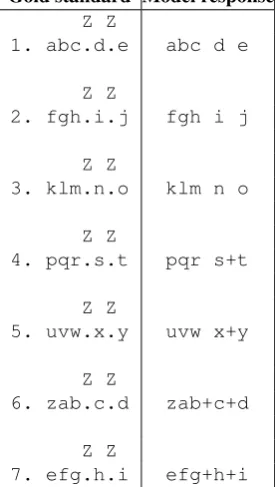
Figure 1: Left column: minimal example gold-standard an-notation, with 7 instances of the 4-way dilemmaZ. Right column: actual segmentations produced by a model to be evaluated using the gold standard; segmentation points are shown with +; blanks mark potential relevant segmenta-tion points that werenotsegmented by the model (shown as blanks to help visualization).
The annotated gold standard for label(X 4 0 1 2 3)
along with an example of a model’s response is shown in Figure 1. As easily seen, the first three cases are segmented according to theory 00, the next two according to theory
01, and the last two according to theory 11; no word is segmented according to theory10. It might seem that
the-ory 00is preferred by this particular model, but a closer look will falsify this. Let us compute the scores for each theory, assuming it is the preferred one. These score are showed in Table 2.
There are 7 words of length 5, so each has 4 potential segmentation boundaries. In total, there are 28 possible boundaries; 14 of these boundaries, which are not related to dilemmaZ, are correctly left unsegmented by the model, regardless of the chosen theory. Depending on the pre-ferred theory, some of the other boundaries are correct or incorrect. For instance if theory00is chosen, for each of the first three words, both boundaries relevant toZwill be counted as correct, so there will be 3×2 additional cor-rect boundaries. For the next two words, only one of the relevant boundaries (the first one) will be counted as cor-rect, which will account for 2 (compare this to the num-ber of bits in common between the preferred theory and the one supported by words 4,5). The last two words have been segmented incorrectly according to theory 00of Z, so they will not contribute anything to the final accuracy score. Thus, the accuracy in case of preferring00will be
14+3×2+2×1+2×0
28 =
22
28 = 0.786. The same process is
fol-lowed for the second theory resulting in an accuracy score of0.821. Although00has more supporters than01, it re-sults in a lower accuracy.
The reason is that for 2-way and higher-order dilemmas, when one theory is preferred, words that have been seg-mented according to other theories—i.e., which support other theories—may still contribute to the accuracy score. This is because the theories are not disjoint, but have seg-mentation points in common and choosing one theory, might partially help other theories as well. Due to these indirect contributions to the total score, sometimes a theory with fewer supporters can surpass another theory with more supporters.
Theory #Supporters P R F A
00 3 0 1 0 0.786
01 2 0.67 0.57 0.62 0.821
10 0 0.33 0.29 0.31 0.679
11 2 1.00 0.43 0.60 0.714
Table 2: Evaluation measures for the minimal example.
in-dependent of the chosen theories. More precisely, it is
ex-actly P
w∈Wgs
(|w| −1)whereWgsis the set of gold standard
words. Thus, we maximize the numerator and find:
arg max
[[D]]t
At= arg max
[[D]]t
tp+tn tp+tn+f p+f n
= arg max
[[D]]t
(tp+tn)
By definition, dilemmas are independent of each other, and selecting one does not influence the others. Additionally, the ambiguities in words do not overlap, and each boundary in the gold-standard words can be marked with a maximum of one label. Thus, we can maximize the sum of true pos-itives and true negativesseparately for each dilemma, and solve the problem by finding the preferred theory for one dilemma at a time.
Contribution totp+tn
Candidate
00 01 10 11
theory
00 2 1 1 0
01 1 2 0 1
10 1 0 2 1
11 0 1 1 2
Table 3: Contribution of each theory to tp+tn score for all candidate theories, for every instance of the dilemma in the data. Each cell shows how many correct segmentation boundaries will be contributed to the accuracy score if the theory corresponding to the row is preferred, and the theory corresponding to the column is supported by the word.
To do this, for each dilemma, we create a “contribution” table similar to Table 3. Each row corresponds to one can-didate theory; given that the theory corresponding to the row is the preferred one, the table shows how many correct boundaries would be contributed by supporters of theories in the columns. Since the dilemma in the Table is a 4-way dilemma, for each instance two boundaries should be exam-ined. For any instance, if the preferred theory is the same as the supported theory, there are two correct boundaries. If a different theory than the preferred one is selected, de-pending on how many segmentation decisions they havein common, it will contribute 1 point or none to the numerator. The number of common segmentation decisions is given by the number of bits the binary representations of the two the-ories have in common.
If the number of supporters of each theory is counted (de-noted byntfor theoryt), the result can be tabulated simi-larly to Table 4. The sum in each row shows what the con-tribution to the numerator will be if the corresponding can-didate theory the preferred one. The task is now straight-forward: select the theory for which the sum is maximized.
Another potential measure to maximize benefit of the doubt is the F-score. However, it is more complex than the accu-racy, since the denominator is not constant with respect to the chosen theories for dilemmas, thus it is not clear how one should find the preferred theory sets for each dilemma at a time without enumerating all possible valuations for dilemmas.
Contribution totp+tn
Candidate
00 01 10 11
theory
002n0+ n1 + n2 + 0
01 n0 + 2n1+ 0 + n3 10 n0 + 0 + 2n2+ n3
11 0 + n1 + n2 + 2n3
Table 4: Contribution of theories totp+tnfor each can-didate for the all occurrences of the dilemma. Each cell shows how many correct boundaries will be contributed to the accuracy score if the theory corresponding to the row is preferred by the whole data set and the theory correspond-ing to the column is supported by the word. ntis the num-ber of supporters of theorytin the data set. Decimal values representing theories are displayed for simplicity.
One potential problem with maximizing accuracy is the so-calledaccuracy paradox, which arises when the set of true positives is smaller than the set of false positives, and the model decides to unconditionally predict negative (i.e., leave all words unsegmented). The same also can happen when the true negative set is smaller than the true positive set and the model decides to segment at every potential seg-mentation point. In these two cases, the model can achieve a higher accuracy, while the F-score will be lower. The same principle of maximal benefit of the doubt can be ap-plied to cases where it is important to avoid this paradox, however the optimization technique presented here for ac-curacy will not be useful, as is for that task and the task might have a larger time complexity. We choose accuracy for optimization in this paper, and will explore optimization of F-score as part of our future work.
5.5.
Evaluation Algorithm
Given a set of segmented words (output of a model) and a gold standard annotation, as explained earlier, we take the following steps to evaluate the model:
1. Determine the set of decisions that the model has made, i.e., find the set of decisions that maximizes the benefit of the doubt as illustrated in Table 4.
2. Generate the reference segmentations of gold standard words based on the decisions.
3. Compare the response segmentations to the reference segmentations and calculate the true positives (tp), true negatives (tn), false positives (f p), and false neg-atives (f n). As earlier, “positive” means segmenting at a potential segmentation point (symbol boundaries).
4. Calculate the values of precision, recall, and F-score based on the computed values.
Most of the above steps are straightforward; we explain the details of step 1.
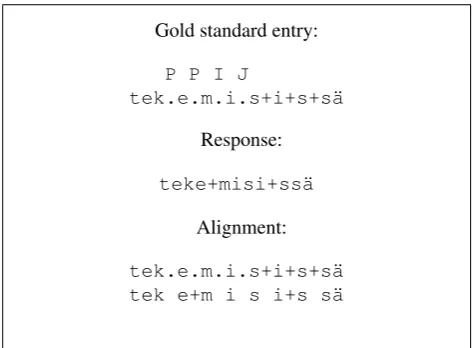
To achieve this, we first determine what decisions the model has made for each word. This is done via an alignment algorithm driven by Levenshtein distance.
Gold standard entry:
P P I J
tek.e.m.i.s+i+s+s¨a
Response:
teke+misi+ss¨a
Alignment:
tek.e.m.i.s+i+s+s¨a
tek e+m i s i+s s¨a
Figure 2: An example of a gold standard to response align-ment. Alignment of “.e.” to “ e+” shows that this par-ticular word prefers theory 01 for dilemma P. Similarly, alignment of “.” to “ ” shows a preference of theory 0 for dilemmasIandJ.
1. For each dilemmaD:
(a) List all the words from the segmentation set that are relevant toD.
(b) For each such word, find the supported theory us-ing Levenshtein algorithm to align the word to the gold standard entry.
(c) Count the number of supporters of each theory.
(d) Determine which choice of the valid theories yields the maximum accuracy, similarly to Ta-ble 4.
2. Once decisions for all dilemmas are made, generate the final reference segmentations (one segmentation per word) based on the decisions.
3. Use BPRA to compute the scores.
6.
Experiments
Experiments with evaluating consistent and inconsistent models using our method demonstrate the two key features: 1. If we have aninconsistentmodel, standard BPRA will
give it ahigherscore than our method.
2. If we have two competing models, our method will give a higher score to the model that ismore consis-tent.
For the experiments, we generated two segmentation sets from a gold standard annotated for a Finnish corpus, con-sisting of about 1000 words. Both sets contain valid seg-mentations for each word viewedseparately, however one of the sets is inconsistent in choosing the alternative seg-mentation points. The consistent set is generated by fixing one of the valid theories for each dilemma, and segmenting the words according to the chosen theory. For generating the inconsistent set, for each word and for each dilemma relevant to that word, one of the valid theories is chosen at random, and the word is segmented according to the deci-sions. Other segmentation boundaries are left untouched.
By definition, both segmentation sets will get the full score using the standard BPRA method, since all plausible seg-mentations are listed as alternatives in the gold standard, and any segmentation that is in that list will be accepted. The evaluation results for the two segmentation sets with our new method are tabulated in Table 5. In addition to pre-cision, recall, F-score and accuracy, several other statistics which are used to calculate the scores are also included. As it can be seen the consistent model gets full credit in all measures, whereas the penalization of the inconsistent model is reflected in the scores of Table 5.
Consistent Inconsistent
|G| 2617 2635
|S| 2617 2600
|G∩S| 2617 2471
tp+tn 8212 7919
tp+tn+f p+f n 8212 8212
Precision 100% 95.04%
Recall 100% 93.78%
F-Score 100% 94.40%
Accuracy 100% 96.43%
Table 5: Evaluation results: consistent and inconsistent seg-mentation sets.|G|is the number of segmentation points in the final reference set (based on gold standard and model’s decisions),|S|is the number of segmentation points in the model’s response,tp+tndenotes the number of matching boundaries, andtp+tn+f p+f nis the number of potential segmentation boundaries.
7.
Conclusion and Future Work
The features discussed in the previous sections distinguish our proposed evaluation method from methods used in prior work—where a model could not be required to segment data in a consistent fashion.In conclusion, we note that “ambiguity” is inherent in mor-phological segmentation: it is impossible to posit a sin-gle segmentation that is “correct” in many cases in many languages. Thus the gold standard must provideflexibility
to accommodate different theories of morphology. How-ever, if two models—where one is consistent and one is inconsistent—receive equal score, that means that the eval-uation method being used is not informative.
In addition to the above crucial features, our evaluation mark-up is easy to read and write by a human annotator, which is convenient for developing evaluation suites. Our evaluation method, while it resolves the matter of con-sistency, still leaves certain problematic cases unresolved. We briefly discuss them here.
One case is what we consider a true morphological am-biguity: a word that can be legitimately segmented in more than one way. For example, Turkish evini (ev: ’home/house’) can be analyzed as ev N+POSS2+ACC or
This applies to all similar word endings, such as+ını,+unu, and+¨un¨u; which one appears in an instance is determined by the rules of Turkish vowel harmony; this also occurs with other suffixes, such as dative, ablative, and other nom-inal cases.
We distinguish regular ambiguity from sporadic ambiguity. An ambiguity is regular if, as in the example above, there are many words that follow the same pattern, and have the same ambiguity. We plan to extend the current algorithm to address true ambiguities in future work.
Acknowledgments
Research supported in part by the Academy of Finland through the FinUgRevita Project, and the National Center of Excellence “Algorithmic Data Analysis” (ALGODAN).
8.
Bibliographical References
Bernhard, D. (2008). Simple morpheme labelling in un-supervised morpheme analysis. In Carol Peters, et al., editors,Advances in Multilingual and Multimodal Infor-mation Retrieval, volume 5152 ofLecture Notes in Com-puter Science, pages 873–880. Springer Berlin Heidel-berg.
Creutz, M. and Lagus, K. (2005). Unsupervised mor-pheme segmentation and morphology induction from text corpora using Morfessor 1.0. Technical Report A81, Helsinki University of Technology.
Creutz, M. and Lagus, K. (2007). Unsupervised mod-els for morpheme segmentation and morphology learn-ing. ACM Trans. Speech Lang. Process., 4(1):3:1–3:34, February.
Creutz, M. and Lind´en, K. (2004). Morpheme segmenta-tion gold standards for Finnish and English. Technical Report A77, Helsinki University of Technology. Creutz, M., Lagus, K., Lind´en, K., and Virpioja, S. (2005).
Morfessor and Hutmegs: Unsupervised morpheme seg-mentation for highly-inflecting and compounding lan-guages. In Proceedings of the Second Baltic Confer-ence on Human Language Technologies, pages 356–370, Tallinn, Estonia.
Koskenniemi, K. (1983). Two-level morphology: A gen-eral computational model for word-form recognition and production. Ph.D. thesis, University of Helsinki, Fin-land.
Mikko Kurimo, et al., editors. (2006). Proceedings of the PASCAL Challenge Workshop on unsupervised segmen-tation of words into morphemes, Venice, Italy. PASCAL European Network of Excellence.
Kurimo, M., Virpioja, S., Turunen, V., and Lagus, K. (2010). Morpho-Challenge 2005-2010: Evaluations and results. InProceedings of the 11th Meeting of the ACL Special Interest Group on Computational Morphology and Phonology, pages 87–95, Uppsala, Sweden, July. Association for Computational Linguistics.
Lavall´ee, J.-F. and Langlais, P. (2010). Unsupervised mor-phological analysis by formal analogy. In Carol Peters, et al., editors, Multilingual Information Access Eval-uation I. Text Retrieval Experiments, volume 6241 of
Lecture Notes in Computer Science, pages 617–624. Springer Berlin Heidelberg.
Monson, C., Carbonell, J., Lavie, A., and Levin, L. (2009). ParaMor and Morpho Challenge 2008. In Carol Peters, et al., editors, Evaluating Systems for Multilingual and Multimodal Information Access, volume 5706 ofLecture Notes in Computer Science, pages 967–974. Springer Berlin Heidelberg.
Poon, H., Cherry, C., and Toutanova, K. (2009). Un-supervised morphological segmentation with log-linear models. InProceedings of Human Language Technolo-gies: The 2009 Annual Conference of the North Ameri-can Chapter of the Association for Computational Lin-guistics, NAACL ’09, pages 209–217, Stroudsburg, PA, USA. Association for Computational Linguistics. Snyder, B. and Barzilay, R. (2008). Unsupervised
multilin-gual learning for morphological segmentation. InACL, pages 737–745.
Spiegler, S. and Monson, C. (2010). EMMA: a novel eval-uation metric for morphological analysis. In Proceed-ings of the 23rd International Conference on Compu-tational Linguistics, pages 1029–1037. Association for Computational Linguistics.
Tchoukalov, T., Monson, C., and Roark, B. (2010). Mor-phological analysis by multiple sequence alignment. In Carol Peters, et al., editors,Multilingual Information Ac-cess Evaluation I. Text Retrieval Experiments, volume 6241 ofLecture Notes in Computer Science, pages 666– 673. Springer Berlin Heidelberg.