Fingerprint Reference-Point Detection
Manhua Liu
School of Electrical & Electronic Engineering (EEE), Nanyang Technological University, Singapore 639798 Email:[email protected]
Xudong Jiang
School of Electrical & Electronic Engineering (EEE), Nanyang Technological University, Singapore 639798 Email:[email protected]
Alex Chichung Kot
School of Electrical & Electronic Engineering (EEE), Nanyang Technological University, Singapore 639798 Email:[email protected]
Received 22 May 2004; Revised 20 August 2004; Recommended for Publication by Montse Pardas
A robust fingerprint recognition algorithm should tolerate the rotation and translation of the fingerprint image. One popular solution is to consistently detect a unique reference point and compute a unique reference orientation for translational and rota-tional alignment. This paper develops an effective algorithm to locate a reference point and compute the corresponding reference orientation consistently and accurately for all types of fingerprints. To compute the reliable orientation field, an improved ori-entation smoothing method is proposed based on adaptive neighborhood. It shows better performance in filtering noise while maintaining the orientation localization than the conventional averaging method. The reference-point localization is based on multiscale analysis of the orientation consistency to search the local minimum. The unique reference orientation is computed based on the analysis of the orientation differences between the radial directions from the reference point, which are the directions of the radii emitted from the reference point with equivalent angle interval, and the local ridge orientations along these radii. Experimental results demonstrate that our proposed algorithm can consistently locate a unique reference point and compute the reference orientation with high accuracy for all types of fingerprints.
Keywords and phrases:fingerprint recognition, fingerprint alignment, reference point, orientation smoothing, orientation con-sistency, reference orientation.
1. INTRODUCTION
Fingerprint iscomposed of parallel ridgesand furrows on the tip of the finger. It is widely used for personal identification because of its easier accessibility, uniqueness, reliability, and low cost. Generally, there are two kinds of features for fin-gerprint recognition: global features such as the special ridge flow pattern and local features like minutia. Consistent ex-traction of these features is crucial for fingerprint recogni-tion. However, pose transformation, that is, translation and rotation, usually exists in different fingerprint samples of the same finger. One popular solution is to consistently locate a unique reference point and compute a unique reference ori-entation for translational and rotational alignment of diff er-ent samples. The singular points, that is, core and delta points (seeFigure 1a), are unique landmarks of fingerprint, where the ridge curvature is higher than other areas and the ori-entation changes rapidly. They are usually used as reference points for fingerprint classification [1,2]. However, some
fingerprints, especially the fingerprints captured with solid-state sensor, contain only partial images with a part of singu-lar points (usually the delta points) left outside the print. In addition, the number of core and delta points differs in dif-ferent types of fingerprints [1]. For example, the plain arch fingerprint has no singular points while the whorl fingerprint has two core points. To locate a unique reference point con-sistently for all types of fingerprints and partial fingerprints, we define the reference point as the point with maximum curvature on the convex ridge, which is usually located in the central area of fingerprint (seeFigure 1b). Therefore, if core points exist in a fingerprint, the core point on the convex ridge is the reference point. As for the reference orientation, it should be unique for all types of fingerprints and can be consistently determined to reflect the rotation of fingerprint image.
Delta point
Core point
(a)
Reference point
(b)
Figure1: (a) Core point and delta point. (b) Reference point with maximum curvature on the convex ridge.
[1,2] is one of the commonly used methods. In this method, the PI of each block is computed by summing up the direc-tion changes around a closed digital curve of the block. This method is efficient, but it is sensitive to noise as the orienta-tion deviaorienta-tion caused by noise will affect the computation of PI, especially when the direction change is nearπ/2 or−π/2. In addition, this method cannot locate the corresponding reference point in plain arch fingerprint because the point with maximum curvature is not core point in a strict sense. Koo and Kot [3] proposed a method of singular point detec-tion based on searching the point with maximum curvature. This method does not work well in poor-quality fingerprint because the computed curvature is sensitive to noise. Jain et al. [4] proposed a sine-map-based method which is to lo-cate a reference point based on multi-resolution analysis of the differences of sine component integration between two defined regions of the orientation field. This method is ro-bust to noise, but the two defined regions are sensitive to the fingerprint rotation. In addition, this method is not eff ec-tive for reference-point localization in plain arch fingerprint. Park et al. [5] proposed an efficient algorithm of reference-point detection based on orientation pattern labeling. This method is also not consistent to fingerprint rotation and its performance for plain arch fingerprint is inferior to that of the method proposed by Jain et al. [4].
This paper proposes an effective approach to locate a unique reference point consistently and accurately for all types of fingerprints. The reference-point localization is based on multiscale analysis of the orientation consistency which indicates how well the orientations in a neighborhood are consistent with the computed dominant direction. In addition, we propose an improved method for orientation smoothing with adaptive neighborhood, which has better performance in attenuating noise while maintaining the ori-entation localization than the traditional averaging method. Since the noise-robust orientation field is continuous and has small change except for the high-curvature areas, the ref-erence point defined as the point with maximum curvature of the convex ridge should have local minimum orientation consistency. The curvature direction is employed to diff er-entiate the reference point from other singular points (delta point and the core point in the concave ridge). Furthermore, this paper proposes a method to compute the reference ori-entation based on analysis of the oriori-entation differences be-tween the radial directions from the reference point and the local ridge orientations along the corresponding radii.
In the following sections, we present in detail our pro-posed algorithm of point detection and reference-orientation computation. An improved reference-orientation smooth-ing method is presented inSection 2. Sections3and4present our proposed approaches of reference-point detection and reference-orientation computation, respectively. The experi-mental results on the FVC2000 fingerprint database DB2, set A, are presented inSection 5. Finally, conclusions are given inSection 6.
2. ORIENTATION FIELD COMPUTATION
Since the reliable orientation field plays a very important role in our proposed algorithm of reference-point localiza-tion and reference-orientalocaliza-tion computalocaliza-tion, it is necessary to address the problem of noise attenuation in the fingerprint orientation estimation.
2.1. Orientation estimation
of each pixel. The orientation of an image block is estimated by averaging the squared gradients to avoid the orientation ambiguity. It was proven that this method is mathematically equivalent to the principal component analysis of the auto-covariance matrix of gradient vectors [9]. Therefore, the least mean square method [7] is employed in this work to estimate the orientation of each block. The processing steps are sum-marized as follows.
(1) Divide the fingerprint image into nonoverlapping blocks of sizew×wpixels (w=5 in our experiment). (2) Compute the gradientsGx(u,v) andGy(u,v) of each pixel corresponding to the horizontal and vertical di-rections. The gradient operator varies from the simple Sobel operator to the complex Marr-Hildreth opera-tor. The Sobel operator is employed in this work for simplicity.
(3) Estimate the orientation of each block (i,j) by averag-ing the squared gradients as follows:
A=
After orientation estimation, the original grey level image of sizeM×Npixels is transformed into the orientation field of size int(M/w)×int(N/w) blocks. The orientation field may still contain some unreliable elements resulting from heavy noise such as scars, ridge breaks, and low grey value con-trast. Orientation smoothing is expected to further attenuate noise of the orientation field and compute a reliable orienta-tion field. A statistical smoothing method [11] was proposed that works well to attenuate impulsivelike noise. However, the resolution of the estimated orientation is limited because of the quantified orientation value. The orientation smooth-ing method based on averagsmooth-ing the unit vectors of doubled orientation over a neighborhood is widely used in orienta-tion smoothing because of its high efficiency and resolution [7]. Obviously, determination of the smoothing neighbor-hood in this method has great influence on the effectiveness and efficiency of orientation smoothing. If the smoothing neighborhood is too small, heavy noise cannot be well at-tenuated. Even when the smoothing neighborhood is large, heavy corrupted orientations will still affect the final orien-tation estimation. In addition, the orienorien-tation localization of high-curvature area will be negatively blurred if the smooth-ing neighborhood is too large. Thus, the orientation is not reliable by using a uniform smoothing neighborhood. This work proposes an improved method for fingerprint orienta-tion smoothing with adaptive neighborhood, which not only maintains the orientation localization of high-curvature area but also has good performance in attenuating noise.
In principle, the determination of the neighborhood in fingerprint orientation smoothing should be based on anal-ysis of the reliability of orientation estimation. A larger smoothing neighborhood is used only if the orientation es-timation on small neighborhood is considered to be unre-liable. Therefore, an effective measurement is necessary to evaluate the reliability of the orientation estimation. The co-herence of the squared gradients was introduced to give a good measure of how well the gradients over a neighborhood are pointing in the same direction [9]. It is computed as fol-lows: herence computed by (3) is a good measurement of the re-liability of the orientation estimation based on the gradients with the least mean square method. However, in this method, not only the gradient phase angle but also the modulus of the gradient vector will affect the value of the coherence. Although the coherence defined by (3) is normalized by the average grey value contrastA+B, the inconsistent grey value contrast in the windowWmay drastically change the value of Coh. As a result, Coh is sensitive to the inconsistency of grey value contrast and may not correctly reflect the orientation consistency in the windowW and the reliability of orienta-tion estimaorienta-tion.
As we are purely concerned with the orientation, orien-tation smoothing in this work is based on the preliminar-ily estimated orientation vectors instead of on the gradient vectors. Orientation consistency is introduced that describes how well the orientations over a neighborhood are consistent with the dominant orientation. In a smoothing neighbor-hoodΩ(s) of each block, orientation consistency is defined as the orientations in Ω(s) are exactly directed to one direc-tion, the orientation consistency Cons(s) gives the highest value of 1. If the orientations inΩ(s) are evenly distributed in [−π/2,π/2), Cons(s) gets the lowest value of 0. Cons(s) varies between these two extreme situations to provide a quanti-tative measure of the orientation consistency and reliability. A larger value of Cons(s) reflects more reliable orientation estimation. If each gradient vector in (1) is converted to a unit vector [Gx(u,v),Gy(u,v)]/G2
x(u,v) +G2y(u,v) to
(a) (b) (c)
Figure2: The orientation fields of a poor-quality fingerprint smoothed in (a) the averaging method on 5×5 neighborhood; (b) the averaging method on 9×9 neighborhood; and (c) the proposed adaptive smoothing method. The significant orientation errors caused by the 5×5 and 9×9 neighborhoods are shown by the white rectangle in (a) and circle in (b), respectively.
the coherence of the squared gradients. Therefore, we use (4) in this work to measure the curvature and the reliabil-ity of the orientation estimation for orientation smoothing and reference-point localization.
The basic idea of our proposed orientation smoothing method is to adaptively change the size of smoothing neigh-borhood based on analysis of the orientation consistency. Fingerprint is composed of parallel ridge flows, and the re-liable local ridge orientations change slowly except for some high-curvature areas such as singular region. In practice, we usually get smooth orientation field in most parts of the fin-gerprint. Sharp orientation changes exist only in either high-curvature or noisy areas. The difference between the high-curvature and noisy area is that the orientation consistency gets larger with increasing the smoothing neighborhood size for the noisy area but is always small with variant neighbor-hood size for the high-curvature area. Based on this observa-tion, the orientation consistency analysis on varying neigh-borhood size is used to differentiate the high-curvature area from the noisy area. Only the orientations in the noisy area are further smoothed with the larger neighborhood.
An improved smoothing method with adaptively varied neighborhood is proposed based on analysis of the orien-tation consistency in this work that works well to attenuate noise while maintaining the orientation localization. Larger smoothing neighborhood is employed to attenuate the heavy noise, while small neighborhood is used in the areas with light noise to maintain the localization. However, the cor-rupted orientations still affect the final orientation estima-tion if all the orientaestima-tions in its neighborhood are included in averaging. The proposed method tries to circumvent the corrupted orientations and use the reliable orientations of its neighborhood to modify the noisy orientations. If the ori-entation consistency of a block on larger neighborhood is
better than that on small neighborhood, the orientations on the outer blocks of the larger neighborhood are more reliable than the orientations on small neighborhood. Therefore, we compute Cons(s) and the orientation of each block based on the outside surrounding blocks of its (2s+ 1)×(2s+ 1) neighborhood consisting of 8s elements to circumvent the corrupted orientations on small neighborhood. The process-ing steps of the proposed orientation smoothprocess-ing method for each block are summarized as follows.
(1) Convert the doubled orientation of each block to a unit vector [cos(2θ(i,j)) sin(2θ(i,j))] and compute Cons(1) (s = 1) in (4) withΩ(1) being the outside 8 blocks of its 3×3 neighborhood.
(2) s=s+1. Compute Cons(s) withΩ(s) being the outside 8ssurrounding blocks of its (2s+ 1)×(2s+ 1) neigh-borhood.
(3) If Cons(s) is smaller than a threshold (0.5 in our ex-periment) or smaller than Cons(s−1), go to step (2) untilsreaches its maximum (5 in our experiment). (4) Ifsequals its maximum,Ω(s) is reset to the
neighbor-hood of size 3×3 blocks.
(5) Compute the smoothed orientation by
θ=1
2arctan
(i,j)∈Ω(s)sin
2θ(i,j)
(i,j)∈Ω(s)cos
2θ(i,j)
. (5)
(a) (b)
Figure3: (a) A whorl fingerprint and its orientation consistency field. (b) A plain arch fingerprint and its orientation consistency field. The white block denotes high orientation consistency.
neighborhoods. FromFigure 2a, we can see that heavy noise of the orientation field cannot be well attenuated with small smoothing neighborhood although the orientation localiza-tion is maintained.Figure 2bshows that heavy noise is well attenuated with larger smoothing neighborhood, but the ori-entation localization near the core point is blurred com-pared with that of Figure 2a. Figure 2c shows that heavy noise is well attenuated while the orientation localization near the core point is maintained by using our proposed adaptive smoothing method. Therefore, our proposed adap-tive smoothing method cannot only attenuate well the heavy noise but also maintain the orientation localization of high-curvature area.
3. REFERENCE-POINT LOCALIZATION
A good approach of reference-point localization should con-sistently and accurately detect a unique reference point for all types of fingerprints including plain arch fingerprint in which no singular points exist. In addition, it should be ro-bust to noise such as ridge cracks, scars and so forth. The approach presented below solves these two problems by mul-tiscale analysis of the orientation consistency.
3.1. Fingerprint segmentation
Almost all fingerprint images consist of not only the fore-ground originated from the contact of fingertip with the sen-sor but also the background, the noisy area on the borders of image, which may produce spurious reference points. Finger-print segmentation is to decide which part of the image be-longs to the foreground and which part bebe-longs to the back-ground. The reference point will be located more accurately if the localization operates only on the foreground of fin-gerprint image. Thus, finfin-gerprint segmentation plays an im-portant role to reduce spurious reference points. Bazen and Gerez [12] proposed a fingerprint segmentation algorithm based on three pixel features: mean grey value, variance, and coherence. An optimal linear classifier is trained for the
segmentation, and morphology is employed as postprocess-ing to obtain compact clusters and reduce the segmentation errors. This approach works well in fingerprint segmenta-tion. It is applied in this work to segment the foreground from the background of fingerprint image and the three fea-tures are computed based on block size (5×5 pixels).
3.2. Reference-point localization
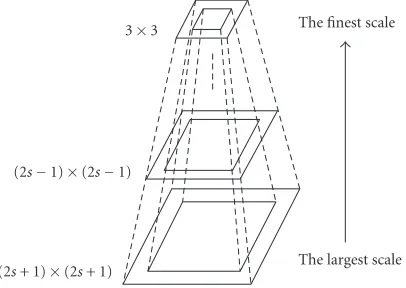
The reference point in this work is defined as the point with maximum curvature on the convex ridge, which is usually located in the central area of fingerprint. The core point on the convex ridge is the reference point if core points exist in the fingerprint. Although there is no core point in a strict sense in plain arch fingerprint, the point with maximum cur-vature is always unique and on the convex ridge. As ana-lyzed in orientation smoothing, the orientation consistency is smaller in the high-curvature area than in homogeneous areas (seeFigure 3). It can reflect the fingerprint ridge curva-ture. Therefore, the reference point should have local mini-mum value of the orientation consistency. However, the ori-entation consistency in the noisy area is also small that may produce spurious reference points. As previously analyzed in orientation smoothing, to differentiate the high-curvature area from the noisy area, the values of orientation consis-tency computed on varying neighborhood sizes are analyzed. The orientation consistency values of high-curvature area on varying neighborhood sizes are always small while the orien-tation consistency of noisy area on the large neighborhood gets larger than that on the small neighborhood. A multiscale analysis (seeFigure 4) of orientation consistency is proposed to search the local minimum orientation consistency from large scale to fine scale. To circumvent the corrupted orienta-tions, the orientation consistency of each block on all scales is computed based on the outside surrounding blocks of its neighborhood.
The finest scale
The largest scale 3×3
(2s−1)×(2s−1)
(2s+ 1)×(2s+ 1)
Figure4: The multiscale analysis of the orientation consistency.
spurious reference points are eliminated. As a fingerprint may contain more than one core point and delta points (see
Figure 3a) which also have minimum consistency, we deter-mine the unique reference point according to the direction of curvature. sistency are larger than 0, this block is the core point on the convex ridge and located as a candidate reference point in the next finer scale. Otherwise, it is not a concern. As a re-sult, the block on the convex ridge with minimum orienta-tion consistency from both large scale and fine scale is lo-cated as the unique reference point. The processing steps of the reference-point localization by multiscale analysis of the orientation consistency are summarized as follows (the scale
sis initialized as 4 in our experiments).
(1) Compute the orientation consistency Cons(s) of each block based on the outside 8ssurrounding blocks of its (2s+ 1)×(2s+ 1) neighborhood.
(2) Find the minimum orientation consistency denoted as Consmin(s). If Consmin(s)<=0.5, letT=Consmin(s) +
0.15. Otherwise,T=Consmin(s) + 0.05.
(3) Select the blocks if their Cons(s)< T.
(4) Computedx(s) in (6) anddy(s) in (7), respectively, and select the blocks with bothdx(s) anddy(s) larger than 0 as the candidate blocks in the next finer scale. (5) If no candidate blocks for the reference point are
lo-cated, letT=T+ 0.01, go to step (3).
(6) Repeat steps (1), (2), (3), (4), and (5) in the selected candidate blocks withs=s−1 untils=1.
(7) Locate the block with minimum orientation consis-tency Cons(1) from the selected finest scale blocks as the unique reference point.
In the above processing steps, if Consmin(s)<=0.5, the
fingerprint most likely contain singular points whose orien-tation consistency is much smaller than those in other ar-eas. Thus, the thresholdT is set to Consmin(s) + 0.15 to
lo-cate the possible reference points. Otherwise, the difference of the orientation consistencies between the reference point and other areas could be small, like the case of plain arch fingerprint. Therefore, the thresholdT in this case is set to Consmin(s) + 0.05, closer to Consmin(s).
4. REFERENCE-ORIENTATION COMPUTATION
There are few papers concerned with the computation of ref-erence orientation. Bazen and Gerez [9] proposed a method to compute an orientation associated with each detected sin-gular point. In this method, the orientation field near the detected singular point is compared with a standard orien-tation field model of the same type of singular point. This method performs well if the neighborhood of the detected singular point is very similar to the standard reference model. However, the neighborhood of the detected singular point may have patterns different from the standard model. In addition, this method cannot compute an orientation for the plain arch fingerprints because this type of fingerprint does not belong to any one of the two proposed reference models.
A good reference orientation should be unique and con-sistently computed for all types of fingerprints to reflect the fingerprint rotation. This work defines 16 radial directions from the reference point withπ/8 interval (seeFigure 5a). After analysis of the orientation field in the neighborhood of reference point, the local ridge orientation, which is most parallel to the corresponding radial direction, is unique for the fingerprint whose reference point is core point and can reflect the fingerprint rotation (seeFigure 5b). Thus, this lo-cal ridge orientation is defined as the unique reference orien-tation of the core point. For the plain arch fingerprint whose reference point is not core point in a strict sense, there ex-ist two different such local ridge orientations, the average of which is defined as the unique reference orientation (see
Figure 5c).
In order to consistently and reliably compute a unique reference orientation, we propose a computing method based on analysis of the orientation differences between the radial directions from the reference point and the local ridge orientations along the corresponding radial. The absolute sine component of the orientation difference is employed to approximate the orientation difference. The mean of the ab-solute sine component of the difference between the radial direction and the local ridge orientations along the corre-sponding radial is computed as
Reference point 0
π/2
3π/2
π
(a)
Reference point
Reference orientation
(b)
Reference point
Reference orientation
(c)
Figure5: (a) The 16 radial directions from the reference point. (b) The reference orientation for the core point. (c) The reference orientation for the plain arch fingerprint.
15 10
5 0
k
0.1 0.2 0.3 0.4 0.5 0.6 0.7 0.8 0.9 1
Va
r
(
k
)
(a)
15 10
5 0
k
0.1 0.2 0.3 0.4 0.5 0.6 0.7 0.8 0.9 1
Va
r
(
k
)
(b)
Figure6: Var(k) againstkwhere the circle denotes the minimum: (a) one minimum and (b) two local minimums.
whereΩkis a set ofMlocal orientations (denoted byθ(i,j)) along the radial with directionθk. It is a rectangle with its length side parallel to the radial and it is symmetric with the radial. Obviously, Var(k) with range [0, 1] equals 1 when
θk is orthogonal to all the orientations inΩk and equals 0 when θk is parallel to them. Therefore, the dominant lo-cal ridge orientations of Ωk with local minimum Var(k) are considered to be most parallel to the radial direction
θk. For the fingerprint whose reference point is core point, only one minimum Var(k) exists (see Figure 6a). For the plain arch fingerprint, however, two local minimums exist in Var(k) (see Figure 6b). In order to effectively search the minimum of Var(k), the size of the orientation set Ωk is adaptively changed in this work. The width ofΩk, the num-ber of blocks along the side orthogonal to the radial, is set to 5 blocks (of size 5×5 pixels) centered with the radial.
The length ofΩkis initialized to 4 blocks (the minimum dis-tance between two core points is assumed to be 4 blocks) and adapted by analysis of Var(k). The processing steps to compute the reference orientation are summarized as fol-lows.
(1) The length and the width ofΩkare initialized as 4 and 5 blocks, respectively.
(2) Compute Var(k) with respect to the 16 radial di-rections in (8) and find the minimum of Var(k) as Var(kmin).
(3) Select the radial directions θk with the Var(k) <
Var(kmin) + 0.1 as the candidate directions. If two or
(a) (b)
Figure7: The identification of partial fingerprint image: (a) the correct identification with the detected point on the boundary of the image; (b) the false identification with the detected point in the internal region of the image.
(4) If more than two candidate directions exist and the length ofΩkdoes not reach the boundary of the im-age or its maximum (15 in our experiment), add the length ofΩkand go to step (2).
(5) Compute the dominant orientation of Ωk with re-spect to the candidate radial directions using the least mean square averaging method. The average of these dominant orientations is the unique reference orienta-tion.
5. EXPERIMENTAL RESULTS
The proposed algorithm has been tested on the FVC2000 DB2, set A, in which 800 fingerprint images from 100 fin-gers (with 8 images from each finger) are captured using a low-cost capacitive sensor. The image size is 364×256 pix-els and the resolution is 500 dots per inch. This fingerprint database contains many poor-quality fingerprints such as the partial images with the reference point left outside and the images with heavy noise like scars, ridge breaks, too wet or dry fingerprints, and so forth. The desired position and ori-entation of the reference point in each fingerprint are not de-tected previously by experts. To evaluate the performance of our proposed algorithm quantitatively, we manually locate the desired reference point and the desired reference orienta-tion of each fingerprint.
There are 13 partial fingerprint images in the test database with the reference point left outside. For these im-ages, no reference point should be detected. However, one point with minimum orientation consistency is usually de-tected in our experiments for each fingerprint. If the dede-tected point is on the boundary of the image (seeFigure 7a), this point is unreliable and considered as no reference point be-ing detected. The image is identified as partial fbe-ingerprint im-age. In this way, we correctly identify 11 partial fingerprint images while two partial fingerprints fail being identified as
the detected reference points are not located on the image boundary (see, e.g.,Figure 7b).
5.1. Reference-point localization
In our experiments, the orientation field is computed in the proposed adaptive smoothing method and 4 scales are ap-plied in the multiscale analysis of orientation consistency to locate the reference point. The orientation consistency com-putation in each scale is based on the outside surrounding 8s
blocks of (2s+ 1)×(2s+ 1) neighborhood andsdenotes the corresponding scale of the multiscale analysis.
The reference points detected using different orientation smoothing methods are shown inFigure 8. FromFigure 8a, we can see that the averaging method on small neighborhood results in the false reference-point detection due to the heavy noise.Figure 8bshows a significant location error of the de-tected reference point caused by averaging method on large neighborhood. Our proposed adaptive smoothing method, however, leads to the accurate reference-point detection for both of the fingerprint images.
(a) (b)
Figure8: The reference points detected by different orientation smoothing methods where “×” denotes the manually detected reference point, “” and “♦” denote the reference point detected by the averaging method on small and large neighborhoods, respectively, and “” denotes the detected reference point by our proposed adaptive smoothing method.
larger than 40 pixels, it is considered as significant error which may have negative effect on the subsequent process-ing steps. If the distance error is larger than 40 pixels, most likely a spurious or false reference point is detected that can-not be used for subsequent processing steps.Table 1shows the accuracy analysis of the reference-point localization for the nonpartial fingerprints of the test database according to the four coarse level measures of the distance error. We can see that the accuracy of the reference point reaches 95.18% if small distance errors can be tolerated in the subsequent processing steps. The experimental results can be further im-proved by reducing the step size of overlapping blocks. Al-most all the significant errors and false detections resulted from the heavy noise of the very poor-quality fingerprints (seeFigure 9).
The sine-map-based approach proposed by Jain et al. [4] is a good approach for reference-point localization, and its definition of reference point is the same as that in this work. Therefore, several examples of reference-point localization in our proposed approach are compared with those in the sine-map-based approach (seeFigure 10). FromFigure 10a, we can see that the detected reference points using the sine-map-based approach are not very consistent among the two fingerprint samples from the same finger due to a slight ro-tation between them.Figure 10ashows that the detected ref-erence points of these two fingerprint samples by using our proposed approach are more consistent than those using the sine-map-based approach.
Furthermore, the standard deviations of the detected ref-erence points by the two methods are computed to compare their consistencies. LetZr(i) andZ(i) be the positions of the manually located reference point and the detected reference
Table1: The accuracy analysis of the reference-point localization for nonpartial fingerprints.
Distance error
The number of fingerprints The probability (pixels)
≤10 659 0.8374
>10 and≤20 90 0.1144
>20 and≤40 25 0.0318
>40 13 0.0165
point of the sample imageifrom the same finger, the stan-dard deviationσis computed as
σ=
1
M M
i=1
dZ(i)−M1 M
i=1 dZ(i)
2
,
dZ(i)=Z(i)−Zr(i),
(9)
(a) (b) (c)
Figure9: Examples of false reference-point detection and the detection with significant error (“×” denotes the manually located reference point and “” denotes the reference point located by the algorithm).
(a)
(b)
Table2: The accuracy analysis of the reference-orientation compu-tation.
Orientation error The number of fingerprints The probability
≤π/16 690 87.67%
> π/16 and≤π/8 47 5.97%
> π/8 50 6.35%
5.2. Reference-orientation computation
The difference between the manually detected reference ori-entation and the reference oriori-entation computed by the pro-posed approach is computed as the orientation error of the reference-orientation computation. Similarly, three coarse level measures of the orientation error are defined to eff ec-tively evaluate the accuracy of the reference-orientation com-putation (seeTable 2). The orientation error larger thanπ/8 rads is considered a significant error while the orientation error larger thanπ/16 but not larger thanπ/8 rads is con-sidered a small error. The orientation error not larger than
π/16 rads is considered an accurate computation. To avoid the ambiguity of the orientation difference computation, the orientation error (OE) is computed as follows:
OE=min θp−θr ,π− θp−θr ,
whereθpandθrare the computed and the manually detected reference orientations, respectively.
FromTable 2, we can see that the computation accuracy is 93.65% if the reference orientation can tolerate error up to π/8. In addition, the accuracy can be further improved if we can improve the accuracy of reference-point localiza-tion.
6. CONCLUSIONS
This paper develops an effective algorithm to consistently locate a unique reference point and compute a unique ref-erence orientation associated with the refref-erence point for all types of fingerprints. The reference-point localization is based on multiscale analysis of the orientation consistency, while the reference orientation is computed by analysis of the orientation differences between 16 radial directions from the reference point and the local ridge orientations along these radii. In addition, to compute the reliable orientation field, we propose an improved orientation smoothing approach which has better performance in attenuating noise while maintaining the orientation localization of high-curvature area than the conventional averaging method. Finally, exper-imental results demonstrate that our developed algorithm can consistently locate a unique reference point and com-pute a unique reference orientation with high accuracy for all types of fingerprints. The located reference point and
the computed reference orientation are useful for transla-tional and rotatransla-tional alignment in fingerprint classification and matching.
REFERENCES
[1] K. Karu and A. K. Jain, “Fingerprint classification,” Pattern Recognition, vol. 29, no. 3, pp. 389–404, 1996.
[2] Q. Zhang, K. Huang, and H. Yan, “Fingerprint classification based on extraction and analysis of singularities and pseu-doridges,” inProc. Pan-Sydney Area Workshop on Visual Infor-mation Processing (VIP ’01), vol. 11, pp. 83–87, Sydney, Aus-tralia, December 2001.
[3] W. M. Koo and A. Kot, “Curvature-based singular points de-tection,” inProc. 3rd International Conference on Audio- and Video-Based Biometric Person Authentication, vol. 2091 of Lec-ture Notes in Computer Science (LNCS), pp. 229–234, Halm-stad, Sweden, June 2001.
[4] A. K. Jain, S. Prabhakar, L. Hong, and S. Pankanti, “Filterbank-based fingerprint matching,” IEEE Trans. Image Processing, vol. 9, no. 5, pp. 846–859, 2000.
[5] C.-H. Park, S.-K. Oh, D.-M. Kwak, B.-S. Kim, Y.-C. Song, and K.-H. Park, “A new reference point detection algorithm based on orientation pattern labeling in fingerprint images,” inProc. 1st Iberian Conference on Pattern Recognition and Image Anal-ysis (IbPRIA ’03), pp. 697–703, Puerto de Andratx, Mallorca, Spain, June 2003.
[6] M. J. Donahue and S. I. Rokhlin, “On the use of level curves in image analysis,” Image Understanding, vol. 57, no. 2, pp. 185–203, 1993.
[7] L. Hong, Y. Wan, and A. K. Jain, “Fingerprint image enhance-ment: algorithm and performance evaluation,”IEEE Trans. on Pattern Analysis and Machine Intelligence, vol. 20, no. 8, pp. 777–789, 1998.
[8] D. Maio and D. Maltoni, “Direct gray-scale minutiae detec-tion in fingerprints,”IEEE Trans. on Pattern Analysis and Ma-chine Intelligence, vol. 19, no. 1, pp. 27–40, 1997.
[9] A. M. Bazen and S. H. Gerez, “Systematic methods for the computation of the directional fields and singular points of fingerprints,” IEEE Trans. on Pattern Analysis and Machine Intelligence, vol. 24, no. 7, pp. 905–919, 2002.
[10] U. Halici and G. Ongun, “Fingerprint classification through self-organizing feature maps modified to treat uncertain-ties,” Proceedings of the IEEE, vol. 84, no. 10, pp. 1497–1512, 1996.
[11] B.-G. Kim, H.-J. Kim, and D.-J. Park, “New enhancement al-gorithm for fingerprint images,” inProc. 16th International Conference on Pattern Recognition (ICPR ’02), vol. 3, pp. 879– 882, Quebec City, Quebec, Canada, August 2002.
[12] A. M. Bazen and S. H. Gerez, “Segmentation of fingerprint images,” inProc. Annual Workshop on Circuits, Systems and Signal Processing (ProRISC ’01), pp. 276–280, Veldhoven, The Netherlands, November 2001.
Xudong Jiang received the B.Eng. and M.Eng. degrees from the University of Elec-tronic Science and Technology of China in 1983 and 1986, respectively, and the Ph.D. degree from the University of German Fed-eral Armed Forces, Hamburg, Germany, in 1997, all in electrical and electronic engi-neering. From 1986 to 1993, he was a Lec-turer at the University of Electronic Science and Technology of China where he received
two science and technology awards from the Ministry for Electron-ics Industry of China. He was a recipient of the German Konrad-Adenauer Foundation Young Scientist Scholarship. From 1993 to 1997, he was with the University of German Federal Armed Forces, Hamburg, Germany, as a Scientific Assistant. From 1998 to 2002, he was with the Centre for Signal Processing, Nanyang Technolog-ical University, Singapore, as a Research/Senior Fellow, where he developed a fingerprint verification algorithm achieving the top in speed and the second top in accuracy in the International Finger-print Verification Competition (FVC2000). From 2002 to 2004, he was a Lead Scientist and Head of the Biometrics Laboratory at the Institute for Infocomm Research, Singapore. Currently he is an As-sistant Professor at the School of Electrical & Electronic Engineer-ing, Nanyang Technological University, Singapore. His research in-terests include pattern recognition, image processing, computer vi-sion, and biometrics.
Alex Chichung Kot was educated at the University of Rochester, New York, and at the University of Rhode Island, Rhode Is-land, USA, where he received the Ph.D. de-gree in electrical engineering in 1989. He was with the AT&T Bell Company, New York, USA. Since 1991, he has been with the Nanyang Technological University (NTU), Singapore, where he is the Head of the Information Engineering Division. His