Earth Planets Space,65, 1095–1100, 2013
Dust attenuation in galaxies up to redshift
2
V. Buat
Aix-Marseille Universit´e, CNRS, LAM (Laboratoire d’Astrophysique de Marseille) UMR7326, 13388, France
(Received October 25, 2012; Revised January 17, 2013; Accepted February 2, 2013; Online published October 24, 2013)
We want to study dust attenuation at ultraviolet (UV) wavelengths at high redshift, where the UV is redshifted to the observed visible light wavelength range. In particular, we search for a bump at 2175 ˚A. We use photometric data in theChandraDeep Field South (CDFS), obtained in intermediate and broad band filters by the MUSYC project, to sample the UV rest-frame of 751 galaxies with 0.95 < z < 2.2. When available, infrared (IR) Herschel/PACS∗data from the GOODS-Herschelproject, coupled withSpitzer/MIPS measurements, are used to estimate the dust emission and to constrain dust attenuation. The spectral energy distribution of each source is fit using the CIGALE code†. The average attenuation curve found for our sample galaxies exhibits a UV bump whose amplitude is similar to that observed in the extinction curve of the LMC super-shell region. The slope of the average attenuation curve at UV wavelength is found steeper than that for local starburst galaxies. The amount of dust attenuation at UV wavelengths is found to increase with stellar mass and to decrease as UV luminosity increases.
Key words:Galaxies: high-redshift, galaxies: ISM, ultraviolet:galaxies, dust: extinction.
1.
Introduction
Although dust is a minor component in galaxies, it cap-tures a large fraction of the stellar emission, especially at short wavelengths. This process makes the direct obser-vation of stellar populations from the UV to the near-IR insufficient to recover all the emitted photons. Thus reli-able dust corrections are mandatory for measuring the star formation rate (SFR) in the universe and its evolution with redshift from UV-optical surveys. The search for relations between dust attenuation and observed or commonly mea-sured quantities are very useful in this context. It is also par-ticularly important to study the dependence of dust attenua-tion on wavelength in order to recover the intrinsic spectral distribution of the stellar light, which gives information on the star formation history at work in galaxies.
Models solving radiation transfer rely on numerous free parameters and physical assumptions that are difficult to constrain from the integrated emission from entire galax-ies and for very large numbers of objects. Simpler mod-els have been specifically developed to analyze large sam-ples of galaxies, introducing simple recipes and templates. The number of free parameters is considerably reduced. These codes are often developed to measure photometric redshifts and physical parameters such as the SFR and the stellar mass. With the availability of mid and far-IR data
∗Herschelis an ESA space observatory with science instruments
pro-vided by European-led Principal Investigator consortia and with important participation from NASA.
†cigale.oamp.fr
Copyright cThe Society of Geomagnetism and Earth, Planetary and Space Sci-ences (SGEPSS); The Seismological Society of Japan; The Volcanological Society of Japan; The Geodetic Society of Japan; The Japanese Society for Planetary Sci-ences; TERRAPUB.
doi:10.5047/eps.2013.02.001
for large samples of galaxies, new codes are emerging that combine stellar and dust emission on the basis of the bal-ance between the stellar luminosity absorbed by dust and the corresponding luminosity re-emitted in the IR. Attenu-ation laws are introduced in these codes. The most popular attenuation curve is that of Calzettiet al.(2000), built for local starburst galaxies. This law, based on spectroscopic data, does not exhibit a bump at 2175 ˚A such as that ob-served in the extinction curves of the Milky Way (MW) or the Large Magellanic Cloud supershell (LMC2). Since the Calzetti and collaborators work, numerous studies have tried to search for the presence of a bump in the attenuation curve of nearby, non starbursting, galaxies. Most studies based on very different approaches conclude to a presence of bump in large samples of nearby star forming galaxies (Burgarellaet al., 2005; Conroy et al., 2010; Wildet al., 2011). At higher redshifts, the situation is more favorable because of the redshifting of the UV emission into visible. Direct evidence of bumps came from the analysis of the galaxy spectra at 1 < z < 2.5 (Nollet al., 2009). Re-cently Buatet al. (2011b, 2012) analyzed spectral energy distributions (SEDs) of UV selected galaxies in a redshift range between 0.95 and 2.2, observed through intermediate band filters and with IR detections from Herschel/PACS, and found evidence for a UV bump in the dust attenuation curve of all these galaxies. The present work extends the analysis performed in these two papers. After a brief de-scription of the data (Section 2) and of the fitting tool used for the analysis (Section 3), the average attenuation curve obtained with the dataset is compared to extinction curves of LMC2 and MW and to the models of Inoueet al.(2006) in Section 4. Relations linking dust attenuation to UV lu-minosity and stellar mass are presented in Section 5.
1096 V. BUAT: DUST ATTENUATION IN GALAXIES
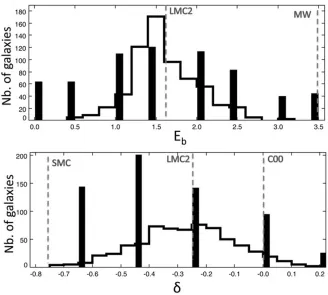
Fig. 1. Distribution of the amplitude of the bumpEband slope of the attenuation curveδas defined in Eq. (1) and (2). Both parameters are determined with the CIGALE code which does not only give the best model fitted (based on aχ2 minimization over all the models) but also calculates the probability of each input model and returns the probability distribution function (PDF) of each parameter. The histograms with spikes correspond to the values found for the best models and the continuous lines represent the distributions of the mean values of the PDF ofEbandδobtained for each object. The values corresponding to the attenuation curve of Calzettiet al.(2000, C00), of the extinction curves of the Milky Way (MW), LMC2 supershell (LMC2) and of the SMC (SMC) are plotted as dotted lines. The parameters for the MW are taken from Fitzpatrick and Massa (1990), those for the Magellanic Clouds come from Gordonet al.(2003).
2.
High Redshift Galaxies Selected in the
Ultravi-olet
The sample selection is described in Buatet al.(2012). We briefly summarize the selection process and the main characteristics of the resulting sample. The field considered is located in the Great Observatories Origins Deep Survey Southern field (GOODS-S). It was observed at 100 and 160μm over 264 hours by the PACS instrument onboard of the HerschelSpace Observatory (Pilbratt et al., 2010) as part of the GOODS-Herschelopen time key project (El-bazet al., 2011). The MUSYC project (Cardamoneet al., 2010) compiled a uniform catalogue of optical and IR pho-tometry for sources in this field, incorporating the GOODS SpitzerIRAC and MIPS data as well as intermediate and broad-band optical data. It provides a valuable means of tracing the detailed shape of the UV rest-frame spectrum. We started with the MUSYC catalogue, selecting sources with a spectroscopic redshift between 0.95 and 2.2 and no X ray detection. In this redshift range we have more than ten photometric bands available in the UV rest-frame and a good sampling around 2175 ˚A. We consider all the op-tical broad bands (7 bands fromU toz) and intermediate-band filters (11 intermediate-bands) whose 5σ depth was fainter than 25 ABmag. Our sample contains 751 sources, all detected by IRAC at 3.6μm. 290 sources have a 3σ detection at 24μm, 76 of these sources are also detected by PACS at 100μm.
3.
CIGALE: A SED Fitting Tool Aimed at
Study-ing Dust Attenuation in Galaxies
The CIGALE code (Code Investigating GALaxy Emis-sion, http://cigale.oamp.fr) was developed by Noll et al. (2009). This is a physically-motivated code that derives properties of galaxies by fitting their UV-to-IR SEDs. CIGALE combines a UV-optical stellar SED with a dust component emitting in the IR and fully conserves the en-ergy balance between the dust absorbed stellar emission and its re-emission in the IR. We refer to Nollet al.paper for details on the code. For the purpose of the present work we focus on the dust attenuation treatment performed by CIGALE, the various input parameters introduced for this analysis are discussed in Buatet al.(2012). The dust atten-uation is described as
A(λ)= AV
4.05(k
(λ)+D
λ0,γ,Eb(λ))
λ
λV
δ
, (1)
Throughout the paper the wavelengthλwill be expressed in ˚
A,λV =5500 ˚A,k(λ)1 comes from Calzettiet al.(2000)
(Eq. (4)) andDλ0,γ,Eb(λ), the Lorentzian-like Drude profile
V. BUAT: DUST ATTENUATION IN GALAXIES 1097
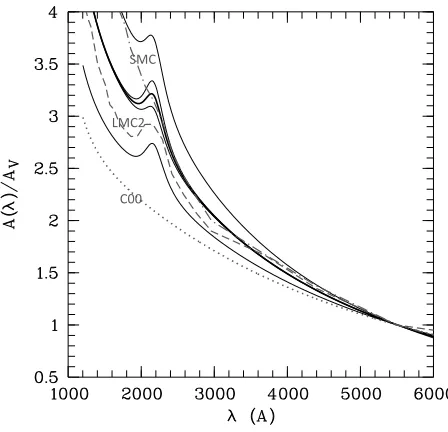
Fig. 2. Mean dust attenuation curve (black heavy line), the thin black lines represent the 1σ variation onEbandδ. The attenuation curve of Calzetti
(2000) is plotted as a dotted line (C00), the LMC2 extinction curve with a dashed line and the SMC extinction curve with a dot-dashed line.
commonly used to describe the UV bump, is defined as
Dλ0,γ,Eb= fying the visual attenuation AV. It implies changes in the
value of the effective total obscuration RV, originally equal
to 4.05 for the Calzettiet al.law.
The reliability of parameter determinations is extensively discussed in Buatet al.(2012) with the analysis of a catalog of artificial galaxies and that of the 76 galaxies detected by PACS. Parameters are better estimated when at least one IR measurement is available, which is the case for 290 of our objects. Without IR data dust attenuation at UV wavelength is found slightly over-estimated for low values of this parameter (of the order of 0.3 mag for an attenuation of 1 mag), the amplitude of the bump Eb is
robustly estimated whereas the slopeδis over-estimated for low values (by 0.1 unit forδ = −0.5). We refer to Buatet al.(2012) for more details about the SED fitting analysis.
Ebandδare estimated for each object as the mean value
of their probability distribution function (PDF) given by CIGALE. The resulting distributions obtained for these es-timated parameters are shown in Fig. 1. The typical un-certainty for each estimation (dispersion of the PDF) is found to be 0.8 for Eb and 0.15 for δ. The average
val-ues and standard deviations of the distributions of Fig. 1 are
Eb = 1.6±0.4 andδ = −0.27±0.17. The large
uncertainty in the determination of the parameters implies that only 20% of individual sources (40% of the sources de-tected in IR) exhibit a secure bump and and an attenuation curve steeper than the Calzettiet al.one. In the next sec-tion, we will focus on the analysis of the average attenuation curve and not on the dispersion found for individual source. A detailed discussion of the individual measurements can be found in Buatet al.(2012).
4.
Average Dust Attenuation Curve
We can tentatively derive an average attenuation curve for our sample.
Models predict a variation of the shape of the attenuation curve and of the amplitude of the bump with the amount of dust attenuation (e.g. Inoue et al., 2006). The mean dust attenuation at 1530 ˚A for the sample is found to be
AFUV = 2.2 mag and the average dust attenuation curve
given above is expected to be representative of galaxies with this average attenuation.
The resulting curve is plotted in Fig. 2 with other curves already considered in Fig. 1. As underlined in Buatet al. (2012) the average attenuation curve is close to the ex-tinction curve found for the LMC2 super-shell. Inoue et al.(2006) predicted various attenuation curves for the UV range. In Fig. 3 we compare the result of their models ob-tained with dust characteristics from Draine (2003) and cor-responding to AFUV=2 mag. The extinction curve for the
LMC2 super-shell is also over-plotted. Whereas the am-plitude of the bump is well reproduced in the Inoueet al. model with LMC dust, the corresponding attenuation curve is steeper than the one derived from the data. The general shape is better reproduced with a MW type dust but this time the predicted amplitude of the bump is too large. The best agreement is found with the LMC2 extinction curve.
5.
Dust Attenuation Variation
use-1098 V. BUAT: DUST ATTENUATION IN GALAXIES
Fig. 3. Average dust attenuation curve derived in this work (black solid line) compared to models from Inoueet al.for a LMC2 type dust (filled circles and red line), and a MW type dust (empty circles and green line). The empty squares and blue line are for the LMC2 extinction curve from Gordon
et al.(2003).
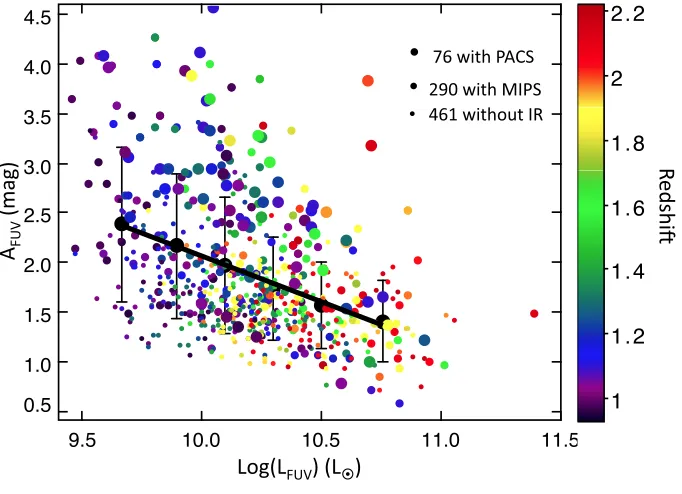
Fig. 4. Dust attenuation versus FUV luminosity. Redshift is color coded. The connected black points and the vertical bars represent the mean and dispersion ofAFUVper bin ofLFUV. The solid line is the result of the linear regression.
ful. Any systematic trend with the observed UV luminos-ity is important to account for when intrinsic, attenuation corrected luminosity functions are studied. Another crucial physical parameter is the stellar mass. It is mainly con-strained by the optical-NIR part of the SED which is not very sensitive to dust attenuation and can be securely es-timated even when dust attenuation is badly known. As a consequence any relation between dust attenuation and stel-lar mass will be particustel-larly useful at least to apply global corrections to large samples of galaxies. Hereafter we will
discuss dust attenuation at FUV, with a FUV wavelength taken at 1530 ˚A (corresponding to the FUV GALEX fil-ter). The FUV luminosity LFUV is defined asλ×Lλand
expressed in solar units (L).
V. BUAT: DUST ATTENUATION IN GALAXIES 1099
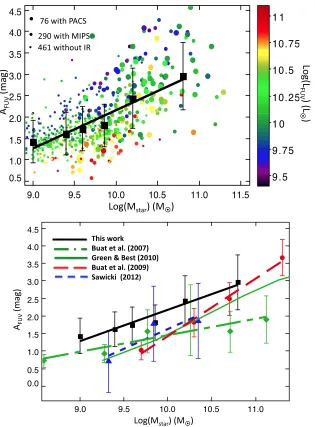
Fig. 5. Dust attenuation versus stellar mass. Upper panel: Individual values ofMstarandAFUVfrom Buatet al.(2012) are reported with the observed FUV luminosity color coded. The mean values and the related dispersion per bin ofMstarfrom Buatet al.(2012) are plotted with filled squares and vertical bars. The solid line is the result of the linear regression. Lower panel: the linear regression found in the upper panel (filled squares and black lines) is compared with other relations from previous works: atz=0 from Buatet al.(2007) (lozenges and green dot-dashed regression line) and from Garn and Best (2010) (solid thin green line), forz < 1 from Buatet al.(2009) (red dots and dashed line, average relation for
log(LFUV)=10.2[L]) and atz=2 from Sawicki (2012) (blue dotted line and triangles).
et al.(2012) are reported in Fig. 4. We perform a linear re-gression between the average values of AFUVexpressed in
magnitudes andLFUVin solar units:
AFUV=(−0.93±0.04)×log(LFUV)+(11.33±0.45) (5)
the uncertainties on the coefficients (slope and constant) correspond to standard deviations, the global R.M.S. error is found equal to 0.04, and the correlation coefficientR is equal to 0.99.
The detected galaxies become more luminous when the redshift increases because of selection effects as clearly seen in Fig. 4. So any study of the variation of dust attenua-tion withzmust account for this decrease of the attenuation whenLFUVincreases.
5.2 Dust attenuation and stellar masses
Stellar masses (Mstar) are obtained as an output of the
fitting code CIGALE as described in Buat et al. (2012). The adopted IMF is that of Kroupa (2001). Mean dust attenuation factors can be calculated per bin of Mstar, the
results are reported in Fig. 5. We perform a linear regression on these average values, the correlation coefficient is found very high (R =0.97) and the linear regression gives:
AFUV=(0.89±0.11)×log(Mstar)−(6.77±1.09) (6)
1100 V. BUAT: DUST ATTENUATION IN GALAXIES
is well sampled with GALEX data. Buat et al. (2007) performed a statistical analysis of the GALEX and IRAS surveys and deduced volume corrected relations about far-IR and FUV properties of galaxies in the nearby universe. Here, we use their UV selected sample to calculate the average far-IR to FUV flux ratio per bin of stellar mass following the method explained in Buatet al.(2007). The amount of dust attenuation is then calculated by applying the relation of Buatet al.(2011a). The average values and the result of the linear regression fitted on them is reported in Fig. 5. Garn and Best (2010) obtained a relation between dust attenuation and stellar mass for SDSS galaxies based on the measure of the Balmer decrement, their relation is extrapolated at FUV wavelength using the Meurer et al. (2009) relation AFUV = 1.68AHα and is also reported on
Fig. 5. Note that this extrapolation is very crude given the large dispersion in the scatter plot between AFUVand AHα
and the uncertainty on the average value ofAFUV/AHα(Bell
and Kennicutt, 2001; Buatet al., 2002; Boselliet al., 2013). Buatet al.(2009) investigated UV selected galaxies from z =0 toz =1 and found a trend withMFUVand no clear
evolution with redshift of the AFUV-Mstar scatter plot. We
report their average relation corresponding to log(LFUV)=
10.2[L], representative of our current sample (see Buatet al.(2012) for more details). Atz=2 Sawicki (2012) built a FUV selected sample from the Ultra-deep Hubble field and found a relation between dust attenuation and stellar mass (estimated from the observed FUV luminosity), his relation is also reported in Fig. 5. The relation obtained in the present work for galaxies with redshift between 0.95 and 2.2 predicts slightly higher dust attenuation factors than the three other ones but remain consistent within the error bars with most of the relations considered in Fig. 5. The relation found at z = 0 by Buat et al. (2007) leads to lower dust attenuation for massive galaxies by∼1 mag for log(Mstar) > 10.5[M] but their statistics for high mass
galaxies was low. The Garn and Best relation based on larger statistics is found closer the other ones at higherz. We can conservatively conclude to a well defined relation between average dust attenuation andMstarfor UV selected
galaxies which does not show a significant evolution from z=0 toz=2.
The trend found with the FUV luminosity (i.e. a lower mean dust attenuation whenLFUVincreases) is clearly
visi-ble in Fig. 5, upper panel. It might imply a modification of the mean relation as a function of the luminosity, the FUV luminosity also acting as a parameter in the variation of dust attenuation. A complete analysis of this relation per bin of FUV luminosity and stellar mass at different redshifts has still to be performed. The current samples are too small for such a study. Heiniset al.(in preparation) will analyze a much larger sample of galaxies in the COSMOS field based on stacked Herschel/SPIRE images to better constrain aver-age dust attenuation factors.
Acknowledgments. This work is partially supported by the French National Agency for research (ANR-09-BLAN-0224). PACS has been developed by a consortium of institutes led by MPE (Germany) and including UVIE (Austria); KU Leuven, CSL, IMEC (Belgium); CEA, LAM (France); MPIA (Germany);
IN-AFIFSI/OAA/OAP/OAT, LENS, SISSA (Italy); IAC (Spain). This development has been supported by the funding agencies BMVIT (Austria), ESA-PRODEX (Belgium), CEA/CNES (France), DLR (Germany), ASI/INAF (Italy), and CICYT/MCYT (Spain).
References
Bell, E. and R. C. Kennicutt, A comparison of ultraviolet imaging tele-scope far-ultraviolet and H? star formation rates,Astrophys. J.,548, 681–693, 2001.
Boselliet al., Integrated spectroscopy of the Herschel Reference Survey. The spectral line properties of a volume-limited, K-band selected sam-ple of nearby galaxies, arXiv:1211.5262, 2013.
Buatet al., Star formation and dust extinction in nearby star-forming and starburst galaxies,Astron. Astrophys.,383, 801–812, 2002.
Buatet al., Local universe as seen in the far-infrared and far-ultraviolet: A global point of view of the local recent star formation,Astrophys. J. Suppl. Ser.,173, 404–414, 2007.
Buatet al., The infrared emission of ultraviolet-selected galaxies from z = 0 to z = 1,Astron. Astrophys.,507, 693, 2009.
Buat, V.et al., Spectral energy distributions of an AKARI-SDSS-GALEX sample of galaxies,Astron. Astrophys.,529, id.A22, 2011a.
Buat, V.et al., GOODS-Herschel: evidence of a UV extinction bump in galaxies atz>1,Astron. Astrophys.,533, id.A93, 2011b.
Buat, V.et al., GOODS-Herschel: dust attenuation properties of UV se-lected high-redshift galaxies,Astron. Astrophys.,545, id.A141, 2012. Burgarella, D., V. Buat, and J. Iglesias-Paramo, Star formation and dust
attenuation properties in galaxies from a statistical ultraviolet-to-far-infrared analysis,Mon. Not. R. Astron. Soc.,360, 1413–1425, 2005. Calzetti, D.et al., The dust content and opacity of actively star-forming
galaxies,Astrophys. J.,533, 682–695, 2000.
Cardamoneet al., The multiwavelength survey by Yale-Chile (MUSYC): Deep medium-band optical imaging and high-quality 32-band photo-metric redshifts in the ECDF-S, Astrophys. J. Suppl.,189, 270–285, 2010.
Conroy, C., D. Schiminovich, and M. R. Blanton, Dust attenuation in disk-dominated galaxies: Evidence for the 2175 ˚Adust feature,Astrophys. J., 718, 184–198, 2010.
Draine, B. T., Scattering by interstellar dust grains. I. Optical and ultravio-let,Astrophys. J.,598, 1017–1025, 2003.
Elbaz, D.et al., GOODS-Herschel: an infrared main sequence for star-forming galaxies,Astron. Astrophys.,533, id.A119, 2011.
Fitzpatrick, E. L. and D. Massa, An analysis of the shapes of ultraviolet ex-tinction curves. III—an atlas of ultraviolet exex-tinction curves,Astrophys. J. Suppl. Ser.,72, 163–189, 1990.
Garn, T. and P. N. Best, Predicting dust extinction from the stellar mass of a galaxy,Mon. Not. R. Astron. Soc.,409, 421–432, 2010.
Gordon, K.et al., A quantitative comparison of the small Magellanic cloud, large Magellanic Cloud, and Milky Way ultraviolet to near-infrared extinction curves,Astrophys. J.,594, 279–293, 2003. Heinis, et al., HerMES: unveiling obscured star formation—the
far-infrared luminosity function of ultraviolet-selected galaxies at z = 1.5, arXiv:1211.4336.
Inoue, A.et al., Effects of dust scattering albedo and 2175- ˚Abump on ultraviolet colours of normal disc galaxies,Mon. Not. R. Astron. Soc., 370, 380–398, 2006.
Kroupa, P.,Mon. Not. R. Astron. Soc.,322, 231–, 2001.
Meureret al., Evidence for a nonuniform initial mass function in the local universe,Astrophys. J.,695, 765, 2009.
Noll, S.et al., Analysis of galaxy spectral energy distributions from far-UV to far-IR with CIGALE: studying a SINGS test sample,Astron. Astrophys.,507, 1793–1813, 2009.
Pilbratt, G.et al., Herschel Space Observatory. An ESA facility for far-infrared and submillimetre astronomy,Astron. Astrophys.,518, id.L1, 2010.
Sawicki, M., Stars, dust, and the growth of ultraviolet-selected sub-L galaxies at redshiftz∼2,Mon. Not. R. Astron. Soc.,421, 2187–2205, 2012.
Wild, V.et al., Empirical determination of the shape of dust attenuation curves in star-forming galaxies,Mon. Not. R. Astron. Soc.,417, 1760– 1786, 2011.