R E S E A R C H
Open Access
An energy- and cost-aware computation
offloading method for workflow applications
in mobile edge computing
Kai Peng
1,5, Maosheng Zhu
1, Yiwen Zhang
2*, Lingxia Liu
1, Jie Zhang
3, Victor C.M. Leung
4and Lixin Zheng
5Abstract
Mobile edge computing is becoming a promising computing architecture to overcome the resource limitation of mobile devices and bandwidth bottleneck of the core networks in mobile cloud computing. Although offloading applications to the cloud can extend the performance for the mobile devices, it may also lead to greater processing latency. Usually, the mobile users have to pay for the cloudlet resource or cloud resource they used. In this paper, we bring a thorough study on the energy consumption, time consumption, and cost of using the resource of cloudlet and cloud for workflow applications in mobile edge computing. Based on theoretical analysis, a multi-objective optimization model is established. In addition, a corresponding multi-objective computation offloading method based on non-dominated sorting genetic algorithm II is proposed to find the optimal offloading strategy for all the workflow applications. Finally, extensive experimental evaluations are performed to show that our proposed method is effective and energy- and cost-aware for workflow applications in MEC.
Keywords: Mobile edge computing, Computation offloading, Time consumption, Multi-objective, Energy
consumption, Cost
1 Introduction
With the development of computer network, cloud com-puting, as well as wireless sensor network, mobile devices (MDs) have become an indispensable part of people’s daily lives [1–7]. In addition, the development of cyber-physical-social systems and big data has further affected people’s life [8–14]. However, compared to a traditional device such as personal computer, a MD has certain lim-itations in computing power, storage capacity, especially for the battery capacity. Mobile cloud computing (MCC) brings new services and facilities to mobile users (MUs) to take full advantage of cloud computing [15–20]. How-ever, the remote cloud is usually located far away from the MUs, which may result in high network latency in the process of data transmission. This inevitably reduces the quality of user service (QoS), in particular, for some applications, such as workflow applications (WAs), which
*Correspondence:[email protected]
2School of Computer Science and Technology, Anhui University, Hefei, China Full list of author information is available at the end of the article
generally have strict execution deadlines. The task may fail to be finished if the transmission latency is too large.
To solve the issue of network latency, a new paradigm called mobile edge computing (MEC) has been proposed [21–23]. MEC has become a key technology for realiz-ing the Internet of Threaliz-ings and 5G [24]. The MEC can be regarded as a special example of MCC. A cloudlet is a type of edge server that provides various services to users in close proximity to MDs [25–27]. That means it can reduce the latency and energy consumption by offloading the WAs to cloudlet.
It is assumed that the resources of cloud are unlimited in MCC. Meanwhile, the resources of the MEC are lim-ited. If there are multiple MUs requesting services from the cloudlet at the same time, a queue latency will occur. When a MU requests a service that exceeds the ability of a cloudlet, the cloudlet service cannot be obtained. In order to ensure the successful execution of the WA, fur-ther consideration needs to be taken to execute the task locally or offload them to the cloud. Moreover, the execu-tion of WA by cloudlet or cloud needs to meet the task
deadline constraint, which further increases the difficulty of computing offloading.
Although the computation offloading issue in MCC has been well investigated (to list a few here [28–33], they cannot be used directly in computation offload-ing in MEC. The main reason is that MEC and MCC have completely different architectures. Existing studies on computation offloading in MEC have mainly focused on the optimization of a single objective (time consump-tion or energy consumpconsump-tion) [34, 35], but seldom con-siders multi-objective optimization. It is still a challenge to balance the multi-objective. Moreover, they focus on general applications and pay little attention to computa-tion offloading of WAs in MEC [36]. For WA, it is very important to consider time constraints [37,38].
Inspired by the idea that the MU has to pay for the resources they used in cloudlet or the cloud [36], in this study, we consider a joint energy consumption, time consumption, and price-cost optimization for WAs in MEC while the completion time of WA is considered as a constraint condition. The main contributions can be summarized as follows:
(1) The computation offloading for WAs in MEC has been well investigated in this paper. Both the energy con-sumption and time concon-sumption, as well as the cost of MU by using cloudlet or cloud, are considered as the optimiza-tion objectives. Besides, based on theoretical analysis, a multi-objective optimization model is established.
(2) We propose a method named multi-objective com-putation offloading method for WAs (MCOWA) based on non-dominated sorting genetic algorithm for the solution. Some parameters in the algorithm step are improved to suit the needs of this problem.
(3) Compared to the other methods, such as the no offloading method, full offloading to cloud method, and full offloading to cloudlet method, extensive experiments and simulations have shown that our proposed method is effective and can provide optimization offloading strategy for MUs.
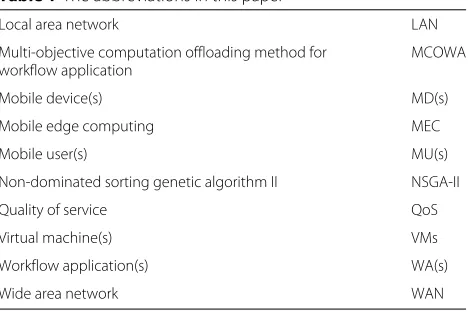
The abbreviations in this paper are shown in Table1. The remainder of this paper is recognized as follows. In
Section 2, system model and problem formulation are
introduced. Section3 elaborates multi-objective compu-tation offloading algorithm for WAs (MCOWA). Section4 presents the comparison analysis and performance evalua-tion. Section5summarizes the related work, and Section6 concludes the paper and describes the future work.
2 System model and problem formulation
In this section, system model and problem formulation are presented. The basic architecture of MEC is described firstly. And then the basic mode is introduced. In addition, the time consumption mode, the energy consumption mode, and the cost mode are described.
Table 1The abbreviations in this paper
Local area network LAN
Multi-objective computation offloading method for workflow application
MCOWA
Mobile device(s) MD(s)
Mobile edge computing MEC
Mobile user(s) MU(s)
Non-dominated sorting genetic algorithm II NSGA-II
Quality of service QoS
Virtual machine(s) VMs
Workflow application(s) WA(s)
Wide area network WAN
The complete organization of MEC is shown in Fig.1. Cloud is a combination of data centers. MD could be mobile phone or tablet. Each MD have one or more WAs which need to be processed. In general, these applications are time constrained. These applications can be executed directly locally, and users can migrate a part of the appli-cation or full appliappli-cation to cloudlet via local area network (LAN) or cloud via wide area network (WAN) according to their needs, to reduce user execution time or energy consumption or both of them.
2.1 Basic mode
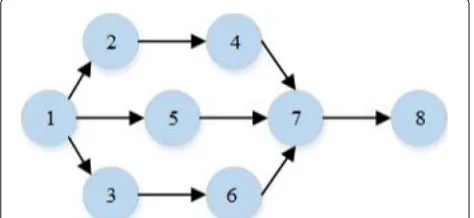
As shown in Fig.2, the WA is modeled by a direct acyclic graphGf(V,E), wheref represents thefth WA(1 ≤ f ≤
F) andF represents the total number of the WAs. Each application consists of multiple tasks and any node in Fig.2can be seen as a task.V = {v1,f,v2,f,. . .,vN,f} rep-resents the set of tasks, and edge inErepresents the set of dependency between any two tasks. Each edge is asso-ciated with a weightdi,jwhich represents the size of data transmission from task vi,f to task vj,f. Cloudlet is con-figured as multiple virtual machines(VMs) for concurrent processing the WAs, which is modeled by a 3-tuple and denoted asCIT = (M,fcl,LLAN). It is assumed that the
capacity of cloudlet equals to the number of VMs in the cloudlet, thusM is the number of VMs in the cloudlet, fcl is the processing capacity of the cloudlet andLLANis
Fig. 1MEC architecture
2.2 Time consumption mode
The total time consumption mainly contains three aspects, namely, waiting time, processing time, and transmission time.
2.2.1 Average waiting time
It is assumed that the interval of the task arrival time obeys the negative exponential distribution of the parameterλ, and the service time of the cloudlet is subjected to the negative exponential distribution of the parameterμ. Based on the queuing theory [39], the waiting time mode can be established. The probability that the cloudlet in idle is expressed as
p0=
M−1
n=0
+ ρM
M!(1−ρM) −1
(1)
where ρ = μλ indicates the utilization of cloudlets and
ρM=Mρ. Letpnbe the probability that the queue size reaches when the cloudlet is running in a steady state. Then,pnis given as
Fig. 2Direct acyclic graph of workflow application
pn= ⎧ ⎪ ⎨ ⎪ ⎩
pn
M!Mn−M ·p0 n≥M pn
n! ·p0 n<M
(2)
Whenn≥M, the probability of the tasks waiting in the cloudlet is given as
Cw(M,ρ)= ∞
n=M
pn= ρ M
M!(1−ρM)·
p0 (3)
Based on the little theorem, the average waiting queue lengthLqand the average queue lengthLMare given as
Lq= ∞
n=M+1
(n−M)pn=
pn·ρM
M! · ∞
n=M
(n−M)ρMn−M (4)
LM =Lq+ρ (5)
Overall, the average waiting time for tasks in the cloudlet is given as
Wq=
LM
λ −
1
μ =
1
M·μ−λCw(M,ρ) (6)
2.2.2 Processing time and transmission time
Tpro(vi,f)=
where LLAN represents the transmission delay between
the MD and the cloudlet. Ifsi,f =2, the processing time of
where LWAN represents the transmission delay between
the MD and the cloud. LetRdenote the data rate of the wireless communication between the MD and the cloudlet or cloud. The computation time of data transmitted from the taskvi,f tovj,f is given as
MD and cloudlet through LAN with the rate Rcl. If
(si,f,sj,f) ∈ {(0, 2),(2, 0)}, it means the data is commu-nicated between MD and cloud through WAN with the rateRc. If(si,f,sj,f) ∈ {(1, 2),(2, 1)}, it means the data is transmitted between cloudlet and cloud and the transmis-sion time can be ignored, namelyTtrans = 0. Therefore,
the total time consumption of the f − th WA which
includes the average waiting time, the processing time and transmission time is given as follows.
Twa,f(S)=
The total energy consumption of WA consists of the energy consumption of processing and transmission. Epro(vi,f) indicates the energy consumption generated during the processing of the taskvi,f, whileEtrans(vi,f,vj,f) represents the energy consumption generated by the data transmission from the taskvi,fto the taskvj,fon MDs. The
wherepAandpI, respectively, represent the power when the MD is in the active state and idle state. The transmission energy consumption from taskvi,f to taskvj,f is described as
Etrans(vi,f,vj,f)=
di,j
B ·pT (13)
where,pTrepresents the transmitted power of the MD. Therefore, the total energy consumption of thefth WA is given as
Ewa,f(S)=
Additionally, the MU has to pay for the resources it used in the cloudlet or the cloud. It is assumed that the per price for the cloudlet isaand the remote cloud is 2a. The expression means that if the user’s task is processed locally and the cost is 0. If the task is offloaded to the cloudlet for processing, the cost will bea. Similarly, if the task is offloaded to the cloud, the cost will be 2a. The average cost of WA is given by Eq. (16), whereNis the total nodes (tasks) of a WA.
The object in this study is to optimize the energy con-sumption and time concon-sumption, as well as cost of all WAs while meeting the deadline constraint given by WAs. It can be formulated as follows
Min Twa,f(S),∀f ∈ {1, 2. . .F} (17)
Min Ewa,f(S),∀f ∈ {1, 2. . .F} (18)
Min Cwa,f(S),∀f ∈ {1, 2. . .F} (19)
s.t.Twa,f(S)≤D(f),∀f ∈ {1, 2. . .F} (20)
si∈ {0, 1, 2} (21)
3 Multi-objective computation offloading algorithm for workflow applications (MCOWA) In this section, the details of MCOWA are described. We firstly introduce the main steps of the MCOWA in Section 3.1, and then the description and the corre-sponding algorithm pseudocode of MCOWA are shown in Section3.2.
3.1 The main steps of mCOWA
In this paper, our objective is to optimize the energy con-sumption, time concon-sumption, and cost for multi-WA. The computation offloading problem is defined as a multi-objective problem. NSGA-II [40] is used to obtain the optimal computation offloading strategies for all WAs.
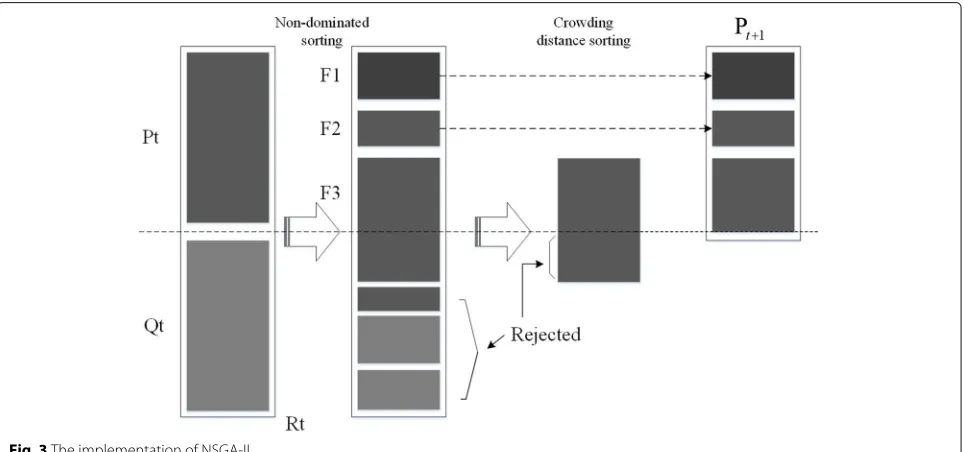
Compared to the traditional genetic algorithm, NSGA-II can find the global optimal solutions among the feasible solutions quickly and accurately. The implementation of NSGA-II is shown in Fig.3, which consists of five steps. Notice that the detail implementation of step 4 is shown in Algorithm 1 and we also introduce how it will be called by Algorithm 2 in Section3.2. The details of each step are shown as follows.
3.1.1 Step 1: Encoding
The WA is numbered by using the results of a topologi-cal with an integer index and starts from{0, 1,. . .,}. The gene denotes the value of each decision variable and also represents the offloading strategy of each task of WA. Multiple genes form a complete chromosome which can also be seen as an individual, representing one solution to the optimization problem. Numbers of individuals form a population, which indicates the diversity of solution.
Each chromosome represents a computational offloading strategy forF WAs. The integer coding method is used, namely, each offloading strategy is encoded as {0, 1, 2}. The number 0 indicates that each task of WA is processed by MD itself and the number 1 represents the task of WA is offloaded to the cloudlet. Similarly, the number 2 repre-sents the task of WA is offloaded to the cloud on the basis of the offloading strategies.
As shown in the Fig.4, an example of encoding is given. Each box on the lower chromosome represents a gene and also indicates a task of the WA. The possible value of each gene is {0, 1, 2} and denoted as vi = 0 vi = 1 ovi=2, which is represented above the gene. In addition, the gene with the same color means that they have the same offloading strategy.
3.1.2 Step 2: Fitness functions and constraints
Fitness function is the criterion for evaluating individual quality, which is given by Eqs. (17), (18), and (19). The three fitness functions of the computing offloading model (17), (18), (19) represent the time consumption, the energy consumption and the cost, respectively. It is necessary to make tradeoffs among the multiple objective functions. Namely, we need to obtain the best offloading strategy to make these three fitness functions well.
Additionally, for each WA, the completion time is obtained according to the computation offloading strat-egy. If the time constraint of formula (20) is not satisfied, the chromosome represented by the offloading strategy will not be considered in the selection process. The chro-mosome that satisfies the time constraint is called the valid chromosome.
Fig. 4An example of encoding
3.1.3 Step 3: Initialization, selection, crossover, mutation To generate initialized populationP0randomly and then
the binary tournament selection, crossover and mutation are performed onP0to obtain new populationQ0.
The crossover operation is to cross the corresponding genes of two individuals and select two points on chro-mosome based on the gene fragments which enhance the adaptability, i.e., crossover point, to exchange the middle part of gene valuevi. An example of crossover operation is shown in Fig.5.
A mutation operation based on enhancing population adaptability is proposed in MCOWA. Each gene value of each individual is mutated with the mutation probability, which is given in advance. And the gene fragment with an added value of 1 is mutated. An example of mutation is given in Fig.6.
3.1.4 Step 4: Non-dominated sort
Form a new group populationRt = PtQt, wheret = 0. Additionally, the non-dominated front-endF1,F2,. . .is
obtained by non-dominated sort ofRt. The main steps are shown as follows [40,41]
(1) The parameters are initialed, and the population size SCALE is determined at the same time. In addition, the attribute of the individual chromosomes dominated the number of those in the tagged population is set, if dominated = 0, then the individual chromosome set the individual dominated empty.
(2)An individual chromosome is selected sequentially in the population, which is compared to other individu-als in the population based on the dominance relation. If the compared individual dominate the selected individual
chromosome, let dominated = dominated + 1; if the
Fig. 6An example of mutation
compared individual is dominated by the selected indi-vidual, add the compared individual to the individual set which is dominated by the chromosome.
(3)Repeat (2) until processing the dominated attribute of theNchromosomes and their dominated individual set.
(4)The population is traversed and the chromosome
whose dominated attribute is 0 is added to the rank 1. (5)The individual chromosome in the rank established is selected sequentially in (2), meanwhile, all of the indi-viduals’ attribute in the set of individuals is operated by auto-decrement, and thus, dominated= dominated−1. If dominated = 0, add the individual to the rank of next level.
(6) Repeat (5) until it is empty that the dominated individual set of the individual chromosome is.
The pseudo-code of the fast non-dominated sorting approach is shown in Algorithm 1.
3.1.5 Step 5: Crowding distance calculation
AllFiare sorted according to the crowding distance com-parison operation ≺n, and the best N individuals are selected to form a populationPt+1. The congestion
dis-tance formula is shown in (22)
id=iTd +iEd+iCd = F
f=1
|Twai+1,f(S)−Twai−1,f(S)|
+ F
f=1
|Ewai+1,f(S)−Ei−wa1,f(S)|
F
f=1
|Cwai+1,f(S)−Cwai−1,f(S)|
(22)
where id represents the crowding distance of the its offloading strategy,si,f represents thefth WA.iTd,iEd, and
Algorithm 1Fast Non-dominated Sort(R) Input: The population of 2Npopsize;
Output: Non-dominated sets; 1: for eachr∈R do
2: Sr = ∅ 3: nr=0
4: foreachq∈Rdo
5: if(r≺q)then
6: Sr=Sr∪q
7: else if (q≺r) then
8: nr=nr+1
9: end if
10: end for
11: ifnr=0then
12: rrank=1
13: H1=H1∪ {r}
14: end if 15: end for 16: i=1
17: whileHi= ∅do
18: Q= ∅
19: for eachr∈Hido
20: for eachq∈Srdonq=nq−1
21: ifnq=0then
22: qrank=i+1
23: Q=Q∪q
24: end if
25: end for
iCd represent the objective functions, respectively.Twai+1,f(S) represents the value of the offloading strategy si+1,f to the objective functionTwa,f(S). In addition,Ei+wa1,f(S) rep-resents the value of the offloading strategy si+1,f to the objective functionEwa,f(S). Similarly,Cwai+1,f(S)represents the value of the offloading strategysi+1,f to the objective functionCwa,f(S).
The population Pt+1 is subjected to replication,
crossover, and mutation operations to form a population Qt+1. If the termination condition is true (the maximum
number of iterations is met), then it ends. Otherwise,t= t+1 and goes to Step 2.
3.2 MCOWA pseudocode
The pseudocode of MCOWA method is shown in Algo-rithm 2. The input of the AlgoAlgo-rithm 2 are multiple WA. The algorithm starts from the first iteration (Line 1). Firstly, the population is initialized, the chromo-somes whose complete time does not satisfy the deadline
Algorithm 2MCOWA
Input: WAs, population size N,the maximum number of iterationsGenerationmax
Output: Optimal computation offloading strategy St,energy consumptionE,time consumptionT,costC 1: Gen=1,t=1
2: whileGen≤Generationmaxdo 3: Initialize the populationPt
4: forevery chromosome inPtdo
5: if each WA completion time meets the time
constraintD(f)then
6: Pt,=Pt−MPt,valid chromosome
7: end if
8: end for
9: Qt=selection, crossover and mutationP,t 10: Rt=P,t+Qt
11: F=Algorithm 1(Rt) 12: Pt+1= ∅
13: i=0
14: whilelen(Pt+1)+len(F[i]) <Ndo
15: crowdingdistanceassignment(F[i]) by formula22
24: return St,energy consumption E,time consumption T,cost C
constraint are removed from the population, and the new generation is denoted as Pt (Line 3 to 8). Two popula-tions Pt and Ot of size N are randomly generated and form a populationRtwith a population size of 2N (Line 9 to 10). The populationRtis divided into multiple non-dominated layers by calling Algorithm 1(Line 11). F is prepared for the selection operation, and populationPt+1
is set to empty and store the new generation of the popu-lation (Line 12). Additionally, the excellent individuals are selected to fill in a new population of size N according to crowding distance (Line 13 to 18). Then the offspring population is generated after the crossover and mutation and put into Qt+1 (Line 19). The offspring population
is merged with the parent population and iterated again until the algorithm ends (Line 2 to 22). Finally, the opti-mal offloading strategies, the time consumption, energy consumption, and cost of all WAs are output (Line 23).
4 Experimental evaluation
In this section, a comprehensive simulation and exper-iment are carried out to evaluate the performance of the proposed MCOWA method. Specifically, the simula-tion setup is introduced firstly, including the experimental parameter settings and other comparative methods. Then, the influence of different WA scales on the energy con-sumption performance, time concon-sumption performance, and cost performance of the compared methods and MCOWA is evaluated.
4.1 Experimental settings
In order to make a comparative analysis, we propose some other computation offloading methods in addition to our MCOWA method. The comparative methods are introduced as follows.
Table 2Parameter settings
Parameter Value
The power of MDs when CPU is idle state 0.001 W
The power of MDs when CPU is active state 0.5 W
The transmission power of MDs 0.1 W
The processing capacity of MDs 500 MHZ
The processing capacity of the cloudlet 2000 MHZ
The processing capacity of the cloud 3000 MHZ
The latency of LAN 1 ms
The latency of WAN 30 ms
The bandwidth of LAN 100 kb/s
The bandwidth of WAN 50 kb/s
The average waiting time of tasks in the cloudlet 20 ms
The cost of cloudlet for each task 2
(a)
(b)
(c)
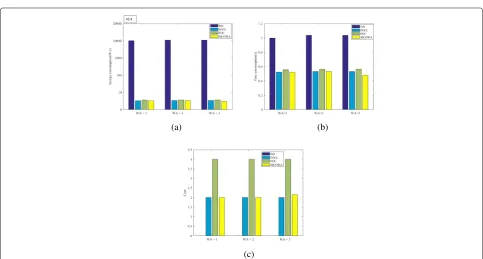
Fig. 7The energy consumption, time consumption, and cost of each method where WAs=2.aEnergy consumption.bTime consumption.cCost
(a) (b)
(c)
(a) (b)
(c)
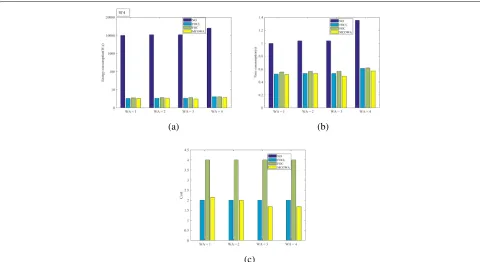
Fig. 9The energy consumption, time consumption, and cost of each method where WAs=4.aEnergy consumption.bTime consumption.cCost
No offloading (NO): All tasks of a WA are processed on the MD. There is no transmit overhead between any two tasks. In addition, there is no cost of using resources of cloudlet of cloud, named as NO.
Full offloading to cloud (FOC): All computation tasks of WAs are moved from the local MD to the remote cloud for processing, named as FOC.
Full offloading to cloudlet (FOCL): All computation tasks of WAs are moved from the local MD to the cloudlet for processing, named as FOCL.
MCOWA: With the help of the MCOWA, all tasks are partitioned into three sets, one for local processing on the MD and another for remote processing on cloud, and the other for cloudlet processing.
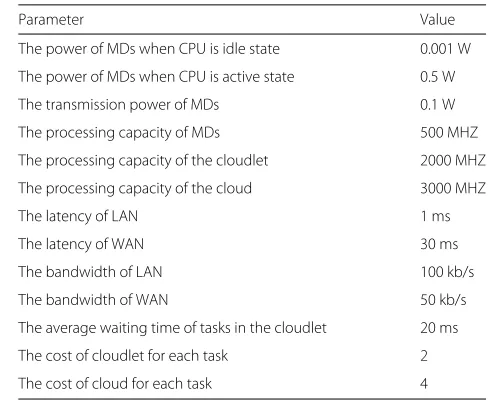
We use the same parameter settings with reference [42] and the value of some new parameters are presented. The details are shown in Table 2. The methods are imple-mented base on JAVA language by using the tool of Eclipse on a PC machine with 2 Intel Core i5-5200U 2.20GHz pr ocessors and 4GB RAM. The operating system is Win7 64.
Table 3The number of WAs=2
Location NO FOCL FOC MCOWA
Local 26 0 0 0
Cloudlet 0 26 0 24
Cloud 0 0 26 2
4.2 Performance evaluation
We have received different results under the different parameters of WAs number. Fifty experiments are per-formed in the case of convergence for each WA scale. Firstly, we discuss how MCOWA balance the three objectives.
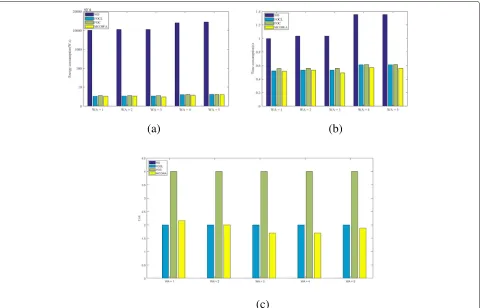
As shown in Fig.7, we can see that MCOWA is effec-tive for two mobile users. Similary, it also can be used for the scenario of three users and more users based on the experimental results which are shown in Figs.8,9,10,11, and12. More specifically, we can conclude that each user can obtain the best results from the perspective of energy consumption and time consumption.
We can conclude that MCOWA is effective with the increasing of number of WAs. More specially, a WA con-sists of 13 tasks. So two WAs are 26 tasks and so on. Additionally, as shown in Figs.7,8,9,10,11, and12, com-pared to FOC and FOCL, MCOWA has a smaller cost. If we only consider the cost factor, there is no cost for local processing and it seems that MCOWA is not better than
Table 4The number of WAs=3
Location NO FOCL FOC MCOWA
Local 39 0 0 2
Cloudlet 0 39 0 35
Table 5The number of WAs=4
Location NO FOCL FOC MCOWA
Local 52 0 0 4
Cloudlet 0 52 0 47
Cloud 0 0 52 1
NO. However, MCOWA minimizes the time consumption and energy consumption of WA while ensures the cost is within a certain acceptable range. Overall, MCOWA is effective as the offloading strategy make these three objects better, not just to make one of them work best.
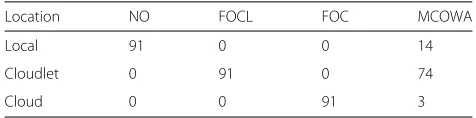
Secondly, we discuss how MCOWA provide effective strategy to balance three offloading destinations, namely local, cloudlet, and cloud. As shown in Tables3,4,5,6,7, and8, as the cost is in an acceptable range, the task is mainly offloaded to the cloudlet. That means the cloudlet is the optimal offloading destination. If the number of tasks exceeds the processing capacity of the cloudlet, some tasks will be offloaded to the cloud in order to reduce the queue latency while meeting the deadline constraint of task. In addition, as the number of WAs increases, the number of corresponding tasks increases. The competition for computing resources of cloudlet among WAs will be more intense as cloudlet is still the first choice to offload. Considering the limitations of cloudlet resources and the cost processing tasks in cloud, the number of tasks which are executed locally will increase and the number of tasks which are offloaded to the cloud will be decreased, which also proves that our method strategy is effective and can balance each offloading destinations well.
5 Related work
MCC brings new services and facilities to MUs to take full advantage of cloud computing. However, the remote cloud is usually located far away from the MUs, which may result in high network latency. This inevitably reduces QoS of MUs. In addition, MUs have to pay for the resources of cloud they use. MEC is a new paradigm can be seen as a example of MEC. Different from the MCC, MEC is a three-layer architecture. The edge server is a bridge which well connects the MU and cloud. MU can connect to edge server or cloud according to requirement of service. There are many kinds of edge servers [43]. Cloudlet is a type of edge server, which has
been widely used in LAN and WMAN [25–27, 44–46].
Table 6The number of WAs=5
Location NO FOCL FOC MCOWA
Local 65 0 0 7
Cloudlet 0 65 0 56
Cloud 0 0 65 2
Table 7The number of WAs=6
Location NO FOCL FOC MCOWA
Local 78 0 0 11
Cloudlet 0 78 0 66
Cloud 0 0 78 1
Cloudlet is a low-cost infrastructure with rich computer resources, high bandwidth, and sufficient power. With the help of cloudlet, MU can improve QoS by computation offloading.
Computation offloading was originally studied in MCC [28–33]. The offloading mode in MEC is similar with the mode in MCC, but the main difference is the location of offloading. It is commonly assumed that the offload-ing destination of computation offloadoffload-ing for MCC is the remote cloud, while the offloading destination of MEC is a edge server such as cloudlet. Different from the cloudlet, it is assumed that the resources in remote cloud are unlimited. Besides, MCC can be seen as a two-layer architecture, while MEC can be seen as a three-layer architecture.
Jia et al. [28] made a thorough study on how to divide and migrate applications in MCC by using heuristic algo-rithm. The relationship between tasks in the WA is abstracted into serial and parallel, and the general WA is seen as a combination of the two. The core idea is to reduce the total processing latency of the task by increasing the parallelism between the local and the cloud. According to the unstable wireless channel and unstable service node in the MCC, Wu et al. [29] proposed a min-cost offload partitioning algorithm to find the best par-titioning plan and minimize processing time and energy consumption. In view of the sequence of task processing in the WA, dynamic voltage and frequency scaling is used to set a number of flag bits to construct a joint optimization function of latency and energy consumption in [30]. The task scheduling strategy based on simulated annealing algorithm is proposed to optimize the processing time consumption and energy consumption of the WA.
There are many studies on WA schedule in MCC. Deng et al. [31] propose a novel offloading system to design robust offloading decisions for mobile services. The dependency relations among component services are taken into consideration. The objectives of them are to optimize execution time and energy consump-tion of mobile services. Xu et al. [32] propose an energy
Table 8The number of WAs=7
Location NO FOCL FOC MCOWA
Local 91 0 0 14
Cloudlet 0 91 0 74
(a)
(b)
(c)
Fig. 10The energy consumption, time consumption, and cost of each method where WAs=5.aEnergy consumption.bTime consumption.cCost
consumption model for applications deployed across cloud computing platforms, and a corresponding energy-aware resource allocation algorithm for VMs scheduling to accomplish scientific workflow executions. Aiming at the problem of scientific WA scheduling with deadline constraints in multi-cloud environment, an adaptive discrete particle swarm optimization algorithm is proposed in [33], which can reduce the processing cost of WA while meeting the deadline of WA. As MEC and MCC have differ-ent architectures, the computation offloading methods in MCC cannot be used for the MEC scenario directly.
Jia et al. [34] proposed a computational offloading algo-rithm for augmented reality applications in MEC environ-ment. They hold the opinion that such applications are multi-user participation and have high latency require-ments. They have established a multi-user augmented reality game system model and proposed a corresponding multi-user computing offloading algorithm. Li et al. [35] proposed a migration algorithm that divides the applica-tion into multiple parts and migrates them to multiple cloudlets to minimize task computation latency. How-ever, their methods mainly focus on latency optimization. Liu et al. [36] utilize a queuing theory to study on the energy consumption, processing latency, and price cost
of offloading process in MEC system. The secularization scheme and interior point method are used to address the formulated problem. They are mainly for general applica-tions in the MEC and do not consider the computation of WAs in the MEC.
Zhang et al. [47] propose an energy-efficient offload-ing strategy for home automation applications in MEC. An improved particle swarm optimization algorithm is implemented to schedule mobile services which mini-mizes the total energy consumption of the WAs within a given constant deadline. However, their approach focuses on the single-user and single-objective optimization sce-nario. Huang et al. [48] proposed a computation offload-ing method for multimedia workflows with deadline constraints in cloudlet-based mobile cloud. The objec-tive of them is to minimize the energy consumption with the constraints of meeting the deadline of each multime-dia workflow. In addition, a multi-objective computation offloading method for WA is proposed in terms of energy consumption and time consumption [42].
(a)
(b)
(c)
Fig. 11The energy consumption, time consumption, and cost of each method where WAs=6.aEnergy consumption.bTime consumption.cCost
(a)
(b)
(c)
6 Conclusion
In this paper, we investigate the multi-objective compu-tation offloading method for WAs in MEC. To tackle the problem, we have proposed a computation-offloading algorithm (MCOWA) that finds the optimal application strategy while meeting the deadline-constrained of WAs. Extensive experimental evaluations have conducted to show the efficiency and effectiveness of our proposed method.
In future work, we will focus on multi-objective opti-mization computation offloading from the perspective of edge servers in MEC. For one thing, the computation offloading for WAs in multi-cloudlet scenario will be stud-ied [49, 50]. For another, the revenue of the edge server will be investigated [51].
Acknowledgements
This work is supported by The Natural Science Foundation of Fujian Province (Grant No.2018J05106), the Education and Scientific Research Projects of Young and Middle-aged Teachers in Fujian Province (JZ160084), and the Scientific Research Foundation of Huaqiao University under Grant No. 14BS316. China Scholarship Council (CSC) awarded Kai Peng’s 1-year research abroad at the University of British Columbia.
Authors’ contributions
KP, MZ, YZ, LL, JZ, VCML, and LZ conceived and designed the study. MZ and LL performed the simulations. KP wrote the paper. All authors reviewed and edited the manuscript. All authors read and approved the final manuscript.
Availability of data and materials
The details of experimental parameters are given in Section4.2.
Competing interests
The authors declare that they have no competing interests.
Author details
1College of Engineering, Huaqiao University, Quanzhou, Fujian, China.2School
of Computer Science and Technology, Anhui University, Hefei, China.3State
Key Laboratory for Novel Software Technology, Nanjing University, Nanjing 210008, China.4Department of Electrical and Computer Engineering, The
University of British Columbia, Vancouver V6T 1Z4, BC, Canada.5Fujian Provincial Academic Engineering Research Centre in Industrial Intellectual Techniques and Systems, Fujian, China.
Received: 20 May 2019 Accepted: 22 July 2019
References
1. T. Wang, G. Zhang, A. Liu, M. Z. A. Bhuiyan, Q. Jin, A secure IoT service architecture with an efficient balance dynamics based on cloud and edge computing. IEEE Internet Things J. (2018).https://doi.org/10.1109/JIOT. 2018.2870288
2. X. Xu, S. Fu, Q. Cai, W. Tian, W. Liu, W. Dou, A. X. Liu, Dynamic resource allocation for load balancing in fog environment. Wirel. Commun. Mob. Comput.2018, 15 (2018).https://doi.org/10.1155/2018/6421607 3. S. Raza, S. Wang, M. Ahmed, M. R. Anwar, A survey on vehicular edge
computing: architecture, applications, technical issues, and future directions. Wirel. Commun. Mob. Comput.2019, 19 (2019).https://doi. org/10.1155/2019/3159762
4. L. Qi, R. Wang, C. Hu, S. Li, Q. He, X. Xu, Time-aware distributed service recommendation with privacy-preservation. Inf. Sci.480, 354–364 (2019) 5. K. Peng, V. C. Leung, Q. Huang, Clustering approach based on mini batch
Kmeans for intrusion detection system over big data. IEEE Access.6, 11897–11906 (2018)
6. Y. Zhang, K. Wang, Q. He, F. Chen, S. Deng, Z. Zheng, Y. Yang,
Covering-based web service quality prediction via neighborhood-aware
matrix factorization. IEEE Trans. Serv. Comput. (2019).https://doi.org/10. 1109/TSC.2019.2891517
7. X. Xu, Q. Liu, Y. Luo, K. Peng, X. Zhang, S. Meng, L. Qi, A computation offloading method over big data for IoT-enabled cloud-edge computing. Futur. Gener. Comput. Syst.95, 522–533 (2019)
8. L. T. Yang, X. Wang, X. Chen, J. Han, J. Feng, A tensor computation and optimization model for cyber-physical-social big data. IEEE Trans. Sustain. Comput. (2017).https://doi.org/10.1109/TSUSC.2017.2777503
9. L. Qi, Y. Chen, Y. Yuan, S. Fu, X. Zhang, X. Xu, A QoS-aware virtual machine scheduling method for energy conservation in cloud-based
cyber-physical systems. World Wide Web (2019).https://doi.org/10.1007/ s11280-019-00684-y
10. X. Xu, S. Fu, L. Qi, X. Zhang, Q. Liu, Q. He, S. Li, An IoT-Oriented data placement method with privacy preservation in cloud environment. J. Netw. Comput. Appl.124, 148–157 (2018)
11. L. Qi, X. Zhang, W. Dou, Q. Ni, A distributed locality-sensitive hashing-based approach for cloud service recommendation from multi-source data. IEEE J. Sel. Areas Commun.35(11), 2616-2624 (2017) 12. X. Wang, L. T. Yang, X. Chen, M. J. Deen, J. Jin, Improved multi-order distributed
HOSVD with its incremental computing for smart city services. IEEE Trans. Sustain. Comput. (2018).https://doi.org/10.1109/TSUSC.2018.2881439 13. X. Xu, Y. Xue, L. Qi, Y. Yuan, X. Zhang, T. Umer, S. Wan, An edge
computing-enabled computation offloading method with privacy preservation for internet of connected vehicles. Futur. Gener. Comput. Syst.96, 89–100 (2019)
14. L. T. Yang, X. Wang, X. Chen, L. Wang, R. Ranjan, X. Chen, M. J. Deen, A multi-order distributed HOSVD with its incremental computing for big services in cyber-physical-social systems. IEEE Trans. Big Data.https://doi. org/10.1109/TBDATA.2018.2824303
15. T. Wang, G. Zhang, M. Z. A. Bhuiyan, A. Liu, W. Jia, M. Xie, A novel trust mechanism based on fog computing in sensor-cloud system. Futur. Gener. Comput. Syst. (2018).https://doi.org/10.1016/j.future.2018.05.049 16. K. Wang, H. Yin, W. Quan, G. Min, Enabling collaborative edge computing for software defined vehicular networks. IEEE Netw.32(5), 112–117 (2018) 17. X. Xu, Y. Li, T. Huang, Y. Xue, K. Peng, L. Qi, W. Dou, An energy-aware
computation offloading method for smart edge computing in wireless metropolitan area networks. J. Netw. Comput. Appl.133, 75–85 (2019) 18. T. Wang, J. Zhou, A. Liu, M. Z. A. Bhuiyan, G. Wang, W. Jia, Fog-based
computing and storage offloading for data synchronization in IoT. IEEE Internet Things J., 2018.https://doi.org/10.1109/JIOT.2018.2875915 19. T. Wang, J. Zeng, Y. Lai, Y. Cai, H. Tian, Y. Chen, B. Wang, Data collection
from WSNs to the cloud based on mobile fog elements. Futur. Gener. Comput. Syst. (2017).https://doi.org/10.1016/j.future.2017.07.031 20. W. Li, K. Liao, Q. He, Y. Xia, Performance-aware cost-effective resource
provisioning for future grid IoT-cloud system. J. Energy Eng. (2019). https://doi.org/10.1061/(ASCE)EY.1943-7897.0000611
21. W. Shi, H. Sun, J. Cao, Q. Zhang, W. Liu, Edge computing: An emerging computing model for the internet of everything era. J. Comput. Res. Dev. 54(5), 907–924 (2017)
22. P. Mach, Z. Becvar, Mobile edge computing: A survey on architecture and computation offloading. IEEE Commun. Surv. Tutor.19(3), 1628–1656 (2017) 23. K. Peng, V. Leung, X. Xu, L. Zheng, J. Wang, Q. Huang, A survey on mobile
edge computing: Focusing on service adoption and provision. Wirel. Commun. Mob. Comput.2018(8267838), 16 (2018).https://doi.org/doi. org/10.1155/2018/8267838
24. X. Xu, D. Li, Z. Dai, S. Li, X. Chen, A Heuristic Offloading Method for Deep Learning Edge Services in 5G Networks. IEEE Access.7, 67734–67744 (2019).https://doi.org/10.1109/ACCESS.2019.2918585
25. M. Satyanarayanan, P. Bahl, R. Caceres, N. Davies, The case for vm-based cloudlets in mobile computing. IEEE Pervasive Comput.4, 14–23 (2009) 26. M. Satyanarayanan, G. Lewis, E. Morris, S. Simanta, J. Boleng, K. Ha, The role of
cloudlets in hostile environments. IEEE Pervasive Comput.12(4), 40–49 (2013) 27. M. Satyanarayanan, Z. Chen, K. Ha, W. Hu, W. Richter, P. Pillai, in6th
International Conference on Mobile Computing, Applications and Services. Cloudlets: at the leading edge of mobile-cloud convergence (IEEE, Austin, 2014), pp. 1-9
29. H. Wu, W. Knottenbelt, K. Wolter, Y. Sun,An Optimal Offloading Partitioning Algorithm in Mobile Cloud Computing. Evaluation of Systems. (Springer, Cham, 2016), pp. 311–328
30. H. Hu, R. Liu, Hu H., Multi-objective optimization for task scheduling in mobile cloud computing. J. Comput. Res. Dev.54(9), 1909–1919 (2017) 31. S. Deng, L. Huang, J. Taheri, A. Y. Zomaya, Computation offloading for
service workflow in mobile cloud computing. IEEE Trans. Parallel Distrib. Syst.26(12), 3317–3329 (2014)
32. X. Xu, W. Dou, X. Zhang, J. Chen, EnReal: An energy-aware resource allocation method for scientific workflow executions in cloud environment. IEEE Trans. Cloud Comput.4(2), 166–179 (2015) 33. B. Lin, W. Guo, G. Chen, Scheduling strategy for science workflow with
deadline constraint on multi-cloud. J. Commun.39(1), 56–69 (2018) 34. M. Jia, W. Liang,Delay-Sensitive Multiplayer Augmented Reality Game
Planning in Mobile Edge Computing. Proceedings of the 21st ACM International Conference on Modeling, Analysis and Simulation of Wireless and Mobile Systems. (ACM, Montreal, 2018), pp. 147–154
35. B. Li, M. He, W. Wu, A. K. Sangaiah, G. Jeon, Computation offloading algorithm for arbitrarily divisible applications in mobile edge computing environments: An OCR case. Sustainability.10(17), 196–210 (2018) 36. L. Liu, Z. Chang, X. Guo, T. Ristaniemi,Multi-objective optimization for
computation offloading in mobile-edge computing. 2017 IEEE Symposium on Computers and Communications (ISCC). (IEEE, Heraklion, 2017), pp. 832–837 37. X. Li, L. Qian, R. Ruiz, Cloud Workflow scheduling with deadlines and time
slot availability. IEEE Trans. Serv. Comput.11(2), 329–340 (2018) 38. Z. Li, J. Ge, H. Hu, W. Song, H. Hu, B. Luo, Cost and energy aware
scheduling algorithm for scientific workflows with deadline constraint in clouds. IEEE Trans. Serv. Comput.11(4), 713–726 (2018)
39. J. Vilaplana, F. Solsona, I. Teixido, J. Mateo, F. Abella, J. Rius, A queuing theory model for cloud computing. J. Supercomput.69(1), 492–507 (2014) 40. K. Deb, A. Pratap, S. Agarwal, T. A. M. T. Meyarivan, A fast and elitist
multiobjective genetic algorithm: NSGA-II. IEEE Trans. Evol. Comput.6(2), 182–197 (2002)
41. Y. Sun, F. Lin, H. Xu, Multi-objective optimization of resource scheduling in Fog computing using an improved NSGA-II. Wirel. Pers. Commun. 102(2), 1369–1385 (2018)
42. X. Xu, S. Fu, Y. Yuan, Y. Luo, L. Qi, W. Lin, W. Dou, Multi-objective computation offloading for workflow management in cloudlet-based mobile cloud using NSGA-II.2018 (2018).https://doi.org/10.1111/coin.12197 43. S. Wang, Y. Zhao, J. Xu, J. Yuan, C. Hsu, Edge server placement in mobile
edge computing. J. Parallel Distrib. Comput.127, 160–168 (2019) 44. X. Xu, R. Huang, R. Dou, Y. Li, J. Zhang, T. Huang, W. Yu, Energy-Efficient
Cloudlet Management for Privacy Preservation in Wireless Metropolitan Area Networks. Secur. Commun. Netw.2018, 13 (2018).https://doi.org/ 10.1155/2018/8180451
45. Z. Pang, L. Sun, Z. Wang, E. Tian, S. Yang,A survey of cloudlet based mobile computing. 2015 International Conference on Cloud Computing and Big Data (CCBD). (IEEE, Shanghai, 2015), pp. 268–275
46. X. Xu, Y. Li, Y. Yuan, K. Peng, W. Yu, W. Dou, A. X. Liu,An Energy-Aware Virtual Machine Scheduling Method for Cloudlets in Wireless Metropolitan Area Networks. 2018 IEEE Cyber, Physical and Social Computing (CPSCom). (IEEE, Halifax, 2018), pp. 517–523
47. J. Zhang, Z. Zhou, S. Li, L. Gan, X. Zhang, L. Qi, W. Dou, Hybrid computation offloading for smart home automation in mobile cloud computing. Pers. Ubiquit. Comput.22(1), 121–134 (2018)
48. T. Huang, F. Ruan, S. Xue, L. Qi, Y. Duan, Computation offloading for multimedia workflows with deadline constraints in cloudlet-based mobile cloud. Wirel. Netw.2019, 1–15 (2019)
49. D. G. Roy, D. De, A. Mukherjee, R. Buyya, Application-aware cloudlet selection for computation offloading in multi-cloudlet environment. J. Supercomput.73(4), 1672–1690 (2017)
50. A. Mukherjee, D. De, D. G. Roy, A power and latency aware cloudlet selection strategy for multi-cloudlet environment. IEEE Trans. Cloud Comput.7(1), 141–154 (2016)
51. X. Xu, Q. Cai, G. Zhang, J. Zhang, W. Tian, X. Zhang, A. X. Liu, An incentive mechanism for crowdsourcing markets with social welfare maximization in cloud-edge computing, Concurrency and Computation: Practice and Experience, e4961 (2018).https://doi.org/10.1002/cpe.4961
Publisher’s Note