Automatic Cheque Image Pre-Processing:
Orientation Correction and Background
Elimination
K Bramara Neelima1, Dr T Saravanan2,
Research Scholar, IEEE Student Member, Department of Electronics, Bharath University, India1
Supervisor & Professor, Department of Electronics, Bharath University, India2
ABSTRACT: Automation has become an important aspectin banking industry. Automatic
cheque processing involves acquisition, preprocessing, segmentation, feature extraction and analysis. In this work, solution is proposed to two preprocessing problems of automatic cheque processing that are orientation correction and background elimination. By the proposed methodology, the orientation of given cheque image is detected by an angle of rotation and corrected automatically to the 0 degree rotation. The corrected oriented cheque images are processed for background elimination. A simple and efficient method is proposed to eliminate the background of cheque image. The resulted background removed cheque image is progressed for segmentation.
KEYWORDS: Automatic cheque processing, Image orientation, background elimination, segmentation
I. INTRODUCTION
A cheque is using worldwide for paying money in a proper and convenient way from a bank account at a specified time bound. Existing methods for processing a cheque requires manpower, cost effective and delay process. Recent developments in image processing and machine vision makethe machines to analyze data and extracts information from images. In banking sector automating the processing has become one of the important aspects. Automatic cheque processing is a vision for researchers from the decades. Make use of advanced image processing algorithms in automating the cheque processing reduces the manual effort, cost and time.
In order to produce a successful cheque processing system, many sub-problems have to be solved such as validation of Cheques, cheque orientation, background and noise removal, segmentation and extracting required fields of interest, recognition of the immense styles of handwriting and signatures, touching and overlapping data in various fields of information and errors in the recognition techniques [1].
TheAutomatic cheque processing, that involves the Analysis and the Recognition of Cheque, has the objective of proceeding the text and the graphical elements recognition, that are in the cheque image, being able to make an analysis just as a human observer is capable to do. Automatic cheque processing involves several independent aspects such as cheque image acquisition, cheque image preprocessing, cheque image segmentation, concerned feature extraction and statistical analysis.
The paper is organized as follows. Section 2 describes the existing and proposed work on image orientation detection and correction. Section 3 describes the existing and proposed approach on image background elimination. Section 4 reports the results and analysis. Section 5 draws conclusions and discusses future directions.
Fig.1 shows the steps required for image processing based automatic cheque processing.
II. ORIENTATION
In the design of automated cheque deposit system, it is possible to produce a cheque image of deposited cheque, with the development of inexpensive scanners. When a user scans a cheque, he expects the resulting image to be displayed in its correct orientation, regardless of the orientation in which the cheque was placed on the scanner. Automatic image orientation detection is a very difficult problem. Humans use object recognition and contextual information to identify the correct orientation of an image.
Unfortunately, the state-of-the-art computer vision techniques still cannot infer the high-level knowledge abstraction of the objects in the real world [2]. The alternative method is to exploit the low-level features from the images for orientation detection [3].
We assume that the input image is restricted to only four possible rotations that are multiples of 90 , i.e., the photograph which is scanned can differ from its correct orientation by 0 (no rotation), 90 , 180 , or 270 . This is reasonable since cheque papers placed on a scanner are usually aligned with horizontal or vertical boundaries of the scanner plate. Mostoftheliteraturehasemphasizedrelatedtopicssuchaspage orientation detection [4], [5]. In paper[6], a Bayesian framework for image orientation detection and spatial color moments are used as the features for classification.
In this paper, we present a heuristic method for automatic cheque image orientation detection and correction. This method is based on the unsupervised classification on navel framework. The marginal regions of each cheque image are used to extract the low level regional color features in terms of the first and second color moments in the HSV color space. The constructed multi-dimensional feature vector is further used to classify and find the angles of orientation for each cheque image.As a result of the proposed method, the orientation of given cheque image is detected by an angle of rotation and corrected automatically to the 0 degree rotation.
Cheque Image Acquisition
Pre-Processing
Segmentation
Feature Extraction
Statistical Analysis
III. BACKGROUND REMOVAL
The removal of background of the bank cheque is an essential part for its processing. The notified point after the execution of background elimination is the physical integrity of remaining information in the cheque image. The literature specifies that the background can be eliminated with simple thresholding techniques. In paper[7], Cheriet presents a tool based on the Otsu’s Method that obtained good results in the background identification and elimination using a recursive process. In [8], a new method to document image binarization by a noise image model, to identify and eliminate many occurrences of text or images that are on the back of the document but that show up on the front from the relevant peeks in its histogram.
In paper [9], Okada eliminates not only the background but all of the pre-printed elements, by a morphological subtraction schemebetween the original image and a filled document image. Several methods for performing background subtraction have been proposed in the recent literature. All of these methods try to effectively estimate the background model from the temporal sequence of the frames. The paper[10] provides a thorough review of the main methods and an original categorization based on speed, memory requirements and accuracy. The methods reviewed Running Gaussian average, Temporal median filter, Mixture of Gaussians, Kernel density estimation (KDE), Sequential KD approximation, Co-occurence of image variations and Eigenbackgrounds.
In this paper, by summon up of prescribed literature a simple and efficient method is defined to eliminate the background of cheque image. In standings of image processing and computer vision background subtraction is also known as foreground extraction. Form the given bank cheque image the background is estimated.By applying the blob analysis, the background is subtracted from the original image. The resulted image is binarized with well-defined threshold through global thresholding technique.
IV. RESULTS
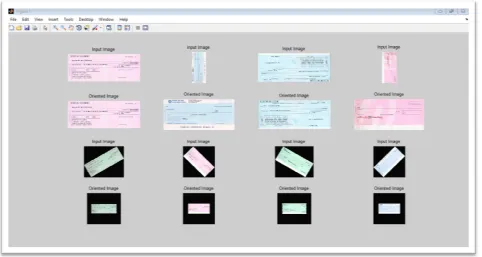
The entire system is simulated in MATLAB. Samples of two different institution bank cheques are taken to test the system. By applying the proposed method, the angles of orientation of each cheque image is found. For the given cheque images, the angle of orientations and corrected orientations are shown in Fig.2.
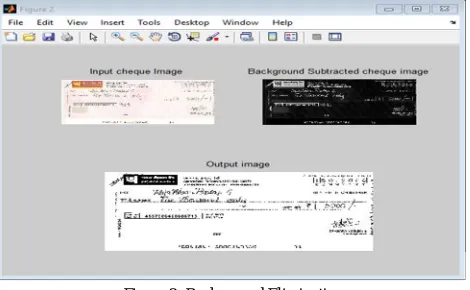
By proposed methodology the backgrounds of cheque images are removed. Fig.3 shows the result of background elimination of given cheque image.
Figure 3: Background Elimination
By applying the segmentation technique [11], segmentation is taken place to acquire each field in the cheque image. Fig.4 shows the segmentation and each field extraction along with background elimination.
Figure 4: Cheque Image Segmentation
V. CONCLUSION
In this work, we considered the two important problems of automatic cheque image preprocessing, orientation of cheque image and the background elimination. With the advanced image processing methods, the orientation of cheque image is detected and corrected. Results explain that image orientation is acquired by rotation angle and corrected automatically to the 0 degree rotation. The correct oriented cheque images are processed for background elimination. A simple and efficient method is proposed to eliminate the background of cheque image. The resulted background removed cheque image is processed for segmentation. In the segmented phase, each field of the cheque image is segmented properly and aims to extract the features of areas of interest.
REFERENCES
[2]. L. Shapiro and G. Stockman, Computer Vision. Englewood Cliffs, NJ: Prentice-Hall, 2000. [3]. R. C. Gonzalez and R. E. Woods, Digital Image Processing. Reading, MA: Addison-Wesley, 1992.
[4]. R. S. Caprari, “Algorithm for text page up/down orientation determination,” Pattern Recognit. Lett., vol. 22, no. 4, pp. 311–317, 2000.
[5] B. B. Chaudhuri and U. Pal, “Skew angle detection of digitized Indian script documents,” IEEE Trans. Pattern Anal. Machine Intell., vol. 19, pp. 182–186, Feb. 1997.
[6]. A. Vailaya, H.-J. Zhang, C.-J.Yang, F.-I. Liu and A. Jain, "Automatic image orientation detection",IEEE Transactions on Image Processing, vol. 11, no. 7, pp. 746-755, 2002.
[7]. Cheriet, M., Said, J.N. and Suen, C.Y. “A Formal Model for Document Processing of Business Forms.” In Proceedings of ICDAR’95. 1995. 210-213.
[8]. Don, Hon-Son. “A Noise attribute Thresholding Method of Document Image Binarization.” In Proceedings of ICDAR’95. 1995. 231-234. [9]. Okada, Minoru and Shridhar, Malayappan. “A Morphological Subtraction Scheme for Form Analysis.” In Proceedings of ICPR’96. 1996. 190-194.
[10]. M. Piccardi, "Background subtraction techniques: Areview", Proc. IEEE Int. Conf. Syst., Man Cybern., vol. 4, pp. 3099-3104, 2004.
[11]. K.BramaraNeelima, “Geometric Based Bank Cheque Segmentation- A Heuristic Approch”, Journal Of Pure And Applied Microbiology, Volume 9 No. Special Edition Aug. 2015 Page No. 155-159.