University of Windsor University of Windsor
Scholarship at UWindsor
Scholarship at UWindsor
Electronic Theses and Dissertations Theses, Dissertations, and Major Papers
2019
Almost Periodic Functions on Topological Groups
Almost Periodic Functions on Topological Groups
Yihan Zhu
University of Windsor
Follow this and additional works at: https://scholar.uwindsor.ca/etd
Recommended Citation Recommended Citation
Zhu, Yihan, "Almost Periodic Functions on Topological Groups" (2019). Electronic Theses and Dissertations. 7748.
https://scholar.uwindsor.ca/etd/7748
This online database contains the full-text of PhD dissertations and Masters’ theses of University of Windsor students from 1954 forward. These documents are made available for personal study and research purposes only, in accordance with the Canadian Copyright Act and the Creative Commons license—CC BY-NC-ND (Attribution, Non-Commercial, No Derivative Works). Under this license, works must always be attributed to the copyright holder (original author), cannot be used for any commercial purposes, and may not be altered. Any other use would require the permission of the copyright holder. Students may inquire about withdrawing their dissertation and/or thesis from this database. For additional inquiries, please contact the repository administrator via email
ALMOST PERIODIC FUNCTIONS
ON TOPOLOGICAL GROUPS
by
Yihan Zhu
A Thesis
Submitted to the Faculty of Graduate Studies
through the Department of Mathematics and Statistics
in Partial Fulfillment of the Requirements for
the Degree of Master of Science at the
University of Windsor
Windsor, Ontario, Canada
2019
Almost Periodic Functions
by
Yihan Zhu
APPROVED BY:
—————————————————————–
L. Rueda
School of Computer Science
—————————————————————–
D. Yang
Department of Mathematics and Statistics
—————————————————————–
M. S. Monfared, Advisor
Department of Mathematics and Statistics
iii
Author’s Declaration of Originality
I hereby certify that I am the sole author of this major paper and that no part of
this these has been published or submitted for publication.
I certify that to the best of my knowledge, my thesis does not infringe upon
any-one’s copyright nor violate any proprietary rights and that any ideas, techniques,
quotations, or any other material from the work of other people included in my
the-sis, published or otherwise, are fully acknowledged in accordance with the standard
referencing practices. Furthermore, to the extent that I have included copyrighted
materials that surpasses the bounds of fair dealing within the meaning of the Canada
Copyright Act, I certify that I have obtained a written permission of the copyright
owner(s) to include such materials in my thesis and have included copies of such
copyright clearances to my appendix.
I declare that this is a true copy of my thesis, including any final revisions, as
approved by committee and the Graduate Studies Office, and that this thesis has not
iv
Abstract
We study the definition and properties of almost periodic functions on topological
groups. We show the equivalence between Bochner’s and Bohr’s definitions of almost
periodicity. We discuss Weil’s construction of Bohr compactification b(G) and study its properties. Using Peter-Weyl’s density theorem we show that a function f in
Cb(G)is almost periodic if and only if it is the uniform limit of linear combinations of coefficients of the finite-dimensional irreducible unitary representations ofG. We show the existence of a unique invariant mean on the space of almost periodic functions. We
investigate the Fourier series of almost periodic functions, and show that it extends
v
Acknowledgements
First, I would like to express my special thanks of gratitude to my supervisor
Dr. Mehdi Monfared who gave me the golden opportunity to be his student. His
patience and kindness helped me overcome various challenges in my studies. His
encouragement is the motivation for me to pursue my goal in my study. And his
wisdom and brilliance guided me to have optimistic opinions both on study and life.
I am also very grateful to all the members of my defense committee. In particular,
I would like to thank Dr. Luis Rueda from the School of Computer Science for agreeing
to be my external program reader. I am also very grateful to Dr. Yang for reading my
thesis and giving me very valuable suggestions and to Dr. Hu for chairing the defense.
I also would like to thank Dr. Zhiguo Hu, Dr. Dilian Yang, Dr. Ilya Shapiro
and Dr. Mohammad Hassanzadeh for their wonderful graduate courses of Analysis
and Algebra. Their patient teaching led me to a fantastic mathematics world and
developed my interest in learning more about interesting mathematics theorems.
Besides professors, I am grateful to my parents for their significant support from
China. Without their support and care I could not finish my courses and thesis. Also,
I want to thank my friends for giving me courage and relief to face the difficulties I
met both in my study and life and for their accompany which makes me feel the
warmth of the friendship.
Finally, I would like to offer my sincere thanks to all students, faculty members
and staff in the department of Mathematics and Statistics for the harmonic, friendly
and positive studying and working environment. In particular, I was deeply impressed
Contents
Author’s Declaration of Originality iii
Abstract iv
Acknowledgements v
Chapter 1. Introduction and Preliminaries 1
1.1. Introduction 1
1.2. Basic Definitions 6
1.3. Banach Algebras and Hilbert Spaces 9
1.4. Topological Groups 10
1.5. Weak Topology 12
1.6. Representations of Topological Groups 13
1.7. The Gelfand Representation 16
Chapter 2. Almost Periodic Functions 17
2.1. Bochner’s Definition and Its Basic Properties 17
2.2. Functions withϵ-Almost Periods 22
2.3. Bohr’s Definition and Its Generalization 27
Chapter 3. Further Properties of Almost Periodic Functions 34
3.1. Weil’s Construction of the Bohr Compactification 34
3.2. Loomis’ Alternative Construction of Bohr Compactification 41
3.3. Bohr Compactification of Abelian Groups 46
3.4. Some Applications of Bohr Compactification 50
3.5. Approximation Theorem for Almost Periodic Functions 53
3.6. Maximally and Minimally Almost Periodic Groups 56
CONTENTS vii
Chapter 4. Invariant Means on Almost Periodic Functions 58
4.1. Bohr Compactification and Invariant Means 58
4.2. The Marriage Lemma and Its Application 60
4.3. Examples of Invariant Means 72
4.4. Fourier Series of Almost Periodic Functions 74
Chapter 5. Further Developments and Future Work 81
Appendix A. Uniform Continuity 84
Appendix B. Stone-Weierstrass Theorem 88
Bibliography 96
CHAPTER 1
Introduction and Preliminaries
1.1. Introduction
We frequently encounter periodic phenomena in our lives. For instance, the
recur-rences of days and nights are repeated periodically every 24 hours due to the rotation
of Earth on its axis. Seasons occur regularly because the period of revolution of Earth
around Sun is roughly 36514 days.
In nature, however, we also encounter motions that are made of a linear
combi-nation of two or more periodic motions. For example, the motion of Moon around
Sun consists of the motion of Moon around Earth combined with the motion of Earth
around Sun. From a mathematical point of view, such combined motions need not be
periodic any longer.
Figure 1. The motion of Moon around Sun
More precisely, if f and g are two periodic functions with periodsp and p′, then
f+g is periodic ifp/p′ is a rational number, otherwisef+g need not be periodic. For
1.1. INTRODUCTION 2
example, both functions cost and cos√2t are periodic, with periods 2π and 2π/√2, respectively. But the function
f(t) = cost+ cos√2t
is not periodic since the equation
f(t) = 2
has a single solution t = 0 (see Example 2.1.6 (b)). If f was periodic, the same equation would have infinitely many solutions.
The above phenomenon leads us naturally to the concept of ‘almost periodicity’.
A numberτ >0is an ϵ-period if |f(x+τ)−f(x)|< ϵ, for allx∈R. Then, although the function f above has no period, it can be shown that it has an abundance of
ϵ-periods, for everyϵ >0(Theorem 2.2.6).
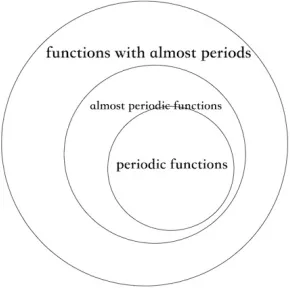
Almost periodic functions are more general than periodic functions, and therefore,
they form a larger class of functions than periodic ones. Unlike periodic functions,
the sums, products, and limits of almost periodic functions always remain almost
periodic, and therefore, the class of almost periodic functions forms a more suitable
object of study from structural point of view.
This thesis is a survey of almost periodic functions and their properties. These
functions were first introduced by H. Bohr in 1923 [7]. He further developed their
properties in his papers [8–10]. The definition of almost periodicity according to
Bohr depends on the notion of ϵ-periods, and is restricted to functions with a real or complex variable.
In 1927, Bochner [4] gave an alternative topological characterization of almost
periodicity, which in some respects is easier to study than the original definition given
by Bohr. Bochner’s work motivated further studies and generalizations. In particular,
we can mention von Neumann’s paper [37], in which almost periodic functions were
1.1. INTRODUCTION 3
In this thesis, we present a unified study of almost periodic functions in the general
setting of an arbitrary topological groupG. If one wishes to study almost periodicity independent of any topology on the group structure (von Neumann’s point of view),
then all one has to do is to assume the underlying group has discrete topology.
We remark that, in the particular case of G = R (the real numbers), the results discussed in this thesis cover the major theorems of the classical theory of the almost
periodic functions, such as: approximation by trigonometric polynomials, existence
of invariant means, expansion by Fourier series, and Parseval’s identity.
What makes our study different from the usual expositions of almost periodic
functions, is that we study this subject from several points of view. This allows us to
have a deeper understanding of the subject, and in some cases, give multiple proofs
for the results in this thesis. For example, we discuss two different constructions of
the Bohr compactification b(G); and we give two proofs of the existence of invariant means on the algebraAP(G) of almost periodic functions.
As is often the case, in modern expositions of almost periodicity (with the notable
exception of Simon [42]), the Bohr’s point of view is abandoned in favour of Bochner’s
more topological definition of almost periodicity. In this thesis, we present the details
of both approaches in Chapter 2. While in Chapter 3, we discuss a third approach to
almost periodic functions via a compactification method due to Weil.
We now give a brief overview of the various sections of the thesis. In the remaining
of Chapter 1, we recall some of the basic definitions and preliminary materials needed
in the later chapters.
In Section 2.1, we introduce almost periodic functions using the topological
char-acterization of Bochner [4]. Bochner’s definition has the advantage of being adaptable
to various generalizations, and for this reason, is commonly accepted as the basic
def-inition of almost periodicity. The fact that almost periodic functions are stable under
addition, multiplication and limits is proved in Theorem 2.1.4.
1.1. INTRODUCTION 4
In Section 2.3, Bohr’s definition of almost periodicity is presented in the general
frame work of topological groups. The equivalence of Bochner’s and Bohr’s definitions
is proved in Theorem 2.3.6.
In Chapter 3 we present further properties of almost periodicity. Section 3.1
con-tains Weil’s construction of a compact groupb(G)associated to any topological group
G. The group b(G)has the property that almost periodic functions on G are exactly those that can be lifted to a continuous function onb(G)(Theorem 3.1.1, 3.1.4). This allows us to deduce many of the properties ofAP(G) from the corresponding proper-ties ofC(b(G)). Following Palmer [39], we callb(G)the ‘Bohr compactification’ ofG, although perhaps, ‘Weil compactification’ would have been a more appropriate name.
The groupb(G)is also know as ‘almost periodic compactification’ of G [1].
In Section 3.2, we give an alternative construction of b(G)due to Loomis [34]. In Loomis’ approach a group structure is defined directly on the spectrum of AP(G). Loomis’ method has the advantage thatb(G)is naturally identified with the spectrum of AP(G).
Section 3.3 deals with Bohr compactification in the category of Abelian topological
groups. For this class of groups, the Pontrjagin duality theorem provided a simpler
description ofb(G), which will be discussed in this section.
In Section 3.4 we establish an isometric isomorphism between the C∗-algebras
AP(G)andC(b(G))(Theorem 3.4.1). Using this isomorphism, it follows immediately that the spectrum of AP(G) can be topologically identified with b(G) (Corollary 3.4.3).
The main result in Section 3.5 is the approximation Theorem 3.5.2, which is one
of the central properties of almost periodic functions. This result shows that almost
periodic functions are exactly those that can be uniformly approximated to arbitrary
degree, by linear combinations of coefficients of finite-dimensional irreducible unitary
1.1. INTRODUCTION 5
Section 3.6 contains a brief study of maximally and minimally almost periodic
groups, which are introduced by von Neumann [37] and von Neumann-Wigner [38].
In Chapter 4, we are concerned with proving the existence of invariant means
on AP(G) (the space of almost periodic functions on G), and showing some of its applications. In Section 4.1 we prove the existence of an invariant mean by using the
normalized Haar measure on b(G). In Section 4.2 we give an alternative proof of the existence of an invariant mean using a combinatorial technique due to W. Maak [35].
Uniqueness of invariant means is established in Theorem 4.2.9. Several examples of
invariant means are given in Section 4.3. In the final section of Chapter 4, we show
how we can use invariant means to prove the existence of Fourier series for almost
periodic functions (Theorem 4.4.4). Establishing the existence of such series is another
major result in the theory of almost periodic functions. Also in this section we show
in details, how in the special case of continuous2π-periodic functions, Theorem 4.4.4 gives the classical result of Fourier series expansions.
Chapter 5 contains a brief discussion on recent developments of the subject and
some ideas for future work.
This thesis has three appendices. Appendix A, contains a brief discussion of
uniform continuity in the context of general topological groups, which is needed in
our discussion of Section 2.3.
Appendix B gives a detailed proof of the Stone-Weierstrass Theorem. This
theo-rem is used in the proof of the Peter-Weyl density Theotheo-rem 3.5.1. This latter theotheo-rem
is an important ingredient of the proof of Theorem 3.5.2.
Author’s contribution. The materials in this thesis are primarily from [17],
[24], [26], [29], [34], [38] and [42]. Additional sources are mentioned in the
rele-vant sections. The author’s main contribution has been to provide full details of the
main results presented in this thesis. Among the results whose proofs have been
sub-stantially expanded, we can mention Theorem 2.1.4, Example 2.1.6, Lemma 2.2.4,
1.2. BASIC DEFINITIONS 6
1.2. Basic Definitions
Definition 1.2.1. Let X be a metric space with metric d. For a positive ϵ > 0, anϵ-mesh in X is a finite set {x1, ..., xn} inX such that for every x∈X,
min{d(x1, x), ..., d(xn, x)}< ϵ,
i.e.,
X =
n
∪
i=1
B(xi, ϵ),
whereB(xi, ϵ)is the open ball in X with center xi and radiusϵ. A metric spaceX is
said to betotally bounded if it admits an ϵ-mesh for every ϵ >0.
Remark 1.2.2. (a)A metric space X is compact if and only if it is complete and totally bounded.
(b)A subsetA of a complete metric space is relatively compact (i.e., the closure of A
is compact) if and only ifA is totally bounded.
Definition 1.2.3. LetX andY be metric spaces,(fα)a family of mappings from X into Y. The family (fα) is said to beequicontinuous atx0 if for every ζ >0, there
exists anη >0 such that
d(x, x0)⩽η ⇒d(fα(x), fα(x0))⩽ζ
for all α.
The family (fα)is said to be equicontinuous onX if it is equicontinuous at every
point ofX.
The family (fα) is said to be uniformly equicontinuous on X if for every ζ > 0,
there exists anη >0 such that
d(x, x′)⩽η ⇒d(fα(x), fα(x′))⩽ζ
1.2. BASIC DEFINITIONS 7
Example 1.2.4. Take X = Y = R. Let (fα) be the family of all differentiable
real-valued functions on Rwhose derivative is bounded by 1 in absolute value. Then
(fα) is uniformly equicontinuous.
Lemma 1.2.5. Let X and Y be metric spaces, (fα) an equicontinuous family of
mappings of X into Y. Assume that X is compact, then the family (fα) is uniformly
equicontinuous.
Theorem 1.2.6 (Ascoli’s theorem). Let X be a compact metric space, Y a
com-plete metric space,A an equicontinuous subset of C(X, Y) (the set of all continuous functions from X to Y). Assume that for each x∈ X, the set of f(x), where f runs overA, has compact closure in Y. Then A has compact closure in the metric space
C(X, Y).
Corollary 1.2.7. Let Cb(X)be the set of all bounded continuous complex-valued
functions on X. A subset F of Cb(X) is compact if and only if it is closed, bounded,
and equicontinuous.
Definition 1.2.8. A topological space(X,T )has thefinite intersection property
if, for any collection F of closed subsets of X such that ∩{F : F ∈ F} =∅, there are F1, . . . , Fn∈F such thatF1∩ · · · ∩Fn=∅.
Theorem 1.2.9. Let (X,T) be a topological space. Then X is compact if and
only if X has the finite intersection property.
Theorem 1.2.10 (The Inverse Mapping Theorem). IfX andY are Banach spaces
and A : X → Y is a bounded linear transformation that is bijective, then A−1 is bounded.
Theorem 1.2.11 (Urysohn’s lemma). Let X be a normal topological space, and
let F and G be disjoint closed subsets of X. Then there is a continuous function
1.2. BASIC DEFINITIONS 8
Theorem 1.2.12 (Heine-Borel theorem). If a setE in Rk has one of the following
three properties, then it has the other two:
(i) E is closed and bounded. (ii) E is compact.
(iii) Every infinite subset of E has a limit point in E.
Definition 1.2.13 (Partition of Unity). If X is a topological space and E ⊂ X,
apartition of unityonE is a collection{hα}α∈Aof functions in C(X,[0,1]) such that
(i) each x∈X has a neighborhood on which only finitely many hα’s are nonzero;
(ii) ∑α∈Ahα(x) = 1 for x∈E.
A partition of unity{hα} is subordinate to an open cover U of E if for eachα there
existsU ∈U with Supp (hα)⊂U.
Theorem 1.2.14. LetX be a locally compact Hausdorff space,K a compact subset
of X, and {Uj}n1, an open cover of K. There is a partition of unity onK subordinate to {Uj}n1, consisting of compactly supported functions.
For the proof of this proposition, we may refer to [11].
Theorem 1.2.15 (Tychonoff’s Theorem). Let ((Ki, τi))i∈I be a nonempty family
of compact topological spaces. Then their topological product is also compact.
Theorem 1.2.16 (Hahn-Banach Theorem). Suppose (a) M is a linear subspace
of a real vector spaceX,
(b) p : X −→ R satisfies p(x+y) ⩽ p(x) +p(y) and p(tx) = tp(x) if x ∈ X, y ∈X,
t⩾0,
(c) f :M −→R is linear and f(x)⩽p(x) on M.
Then there exists a linear function F : X −→ R such that F(x) = f(x) for x ∈ M
and −p(−x)⩽F(x)⩽p(x) for x∈X.
Definition 1.2.17. LetX be a vector space andA ⊆ X. The convex hull of A,
1.3. BANACH ALGEBRAS AND HILBERT SPACES 9
If X is a normed space, then the closed convex hull of A is the intersection of all closed convex subsets of X that contain A; it is denoted byco(A).
1.3. Banach Algebras and Hilbert Spaces
Definition 1.3.1. Let A be an algebra over C. Then A is a Banach algebraif A
is a Banach space with a norm ∥·∥ satisfying ∥ab∥⩽∥a∥∥b∥, for all a, b∈A.
Definition 1.3.2. An involution on an algebra A is a map∗:A−→A, a 7→a∗,
that satisfies
(x+y)∗ =x∗+y∗,
(λx)∗ =λx∗,
(xy)∗ =y∗x∗, x∗∗ =x
for all x, y ∈A and λ∈C.
If A is a Banach algebra, we shall also assume that ∥x∗∥ =∥x∥ for all x ∈A. A Banach algebra equipped with an involution is called an involutive Banach algebra or
a∗-Banach algebra.
Definition 1.3.3. A C∗-algebra is a Banach algebraA equipped with an
involu-tion which satisfies
∥x∗x∥=∥x∥2 for all x∈A.
Example 1.3.4. IfX is a topological space, then the setCb(X) of all continuous complex-valued bounded functions fromX, with pointwise operations and supremum norm, is a C∗-algebra.
Definition 1.3.5. If X is a vector space over C, an inner product on X is a
function(·|·) :X×X →C such that for all α, β in C, and x, y, z in X, the following are satisfied:
1.4. TOPOLOGICAL GROUPS 10
(b) (x|αy+βz) = ¯α(x|y) + ¯β(x|z),
(c) (x|x)⩾0,
(d) (x|y) = (y|x),
(e) if(x|x) = 0, then x= 0.
An inner product induces a norm on X by the relation
∥x∥= (x|x)12.
(1.3.1)
Definition 1.3.6. A Hilbert space is a vector space H over C together with an
inner product (·|·) such that relative to the metric d(x, y) = ∥x−y∥ induced by the norm (1.3.1), H is a complete metric space.
Example 1.3.7. (Cn,(·|·)) with inner product
(x|y) =
n
∑
i=1
xiyi
is a Hilbert space.
Definition 1.3.8. Let H,K be Hilbert spaces. If A ∈ L(H ,K ), then the
unique operatorB inL(K ,H )satisfying (Ah|k) = (h|Bk)for all hinH and all k
inK is called the adjoint of A and is denoted by B =A∗.
Example 1.3.9. If H is a Hilbert space, A = L(H) is a C∗-algebra where for
eachA in L(H), A∗ is the adjoint ofA.
1.4. Topological Groups
Definition 1.4.1. A topological group G is a topological space which is also a
group such that the maps
G×G→G, (x, y)7→xy
and
G→G, x7→x−1
1.4. TOPOLOGICAL GROUPS 11
Lemma 1.4.2. If H is a subgroup or normal subgroup of a topological group G,
then its closure H is also a subgroup, or normal subgroup of G.
Alocally compact groupis a topological groupGfor which the underlying topology is locally compact and Hausdorff.
Definition 1.4.3. LetX be a locally compact space and let BX be the smallest
σ-algebra of X that contains the open sets. Sets in BX are called Borel sets.
A positive measure µon (X,BX)is a regular Borel measureif
(a)µ(K)<∞ for every compact subset K of X;
(b) for any open setU ∈X inBX, µ(U) = sup{µ(K) :K ⊆U and K is compact};
(c) for any E inBX, µ(E) = inf{µ(W) :W ⊇E and W is open}.
If µ is a complex-valued measure on (X,BX), µ is a regular Borel measure if |µ|
is a regular Borel measure.
Let M(X) be all of the complex-valued regular Borel measures on X. Note that
M(X) is a vector space overC. For µ inM(X), let ∥µ∥ ≡ |µ|(X).
Definition1.4.4. LetGbe a locally compact group. By aleft Haar measureonG, we mean a nonzero positive regular Borel measurem onGsuch that m(xE) = m(E)
for all x∈G, E∈BX.
The measure m is called the Haar measure for G.
It can be shown that every locally compact group has left Haar measure m which is unique up to a multiplicative constant. If G is compact then m(G) < ∞, and so by dividing m with m(G), we may assume m is normalized, that is, m(G) = 1.
Example 1.4.5 (The Group Algebra). Let G be a locally compact group. The
space L1(G) of all integrable functions on G (i.e., all measurable functions f on G
satisfying ∥f∥1=∫G|f(s)|ds <∞) is a Banach algebra, called thegroup algebra of G, with the convolution product ∗ defined by
1.5. WEAK TOPOLOGY 12
To show that ∥f g∥1 ⩽∥f∥1∥g∥1, we observe that
∥f g∥1 =
∫
G
|f ∗g(s)|ds
=
∫
G
∫Gf(t)g(t−1s)dtds
⩽
∫
G
∫
G
|f(t)g(t−1s)|dtds
(Fubini’s theorem) =
∫
G
∫
G
|f(t)g(t−1s)|dsdt s7→ts =
∫
G
∫
G
|f(t)g(s)|dsdt
=
∫
G
|f(t)|dt
∫
G
|g(s)|ds
=∥f∥1∥g∥1.
1.5. Weak Topology
Definition 1.5.1. A topological vector space is a vector space E together with a topology such that with respect to this topology
(a) the map ofE×E →E defined by (x, y)7→x+y is continuous; (b) the map ofC×E →E defined by (α, x)7→αx is continuous.
Definition 1.5.2. A locally convex space is a topological vector space whose
topology is defined by a family of seminormsP such that∩p∈P{x:p(x) = 0}={0}.
Theorem1.5.3. SupposeP is a separating family of seminorms on a vector space
X. Associate to each p∈P and to each positive integern the set
V(p, n) ={x:p(x)< 1 n}.
Let B be the collection of all finite intersections of the sets V(p, n). Then B is a convex balanced local base at 0 for a topology τ on X, which turns X into a locally convex space such that
(i) every p∈P is continuous, and
1.6. REPRESENTATIONS OF TOPOLOGICAL GROUPS 13
Theorem 1.5.4. A topological vector space X is normable if and only if its origin has a convex bounded neighborhood.
Two important examples of locally convex spaces are as following:
Let X be a normed space. For each x∗ in X∗, define px∗(x) = |x∗(x)|. Then px∗
is a seminorm and ifP ={px∗ :x∗ ∈X∗}, P makes X into a locally convex space.
The topology defined on X by these seminorms is called the weak topology, and is denoted byw-topology.
Let X be a normed space. For each x in X, define px :X∗ →[0,∞) bypx(x∗) =
|x∗(x)|. Thenpx is a seminorm and ifP ={px :x∈X}, P makesX∗ into a locally convex space. The topology defined onX∗ by these seminorms is called theweak-star topology and denoted by w∗-topology.
Definition 1.5.5. Let E be a Banach space. The strong operator topology on
L(E) is the topology defined by the family of seminorms {px : x ∈ E}, where px(A) = ∥Ax∥. Thus if {Tα}α is a net of operators in L(E), then Tα → T in the
strong operator topology if and only if∥Tαx−T x∥ →0for all x∈E.
1.6. Representations of Topological Groups
Definition 1.6.1. Let H be a Hilbert space, T a bounded operator onH. Then
T is said to be unitary if T is a linear isometry of H onto H. Equivalently, T is unitary if T∗ =T−1.
Definition 1.6.2. Let G be a topological group and H a Hilbert space. A
con-tinuous unitary representation of G in H is a homomorphism π of the group G into the unitary groupU(H)of H which is continuous with respect to the strong operator topology. The dimension ofH is called the dimension of π and is denoted by dimπ. AndH is called the representation spaceof π, and is denoted by Hπ.
1.6. REPRESENTATIONS OF TOPOLOGICAL GROUPS 14
of G into H is continuous (for the norm topology of H). We may also note that the condition π(st) =π(s)π(t) implies that π(e) = 1 and π(s−1) = π(s)−1 =π(s)∗.
(b)The strong and weak operator topologies coincide on the unitary group of H
[17]. However, we do not require a representationπ to be continuous with respect to the norm topology because norm continuity is too restrictive to be of much interest.
Definition 1.6.4. Let π : G → L(H) be a continuous unitary representation.
The functions πξ,η : G −→ C, s 7→ πξ,η(s) = (π(s)ξ|η), where η, ξ are fixed elements
inH, are called the coefficients of π.
We denote the linear span of all the coefficient functions of π byEπ.
Definition 1.6.5. Let G be a locally compact group. If π1, π2 are unitary
rep-resentations of G, an interwining operator for π1 and π2 is a bounded linear map
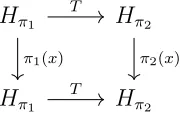
T : Hπ1 −→ Hπ2 such that T π1(x) = π2(x)T for all x ∈ G. The set of all such
operators is denoted by C(π1, π2).
Two representations π1 and π2 are called(unitary) equivalent if C(π1, π2) contains
a unitary operator. That is, if there exists a unitary operator T : Hπ1 −→ Hπ2 such
that π2(x) = T π1(x)T∗ for all x∈G.
Hπ1 Hπ2
Hπ1 Hπ2
T
π1(x) π2(x)
T
Figure 2. The diagram of equivalent representations π1 and π2
Definition 1.6.6. LetG be a locally compact group. If π is a unitary
represen-tation ofGand u∈Hπ, the closed linear span Mu of {π(x)u:x∈G}in Hπ is called
the cyclic subspacegenerated by u. If Mu =Hπ,u is called acyclic vector forπ. π is
called acyclic representation if it has a cyclic vector.
1.6. REPRESENTATIONS OF TOPOLOGICAL GROUPS 15
are 0 and H; (ii) the only operators in L(H) that commute with every π(s) (s∈G) are the scalar operators;(iii) every non-zero vector of H is a cyclic vector for π, i.e., if ξ∈H, ξ̸= 0, then π(G)ξ is dense in H.
Definition 1.6.8. If the conditions in Theorem 1.6.7 are satisfied, then π is said to be topologically irreducible. Topologically irreducible representations are usually
called irreducible, when there is no fear of confusion.
Let G be a compact group. We denote by Gb the set of equivalence classes of irreducible unitary representations ofG. WhenGis Abelian, Gb is a set of continuous characters onG, that is, continuous functions χ:G→T.
Theorem 1.6.9 (The Gelfand-Raikov Theorem). If G is any locally compact
group, the irreducible unitary representations of G separate points on G. That is, if
x and y are distinct points of G, there is an irreducible representation π such that
π(x)̸=π(y).
Theorem 1.6.10. LetGbe a compact group, and (σα)be the family of continuous,
irreducible, finite-dimensional unitary representations of G, then ∩
α
Kerσα ={e}.
Theorem 1.6.11. If G is a locally compact Abelian group, then every continuous
unitary irreducible representation ofG is one-dimensional.
Theorem 1.6.12. Let G be a compact group.
(i) Every representation in Gb is finite-dimensional;
(ii) Every continuous unitary representation of G is a direct sum of elements in Gb.
Definition 1.6.13. Suppose {π, H} and {π′, H′} are unitary representations of
G. Let H⊗H′ be the Hilbert space tensor product ofH and H′. The simple tensors
x⊗x′, with x ∈ H, x′ ∈ H′, span a dense linear subspace of H ⊗H′. For s ∈ G,
1.7. THE GELFAND REPRESENTATION 16
The mappings7→π(s)⊗π′(s)is a continuous unitary representation ofGonHπ⊗Hπ′,
calledthe tensor product of π and π′ and is denoted by π⊗π′.
1.7. The Gelfand Representation
Definition 1.7.1. Let A be a commutative Banach algebra and ∆(A) the set of
all nonzero algebra homomorphisms fromA toC. We endow ∆(A)with the weakest topology with respect to which all the functions
∆(A)→C, φ7→φ(x) (x∈A)
are continuous. A neighborhood basis at φ0 ∈ ∆(A) is then given by the collection
of sets U(φ0, x1, ..., xn, ϵ) = {φ ∈ ∆(A) : |φ(xi)−φ0(xi)| < ϵ,1 ⩽ i ⩽ n}, where ϵ > 0, n ∈ N, and x1, ..., xn are arbitrary elements of A. This topology on ∆(A) is
called theGelfand topology. The space ∆(A), equipped with the Gelfand topology, is called the spectrum of A or the Gelfand space of A.
Definition 1.7.2. For x∈ A, we define xˆ: ∆(A) →C, φ7→ φ(x). It is easily checked that the mappingΓ :A →C(∆(A)), x7→xˆis a homomorphism. We call Γ
theGelfand homomorphismorGelfand representation ofA and we often denoteΓ(A)
byAb.
Theorem 1.7.3. For a commutative C∗-algebra A, the Gelfand homomorphism
CHAPTER 2
Almost Periodic Functions
In this chapter, we study almost periodic functions using the Bochner’s
charac-terization of almost periodicity. We discuss the notion of ϵ-periods and study Bohr’s condition of almost periodicity. Basic properties of almost periodic functions are
developed and several examples are discussed.
2.1. Bochner’s Definition and Its Basic Properties
In this section we discuss a definition of almost periodicity which was given by
Bochner in 1927 [4]. Bochner’s definition deals with almost periodic functions on the
real line R. We will however consider the more general case of the functions defined
on the topological groups. Our main reference for this is [26].
For a complex function f on topological group G and a, b ∈ G, we use Daf to denote the function on G× G = G2 such that D
af(x, y) = f(xay) for all x, y ∈ G. We use af (resp. fa) to denote the function on G such that af(x) = f(ax)
(resp. fa(x) =f(xa))for allx∈G. And we usebfa to denote the function on Gsuch
that bfa(x) =f(bxa) for all x∈G.
Theorem 2.1.1. Let G be a topological group and f be a function in Cb(G) (the
space of all bounded continuous complex functions on G). Let − denote the closure in the uniform topology for Cb(G). Then the following properties of f are equivalent:
(i) {fa :a ∈G} is compact in Cb(G).
(ii) {af :a ∈G} is compact in Cb(G).
(iii) {bfa :a, b∈G} is compact in Cb(G).
(iv) {Daf :a∈G} is compact in Cb(G2).
2.1. BOCHNER’S DEFINITION AND ITS BASIC PROPERTIES 18
Proof. According to Remark 1.2.2 (b)a subset Aof Cb(G)is relatively compact if and only if it is totally bounded. Hence we only need to prove the equivalence of
total boundedness for the sets {fa : a ∈ G}, {af : a ∈ G}, {bfa : a, b ∈ G} and
{Daf :a∈G}.
It is obvious that (iii)implies(i)and (ii). We will prove that(iv)implies(i)and
(ii), (i)implies (iv), (ii) implies (iv), (i) implies(iii), and (ii) implies (iii).
First, we prove that (iv) implies (i). Let a be an arbitrary element in G. Then according to the total boundedness of{Daf :a ∈G}, for any given ϵ >0, there exists
a finite set{a1, . . . , an} inG such that for someai ∈ {a1, . . . , an},
∥Daif−Daf∥sup < ϵ.
Then
∥fa−fai∥sup = sup{|f(xa)−f(xai)|:x∈G}
⩽sup{|f(xay)−f(xaiy)|:x, y ∈G}
=∥Daif −Daf∥sup < ϵ,
which proves (i). The proof that (iv) implies (ii) is very similar and we omit the details.
Then we prove that (i) implies (iv). Suppose {fa : a ∈ G} is totally bounded.
Given ϵ > 0, there is a finite subset {a1, a2, . . . , am} of G such that {faj}
m
j=1 is an
ϵ/4-mesh in {fa :a∈G}. Forj = 1,2, . . . , m, letAj ={a∈G:∥fa−faj∥sup < ϵ/4}.
Consider the family of all sets
(Al1a −1
1 )∩(Al2a −1
2 )∩ · · · ∩(Alma
−1
m ), for lj, j ∈ {1, . . . , m}.
Write the nonempty sets in this family as B1, . . . , Bn, and choose bk ∈ Bk for k =
1, . . . , n. Let a ∈ G, and consider aa1, . . . , aam. Since G =
m
∪
j=1
Aj, we can find
l1, . . . , lm ∈ {1, . . . , m}so thataa1 ∈Al1, . . . , aam ∈Alm, i.e.,a∈(Al1a −1
1 )∩(Al2a −1 2 )∩ · · · ∩(Alma−
1
m ). Therefore, G = n
∪
k=1
2.1. BOCHNER’S DEFINITION AND ITS BASIC PROPERTIES 19
{Bk} such that c∈Bk0. Let (x, y)∈G
2, and select j
0 (j0 ∈ {1,2, . . . , m}) such that
y∈Aj0. Then we have |f(xcy)−f(xbk0y)|
⩽|f(xcy)−f(xcaj0)|+|f(xcaj0)−f(xbk0aj0)|+|f(xbk0aj0)−f(xbk0y)| ⩽∥fy −faj0∥sup+∥fcaj0 −fbk0aj0∥sup+∥faj0 −fy∥sup.
Since y ∈ Aj0, ∥fy −faj0∥sup < ϵ/4. By our choice of Bk0, c ∈ Bk0 = (Al1a −1 1 )∩ (Al2a
−1
2 )∩ · · · ∩(Alma−
1
m ), which means c∈ Alj0a
−1
j0 for some lj0. Also, by our choice
of bk0, we have bk0 ∈Bk0. Writing c=aa −1
j0 and bk0 =a′a −1
j0 where a, a ′ ∈A
lj0, then ∥fcaj0 −fbk0aj0∥sup =∥fa−fa′∥sup
⩽∥fa−falj
0∥sup
+∥falj
0 −
fa′∥sup< ϵ/4 +ϵ/4 = ϵ/2.
Therefore, |f(xcy)−f(xbk0y)| < ϵ/4 +ϵ/2 +ϵ/4 = ϵ. Since (x, y) is arbitrary, the
functionsDb1f, . . . , Dbnf form an ϵ-mesh in {Dcf :c∈G}. Thus (iv)holds.
The proof that (ii) implies(iv)is very similar to the proof just given and we omit the details. Thus so far we can say that (i), (ii)and (iv)are equivalent.
Finally, suppose that (i)holds, we want to show (iii)holds. Since(i)and (ii)are equivalent, (ii) also holds. Let {faj}
m
j=1 and {bkf}
n
k=1 be ϵ/2-meshes in {fa :a ∈ G}
and {bf :b ∈G}, respectively. Then for all x, a, b ∈G, we have
|f(bxa)−f(bkxaj)|⩽|f(bxa)−f(bkxa)|+|f(bkxa)−f(bkxaj)|< ϵ/2 +ϵ/2 =ϵ,
for some k and j. That is, {bkfaj}(j = 1,2, . . . , m;k = 1,2, . . . n) is an ϵ-mesh in
{bfa :a, b∈G}. □
Definition 2.1.2. LetGbe a topological group. A functionf inCb(G)satisfying
2.1. BOCHNER’S DEFINITION AND ITS BASIC PROPERTIES 20
Remark 2.1.3. Almost periodic functions can be studied on arbitrary groups
with no underlying topology. This is equivalent to assuming that G has the discrete topology.
The following theorem shows several basic properties of elements in AP(G).
Theorem 2.1.4. Let G be a topological group, then
(i) every constant function is in AP(G).
(ii) if f is in AP(G), then also ℜf, ℑf, and f are in AP(G). (iii) if f, g are in AP(G), then f+g and f g are in AP(G). (iv) if f1, f2, . . . , fn, . . . are in AP(G) and lim
n→∞∥fn−f∥sup = 0, then f ∈AP(G).
(v) if f is in AP(G) and a, bare in G, then af, fa and bfa are in AP(G).
Proof. The proofs of (i) and (v) are obvious. ((i) can be easily proved using total boundedness while(v) comes directly from Theorem 2.1.1).
To prove (ii), let f ∈AP(G). Then we have{fa:a ∈G} is totally bounded. For
givenϵ >0 and any a∈G, there exist a finite set{a1, . . . , an}in G (depending only
onϵ and f) andj0 ∈ {1, . . . , n} such that
∥ℜfa− ℜfaj0∥sup ⩽∥fa−faj0∥sup < ϵ.
Thus {ℜfa : a ∈ G} is totally bounded and therefore compact. This proves that
ℜf ∈AP(G). Similarly, ℑf ∈AP(G) and f ∈AP(G).
To prove (iii), consider f +g. Let ϵ > 0 be given. Let {faj}
m
j=1 be an ϵ/4-mesh
for {fa : a ∈ G} and {gbk}
n
k=1 be an ϵ/4-mesh for {gb : b ∈ G}. Let Aj = {a ∈ G : ∥fa −faj∥sup < ϵ/4} (j = 1,2, . . . , m) and Bk = {b ∈ G : ∥gb −gbk∥sup < ϵ/4}
(k = 1,2, . . . , n).Let the nonempty setsAj∩Bk be written asC1, . . . , Cp, and choose cl ∈ Cl (l = 1,2, . . . , p). We want to prove {(f +g)cl}
p
i=1 is an ϵ-mesh for {(f+g)c : c∈G}. For any c∈G, there exist j0 and k0 such that
2.1. BOCHNER’S DEFINITION AND ITS BASIC PROPERTIES 21
Letcl0 ∈Cl0 =Aj0∩Bk0, then ∥fcl
0 −faj0∥sup < ϵ/4 and ∥gcl0 −gbk0∥sup < ϵ/4.
Therefore
∥(f +g)cl0 −(f +g)c∥sup ⩽∥(fcl0 −fc)∥sup+∥(gcl0 −gc)∥sup
⩽∥fcl0 −faj0∥sup+∥faj0 −fc∥sup+∥gcl0 −gbk0∥sup+∥gbk0 −gc∥sup < ϵ.
Next, we show that f g ∈ AP(G). Suppose ∥f∥sup >0 and ∥g∥sup >0, and we form anϵ/(4∥g∥sup)-mesh for{fa:a∈G}and anϵ/(4∥f∥sup)-mesh for{gb :b ∈G}. Then,
as above, the setsCl and points cl ∈Cl yield anϵ-mesh for {(f g)c :c∈G}.
To prove (iv), note that if {(fn)a1, . . . ,(fn)ap} is an ϵ/3-mesh for {(fn)a:a∈G},
and ∥f−fn∥sup < ϵ/3, then there exists an aq ∈ {a1, a2, . . . , ap} such that
∥faq −fa∥sup ⩽∥faq −(fn)aq∥sup+∥(fn)aq −(fn)a∥sup+∥(fn)a−fa∥sup
< ϵ/3 +ϵ/3 +ϵ/3 =ϵ.
Therefore{fa1, . . . , fap} is an ϵ-mesh for {fa:a∈G}. □
With Theorem 2.1.4, we can immediately get the following consequence.
Corollary 2.1.5. If G is a topological group, then AP(G) is a C∗-subalgebra of
Cb(G).
Example 2.1.6. (a) Let G be R. Then every periodic function on R is almost
periodic. Let p > 0 be a period of f. Then {fa : a ∈ R} = {fa : a ∈ [0, p]} is a
compact subset ofCb(R)since it is the image of the compact interval[0, p] under the
continuous functiona7→fa,R−→Cb(R).
2.2. FUNCTIONS WITHϵ-ALMOST PERIODS 22
functions are almost periodic. For example, trigonometric polynomials of the form
f(t) =
n
∑
k=1
akeiλkt (λk ∈R).
In particular, f(x) = cosx+ cos√2x is an almost periodic function, since it is the sum of two periodic functions. However,f(x)is not periodic. We claim that the only root of the equation f(x) = 2 is x = 0. Let cosx = cos√2x = 1, then x = 2k1π
and √2x = 2k2π where k1, k2 ∈ Z. Therefore, 2k1π = 2√k22π and the only solution is
k1 =k2 = 0, i.e., x= 0. Similarly, the product g(x) = cosx·cos √
2x of two periodic functions is also not periodic since the only solution for g(x) = 1 isx= 0.
(c) If we restrict the zeta function ζ(s) = ∑∞
n=1
n−s (s ∈ C) to the vertical line R(s) = σ0 >1, and write s=σ0+it, then
ζ(s) = ∞
∑
n=1
n−σ0n−it = ∞
∑
n=1
n−σ0e−itlogn.
This series consists of terms that are periodic intwith period 2π
logn, therefore its partial
sums are almost periodic. Since σ0 >1, the series is uniformly convergent, and thus
by Theorem 2.1.4(iv), ξ(s) is almost periodic on the vertical line s=σ0+it. (d) Every uniform limit of trigonometric polynomials is almost periodic.
2.2. Functions with ϵ-Almost Periods
In this section, we discuss the concept of ϵ-almost periods, which was given for the functions on R by Bohl [6]. However, we generalize the definitions of ϵ-almost periods to the functions on general topological group as follows.
Definition2.2.1. LetGbe a topological group,f a bounded continuous
complex-valued function onG and ϵ >0. An element x∈G is called a left ϵ-almost period of
f if
2.2. FUNCTIONS WITHϵ-ALMOST PERIODS 23
An element y∈G is called a right ϵ-almost period of f if
∥fy −f∥sup ⩽ϵ.
When G is Abelian, the left ϵ-almost periods are also right ϵ-almost periods. In particular, whenG=R, we give the following definition.
Definition 2.2.2. Let f :R → C be a continuous bounded function and ϵ >0.
A numberτ > 0is called an ϵ-almost period if for all x∈R,
|f(x+τ)−f(x)|⩽ϵ.
Example 2.2.3. (a)If f is periodic with periodp, thenp is anϵ-period for every
ϵ >0.
(b) If f is uniformly continuous, then for a given ϵ >0, there exists a δ >0 such that for allx, y ∈Rsatisfying|x−y|< δ, we have|f(x)−f(y)|< ϵ. Therefore, every
τ satisfying 0< τ < δ is an ϵ-almost period.
Bohl showed that a trigonometric polynomial of the form
f(t) =
n
∑
k=1
akeiλkt,
where λk ∈R are arbitrary, has infinitely manyϵ-periods for every ϵ >0. Note that
such polynomials need not be periodic.
In the remaining of this section we verify Bohl’s result for the simple case where
f(x) =eiαx+eiβx. First we observe that if α/β=q/p is rational(p, q ∈Z), thenf is
periodic with periodσ = 2πqα−1.
f(x+σ) = eiα(x+σ)+eiβ(x+σ) =eiαx+i2πq+eiβx+i2πqβ/α
=eiαxei2πq +eiβxei2πp =eiαx+eiβx =f(x).
Thereforeσ = 2πqα−1 and all of its integer multiples can serve asϵ-almost periods for all ϵ >0.
2.2. FUNCTIONS WITHϵ-ALMOST PERIODS 24
We want to show the existence of ϵ-almost periods for the function f when α/β
is irrational. The idea is to find ϵ-almost periods in the form of 2πq/α for suitable
q∈N. First, we need the following lemmas from the number theory.
Lemma 2.2.4. If x is a real number and t is a positive integer, there are integers
p and q such that
x− p
q
⩽ 1
q(t+ 1), 1⩽q ⩽t.
Proof. The t+ 1 numbers
0·x−[0·x],1·x−[1·x], . . . , tx−[tx]
all lie in the interval[0,1). Call them, in increasing order of magnitude,α0, α1, . . . , αt.
Mark the numbers α0, α1, . . . , αt on a circle of unit circumference, that is, a unit
interval on which 0 and 1 are identified. Then the t+ 1 differences
α1−α0, α2−α1, . . . , αt−αt−1, α0−αt+ 1
are the lengths of the arcs of the circle between successiveα’s, and so they are non-negative and
(α1−0) + (α2−α1) +. . .(1−αt) = 1.
It follows that at least one of these t+ 1 differences does not exceed (t+ 1)−1. But
each difference is of the form
g1x−g2x−N,
whereN is an integer and g1, g2 ∈ {1,2, . . . , t}.
Ifg1 > g2, thenN ⩾0. In this case, we can take q=g1 −g2, p=N. Then
x− p
q
= |(g1−g2)x−N|
g1−g2 ⩽
1
(g1−g2)(t+ 1)
= 1
2.2. FUNCTIONS WITHϵ-ALMOST PERIODS 25
Ifg1 < g2, then we can take q=g2−g1,p=−N. Then
x− p
q
= |(g2−g1)x+N|
g2−g1
⩽ 1
(g2−g1)(t+ 1)
= 1
q(t+ 1).
□
Lemma 2.2.5. For any irrational number x, there are infinitely many distinct
rational numbers pn/qn, n = 1,2, . . . , such that
x− pn qn
< 1
qn2 (n ⩾1).
(2.2.2)
Proof. According to the above lemma, if x is irrational, then for each positive
integer t, the inequalities
0<x−p q
⩽ 1 (t+ 1)q <
1
q2, 1⩽q ⩽t
(2.2.3)
have suitable p and q. Let t1 be any integer exceeding |x−p/q|−1. Then by Lemma
2.2.4, there exist integers p1,q1 such that 0<x−p1
q1
⩽ 1 (t1+ 1)q1
< |x−p/q| q1
⩽x− p q
.
Thus, p1/q1 ̸= p/q. Furthermore, |x−p1/q1| < 1/q12. By this procedure, we can
obtain infinitely many rational numbers pn/qn with
0<· · ·<x−pn qn
<x− pn−1 qn−1
<· · ·<x− p1 q1
and
x− pn qn
< 1
qn2
(n ⩾1).
□
2.2. FUNCTIONS WITHϵ-ALMOST PERIODS 26
Theorem 2.2.6. Let f(x) = eiαx +eiβx, where α, β ∈ R are such that α/β is irrational. Let ϵ >0 be given, and let p/q be a rational number such that q⩾1 and
2πqβ α −
p q
< ϵ.
(2.2.4)
Then τ = 2πq/α is an ϵ-almost period for f.
Proof. The existence of rational numbers p/q satisfying (2.2.4) follows from
Lemma 2.2.5. For given ϵ >0, we only need to choose n in the lemma large enough so that1/qn< ϵ/2π. Then we have
αβ −pn qn
< 1
qn2 <
ϵ
2πqn,
which means 2πqn|β/α−pn/qn| < ϵ. In fact, the lemma shows the existence of
infinitely many such rationals.
Then for every x∈R, we have
f(x+ 2πq
α )−f(x)
=eiαx+eiβxei2πqβ/α−eiαx−eiβx
=|eiβx(ei2πqβ/α−1)|=|ei2πqβ/α−1| =
√
(cos(2πqβ/α)−1)2+ sin2(2πqβ/α) =√2(1−cos(2πqβ/α))
= 2sin(πqβ
α )
= 2sin(πq(β
α − p q))
⩽2πqβ α −
p q
< ϵ.
Since x ∈R is arbitrary, it follows that ∥fτ −f∥sup ⩽ ϵ. Therefore τ = 2πq/α is an
2.3. BOHR’S DEFINITION AND ITS GENERALIZATION 27
2.3. Bohr’s Definition and Its Generalization
In this section we discuss Bohr’s original definition of almost periodicity and its
generalization to arbitrary topological groups.
Starting in 1923, H. Bohr adopted the results of Bohl on the existence ofϵ-periods’ discussion and used it as the definition of a class of functions which he called almost
periodic functions. He developed the basic properties of almost periodic functions
in [8], [9] and [10].
Definition 2.3.1 (Bohr). A function f :R→Cis called Bohr almost periodicif
it is continuous and if for every ϵ > 0, there exists a number l > 0 such that every closed interval of lengthl contains an ϵ-almost period.
Thus for a function to be Bohr almost periodic, for each ϵ, the number of its ϵ -almost periods must occur with some regularity in the real line. In other words, the
set ofϵ-periods must be relatively dense in R for every ϵ >0.
Next we extend the notion of ϵ-periods and Bohr’s condition of almost periodicity to general topological groups.
Definition 2.3.2. LetGbe a topological group, f a complex-valued function on
Gandϵ >0. We say thatf satisfies theleft Bohr’s condition(LBC) iff is continuous and for everyϵ >0, there is a compact set K ⊂Gso thatyK contains a leftϵ-almost period for ally ∈G.
Right Bohr’s condition is defined similarly. We say thatf satisfies theright Bohr’s condition (RBC) iff is continuous and for everyϵ >0, there is a compact set K ⊂G
so that for ally ∈G, Ky contains a right ϵ-almost period.
We say that f satisfies theBohr’s conditions, if it satisfies both LBC and RBC. If G is Abelian, left and right Bohr’s conditions are equivalent. A discussion of Bohr’s conditions on Abelian group can be found in [42].
Remark 2.3.3. (a) It is easy to check that when G = R, Bohr’s conditions are
2.3. BOHR’S DEFINITION AND ITS GENERALIZATION 28
l > 0 large enough so that K ⊂ [−l, l], then every interval of length 2l contains an
ϵ-almost period. In fact, if I is such an interval and a is the center of the interval, then I −a = [−l, l] ⊃ K, and hence by assumption there must exist an ϵ-period in
a+K ⊂a+ (I−a) = I. As for the converse, if every interval of lengthl > 0contains anϵ-almost period, then we may take K = [0, l].
(b)Let us note that the inequality∥xf−f∥sup ⩽ϵis equivalent to∥x−1f−f∥sup ⩽ϵ
wherex−1 ∈K−1y−1, andK−1 is compact. Thus the LBC can be rephrased as follows:
for every ϵ > 0, there is a compact set K ⊂ G so that for all y ∈ G, Ky contains a leftϵ-almost period. Also, the RBC can be similarly rephrased.
For a discussion of uniform continuity on topological groups we refer to Appendix
A.
Theorem 2.3.4. (a)Every function satisfying the LBC is bounded and right uni-formly continuous.
(b) Every function satisfying the RBC is bounded and left uniformly continuous.
Proof. (a) Let f satisfy the left Bohr’s condition, and x ∈ G. For ϵ = 1, there exists a compact set K0 such that K0x−1 contains a left 1-almost period, say k0x−1.
Thus∥k0x−1f −f∥sup ⩽1, and therefore |k0x−1f(x)−f(x)|⩽1, from which it follows
that
|f(x)|⩽1 +|f(k0)|⩽1 + sup
k∈K0
|f(k)|.
SinceK0 is independent of x, f is bounded.
Next, we prove that f is right uniformly continuous. Given ϵ >0, we need to find a neighborhoodU of the identitye such that ify−1x∈U, then|f(x)−f(y)|< ϵ. For eachy∈G, yf is continuous at e, so there exists a neighborhoodVy of e such that if z ∈Vy, then |yf(z)−yf(e)|< ϵ/4. Therefore if z, z′ ∈Vy, then
|yf(z)−yf(z′)|< ϵ