ABSTRACT
WANG, PENGCHENG. Deep Reinforcement Learning for Interactive Narrative Planning (Under the direction of Dr. James C. Lester).
Interactive narrative-centered educational games feature rich interactive story scenarios. They tightly integrate curricular content with engaging plots that are designed to naturally unfold during gameplay. To generate interactive narratives that are tailored to individual students, an intelligent interactive narrative planner can create personalized gameplay experiences that target effective learning outcomes. Data-driven interactive narrative planning shows particular promise for inducing adaptable interactive narrative planners. Data-driven methods can learn narrative planning policies from prior interaction experiences so that the learning outcome can be optimized.
Data-driven interactive narrative planning presents two major challenges. First, because training an interactive narrative planning policy requires enormous player interaction training corpora, there is the challenge of collecting enough data for both training and evaluating interactive narrative planning policies. Second, because interactive narrative planners’ interactions with players are usually complex and nonlinear, there is a significant challenge of modeling complex interaction patterns to learn effective interaction policies.
derived. The reinforcement learning framework naturally aligns with the sequential decision-making problem of interactive narrative adaptation, and the deep neural network function approximator endows narrative planners with the ability to learn highly complex interaction patterns.
Deep Reinforcement Learning for Interactive Narrative Planning
by
Pengcheng Wang
A dissertation submitted to the Graduate Faculty of North Carolina State University
in partial fulfillment of the requirements for the Degree of
Doctor of Philosophy
Computer Science
Raleigh, North Carolina 2018
APPROVED BY:
_______________________________ _______________________________
Dr. James C. Lester Dr. Bradford W. Mott
Committee Chair
_______________________________ _______________________________
DEDICATION
BIOGRAPHY
Pengcheng Wang was born in Xuanhua, China. He entered Beijing University of Technology in 2006, where he majored software engineering. At BJUT he was awarded three undergraduate student scholarships from 2007 to 2009, the student technical innovation award, and the outstanding undergraduate student award in 2009. He served as the president of the Microsoft Club of School of Software Engineering from 2008 to 2009, when he led a team to win third prize in the Microsoft Imagine Cup software development contest with the Digital Farm project, a solution to effectively collect and analyze agricultural data and connect farmers and experts. An upgraded version of the project won the third prize in the Second China College Students’ Software Development Innovation Competition.
Pengcheng entered the Department of Computer Science at Beijing University of Technology to pursue his master’s degree in 2010. Advised by Dr. Baocai Yin, he studied real-time water rendering for particle systems-based fluid simulation. He published multiple journal and conference papers and was recognized with the graduate student scholarship in 2011 and the Outstanding Master’s Thesis Award in BJUT in 2013.
ACKNOWLEDGMENTS
I would like to sincerely thank my advisor, Dr. James Lester, for his insightful advice on my research work, as well as his perfect demonstration of being a successful person. James encourages me to pursue the research field of my interest and is always supportive of my research efforts. During my PhD study, I was able to have multiple competitive publications under his guidance. Many times he directed my paper writing in late evenings or weekends, for which I cannot thank him enough. James is a very efficient person. His calendar is always full. He can finish many tasks across multiple projects every day. He walks along the greenway at Lake Johnson much faster than I do. I am fortunate to have a seat close to his office and see how he works. I learned a lot from him.
Margo Jordan was so cool that we together created an awesome 3D game, Inspire. I cannot thank all my other professors and friends enough in the Department of Computer Science. I appreciate all the help and support to make finish my PhD study.
TABLE OF CONTENTS
LIST OF TABLES ... viii
LIST OF FIGURES ... ix
CHAPTER 1 INTRODUCTION ... 1
1.1 Problem ... 3
1.2 Approach ... 5
1.3 Thesis Statement and Research Questions ... 9
1.4 Organization ... 12
CHAPTER 2 BACKGROUND AND RELATED WORK ... 14
2.1 Interactive Narrative Generation and Adaptation ... 14
2.2 Simulated Player Model ... 21
2.3 Deep Learning ... 28
2.4 Reinforcement Learning ... 34
CHAPTER 3 CRYSTAL ISLAND INTERACTIVE NARRATIVE ... 40
3.1 CRYSTAL ISLAND Backstory and Game Environment ... 40
3.2 CRYSTAL ISLAND Player Interaction Representation ... 42
3.3 Narrative Adaptation in CRYSTAL ISLAND ... 45
3.4 CRYSTAL ISLAND Interactive Narrative Corpus ... 47
CHAPTER 4 STATISTICAL PREDICTIVE SIMULATED PLAYER MODEL ... 49
4.1 Simulated Player Modeling in CRYSTAL ISLAND ... 49
4.2 Neural Network Models for Sequence Data Modeling ... 53
4.3 Long Short-Term Memory Network for Sequence Data Modeling ... 56
4.4 Deep Recurrent Neural Networks for Sequence Data Modeling ... 58
4.5 Deep Convolutional Neural Networks for Sequence Data Modeling ... 61
4.6 Regularization Techniques in Neural Network Models ... 63
4.6.1 Dropout ... 64
4.6.2 Mixture of Experts ... 65
4.6.3 Multi-Task Learning ... 67
CHAPTER 5 REINFORCEMENT LEARNING-BASED INTERACTIVE NARRATIVE PLANNING ... 70
5.1 Reinforcement Learning Framework for Interactive Narrative Planning ... 70
5.2 Q-Network-Based Interactive Narrative Planning ... 73
5.2.1 Deep Reinforcement Learning Stabilization ... 74
5.2.2 Recurrent Q-Network ... 76
5.2.3 Dueling Q-Network ... 78
5.3 Actor-Critic Network-Based Interactive Narrative Planning ... 80
CHAPTER 6 EVALUATION ... 84
6.1 Statistical Simulated Player Model Evaluation ... 84
6.2 Reinforcement Learning-Based Interactive Narrative Planner Evaluation ... 90
CHAPTER 7 DISCUSSION ... 99
7.1 Constructing High-Fidelity Simulated Player Models ... 99
7.2 Deriving Interactive Narrative Planners ... 102
7.3 Limitations ... 104
CHAPTER 8 CONCLUSIONS AND FUTURE WORK ... 106
8.1 Research Questions Revisited ... 106
8.2 Summary ... 112
8.3 Future Work ... 115
LIST OF TABLES
Table 3.1: CRYSTAL ISLAND players’ gameplay actions ...43
Table 6.1: Player action prediction performance of non-deep learning models ...86
Table 6.2: Player action prediction performance of deep learning models ...87
Table 6.3: Player outcome prediction performance of non-deep learning models ...88
Table 6.4: Player outcome prediction performance of deep learning models ...89
Table 6.5: Interactive narrative planning policy evaluation – RL methods with distinct exploratory strategies ...92
LIST OF FIGURES
Figure 2.1: Plot graph of the interactive fiction, Anchorhead ...15
Figure 2.2: Architecture of a spoken dialogue system with simulated users ...26
Figure 3.1: CRYSTAL ISLAND interactive narrative ...40
Figure 3.2: CRYSTAL ISLAND open-world game environment ...42
Figure 4.1: Example of interactive narrative planner action timeline and player action timeline ...52
Figure 4.2: RNN structure and its unfolding along time axis ...55
Figure 4.3: 2D Grid-LSTM unit ...60
Figure 4.4: RHN model for player action prediction ...61
Figure 4.5: CNN model for player outcome prediction ...63
Figure 4.6: Mixture of Experts model structure ...66
Figure 4.7: Multi-task LSTM network implementation of a simulated player model for interactive narrative planning ...69
Figure 5.1: Deep reinforcement learning-based interactive narrative personalization framework ...72
CHAPTER1 INTRODUCTION
Interactive narrative is a form of interactive experience which allows players to create or influence a dramatic storyline during the interaction between the players and the interactive narrative systems, by assuming the role of a player character in the narrative environment, or directly allowing players to manipulate the narrative environment state (Riedl & Bulitko, 2012). Interactive narrative systems afford players the opportunities to be able to fundamentally affect the unfolding story and the interaction outcomes. Narrative intelligence (Blair & Meyer, 1997; Mateas & Sengers, 1999), which studies the ability to organize experiences in narrative forms, have been a research focus in artificial intelligence and cognitive science communities for a long time. Narrative intelligence tasks, such as story understanding (Wilensky, 1981; Cullingford, 1981; Cox, 1996), story generation (Gervás, 2009; Young et al., 2004; Li et al., 2012), and commonsense reasoning (Mott & Lester, 2006; Riedl & Stern, 2008; Young & Riedl, 2003) present significant promises and challenges.
in narrative scenarios created by experience managers (Riedl & Stern, 2008). Empirical evidence has revealed interactive narrative-centered games’ capabilities in improving players’ (often students’) engagement and learning outcomes in educational settings (Lester et al., 2013).
Data-driven methods can fully or partially learn the narrative environment dynamics, player interaction preferences, and player’s interaction outcome tendencies from prior interaction experiences. This property makes data-driven method an appropriate choice to derive adaptable interactive narrative experience managers in open-world narrative environment, which has limited restriction on player’s gameplay behavior; as well as educational narratives, in which narrative evaluation does not have to correlate with the narrative structure.
1.1 Problem
designing and adopting data collection protocols that are not easy to generalize to other domains (Li et al., 2013; Harrison & Riedl, 2016). So, to study the problem of interactive narrative generation using data-driven methods, generating reliable and sufficient data is a major problem to solve.
restriction in RL-based interactive narrative planning to identify complex non-linear player interaction patterns that are relevant to effectively personalize interactive narratives. In this dissertation, the major research question about how to construct effective reinforcement learning-based interactive narrative planner will be thoroughly studied and evaluated.
1.2 Approach
experience managers. Compared to utilizing assumption-based synthetic data in learning adaptable interactive narrative experience manager, the statistical predictive simulated player model is easier to be validated, which reveals how accurate the simulated player model is to imitate human player’s behavior. Adopting a statistical predictive simulated player model is especially helpful when player action distribution has large variance, e.g., in open-world interactive narrative interaction environment where players are relatively free to move or talk; or in case the player outcome distribution has large variance, e.g., in educational setting when learning outcome is the adaptation measurement metric. Although this category of simulated player modeling method has not been broadly utilized in the field of interactive narrative generation and adaptation, long-term research and prominent achievements have been seen in some other fields, like spoken dialogue system, in which statistical user simulation serves an important role in training and evaluating reinforcement learning-based dialogue managers (Schatzmann et al., 2006; Young et al., 2013). The success of the broad usage of statistical user simulation sheds light on its prominence in serving both training and evaluation of data-driven experience mangers in interactive narrative environments.
reinforcement learning policy and optimization methods (Mnih et al., 2015; Wang, Schaul, Hessel, Van Hasselt, Lanctot, & De Freitas, 2016; Mnih et al., 2016; Schulman et al., 2015; Schulman et al., 2017; Wu et al., 2017; Lillicrap et al., 2015), so that even human-level performance can be achieved in some commonly adopted reinforcement learning problems (Mnih et al., 2015; Silver et al., 2016; Silver et al., 2017). All of these recent achievements motivate the work in this dissertation to utilize state-of-the-art reinforcement learning techniques in adapting interactive narratives.
2013; Amodei et al., 2016) and generation (Oord et al., 2016; Arık et al., 2017; Wang, Skerry-Ryan, Stanton, Wu, Weiss, Jaitly, Yang, Xiao, Chen, Bengio & Le, 2017; Mehri et al., 2016; Sotelo et al., 2017), natural language processing and understanding (Kumar et al., 2016; Mikolov et al., 2013; Pennington et al., 2014; Hermann et al., 2015), machine translation (Bahdanau et al., 2014; Cho et al., 2014; Luong et al., 2015; Wu et al., 2016), reinforcement learning (Mnih et al., 2015; Silver et al., 2016; Silver et al., 2017), human intention and plan recognition (Min et al., 2014; Min et al., 2016; Min et al., 2017), and application in medicine and biology (Ciodaro et al., 2012; Helmstaedter et al., 2013; Leung et al., 2014; Xiong et al., 2015), etc. Specifically, for the tasks of statistical predictive simulated player modeling and data-driven interactive narrative planner derivation, deep learning offers significant potential because some neural network models properly fit the sequential pattern recognition task in the player behavior prediction and player—interactive narrative planner interaction. An effective machine learning model should be able to utilize the property that features at each time step is with the same format. In the neural network family, several types of models, like recurrent neural networks and convolutional neural networks, can effectively utilize this regionally repeated feature map to efficiently learn sequential patterns. In this dissertation, both recurrent neural networks (Siegelmann, 1992; Schmidhuber, 1990) and convolutional neural networks (LeCun et al., 1989; LeCun et al., 1990) will be deeply investigated for constructing high-fidelity statistical simulated players and effective data-driven interactive narrative planners.
1.3 Thesis Statement and Research Questions
Based on the proposed simulated players, various deep reinforcement learning techniques are investigated on their effectiveness in deriving adaptable interactive narrative planners to maximize player’s interaction outcomes. More specifically, focusing on the investigation of effective machine learning models and methods to achieve the previously proposed targets, the following thesis statement is studied in this dissertation:
Deep learning offers effective models to predict human players’ interaction actions
and interaction outcomes if proper neural network structures, optimization and
regularization techniques are utilized. Deep reinforcement learning trains effective
adaptable interactive narrative planners to personalize interactive narratives to individual
players in educational games.
number of episodes. Policy value is a standard metric utilized in reinforcement learning to evaluate the effectiveness of derived policies.
Specifically, in this dissertation, deep learning is the major machine learning technique investigated and evaluated using these metrics. Although deep learning achieves great performances in plenty of fields as mentioned Section 1.2, it is not an easy-to-use off-the-shelf machine learning toolbox. To obtain good results in the task of interactive narrative adaptation, several technical aspects in constructing deep learning models, e.g. deep neural net structure, depth of network, regularization, optimization, and convergence property etc. are necessary to carefully discuss. With these major topics mentioned so far, the following research questions (RQs) and sub-questions are proposed and investigated in this dissertation:
• RQ 1: Is deep learning an effective choice to construct data-driven simulated player models?
• RQ 1.1: Can deep learning outperform commonly utilized machine learning methods (baselines) in both tasks of player action prediction and player outcome prediction?
• RQ 1.2: Can deep learning offer proper model to deal with sequential player— narrative planner interaction patterns in simulated player modeling?
• RQ 1.3: Does deep neural network models outperform shallow models in constructing simulated player models?
• RQ 2: Can deep reinforcement learning derive effective interactive narrative planners in narrative-centered educational games to personalize narratives to individual players?
• RQ 2.1: Is deep reinforcement learning a tractable method in training interactive narrative planners?
• RQ 2.2: Can deep reinforcement learning outperform linear reinforcement learning method (baseline) in training adaptable interactive narrative planners?
• RQ 2.3: What are proper neural network structures to form a reinforcement learning-based interactive narrative planner?
• RQ 2.4: How does deep reinforcement learning-based interactive narrative planner perform in interaction with unfamiliar player population (generalization performance)?
The proposed interactive narrative adaptation work is investigated and analyzed on an interactive narrative-centered educational game—CRYSTAL ISLAND. One dataset collecting from multiple studies involving more than 400 players is utilized in simulated player modeling. The CRYSTAL ISLAND narrative context is also adopted in constructing the interactive narrative generation and adaptation environment. Performance of all modules mentioned above is finally evaluated using this CRYSTAL ISLAND testbed.
1.4 Organization
CHAPTER2
BACKGROUNDANDRELATEDWORK
The proposed data-driven interactive narrative adaptation framework involves work in several active research fields: (1) interactive narrative generation and adaptation, which drafts and tailors stories with computational methods, (2) player simulation techniques, which establish simulated users to imitate human user behaviors, (3) deep learning techniques, which utilize deep neural networks to formulate machine learning models, (4) reinforcement learning techniques, which offer the framework to solve sequential decision making problems in uncertain environments. The remainder of this section describes background and related works from the aspects of these four research fields and attempts to clarify where the proposed framework stays in these mentioned research fields. Section 2.1 presents the previously studied computational methods in interactive narrative generation and adaptation. Section 2.2 describes data sources adopted in prior interactive narrative generation and adaptation works, with a focus on user simulation techniques utilized in this field and other similar fields. Section 2.3 briefly demonstrates the recent success of the deep learning techniques, which motivates the choice of the machine learning tools utilized in this dissertation. Section 2.4 depicts the recent advancement of the reinforcement learning technique, especially the branch of deep reinforcement learning research.
2.1 Interactive Narrative Generation and Adaptation
been adopted to balance author’s intent and creative freedom in story generation, controlling non-player character’s behavior, and tailor interactive narrative to fit individual player’s personalized preferences (Riedl & Bulitko, 2012). A broad range of computational methods, including adversarial search (Bates, 1992; Weyhrauch 1997; Lamstein & Mateas, 2004; Nelson & Mateas, 2005; Garber-Barron & Si, 2013; Li et al., 2013), STRIPS-planning (Porteous et al., 2015; Robertson & Young, 2015), and machine learning-based techniques (Lee et al., 2014; Yu & Riedl, 2014; Nelson et al., 2006; Roberts et al., 2006; Harrison & Riedl, 2016; Rowe et al., 2014; Rowe & Lester, 2015; Wang, Rowe, Mott, & Lester, 2016, Wang et al., 2017a, Wang et al., 2017b) have been developed for interactive narrative generation.
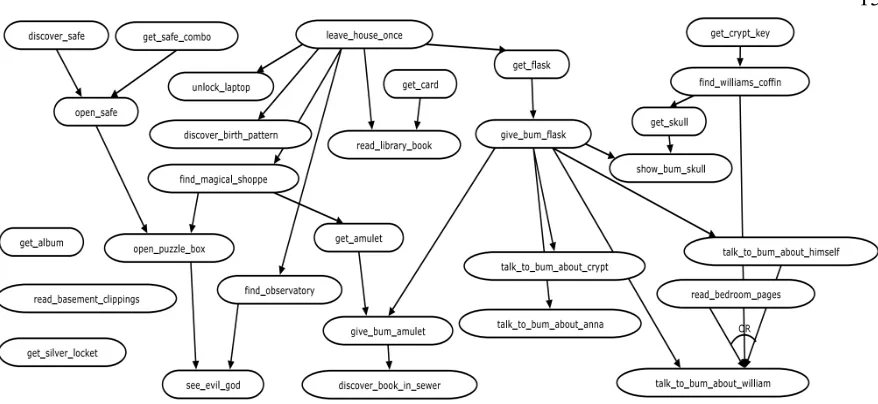
Adversarial search algorithms usually encode narrative content into a plot graph (Figure 2.1), in which arcs denote precedence constraints and graph nodes represent narrative events so that one narrative event can only occur if all events constrained to occur prior to it have already occurred. A complete story is then formed as a plot trajectory, in which a smart
experience manager would be able to visit favorable nodes while avoiding unfavorable ones for individual players. Bates first proposed the idea of search-based drama management (SBDM) in (Bates, 1992), with Weyhrauch further developing this work by applying it on a simplified version of the Infocom interactive fiction Deadline (Weyhrauch, 1997). Lamstein and Mateas (2004) implemented the first full SBDM in a real-time story world setting and evaluated its performance with human players. Nelson and Mateas (2005) expanded the prior SBDM systems and enabled it to process hundreds of plot points using Boolean concatenated ordering constraints on plot points on interactive fiction Anchorhead. Garber-Barron and Si (2013) exploited graph-based searching technique in an automatic storytelling system, and adapted story contents according to periodically estimated user preference. They also made progress on consistency and novelty in automatically generated storytelling. Li et al. utilized an innovative crowdsourcing framework to generate plot graphs (Li et al., 2013), so that plot structure could be automatically abstracted from a corpus of narratives, and new stories could be formed by sampling in a domain model.
behavior generation. They used a tiered re-planning approach to restore causal coherence by removing threatened causal link events and filling in new events. Kartal et al. (2013) used plan-based narrative generator in large story domains in which the number of optional actions could exceed 100. Monte Carlo tree search was adopted for searching through large domains, and a Bayesian story evaluation method was utilized to guide planning toward believable stories. Porteous et al. (2015) proposed an automatic method to generate an extended interactive narrative domain under planning framework. They used opposite actions and predicates to those forming the baseline and enabled the automated creation of alternative narrative contents. User evaluation demonstrated that the generated contents are understandable to humans. Another narrative-centered game engine has also been developed to support planning in the content management pipeline, which functions by layering a procedural content generation pipeline on top of an experience management framework (Robertson & Young, 2015). The so-called General Mediation Engine system, can produce an interactive narrative by instantiating, controlling, and destroying assets based on narrative state.
off-line evaluation methods (Peshkin & Shelton, 2002; Mandel et al., 2014) to assess drama management policies induced from player interaction data, enabling policy evaluation without the requirement to collect additional data from new groups of human players. Based on a corpus collecting from more than 400 students’ gameplay, it is found that decomposition structure in modular RL has significant effect on narrative planning policy’s quality. In case with limited human player generating data, the modular RL agent with the optimal decomposition structure would statistically significantly outperform singular RL and fully-decomposed RL agents’ policies and the uniform random policy, although it is not clear if an optimal decomposition structure can be efficiently found.
2.2 Simulated Player Model
might be too simple to reflect human players’ gameplay preferences in complex interactive narratives. Roberts et al. (2006) adopted a heuristic about pre-defined narrative interaction trajectory distribution in their study of how the TTD-MDP model generates interactive narratives. Compared to the self-cooperative / self-adversarial assumption, the narrative trajectory distribution heuristic is more powerful in describing human players’ interaction patterns with commonly seen large variance in its distribution; however, it is hard to properly define this distribution accurately even by experts. Also, for certain problems like interactive narrative adaptation for individual players, the objective of the interactive narrative planner is not manipulating the distribution of the narrative trajectories. This fact makes the TTD-MDP model less useful in solving these problems. In interactive narrative application domains like education, it is also difficult to directly build up a linear state transition model to describe the narrative interaction dynamics precisely. This property prohibits the general employment of TTD-MDP in interactive narrative adaptation problems in educational interactive narratives.
Based on the learned reward function, virtual agents’ behavior can be rationally controlled by a reinforcement learning model. In a case study, they found that virtual agents’ behavior generated by Quixote matched with the behaviors from the training corpus in the interactive story environment Robbery World.
for the optimal narrative interaction policies under the sequential decision making framework, even though it can be challenging to properly train a reinforcement learning agent with corpus of limited size, which is not uncommon in human players involving studies. Rowe et al. (2014; 2015) built up Markov decision processes (MDPs) from the human player generating corpus, and then did training and evaluation on the same MDPs using the metric of expected cumulative rewards (Tetreault & Litman, 2006), in which case the generalizability of the trained reinforcement learning-based narrative adaptation policy cannot be evaluated. Wang, Rowe, Mott and Lester (2016) applied cross-validation to verify the effectiveness of modular reinforcement learning-based interactive narrative planners using importance sampling with human player generating data. However, statistical techniques, like importance sampling and weighted importance sampling, usually inherit large variance (Mandel et al., 2014), which can be problematic in certain cases, especially when narrative trajectories are long.
2015). Out of these works, the ADVISOR intelligent tutoring system proposed by Beck et al. (2000) solves a similar problem to the one studied in this dissertation. The ADVISOR system employed two machine learning driving agents, with the first agent being responsible for learning a model of how students perform when use the tutoring system in various contexts, and the second agent utilizing reinforcement learning to train a tutoring policy to teach the tutee simulated by the first agent. The architecture of ADVISOR is designed for the purpose of centralizing the reasoning of an ITS into a single component to offer customized tutoring to tutees. Experiments conducted with human students demonstrated the effectiveness of the ADVISOR architecture in deriving successful teaching policies.
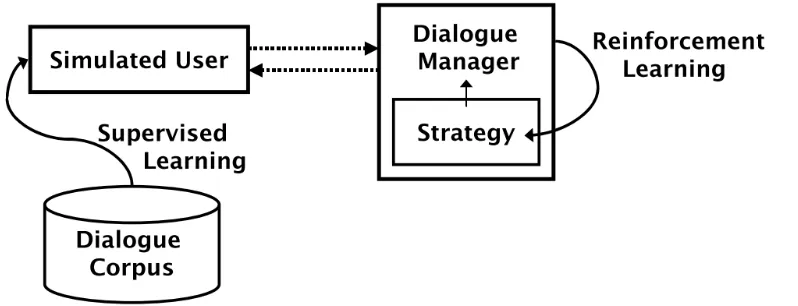
dialogue space of states and policies cannot be thoroughly explored without the usage of automatic simulated users. Although traditionally, non-statistical user modeling techniques was the major research direction of user modeling in spoken dialogue systems, these techniques demonstrated their disadvantages of being highly complex to design in nature (Zukerman & Litman, 2001). On the other hand, user simulation systems using machine learning approaches to construct statistical user models have gained increasing attention in recent decades (Levin et al., 2000; Young, 2002). Machine learning driving simulated users are often utilized to imitate human users behavior, and they have been adopted effectively in training and evaluating dialogue strategies (policies) through trial-and-error interactions. Usually, utilization of statistical simulated users in spoken dialogue systems is of two phases (Figure 2.2). First, a simulated user model is trained using supervised learning approaches upon a dialogue corpus collected from human users. Second, a dialogue manager strategy would be learned with reinforcement learning methods in interactions between the dialogue manager and simulated users, when simulated users would behave by predicting and imitating human users’ preferences learned in the prior phase.
systems, as well as the probabilistic modeling convering the conversational behavior distribution learned form human user corpus. Bayesian networks were later utilized to model users’ interaction in dialogue systems (Pietquin & Dutoit, 2005; Pietquin & Beaufort, 2005). Compared to prior methods, Pietquin et al. proposed to train a Bayesian network model to learn user action distribution based on requested information, user’s goal and memory of dialogue interactions. They acknowledged the importance of understanding user state and its effect on dialogue behavior to accurately predict user’s actions. Georgila et al. (Georgila, Henderson & Lemon, 2005; Georgila, Lemon, & Henderson, 2005) utilized supervised learning techniques to predict user actions in dialogues. Specifically, user action prediction is formed as a classification problem, in which the probability of the user taking each action is estimated given a real-valued feature vector representing the dialogue interaction state between the dialogue manager and the user. Hidden Markov models have also been studied to simulated user-dialogue manager interactions, in which an Input-Output-HMM is employed (Cuayáhuitl et al., 2005). A set of state transition probabilities and a set of output probabilities are maintained to record the interaction, and then user response is predicted from user model probabilities.
2.3 Deep Learning
Although learnable neural network related research can be dated back to 1950s (Rosenblatt, 1958), the most recent popularity of deep neural network models started from around 2006. Even though neural network models, as universal function approximators (Csáji, 2001), have astonishing capability to fit very complex functions, training of deep neural networks is usually not intuitive. Hinton et al. (2006) proposed a layer-wised pretraining method, which can be utilized, as an unsupervised method, to initialize the network parameters in a deep belief network. This work represents the start of quick growth in research to design, train and apply deep neural network models in this recent deep learning upsurge.
VGGNet demonstrated outstanding performance on the Imagenet dataset, with a top-5 evaluation error rate of 6.8%, and good generalizability on other datasets. In 2015, the novel deep residual network (ResNet) was proposed and employed in the LSVRC competition (He et al., 2016). ResNet innovatively uses skip connection in building very deep CNNs, so convolutional layers in ResNet does not just learn a hierarchical feature presentation, instead it learns a residual representation with respect to features in prior layers which have skip connections into the current layer. The usage of skip connection significantly increases the capability of training even deeper CNNs, so a 152-layer ResNet achieved a top-5 evaluation error rate of 3.57%, which surpasses human expert’s performance (Russakovsky et al., 2015) on recognizing image categories in the Imagenet dataset.
GNMT achieved competitive results to the state-of-the-art at that time on English-to-French and English-to-German benchmarks.
narrative planner, although potentially with large variance in the distribution, could be properly handled with deep learning techniques.
2.4 Reinforcement Learning
As a framework to solve sequential decision making problems, reinforcement learning has been broadly studied and successfully exploited in several domains in recent years. The considerably increasing popularity and advancement of the deep learning techniques significantly boosts the development of reinforcement learning research, so even human-level or super-human performance has been achieved by reinforcement learning methods in several fields (e.g., playing video games, playing go game, controlling humanoid robot et al.). In this subsection, we’ll briefly cover some recent success and advancement of reinforcement learning, especially deep reinforcement learning approaches. Because the prior utilization of reinforcement learners in the task of interactive narrative generation and adaptation has been discussed in Section 2.1, these applications will not be covered in this subsection anymore.
is regarded as a hard problem because of the highly stochastic and nonlinear dynamics in the flight environment. The authors utilized supervised learning to identify a model of the helicopter’s dynamics, with which reinforcement learning is adopted in training a policy which learns to control the helicopter’s locomotion, including difficult inverted hovering. Reinforcement learning also have demonstrated its capability in learning strategies to play some board games. Temporal difference learning has been adopted successfully to play games like backgammon (Tesauro, 1995) and checker (Schaeffer et al., 2001). Abe et al. (2004) investigated the usage of reinforcement learning in marketing. In their work, they described a novel solution that treats problems of cross channel integration and customer life time value modeling in one unified MDP framework. And the result demonstrated a 7% to 8% increase in the store profits by exploiting a mailing policy induced by reinforcement learning.
together using shared Q-network parameters. This proposed Q-network implementation architecture is able to significantly speed up the training of Q-networks, as well as generate policies with comparable quality.
dueling network architecture, and an efficient implementation of TRPO by maintaining an average policy network to represent a running average of past policies which is used to constrain policy update, have enabled ACER to perform well on both Atari gameplay and continuous control problems. Wu et al. (2017) introduced another trust-region method for deep reinforcement learning, which is named as actor-critic using Kronecker-Factored Trust Region (ACKTR). The Kronecker-factored curvature approximation method is used to do natural policy gradient optimization in neural network based actor-critic reinforcement learning. The empirical results also show the effectiveness of this method in both Atari gameplay and MuJoCo continuous robot control.
CHAPTER3
CRYSTALISLANDINTERACTIVENARRATIVE
This section presents the testbed utilized in this data-driven interactive narrative adaptation research, which is an interactive narrative-centered open-world educational game— CRYSTAL ISLAND. The following aspects of the CRYSTAL ISLAND will be introduced. First, the backstory and the open-world game environment of the CRYSTAL ISLAND interactive narrative will be described. Second, we will present the selected features and player actions in player interaction representation used in the interactive narrative adaptation framework. Then, adaptable narrative events designed in the CRYSTAL ISLAND interactive narrative will be introduced. Finally, the corpus investigated in the research will be described.
3.1 CRYSTAL ISLAND Backstory and Game Environment
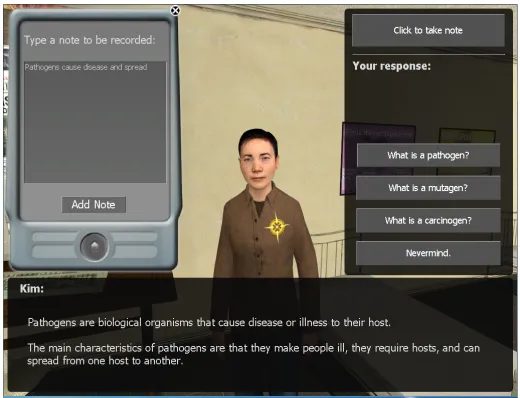
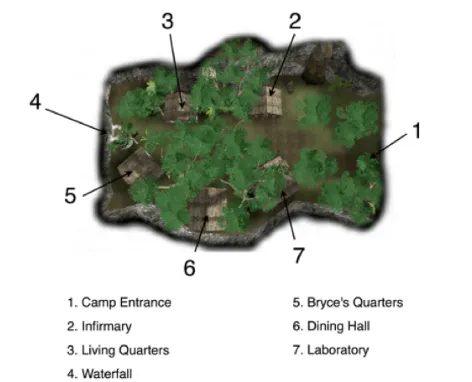
CRYSTAL ISLAND is an interactive narrative-centered open-world educational game. It offers a rich, large virtual 3D environment that features eighth grade microbiology course content following the North Carolina curriculum standard (Figure 3.1). With one major subject of
3.2 CRYSTAL ISLAND Player Interaction Representation
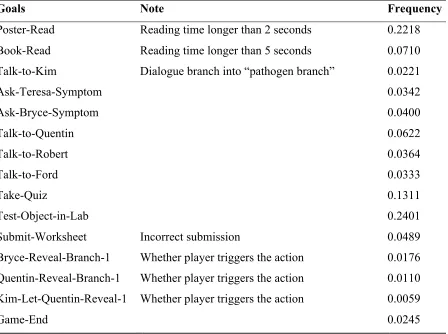
Player’s interaction in the CRYSTAL ISLAND game environment are recorded with information in three categories: players’ gameplay action sequences, players’ traits, and players’ interaction history with the narrative planner. In this interactive narrative adaptation research, we concentrate on 15 player actions, which can basically describe the way how a player explores the game environment, unfolds the narrative during gameplay and conducts learning related activities. These actions are concretely illustrated in Table 3.1.
The actions listed here contain all major actions that can describe the amount of narrative that has been unfolded, as well as the amount of curriculum related contents that have been revealed. More importantly, using this set of player actions, narrative adaptation triggering opportunities can be deterministically determined. This means in the simulated player model, one set of rules for defining the narrative adaptation opportunities can be easily defined, so that we can clearly and accurately depict how players and interactive narrative planner interact in the simulation mode. Table 3.1 also shows the player action frequency is
listed. This frequency statistic is counted from the corpus collected in human players involved studies, which will be introduced in later subsection.
The actions listed here contain all major actions that can describe the amount of narrative that has been unfolded, as well as the amount of curriculum related contents that have been revealed. More importantly, using this set of player actions, narrative adaptation triggering opportunities can be deterministically determined. This means in the simulated player model, one set of rules for defining the narrative adaptation opportunities can be easily defined, so that we can clearly and accurately depict how players and interactive narrative planner interact in the simulation mode. Table 3.1 also shows the player action frequency is
Table 3.1: Players’ gameplay actions
Goals Note Frequency
Poster-Read Reading time longer than 2 seconds 0.2218
Book-Read Reading time longer than 5 seconds 0.0710
Talk-to-Kim Dialogue branch into “pathogen branch” 0.0221
Ask-Teresa-Symptom 0.0342
Ask-Bryce-Symptom 0.0400
Talk-to-Quentin 0.0622
Talk-to-Robert 0.0364
Talk-to-Ford 0.0333
Take-Quiz 0.1311
Test-Object-in-Lab 0.2401
Submit-Worksheet Incorrect submission 0.0489
Bryce-Reveal-Branch-1 Whether player triggers the action 0.0176 Quentin-Reveal-Branch-1 Whether player triggers the action 0.0110 Kim-Let-Quentin-Reveal-1 Whether player triggers the action 0.0059
listed. This frequency statistic is counted from the corpus collected in human players involved studies, which will be introduced in later subsection.
With this set of player actions, we build the player interaction feature set, which can be used to trace how a player plays the game and how the interactive narrative planner tailors the narrative for each individual player. This feature set contains 21 features, fourteen out of which are from the player action information as listed in table 3.1. From the 1st player action to the 11th player action listed in Table 3.1, we use player action counts as feature values; for the 12th to the 14th actions in Table 3.1, a binary indicator is utilized to denote whether the player has triggered that event to happen at least one time in the gameplay. Game ending player action is not counted in the feature set.
Three player trait features are adopted. They indicate the player’s gender (binary value), player’s gaming frequency (integer value, 1-5), and player’s pre-test score (integer value, 1-19). There are other 4 features storing interactive narrative planners’ decision history, which have real values ranging in [0,1]. The meaning of these four features will also be described in the following subsection.
Standardization preprocessing of these 21 features is adopted in both simulated player modeling and adaptable interactive narrative planner derivation. The standardization process rescales the values of all features, so each feature should have zero mean and unit variance after preprocessing.
normalized difference between player’s post-test score and pre-test score, which is demonstrated in Equation 3.1.
𝑁𝐿𝐺 =%&'()*+,-.%&'()*/0
%&'()123.%&'()*/0 (3.1)
In our analysis, we group player experiences into two categories: high NLG and low NLG. Players with NLG scores above or equal to the median value are in the high NLG group, and players with NLG scores below the median are labeled with low NLG. Although NLG is adopted in this study, other experience metrics (e.g., engagement questionnaire scores) could also fit into this interactive narrative adaptation framework.
3.3 Narrative Adaptation in CRYSTAL ISLAND
In the CRYSTAL ISLAND interactive narrative, several places are adaptable. It means NPC’s dialogue contents, feedbacks to player’s certain behaviors, and extra in-game functionalities can be dynamically controlled and adjusted to individual players. In this dissertation, we study four adaptable events. These four adaptable events can be triggered by certain player actions, and all affect the unveiling of curriculum content to players in the narrative:
• Teresa Symptoms Event is triggered each time the player inquiries about the sick
• Bryce Symptoms Event is triggered each time the player inquiries about the sick
NPC Bryce’s symptoms. The interactive narrative planner has two optional responses: providing minimal detail or moderate detail about his symptoms. In player interaction feature set, these two actions are encoded as real numbers, with 0 representing the event not being triggered yet; 0.5 representing providing minimal detail; 1 representing providing maximal detail. The interactive narrative planner’s most recent decision is stored in the player interaction feature set (described in Section 3.2).
• Diagnosis Feedback Event is triggered when a player submits an incorrect diagnosis
worksheet. The interactive narrative planner selects one of three options for the camp nurse’s feedback: providing minimally detailed, moderately detailed, or maximally detailed feedback. In player interaction feature set, these three actions are encoded as real numbers, with 0 representing the event not being triggered yet; 0.33 representing providing minimal detail; 0.67 representing providing moderate detail; 1 representing providing maximal detail. The interactive narrative planner’s most recent decision is stored in the player interaction feature set (described in Section 3.2).
• Knowledge Quiz Event is triggered when a player converses with a subset of the
The appearance of these four adaptable events follows a clear rule in the game. For the Teresa symptoms event and Bryce symptoms event, they are triggered when the player adopts the Ask-Teresa-Symptom action or Ask-Bryce-Symptom action respectively. The diagnosis feedback event will be triggered when the submit-worksheet player action is taken. Triggering rule of the knowledge quiz event is a little more complex. When the player talks with NPC Quentin, or Ford, or Robert for the first time, the knowledge quiz event will be triggered to determine if the player will or won’t receive a knowledge quiz. All these rules are clearly and strictly followed in the simulated player modeling design. The purpose of adapting interactive narratives in CRYSTAL ISLAND is to improve players’ interaction outcomes and/or experiences. Specifically, because of the educational nature of CRYSTAL ISLAND, in this study we utilize normalized learning gain as a metric to evaluate the narrative adaptation effect in the game. Normalized learning gain has been presented in Section 3.2.
3.4 CRYSTAL ISLAND Interactive Narrative Corpus
CHAPTER4
STATISTICALPREDICTIVESIMULATEDPLAYERMODEL
This section presents a statistical predictive simulated player model that was created for the interactive narrative adaptation research. The following aspects of simulated player modeling will be described. First, we introduce the general framework of the statistical simulated player model. Second, we will introduce neural network models specifically designed to model sequence data, which is aligned with the temporal player interaction data in interactive narratives. Third, we describe long short-term memory networks (LSTMs), a family of recurrent neural networks that effectively address the vanishing gradient problem. Fourth, we describe methods to construct deep recurrent neural networks, including stacked deep LSTM, Grid LSTMs, and deep recurrent highway networks. Fifth, deep convolutional neural networks in simulated player modeling is introduced. Finally, we describe several regularization techniques for deep neural network models that we utilize in simulated player modeling.
4.1 Simulated Player Modeling in CRYSTAL ISLAND
In interactive narratives with open-world virtual environments such as CRYSTAL ISLAND, players actively drive the narrative forward by performing actions in the virtual world. Usually, open-world environments afford many possible narrative trajectories—players may follow different sequences of conversing with NPCs, completing in-game sub-tasks, or interacting with virtual objects—and each player is likely to experience his or her own unique trajectory, albeit with similarities to peers’ experiences.
history, player trait data and narrative planner’s prior decisions as input. In addition, the player simulation model predicts the player’s experiential outcome distribution at the conclusion of the narrative episode. As in the CRYSTAL ISLAND interactive narrative, in which the open-world interaction environment affords a large space for players to freely explore the game environment and spread out the narrative without much constraints, usually players’ interaction patterns could diverse dramatically. One example in CRYSTAL ISLAND is that, some players might be interested in reading some virtual books and posters with curriculum content to gain curriculum knowledge before start to thoroughly explores the environment and find evidences of the disease breakout, while other players might prefer to collect suspicious items and conduct laboratory test to identify the disease source in the early stage of gameplay. Further, because learning outcome (measured by normalized learning gain) is the adopted metric for interactive narrative quality evaluation in the CRYSTAL ISLAND study, it’s almost impossible to find clearly deterministic rule even for experts to tell what type of player interaction patterns could result in good learning outcome. So, in this research, the statistical predictive simulated player model is employed. For both the player actions and player outcome, the goal of simulated player modeling is to derive a function to approximate the distribution of players’ behavior at each interaction time step, and the distribution of players’ normalized learning gain after the gameplay interaction ends.
distribution (induced from human players’ corpus). The sampled initial player state should only indicate what type of player she is, by setting player trait feature values, and zeroing out all player action feature values and narrative planner past decision feature values. Next, the simulated player model is used to determine the distribution over likely player actions at the next player interaction time step. One action is sampled according to this distribution, and the player simulation’s current state is updated according to the effects of the synthetic player action. If the player action triggers an adaptable event, then a narrative adaptation decision by the narrative planner occurs, once again updating the simulation’s current state. This process continues until a game-ending player action is generated. Afterward, the simulated player’s experiential outcome is predicted.
educational interactive narrative is a very difficult problem, especially considering the human subjects generating corpus is not large. A binary split simplifies the problem so useful interaction patterns can probably be extracted. Second, binary divide using median learning outcome (normalized learning gain) value makes each class with similar amount of samples. An unbiased corpus makes it easier to train an effective player outcome predictor. Third, a binary divide is also a conventional way to preprocess player outcome data in educational interactive narrative settings (Rowe & Lester, 2015; Rowe et al., 2014; Wang, Rowe, Mott, & Lester, 2016).
The input features to the player simulation model are designed to represent key player attributes, including how the player interacts with the virtual environment as well as how the interactive narrative planner adapts events to shape the player’s experience. This set of 21 features has been defined and concretely introduced in Section 3.2.
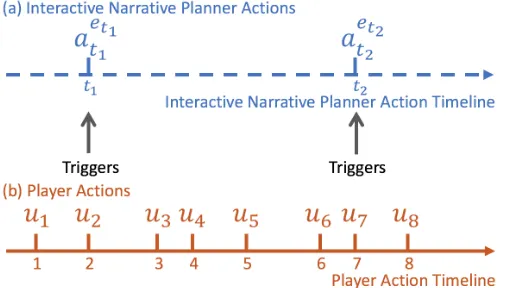
The interaction of simulated players and the narrative planners is illustrated in Figure 4.1. In Figure 4.1(b), the simulated player is demonstrated as sampling and adopting a series of player actions 𝑢6 along the player action timeline. A certain subset of player actions (e.g.,
𝑢7 and 𝑢8 in Figure 4.1(b)) would trigger narrative adaptation opportunities following the game rule. Then an interactive narrative planner would pick a narrative adaptation action 𝑎6
:
)-:
from optional adaptations for adaptable event type 𝑒6: to affect the narrative. One thing to
notice in this design is that, player actions in simulated player model and narrative planner’s adaptation actions from interactive narrative planners are depicted in different granularity. It is acceptable to model player’s behavior (actions) in a finer granularity because simulated player model is formed under a supervised learning framework, which is relatively easier to train. Interactive narrative planner’s behavior, when trained under the reinforcement learning framework, would be hard to optimize with long interaction sequences and sparse reward signals. So, in this dissertation research, I adopt a coarsely grained description for interactive narrative planner’s adaptation (compared to player action description’s granularity). Because players are the active drivers of the interaction process, it is natural to integrate the rules of how narrative adaptation is triggered. Also, extra rules might be integrated to prohibit certain player interaction trajectories to be sampled, which introduces more prior knowledge in generating synthetic simulated player interaction trajectories. This means compared to training an adaptable interactive narrative planner directly from human generating corpus, training a simulated player model using the corpus and logical game rules might improve the induction of effective adaptable data-driven interactive narrative planners.
4.2 Neural Network Models for Sequence Data Modeling
gameplay predictions, one important property of the interaction data is that they are sequences following the same format along the time axis. Although multiple methods, including sliding window method, recurrent sliding windows, hidden Markov model and conditional random fields et., could be utilized in dealing with machine learning problems utilizing sequence data (Dietterich, 2002), deep learning methods offer an especially effective set of models in solving the simulated player modeling problem with sequence data. Several neural network models, including recurrent neural networks (RNNs) and convolutional neural networks (CNNs) have demonstrated impressive performance in processing and predicting sequence data in multiple fields including language modeling, machine translation and speech generation (Kumar et al., 2016; Luong et al., 2015; Wu et al., 2016; Arık et al., 2017; Wang, Skerry-Ryan, Stanton, Wu, Weiss, Jaitly, Yang, Xiao, Chen, Bengio, & Le, 2017). Compared to other methods, deep learning methods give the advantage that no prior expert knowledge is required in forming an effective feature extractor. A properly designed neural network (NN) model should be able to extract useful sequential patters and encode historical information all by itself, even though the choice of potential neural network structures still needs some human expertise and extra experiments.
In Figure 4.2, the middle layer represents a recurrent layer, in which a self-pointed connection is constructed. For the ease of reading, the RNN model could be unfolded along the time axis, illustrating the way how recurrent layer propagates history information along time axis (right part in Figure 4.2). If we use 𝑠6 to represent the output of the recurrent layer at time step t, the calculation of 𝑠6 follows:
𝑠6= 𝑓(𝑈𝑥6+ 𝑊𝑠6.C) (4.1)
in which 𝑥6is the input into this recurrent layer at time step t, 𝑠6.C is the output of this recurrent layer from the previous time step. U and W are trainable parameters in the network, and f is an activation function, usually can be sigmoid function or tanh function. In Figure 4.2, 𝑜6 is the output of the whole RNN. In case it is a one recurrent layer NN model, the output can be a linear function of 𝑠6, or with an extra non-linearity conducted upon it. As demonstrated in Equation 4.1, a recurrent network encodes its history information in 𝑠6.C, which is a representation from the recurrent hidden layer containing information from all prior time steps. In this case, the input of the RNN model can only takes information from the current time step, and don’t have to employ a sliding window which may increase the dimension of input feature set.
Convolutional neural networks (CNNs) process sequence data in a different way compared with RNNs. Instead of keeping an encoded hidden representation for interaction
history, CNNs utilize a series of observations across multiple timesteps in inference. The core idea in CNN is that convolutional kernels apply the same processing on the input features at each time step, so that invariant patterns along the time axis can be identified. The domain of simulated player modeling in interactive narrative environment properly fits this framework. Details of utilizing CNN models in simulated player modeling will be covered in Section 4.5.
4.3 Long Short-Term Memory Network for Sequence Data Modeling
Although RNNs contribute well to sequence data modeling, vanilla RNNs are not commonly utilized in real world problems. The major reason is that vanilla RNNs are not good at processing long dependencies (Bengio et al., 1994). RNNs use back propagation through time (BPTT) in its optimization, which uses chain rule to propagate error from later time step backwards to early time step (opposite to the direction of how information is propagated in prediction). The chain rule multiplies the gradient of error w.r.t RNN parameters along the time axis, so when the sequence is very long, the potential appearance of several small gradient will make the error hard to propagate backwards for a long distance. The so-called gradient vanishing problem prohibit vanilla RNNs to learn well on sequences with long dependences. To solve the gradient vanishing problem, long short-term memory network (Hochreiter & Schmidhuber, 1997) was proposed.
Long short-term memory (LSTM) network is a special kind of RNN. It uses gate structures to control the way how information flows in the recurrent layer in an RNN. Specifically, we adopt an implementation of LSTM network in (Graves et al., 2013), which is one commonly utilized LSTM implementation:
𝑓6 = 𝜎R𝑊KS𝑥6+ 𝑊MSℎ6.C+ 𝑊&S𝑐6.C+ 𝑏ST (4.3)
𝑐6 = 𝑓6𝑐6.C+ 𝑖6𝑡𝑎𝑛ℎ(𝑊K&𝑥6+ 𝑊M&ℎ6.C+ 𝑏&) (4.4)
𝑜6 = 𝜎(𝑊K'𝑥6+ 𝑊M'ℎ6.C+ 𝑊&'𝑐6+ 𝑏') (4.5)
ℎ6= 𝑜6𝑡𝑎𝑛ℎ(𝑐6) (4.6)
Equations 4.2 to 4.6 concretely describe how LSTM works. In an LSTM cell, three gate structures are adopted to control how sequence information flows. Input gates (Equation 4.2), forget gate (Equation 4.3) and output gate (Equation 4.5) are all trainable gate structures. Input from current time step 𝑥6, hidden value from prior time step ℎ6.C and cell value from prior time step 𝑐6.C are features to determine the behavior of the three gates. Weight parameters 𝑊s and bias parameter 𝑏s (Equation 4.2, 4.3, 4.5) are learned to properly define the weights to inputs at current time step 𝑥6, ℎ6.C, encoded information from prior partial sequence 𝑐6.C, and encoded information at current time step 𝑐6, for their contribution to the final output of the LSTM cell ℎ6. The cell activation value 𝑐6 performs as an encoding of the information gathered from current input and all compressed history information.
4.4 Deep Recurrent Neural Networks for Sequence Data Modeling
An important property of neural network models is that multiple hyperparameters can be tuned, and hyperparameter tuning may have significant effects on neural network models’ performance. The depth of a neural network is such a hyperparameter, which significantly affects the complexity of the NN function approximator, as well as the number of learnable parameters to train. In recent years, both theoretical analysis (Bengio, 2009; Srivastava et al., 2015) and empirical evidence (Zilly et al., 2017; Kalchbrenner et al., 2016; He et al., 2016) support the idea that deeper NN models have clear advantages over shallow NN models in forming effectively learners. In this section, the topic of constructing deep RNN models to effectively utilize sequence data in simulated player modeling is discussed. Besides the deep LSTM model, which is a straightforward extension over the shallow LSTM network covered in the prior section, two successfully applied deep RNN models, Grid LSTM model and Recurrent Highway Network models, are introduced.
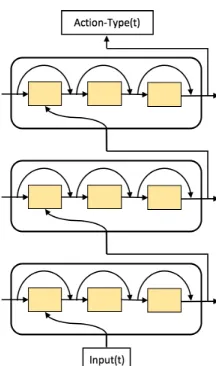
The third deep RNN model that is investigated in this dissertation in for sequence data (especially player interaction sequence) modeling is recurrent highway networks (RHNs). Recurrent highway networks (RHNs) construct recurrent NNs using highway layers (Zilly et al., 2017). A highway layer calculates its output as a weighted summation of an input’s non-linear transformation and the input itself. This design has proven effective for building deep and trainable NNs (Srivastava et al., 2015). Specifically, RHNs increase network depth by utilizing a high recurrence depth in the recurrent step transition: at each transition time step, multiple highway layers (yellow blocks in Figure 4.4) are connected. A 3-layer RHN with recurrence depth of 3 is depicted in Figure 4.4. The output of the adopted RHN model at recurrence depth l and time step t on any RHN layer (the output of any yellow block in Figure 4.4) is calculated as follows:
s[6= h [ 6⋅ r
[6+ s[.C6 ⋅ (1 − r[6) (4.7)
in which ℎ[6 is a nonlinear transformation of 𝑠
[.C6 with 𝑠a6 being the recurrent output from time step t-1, and 𝑟[6 is the transform gate that controls the contribution of ℎ
[6 into the output 𝑠[6. 1 − r[6 calculates the weight for the prior recurrent state 𝑠
[.C6 into 𝑠[6. Calculation of ℎ[6 and 𝑟[6 is as follows:
h[6 = tanhR𝑊
M𝑥6𝕀[gC+ 𝑅Mi𝑠[.C6 + 𝑏MiT (4.8)
r[6 = sigmoidR𝑊
(𝑥6𝕀[gC+ 𝑅(i𝑠[.C6 + 𝑏(iT (4.9)
where 𝑥6 is input into one RHN layer at time step t, 𝕀 is the identity function, and W, R, b are trainable weights and biases in RHN.
4.5 Deep Convolutional Neural Networks for Sequence Data Modeling
Convolutional neural networks (CNNs) are another major branch of NN models that are investigated in this dissertation. The major computational process adopted in a CNN model is described as “convolution,” which sums up the values of a subset of features by adopting weights in the convolution kernel. Convolution kernels usually have a size smaller than the input size, and the convolution process slides the kernel on the input feature set to conduct dot products centered at certain positions in the input. In this way, convolution can process and extract regional invariant features that could appear at different positions in the input feature set with properly defined convolution kernels. Training of a CNN model learns meaningful kernel values, so representative invariant features to describe the original input can be extracted. Usually CNN models also adopt pooling modules, which are non-learnable
layers mainly utilized for down-sampling purposes. Since player interaction data usually does not have very high dimension. In this dissertation pooling is not adopted in CNN models.
Because player outcomes are typically measured only after the conclusion of an interactive narrative experience, outcome data tends to be sparser than player action data. To address this problem, it is especially interesting to investigate the effectiveness of convolutional NN-based (CNN) models for player outcome prediction. CNN-based player outcome prediction models can detect repeatable patterns from each gameplay time step and eliminate the constraint imposed by recurrent NN models of having to extract patterns using the exact input sequences.
CNN models can be leveraged in simulated player modeling because the same feature set is usually utilized at each gameplay time step to record the player’s behaviors, thereby enabling convolution to be naturally applied along the time axis. This strategy has been used in machine translation tasks (Gehring et al., 2017). One example of utilizing CNN models in simulated player modeling is the CNN-based player outcome prediction model that is experimented in this dissertation, which has two convolution layers stacked above the input layer (Figure 4.5).
assign weights to lower layer raw input and non-linearly transformed values, while residual learning does not learn a gate structure but directly propagates lower layer values into upper layers, which makes the structure of the network simpler, and empirically to be more efficient in learning very deep CNN models (He et al., 2016). Specifically, we adopt a residual structure that directly adds raw input into the output of each of the two convolution layers. In this way, the output of convolution layer l is ol=conv(il)+il in which il represents the input into convolution layer l.
4.6 Regularization Techniques in Neural Network Models
As a universal function approximator, neural network models can be ultimately significantly powerful and complex by increasing the size of hidden layers or stacking a larger number of hidden layers in a NN model. Although more complex models can potentially extract more complicated nonlinear patterns, the probability of overfitting also grows dramatically along with the increasing model complexity. To effectively resist overfitting, properly
regularization techniques should be adopted, especially for the problem of simulated player modeling, in which the human generating corpus is usually small.
In this dissertation, we will cover the successfully utilized regularization techniques in neural network model training in the problem of simulated player modeling and RL-based interactive narrative generation.
4.6.1 Dropout
Deep neural network models are powerful function approximators, which also introduces the problem that overfitting could easily happen with a large number of trainable parameters in deep NN models. Besides regular and universal regularization techniques (e.g., L1-norm, L2-norm, etc.) that are also broadly investigated with other machine learning models, dropout technique (Srivastava et al. 2014), as a broadly adopted NN specific regularization tool, has achieved particular success and extensive usage in plenty of domains (He et al., 2016; Zilly et al., 2017).