Basic Algorithm Implementation on
High Performance Computing
Systems
Venkatesh K1, Siva Parvathi V2, Phani Praveen S3, Rajesh V4
Department of Computer Science & Engineering, PVP Siddhartha Institute of Technology,
Vijayawada, India1, 2, 3, 4
ABSTRACT: Now a days the need to implement complex algorithms is at acme level. The ever growing business data or social media or other sources play huge importance on their representation. For efficient implementation and fast retrieval, complex systems are required. In this paper, we enlighten the overview of High Performance Computing Systems and implementation details of simple algorithm. Later, discussed the result analysis of dual core and HPC systems.
I. INTRODUCTION
600 GFLOPS in 1996 by using 2048 processors connected via a fast three-dimensional crossbar network. The Intel Paragon could have 1000 to 4000 Intel i860 processors in various configurations, and was ranked the fastest in the world in 1993. The Paragon was a MIMD machine which connected processors via a high speed two dimensional mesh, allowing processes to execute on separate nodes, communicating via the Message Passing Interface [4].
The most common users of HPC systems are scientific researchers, engineers and academic institutions. Some government agencies, particularly the military, also rely on HPC for complex applications. High-performance systems often use custom-made components in addition to so-called commodity components [5]. As demand for processing power and speed grows, HPC will likely interest businesses of all sizes, particularly for transaction processing and data warehouses. An occasional trend might use an HPC system to satisfy an exceptional desire for advanced technology [6].
II. HIGH PERFORMANCE COMPUTERS HARDWARE AND SOFTWARE
This section describes the Hardware and Software components of High performance computers.
A. SYSTEM HARDWARE
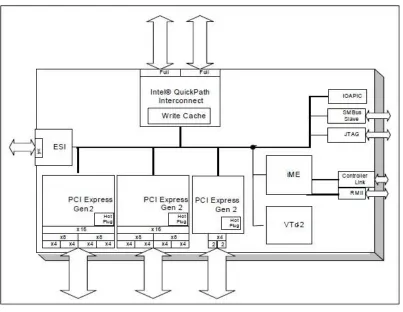
Approaches to High performance computers architecture have taken dramatic turns since the earliest systems were introduced in the 1960s. Early High performance computers architectures pioneered by Seymour Cray relied on compact innovative designs and local parallelism to achieve superior computational peak performance [7]. However, in time the demand for increased computational power ushered in the age of massively parallel systems [8].
Fig. 1. Architecture of High Performance Computers.
The Connection Machine CM-5 High performance computers are a massively parallel processing computer capable of many billions of arithmetic operations per second.
Throughout the decades, the management of heat density has remained a key issue for most centralized High performance computers. The large amount of heat generated by a system may also have other effects, e.g. reducing the lifetime of other system components. There have been diverse approaches to heat management, from pumping Fluorine through the system, to a hybrid liquid-air cooling system or air cooling with normal air conditioning temperatures. A typical supercomputer consumes large amounts of electrical power, almost all of which is converted into heat, requiring cooling. For example, Tianhe-1A consumes 4.04 megawatts (MW) of electricity. The cost to power and cool the system can be significant, e.g. 4 MW at $0.10/kWh is $400 an hour or about $3.5 million per year [10].
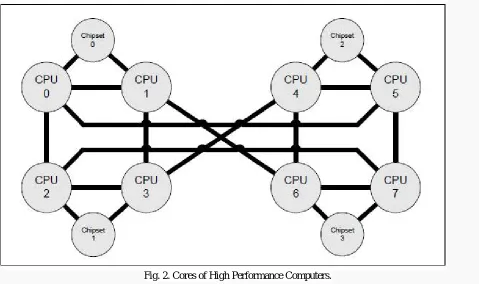
Fig. 2. Cores of High Performance Computers.
In the Blue Gene system, IBM deliberately used low power processors to deal with heat density. On the other hand, the IBM Power 775, has closely packed elements that require water cooling. The IBM Aquasar system, on the other hand uses hot water cooling to achieve energy efficiency, the water being used to heat buildings as well. The energy efficiency of computer systems is generally measured in terms of "FLOPS per watt". IBM's Roadrunner operated at 3.76 MFLOPS/W. The Blue Gene/Q reached 1,684 MFLOPS/W. Because copper wires can transfer energy into a supercomputer with much higher power densities than forced air or circulating refrigerants can remove waste heat, the ability of the cooling systems to remove waste heat is a limiting factor [13]. Many existing supercomputers have more infrastructure capacity than the actual peak demand of the machine designers generally conservatively design the power and cooling infrastructure to handle more than the theoretical peak electrical power consumed by the supercomputer. Designs for future supercomputers are power-limited the thermal design power of the supercomputer as a whole, the amount that the power and cooling infrastructure can handle, is somewhat more than the expected normal power consumption, but less than the theoretical peak power consumption of the electronic hardware [14].
B. SYSTEM SOFTWARE
High Performance Computers have undergone major transformations, based on the changes in supercomputer
manufacturer has its own specific Linux-derivative, and no industry standard exists, partly due to the fact that the differences in hardware architectures require changes to optimize the operating system to each hardware design [16].
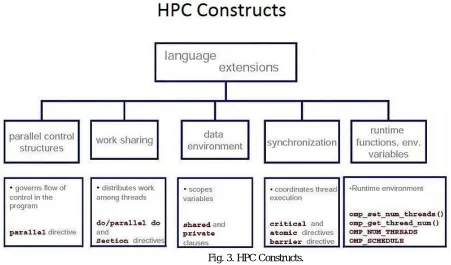
The parallel architectures of supercomputers often dictate the use of special programming techniques to exploit their speed. Software tools for distributed processing include standard APIs such as MPI and PVM, VTL, and open source-based software solutions such as Beowulf. In the most common scenario, environments such as PVM and MPI for loosely connected clusters and OpenMP for tightly coordinated shared memory machines are used. Significant effort is required to optimize an algorithm for the interconnect characteristics of the machine it will be run on; the aim is to prevent any of the CPUs from wasting time waiting on data from other nodes. GPGPUs have hundreds of processor cores and are programmed using programming models such as CUDA or OpenCL. Moreover, it is quite difficult to debug and test parallel programs. Special techniques need to be used for testing and debugging such applications. The following Fig. 3 shows the constructs of High Performance Computers [17].
Fig. 3. HPC Constructs.
III. SAMPLE ALGORITHM IMPLEMENTATION ON HPC SYSTEM
The algorithm we implemented on HPC is as follows, which computes sum of elements in an array.
ALGORITHM: sum(A)
Start
1 if |A| = 1 then return A[0]
2 else return sum({A[2i] + A[2i + 1] : i ∈ [0..|A|/2)})
The work and depth for this algorithm are given by the recurrences
W(n) = W(n/2) + O(n) (1)
D(n) = D(n/2) + O(1) (2)
which have solutions W(n) = O(n) and D(n) = O(log n) end
This algorithm can also be expressed without recursion using a while loop, but the recursive version as indicated in (1) & (2) for shadows the recursive algorithm for the scan function. the algorithm only works on sequences that have lengths equal to powers of 2. Removing this restriction is not difficult by checking if the sequence is of odd length and separately adding the last element in if it is. This algorithm can also easily be modified to compute the “sum” using any other binary associative operator in place of +. For example the use of max would return the maximum value of in sequence.
A) Efficiency of the HPC over Single Core System
The algorithm is successfully deployed on dual core system as well as HPC the following are the results. HPC has produced the better results than dual core system.
IV. CONCLUSION
In this paper, we implemented a basic algorithm on dual core as well as HPC system. The performance of dual core system is far lesser than HPC system. The implementation process is similar in both the systems. Implementations of complex approaches give better results using HPC. Multi core systems always produce efficient results. HPC platform provides a better approach to implement graphic level applications.
REFERENCES
[1] Bacon, David F., Susan L. Graham, and Oliver J. Sharp. "Compiler transformations for high-performance computing." ACM Computing Surveys (CSUR) 26.4 (1994): 345-420.
[2] Fan, Zhe, et al. "GPU cluster for high performance computing." Proceedings of the 2004 ACM/IEEE conference on Supercomputing. IEEE Computer Society, 2004.
[3] Gropp, William, et al. "A high-performance, portable implementation of the MPI message passing interface standard." Parallel computing 22.6 (1996): 789-828.
[4] Dowd, Kevin. High performance computing. O'Reilly & Associates, Inc., 1993.
[5] Huang, Wei, et al. "A case for high performance computing with virtual machines." Proceedings of the 20th annual international conference on Supercomputing. ACM, 2006.
[6] Tang, Qinghui, Sandeep Kumar S. Gupta, and Georgios Varsamopoulos. "Energy-efficient thermal-aware task scheduling for homogeneous high-performance computing data centers: A cyber-physical approach." IEEE Transactions on Parallel and Distributed Systems 19.11 (2008): 1458-1472. [7] Mergen, Mark F., et al. "Virtualization for high-performance computing." ACM SIGOPS Operating Systems Review 40.2 (2006): 8-11.
[8] Buyya, Rajkumar. "High performance cluster computing: Architectures and systems (volume 1)." Prentice Hall, Upper SaddleRiver, NJ, USA 1 (1999): 999.
[9] Taubenblatt, Marc. "Optical interconnects for high performance computing."Optical Fiber Communication Conference. Optical Society of America, 2011.
[10] Katopis, George A. "Delta-I noise specification for a high-performance computing machine." Proceedings of the IEEE 73.9 (1985): 1405-1415. [11] Plaza, Antonio J., and Chein-I. Chang, eds. High performance computing in remote sensing. CRC Press, 2007.
[12] Kindratenko, Volodymyr V., et al. "GPU clusters for high-performance computing." 2009 IEEE International Conference on Cluster Computing and Workshops. IEEE, 2009.
[13] Younge, Andrew J., et al. "Analysis of virtualization technologies for high performance computing environments." Cloud Computing (CLOUD), 2011 IEEE International Conference on. IEEE, 2011.
[15] Armstrong, Rob, et al. "Toward a common component architecture for high-performance scientific computing." High Performance Distributed Computing, 1999. Proceedings. The Eighth International Symposium on. IEEE, 1999.
[16] Barker, Kevin J., et al. "On the feasibility of optical circuit switching for high performance computing systems." Proceedings of the 2005 ACM/IEEE conference on Supercomputing. IEEE Computer Society, 2005.
[17] Tezduyar, T., et al. "Flow simulation and high performance computing."Computational Mechanics 18.6 (1996): 397-412.
[18] Yoo, Richard M., et al. "Performance evaluation of Intel® transactional synchronization extensions for high-performance computing." 2013 SC-International Conference for High Performance Computing, Networking, Storage and Analysis (SC). IEEE, 2013.
[19] Giunta, Giulio, et al. "A GPGPU transparent virtualization component for high performance computing clouds." European Conference on Parallel Processing. Springer Berlin Heidelberg, 2010.