University of Windsor University of Windsor
Scholarship at UWindsor
Scholarship at UWindsor
Electronic Theses and Dissertations Theses, Dissertations, and Major Papers
8-13-1965
Electromagnetic fields in coupled cavities.
Electromagnetic fields in coupled cavities.
Bing Yiu Tam University of Windsor
Follow this and additional works at: https://scholar.uwindsor.ca/etd
Recommended Citation Recommended Citation
Tam, Bing Yiu, "Electromagnetic fields in coupled cavities." (1965). Electronic Theses and Dissertations. 6405.
https://scholar.uwindsor.ca/etd/6405
ELECTROMAGNETIC FIELDS IN COUPLED CAVITIES
BY
BING YIU TAM
A Thesis
Submitted to the Faculty of Graduate Studies through
the Department of Electrical Engineering in Partial
Fulfillment of t h e 'Requirements for the Degree
of Master of Applied Science at the
'University of Windsor
Windsor,' Ontario
UMI Number: EC52586
INFORMATION TO USERS
The quality o f this reproduction is dependent upon the quality o f the copy
subm itted. Broken or indistinct print, colored or poor quality illustrations and
photographs, print bleed-through, substandard m argins, and im proper
alignm ent can adversely affect reproduction.
In the unlikely event that the author did not send a com plete m anuscript
and there are missing pages, these will be noted. Also, if unauthorized
copyright m aterial had to be removed, a note will indicate the deletion.
®
UMI
UMI Microform EC52586C opyright 2008 by ProQ uest LLC.
All rights reserved. This m icroform edition is protected against
unauthorized copying under Title 17, United States Code.
ProQ uest LLC
Approved by:
\A\C. /&.L'ls£u2.
ABSTRACT
Two cavities resonating at about the same
frequency are coupled with each other through a small
iris closed hy a thin partition. The radius of this
iris is assumed to be small compared with the wave
length. If one cavity is excited, fictitious surface
magnetic charge and a fictitious surface magnetic
current density are formed in the iris. The distribut
ion of these magnetic charge and current densities
constitutes a boundary condition for the calculation^
of the electromagnetic fields in the cavities. This
solution is in terms of certain orthogonal functions
of the separate cavities.
hCIRTOWIEDGEkEK'TS
The author gratefully acknowledges the able
direction of Dr. S. N. Kalra, under whose suggestion
these' studies were undertaken. In particular the
author wishes to express his thanks to Dr. P. H o l u j ,
Dr. E. P. Hsu and Dr. H.H. Hwang for their excellent
advise and encouragement. Financial assistance was
provided by the National Research Council of Canada.
Page
ABSTRACT ... ii
A C Of 0WLEDGEKEN T S ... iii
1. INTRODUCTION ... .... ... 1
2. .THE COMPLETE EXPANSION OP ELECTROMAGNETIC
FIELDS IN CAVITY RESONATORS ... 4
3. ASSUMPTIONS AND BOUNDARY CONDITIONS ... 11
4. SURFACE MAGNETIC CHARGE L CURRENT
DISTRIBUTIONS ... 1?
5. GENERAL-FIELD SOLUTION ... 24
6. EXAMPLE ... ■... 32
APPENDIX
A. Vector and Scalar Functions ... 41
B. Orthogonality ... 47/
BIBLIOGRAPHY ... " ' 54
1 . INTRODUCTION
An electromagnetic field vector function, as
defined by Helmhotz, can be represented by the sura of an
irrotational function and a.solenoidal function. This
concept was first applied to the theory of cavity reso
nators by Slater [ 1] . However, he considered that
on-iy the electric field in the cavity consists of both
irrotational as well as 'solenoidal fields; that the
magnetic field, on the other hand, has no irrotational
part. later, .Teichmann and Y/igner [2] pointed out that ■
a complete expansion of electromagnetic field should
include the irrotational magnetic field which w a s found',
to be inversely proportional to its frequency Basing
on this suggestion, Kurokawa [3] gave a proof that for a
complete expansion of electromagnetic field it is neces
sary to* add the irrotational component in the magnetic
field. He asserted that if the irrotational component
was neglected, there would be no' magnetic field through
the opening of the cavity at all when the cavity is
coupled.to a waveguide through an iris.
Cavity coupling systems have long been used and
2
studied by physicists and engineers. Either, in experi
mental or in theoretical analysis, they are generally
considered as equivalent admittance or impedance circuit
representation in form of parallel or series resonant
circuits or both [4] • The coupling device is repre
sented by an equivalent capacitive reactance if electri
cally coupled; by an equivalent inductive reactance if
magnetically coupled [5 ] . This approach has little or
no contribution to the analysis of the fields in the
coupling systems. Up to present time, not much effort
has been made on the field analysis as yet.
For most common practice, the cavities are
coupled through apertures. The degree of coupling is
depending on the sise and shape of 'the aperture. If the
aperture is large, there are many difficulties in dealing
with the field analysis of cavity-coupling problem:
large disturbance due to the presence of the aperture,;
strong interaction due to the infinite number of reflec
tions of fields.between cavities; and the unknown field
distributions in the region of the aperture. On the
other hand, if the aperture is small, all these field
perturbations may.be negligible and an approximation
method may be applied in solving this problea. In this
thesis, the author makes an attempt- to work out the
5
the theory of cavity resonators and the Bethe's method
of the field diffraction by small holes [6"] . An
example is also given to illustrate the application of
2. SHE COMP LEI'2 EXPANSION 01' ELECTROMAGNETIC FIELDS
IN CAVITY RESOLATORS
Resonance phenomena may occur in a number of
types of structures which are used in microwave system.
Any volume completely enclosed by a conductor is usually
called a cavity resonator. In distinction with a lumped
constant resonant circuit, a cavity resonator can reso
nate at an infinite number of discrete frequencies. The
electromagnetic fields in a cavity resonator can be re
presented by the sum of modes of certain frequencies of
oscillation which are' the characteristics of the eigen
values of the wave equation with suitable boundary con
ditions. Both for electric field and magnetic field at
an interior point in the cavity resonator, we have irro-i
tational as well as solenoidal components.
In the expansion for the electromagnetic fields
in the cavity resonator, we can express the electric
field E as a series of E a s and I V s, and the magnetic
field H .as a series of H a s and G^ s. That is,
5
£
= Z 2 4
+ L fa fa
... ... (2' 1)
H = I L S^Ha, + X y & p .. ... (2*2)
where rA , sa , p^/and are the time dependent expan-I
sion coefficients; E^, H a , P ^ and Gg are the functions
of space. The orthogonal functions E ft s and H a s are
the solutions of wave equations with the corresponding
boundary conditions.
V 1
Ea. - i l Ea,
=0
(in Y) (2.3a)n
XBa.
= 0 (on S) (2.3b)V
Ha,
- ~$a.Ha. = 0
(in Y) (2.4a)% ‘ Ha.
— 0
(on S) .'... (2.4b)The orthogonal functions E ^ and H a satisfy the
relations:
ia. E*.
=V X.Ha,
(2.5a)■ia. Ha.
= ■
V X Ea.
(2.5b)Por the orthogonal functions "P^ and G^ , we have
i
6
V ^ 'J'x — (in V) ...(2, 6"d)
^ (on S) ... (2.6c)
and
= 7 ^ (:Ln v > ... (2 -7a)
= O' (in V) ' ... ..(2.7b)
^ = O (on S) (2.7c)
We assume that the medium in the volume of
the cavity V enclosed by a perfectly conducting surface
S is homogeneous and isotropic, that is, 6 and u. are
constant throughout the entire region. Thus Maxwell'3
equations are given in the form
= - f *
d t J
V X
H +
| | = /.
7 -
g
=
7 • D = .
The quantities J* and |°* are fictitious volume
densities of magnetic current and magnetic charge v/hich
have no physical existence. But they will contribute
to the discontinuity in both E and H . Currents and
(I)
(II)
d m
charges of "both types satisfy the equations of continuity
V ‘f + = o (V a )
o t
V -J* +■
| / * = 0 • - ... ( v *>)p
By the use of the orthogonal property of the functions
of E a , H a , Pj* , and T Eqs. ( 2 . 1 ) and ( 2 . 2 ) may be
rewritten as:
f = 5 ^ d v f .'(Z.8)
v v '
H ~ Z & J J f ... (2>g)
In addition to E and H , we define
J * = Z h l $ J * %,.<*» (2.10)
J
= |+ZjFk^J-F*‘(v.
. (2
.11
)a V. V
f . ~ % { * < $ < * « ■ (2.12)
, f ' V
f
= Z% Iff / ° %
d v
( 2 . 1 3 )C<
V
The next step is to substitute these series expansions
into the Maxwell's equations. From E qs.(2.8) and (2.9),
we realize that the curl of E is equivalent to "H .
that i s ,
V x £
=vx £ ■
t Z
jVXE-fydv
?
... (
2.
14)
Upon making use of the vector identities,
p X
E
*He,
=V
xH^- E +
V -
( If x Ha.) ■
=
-Lt-
+ V' ( £,x Ha.)
V x1
£
• 6 ^ =V x
•E -f
V '
( E
x G^)= V • ( £ x 6*.,)
and the divergence theorem, E q . (2.14) becomes
V x E = ^ fff £ •Ea.dv + n x £ • Hcc c/s)
a v 5
From the first Maxwell's equation, we have
X #«.(
i a J i f £■ E ^ d v+ jJ?£ x 5 - A <6 ) ■
+
2 L & J ( n x £ - & c/sA v s . P / s r
Multiplying both sides by H a and integrating over the
9
1^0.
Jff
Ecl c(v + UJff
hj * Ha, d ifV V
J * . - ff n X £ • H tl d s (2.16)
V s
t h
'y
Repeating that again with G ^ , we get
/ i f ' ^ - % J * - C r l v - l l n * E - G ^ s
v / 5 ... (2.17)
^ a
In the like manner in obtaining .7 X E, V X H is
V x. H
Z,SAj f f VXH-£<
l<J
v+
Z £ jjVKH- F«dxr
V V
= Z £ » ( 4.
I f f H ■Hxdv t f f n x H - \ d s )
v 5
+ - % d s (2-18)
5
Upon making use of the vector identities
n x H • P * , = H • n x and n x H • E fl = H • n x E ^
and the boundary conditions n x E a = 0 and n x P ^ = 0
on S, Eq. (2.18) reduces into
V x R = ^ E ^ f f f H - n , d v ...
V
Me again substitute the known functions into the second,
Maxwell's equation and take advantage of their ortho
gonality as for the first Maxwell's equation. The final
10
*« Iff fi• f f . -
ej f f f [ e - ^ v ~
12.20)
' i
d t
I f f E ' F* dv ~ I f f J ' f * c/v
...(2-21)
]/ v
From the third Maxwell's equation, we obtain
f ± f f f f f ■ 6. d v
=
I f f J*4>» dv
f f H -n 4j,ds
v . * S
(
2.
2 2)
Finally, the fourth Maxwell's equation gives
- e iL {{[ E • F«
~o(
f3 <LvV
(2.23)
Basing on that the electromagnetic fields must
satisfy the Maxwell's equations, we have established
Eqs. (2.16), (2.17), (2.20) , (2.21), (2.22), and (2.23)
in solving the expansion coefficients ra , sa , p<*, and
*
q^ . as defined in Eqs. (2.1) and (2.2). As soon as
sufficient conditions are given, these coefficients can
be evaluated. And the desired electromagnetic fields
in a cavity resonator will be obtained in series expan
3. ASSUMPTIONS AND BOUNDARY CONDITIONS
Generally, the cavities communicate with one
another' hy means of apertures or irises in their common
walls. The coupling "between any one pair of cavities
is dependent upon the size, the shape and the location
of the iris. If the location is fixed, the coupling
will be proportional to the size of the iris. Since
the cavity resonator is a very sensitive device, a hole
on the wall will shift the original resonant frequency
^nd perturb, the fields in amplitude, phase and orien
tation. The bigger the iris, the larger the change.
Gould and Cunliffe [7] related the fields in two coupled
cavities in such a way that the tangential component of
electric field and magnetic field are continuous over
the iris. They ignored the normal components of the ■
electric and magnetic fields which also have the same
contribution to the solution as the tangential components.
The distribution of the fields over the region of the
iris, however, must be given as a basic requirement to
seek the solution for the field configurations in both
cavities. Due to the fact that there is continuity of
fields only in the iris and the field interaction
12
between the two cavities occurs through the iris,. the
field distributions over the iris will be resultant of
infinite number of incident and reflecting waves flowing
via the iris. We need the boundary conditions'~to-~solve—
the coupling problem. In this case, however, we have
to know the coupling before- we can determine the
boundary conditions. Under this condition, the solution
seems hopeless.
let us now imagine that the iris is so small
that the interaction between these two coupled cavities
can be made negligible. The fields in the iris, as
pointed out by Bethe, are the incident fields from the
main cavity which is originally excited. Since the
energy is radiated via the iris, the iris will be con
sidered as the source of excitation for the subsidiary
cavity. The field configurations in the subsidiary v:
cavity and the perturbed fields in the main cavity can
be calculated in terms of fictitious magnetic charge
and current density in the iris.
In solving the problem of two cavities coupled
through 'a small iris, we make the following assumptions:
(1) The .iris is circular and its radius is small
compared with the wavelength.
negligible.
(3) The screen of the iris is a plane surface.
(4 ) Both caviti-es contain the same medium which is
assumed to he isotropic' and homogeneous. 1
(5) Bo electric charge and current are present in
the subsidiary cavity.
(6) The subsidiary cavity is originally unexcited.
IRIS
Pig. 1 Two cavities coupled by a circular iris
Let us consider two cavities of arbitrary shape
coupled.through a circular iris of radius a , as shown
in Pig. 1-. The main cavity is initially excited.
Regardless of the source of excitation, the electromag
netic fields existing in this cavity m a y be expressed,
in general, as:
14
H o — ^ S ao H a 0 + ^ JjSo &j3o
with the boundary conditions
(3.2)
n x E a - o
n ‘'Ha.' - o
y * = o
W p U n - ^ . O
on S
on S
The fields incident upon the region of the iris when the
latter'is absent, as shown in Pig. 2a, are
Eon ~ 7*r" Ho — Z , ya0n r‘Ho, + EL f<*o ’ F*o
O' • «
....--- (3.3).
H o t = n r x H e = Z 5 ao n ^ h ^ - t £ U 0 n r x 4
? ...(3.4)
where n is the unit normal vector of the iris. In t h e
-presence of the iris, the boundary conditions at the iris
I
as used by Bethe are as follows: the tangential component
of magnetic field and the normal component of electric
field are discontinuous. The iris is assumed to be small
compared with the wavelength so that n • E Q and
n x H may be considered constant over the iris and
r o °
equal to their values at the. center of the iris. We
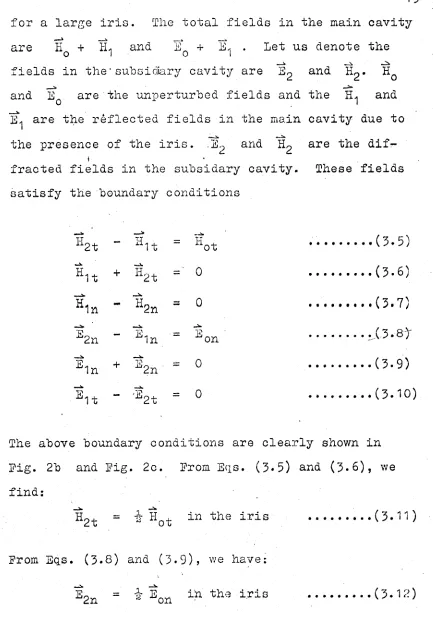
for a large iris. The total fields in the main cavity
are H + Hi and E „ + iL . Let us denote the
O J 0 I
— i.
fields in t h e - subsidiary cavity are E 2 and Eg. H Q
and E Q are the unperturbed fields and the and
E-j are the reflected fields in the main cavity due to
the presence of the iris. .S2 and H 2 are the
dif-t
fracted fields in the subsidary cavity. These fields
satisfy the boundary conditions
i t - i t = i t i... (3.5)
i t + i t = ' 0 ...(3-6)
H ln - i n = 0 ...(3.7)
E 2n - E 1n E on ...,(3.8)'
E 1n + Xj2nIT' = 0 ...(3.9)
i t •E2t = 0 ...(3.10)
The above boundary conditions are clearly shown in
Fig. 2b and Fig. 2c. From Eqs. (3*5) and (3-6), we
find:
Hpt = i H 0t in ttLe iris ... (3.11)
From Eqs. (3.8) and (3.9), we have:
16
0 ’ 0
E on
E ? = H p = 0
(a)
4. V
0 +
^ . - +
H-■2n
n
Hr
(*)
2t
1n
E 2n
(o)
Pig. 2 Boundary conditions at the vicinity of
the iris. (a) Before■the iris is cut. (h) and
(c) Reflected and diffracted fields after the
4. SURFACE MAGNETIC*CHARGE & CURRENT DISTRIBUTIONS
In dealing with the discontinuities in elec
tromagnetic fields which is physically impossible, it
is usually explained by assuming the presence of sur
face distributions'of magnetic charge and current
whereby these discontinuities would be generated. In
other words, the.surface magnetic charge and current
distributions may be induced by the discontinuities i'fj
both E . and H. These quantities have no physical
meaning' but are mathematically important. Nor the sam
reason, the discontuities of the normal component of
the electric field and tangential component of the
magnetic field can be best analyzed by assuming the
formation of fictitious surface magnetic charge and
current densities in the coupling iris. Since the
subsidiary cavity■is initially unexcited, they are
considered"to be a complete set of the source of exci
tation from which the fields in that cavity originates
Maxwell's'equations in three dimensions are given by:
V • H = P *
...( 4 . 1 )
18
(4.2)
and the continuity equation is given by
V - J * + f T - 0
(
4.
3)
where. and P are'the fictitious volume magnetic
current density and charge density respectively. . let
us now designate the fictitious surface charge density
If either Z * or 7J* is determined, the other one can'
he calculted hy Eq. (4.4).
If there are no electric currents and charges
present, the electromagnetic fields in the subsidiary
cavity will satisfy Maxwell's equations
by J * and the fictitious surface magnetic current
d
ensity by Z.t By analogy, to Eq. (4.3), K* and
satisfy the relation
7
.
ft* +
=
o
3t
(4.4)(4.5)
19
We assume now a scalar potential <fi and a vector poten
tial T so that
=
v x ft
(4
.7
)dt
v r
(4
.8
)as implied by Eqs. (4-5) and (4.6). Analogous to the
electric case, the scalar and the vector potentials
can be expressed by:
<j> (?)
=-L
f J*cr) S I? ~r>l ds
S '
T u JJ / 1 (4.9)
ft (?) = -±- (( K*(r) $ l r ~ r ! ds
4K' J) (4.10)
S'
where r' is a source point on the iris; r is any
vector in the cavity from the center of the iris; S'
is the area of the iris; and g jr - r'| is the Green's
function
ilc Ir-r 'I I *** » I ' ©
g r - r' = —
r - r
By substituting Eqs. (4-9) and (4.10) into Eqs. (4.7)
and (4*8) and making use of the boundary conditions of
Eqs. (3.11) and (3.12) as obtained in Section 3, we
20
'2/1
-1 P
2 on,
Vr
xA ( r k )
4 n K*(f>) x
v yg \ r - r
Ids
H zt 2 Hct
M
at
v
_ !
4-TC J] dt
■5'
6
4lts'.V (4.12)
where . r^ is the field point in the iris, and
V r - K 7 7
21
In Eq.(4.12), the integrand of the first tern on the
right hand side is of the order of a? , while the second
term is of the order of d Z . Since the radius of the
iris is small compared with the wavelength, we may
neglect the first term 'of Eq. (4-.12). Moreover,-if we
also neglect the retardation in g |r - "r’l Eq. (4.12)
reduces to
= ~ 4 K ^ ... '
S'
where g' | rh- r'| = 1 / | r^- r 1
As an approximation, we may assume Hg-j. to be constant
over the iris and equal to 1- H Eq. (4.13) becomes
5' ■ (4.14)
It is well known that a constant electric field may be
produced by a uniform distribution of electric dipoles
on an ellipsoid, the dipoles having the same direction
as the field. The surface electric charge density will
be proportional to the product of the field and the
gradient of the surface electric dipole density. let
us apply the same idea to the magnetic field. The
desired surface magnetic charge density in the iris is
*
S'22
Up.on substituting Eq. (4 .15) into Eq. (4 .14) and
carrying out the integration, we can find that the
proportionality constant G is
c =
1
/ i t
2
.Consequently, the surface magnetic charge density is
*
Hot
*%
7[z ( ol-Y<z)'/z
(4.16)
Erom the continuity equation of Eq. (4.-4), the surface
magnetic current is found to be
K*
= -
-k (a'-r'Y* ItL
-«.
f-
... . . (
4.
1 7)
71 d t
Bethe chooses a magnetic charge density on the iris to
create the proper The surface magnetic current
density K * creates a term in Eq. (4.11) of the order
2
of CL . Since this is presumably negligible as com
pared with the actual normal component of "E2n = i ^ 0n ’
another magnetic current ,K'*is needed to maintain the
proper boundary condition for Eg^. on the iris with
out disturbing the proper H 04- given by Eq. (4.12).
This is accomplished by means of a circulating current
with no divergence and hence no additional surface
magnetic charge density. Using the same technique as in
magnetic current density is obtained as
23
p/ £ T/ X Eon
^ ~- — --- jT • (4.1&)
Z n z (a7- p z)
In combining with. Eq. (4*17), the total surface magnetic
current density is
K * = K * + K'*
i ( r f - r l)A
M * ‘ . r - -i x]
n L bt z ( oE- t )
... (4.
T9)-Since the tangential component of the magnetic field'
and the nafinal component of the electric field over the
iris are given as
Hoi = 2
2a.o
^r x E ao f ^ y n r xEon = 2 >2„ n r(nr £?40) + (2 f*e ^r( * % ) ■
n
0<
Consequently, Eq. (4.19) and Eq. (4.1(1) can be written
as
K
7' x n Y
Z(a-Y') *
( «■ 1 os/
(
4.
20)
'j *
--- - ---- • ( 2) Sao'tf/ XHao
t 2^*j?°nrX fyo]
/ 7tz(cE-yt)'^ I u p r J
5. GENERAL EIELL SOLUTION.
The surface magnetic charge and current
density distribution over the coupling iris was obtained
in previous section. The next step is to determine
•the electromagnetic fields in the cavity coupling
system. As' stated before, the surface magnetic charge
and current densities may be considered as the only
sources of the excitation for the electromagnetic
fields in the subsidiary cavity. The fields in the
main cavity would not be the original fields alone but
are the resultant of the original wave and the re
flected wave due to the opening of the iris on the
wall. In Section 4, we defined a scalar and a vector
potential
Substituting the values of J * and ( Eq.s. (4.21)
and (4.20) ) into Eqs.,(5.1) and (5.2) respectively,
we have
S'
( 5 . 2 )
25
4 -xn a. d t
jj (q2+ z
f dt
nr *Gso • p $ i r - r ’l
S'
(
a*- - r,z)
Z \ '/« d s ]
(5.3)
R ( r , t ) = ~-L-3 j f z j i L o j j
t ,
x Ha„(o?-
\ r
- r ' \ d s
+ Z J^°f{ n, x . ( L( a' -
’"Y ^ J
r
- r ' | Js ]
/ <f
i U T'CLO
T r x * r ( n r -£«o)
(az - r^)^
gj r - r ' l ot s
f ?' K nr (* r ‘
fka)
,
_ _ ,
,
, ---
n— S r - r
I
'J
(a *
-
r f ) M
(5.4)
Both Eq. (5.3) and Eq. (5-4) satisfy the M ax w e l l ’s'
equations
Ez ( r, t )
=
-V
x
fl ( f A )
(5.5)(5.6)
It is seen that Eq. (5.5) and Eq. (5.6) are similar
in form to the general fields equations for a cavity
2 6
E
- EL To. E
clt EEL -Pu jL ,
Ol 0 ^ 1
H ' — LEj Ha. GEL f* Gra .
p r f
We write the scalar potential as a product of a func
tion of time and a function of space:
f ( f ' t )
=Z, fy/t) tyjr).
...( 5 > 7 )Similarly, the vector potential:
ft ( r , t )
= 2L yaz(t) Haj r )
... ( 5 , 8 )Substituting Eqs. (5.7) and (5*8) into Eqs. ( 5 - 5 ) and
(5*6) respectively, we have
Ez ( r , t )
= X
r-az V x HaCL ... ( 5 . 9 )
H A f . t )
= Z
(
5.
10)
where <fi'A and A# are 'the eigenfunctions satisfying 7*’z
the boundary conditions
n • = O ,
27
Prom Eq. (5*9)> we see that the irrotational electric
field does not appear in the expression. It is
now-necessary to give the proof_that the exclusion of P<*
terms from the general field equations for the sub
sidiary cavity is justified. Y/e recall that the sur
face magnetic charge- and current densities over the
iris are the only sources of excitation of the
sub-sidary cavity, and that there is no electric current
or charge present in V. Prom the M axwell’s equation
the time function or the expansion coefficient of P^<
is
v
In Section 2, Eq. (2.22) gives
V
s + s'
B y replacing J * by its known value ( Eq. (4*21) ),
Eg;. (5.11) becomes
/
7Tz/l 'kk
~t ____
f vr JJ
(az - r^)'^
r> • n r y tip* d s j
— .(5.12)
Again from Eq. (2.16) in Section 2, we have
tie
/ a v
f ~kaz ra*.
" f J * - H ^ c t v
v i x E - H « Z ^S
sts'
With the aid of the conditions:
J* = 0 in V
n x E = 0 on S
n x E = ]<* on S',
^ it
Eq. (5-15) can be reduced to:
( 5 . 1 3 )
29
Bor H aJ r ) = (r)_, we finally get
' / " J F * = - f[icf -/ t i & ) * ... (5.14a)
5'
Since the value of Kr* is given "by Eq.(4.20) in
Section 4, the right hand side of Eq. (5*14a) may "be
expanded into
_ i{ K* ■ A'a*( % ) d s
S'
+ ( *r * f c j a* - r * y * ds f St. &
~ j r _&»■ (f r YYt,{?%■ £ » p • ,
-a ^ y, ( a.1 - rA ) \
- ZL
ff x7Ir
‘ ‘o<
z n
(a* - rfZ)
^
( 5 - H h )
By solving the linear differential equation of Eq.
(5.14a ) , we can determine the expansion coefficient
r aX/ whereby sa A will be obtained
d Yclz
= I F ' < 5 - 1 5 ’
30 ,
coordinates Taut depends on the time dependent expan
sion coefficients of the fields in the main cavity.
This equation is well known as a forced oscillation
differential equation as it must he.
As shown in Eqs. (5*12) and (5*H a ) , the
expansion coefficients depend on the eigenfunctions
A ^ s and s of possible modes in the subsidiary
cavity. In turn, -A^s and s depend upon the
shape, construction of the cavity, its boundary con
ditions, and the frequencies of the fields in the main
cavity. If the shape and the boundary conditions of
the subsidiary cavity are specified, the eigenfunctions^
A'azs and 5^ s will be obtained, so as the expansion
coefficients ra z , s az and q ^ . - Substituting these
'known values into Eq. (5.9) and Eq. (5.10), we shall
h a v e .a complete solution for the field configuration
in the subsidiary cavity. In the like manner, we shall
obtain the reflected fields in the main cavity only
due to the presence of the fictitious surface magnetic
charge and current in the iris. Then applying the
superposition method, we shall acquire the total fields
in the main cavity.
The problem in determining the field, con
31
solved. In the next chapter, we shall work out an
example to illustrate the application of the solutions.
In the meantime, the proper procedure and technique in
solving a practical problem will be given in detail.
The solution obtained in the last two chapters are
also applicable to the cavity-waveguide system coupled
7. EXAMPLE
The cavity-coupling system consists o f a main
cavity of dimensions 1%, , I'j, and <4, , and a subsidary
cavity of dimensions JL*Z > l y z > and . These two
cavities are resonating at about the same frequency and
are coupled through a circular iris of radius 'a. ’.
The iris is located at the centre of the common wall
whose thickness is negligible. The schematical diagram
of this system is shown in Figure 4.. Now let us assume
I c o t
that only mode of the £ time dependence is
being excited in the main cavit,/. Regardless of the
sources of excitation, the fields are given by:
(
6v
1)
B j n t ^ k b
■+ . Q-z. B & /Q/syi
7
o
Pig. 4 Schematical diagram of the
cavity-coupling. system.
f
X
2
34
•—* _> jM * >
Ea, = A £ ^ J L Jjst 5J_L Airt, HJL ... (6 .3 )
/*, A
-i
where A and B are arbitrary constants and
z
_ f 3 r t f
f ix ^
f ^
\z
«/ ~ -r- +
t
L
■ c-+
c*i.‘ U'/
Prom now on, it is convenient to translate the origin
of'the coordinate system to a position so that it co
incides with the centre of the iris and the xy-plane
coincides with the plane of the iris. It is shown in
Pigure 5. The new coordinates ( x ' , y * , and z' ) and
the old coordinates ( x, y, and z ) systems are related'
by •
X =
x ' •+
h t/ &t = f + h / t
-Z = Z '
+
h ,With the new set of coordinates, Eqs. (6.1), (6.2), and
(6.3) now become
35
Ta, £ * = - /2ZL } m
w i a * r ~z,
•
(
6.
6)
At the centre of the iris or at O' (x1 = y ’ = z' = 0)
_» _ / 37lZ \
S« H «
Of, = - a t B ( J J L . } g/"*
Xl /'
'fa./ B a., — 0
Since the iris is assumed'small compared to the wave
length, the fields incident on it will be considered
constant throughout
3 At*' ^ 3 3rt 1 J vt
H ‘ “ - a% 1 > 1 4 1 + - T T 1 e
(6.7)
E
0
—
O
(
6
.
8
)
determine the fictitious magnetic charges and currents
b y applying Eq. (5.21) and (5.22) in Section 5.
r t * r f r j.\ = L [ J A l L _ 3 3 ? r a * ‘ T ' e Jcot
/
**1 4 4 4
4a:, J («"
-... ( 6 . 9 )
T2*/z:. l\ _ _ 4 ^ f '3 6co ^
K ( n t ) - j e I J J J l .
(
6.
10)
If we neglect the retardation, the scalar potential
due to the fictitious magnetic charges is :
9
U r , t )=
[ J A I L . _ A S J L* f 1
4 4 4 4 41
lK aX- * r *
After performing the integration over the iris, we hove
in, -kp,
(
6.
1 1)
Similarly, the vector potential due to presence of the
fictitious magnetic current is :
* < ’ ■ • > ■ -j * l
’ ,..(6.12)
She next step is to evaluate the time co
37
3 a J F __________
7r
a 'iw,
I
/ /
aj
/ / ' ^Xr^-Z, K.a, kf}t
T z 7r u - i , I 7 " T ~ 7 3 " “ 3 ~ I e '
I >)
From Eq. (5. H a ) in Section 5, we have
f
6 j j r
+
i l r«i
=
-
'
4
...(
6
.
14
)
Since z
O'
-
;3nco\ A
8
r f s
-~ y - T — / -nrr*. — 7-7 - / ~ -f ) <?*
.
<? ' 4 4 4 , T r / ^ ^ J £
The integral on the right-hand side of Eq. (6.14) can
be e a s i l y evaluated ;
ff
a
J
-
3c"
f - -
- 5
s je° f
jj
K ■
/£&
Jz ~ —/£
, 4
w)J <2 •
5' r
By substituting this value into Eq. (6.14), we have
.6
2%z + i z r - 3 1
-
^ /
a&
m
^ “7 - f-T7J - - V <T .
/ - 4 14 tt^/j
By solving this linear differential equation, we find :
= - -- — ---- — I 3<o, fl ft s Y rJ ( ^ r ^ ) t ,
3>3
or
.. 5
icot
3#coajta 6 _____ <• _ _3_\1 /)
'5Jjue (&>at + <*>) d 00 A, A^*, ltfyt •*
...( 6 . 1 5 )
where
k co ~ ^dz
- ^The time coefficient for the eolenoidal magnetic field
is :
5*a, aftt
a f
= “7
/ 5" jcot ycogcoa e
/$JjOZ ( <Vat +cu)Aco
£
iAOjt
(e
1 I ( 6 . 1 6 )In case of
co —*■ cu
<**c Jco-t
r .
2<n e
f3co t
f\s
'a*, = “
K j / T e A W
1Xt, h,ii,
r Y
j
...( 6 . 1 7 )
r Jcot
-
-j
f - - § - ) ] * ( e j W . , ,y # J/ie A < o t U f a rfy/J '
39
Now, we assume further that only T E . ^ mode
can be excited in the subsidiary cavity. The fields
in the subsidary cavity are
4 - y - W - « ) V 4 e j M t - ,)
AWj.ii j.Zf'fea., ~K"kj$t
[ s * T ~ r ~ / r ^ ( - o f f ? ) ; < * , S i L
1
444\
A, 27
A.
V/xA,/ ' /x, * / . . . A . . .(6 .19)
( _ 4 2 L _ - _ e _ )
' 4 A 4 4 * A,
4-[ « „ _ Z L _ t J L ) A n 1 ? L
i-uip* ‘ A . * ' A
- tfg — CxW / -f - f ) x?x(*. -A. 1
A, ha
Ax
)
A*
(
6
.
20
)
%, 4 = - / a: 4 : / / L + _ s _ ) V w V e ^ ()
4 , a * }
[ t V ^ + - f ) ^ ) 1 ■
A? & ) t 11 .,.(6.21)
The total fields in the main cavity are now the sum
of the incident fields plus the reflected fields due
4 0
so designed that at frequency t> 33L2j( only TE,A1 mode canj 301
be excited. The field configuration remains unchanged
but the amplitude ( or the time dependent expansion
coefficients ) differ slightly from the unperturbed
amplitude.
Si, Ha,
=
6a/a
5
Q 2 jACoi
j'Ot
g y ; nip,
a,x faJL - jSjAt f.
1 Jty *>
3 m ' , 3n\ -ni'
j ^ ~ r~
+
V/
a.
a . 6 v =
h
«/
xun (-AlUL + J f a yd-^v
[ A *>>
ft + 3 d 3 f
(
dt - A L £
-- a,
A i y
TV
i t
U
CdV
U, & at -
I *
tz, ■y/
6cozo f
<-tl
f\
rr
fi ' u
3nx' 3tt v- —
Z
5
)
i fat
A
f ayCMd
7TZ'ig.
^ ydivu 7fZ' 1 ii, •
3 y.
f a !
(c —
^ ydU/i 7TZ' )
4 J KZ'
ig,
-(
6.
22)
(6.23)
0]
e >ut
A. Vector and Scalar Functions
In any closed region V bounded by a regular
surface S , we may define an arbitrary piecewise con
tinuous vector function and an arbitrary piecewise con
tinuous scalar function by setting up two complete sets
of orthogonal eigenfunctions for each of them. Each
of-these satisfies the wave equation and its corresponding
boundary conditions. For the vector function, we have
f T Kf V " ° (in V ) (A. 1a)
.
% x Wp
o
n • n
X 'gj,, =o
( o n S ) (A. 1b)and
* 4 — O (in V ) ...(A.2a)
n
*<£j. = O
For the scalar function, we have.
41
42
V f* + = 0 ( in V )... (A . 3a)
Y * = 0 ( on S (A.3b)
and
tp * ~ 0 ( in Y ) ... (A. 4a)
^ ( on S ) ... (A. 4b)
where k^ , k^ , k ^ , and ly are the eigenvalues of
the eigenfunctions ^ ^ , and ^ res
pectively; p, q , c< , and are integers ( = 0, .1 ,• 2,
3, .); n is a unit normal vector on S.
Green's theorem states that if two vector
functions, and , are continuous in a closed
region of- space V' bounded by a rdgular surface S,
we' can write
[fSr ‘( 7 X 7 x ^ ) - ^ • ( v x v x ' ^ ) j A v v
= [ J- x' V x ^ - Ify, X V x ^ ] . n d s
s
... ( A . 5)
Expanding V x V X terms and applying the divergence
theorem, we get:
\\\
-S?
-v*yf ] l v
V
[ V f V - i , - $ t 7 -wr y n - [ Z r - ( H w . f , (A>6)
43
Prom Eq.. (A. 1a) and Eq. (A. 2a), we have
„ ^ r $f - v ^ r - ( -I; - 4 ) • 4 ,
Eor k = lc , the volume integral in Eq.. (A. 6) vanishes,
£T M.
Further applying the boundary conditions, Eq. (A.6)
reduces to
jT j
x s^)}
=
jjj
dv
u - nSince the fields are confined in an enclosed region
bounded by a surface S, the integrand in Eq. (A.7)
must equal . to zero, i.e.,
( v- $p) *n - • ( n X & j X V X - n
■■= 0
Since none of the normal component of e$ch term in the \
above expression vanishes on the surface S, it must be
V r v * f - f y x v x y . - 0 (A>8)
From the vector identity, we may put
V ' f
v-
<1) =
v-WfV-$2 -t
■ v*
44
we have
...(A.10)
Upon substracting Eq. (A.10) from Eq. (A.9), we again
get
v • (iPr v-$f ) - v- ( $ f V - w f )
= ^ * V z$f - $ .
- ( t f - (ju11) .
The volume integral of the right hand side of Eq.(A.11)
-equals to zero if = k^. Using the divergence
theorem, the volume integral of the left hand side is
v ^
7
- ^ ) -v- ( $j v- WpjJJv
=jjn-[iPfr-gf-$/ v-ii'f]c/s
V 5
or
n
~r ' ' T ' ” ■
5
n
•
typ ( V - d s -
JJn-
( v - ^ ) ds
for n * ^ = 0 on the surface S. Since . n , * ^ ^ 0 on S,
V ^ ) (A. 1 2)
Hence, we obtain from Eq. (A.8) that
X V X % = 0
45
By the use of Eqs. (A.12), (A.2b) and (A.13), Eq. (A.5)
reduces to
^ • ( 7 X 7 X ^ ) - l ^ f 7 X 7 X ^ ) ] V v 2 Q
V
or
nPp-C V K V X ~ ( V x V X IPf) = o
(A.14)
Now let us consider Eq. (A.12) and (A.13)
carefully. Since 3Z^ j ^ ^ 0 in V or on S, ^
must be a curl of a vector function and , on the
other hand, may either be a gradient of a scalar
function or be that its curl is proportional to 2^ .
if ^ and ^ also have to satisfy Eq. (A.14), the
solution is
'tf&f = ^
= V X
and k = k .
^ ir
If we let k = k = k a (a, =>1, 2, 3, .... )
— V X ^ '.(A. 15a)
ka. 'Wa, = V.X (A. 15b)
For k 7^ k , 3^ and ^ will no longer
P q / n
have any correlation between them. It is quite obvious
corresponding boundary conditions which distinguishable/
mark their different characteristics. Let us consider
the boundary condition n x Uy, = 0 from Eq. (A.1b).
Its surface integral will also he zero since the
tangential component on S vanishes,
i.,e.,-\\ n
x ijL
ds = o
5
But
n
5
A
§f ds
= jff
VX §f d v = 0
on S or in V. Hence
V
X ^ = 0 if ^ 0. Thepossible solution of is
ip
=
V f *' ' ' . ...(A.16)
By using similar technique for the boundary condition
= 0, we obtain /
j l " 71 X 7 X Wj d s = j H &X V X dLv = r O
S V
Nov/ we can equate
V x V x & = 0
f
Since V X V X = V(V')~ V*' and f £ % & z-O , it becomes
o f f
V ( V ■
Sf ) - 7^
=o
How we see that is a gradient of a scalar function.
If k 4 0 and 4 0 in V, then the solution for
47
in general is
(A.17)
Y/e have now proved that in a closed region hounded by
a regular surface, a piecewise continuous field vector
can always be expressed by an irrotational and a
solenoidal function with corresponding boundary condi
tions. When two vector functions of different boundary
conditions are presented in that closed region, one
can be determined by the curl of the other for equal
eigenvalues. For unequal eigenvalues, these functions
are measured by a gradient of scalar functions. It is
also obvious as shown in the proof that although we
have defined four groups of orthogonal eigenfunctions,
namely, ^ ^ , and <p , the last two /nay be
derived from the first two.
B. Orthogonality
Yfe are satisfied that the..electric field as
well as the magnetic field are orthogonal, and that in
a complete expansion of^electromagnetic fields in a
of orthogonal functions. But, for the series expansions
of Eqs. (2.1) and (2.2) in Section .2 to be valid, the
orthogonality of these functions must be shown. Prom
the vector relation, we can write
V ' [ £t,*(VxE«,)3 = ( V x £ 6 )-(V*£a.) - E ^ V X (v x e a)
...(B.1 a)
V -f ( 7 x Ei)] = ( V x Bo,)' ( 7 X E b) - £ • V X ( V X Eb)
...(B.1b)
Iheir difference gives
(B.2)
V' [ £6
X(VX U ) ]
-V- [Ea, x ( V X E b) ]
= Kl' V x (V.XEb) - Eb .
vx (VXE^)
Since 7 X V * 4 =
' v ( v - -
V ZE^
,V ' Ect, — O f
V*Ea, -f il E o ^ - 0
Eq.-(B.2) reduces to
7- [ E b X ( V X U ) J - V'[Ec,x(Vxeb)J = (il- A*) E«,-Eb
Upon taking volume integral on both sides and using the
divergence theorem, we obtain
= . / / f
n - [ t hx ( V x t a ) - EnXf VX £6)] J jSv s
- “ka. \ \ n
*[Eb X Ha.
-Ea. X Hb] ds
■5
Owing to the vector identities
'n-
x
Hb - Hb• ( n x
)
71. Bb X Ha, = H a ‘ ( n x E b)
and the boundary conditions, the surface integral in
Eq. (B.3) equals to zero. If a ^ b, It ^ k ,
>(B>4)
If a = b , Eq. (B.1a) or Eq. (B.1b) becomes
V' [ L
k(
v iE
cl)] = (vxE4.)'(vx£a.) -£«.-rx (rxea.)
P rom the relations of Eqs. (2.5a) and (2.5b)» we have
7- [E«x (vx£a)]
=ilHi - it El
As before, the volume integral of the left hand side
of the above expression vanishes. The volume integral
of the right hand side is
• C /// ( H t - EJt) d v = 0 V
Hence,
v
H i c L v - JjT e £ d v - o
V
■
V
'... (B.5)where C is an arbitrary constant. Through the
similar procedure as above, we (have, the similar
results for the functions H a and H b . After the
normalization, we finally have
50
( B . 7 )
Snd
5.* =
I 0 . i f/ if
a = b
Now, let us consider
7
- (ft V
fa)
= 17
fa - 7 f t ~
%
7*
ft
Because of Eq. (2.6t>), it can be rewitten as
■7 '(fa 7 f t)
=
V fa ' 7
ft - ^ fa ft
(B.8)
By interchanging the roles of
'fa
and^ b
, we againget
7 ‘{ft 7 % )
=7
fa-V
ft- itfafk
,
.
'
(B.9)
The substraction of Eq. (B.8) from Eq. (B.9) gives
{-it -■ i t ) f a f t = 7 - ( f a 7 f b) - V ■( f t 7 f a )
Ag a i n taking volume integration on both sides and
using the divergence theorem on the right hand side,
we have
( £
-it) ( ( ( iv
=J[[[
p‘Ciinfii) -
17-(fb vfjldv
V
V
51
Since ^ =
'fb -
0 on S,( H
-it) \\\ % f h<Lv
=* 0v
If a
^
b, k & ^ kb , then\ \ \ ' % % < t v = 0 (B. 10)
V
Prom Eqs. (B.8) and (2.6a), we obtain
v ' (faFb)
=
^b ( kcfcc'h - ibfc,fb)
Using the same integration technique as before,
% V * ( % h
)
4 *=
-
kb Jff f a d i fV V V
* F b
*f*. &
s = -i*. Fy-f^cLv- ib ^ % f b<lv
6 y y,
P or the boundary condition ^ = 0 on S,
-£«. Pa - Pb -
i b§\
f«.fb d v = 01/ V
If a / b,
'fa.'j'b^v-
0 as before. Hence,V
? a Pb = 0 ( B . 1 1 )
V
If a = b,
1 H I
-V
V
After normalization,