Identification of Distortion and Rectification
of Fingerprints in Negative Fingerprint
Recognition
Harsh Anand
Student, Dept. of C.S., Sinhgad Institute of Technology, SPPU, Lonavala, India
ABSTRACT: Automatic fingerprint recognition technologies have rapidly adapting during the last few years, there still exists several challenging research problems, for example, recognizing low quality fingerprints. One of the disadvantages of fingerprint confirmation is the lack of robustness against image quality degradation. Low quality images result in misleading and missing features, thus degrading the performance of the overall system. Hence it is of utter importance for a fingerprint acknowledgement system to estimate the quality and validity of the captured fingerprint image samples. Distortion of fingerprint hides the identity of the person, while this problem affects the procedure of identifications. It is very dangerous in negative recognition application. Many places malicious users distort their fingerprints to hide their identification. We proposed novel algorithm to detect and rectify skin distortion based on a single fingerprint image. Distortion detection is viewed as two-class classification problem, the registered ridge orientation map and period map of fingerprint are used. SVM classifier performs the classification task.
KEYWORDS: Fingerprint, distortion, registration, nearest neighbour regression
I. INTRODUCTION
Fingerprint recognition refers to the automated method of identifying or confirming the identity of an individual based on the comparison of two fingerprints. Fingerprint recognition is one of the most well-known biometrics, and it is by far the most used biometric solution for authentication on computerized systems. The reasons for fingerprint recognition being so popular are the ease of acquisition, established use and acceptance when compared to other biometrics, and the fact that there are numerous (ten) sources of this biometric on each individual. The success of fingerprint recognition systems in accurately identifying individuals has prompted some individuals to engage in extreme measures for the purpose of circumventing these systems. The primary purpose of fingerprint alteration is to evade identification using techniques varying from abrading, cutting, and burning fingers to performing plastic surgery. The three basic patterns of fingerprint ridges are the arch, the loop, and the whorl. An arch is a pattern where the ridge enters one side of 1 the finger, then rises in the centre forming an arch, and exits on the other side of the finger. With a loop the ridge enters one side of the finger, then forms a curve, and exits on the same side of the finger from which it entered. Loops are the most common pattern in fingerprints. Finally a whorl is the pattern you have when ridges form circularly around a central point. Fingerprint matcher is very sensitive to the image quality, the matching accuracy of the same algorithm is significantly different among various datasets due to variation in image quality. Imaging sensor inaccuracies can be considered as a unique fingerprint identifying a specific acquisition device, enabling various major forensic operations, such as device identification, device linking, and recovery of processing history, etc. The effect of low quality fingerprints depends on the type of the fingerprint recognition system. The fingerprint recognition system can be classified as either a positive or negative system. In apositive recognition system, for example, the physical access control systems, the user is assumed to be cooperative and is willing to get identified. In a negative recognition system, such as identifying individuals in watch lists and identifying multiple entries or enrolments under different names, the user of interest (e.g., criminals)
for a negative recognition system, is more serious since malicious users may purposely reduce fingerprint quality such that fingerprint system fails
From finding the true identity [5]. In fact, law enforcement officials have encountered a number of cases in which the criminals tried to avoid identification by damaging or surgically altering their fingerprints. Elastic distortion occurs due to the flexibility of fingertips, contact-based fingerprint acquisition procedure, and an explicitly applied lateral force or torque. The skin distortion increases the intra-class variations and thus leads to false non-matches due to limited capacity of initial existing fingerprint. Matchers in recognizing severely distorted fingerprints. As shown in fig 1, the left two are normal fingerprints, and right one contains severe distortion. According to Veri-Finger, the matching index in between the left two is much higher than the matching index amongst the right two. This major difference is a result of distortion rather than the overlapping area. While it is possible that matching algorithms can handle bigger skin distortion, it may result into to more false matches and slow down matching speed. Distorted rectification is shows a regression problem, where we take input as a distorted fingerprint and the output comes in distortion field. To solve this problem, a database (called reference database) having many distorted reference fingerprint and corresponding distortion field is built in offline stage. The reference database and the corresponding distortion field is used to rectify the input fingerprint to the normal one. We use two database containing many distorted fingerprint, namely FVC2004DB1,and the NIST SD27 [6] latent fingerprint database.
II. RELATED WORK
A. In Detecting fingerprint distortion from a single image
The effect of intrusion detection and response on the reliability of a cyber physicalsystem (CPS) comprising sensors, actuators, control units, and physicalobjects for controlling and protecting a physical infrastructure. We developa probability model based on stochastic Petri nets to describe the behaviourof the CPS in the presence of both malicious nodes exhibiting a range of attackerbehaviours, and an intrusion detection and response system (IDRS) fordetecting and responding to malicious events at runtime. Our results indicate that adjusting detection and response strength in response to attacker strengthand behaviour detected can significantly improve the reliability of the CPS. Wereport numerical data for a CPS subject to persistent, random and insidiousattacks with physical interpretations given [1].
B. Localized dictionaries based orientation field estimation for latent fingerprints
Dictionary based orientation field estimation approach has shown promising performance for latent fingerprints. In this paper, we seek to exploit stronger prior knowledge of fingerprints in order to further improve the performance. Realizing that ridge orientations at different locations of fingerprints have different characteristics, we propose a localized dictionaries-based orientation field estimation algorithm, in which noisy orientation patch at a location output by a local estimation approach is replaced by real orientation patch in the local dictionary at the same location. The precondition of applying localized dictionaries is that the pose of the latent fingerprint needs to be estimated. We propose a Hough transform-based fingerprint pose estimation algorithm, in which the predictions about fingerprint pose made by all orientation patches in the latent fingerprint are accumulated. Experimental results on challenging latent fingerprint datasets show the proposed method outperforms previous ones markedly [4].
C. Orientation field estimation for latent fingerprint enhancement
an overlapped latent fingerprint database demonstrate the advantages of the proposed orientation field estimation algorithm over conventional algorithms [3].
III.PROPOSED ALGORITHM
A. DESIGN CONSIDERATIONS:
Modeling of distortion parts.
Generate the distorted reference fingerprint database.
Estimation of nearest neighbor search.
Orientation Field approximation.
Region masks estimation.
Initial orientation field estimation.
Context-based orientation field correction.
B. DESCRIPTION OF THE PROPOSED ALGORITHM:
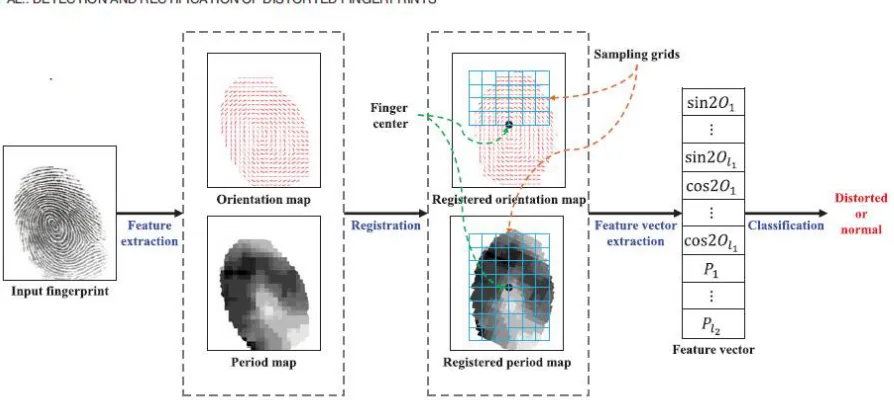
In Proposed System was evaluated at two levels: finger level and subject level. At the finger level, we evaluate the performance of distinguishing between natural and altered fingerprints. At the subject level, we evaluate the performance of distinguishing between subjects with natural fingerprints and those with altered fingerprints. This paper described a novel distorted fingerprint detection and rectification algorithm.[1] For distortion detection, the registered ridge orientation map and period map of a fingerprint are used as the feature vector and a SVM classifier is trained to classify the input fingerprint as distorted or normal
IV.SIMULATION RESULTS
Fig. 1. Flowchart of fingerprint distortion detection. Oi represents ridge orientation at the ith sampling grid of registered orientation map, while Pj represents ridge period at the jth sampling grid of registered period map. l1 and l2 represent the number of sampling points in registered orientation
map and registered period map, respectively
Fig.2. The CMC curves of three matching experiments on NIST SD27:
V. CONCLUSION AND FUTURE WORK
the distortion field from the input distorted fingerprint and then inverse of the distorted field is used to transform the distorted fingerprint into a normal one. The database we used to take result is FVC 2004 DB1 and NIST SD27 [6] database. The limitation of the current approach is efficiency. Detection and rectification done fastly if robust and accurate fingerprints registration algorithm can be developed. Another limitation is also present that the current approach does not support rolled fingerprint. It is our ongoing work to address the above limitation.
REFERENCES
1. X. Si, J. Feng, and J. Zhou, “Detecting fingerprint distortion from a single image,” in Proc. IEEE Int. Workshop Inf. Forensics Security, 2012, pp. 1–6.
2. F. Turroni, R. Cappelli, and D. Maltoni, “Fingerprint enhancement using contextual iterative filtering,” in Proc. Int. Conf. Biometrics, 2012, pp. 152–157
3. J. Feng, J. Zhou, and A. K. Jain, “Orientation field estimation for latent fingerprint enhancement,” IEEE Trans. Pattern Anal. Mach. Intell., vol. 35, no. 4, pp. 925–940, Apr. 2013
4. X. Yang, J. Feng, and J. Zhou, “Localized dictionaries based orientation field estimation for latent fingerprints,” IEEE Trans. Pattern Anal. Mach. Intell., vol. 36, no. 5, pp. 955–969, May 2014.
5. L. M. Wein and M. Baveja, “Using fingerprint image quality to improve the identification performance of the U.S. visitor and immigrant status indicator technology program,” Proc. Nat. Acad. Sci. USA, vol. 102, no. 21, pp. 7772–7775, 2005.
6. V. N. Dvornychenko, and M. D. Garris, “Summary of NIST latent fingerprint testing workshop,” Nat. Inst. Standards Technol., Gaithersburg, MD, USA, Tech. Rep. NISTIR 7377, Nov. 2006.
7. L. Hong, Y. Wan, and A. K. Jain, “Fingerprint image enhancement: Algorithm and performance evaluation,” IEEE Trans. Pattern Anal. Mach. Intell., vol. 20, no. 8, pp. 777–789, Aug. 1998.
8. N. K. Ratha, K. Karu, S. Chen, and A. K. Jain, “A real-time matchingsystem for large fingerprint databases,” IEEE Trans. PatternAnal. Mach. Intell., vol. 18, no. 8, pp. 799–813, Aug. 1996.
9. A. M. Bazen, and S. H. Gerez, “Fingerprint matching by thin-plate spline modelling of elastic deformations,” Pattern Recognit.,vol. 36, no. 8, pp. 1859–1867, Aug. 2003.
10. J. Feng, Z. Ouyang, and A. Cai, “Fingerprint matching using ridges,” Pattern Recognit., vol. 39, no. 11, pp. 2131–2140, 2006
11. X. Yang, J. Feng, and J. Zhou, “Localized dictionaries based orientationfield estimation for latent fingerprints,” IEEE Trans. Pattern Anal. Mach. Intell., vol. 36, no. 5, pp. 955–969, May 2014.
BIOGRAPHY
Harsh Anand is a student in the Computer science Department, Sinhgad institute of technology, Pune University. He