59 (2012) 99–103 | www.jurnalteknologi.utm.my | eISSN 2180–3722 | ISSN 0127–9696
Full paper
Teknologi
Delaminating Control on Drilling the Medium Density Fiber Board with
Robust Optimization
Khairur Rijal Jamaludina*, Mohd Shahriman Adenanb, Mohd Yusof Md Dauda, Norazmein Abd Ramana
a
UTM Razak School of Engineering & Advanced Technology, Universiti Teknologi Malaysia
b
Faculty of Mechanical Engineering, Universiti Teknologi MARA, 40450 Shah Alam, Selangor Darul Ehsan, Malaysia
*Corresponding author: [email protected]
Article history
Received :
Received in revised form : Accepted :
Abstract
Drilling the medium density fiber (MDF) board always emerge the occurrence of delaminating, as the unwanted result of the process. The defect will moderate the aesthetical value of the finished products particularly if the product is a furniture product. This work optimizes the control factor of delamination using robust engineering technique founded by Genichi Taguchi, father of robust engineering. The optimum drilling parameter which based on smallest the better is optimized and it is confirmed by the confirmation experiment that the imperfections is minimized. Three control factors are investigated in the study: feed rate, cutting speed, and drill bits diameter. The response plot of the control factor shows a drill bit diameter is the highest contributing control factor that influences delaminating as the different of the robustness is 2.047 dB. The optimum parameter shows that the variability of the noise factor is improved as compared to the initial parameter by means of the dB gain of 1.308 dB and 1.451 dB for the prediction and confirmation respectively. The robust assessment of the optimization has indicates that the drilling parameter is less sensitive to the noise factor.
Keywords: Medium density fiber board; drilling; robust; Taguchi Abstrak
Mengerudi papan berserat ketumpatan sederhana akan sentiasa terdedah kepada masalah dilaminasi, iaitu suatu hasil yang tidak dikehendaki. Kecacatan ini akan mengurangkan nilai estetik produk akhir terutamanya sekiranya produk tersebut adalah perabut. Kajian ini telah mengoptimumkan faktor yang mengawal dilaminasi menggunakan teknik kejuruteraan robust yang dipelopori oleh Genichi Taguchi, bapa kepada kejuruteraan robust. Parameter optimum pengerudian yang berdasarkan kepada yang terkecil terbaik telah dioptimumkan dan ianya telah disahkan oleh eksperimen pengesahan bahawa ketidaksempurnaan tersebut telah dikurangkan. Tiga faktor kawalan telah diteliti dalam kajian ini iaitu: kadar suapan, halaju pemotongan, dan diameter mata gerudi. Plot respon bagi faktor kawalan menunjukkan diameter mata gerudi adalah yang lebih menyumbang kepada delaminasi tersebut disebabkan perbezaaan robustnya ialah 2.047 dB. Parameter optimum menunjukkan bahawa keragaman factor hingar telah dipertingkatkan berbanding parameter terdahulu dengan pencapaian sebanyak 1.308 dB dan 1.451 dB bagi eksperimen jangkaan dan pengesahan masing-masing.
Kata kunci: Papan berserat ketumpatan sederhana; pengerudian; robust; Taguchi
© 2012 Penerbit UTM Press. All rights reserved.
1.0 INTRODUCTION
Medium-density fiberboard (MDF) is an engineered wood product formed by breaking down hardwood or softwood residuals into wood fibers, often in a defibrator, combining it with wax and resin binder, and forming panels by applying high temperature and pressure. MDF is denser than plywood. It is made up of separated fibers, (not wood veneers) but can be used as a building material similar in application to plywood. It is much denser than normal particle board. The name derives from the distinction in densities of fiberboard.
discussed in any publications. Most researches are focusing on reducing defects. The parameters of drilling materials are differing between one to another.
There are experiments reported by many authors on the use of Taguchi method for the machining process optimization such as by Ghani et al. [4], Moshat et al. [5], Gopalsamy et al. [6], Akhyar et al. [7] and Mustafa [8]. Their studies has indicated that feed rate, cutting speed and depth of cut are among the common cutting parameters used in the optimization [4,5,6,8] except literature [7] has included type of tool as another parameter for the optimization. Although, most literatures are reporting their works on machining melt materials, except work by Prakash et al. [9] is on the MDF, the results however is relevant to show the significance of the use of the Taguchi method in the machining process optimizations.
Authors of the literatures [4&6] has demonstrated that cutting speed is the most dominant parameters to minimize the surface roughness, whilst feed rate and cutting depth are discussed by literatures [7] and [8] respectively. However, literature [9] which is related with MDF indicates that the feed rate is the most significant cutting variable which also similar to the findings reported by literature [7]. These indicate that robust engineering optimization with Taguchi method has been proven by other literatures as feasible tools to optimize the machining processing parameters.
Hence, since most literatures are deals with melt materials and very few reported on the MDF materials except by literature [1&9], it is significant to optimize the drilling parameter of the MDF, and this article elaborates the robust optimization assessment of such materials. In the nutshell, the objective of this study is to optimize the drilling parameter using robust assessment methodology which also known as a Taguchi method and finally proposes the optimum cutting parameter that minimizes the variability of the noise factor and lastly reduces delamination during drilling process.
The scope of the optimization is limited only to the drilling process, while the ideal function/response is the delamination ratio. The contributions of the drilling parameters to the ideal function/response are also discussed in this paper. Such information is crucial for manufacturers as it helps to classify the most important control factors to drilling process. In MDF drilling, the machining ability is strongly dependent to cutting parameters, cutting forces, and cutting tool [10]. Drilling is significantly affected by the delamination tendency of the materials. Delamination caused by the cutting conditions in which the chisel edge of the twist drill cannot cut through to the materials [3], is the characteristic feature in drilling of MDF, which affected significantly by the cutting conditions. This condition occurs because of the localized bending in the zone situated at the point of attack of the drill [1]. The uncut material by the twist drills, which reduces strength against fatigue, is also the possible caused to the delamination of the hole and as a result it affects the assembly due to poor tolerance.
2.0 MATERIALS AND METHOD
Medium density fiber (MDF) board was used in the experiment and the holes were drilled using Adcock Shipley machine with spindle speed ranges from 250 to 3750 rpm and feed rate from 0.0015 to 0.04 mm/rev. The MDF board prepared for the experiment was 100×100×25 mm and the modulus of elasticity was 2900 N mm-2, humidity 8-10% and density was 0.07 kg/m3.
The L27 Taguchi’s orthogonal arrays were used in the experiment
and they consist of ranges of three level drilling control factors as
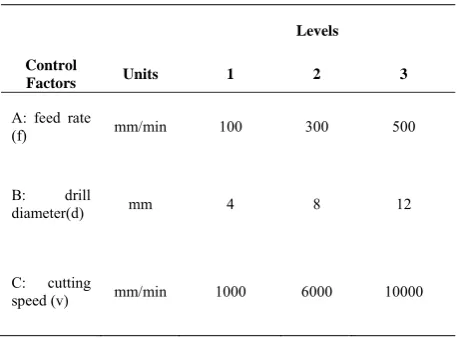
shown in Table 1. The delamination was observed using NK Vision Microscope model NZM 70 45-T1.
Table 1 Parameter-level of drilling process
Levels
Control
Factors Units 1 2 3
A: feed rate
(f) mm/min 100 300 500
B: drill
diameter(d) mm 4 8 12
C: cutting
speed (v) mm/min 1000 6000 10000
3.0 RESULTS AND DISCUSSION
Delamination is defined as a ratio of excess diameter (defects) against the actual diameter of the holes. The ratio of delamination is obtained when the excess diameter of defects is divided over the diameter of its actual holes, D/Dmax as shown in Figure 1. The measured delamination based on the L27(3)13 orthogonal array
experimental setting is shown in Table 1. This delamination is considered a defect that has to be minimized and the smallest the better signal to noise ratio (eq. 1) is considered. The signal to noise ratio is an indexed of robustness. It measures the quality of energy transformation that occurs within processing parameter. The main purpose of robust engineering optimization is to minimize the loss imparted by the products to the society from the time the products are shipped [11, 12]. In addition, the noise condition for this experiment such as variation of MDF materials quality, spindle vibration, tool wear, ambient temperature and humidity is compensated in the experiment while the energy function is the torque delivered by the spindle.
Figure 1 Delamination (mm) of the board.
⎟⎟
⎠
⎞
⎜⎜
⎝
⎛
−
=
∑
=
n
1 j
2 ij
X
n
1
10log
S/N
(1)where Xij is the delamination ratio and n is the number of
the noise factor and thus it is robust. The robustness of the control factor is indicated by its S/N ratio [13]. As shown by Table 1.1, the experiment combination of run number 9 with combination of A1 B3 C3 is the robust combination with low variability to the noise factor.
Table 1.1 The delamination, xn(mm), S/N ratio (dB) and mean (mm)
Ru ns 1 x1 2 x2 3 x3 4 x4 5 x4 S/N Ratio (dB) Mea n (m m)
L1 1.787743 1.383353 1.620823 1.42459 1.493654 -3.801
10 1.54
L2 1.2573 41 1.3834 2 1.8734 14 1.2875 92 1.2581 49 -3.115 53 1.41
L3 1.813808 1.205587 1.233139 1.490085 1.391779 -3.189
55 1.43
L4 1.509947 1.630983 2.184354 1.59202 1.667303 -4.778
70 1.72
L5 1.2056 76 1.3744 06 1.0424 26 1.2793 99 1.0114 27 -1.516 24 1.18
L6 1.2753 58 1.1593 51 1.1547 06 1.1993 66 1.0760 59 -1.399 02 1.17
L7 1.015671 1.134175 1.172936 1.289254 1.407283 -1.665
09 1.20
L8 1.125226 1.154258 1.126466 1.171517 1.245245 -1.329
29 1.16
L9 1.2452 45 1.0504 98 1.0904 3 1.1062 7 1.2471 88 -1.220 54 1.15
L10 1.2092 61 1.7630 6 1.5715 1 1.7092 72 1.7731 09 -4.184 96 1.61
L11 1.493945 2.159603 1.219552 1.422018 1.172259 -3.721
53 1.49
L12 1.452945 1.592034 1.927689 1.67864 1.147786 -3.978
31 1.56
L13 2.3106 27 1.5075 91 1.2088 49 1.4032 7 1.8502 07 -4.613 66 1.66
L14 1.2112 13 1.3233 38 1.2183 75 1.1212 9 1.1202 61 -1.592 65 1.20
L15 1.782769 1.176936 null 1.189801 1.009374 -1.459
98 1.03
L16 1.339552 1.482153 1.144868 1.350906 0.793572 -1.907
02 1.22
L17 1.2339 78 1.2343 19 1.4975 47 1.2439 97 1.1226 99 -2.093 47 1.27
L18 1.209719 1.104859 1.130208 1.27551 1.061728 1.281 -21
1.16
L19 1.588859 2.073171 1.836461 1.942249 1.556701 -5.156
29 1.80
L20 1.427507 1.829462 2.088952 1.599433 1.745609 -4.872
45 1.74
L21 1.4631 34 1.3740 93 1.7464 59 1.6308 2 1.6498 6 -3.965 70 1.57
L22 1.825361 2.085566 1.350861 1.68087 1.989357 5.129- 1.79
30
L23 1.157068 1.875903 1.233507 1.563802 1.235033 -3.159
76 1.41
L24 1.0216 49 1.2006 61 1.3918 4 1.0478 49 1.2483 46 -1.509 97 1.18
L25 1.394722 1.239739 1.376763 1.616431 1.222468 2.780 -65
1.37
L26 1.200877 1.191324 1.10272 1.339191 1.181126 -1.623
16 1.20
L27 2.045881 1.14204 1.603284 1.237585 1.424596 -3.662
92 1.49
The response graphs shown in Figure 2 indicates, A1 B3 C3 is the optimum drilling parameter that gives less variability to the noise factor for minimizing delamination of the MDF. The optimum parameter is focuses to the highest S/N ratio as it indicates the more robust the function. As shown in Table 1, experiment combination number 9 that indicates the highest S/N ratio and coincidently the optimum parameter is the same as shown in Figure 2. The S/N ratio is also defined as a ratio of efficiency and variability. Figure 2 shows that the optimum drilling parameter that minimizes the delamination ratio will improve the drilling efficiency and thus minimizes the waste of machining power that constitutes to the energy function of the scope of optimization. The response plot shown in Figure 2 shows that the feed rate should be kept as low the low level and the cutting speed is at the high level. This is in agreement with findings published by Gaitonde et al. [1].
Figure 2 Control factor’s response plot (a) Mean (mm), (b) Signal Noise ratio (dB)
The control factor’s response table in Table 2 shows the largest difference between all levels of given factor. It represents the strength of effect for each factor. As shown in Table 2, drill diameter has strong effect to the delamination ratio, followed by cutting speed and feed rate. This signifies that the drill diameter is the control factor that needs much attention by the manufacturer. However, from another study by Prakash et al. [9,14] and, Prakash & Palanikumar [15] on the experimental studies on
(a) (b) -4.5 -4 -3.5 -3 -2.5 -2 -1.5 -1 -0.5 0 0.5 1 1.5 2
A1 A2 A3 B1 B2 B3 C1 C2 C3
Mean
surface roughness in drilling of the same materials, feed rate is the most significant control factor followed by drill diameter and spindle speed. The different of the result is partly contributed by the density of the MDF as mentioned by Lin et al. [16] that they found board densities have a major influence on the machinability characteristics of the boards.
Table 2 Response Table (a) Signal Noise ratio (dB), (b) Mean (mm)
a. S/N ratio (variability analysis). Average = Tഥ=-2.91511dB
Level A feed rate
B drill diameter
C cutting speed
1 -2.446 -3.998 -3.78
2 -2.759 -2.795 -2.558
3 -3.54 -1.951 -2.407
Delta Δ 1.094 2.047 1.372
Rank 3 1 2
b. Mean. (mean analysis). Average = Tഥ= 1.396891
Level A feed rate
B drill diameter
C cutting speed
1 1.33 1.572 1.545
2 1.354 1.371 1.341
3 1.506 1.247 1.305
Delta Δ 0.176 0.325 0.24
Rank 3 1 2
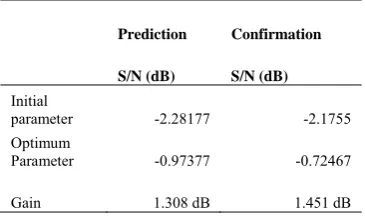
The prediction of the optimized S/N ratio is done based on the response of the control factor shown in Figure 2. The initial prediction and conformation value shown in Table 3 is based on the current drilling parameter used before robust optimization was done, while the prediction and conformation optimum parameter is based on the optimum drilling parameter obtained based on Figure 2. A gain between the initial parameter to the optimal parameter of the prediction and conformation is 1.308 dB gain and 1.451 dB respectively.
Table 3 Prediction and conformation
Prediction Confirmation
S/N (dB) S/N (dB)
Initial
parameter -2.28177 -2.1755 Optimum
Parameter -0.97377 -0.72467
Gain 1.308 dB 1.451 dB
4.0 CONCLUSION
Robust engineering optimization based on Taguchi method has optimized the delamination ratio of the drilled MDF. The optimization has optimized A1 B3 and C3 as the optimum control
factor for minimizing delamination and a drill diameter is the most influential control factor. The optimization is confirmed by the confirmation experiment with a gain of 1.451 dB which stronger than the prediction gain. In addition, by comparing the initial parameter and the optimum parameter, the optimum parameter’s signal to noise ratio are more robust to the noise factor. This has concluded the objective of this work is achieved because the confirmation experiment is confirmed very well as the dB gain for the confirmation experiment is higher than the prediction ones. It shows that the confirmation dB gains show its robustness over the prediction ones.
Acknowledgement
Thank you to the Research Management Centre, Universiti Teknologi Malaysia for providing support to this research in a form of Seed Fund Research Grant.
References
[1] Gaitonde V., Karnik S. R. & Paulo Davim J. 2008. Taguchi Multiple-Performance Characteristics Optimization in Drilling of Medium Density Fibreboard (MDF) to Minimize Delamination Using Utility Concept. Journal of Materials Processing Technology. 196(1–3): 73–78. [2] Paulo Davim, J., Clemente, V. C. & Silva, S. 2008. Drilling Investigation
of MDF (Medium Density Fibreboard). Journal of Materials Processing Technology. 203(1–3): 537–541.
[3] Paulo Davim, J., Gaitonde, V. N. & Karnik, S. R. 2008. An Investigative Study of Delamination in Drilling of Medium Density Fibreboard (MDF) Using Response Surface Models. International Journal of Advanced Manufacturing Technology. 37: 49–57.
[4] Ghani, J. A, Choudhury, I. A. & Hassan, H. H. 2004. Application of Taguchi Method in the Optimization of End Milling Parameters. Journal of Materials Processing Technology. 145: 84–92.
[5] Moshat, S., Datta, S., Bandyopadhyay, A. & Kumar, P. P. 2010. Optimization of CNC End Milling Process Parameters Using PCA-Based Taguchi Method. International Journal of Engineering, Science and Technology 2(1): 92–102.
[6] Gopalsamy, B. M., Mondal, B. & Ghosh, S. 2009. Taguchi Method and ANOVA: An Approaches For Process Parameters Optimization of Hard Machining While Machining Hardened Steel. Journal of Scientific & Industrial Research. 68: 686–695.
[7] Akhyar, G., Che Haron, C. H., Ghani, J. A. 2008. Application of Taguchi Method in the Optimization of Turning Parameters for Surface Roughness. International Journal of Science Engineering and Technology. 1(3):60–66.
[8] Mustafa, A. 2011. Determination and Optimization of the Machining Parameters of the Welded Areas in Moulds. Scientific Research and Essays. 6(2): 485–492.
[9] Prakash, S., Lillymercy, J., Palanikumar, K., Ramesh, S., Rizwan Jamal, M. I. & Michael, A. J. 2012. Experimental Studies on Surface Roughness in Drilling MDF Composite Panels using Taguchi and Regression Analysis Method. Journal of Applied Sciences: 1–7.
[10] Prakash, S., Palanikumar, K. & Manoharan, N. 2009. Optimization of Delamination Factor in Drilling Medium-Density Fiberboards (MDF) Using Desirability-based Approach. International Journal of Advanced Manufacturing Technology. 45: 370–381.
[11] Taguchi, G., Chowdhury, S. & Wu. Y. 2007. Quality Engineering: The Taguchi Method, in Taguchi's Quality Engineering Handbook. John Wiley & Sons, Inc., Hoboken, New Jersey.
[12] Taguchi, G., S. Chowdhury & Taguchi, S. 1999. Robust Engineering: Learn How to Boost Quality While Reducing Costs & Time to Market. McGrawHill Professional, USA.
[13] Park, S. H. 1996. Robust Design and Analysis for Quality Engineering. New Jersey: Chapman & Hall.
[14] Prakash, S., Palanikumar, K., Mercy, J. L. & Nithyalakshmi, S. 2011. Evaluation of Surface Roughness Parameters (Ra, Rz) in Drilling of MDF Composite Panel using Box-Behnken Experimental Design (BBD). Int. J. Design Manuf. Technol. 5: 52–62.