Simulation Platform for Performance Analysis
of Energy Detection based Spectrum Sensing
Technique in Cognitive Radio
Pawan Sharma1, Prof. Angeeta Hirwe2
M.E Student, Dept. of Electronic and Communication Engineering, IES IPS Academy, Indore, M.P, India1 Associate Professor, Dept. of Electronic and Communication Engineering, IES IPS Academy, Indore, M.P, India2
ABSTRACT: The electromagnetic spectrum which is limited and precious resource. In Radio transmission, A small portion of the electromagnetic spectrum is used.The demand for high data transmission requires the increase in the spectrum which over burdens the available frequency spectrum because of licensed spectrum management. But on the other hand the studies indicate that the licensed spectrum is underutilized. Therefore this underutilized spectrum needs to be relocated dynamically so that the spectrum can be used by unlicensed user when it is not used by primary users.Cognitive radio which providessolution for spectrum scarcity problemSpectrum sensing is the function of cognitive radio to monitor the existence of the primary user. In this Paper, The cognitive radio utilizes an energy detector for making a decision of the presence and the absence of primary user as well as a brief overview of all existing spectrum sensing techniques. Performance parameter like probability of false alarm (Pf), probability of
detection (Pd) & signal to noise ratio (SNR) are analysingvia receiver operating characteristics (ROC). In addition we
present Simulation platform for energy detection methodto do analysis of ROC with varying different parameter using Graphic User Interface tool in MATLAB for theoretical as well as practical values.
KEYWORDS: Cognitive Radio; Spectrum Sensing; Graphic User Interface; Energy detector; Receiver operating characteristics (ROC).
I. INTRODUCTION
With the growth of wireless communication, the last decade has seen an extensive amount of growth in demand for wireless radio spectrum. The electromagnetic spectrum is a natural scarce resource. The radio frequency spectrum involves Electromagnetic radiation have frequencies between 3 kHz and 300 GHz. The use of electromagnetic spectrum is licensed by Governments for wireless and communication technologies.
Wireless communication is a convenient and cost-effective communication mode. Because the current use of radio spectrum distribution system is still a fixed allocation system, namely the static spectrum is divided into two parts, the authorized spectrum and the unlicensed spectrum [1]. The authorized spectrum is related to the fixed frequency spectrum that has been assigned to a specific user by spectrum resources management departments, so spectrum resources are scarce. In fact, authorized spectrum has occupied most of the radio spectrum resources, at the same time; unlicensed spectrum only takes up a small percentage. However, In the studies it has been found that the allocated radio spectrum is underutilized because it has been statistically allocated not dynamically (allocated when needed).Due to this fixed frequency spectrum assignment this strategy faces the spectrum scarcity in some part of spectrum bands [2]. Similarly large portion of frequency bands in the spectrum are unutilized or unoccupied most of time, some other frequency bands are incompletely occupied and some frequency bands are heavily occupied. However lots of licensed spectrum bands are resulting in spectrum wastage.In the present scenario, it has been found out that these allocated radio spectrums are free 15% to 85% most of the time.
Dynamic Spectrum access is Key to solve these current inefficiency problems and hence Cognitive Radio (CR) is the technology which will enable the user to determine which portion of spectrum is available and also detect presence of licensed users when user is operated in licensed band (i.e. Spectrum Sensing). CR detect unused spectrum and share spectrum without any harmful interference with primary users. To sense the existence of licensed user, Spectrum Sensing techniques are used [5].
Fig.1Spectrum under-utilization [3] Fig.2 Spectrumhole Concept [9]
Spectrum sensing is a fundamental component in a cognitive radio. Since a cognitive radio operates as a secondary user which does not have primary rights to any pre-assigned frequency bands, it is necessary for it to dynamically detect the presence of primary users. In December 2003, the FCC issued a Notice of Proposed Rule Making that identifies cognitive radio as the candidate for implementing negotiated/opportunistic spectrum sharing [6]. In response to this, in 2004, the IEEE formed the 802.22 Working Group to develop a standard for wireless regional area networks (WRAN) based on cognitive radio technology [7] [8]. WRAN systems will operate on unused VHF/UHF bands that are originally allocated for TV broadcasting services and other services such as wireless microphone, which are called primary users. In order to avoid interfering with the primary services, a WRAN system is required to periodically detect if there are active primary users around that region.
Cognitive Radio is characterized by its unique property that it can adapt according to the environment by changing its transmitting parameters, they are modulation, frequency, frame format, etc. The main challenges with cognitive radios are that it should not interfere to the licensed users and should utilize only vacate the band when required. For this it should sense the signals faster. This Paper is aimed to discuss overview of Cognitive radio & especially energy detection based spectrum sensing. In this we mainly use a simulator developed by using MATLAB software. This paper involves the comparative analysis by varying different parameter in spectrum sensing techniques for efficient working of cognitive radios.
II. BACKGROUND
A. Cognitive Radio Terminology:
There are some terminologies in cognitive radio which is described as following [6]:
Spectrum Hole: The frequency which is spatially or temporally unused part of a radio spectrum which is considered for use by Cognitive Radio. Spectrum hole is shown in figure 4.
Primary User: Primary user is a one type of licensed user. It can be defined as a user who uses the frequency from the licensed frequency band and having a first priority for using that spectrum. Sometimes it is abbreviated as a PU shortly.
B. Function of Cognitive Radio:
Spectrum Sensing: The unlicensed user continuously searches a vacant frequency from the licensed band which is called spectrum hole. To find out the spectrum hole without causing any harmful effect to licensed users and making communication possible is known as a spectrum sensing [10].
Spectrum Management: Cognitive operator gets more than one spectrum hole from the licensed spectrum, from this available spectrum holes secondary user selects a best spectrum hole. This function is referred as a spectrum management [10].
Spectrum Sharing: Cognitive radios assign the spectrum hole to unlicensed user since licensed user does necessitate it. This function of cognitive radio is referred as a spectrum sharing [10].
Spectrum Mobility: While unlicensed user uses vacant spectrum and during this intervals a licensed user sensed by cognitive radio then immediately the unlicensed user leaves that frequency in order to avoid the interference with licensed user [10].
C. Spectrum Sensing Challenges:
Hidden Node Problem: The fading effects of the wireless channel play an especially negative role in the well- known „hidden node‟ problem which also refers to hidden primary user.The spectrum sensing node
then senses a free medium and initiates its transmission, which produces interference on the primary transmission.To solve this issue, cooperative sensing has been proposed [11].
Sensing Time: Using CR it is guaranteed that licensed users can use their frequency bands any time and to increase the capacity of the spectrum and avoid interference; spectrum holes must be detected as quickly as possible to accommodate the secondary users. In [12], it’s underlined that spectrum sensing algorithm must be performed within a limited time duration. It also must be taken into account that how often CR sense the spectrum. It needs to sense very frequently in order not to miss any opportunity.
D. Spectrum Sensing techniques in Cognitive Radio:
Fig. 3Classification of Spectrum Sensing [13]
A CR cannot transmit and detect the radio environment simultaneously, thus, we need such spectrum sensing techniques that take less time for sensing the radio environment. In literature the spectrum sensing techniques have been classified in the following three categories [13] & Transmitter detection is sub-classified in three categories
Energy detection is the simplest technique to detect PU present. If the receiver can-not gather sufficient information about primary user signal, optimal detector is energy detector. However the performance of energy detector is susceptible to uncertainty in noise power
Matched filter detection method used when the information of the primary signal is known to the CR user, the optimal detector is stationary Gaussian noise is the matched filter. However the matched filter requires prior knowledge of the characteristic of the primary user signal.
III.RELATED WORK
The fundamental concept of cognitive radio has been discussed in detail in a paper by S.Hykin, [2]. It states that the spectrum utilization can be improved significantly by making it possible for a secondary user to access a spectrum hole unoccupied by primary user at right location and time in question. Cognitive radio has been proposed to promote the efficient use of spectrum by exploiting the existence of spectrum holes Jj.Mitoleet. al. [6] elaborates the need of cognitive radios by considering the example of an equalizer. In paper the authors name Akyildiz, I.F et.al. Were suggested the new networking paradigm for NeXT Generation (xG) Networks as well as Dynamic Spectrum Access (DSA) and cognitive radio networks [13]. In paper the authors name, F. F. Digham et.al. Were suggested the concept of energy detection of unknown signals over different fading channels [14]. In paper the authors name Urkowitz, H., was suggested the problem of the detection of a deterministic signal in white Gaussian noise, by means of an energy-measuring device, and reduces to the consideration of the sum of the squares of statistically independent Gaussian variates was investigated [15].
IV.SYSTEM MODEL &METHODOLOGY
A. Problem Formulation:
Spectrum Sensing forms an important and primary step in the setup of cognitive radio network. It helps one to fix on the vacant frequency bands for the primary user and also finds out the condition of the channel over which transmission is to take place. At present, there is no any specific simulator/simulation platform available for cognitive radio technology. A number of parameters is to be set for checking performance of spectrum sensing using energy detection for doing comparative analysis theoretically as well as practically. As an initial we have proposed simulation platform for doing analysis for spectrum sensing using energy detection method in cognitive radio.
B. System Model:
In transmitter detection we have to find the primary transmitters that are transmitting at any given time. We consider a system of one cognitive radio (CR), one primary user (PU)when a signal from PU is transmitted; the received signal by the CR for the detection of PU can be modelled under two hypotheses (H0&H1), is gives as
follows
H
0: y (t) = n (t): PU is absent
H
1: y (t) = h*s (t) + n (t): PU is Present
Where y (t) the received signal by secondary users is .s (t) is the transmitted signal of the primary user, h is the
channel coefficient and n (t) is AWGN with zero mean and σ2variance (i.e. N (0. σ2)). The output is considered as the test statistic to test the two hypotheses H0 and H1 [13].
H0: corresponds to the absence of the signal and presence of only noise.
H1: corresponds to the presence of both signal and noise We can define three possible cases for the detected signal:
1) H1 turns out to be TRUE in case of presence of primary user i.e. P (H1 / H1) is known as Probability of Detection (Pd).
2) H0 turns out to be TRUE in case of presence of primary user i.e. P (H0 / H1) is known as Probability of Missed-Detection (Pm).
3) H1 turns out to be TRUE in case of absence of primary user i.e. P (H1 / H0) is known as Probability of False Alarm (Pf).
C. Methodology:
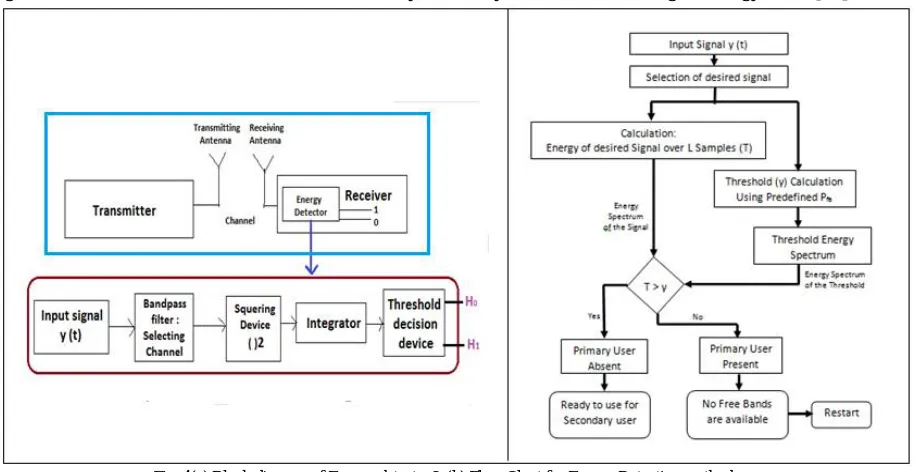
This method is optimal when the secondary user doesn’t have any information about the primary user. Following figure 1 shows how the vacant channel is detected by secondary user based on PU signal energy level. [16]
Fig. 4(a) Block diagram of Energy detector& (b) Flow Chart for Energy Detection method
The energy detection method is very to implement and it does require any prior information about the primary signal. It calculates the energy of received signal over L samples using Monte Carlo simulation. If the energy of signal founds more than energy level of threshold value then primary user is absent. Where the energy of signal founds less than the energy level of threshold value then the primary user is present.
The decision statistic for the energy detector is as follows [17].
= ∑ [ ( )]2
The decision static has a central chi square distribution with L number of freedom while primary user is absent. The decision statistic has a non- central chi square distribution with the same degree of freedom. So, T is random variable. It is a probability distribution function (PDF) under H0 and H1 respectively. The noise has the random distribution with zero mean and its variance is given by n2 and the signal can also represented by zero mean and its variance is s2.
Using this variance of noise and signal we can define a signal to noise ratio by,
=σs2/ σn2
The test statistic used for energy detection model is shown as under [18].
= ∑ [ ( )]2 > <
Here L is number of samples taken to compute the spectrum estimation of received signal and the value of L is very large (L >> 1). In this case noise parameter is unknown in real situation. is the threshold value which can decide between the real time noise and available primary user signal. When the number of sample is large enough, the probability distribution function of T represent as a test statistic as a Gaussian distribution with mean and variance as shown here [18].
( ) = ( n 2
, n 2
/L) under H0 = ( t
2
, t 2
/L) under H1
The threshold value can be found by taking certain amount of probability of false alarm for detection of the received signal [19].
The Q function is related to complementary error function which is given by
(. )= ( √)
The theoretical value of threshold for energy detector in the presence of additive Gaussian noise for the desired probability of false alarm [19].
= n2(1+√2 -1(Pfa)/√ )
First of all input signal y (t) is filtered by band pass filter. Here the function of Band pass filter (BPF) is in order to reduce the noise and choose the significance bandwidth,the output of band pass filter is given as an input to the squaring device. In this stage measurement of received signal is take place. The output of squaring device is followed by the input to integrator device which can decide the observation interval. At final stage the output of the integrator is compared with a threshold to determine the availability of primary user. Now the threshold value can be set either fix or variable depending upon the condition of channel. In this method, it does not identify the formation of the signal and determine the presence of user by only comparing the known threshold value with received energy of primary signal [20].
V. PROPOSED SIMULATOR PLATFORM
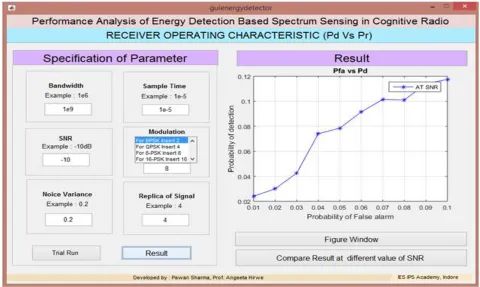
This section describes the MATLAB-based simulation platform that provides interactive access to check the performance and comparative analysis for energy detection method theoretically as well as practically by varying various Parameters. The platform GUI (Graphic User Interface) is shown in below figure 6. In order to deal with GUI, We deploy the project via using MATLAB Compiler.Using GUI tool it minimize the easy way to analyze the simulation result in less time. In simulator just insert the require parameter Basically, Bandwidth, Sample time, SNR, Noise Variance, Replica of Signal & Modulation technique used as BPSK inset 2 in the edit box. When the Required parameter are insert then click on Result it will generate output in term of ROC as Graph.
VI.PERFORMANCE EVOLUTION &SIMULATION RESULT
All Simulation was done on MATLAB version R2015a as well as GUI as shown in figure. We use complementary receiver operating characteristic (ROC) for analysis performance analysis of energy detection technique.
Table 1: Specification of Parameter
Table 1 show that necessary parameter used in our work, such as Bandwidth, Sample Time, SNR, Modulation, Noise Variance & Replica of signal. Parameters for simulation are insertvia edit box in the MATLAB based Simulation Platform (GUI) which is shown in figure 6.
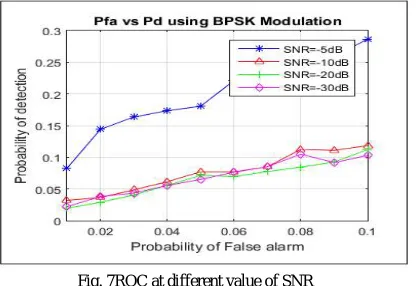
Fig. 7ROC at different value of SNR
The Figure 7 shows, the receiver operating characteristic (ROC), (Pd versus Pf) curve for different value of SNR
(SNR=-5dB, SNR=-10dB, SNR=-20dB & SNR=-30dB), Specification of parameter are used as shown in Table 1. So by analyzing of figure 7, it clears that varying the value of SNR as shown in figure SNR value at -5dB give the best result as it will give better probability of detection.
Fig. 8ROC at different value of SNR is 5dB
Parameter Values
Bandwidth 1e6 Sample Time 1e-5
The Figure 8 shows, the receiver operating characteristic (ROC), Probability of detection (Pd) versus Probability of
false alarm (Pf) for SNR value is 5dB i.e. positive SNR value So by analyzing of figure 8, it clears that probability of
false alarm increases, values for probability of detection constant i.e. positive value of SNR give a straight line as Probability of detection is 1 as primary user present. This is fake detection.
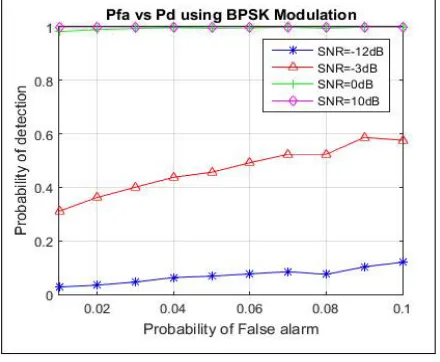
Fig. 9ROC at different value of SNR
The Figure 9 shows, ROC, as Pd versus Pf curve for different value of SNR (SNR= -12dB, SNR= -3dB, SNR= 0dB
& SNR=-10dB), So by analyzing of figure 9, it clears that for positive value of SNR (SNR=0 & SNR=10) Pd show
always 1 which is fake response (shows PU Present) but the Performance is better when the SNR value which is negative and close to zero. So it is clear from figure 9, probability of false alarm increases, values for probability of detection increase at SNR is -12 but as compare to other when SNR is -3dB probability of false alarm increases, values for probability of detection also increase and value of Pd (at SNR = -3) is greater than Pd (at SNR = -12). So, we obtain
best result when SNR value is -3dB gives better probability of detection (near to 1) at different value of probability of false alarm (Pf).
VII. CONCLUSION AND FUTURE WORK
Cognitive radio is a novel approach that basically improves the utilization of efficiency in the radio spectrum. This paper presents a brief study review of cognitive radio as well as different types of spectrum sensing techniques challenges towards spectrum sensing. Basically, performance metrics such as probability of detection, probability of false alarm and signal to noise ratio are considered for analysis for energy detection based spectrum sensing technique. Various ROC (Receiver Operating Characteristics) curves i.e. plot of Pd versus Pf has been plotted over different value
of SNR values. We design Graphic User Interface simulation platform in MATLAB for doing comparative analysis which can reduce a time for setting the parameters every time while doing simulation for new parameter. As we can conclude that by analysing our result in ROC, Where SNR value is lower or near to zero gives a better performance in Pdvs Pf graph as we observe at SNR value at -3dB & -5dB for specified parameter.
In future, This work can be extend by using various fading channels as Rayleigh, Rician and Nakagami fading channel & performance analysis can be evaluated. This work can also be extend for the different diversity schemes like equal gain combining (EGC), selection combining (SC) etc.
REFERENCES
1. S. Haykin, “Cognitive Radio: brain-empowered wireless communications” IEEE Journal on Selected Areas in Communications, Volume 23, Issue 2, February 2005, pp.201– 220.
2. M. McHenry, “Frequency agile spectrum access Technologies” in Proc. of FCC Workshop on Cognitive Radio, May 2003. 3. Federal Communications Commission, “Spectrum Policy Task Force”Rep. ET Docket no. 02-135, Nov. 2002.
5. Ahmed Hassan, Mohammed Hassan, "Brief Overview of the Cognitive Radio Technologies" International Journal of Advanced Research in Computer Science and Software Engineering, Volume 5, Issue 10, October-2015
6. J. Mitola and G. Q. Maguire, “Cognitive radios: making software radios more personal" IEEE Personal Commun., vol. 6, no. 4, pp. 13-18, 1999.
7. FCC, “Facilitating opportunities for flexible, efficient, and reliable spectrum use employing cognitive radio technologies, notice of proposed rule making and order" FCC 03-322, Dec. 2003.
8. 802.22 Working Group, IEEE P802.22/D0.1 Draft Standard for Wireless Regional Area Networks, [Online]. Available: http://grouper.ieee.org/groups/802/22/, May 2006.
9. D.D. Ariananda, M.K.Lakshmanan, H. Nikookar, “A survey on spectrim sensing techniques for Cognotive radio”, IEEE, International Research center for Telecommuniaction and radar, 2009.
10. AnkitDobariaa, SagarSodhatarb "A Literature Survey on Efficient Spectrum Utilization: Cognitive Radio Technology" International Journal of Innovative and Emerging Research in Engineering, Volume 2, Issue 1, 2015
11. G. Ganesan and Y. Li, “Cooperative spectrum sensing in cognitive radio, part II: multiuser networks” IEEE Trans. Wireless Commun., vol. 6, no. 6, pp. 2214–2222, June 2007
12. Hoyhta, M.A. Hekkala, M. Katz, and A. Mammela. 2007. “Spectrum Awareness: Techniques and Challenges for Active Spectrum Sensing Cognitive Wireless Networks”: 353 372.
13. Akyildiz, I.F., W. Y. Lee, M. C. Vuran, and S. Mohanty. 2006. “NeXt generation Dynamic spectrum access cognitive radio wireless networks: a survey”. Computer. Networks 50(13): 2127-2159.
14. F. F. Digham, M. S Alouini and M.K Simon, “On the energy detection of unknown signals over fading channels”, Proc. IEEE International Conference on Communication (ICC003), pp. 3575-3579, May 2003.
15. Urkowitz, H. 1967. “Energy detection of unknown deterministic signals”, Proceedings of the IEEE 55(4): 523 - 531.
16. TulikaMehta,NareshKumar,Surender S Saini, “Comparison of Spectrum Sensing Techniques in Cognitive Radio Networks” IJECT, Vol. 4, April - June 2013.
17. Daniela Mercedes Martinez Plata, Angel Gabriel Andrade Reatiga, “Evalution of energy detection for spectrum sensing based on the dynamic selection of detection threshold” SciVerseScienceDirect, Procidia Engineering 135, 2012.
18. SaqibSaleem and KhurramShazad, “Performance Evaluation of energy detection based spectrum sensing thchnique for wireless channel” IJMSE, Vol. 3, No. 5, May 2012.
19. TomazSolc, “Spectrum sensing methods and implementation”, IEEE, Vol. 2, 2014.
![Fig. 3Classification of Spectrum Sensing [13]](https://thumb-us.123doks.com/thumbv2/123dok_us/1439715.1176344/3.595.137.459.459.625/fig-classification-of-spectrum-sensing.webp)