Cloud Technique for Aggregate Key Sharing
Mechanism
R U Patil, Prof.A.J.Kadam
Department of Computer Engineering, All India Shri Shivaji Memorial Society’s, College of Engineering Pune, India
ABSTRACT: An efficient cryptographic approach for data sharing where datailsshared among a group of users as Data sharing is an important functionality in cloud storage. How to securely and efficientlyshare a collection of data related to any subject areas with others in cloud storage. Development of new novel concept of Key- Aggregate Searchable Encryption (KASE). This concept is implemented through development of a concrete key-aggregate searchable encryption framework scheme. This scheme is described as where a data owner only needs to generate and distribute a single aggregate key to a data user for sharing a large number of documents and on the other side user only needs to submit a single aggregate trapdoor to the cloud server, so that he/she can query over the shared documents by the help of generated single aggregate trapdoor. This proposesscheme is perfectly more secure and practically efficient. It is an effective method which is considered as best solution to build a practical data sharing system based on public cloud storage. A detailed review of various methods used for data access controls and encryption is presentedand a brief comparison among the discussed methods is given.Multi cloud scheme reduce storage overhead of thecustomer by compressing the data and reduce computationaloverhead of the cloud storage server.
KEYWORDS: Searchable encryption, data sharing, cloud storage, data privacy
I. INTRODUCTION
II. LITERATURE SURVEY
Monica G. Charate1, Dr. Savita R. Bhosale proposed a Cloud Computing Security Using Shamirs Secret Sharing Algorithm From Single Cloud to Multi Cloud. This paper is carried out to design single and multi-cloud using secret key sharing algorithm which will result in deduction of the cost for the physical infrastructure, reducing the cost entry and execution as well as the response time for various associated applications. In this paper ,I have referred the solution for performance of the Shamirs secret sharing scheme, is used in a multi cloud environment [1]. AdlaShekhar, JanapatiVenkata Krishna proposed a Secure and Reliable Cloud Security from Single to Multi Clouds. This paper studies recent investigation related to single and multi-cloud security and addresses. It is found that the investigation into the use of multi-cloud service providers to keep security has received less attention from the study community than has the use of single clouds. This effort aims to help the use of multi clouds due to its capability to reduce security threats that move the cloud computing user [2]Jin Li, Xiaofeng Chen, Mingqiang Li, Jingwei Li, Patrick P.C. Lee, and Wenjing Lou, design a Secure Deduplication with Efficient and Reliable Convergent Key Management. In this paper, I have referred Proof of ownership, Convergent encryption, Key management, Security of Convergent Encryption Key [3]. Cheng-Kang Chu, Sherman S.M. Chow, Wen-GueyTzeng, Jianying Zhou, and RobertH. Deng, proposed a Key-Aggregate Cryptosystem forScalable Data Sharing in Cloud Storage. In this paper, Ihave referred Cloud storage, Data sharing, Key-aggregateencryption, Patient-controlled encryption, Compact Keyin Symmetric-Key Encryption, Compact Key in Identity-Based Encryption [4]. X. Liu, Y. Zhang, B. Wang, and J. Yan, proposed Mona: Secure multi-owner data sharing for dynamic groups in the cloud and from this paper I have referred secure multi multi-owner data sharing scheme, named Mona, for dynamic groups in the cloud [5].Ms.V.Mangaiyarkkarasiand Mr.K.A.Dhamodaran proposed A Comparative Surveyon Availability and Integrity Verification in Multi-Cloud. This survey paper provides overview about variousProvable Data Possession techniques in cloud. In thisPaper, I have referred the solution of various availabilityand integrity verification schemes and its methodologyare classified along with their adaptation to single/multicloud environment [6]. R. Lu, X. Lin, X. Liang, and X. Shen, proposed Secure Provenance: The Essential of Bread and Butter of Data Forensics in Cloud Computing. In this paper, I have referred information confidentiality on sensitive documents stored in cloud, anonymous authentication on user access, and provenance tracking on disputed documents [7]. CongWang, Qian Wang, and KuiRen Privacy-Preserving PublicAuditing for Data Storage Security in Cloud ComputingProposed Privacy-Preserving Public Auditing for DataStorage Security in Cloud Computing. In this paper,utilization and uniquely combine the public key basedhomomorphic authenticator with random masking toachieve the privacy-preserving public cloud data auditingsystem, which meets all requirements. To support efficienthandling of multiple auditing tasks,further explore thetechnique of bilinear aggregate signature to extend mainresult into a multi-user setting[8]. Y. Hwang and P. Lee, proposed a Public key encryption with conjunctive keyword search and its extension to a multi-user system. In this paper I have referred the PECK scheme provides the document search containing each of several keywords over a public key setting [9]. Dawn Xiaodong Song, David Wagner, Adrian Perrig, proposed a Practical Techniques for Searches on Encrypted Data. In this paper, I have referred Searching on Encrypted Data, Sequential Scan, Controlled Searching, Support for Hidden Searches [10].
III. EXISTING SYSTEM APPROACH
IV. PROPOSE SYSTEM APPROACH
In this paper, we address this challenge by proposing the novel concept of key-aggregate searchable encryption (KASE), and instantiating the concept through a concrete KASE scheme. The propose KASE scheme applies to any cloud storage that supports the searchable group data sharing functionality, which means any user may selectively share a group of selected files with a group of selected users, while allowing the latter to perform keyword search over the former. To support searchable group data sharing the main requirements for efficient key management are twofold. First, a data owner only needs to distribute a single aggregate key (instead of a group of keys) to a user for sharing any number of files. Second, the user only needs to submit a single aggregate trapdoor (instead of a group of trapdoors) to the cloud for performing keyword search over any number of shared files. To the best of my knowledge, the KASE scheme proposed in this paper is the first known scheme that can satisfy both requirements (the key-aggregate cryptosystem , which has inspired this work, can satisfy the first requirement but not the second).
I first define a general framework of key aggregate searchable encryption (KASE) composed of seven polynomial algorithms for security parameter setup, key generation, encryption, key extraction, trapdoor generation, trapdoor adjustment, and trapdoor testing. I then describe both functional and security requirements for designing a valid KASE scheme.
I then instantiate the KASE framework by designing a concrete KASE scheme. After providing detailed constructions for the seven algorithms, I analyze the efficiency of the scheme, and establish its security through detailed analysis. I discuss various practical issues in building an actual group data sharing system based on the propose KASE scheme, and evaluate its performance. The evaluation confirms this system can meet the performance requirements of practical applications.
V. SYSTEM ARCHITECTURE
Fig.1. Propose System Architecture
Cloud
Owner
Select File
Encrypt File
Upload file
Generate Trapdoor
User Aggregate Keys
for{k1,k2,k3,....,kn} Request For Keys
MODULE DESCRIPTION
1. KEY GENERATION
In this module admin going to generate two keys for encryption and decryption process.By using Asymmetric algorithm, admin going to generate master secret key and public key.
2. ACCESS CONTROL
In this module admin going to give access control for the files he will going to upload, while uploading admin going to encrypt the file with the help of master secret key for the security purpose to the cloud.
3. KEYWORD INDEXING
Remove un-necessary words from the file and Find the keywords. Calculate the Content Weight age of keywords Convert the Keywords into hash code by using MD5 algorithm; place the hash code in Index Array.
4. SEND AGGREGATE KEY
Based on the categories selected by admin, system has to fetch the corresponding hash keys + fetch the Public Key. Generate the User Aggregate Key and finally send it to users.
5. SEARCH WITH KEYWORD
User has to select the aggregate Key then after that Input the search keyword. Convert the keyword into hash code .Decrypt the aggregate Key, Separate and get hash keys and separate and get public Key. Using Hash Key and keyword generate hash codes (Trapdoor). Send the Hash codes to server, based on the Hash codes received server has to check the keyword index and if any matching files are available, list all the file names to the user. (Adjust & Test)View the shortlisted files from server, download the files and finally decrypt the file with owner public key.
VI. MATHEMATICAL MODEL
Input
Input given to the system is: - File in any format.
Output
I check or test the result of the keys aggregation, trapdoor generation, file stored into cloud.
Process
Step 1: Data owner Select File
Step 2: Encrypt File (For encryption we user AES or RSA). Step 3: Upload file on cloud
Step 4: User search file on cloud Step 5: Send key request to Data owner
Step 6: Data owner receive key request and Aggregate the keys Step 7: Send keys to user
Step 8: User receives keys and generate trapdoor Step 9: File decryption
Step 10: Download file
VII. EXPERIMENTAL RESULT
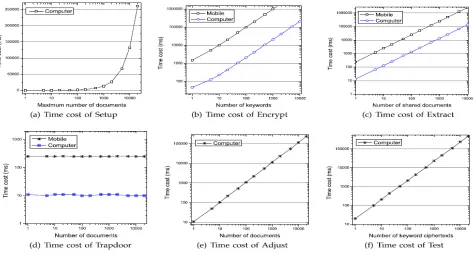
KASE. Setup is linear in the maximum number of documents belonging to one owner, and when the maximum number grows up to 20,000, it is reasonable that KASE. Setup algorithm only needs 259 second. 2) The execution time of KASE. Encrypt is linear in the number of keywords, and when the number grows up to 10,000, KASE. Encrypt algorithm only needs 206 second in computers, but 10,018 second in mobile devices. Therefore, I can draw two conclusions; one is that it is not feasible to upload document with lots of keywords using a mobile phone;
Fig. 2. Time cost of KASE algorithms.
VIII. PERFORMANCE MEASURES AND EFFICIENCY CALCULATION
Performance with ECB
Encryption Performance comparison with ECB Result Table
Data Block Size AES 3DES
1 0 0
2 5 1
4 10 1.8 6 12 2
Description
ECB(Electronic Codebook Mode) is the basic form of clock cipher where data blocks are encrypted directly to generate its correspondent ciphered blocks.Compared to all other algorithms the AES algorithm has made its mark in the cryptographic field. The unbeatable strength of the encryption algorithm is mainly depended upon the key length. The results show the impact of changing data load on each algorithm and the impact of Cipher Mode used.The results show the superiority of AES algorithm over other algorithms in terms of the processing time. It shows also that 3DES consumes more resources when the data block size is relatively big.
IX. CONCLUSION
REFERENCES
[1] Monica G. Charate1, Dr. Savita R. Bhosale,” Cloud Computing Security Using Shamir’s Secret Sharing Algorithm From Single Cloud To Multi Cloud”, Volume No 03, Special Issue No. 01, April 2015.
[2] AdlaShekhar, JanapatiVenkata Krishna,” Secure and Reliable Cloud Security from Single to Multi Clouds”, volume 16 number 2 – Oct 2014. [3]J.Li, X.F. Chen, M.Q. Li, J.W. Li, P. Lee, Wenjing Lou. “Secure Deduplication with Efficient and Reliable Convergent Key Management”, IEEE Transactions on Parallel and Distributed Systems, 25(6): 1615-1625, 2014.
[4] C. Chu, S. Chow,W. Tzeng, et al. “Key-Aggregate Cryptosystem for Scalable Data Sharing in Cloud Storage”, IEEE Transactions on Parallel and Distributed Systems, 2014, 25(2): 468-477.
[5] X. Liu, Y. Zhang, B. Wang, and J. Yan. “Mona: secure multi owner data sharing for dynamic groups in the cloud”, IEEE Transactions on Parallel and Distributed Systems, 2013, 24(6): 1182-1191.
[6] Ms.V.Mangaiyarkkarasiand Mr.K.A.Dhamodaran,” A Comparative Survey on Availability and Integrity Verification in Multi-Cloud”, Volume 1,
Issue 10, December 2012.
[7] R. Lu, X. Lin, X. Liang, and X. Shen, “Secure Provenance:The Essential of Bread and Butter of Data Forensics in Cloud Computing”, Proc. ACM Symp. Information, Computer and Comm.Security, pp. 282-292, 2010.
[8] Cong Wang, Qian Wang, and KuiRen“Privacy-Preserving Public Auditing for Data Storage Security in Cloud Computing”IEEE INFOCOM
2010.
[9] Y. Hwang, P. Lee. “Public Key Encryption with Conjunctive Keyword Search and Its Extension to a Multi-user System”, In:Pairing-Based Cryptography C Pairing 2007, LNCS, pp. 2-22, 2007.