KEEPING IT SIMPLE : APPROACHES TO AND VALUE OF
SIMPLICITY IN COMPUTATIONAL MODELLING,
WITH EXAMPLES FROM MODELLING THE CORE OF THE
ADVANCED GAS COOLED REACTOR
Richard Crawford1
1Lead Analyst, AMEC Foster Wheeler, UK
Abstract
Computing power continues to increase and yet run times don’t improve as models get increasingly
complex. This paper examines some of the reasons for this and argues that it is worth overcoming these in many cases. Using examples from modelling the graphite core of the Advanced Gas-cooled Reactor, the paper highlights the value of simple models and discusses some approaches to using them.
INTRODUCTION
This paper contrasts two alternative narratives of complexity in computational modelling before offering suggestions that enable model developers to take advantage of the narrative of progress while avoiding the pitfalls described in the more complex narrative. It presents neither a complete assessment method nor a complete account of the Graphite Core Project.
THEORETICAL BACKGROUND
Uncertainty
The Health and Safety Executive (HSE) (2001) distinguishes between three types of uncertainty:
· Knowledge uncertainty, arising from sparsity of data or random measurement errors.
· Modelling uncertainty, concerning the validity of the model to represent the process giving rise to the risks.
· Limited predictability or unpredictability, arising from a system that is random or chaotic in the mathematical sense.
When dealing with modelling uncertainty, the HSE states “The rigour of the peer review process and openness to alternative hypotheses are the main safeguards. However, the most intractable problems arise when it is not practical or physically possible to subject the alternative hypotheses to rigorous testing. In such cases, the exercise of expert judgement is paramount and confidence depends on the procedures
adopted for selection of the experts and the management of bias (or appearance of bias).”
The author has previously (Crawford, 2014) described lessons from the Graphite Core Project for reducing uncertainty.
Development of Computational Methods
have improved, practice has moved towards best-estimate plus uncertainty; i.e. models are used that are not intrinsically conservative, and a distribution of potential input data is used to estimate potential outcomes.
In relation to software more generally, an apparently contrasting view comes from Niklaus Wirth, the designer of several programming languages, including Pascal. He contends that software often grows in complexity beyond what is necessary or useful, largely because hardware advances make this possible (Wirth 1995).
ENGINEERING BACKGROUND
The Core of the Advanced Gas-cooled Reactor
There are seven power stations of the Advanced Gas-cooled Reactor (AGR) design, each with two reactors, all in the UK and all owned and operated by EDF Energy. The structure of each reactor core comprises several thousand graphite bricks connected by a similar number of graphite keys, which fit into keyways in the bricks. The precise number of bricks and keys depends on the variant of the AGR design. Several hundred channels in the core hold fuel assemblies and control rods.
The Fundamental Nuclear Safety Requirements (FNSR) for the core are that it:
1. Allows unimpeded movement of control rods and fuel assemblies (Bradford, 2007) 2. Directs gas flows to ensure adequate cooling of the fuel and core (Bradford, 2007) 3. Provides neutron moderation and thermal inertia.
The properties of nuclear graphite change over time, chiefly due to fast-neutron irradiation and radiolytic oxidation in the coolant gas. This can have a number of effects, including:
· Changed clearances between bricks
· Changed clearances between keys and keyways
· Cracked bricks
· Failed keys
· Reduced channel-bore radius
· Reduced neutron moderation and thermal inertia.
These effects have the potential to reduce the ability of the core to meet the FNSR. Due to the impracticality of repair and replacement, the graphite core is likely to be the life-limiting component of most power stations that use the AGR design.
The Graphite Core Project
EDF Energy is pursuing a long-term programme of work known as the Graphite Core Project, which continues to successfully deliver lifetime extension and continued operation of the AGR core. The programme encompasses inspection, monitoring, plant modification and both physical and computational modelling (Bradford, 2007). Some features of the programme are listed below.
· Schedules and priorities are tuned to the delivery of the safety cases (safety cases are time limited and need to be updated periodically). When a particular safety case is written it can take advantage of the latest analyses.
· The lead reactors inform the development of methods, but the methods are kept as generic as possible, to make them easier to apply to other reactors.
· The FNSR are assessed directly, without surrogate criteria such as brick integrity or weight loss.
Initially, a highly conservative approach was taken to modelling. For example FNSR 1 was assessed by comparing two values:
· Maximum tolerable amplitude over a number of idealised postulated channel shapes, i.e. the maximum peak displacement of those shapes that would allow both fuel assemblies and control rods to move unimpeded.
This is conservative because:
· Realistic displacements in a core will be less than those caused by tilting it on its side.
· For a given amplitude, the worst of the idealised postulated shapes will be more onerous than the actual shapes of channels in the core.
In addition, the computational models used to calculate both these values were conservative. While these methods successfully delivered evidence for a number of safety cases, it was clear that they would conclude that an FNSR would not be met at a much earlier date than the actual date. By 2012, the project had moved towards the best-estimate-plus-uncertainty approach. For example, more realistic load cases were applied to models of the core and the resulting (more realistic) channel shapes were assessed for their ability to allow unimpeded movement of control rods and fuel assemblies.
AGRIGID and LEWIS
Two computational models used as part of the Graphite Core Project are AGRIGID and LEWIS. AGRIGID (Shaw et al 2007) is a stick-and-spring finite-element model of the whole core. Each fuel brick is modelled as a rigid beam and each interaction between neighbouring bricks is modelled using non-linear springs. Keys are not modelled directly – just their effect on the interaction between bricks.
LEWIS (Crawford 2013)
analyses the ability of control rods and fuel stringers to fit and move in a
channel of the AGR core. It ignores forces to simplify a physical problem into a geometric one.
It uses the small-angle approximation to simplify a geometric problem into alinear programming
problem, which can then be solved with an off-the-shelf solver. The relative speed of this
method enables assessment of every channel in a whole-core model, which enables the
production of core maps and the ranking of channels in terms of their functionality.
CONTRASTING NARRATIVES OF THE COMPLEXITY OF MODELS
A Narrative of Progress
The world is a complex place. Complexity in models allows us to model complexity in reality. The aim in adding complexity to models is to represent reality more accurately and so get more informative results. Increasing computational power has enabled models to be more and more complex while still maintaining a reasonable run time. Furthermore, increasingly complex software components and environments are available to model developers, enabling complex models to be developed without excessive development time.
A More Complex Narrative
The world is a complex place. Making simple models requires additional effort. Increasing computational power has enabled models to be more and more complex while still maintaining a reasonable run time. The increasing complexity of models is a result of model developers not having to expend effort on making models simple, to achieve run times they find acceptable.
this requires effort and may result in a model that is unable to show that a safe system is safe. Validation work may justify simplifications, but it may not, potentially leading to rework. For these reasons, model developers often find it easier to not simplify more than is required by the immediate needs of run time and developer time. Implicitly or explicitly, a decision is made to use a model that is more complex than one that might have been developed with additional effort to understand the problem and justify the simplification. As computing power increases and more complex software components become available, models become more complex than is necessary, because they can be more complex than is necessary.
THE VALUE OF SIMPLICITY
Simpler models offer a number of advantages. As already mentioned, simpler models generally run quicker. This helps to get an answer sooner, but the value of quick run time goes deeper than this. As the HSE notes, knowledge uncertainty can result from data sparsity. Simpler, quicker models allow more scenarios to be investigated, reducing data sparsity. While computing power has enabled us to drop simplifications, an alternative approach would keep the simplifications and perform more analyses. For example, AGRIGID is many times quicker than a solid FE model of the core. While computing power has reached the point where a solid FE model may be solvable in an acceptable time, using AGRIGID enables many more load cases to be considered and so the effects of varying input values to be studied. With many variables to consider, performing only one or two analyses will lead to sparsity of data.
As mentioned above, successful simpler models require a deeper understanding of the problem. Going through the process of developing simpler models is a good way to develop a deeper understanding. This can have further benefits, beyond the model itself.
Paradoxically, once developed, simpler models are often easier to understand. This may not be apparent at first. When presented with a list of simplifying assumptions, we may not understand why these assumptions were chosen. We may ask why things were not modelled in more detail. But once this is understood, we are well on our way to understanding the model. A more complex model will have more complex assumptions, whether implicit or explicit.
For example, AGRIGID does not model friction. This may not be easy to understand at first. Once we have understood that this is conservative because the biggest concern is large displacements, we have understood the simplification. In contrast, if we were to model friction we would have to make further assumptions about the coefficient of friction, the model of friction, and the dynamic effects of vibration.
This relative ease of understanding of simple models makes them easier to validate and peer review. With simpler models it is easier to be satisfied that alternative hypotheses have been given sufficient consideration.
Simpler models often require less input data. This reduces the requirements to get the data, but it can also mean that the output will be more-generally applicable. For example, as mentioned, AGRIGID does not model friction. This conservative assumption means that suitable coefficients of friction do not have to be found. It also means that the results are not dependent on the choice of coefficient of friction.
ACHIEVING SIMPLICITY
The above points about the value of simplicity can just as easily be thought about from the opposite direction: The detrimental effects of complexity. Complexity can be necessary. Unnecessary complexity can result in data sparsity, and models that are difficult to apply in new situations and difficult to understand. Unnecessary complexity will save human effort at some stages but waste it later on.
While improved computing power is the proximate cause of much increase in model complexity, it is the opinion of the author that the ultimate cause of unnecessary complexity is decision making that gives insufficient weight to the difficulties caused by models being more complex than is necessary.
A number of ideas that can help realise the benefits of simplicity are described below.
Increasing Complexity When it is Required
Part of avoiding unnecessary complexity is adding complexity where it really is required. This allows attention to be focused on understanding necessary complexity. If the aim is to prove that a system is safe, an efficient approach is to make conservative, simplifying assumptions until it is either known or believed that a particular conservative assumption would mean concluding that a potentially safe system is unsafe. At this point a more complex model is used. On the Graphite Core Project, this occurs in two distinct ways.
Firstly, on a given safety case, simple models are used to filter results and determine where more complex models are most appropriate. For example, LEWIS can be used to assess every channel in every load case analysed using AGRIGID, ranking them by a measure of their functionality. This method enables the finite-element solid stringer model (FESSM) to be used only on channels that LEWIS has identified as most concerning.
Secondly, the complexity of models have increased over the years. Anticipating the need for reduced uncertainty, model improvements are developed. For example, LEWIS was extended into three dimensions and improvements were made to how it modelled the shear and separation of doubly cracked bricks (Crawford 2015).
The author has described both of these approaches as progressive reduction in uncertainty (Crawford 2014).
Decoupled Models
Two systems are coupled if each is dependent on the other, i.e. if information flows in both directions between the systems. They are decoupled if one system is not dependent on the other, i.e. if information only flows in one direction. Modelling a coupled system with decoupled models is a simplifying assumption. It is approximating the coupled system by a number of uncoupled systems. Correct use of decoupled models requires an understanding of this. For example, LEWIS and FESSM can both calculate the gapping between fuel sleeves caused by a channel shape taken from a whole-core model. If gapping is assessed this way, the resistance of the stringer to gapping does not feed back into the-whole core model, meaning that the assessment route can over-estimate gapping and under-estimate forces. While gapping calculated with this method is small, this is tolerable and enables the advantages of decoupled models.
these components of the assessment are recognised as part of the overall assessment method. This
approach contrasts with a “model everything” approach whereby all considerations are accounted for in a
single, complex model. Beyond those discussed above, the advantages of this decoupled approach are that:
· Each model models a relatively simple system, making it easier to develop, validate and understand.
· If one model needs to be replaced or improved, it needn’t affect the other models.
Therefore, using decoupled models is central to keeping models simple and to allowing them to get more complex when it is required.
Having a wide variety of decoupled models allows greater specialisation of the models and the people working with them. However, this brings with it the following requirements:
· Communication between people, so that they understand:
o The assumptions and limitations of the models developed and used by others o When input data will be available and output data will be required.
· The ability for models to use data produced by other models. In many instances, data is input by hand. However, where large quantities of data have been exchanged, common file formats have been developed and in some cases the assessment route has been automated.
Tabulating Simplifying Assumptions
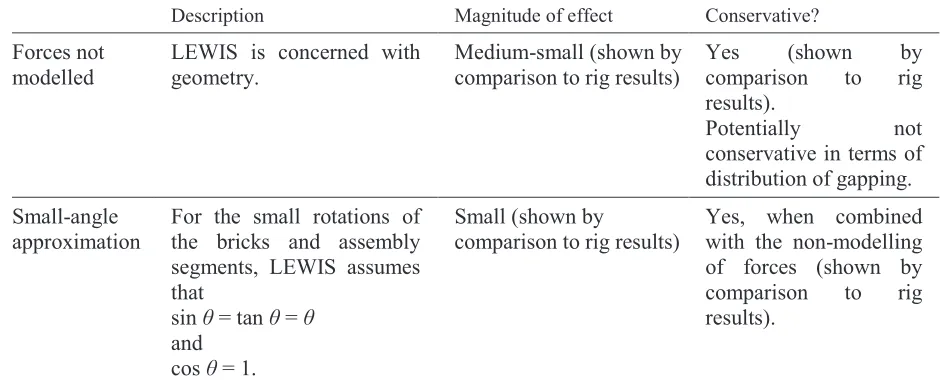
Understanding the simplifying assumptions is key to understanding the nature of a simple model and so understanding where it can be used. Tables of these assumptions have been drawn up for both LEWIS and AGRIGID. Each includes judgements on the magnitude of the effect of these assumptions, whether or not these are judged to be conservative and any evidence to support this. For example, the LEWIS table has 16 rows, including those shown in Table 1.
Table 1: Two lines from the table of assumptions for LEWIS
Description Magnitude of effect Conservative?
Forces not modelled
LEWIS is concerned with geometry.
Medium-small (shown by comparison to rig results)
Yes (shown by comparison to rig results).
Potentially not conservative in terms of distribution of gapping.
Small-angle approximation
For the small rotations of the bricks and assembly segments, LEWIS assumes that
sin θ = tan θ = θ
and cos θ = 1.
Small (shown by
comparison to rig results)
CONCLUSIONS
Increased computational power has enabled increased complexity in models, allowing them to more accurately represent a complex world. However, unnecessary complexity of models can make them difficult to understand, difficult to modify and difficult to apply in new situations. This paper has argued that the ultimate cause of unnecessary complexity is decision making that gives insufficient weight to the difficulties caused by models being more complex than is necessary.
This paper has presented a number of techniques that have proved valuable on the Graphite Core Project to reduce unnecessary complexity. Simple models can be used to identify cases where the use of complex models is necessary. Simple models can by made more complex over time by identifying those assumptions whose removal is necessary. This process can be assisted by tabulating simplifying assumptions and by the use of decoupled models.
This paper has presented two contrasting narratives. The narrative of progress appears naïve in comparison to the more complex narrative. However, bymaking decisions that gives sufficient weight to the difficulties caused by models being more complex than is necessary, complexity can be focused where it is necessary to progressively reduce uncertainty.
REFERENCES
Health and Safety Executive (2001). Reducing Risks, Protecting People : HSE’s Decision-Making Process, HSE Books, UK
Crawford, R.J. (2014). “Lessons from the graphite core project”, Nuclear Future 10 (6), The Nuclear Institute, London, UK
International Atomic Energy Agency (2009). Deterministic Safety Analysis for Nuclear Power Plants : Specific Safety Guide SSG-2
Wirth, N. (1995). “A Plea for Lean Software”, in Computer 28 (2), The Institute of Electrical and Electronics Engineers, New Jersey, USA
Bradford, M.R. (2007). “An Overview of British Energy’s Graphite Core Assessment Methodology”, in
Management of Ageing in Graphite Reactor Cores, The Royal Society of Chemistry, Cambridge, UK
Shaw, D.J., Salih, M.H.S. and McLachlan, N. (2007). “Development and Validation of Whole Core Modelling Methodology for AGR Graphite Cores”, in Management of Ageing in Graphite Reactor Cores. Neighbour G.B. (Ed.), The Royal Society of Chemistry, Cambridge, UK
Crawford, R.J. (2013). “The LEWIS Method of Channel Functionality Assessment”, in Modelling and Measuring Reactor Core Graphite Properties and Performances, The Royal Society of Chemistry, Cambridge, UK
Crawford, R.J. (2015). “Extending and Validating the LEWIS Method of Channel Functionality
Assessment”, in Engineering Challenges Associated with the Life of Graphite Cores, EMAS,