ABSTRACT
MCQUIGGAN, SCOTT W. An Inductive Approach to Modeling Affective Reasoning in Interactive Synthetic Agents (Under the direction of James C. Lester).
Recent years have witnessed significant progress on synthetic agents. With a broad range of applications in education, training, and entertainment, foundational work on synthetic agents has yielded expressive models of embodied cognition and behavior that support rich interaction. Complementing advances in cognition and behavior, affective reasoning has begun to play a central role in synthetic agents. A key challenge posed by affective reasoning in synthetic agents is devising empirically informed models of affect that enable synthetic agents to accurately respond in social situations.
This thesis presents an inductive affective modeling paradigm for learning models of affect by observing human-human social interactions. First, in training sessions, one trainer directs a synthetic agent to perform a sequence of tasks while another trainer manipulates a synthetic agent’s affective states to produce appropriate behaviors. These include spoken language, gestural behaviors, and posture. Second, the model generator tracks observable situational attributes pertaining to locational, intentional, and temporal information to induce a model of affect. Finally, at runtime, a synthetic agent applies the model by tracking precisely the same observable attributes and using them to drive situation-appropriate behaviors.
An Inductive Approach to Modeling Affective Reasoning
in Interactive Synthetic Agents
by
SCOTT W. MCQUIGGAN
A thesis submitted to the Graduate Faculty of North Carolina State University
in partial fulfillment of the requirements for the Degree of
Master of Science
COMPUTER SCIENCE
Raleigh 2005
APPROVED BY:
Dr. R. Michael Young Committee Member Dr. Munindar P. Singh
To Mother, Pops,
and
Biography
Acknowledgements
I would like to first thank the members of my committee, Dr. Munindar P. Singh and Dr. R. Michael Young for their academic enthusiasm and support.
I am immensely thankful for the opportunity to be a student of my advisor, Dr. James C. Lester, who has given continuous guidance, support, and confidence throughout this work. Dr. Lester has bestowed many lessons in academia and insightful discussions for which I am genuinely grateful.
I am also appreciative of the generosity and help offered by the members of the IntelliMedia Center for Intelligent Systems. I would like to especially thank Sueng Lee, Sunyoung Lee, and Bradford Mott for considering me a peer. Discussions with fellow graduate students have often led to a better understanding of my own work and its application. For this I owe thanks to Leo Bae, Yuna Cheong, Neha Jain, Arnav Jhala, and Ben Rose.
I would like to additionally thank SAS Institute, Inc., particularly the JMPP
™ division
and Dr. Richard Potter, for allowing me to gain valued experience in the development of first-class statistical software while prioritizing academics throughout the course of this research.
I am grateful to Dr. Boris Roussev, who engraved much confidence and motivation at SU, leading me to pursue the graduate studies I have come to treasure so deeply.
piece of who I am. Furthermore, it is with the loving support, ready advice and unending encouragement gifted to me by my parents, William and Carol McQuiggan that has enabled me to pursue my interests and flourish in whatever makes me happy.
Table of Contents
List of Figures... viii
List of Tables ... ix
1. Introduction... 1
1.1 Overview of Research... 3
1.2 Thesis Organization ... 4
2. Modeling Affect... 6
2.1 Computational Models of Affect ... 7
2.1.1 Ortony, Clore and Collins’ Structure of Emotion... 7
2.1.2 Smith and Lazarus’ Appraisal Theory ... 9
2.2 Empathy ... 10
2.2.1 Defining Empathy... 11
2.2.2 Empathy Limitations in Computational Models of Affect ... 13
3. An Inductive Model of Empathy ... 15
3.1 The CARE Architecture ... 15
3.2 Training and Learning... 17
4. Implementation ... 25
4.1 The Treasure Hunt Virtual Environment ... 25
4.2 Implementing CARE... 27
4.3 Example Scenario ... 29
5. Evaluation... 32
5.1 Method ... 32
5.1.1 Participants and Design... 33
5.1.2 Materials and Apparatus – Training Target ... 33
5.1.3 Materials and Apparatus - Empathizer ... 34
5.2 Procedure ... 35
5.3 Results... 39
5.3.1 IRI Empathy Instrument Results... 39
5.3.2 Model Results ... 43
6. Related Work ... 53
6.1 Believable Characters ... 54
6.2 Affective Agents ... 56
6.2.1 Pedagogical Agents... 56
6.2.2 Learning Companions... 59
6.2.3 Embodied Conversational Agents... 60
6.3 Socially Intelligent Synthetic Agents... 61
6.3.1 Politeness ... 61
6.3.2 Generating Empathetic Behaviors ... 62
6.3.3 Eliciting Empathy from Users ... 64
7. Conclusion and Future Work ... 66
7.1 Summary ... 67
7.2 Future Work ... 67
7.2 Concluding Remarks... 72
References ... 73
A. Extended Model Results ... 79
A.1 Decision Tree Model of Empathetic Assessment ... 80
A.2 Naïve Bayes Model of Empathetic Assessment ... 81
A.3 Decision Tree Model of Empathetic Interpretation - Emotion ... 82
A.4 Naïve Bayes Model of Empathetic Interpretation - Emotion ... 83
A.5 Decision Tree Model of Empathetic Interpretation - Arousal ... 84
A.6 Naïve Bayes Model of Empathetic Interpretation - Arousal... 85
A.7 Decision Tree Model of Empathetic Interpretation - Valence... 86
A.8 Naïve Bayes Model of Empathetic Interpretation - Valence ... 87
A.9 Decision Tree Model of Empathetic Interpretation - Quadrant ... 88
List of Figures
Figure 1-1: Treasure Hunt Virtual Environment ... 5
Figure 2-1: The OCC Model... 8
Figure 2-2: The Smith and Lazarus Model ... 10
Figure 2-3: Empathy Construct... 12
Figure 3-1: General CARE Architecture... 16
Figure 3-2: Two-dimensional Affective Space... 19
Figure 3-3: General Training and Learning Data Flow ... 21
Figure 4-1: A Relaxed Companion Agent in Treasure Hunt ... 26
Figure 4-2: An Excited Companion Agent ... 30
Figure 4-3: A Relaxed Companion Agent ... 30
Figure 4-4: A Frustrated Companion Agent in Treasure Hunt ... 31
Figure 5-1: Evaluation Data Flow... 38
Figure 5-2: Individual Empathizer IRI Results... 40
Figure 5-3: Individual Empathizer IRI Subscale Results ... 40
Figure 5-4: Average Empathizer IRI Subscale Results by Gender... 41
Figure 5-5: Affective State Frequencies ... 41
Figure 5-6: Affective State Frequencies by Gender ... 42
Figure 5-7: Average Affective State Frequencies by Gender ... 42
Figure 5-8: ROC Curves for Empathetic Assessment ... 44
Figure 5-9: Partial Decision Tree for Empathetic Assessment... 44
Figure 5-10: ROC Curves for Empathetic Interpretation (Emotions) ... 46
Figure 5-11: ROC Curves for Empathetic Interpretation (Valence)... 48
Figure 5-12: ROC Curves for Empathetic Interpretation (Arousal) ... 48
List of Tables
Table 5-1: Areas Under ROC Curves in Figure 5.10... 47
Table 5-2: Areas Under ROC Curves in Figures 5.11 and 5.12 ... 48
Table 5-3: Areas Under ROC Curves in Figure 5.13... 49
Table 5-4: Empathizer Suggested Empathetic Emotions... 51
Table A-1: Empathetic Assessment Decision Tree Confusion Matrix... 80
Table A-2: Empathetic Assessment Decision Tree Evaluation Measures... 80
Table A-3: Empathetic Assessment Decision Tree Measurements of Error ... 80
Table A-4: Empathetic Assessment Naïve Bayes Confusion Matrix ... 81
Table A-5: Empathetic Assessment Naïve Bayes Evaluation Measures ... 81
Table A-6: Empathetic Assessment Naïve Bayes Measurements of Error... 81
Table A-7: Empathetic Interpretation (Emotion) DT Confusion Matrix... 82
Table A-8: Empathetic Interpretation (Emotion) DT Evaluation Measures... 82
Table A-9: Empathetic Interpretation (Emotion) DT Measurements of Error ... 82
Table A-10: Empathetic Interpretation (Emotion) NB Confusion Matrix... 83
Table A-11: Empathetic Interpretation (Emotion) NB Evaluation Measures ... 83
Table A-12: Empathetic Interpretation (Emotion) NB Measurements of Error ... 83
Table A-13: Empathetic Interpretation (Arousal) DT Confusion Matrix ... 84
Table A-14: Empathetic Interpretation (Arousal) DT Evaluation Measures... 84
Table A-15: Empathetic Interpretation (Arousal) DT Measurements of Error ... 84
Table A-16: Empathetic Interpretation (Arousal) NB Confusion Matrix... 85
Table A-17: Empathetic Interpretation (Arousal) NB Evaluation Measures... 85
Table A-18: Empathetic Interpretation (Arousal) NB Measurements of Error ... 85
Table A-19: Empathetic Interpretation (Valence) DT Confusion Matrix ... 86
Table A-20: Empathetic Interpretation (Valence) DT Evaluation Measures ... 86
Table A-21: Empathetic Interpretation (Valence) DT Measurements of Error ... 86
Table A-22: Empathetic Interpretation (Valence) NB Confusion Matrix ... 87
Table A-23: Empathetic Interpretation (Valence) NB Evaluation Measures ... 87
Table A-24: Empathetic Interpretation (Valence) NB Measurements of Error... 87
Table A-25: Empathetic Interpretation (Quadrant) DT Confusion Matrix... 88
Table A-26: Empathetic Interpretation (Quadrant) DT Evaluation Measures... 88
Table A-27: Empathetic Interpretation (Quadrant) DT Measurements of Error ... 88
Table A-28: Empathetic Interpretation (Quadrant) NB Confusion Matrix ... 89
Table A-29: Empathetic Interpretation (Quadrant) NB Evaluation Measures ... 89
Chapter 1
Introduction
Recent years have witnessed significant progress on synthetic agents. With a broad range of applications in entertainment, education, and training, foundational work on synthetic agents has yielded expressive models of embodied cognition and behavior that support rich interactions in virtual environments [André and Müller 2003; Bates 1994; Cavazza et al. 2002; Johnson and Rizzo 2004; Lester et al. 2000; Reilly and Bates 1992; Ryokai et al. 2003; Swartout et al. 2004]. Complementing advances in cognition and behavior, affective reasoning [Elliott 1992; Gratch and Marsella 2004b; Ortony et al. 1988; Picard 1997] has begun to play a central role in synthetic agents [Bickmore 2003; Burleson and Picard 2004; Marsella and Gratch 2003]. The community is now well positioned to investigate affective reasoning in the context of social interaction [Johnson and Rizzo 2004; Paiva et al. 2004; Paiva et al. 2005; Prendinger et al. 2003; Prendinger and Ishizuka 2005] and to apply affective reasoning to the relationships agents have with one another and with their users.
agents that provide motivating support and compassionate comfort to their users. Companion agents can facilitate social interaction, a critical capability in virtual environments for education [Burleson and Picard 2004; Conati and McLaren 2005; Conati 2002; Lester et al. 1999] and training [Prendinger and Ishizuka 2005]. Companion agents help users cope with frustration [Burleson and Picard 2004], deal with stress [Prendinger and Ishizuka 2005], and counsel children on social behaviors, such as bullying in schools [Paiva et al. 2004; Paiva et al. 2005].
An alternative to analytically devising models of empathy for affective synthetic agents is the empirical approach. If somehow we could create models of empathy that were derived directly from observations of “empathy in action,” we could create empirically grounded models based on human-human empathetic behaviors exhibited during the performance of a specific task within a given domain. While it is not apparent that this approach could produce a universal model of empathy—a universal model may not even be achievable, at least in the near term—the empirical approach could nonetheless generate models of empathy that significantly extend the communicative capabilities of socially intelligent companion agents. Socially intelligent companion agents should have the ability to relate to, understand and interact effectively with their users and other synthetic agents.
Many have reported on the benefits of equipping synthetic agents, such as pedagogical agents [Baylor 2005; Lester et al. 1999], with expressive affective abilities. While such benefits stem from the internal assessment used to determine affective state of synthetic agents, we have only begun to explore what the potential benefits might then be for socially intelligent, empathetic synthetic agents whom assess situational contexts from another’s point of view, considering too the affective state and goals of another to arrive at their (the agent’s) own affective state.
1.1 Overview of Research
The empirical approach calls for a data-driven framework for modeling empathy. This paper presents CARE (Companion-Assisted Reactive Empathizer agent) a data-driven affective
observations of human-human social interactions. CARE begins with training sessions.
During training sessions, CARE monitors observable situational data including locational, intentional, and temporal information while one trainer (the target) directs her synthetic agent to perform a sequence of prescribed tasks in a virtual environment as another trainer (the empathizer) reactively manipulates her synthetic agent’s affective state producing empathetic behaviors. These behaviors include spoken language, gestural behaviors, and posture. Inducing a model of empathy, CARE uses observable situational data as predictive features for empathetic assessment (when to exhibit an empathetic behavior) and for empathetic interpretation (which affective state should be chosen). The recorded observable attributes are reported to an empathy learner during the training phase. During the subsequent learning phase, CARE, induces operational models for each empathetic
assessment and empathetic interpretation. At runtime, CARE uses the resulting models to drive situation-appropriate empathetic behaviors by determining first when and then how a companion agent should be empathetic as it interacts with actual users.
1.2 Thesis Organization
This thesis is organized as follows: Chapter 2 provides background on affective reasoning and empathy with a focus on synthetic agents. Chapter 3 presents the CARE architecture and
methodology, describing how CARE models of empathy are induced. Chapter 4 describes a CARE implementation and its generation of the empathy model for the companion agent
Figure 1-1: Treasure Hunt virtual environment (companion agent, left, and the user’s agent, right).
on a 31-subject training focus group experiment. Chapter 6 presents a comprehensive comparison of this work with related work from the affect reasoning and synthetic agent communities. Chapter 7 concludes the discussion and suggests directions for future work.
Chapter 2
Modeling Affect
Emotions are an intricate system in humans which influence our interactions, our behavior and even our thinking. Emotions are almost always being expressed by the words we say, our facial expressions, our posture, and our actions. If computer systems are going to achieve high levels of believability, immersion, and more effective interaction, then emotion clearly needs to be incorporated into games, educational software, user-interfaces, and virtual environments. The field of affective computing, which focuses on the ability of computers to recognize, model, understand, express and respond to emotion effectively, is applicable in a wide range of application areas. Affective computing has found that emotions play a role in decision making, perception, learning and rational thinking and could positively affect the success of a broad range of computer systems.
brain nearest the surface) processes [Cytowic 1989]. Cytowic discovered that the limbic systems of the brain (thought to lie beneath the cortex) were triggered during perception and decision-making processes in addition to the cortex. The limbic systems are thought to be responsible for emotion, memory and attention [Cytowic 1989]. This finding blurs the line between “thinking” and “feeling” and has led to the development of cognitive appraisal theories of emotion which will be introduced in the next section. Such computational models of emotion have been the heart of affective computing, which relies heavily on the notions of the OCC model [Ortony et al. 1988] and the Smith and Lazarus model [Smith and Lazarus 1990; Lazarus 1991].
2.1 Computational Models of Affect
Several computational models of affect have been developed in the last two decades. However, only two models, OCC [Ortony et al. 1988] and Smith and Lazarus [Smith and Lazarus 1990; Lazarus 1991] have been implemented in synthetic agent architectures. These are discussed in the following sections.
2.1.1 Ortony, Clore and Collins’ Structure of Emotion
Figure 2-1: The OCC Model (from Figure 2.1 of [Ortony et al. 1988]).
reactions, positive and negative, to appraised situations consisting of events, agents, and objects [Ortony et al. 1988]. The outcome of situations in the OCC model is a synthesized emotional state.
2.1.2 Smith and Lazarus’ Appraisal Theory
The Smith and Lazarus appraisal theory of emotion (Figure 2-2) characterizes emotion as a two-staged cognitively informed process consisting of appraisal and coping [Smith and Lazarus 1990]. Appraisal refers to one’s interpreted relationship with her surrounding physical and social environment. Appraisal is a cognitively-constructed representation of events and how these events relate to internal goals. Coping is the process by which one considers actions that either maintain or manipulate their existing relationship with the environment based on affective behavioral tendencies, current affective state, desired affective state, and physiological factors [Lazarus 1991]. Coping determines the response to appraised situations based on past, present and future events.
Environment Situational Construal
Goals/ Beliefs/ Intentions
Appraisal Outcome Appraisal
Coping
Coping Outcome
Physiological Response Affect
Action Tendencies
Emotion-focused Problem-focused
Strategies Strategies
Figure 2-2: The Smith and Lazarus Model [Smith and Lazarus, 1990].
2.2 Empathy
focused on empathy to drive social interactions in synthetic agents.
Devising computational models of empathy contributes to the broader enterprise of modeling affective reasoning [Picard 1997]. Beginning with Elliott’s implementation [Elliott 1992] of the OCC model [Ortony et al. 1988], advances in affective reasoning have accelerated in the past few years, including the appearance of a sophisticated theory of appraisal [Gratch and Marsella 2004b] based on the Smith and Lazarus appraisal theory [Lazarus 1991; Smith and Lazarus 1990]. We have also begun to see probabilistic approaches to assessing users’ affective state in educational games [Conati 2002] and investigations of the role of affect and social factors in pedagogical agents [Baylor 2005; Burleson and Picard 2004; Elliot et al. 1999; Johnson and Rizzo 2004; Lester et al. 1999; Porayska-Pomsta and Pain 2004]. Recent work on empathy in synthetic agents has explored their affective responsiveness to biofeedback information and the communicative context [Prendinger et al. 2003]. It has also yielded agents that interact with one another and with the user in a virtual learning environment to elicit empathetic behaviors from its users [Paiva et al. 2005].
2.2.1 Defining Empathy
Figure 2-3: Empathy construct (modified from [Davis 1994]).
another’s situation than with his own situation” [Hoffman 2000].
Social psychologists describe three constituents of empathy. First, the antecedent consists of the target’s intent and affective state, and the situation at hand. Second, assessment consists of evaluating the antecedent and the empathizer’s consideration of herself. Third, empathetic outcomes, e.g., behaviors expressing concern, are the products of assessment [Davis 1994] including both affective and non-affective outcomes (e.g., judgment, cognitive awareness). Two types of affective outcomes may occur: parallel and reactive.
• In parallel outcomes, the empathizer mimics the affective state of the target. For
example, the empathizer may become fearful when the target is afraid.
• In reactive outcomes, empathizers exhibit a higher cognitive awareness of the situation
2.2.2 Empathy Limitations in Computational Models of Affect
The OCC model accounts for empathetic emotions, although it is somewhat limited with respect to the definition of empathy presented in Section 2.2.1. The OCC model refers to this set of emotions as “fortune-of-others” emotions [Ortony et al. 1988]. These emotions do consider what has happened to other people and arrives at an emotional reaction based on that assessment [Ortony et al. 1988]. However, this assessment only has 4 potential outcomes: pleasing and target-desired”, pleasing and target-undesired”, “self-displeasing and target-desired”, and “self-“self-displeasing and target-undesired.” These four outcomes respectively, translate into the following emotions defined by [Ortony et al. 1988]: happy-for, gloating, resentment, and sorry-for. These fortune-of-other emotions do not capture the essence of the definition of empathy which allows for any emotion to be felt by the empathizer.
Smith and Lazarus do not address empathy specifically. Instead they address compassion. The definitions of empathy and compassion clearly overlap; compassionate behaviors entail those defined by empathy. Compassion refers to being aware of another’s suffering and wishing to relieve it. Essentially, this is “reactive empathy.” Smith and Lazarus do not accommodate “parallel empathy.”
Chapter 3
An Inductive Model of
Empathy
The prospect of creating an “empathy learner” that can induce empirically grounded models of empathy from observations of human-human social interactions holds much appeal. To this end, we propose CARE, an affective data-driven paradigm that learns empathetic assessment (when to be empathetic) and empathetic interpretation (how to be empathetic). CARE consists of a trainable agent architecture and a two-phase methodology of training and
learning.
3.1 The C
ARE
Architecture
Figure 3-1: General CARE Architecture
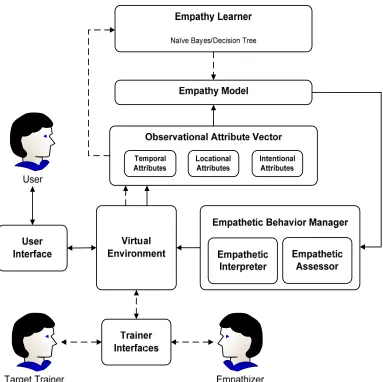
agent interacting with a user (denoted in the diagram with solid lines) (Figure 3-1):
• Empathetic Model Induction: Trainers interact with CARE via interfaces through
locational, and intentional information. These are passed to the empathy learner during the training phase. During the subsequent learning phase, the learner induces a model of empathy that is operational, i.e., it will be used at runtime.
• Runtime Operation: Users interact with CARE via an interface through which they
direct a synthetic agent in the virtual environment. Throughout their experience, they interact with a companion agent controlled by CARE. The virtual environment again tracks all activities in the world and monitors the same observable attributes reported to the empathy learner during empathetic model induction. The induced model is used by the empathetic behavior manager to (1) assess the situation to determine when to be empathetic, and (2) interpret situations deemed “empathy-worthy” to decide how to be empathetic. When a situation calls for empathy, a suitable empathetic behavior (including speech, gesture, and posture) is selected for sequencing in the virtual environment for execution by the companion agent to react empathetically to the user’s situation.
3.2 Training and Learning
In the training phase, CARE’s trainable agent must be exposed to social situations similar to the ones it will encounter at runtime. Because empathy by its very nature involves multiple actors (here we focus on two), the training experience should revolve around the interaction of multiple subjects in situations that elicit empathetic behaviors.
CARE training sessions are therefore situated in task-oriented scenarios involving two
3D virtual environment where training takes place. The target, whom is given a multi-objective mission to complete, controls her agent to navigate and perform tasks in the virtual environment from a first-person point-of-view (POV). It is the task of the empathizer, who looks on from a third-person POV, to monitor the target’s activities and select suitable empathetic affective states based on the target’s observed behaviors. Selecting an affective state causes her agent to perform an empathetic behavior.
To collect empathy data that is as representative as possible of that which will be encountered by the companion agent at runtime, training sessions must satisfy the following requirements:
Affective space coverage: At each stage of the mission, to promote the target’s
experiencing a range of emotions spanning the classic two-dimensional affective space defined by valence (degree of attraction, ranging from negative to positive) and arousal (level of stimulation, ranging from low to high) [Lang 1995] (Figure 3-2), the target should be faced with goals of varying degrees of difficulty: some should be very easy to achieve, while others should be very challenging. For example, in Treasure Hunt, the virtual environment that serves as a test bed for CARE, some treasures are in plain view
Figure 3-2: Two-dimensional Affective Space.
• Double-blind training: Training sessions should be conducted such that the target is
unaware that an empathizer is at the controls of the empathetic behaviors of the companion agent in the virtual world. Likewise, restricting the empathizer’s environment to the virtual world (i.e., without access to the target’s facial or vocal expressions) enables empathetic decisions to be based solely on inferences from the observed virtual world.
• Empathy-centered control: The empathizer should be able to focus exclusively on
empathy decision making. Thus, navigation control for the companion agent is provided by an autonomous path planning mechanism that ensures that the companion agent is always within a specified proximity to the target’s agent in the virtual environment.
being long enough to yield a large body of data and short enough so that the trainers do not become overly fatigued. In the Treasure Hunt environment, experimentation indicated that 7-minute sessions satisfied this requirement.
• Controlled affective expression: Minimizing the complexity of the empathizer’s task
can be achieved by limiting the set of emotions at her disposal. For example, empathizers in Treasure Hunt have access to six affective states: excited, joyful, relaxed, fearful, frustrated, and sad. This particular set of emotions was chosen because it covers the four quadrants of the two-dimensional affective space [Lang 1995] and addresses three levels arousal (high, medium, and low) for each level of valence (positive or negative).
• Uniform agent personae: While investigating different personae is a promising
direction for future work, e.g., pedagogical agent personae experiments [Baylor 2005], baseline training should control for personae by holding both the target’s agent and the empathizer’s agent constant throughout training sessions.
• Situation data collection intervals: Situation data should be collected at least as often
Accurately modeling empathy requires a representation of the situational context that satisfies two requirements. First, it must be sufficiently rich to support empathetic assessment and empathetic interpretation. Second, it must be encoded with features that are readily observable at runtime so that they may drive companion agents’ empathetic decision making. CARE therefore employs an expressive representation of activities in the virtual environment by encoding them in an observational attribute vector, which is used in both modes of operation: during empathetic model induction, the observational attribute vector is passed to the empathy learner for model generation; during runtime operation, the attribute vector is monitored by the empathetic behavior manager for determining empathetic behavior. CARE’s observable attribute vector represents three interrelated categories of features for making empathetic decisions:
• Temporal features: CARE tracks the amount of time that has elapsed since the
target/user arrived at the current location, since the target/user achieved a goal, since the empathizer/companion agent last behaved empathetically, and since the target/user was last presented with an opportunity to achieve a goal.
• Locational features: CARE continuously tracks the location of all agents. It monitors
locations visited in the past, locations recently visited, locations not visited, and locations being approached.
• Intentional features. CARE tracks goals being attempted (as inferred from locational
In the CARE implementation for Treasure Hunt, the observational attribute vector encodes
192 features. During empathetic model induction, an instance of the vector is logged every time a significant event occurs. On average, vectors are updated several hundred times each minute. At runtime, the same features are updated continuously by the virtual environment and are used by the empathetic behavior manager to select situation-appropriate empathetic behaviors.
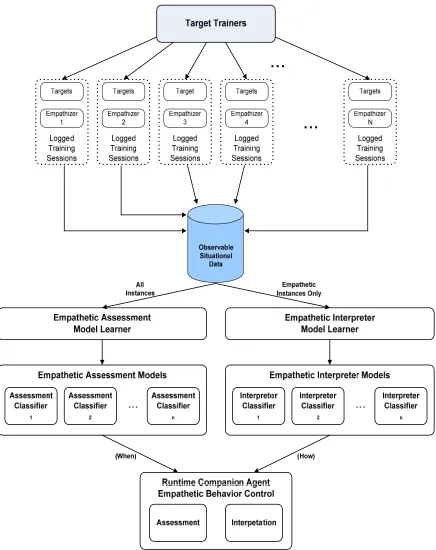
Finally, in the learning phase, CARE induces a dual model of empathy. One component will be used at runtime to support empathetic assessment, and the other will be used to support empathetic interpretation. CARE’s empathy learner first uses all of the data
collected in the training session to induce the empathetic assessment model. Induction may be based on any standard classifier learning technique. Two versions of CARE have been
implemented in Treasure Hunt, one with naïve Bayes classifiers and one with decision trees. The evaluation reported in Section 5 discusses the performance of both approaches. CARE’s
empathy learner next uses a subset of the data collected in the training sessions to induce the empathetic interpretation model. Here, it only considers data instances in which empathy was in fact exhibited. The second induction produces a model of empathy interpretation that at runtime is used to instruct the agent which empathetic behaviors to perform.
making. When the conditions of empathetic assessment rules are met other conditions are then checked to determine how to be empathetic. Both the naïve Bayes and decision tree machine learning classification techniques are useful for preliminary predictive model induction for large multidimensional data, such as the 192-observational attribute vector used in the implementation of CARE discussed in the next chapter. Since it is unclear which particular runtime variables are likely to be the most predictive, using advanced machine learning techniques (e.g., Bayesian networks) is much more difficult without the knowledge of a preliminary analysis and relies heavily on the authors own beliefs. Instead, by making all observable attributes available to the model learner it is more likely to induce models that better predict empathizer assessment and interpretation. As discussed in the future work of Chapter 7, analysis of naïve Bayes and decision tree classifications can lead to the identification of select attributes that can be used sufficiently for prediction, significantly reducing the dimensionality of monitored attributes.
Chapter 4
Implementation
The CARE paradigm has been used to train models of empathy and to control the behavior of
a companion agent at runtime in Treasure Hunt, a virtual environment test bed in which targets/users are instructed to collect treasures in the allotted time. After introducing the Treasure Hunt virtual environment, we describe the implementation and present an illustrative example of CARE generating an empathetic behavior.
4.1 The Treasure Hunt Virtual Environment
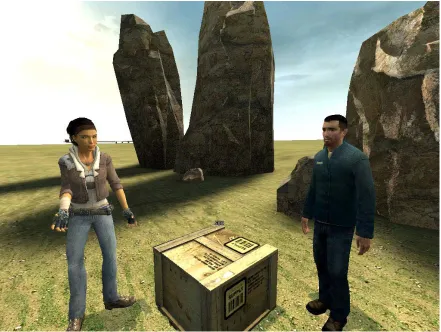
Figure 4-1: A relaxed companion agent in Treasure Hunt with target/user agent (right).
agent follows along and expresses empathetic behaviors as appropriate situations arise (Figure 4-1).
The following description of Treasure Hunt was presented to target trainers in an effort to establish a controlled backstory. Each target trainer received a copy of the same backstory, verbatim.
You are about to find yourself on what appears to be an abandoned island with your
throughout the island and particularly in the warehouse you may find boxes labeled
by the value of their contents. Break open the boxes to collect the treasure within
using your crowbar. Beware, some boxes may be unusually marked and have
unknown contents. Collect such treasure at your own risk. You will have 7 minutes
to explore the environment and collect treasure. The treasure you have collected, the
number of remaining treasure boxes and the time left will be displayed in the bottom
left corner of your display. Those that have ventured to the island before have left
with treasure valued over 3,500!!!
4.2 Implementing C
ARE
CARE’s empathetic assessment model and interpretation model have been implemented using
naïve Bayes and decision tree approaches. A discussion of their relative performance follows in Section 5. The empathetic models were induced from a dataset consisting of a 192-dimensional observational attribute vector. Treasure Hunt is implemented using a high-performance 3D game platform from Valve Software. The virtual environment, observational attribute monitoring, and empathetic models have been implemented with Valve’s Source™ engine and the accompanying 3D game platform for Half-Life 2.
As described in chapter 3, CARE models track temporal, locational and intentional
features. Examples of those features include the following:
• 10-second score window. A temporal feature which tracks whether the user has
second window of time after a significant score, while empathetic emotions such as frustrated most frequently occurred after collecting a treasure worth a minuscule value took much longer. Time-windows for monitoring the last score are monitored at 5, 10, 15, 20, 30, 50, 75 and 100 second intervals.
• Been to rocks on the beach. A locational feature, the been-to-the-rocks-on-beach
attribute monitors whether the user has visited a specific location where a known high-valued treasure is hidden behind a group of rocks. Other locational features track the user’s navigation trends over time. For example, there are attributes to monitor where the user has been in a series of time-window attributes like those described above.
• Moving towards high-valued treasure in sight. This is an example of an intentional
attribute that is monitoring whether or not there is a treasure in the user’s view, if there is a treasure box, the value of the treasure and whether the user is navigating in the direction of the treasure. This represents the user’s intent to approach and perhaps collect the treasure in sight.
• Time left and total score. The time remaining and the total score are displayed to
selections of joyful and excited, based on the target trainers overall success.
• Last emotion. Tracking the last emotion could prove to be quite predictive of the next
empathetic interpretation. Especially in the male empathizers it was uncommon to move from highly-aroused, positive-valenced emotion (excited) to a low-aroused, negative-valenced emotion (sad). This exact example, however, was witnessed several times with female empathizers. Tracking the last emotion is also useful for determining how far in the two-dimensional affective space empathizers moved between empathetic interpretations.
As users interact with Treasure Hunt, the observational attribute vector monitors variables such as those noted above to update when and how to be empathetic. Figures 4-2 and 4-3 depict similar situations that have been assessed as a situation calling for empathy but have been interpreted differently. Notice that a treasure box is in the user’s view in Figure 4-2 where the companion is excited, in an “easy” environment, but not in Figure 4-3 the companion is relaxed, in a challenging environment.
4.3 Example Scenario
To illustrate the empathetic behavior control posed by CARE, consider the following scenario in Treasure Hunt, which repeatedly played out in CARE training sessions. As we catch up
Figure 4-2: An excited companion agent. Figure 4-3: A relaxed companion agent.
Now, the user has found her agent’s way into a location on the beach, a location visited by the user’s agent in the early moments when the session began. The empathizer realizes that this particular location has been previously visited and was already determined to be an area without any treasure boxes. It has now been over one minute since the user last discovered any treasure at all.
Assessing the situation, the empathizer selects the frustrated affective state, igniting a behavioral sequence in which the companion agent announces her frustration, “This is becoming quite frustrating,” and using gestures and posture similar to Figure 4-4. (The agent’s speech segments are stored in high quality pre-rendered audio clips.) CARE’s
Figure 4-4: A frustrated companion agent in Treasure Hunt with target/user agent (right).
Chapter 5
Evaluation
This section presents a discussion of a user study, training sessions and the experiment conducted to create, implement, and evaluate CARE models of empathy for companion agents. The purpose of the experiment is to develop models of human-human social interaction by observing situational data changes in the Treasure Hunt virtual environment.
5.1 Method
5.1.1 Participants and Design
In a formal evaluation, more than two hours of data were gathered from thirty-one subjects in an Institutional Review Board (IRB) of North Carolina State University approved user study. The subjects were divided into 25 targets and 6 empathizers. There were 20 male subjects serving as target trainers and 5 female subjects serving as target trainers varying in race, ethnicity, age and marital status who participated as training targets. There were 3 male and 3 female subjects participating as training empathizers. On average, empathizers completed 4 training sessions, each with a unique training target participant.
5.1.2 Materials and Apparatus – Training Target
For each target trainer pre-experiment paper-and-pencil materials consisted of a demographic survey, Half-Life 2 controls reference sheet, and a controlled backstory in preparation for interacting within the environment. The post-experiment paper-and-pencil materials consisted of a general survey about the training target’s experience and opinions on affect in applications such as games. The demographic survey collected basic information such as gender, age, ethnicity, marital status, and number of children. The Half-Life controls reference sheet described which keys and mouse movements would be needed to manipulate the agent in both the practice task and the training task. The controlled backstory for the interactive environment was constructed in such a way that each participant would be given the same preparatory information.
directly from the game Half-Life 2. The easiest version of Treasure Hunt offered many opportunities to find treasures and meet the expectations that were set in the backstory. The most challenging version of Treasure Hunt made it difficult to find treasures; there were fewer treasures worth less value and more occluded treasure boxes making it difficult to meet backstory expectations. The practice task from the game Half-Life 2 was an opportunity for target trainers to become familiar with the required controls. The practice task required completing activities such things as climbing a ladder, stacking boxes, and jumping.
The target training apparatus consisted of a Gateway 7510GX laptop with a 2.4 GHz processor, 1.0 GB of RAM, 15-in. monitor and built-in speakers.
5.1.3 Materials and Apparatus - Empathizer
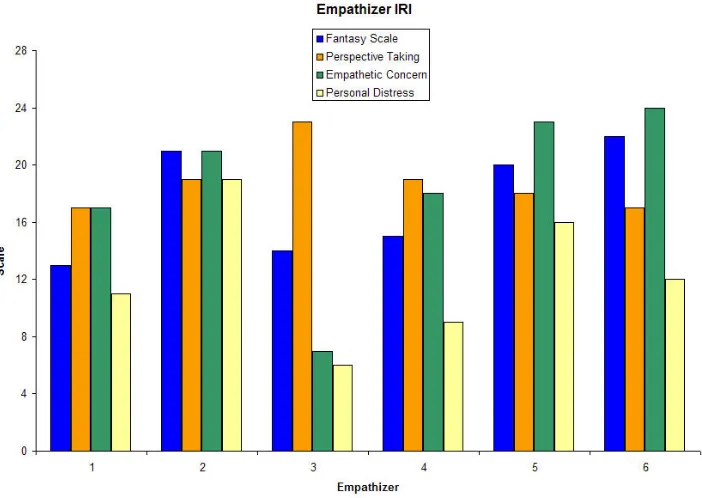
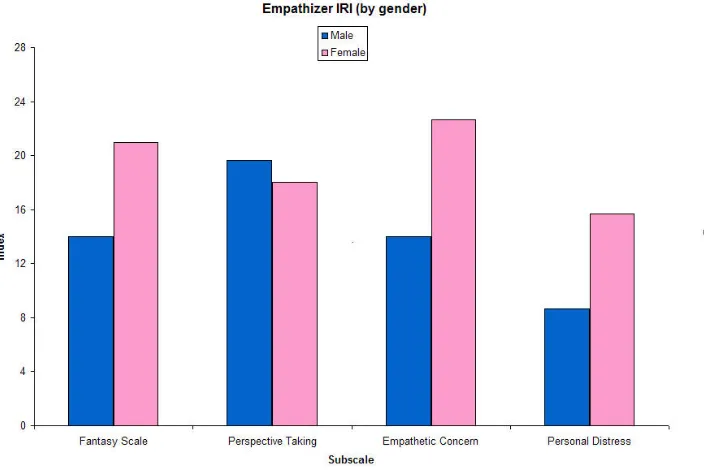
For each empathizer pre-experiment paper-and-pencil materials consisted of a demographic survey, Davis’ Interpersonal Reactivity Index questionnaire, a two-paged background on emotions and empathy, and an empathizer controls reference sheet. Post-experiment paper-and-pencil materials consisted of a survey inquiring about the emotions used/unused, other emotions that could have been useful, and general opinions regarding affect in applications, such as games. The demographic survey collected basic information such as gender, age, ethnicity, marital status, and number of children. Before empathizers began training, they completed Davis’s Interpersonal Reactivity Index (IRI) to gain a measure of their empathy [Davis 1983].
subscale values pertaining to the following qualities of empathy: fantasy, perspective taking, empathetic concern and personal distress [Davis 1994]. These empathetic qualities are described below:
• Fantasy scale. The fantasy scale refers to tendency one has to immerse themselves
into fictional situations.
• Perspective taking. Perspective taking measure indicates tendency one has to adapt
to the psychological point-of-view of others.
• Empathetic concern. Empathetic concern reflects tendencies to have feelings of
sympathy and compassion when others experience unfortunate circumstances.
• Personal Distress. Person Distress describes the general discomfort and distress
one experiences in response another’s distress.
The computerized materials consisted of a spectator view (third person point of view) of the 3D virtual environment, Treasure Hunt, that target trainers would be interacting in. Empathizers did not view target trainer practice tasks and they were not informed of the degree of difficulty.
The empathizer apparatus consisted of a Gateway 7510GX laptop with a 2.4 GHz processor, 1.0 GB of RAM, 15-in. monitor and built-in speakers.
5.2 Procedure
computer. Training targets were unaware of the empathizer’s participation at this point. Empathizers were only aware that a target training participant was in the next room. There was no contact between the participants at any point disabling the empathizers’ ability to distinguish any characteristics of the target trainer other than those assumed from the interaction portrayed on their monitor. Empathizers also first completed the same demographic survey as the targets, also at their own pace. Next, empathizers completed Davis’ IRI questionnaire at their own rate while targets where given the Half-Life 2 controls reference sheet to read until the practice task was loaded on the laptop in front of the target. Once loaded target trainers were able to complete the practice task at their own rate until the task was accomplished. At this point empathizers were given the emotion and empathy reference sheet and instructed to read over the definitions and empathizer controls. Next, one of the degrees of difficulty was randomly selected and that Treasure Hunt training environment was loaded on the target machine while the spectator view application was concurrently loaded on the empathizer machine.
informed about the presence of the empathizer during the training session.
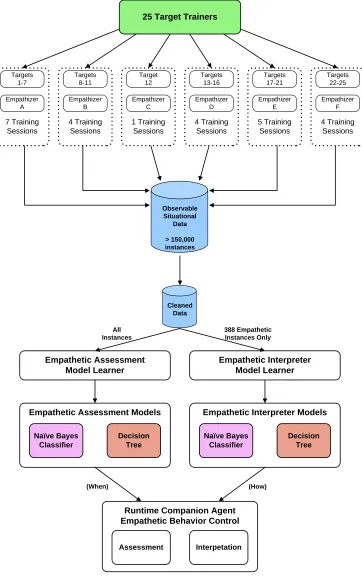
The following procedural steps were used to generate models of empathy from the training sessions (Figure 5-1 presents the evaluation data flow):
• Data Construction. Each session log, containing 6,000 – 9,000 observation
changes, was first translated into a full observational attribute vector. For example, if a treasure box came into view (and all other observable attributes remained constant) then the observational attribute vector would modify the previous vector to account for the noted change.
• Data cleansing. After data was converted into the observational attribute vector
format the data was ready to be cleaned. This step included generating the dataset containing only records in which the empathizer selected an empathetic emotion.
• Naïve Bayes classifier and Decision Tree analysis. Once the dataset was ready it
was loaded into the Weka machine learning package [Witten and Frank 2005], a naïve Bayes classifier and decision tree were learned, and tenfold cross-validation analyses were run on the resulting models. The entire dataset was used to generate models for empathetic assessment (when to be empathetic) and empathetic interpretation (how to be empathetic). Empathetic assessment is determined using the entire dataset, while empathetic interpretation is determined from a transformed dataset containing only empathetic records.
25 Target Trainers 7 Training Sessions Empathizer A Targets 1-7 Naïve Bayes Classifier
Empathetic Assessment Models Empathetic Assessment Model Learner 4 Training Sessions Empathizer B Targets 8-11 1 Training Sessions Empathizer C Target 12 4 Training Sessions Empathizer D Targets 13-16 5 Training Sessions Empathizer E Targets 17-21 4 Training Sessions Empathizer F Targets 22-25 Decision Tree Naïve Bayes Classifier
Empathetic Interpreter Models
Decision Tree Observable Situational Data > 150,000 instances
Runtime Companion Agent Empathetic Behavior Control
5.3 Results
The following sections report results from the training sessions and on the performance of constructed models of empathetic assessment and empathetic interpretation.
5.3.1 IRI Empathy Instrument Results
Figure 5-4: Average Empathizer IRI Subscale Results by Gender.
5.3.2 Model Results
Models were induced from data collected in the training sessions described above. As noted earlier, 192 observational attributes were used to define the feature vectors. Figure 5-8 shows the ROC curves for CARE’s naïve Bayes and decision tree approaches for modeling
empathetic assessment. Figures 5-10 through 5-13 show ROC curves for CARE’s naïve Bayes and decision tree approaches for empathetic interpretation modeling. Associated areas under the curve can be found in the figures’ captions. Additional tables and figures reporting the statistical performance of the models below can be found in Appendix A.
Cross-validated ROC curves are useful for presenting the performance of classification algorithms for two reasons. First, the curve represents the positive classifications (true positives), included in a sample, as a percentage of the total number of positives along the vertical axis, against the negative classifications (false positives) as a percentage of the total number of negatives [Witten and Frank, 2005]. Second, the area under the ROC curve has widely been accepted as a generalization of the measure of the probability of correctly classifying an instance [Hanley and McNeil 1982].
Figure 5-8: ROC Curves for Empathetic Assessment. The ROC curves for each model predicting assessed empathetic behavior triggers in a ten second interval. The area under the Naïve Bayes curve is 0.72 and the area under the Decision Tree curve is 0.89.
hallway of the Treasure Hunt virtual environment. This locational feature coupled with several other observational attributes were used to construct shallower decision trees compared to the decision tree (Figure 5-9) for determining when to be empathetic.
Second, the naïve Bayes classifier was best suited to modeling empathy interpretation, i.e., it was better able to determine how to be empathetic. The smoothness of the curve in Figure 5-8 indicates that sufficient data seems to have been used for training empathy assessment, while the jaggedness of the curve in the empathetic interpretation ROC graphs (Figures 5-10 through 5-13) indicates that more data covering a larger space of situations is called for in training empathy interpretation.
Many empathizers only rarely used particular emotions, e.g., sad, and some trainers suggested that having more affective states available would have been helpful. In general, however, it appears that effective classifiers can indeed be learned for both empathy assessment and empathy interpretation.
(a) (b)
Table 5-1: Areas under ROC curves in Figure 5-10.
Emotion Area under naïve Bayes ROC curve
Area under decision tree ROC curve
(a) Fearful 0.74 0.66
(b) Excited 0.80 0.56
(c) Frustrated 0.78 0.56
(d) Joyful 0.69 0.56
(e) Sad 0.69 0.50
(f) Relaxed 0.57 0.51
Figure 5-11: ROC Curves for Empathetic Figure 5-12: ROC Curves for Empathetic Interpretation (Valence). Prediction of Interpretation (Arousal). Prediction of high,
positive valence. medium, or low arousal.
Table 5-2: Areas under ROC curves in Figures 5-11 and 5-12.
Classification of: Area under naïve Bayes ROC curve
Area under decision tree ROC curve
Positive valence 0.84 0.74
Negative valence 0.84 0.74
High arousal 0.75 0.54
Medium arousal 0.70 0.52
Low arousal 0.60 0.53
(a) (b)
(c) (d)
Figure 5-13: ROC Curves for Empathetic Interpretation (Quadrant). Predicting empathetic interpretation as a quadrant of the two-dimensional affective space.
Table 5-3: Areas under curves in Figure 5-13.
Quadrant Area under naïve Bayes
ROC curve
Area under decision tree ROC curve
Positive valence, Positive arousal 0.84 0.71
Positive valence, Negative arousal 0.64 0.49
Negative valence, Positive arousal 0.82 0.69
5.4 Discussion
The results clearly demonstrate that a decision tree classification approach is sufficient for modeling empathetic assessment and that significantly more training is needed to produce large quantities of empathetic instances for the same approach to have such compelling results for empathetic interpretation. Although, naïve Bayes makes the assumption that all attributes of the observational attribute vector are independent – this assumption is false – it nonetheless induces a model sufficient for controlling empathetic interpretation in companion agents.
Only 388 instances were available for modeling empathetic interpretation. Collecting more data would likely improve the predictability of the decision tree classifier for interpreting how to be empathetic. We speculate that for this reason, the decision tree classifier was outperformed by the naïve Bayes classifier for modeling empathetic interpretation. Although more data would likely improve decision tree classification it is unclear whether more data would increase the true positive rate of the decision tree model such that it would surpass that of the naïve Bayes classifier.
The empathetic assessment models had over 10,000 instances from which to learn from; a significantly larger dataset. There was a sufficient amount of collected data to generate naïve Bayes and decision tree models of empathetic assessment while the transformed dataset of empathetic records seems to have been insufficient for decision tree models of empathetic interpretation.
Table 5-4: Empathizer Suggested Empathetic Emotions.
Angry (2) Curious (2)
Annoyed (2) Encouraging (1)
Bored (1) Relieved (1)
Confused (3) Worried (1)
Congratulatory (1)
Part of the post-experiment experience for target trainers was to answer several oral questions posed by the researcher. One such question concerned the target trainer’s expectations of the companion agent’s role contrasted with the role the companion agent portrayed in actual training. An overwhelming majority of target trainers expected the companion to play the role of a guide, or at least be able to make constructive comments concerning exploration by providing some form of assistance or advice. Some target trainers expected the companion agent to explore the world on her own, dividing the task between the user and the companion agent. Most target trainers described the companion agent has providing comic relief based on the current situation and still others commented that the companion agent provided emotional commentary throughout the interaction. We revisit this issue in the future work of Chapter 7.
suggesting the emotion as an additional empathetic affective state choice.
Three empathizers expressed, in post-experiment interviews, that they wished they could have experienced the target trainers’ response. Empathizers expressed that from solely watching the interaction, assessing only situational context, it was difficult to judge the impact of their empathetic selections.
Chapter 6
Related Work
The complexity of empathy as a construct prohibits models of affect, such as OCC [Ortony et al. 1988] and Smith and Lazarus [Smith and Lazarus 1990; Lazarus 1991] from effectively covering the range of empathetic behaviors permitted by our definition of empathy [Hoffman 2000]. The OCC and Smith and Lazarus models are sufficiently expressive to model the affective state of an individual agent in situations inhabited solely by that same agent. As the complexity of social situation increases (e.g., more agents) so to does the complexity of empathetic assessment and interpretation, making it less deterministic as to how one should feel, or may feel. Thus, the empirical approach to modeling empathy in combination with either OCC [Ortony et al.1988] or Smith and Lazarus [Lazarus 1991] may lead to more effective models of affect, especially for socially enriched situations were empathy occurs.
intelligent synthetic agents including several projects that have investigated empathy.
6.1 Believable Characters
in the Oz project through the emotional model described by Reilly have led to increased believability in agents and a more intensive immersion in the virtual environments. We believe that introducing empirically-grounded models of empathy, such as CARE, into
Oz-like environments would increase the believability of agents.
MRE has several opportunities to exploit empathy: (1) in its users and (2) in its accompanying agents. Users of MRE are faced with tense, emotionally-high situations, like the one described above with the emotionally expressive mother. Whether commanding officers have the opportunity to be empathetic, they are faced with an empathetically assessable situation. There are additional agents in the MRE virtual environment exposed to the same situational context, witnessing the same events as the user.
Although Gratch and Marsella use Smith and Lazarus’ model of affect they do not account for empathetic situations which seem readily available in MRE. There certainly is an opportunity to exploit empathy as a social construct in their work. Incorporating empirically grounded models of empathy into EMA would allow citizen agents to empathize with the soldiers in the environment and with the user.
6.2 Affective Agents
Several recent projects have been conducted on affective agents. Below we discuss pedagogical agents, learning companion agents, and embodied conversational agents.
6.2.1 Pedagogical Agents
Technology for Education, Lockheed AI Center and USC Behavior Technology Laboratories. Steve’s goals for a particular situation may include engaging the user, and teaching the user so that the user performs better over time [Johnson and Rickel 1998]. From such goals Steve exhibits emotions of caring about the user and desiring to ensure successful learning. Steve is happy-for the student when the student successfully completes a task and is disappointed when the student fails. A goal of the user exhibiting caution is an indication that possible actions would include fear of possible future actions and/or hope of the user performing possible actions [Johnson and Rickel 1998]. Steve not only is able to simulate the expression of motion, but through its procedural tasks, it invokes emotions in the user.
Herman-the-Bug inhabits Design-A-Plant, a knowledge-based learning environment used to explore interactive problem solving in the domain of botanical anatomy and physiology, with an animated pedagogical agent [Elliott et al. 1999; Lester et al. 2000]. Herman-the-Bug employs an affective user modeling architecture [Lester et al. 2000]. Herman-the-Bug appraises the world allowing him to interpret situations that arise which may invoke emotional responses [Lester et al. 2000]. The agent maintains emotional models about the fortune of its users, including enjoyment and happiness when goals are met [Lester et al. 2000]. Herman-the-Bug maintains structures which monitor user goals, principles and preferences and supports inferences concerning motivations and pleasure which can be used by Herman-the-Bug to produce emotional expressions to encourage a user [Lester et al. 2000].
approaches. Prime Climb investigates using affective user models derived from probabilistic approaches in educational games [Conati 2002]. It makes use of dynamic Bayesian networks to detect a variety of affective states based on the OCC model [Ortony et al. 1988]. Prime Climb links detected personality traits (extraversion, agreeableness, and conscientiousness) directly to goals associated with the math game [Conati 2002]. Bodily expression of emotion is measured, including eyebrow tracking, skin conductivity and heartbeat, while probabilities determine which trait is portrayed by a given set of measurement values [Conati 2002]. While such techniques are very representative of internal affective states and, in this case, personality traits building deployable systems cannot rely on the “wiredness” required by this implementation. Using “wired” approaches are useful for inducing models based on internal system features.
complexity. The first looked into associated meanings of agent images by asking participants what they thought the displayed figure was. Responses were categorized as either an emotion-related (sad, happy) or word association (spoon, dinosaur) response. The more complex the agent the more likely participants were to match the agents with their intended meanings. The last study focused on the role of color and shape. Color was determined to have a very low impact if any while the more complex the shape (fish and dog, vs. a geometric shape) the more the likely the agent was perceived as instructor-like. All six of Baylor et al.’s studies indicate that characteristics such as gender, ethnicity, and realism are influential agent characteristics affecting student learning experiences, in particular student affect and motivation [Baylor 2005].
6.2.2 Learning Companions
failure and frustration, required phases for becoming an expert, and in particular focus on the characteristics of the affective agent that influence sustaining a high-level of motivation to continue through failure or a state of “stuck” [Burleson and Picard 2004]. This is accomplished through two approaches: (1) manipulating the environment to maintain an optimal experience for the user and (2) promoting self-awareness to users to empower them to self-regulate their own motivation [Burleson et al. 2004]. While this work is still in its beginning stages, initial results suggest that the detection mechanisms provide enough detail to determine user affect and that affective agents can positively influence users in maintaining their motivational state and self-awareness.
6.2.3 Embodied Conversational Agents
interest in investigating notions of caring and empathetic behaviors as they play an instrumental role in relational strategies and need be considered in their model of social relationships [Cassell and Bickmore 2003].
6.3 Socially Intelligent Synthetic Agents
With demonstrated models of emotion the logical next step for affective reasoning is to create socially intelligent synthetic agents that exploit constructs such as empathy. Below work on synthetic agents that use empathy and politeness are discussed.
6.3.1 Politeness
The Social Intelligence Project led by W. Lewis Johnson is dedicated to producing socially-skilled pedagogical agents. They strive to create agents that are expressive with regard to both emotion and attitude, sympathetic and sensitive to student’s motivational states, and are polite, knowing how to appropriately interact in different social contexts. Johnson uses such agents to exploit Reeves and Nass’ findings [Reeves and Nass 1996] that people tend to relate to and other media as if such mediums were people. Adele is one of the first agents developed by Johnson. Adele is used in a medical domain setting for teaching medical materials and as an assistant to doctors in clinical workups. Making using of a variety deictic gestures and head movements Adele is able to communicate in social-normal ways [Johnson et al. 2005].
effects of social techniques, in this case politeness strategies, on the self-confidence, interest and motivation of the learner. The results of the experiment will be used to construct models of politeness for pedagogical agents in intelligent tutoring applications [Johnson and Rizzo 2004]. Politeness is a technique used when a socially rich situation assessment calls for reactive empathy. In this case, understanding the need to use positively valenced emotions to effect the learner’s motivation and self-confidence is deemed necessary. It is not the case that all instances of politeness can be handled by empathetic assessment and interpretation, but some can. Regardless, [Johnson and Rizzo 2004] and [Johnson et al. 2005] clearly identify the type of socially intelligent opportunities that are now available based on the rich models of affect [Ortony et al. 1988; Smith and Lazarus 1990; Lazarus 1991].
6.3.2 Generating Empathetic Behaviors
agents prompts similar valenced emotions. For example, if an agent is satisfied with a good grade one could expect the agent’s friends to be happy-for the agent, both are positive emotions, while happy-for is empathetic in nature. Animosity typically provokes oppositely valenced emotions between two agents. The emphasis of his system is work is reasoning about emotions for a social context. The Affective Reasoner does this by using a rule-based rule system for appraising events to determine its own emotions while modeling concern for other agents using a backward, case-based system [Elliott 1992]. It is notable, in the Affective Reasoner project emotional recognition is not solely based on the expression of other agents; rather, the significance of situational context is considered in conjunction with expression to determine other agent’s emotions. This point is an important implementation consideration since humans derive their emotions from a number of factors such as past emotion, mood, the emotions of those nearby, and the mood of the environment. Elliott’s Affective Reasoner is one the most comprehensive affective projects to date, particularly in a social interaction context.
the interviewer asks the interviewee if they would mind working unpaid overtime the interviewee may become frustrated and cause the Empathic Companion to intervene and make the user aware of their affective state so that they may cope with such a situation differently if actually presented with such a scenario. No study has yet been conducted to determine the effectiveness of the Empathic Companion; however, Prendinger et al. believe from a small experiment that the empathic feedback has a positive effect for the interviewee’s management of stress [Prendinger and Ishizuka 2005]. A direction for future work discussed later in this thesis is the inclusion of biofeedback for determining target/user affective state, such as Prendinger has done. The empathetic behaviors used in this application are purely reactive to help cope with stressful questions in an interview. The focus is narrow and does not require the breadth of empathetic behaviors and particularly parallel empathetic behaviors. It would be interesting to see how their author structured model compares to an empirically constructed model of empathy.
6.3.3 Eliciting Empathy from Users
2005]. Empathy in users accomplishes this objective because, by its very nature, empathy requires being immersed in another’s perspective. If users are able to allow themselves to feel empathetic towards agents in the world, then they have achieved a level of immersion to be empathetic and increased the believability of the target agent. Using empirical approaches to model empathy for the synthetic agents inhabiting the FearNot! environment their approach would allow a greater reciprocation of empathy and further develop believability, because users would be able to recognize other agents as responding to their own affective state and situation.
Chapter 7
Conclusion and Future Work
Recent advances in affective reasoning have demonstrated that emotion plays a central role in human cognition and should therefore play an equally important role in synthetic agents. A key affective capability of human social intelligence is empathy. Because empathy is paramount in successful human-human interactions, it would therefore be useful to endow companion agents who are to accompany users in interactive virtual environments with the ability to empathize. Empathy modeling requires accurately assessing a social context in order to determine (1) if an empathetic reaction is warranted, and (2) if so, what sort of empathetic behavior should be performed.
![Figure 2-1: The OCC Model (from Figure 2.1 of [Ortony et al. 1988]).](https://thumb-us.123doks.com/thumbv2/123dok_us/1511419.1185111/19.612.143.489.70.469/figure-occ-model-figure-ortony-et-al.webp)
![Figure 2-2: The Smith and Lazarus Model [Smith and Lazarus, 1990].](https://thumb-us.123doks.com/thumbv2/123dok_us/1511419.1185111/21.612.179.450.68.421/figure-the-smith-and-lazarus-model-smith-lazarus.webp)