UNDERWOOD, TABITHA LYNN. Individual and Contextual Factors Associated with Community Building in Apartment Complexes. (Under the direction of Roger E. Mitchell).
Although a large portion of society is housed in rental units, much of the literature on sense of community has focused on homeowners and their role in community development activities within neighborhoods. Much less attention has been paid to the circumstances under which renters become engaged in local communities. In particular, the potential for apartment complexes to serve as locations for community development and the promotion of sense of community has not been examined. As an initial step, this study explored the factors associated with apartment complex managers engaging in community building activities within their complexes. It was hypothesized that individual characteristics of the managers (i.e., perceived importance of community building to their role, managers‟ personal experience with community building in their non-work life, and favorable perceptions of renters more generally) would be associated with community building activities, and that these relationships would be moderated by a contextual variable (i.e., the perceived organizational support for community building from the management company).
A sampling frame was constructed by identifying all apartment complexes in North Carolina advertised in online search engines (e.g., Apartments.com, Forrent.com,
organizational support for community-building.
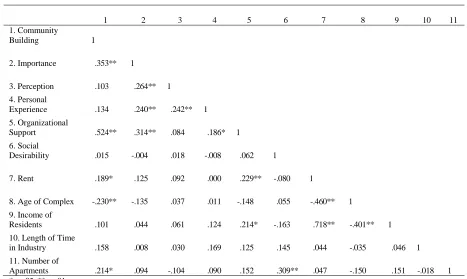
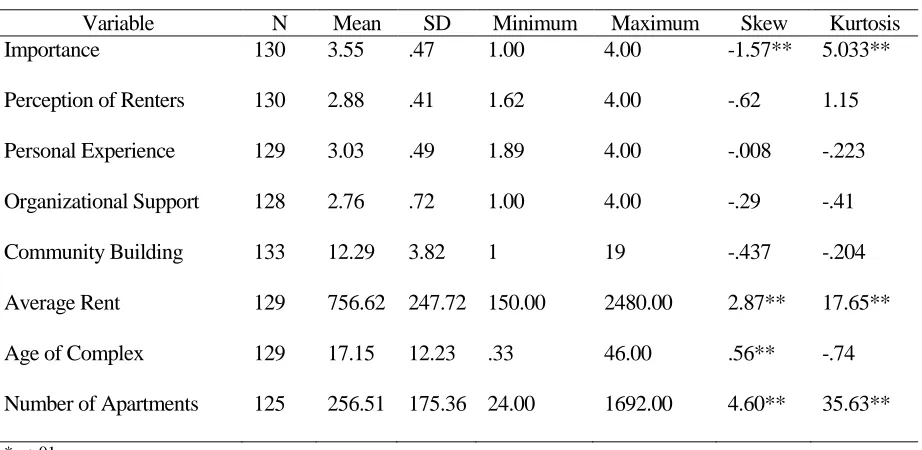
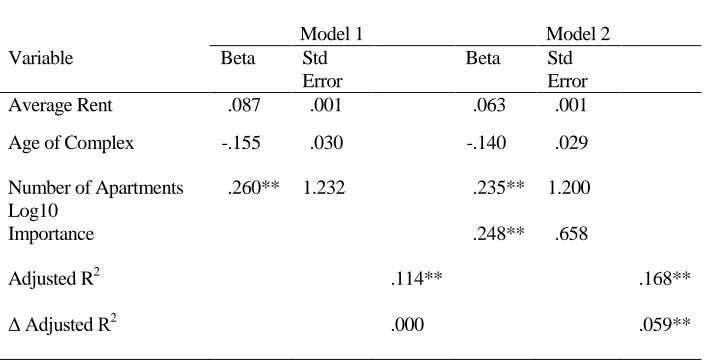
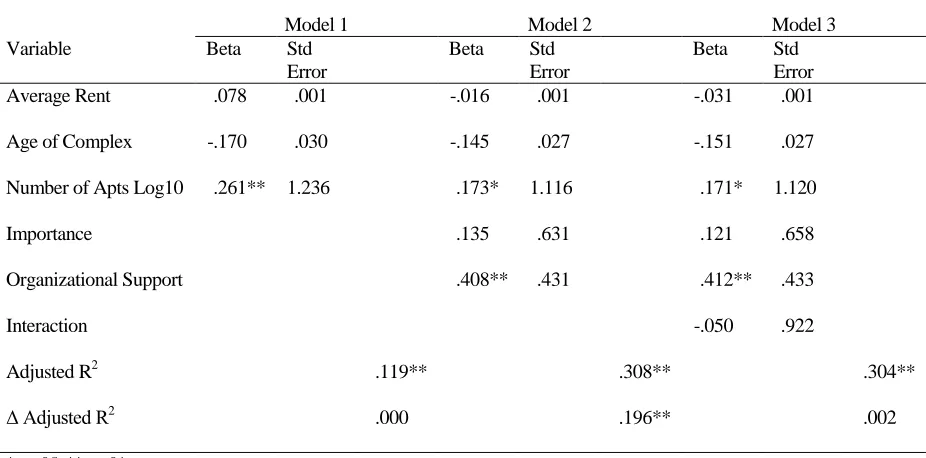
At the bivariate level, there was no relationship between managers‟ community building activities and the following variables: average income of residents, managers‟ length of time in the management industry, personal experiences with community building, perceptions of renters, and a measure of social desirability. Average rent, age of complex, number of apartments, perceived importance of community-building, and organizational support were all significantly correlated with community-building at the bivariate level. Hierarchical regressions showed evidence of a significant relationship between community building and the independent variables of number of apartments, importance of community building, and organizational support. However, the analyses failed to show evidence of a moderating effect of organizational support. Such analyses clearly indicated that organizational support was the strongest predictor of community-building activities.
Complexes
by
Tabitha Lynn Underwood
A dissertation submitted to the Graduate Faculty of North Carolina State University
in partial fulfillment of the requirements for the Degree of
Doctor of Philosophy
Psychology
Raleigh, North Carolina 2010
APPROVED BY:
___________________________ ___________________________ Jason C. Allaire Pamela P. Martin
DEDICATION
BIOGRAPHY
Tabitha Underwood grew up in Bruceville, a small town in southern Indiana. She
ACKNOWLEDGEMENTS
I would like to thank many people for helping me through this process. I would especially like to thank Roger Mitchell for his support over these long years. He has helped me through all stages of this degree including all the trials and tribulations of being a graduate student. I would also like to thank my committee for their support and always believing in me. Thank you to Jocelyn Taliaferro, Pamela Martin, and Jason Allaire. Thank you to John Misenheimer for
TABLE OF CONTENTS
LIST OF TABLES . . . vii
INTRODUCTION . . . 1
Definition of Community . . . 5
Definition of Community Building . . . 8
Community Building in Relation to Other Constructs . . . 10
Effects of Community Building . . . 13
Instances of Community Building in Apartment Complexes . . . 22
Roles of Residents and Property Managers . . . 26
Predictors of Community Building . . . 30
Individual Level Predictors . . . 31
Contextual Factors . . . 38
Other Factors Influencing Community Building . . . 40
Measurement of Community Building . . . 41
Gaps in the Literature . . . 43
Purpose . . . 45
Research Questions . . . 45
Hypotheses . . . 45
METHODS . . . 47
Setting . . . 47
Respondents . . . 47
Procedure . . . 50
Measures . . . 52
Analyses . . . 57
RESULTS . . . 58
Missing Data . . . 58
Exploratory Factor Analyses and Composites . . . 59
Descriptive Statistics . . . 63
Hypothesis Testing . . . 64
DISCUSSION . . . 72
Predictors of Community Building . . . 74
Strengths of the Study . . . 79
Limitations . . . 81
Directions for Future Research and Practice . . . 85
Conclusion . . . 87
REFERENCES . . . 89
APPENDICES . . . 101
Appendix A: Model for Hypothesis Testing . . . 102
Appendix B: Apartment Property Manager Survey . . . 103
LIST OF TABLES
Table 1. Apartment Complex Info . . . 48
Table 2. Comparison of Means for Respondents and Non-respondents . . . 49
Table 3. Reliabilities . . . 61
Table 4. Correlations . . . 62
Table 5. Descriptive Statistics . . . 63
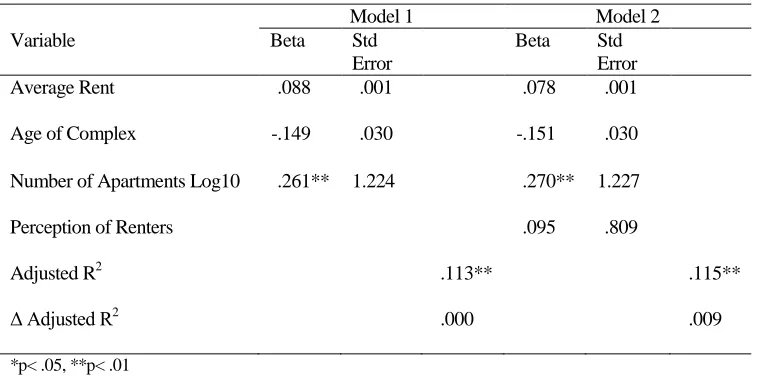
Table 6. Regression Analysis for Hypothesis 1 . . . 66
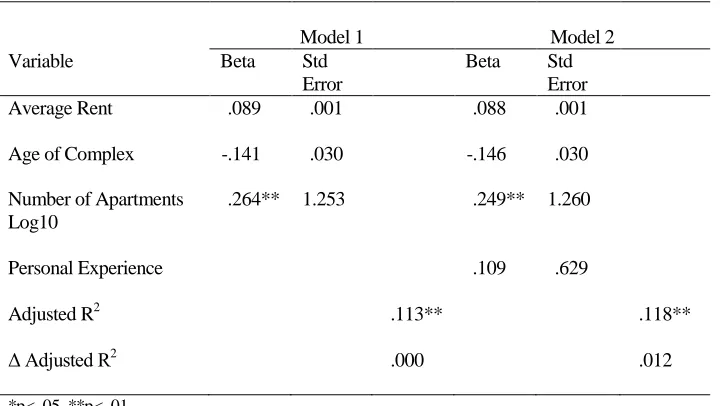
Table 7. Regression Analysis for Hypothesis 2 . . . 67
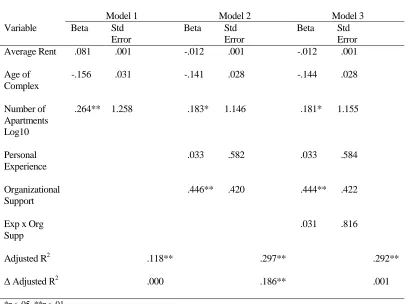
Table 8. Regression Analysis for Hypothesis 3 . . . 69
Table 9. Regression Analysis for Hypothesis 4. . . 70
INTRODUCTION
As you drive through many of our cities today, you will see that large portions of the American population are housed in high density apartment complexes. Due to increasing urban populations, the potential for urban sprawl, and the recent crisis in the housing market, there is an increasing demand for these higher density developments. Approximately 33% of the population rents, 44% of which live in complexes with more than 5 units. As of 2008, there were over 17 million individual apartment units across the US (National Multi-Housing Council, n.d. b). They are becoming fixtures in our neighborhoods and are often communities in and of themselves. Therefore, it is important to understand how these complexes operate and how they function as communities. However, little attention has been paid to the ecological context of complexes or to renters as a housing class. Part of this context includes sense of community and neighbor
interaction. The purpose of this study was to examine whether apartment property managers can facilitate community building in the complex and what influences their participation in such endeavors.
it has been linked to decreased turnover (Babka, 2008; Day, 1988). Sense of community is the result of community building which has been linked to a reduction in crime and in social and physical disorder (Sampson & Raudenbush, 1997; 1999) and enhanced well-being of the residents (Farrell, Aubry, & Coulombe, 2004; Prezza, Amici, Roberti, & Tedeschi, 2001).
Much of the literature on community building comes from work with traditional single family owner-occupied neighborhoods. In our society, the American Dream encompasses and portrays a bias toward homeownership (Barreto, Marks, & Woods, 2007; Dreier, 1982; Heskin, 1981; Lands, 2008). It is expected that people will make a natural progression from renting to owning (Perin, 1977; 1988) and that people should not be “spatially out of place” for the renting phase of their life (Perin, 1988, p.98). Renting is seen as a temporary situation reserved for certain points in the life cycle while homeownership is perceived as the housing situation that everyone should be striving to achieve. So, much effort goes into understanding and enhancing these types of mostly owner-occupied communities.
pool, or tennis court. Yet, few have neighborhood groups that work to build community among the residents. The prevailing view in community development practice seems to be that if we could just get more people into homeownership we could increase their quality of life (Glickman & Servon, 1998). What about influencing the lives of people where they are and working to make the communities and homes in which they live better?
One reason for the lack of research on apartment complexes could be the prevailing view of renters, which often includes stereotypes of transiency and apathy. Renters are often treated as second class citizens (Heskin, 1981; Perin, 1977; Perin, 1988). For instance they are not always included in communication from municipalities. Only owners are sent information about
upcoming initiatives, ordinances, zoning issues, and any other pieces of communication. There is a stereotype that renters are apathetic, uninterested in their communities, transient, and
how property managers‟ perception of renters may influence their own behaviors in terms of community building activities, not to determine the causes of the negative perceptions.
It was the purpose of this study to shed light on what is happening within apartment complexes in terms of community building activities and how those efforts can be increased. Many complexes are not fortunate enough to have a tenant association that can act in place of a homeowners association and activate social programs to build community within the complex. So, the task falls on lone renters. However, the level of community building may also be influenced by the actions of the apartment management. Research has shown that community building is most successful when there is motivation for such activities from the community itself and not imposed upon a community by outsiders. However, the existence of leadership is also a critical factor (Mattessich, Monsey, & Roy, 2004). This study proposed that property managers exist within the community and can serve as potential leaders and allies in a community building process. Traditionally community building is a grassroots process whereby residents are empowered. It was not the intent of this study to claim that community building cannot be a grassroots process nor that the residents cannot be the experts in the process. It merely suggests that one can examine the circumstances in which property managers can assist in the process and help it along.
community building. It was hypothesized that if the manager has a negative view of renters as apathetic, irresponsible, or transient, the manager may be less willing to help the residents organize or put any effort into community building. It was also hypothesized that if property managers have personal experiences with community such as interacting with their own neighbors and feeling a sense of community in their own neighborhoods or place importance on community building as part of their job they will be more likely to participate in community building.
Another mechanism is contextual, which pertains to the organizational resources and support available for community building within the complex. Property managers may want to help residents with programs to build their sense of community but do not have the staff, funding, or support to do so. In terms of organizational characteristics, it is proposed that the support received by the managers for community building will moderate the relationship between two of the individual characteristics and community building. For instance, even if managers place a large importance on community building or have an enormous amount of experience with community building, if they do not have the organizational support from the management company, they will be less likely to implement community building endeavors. The following literature review outlines what it means to be a renter in American society, what community building looks like, its effects on the individual and community, and the organizational atmosphere of apartment property management.
Definition of Community
(Heller, 1989; McMillan & Chavis, 1986; Walter, 2005). A community defined as a locality refers to a geographic area with defined boundaries and residents as members. For instance with a locality definition a neighborhood, city, or block could be considered a community. On the other hand, some have argued that groups can be merely relational and not be bound by a geographic location. A relational community is one that is based on interpersonal relationships. For instance, a church group or sports team does not have particular geographic boundaries, yet these groups have the same potential for social cohesion, strong ties, and a sense of community (Heller, 1989). A relational community is one in which members are drawn together by shared interests or skills (McMillan and Chavis, 1986). Heller (1989) proposes a third type of community, community as collective political power. This definition of community is typified by a political coalition, a group of like-minded individuals that come together to express their political will.
decisions together (4) identify themselves as part of something larger than the sum of their individual relationships (5) commit themselves for the long term to their own, one another‟s, and the group‟s well-being.” (p.10). The social interaction that forms the interpersonal relationships and in turn the sense of belonging creates a community.
Depending on the quality of the relationships, community can be seen on a continuum (Minkler, 2005) or categorized into a typology. Warren (1978) developed a typology based on three characteristics: residents‟ identification with the neighborhood, neighboring, and connection to the larger community. The combination of these three characteristics created six different types of neighborhood. They were integral, parochial, diffuse, stepping-stone, transitory, and anomic. Each has a different combination of identification, neighboring, and connection to the wider community. For instance, an integral community has high levels of interaction, strong connections to the local government and political process, and residents feel a deep sense of community with the neighborhood. Anomic, on the other hand, has a lack of resident interaction with each other and with the wider community and residents do not identify with the neighborhood. The type of neighborhood has the potential to influence the success of different interventions based on the informal helping networks in the neighborhood. In all of the above instances of defining
community, the term entails social ties and a sense of community both of which are the outcomes of community building.
This study uses Mattessich‟s (2004) definition of community developed for a study of factors that influence community building. They define it as “people who live within a
the place where they live.” (p.6). Social ties refer to the neighbor interaction and social participation in the community and the psychological ties refer to a sense of community
(Mattessich, 2004). It combines the ideas of a locality and a relational group to define community. How we define community is crucial to our practice. If community was not something more than just a locality then there would be no meaning to the practice of community building. “The goal [of community building practice] is to build the capacity of the entire system and all of its participants to operate as community” (Walter, in Minkler, 2005 p.66) and “the emergence of community depends on the opportunity for, and the impulse toward, comprehensive interaction, commitment, and responsibility.” (Minkler, 2005, p.359)
Definition of Community Building
As mentioned above, this study examined community building in apartment complexes. Community building has been defined as “any identifiable set of activities pursued by a
increasing resident interaction, neighboring, sense of community, collective efficacy, social cohesion, pro-social norms, informal social control, community organizing, etc.
Examples of how to build a sense of community and neighbor interaction include resident initiated activities, recreational opportunities, a resident organization, informal neighboring, social activities, and clubs (Zaff & Devlin, 1998). The following are examples of community building activities in homeowner communities with an association and association manager: neighborhood watch, walking groups, book clubs, and welcome meetings (Overton, 2004). In the realm of community policing, community building has been utilized by police departments through the following steps: improving neighborhood space, identifying with neighborhoods, encouraging resident efforts, resident participation, and coordinating organizations (Renauer, Duffee, Scott, Chermak, & McGarrell, 2004). Besides these examples, The Foundation for Community Association research includes a list of tips that neighborhood association managers can utilize in order to build resident involvement. These include welcoming new residents and helping them become affiliated with the activities of the neighborhood, creating activities for new residents, utilizing give-aways, sending thank-you‟s when someone volunteers, practicing positive customer service, holding board office hours and quarterly town hall meetings, celebrating successes, helping residents become involved in the wider community, facilitating awareness of local
creating human, family, and social capital that provides a new base for a more promising future and reconnection to America‟s mainstream.” (McNeely, 1999, p. 742). In all, community building helps residents claim responsibility for the outcomes of their community (McNeely, 1999).
Community Building in Relation to Other Constructs Community Organizing
Community building is sometimes used interchangeably with community organizing. Although there is overlap in the use of these terms, there are differences in emphases. Typically, the literature refers to community building as consensus based and community organizing as conflict based. Community building is seen as a neighborhood improvement strategy that focuses on developing relationships. Community organizing is seen as a confrontational strategy that focuses on changing existing power structures. Community building does not presume equality across groups yet doesn‟t focus on power differences as a starting point. It works to bring people together from multiple constituencies to solve a common problem and realize a common interest. Community organizing also works to solve a common problem, yet starts with the premise of inequality and works to change the power structures in order to combat the inequality, which in turn solves the problem facing the residents (Saegert, 2006). Saegert (2006) proposes that
methods (Gittell & Vidal, 1998). Saegert (2006) argues that we should be building civic capacity and that community building and community organizing both do just that but in slightly different ways. In general, the distinction made refers to community organizing as addressing power dynamics and community building as building relationships. However it is still unclear as to whether community building and community organizing are two separate constructs. For instance, community organizing benefits from community building. The effects of organizing could be greater if the residents know one another and feel bonded to one another before beginning to combat the existing power structures. So, currently, the literature does not support any conclusions as to whether community building and community organizing are separate constructs.
Community Capacity Building
The terms community building and community capacity building are often used interchangeably as well. According to the Aspen Institute (1996), “community capacity is the combined influence of a community‟s commitment, resources and skills that can be deployed to build on community strengths and address community problems and opportunities” (p.8). For the purposes of this study, community building creates or enhances the social capacity of the neighborhood (Nitzberg, 2005). It creates sense of community and neighbor interaction.
Community capacity is considered a broader concept. It is the community‟s capacity to create change. Social capacity is a part of that but community capacity is much more. Goodman et al (1998) proposed that community capacity has the following dimensions: participation,
understanding of community history, community power, community values, and critical reflection. Community building is not only a part of the concept of community capacity but it also has the potential to enhance any of these other dimensions. For instance, community building activities such as organizing a community watch could enhance the leadership skills of the residents. Similarly, Chaskin (2001) defines community capacity as “the interaction of human capital, organizational resources, and social capital existing within a given
community that can be leveraged to solve collective problems and improve or maintain the well-being of a given community” (p. 295). The term community building focuses on the social capital dimension of this equation.
Social Capital
with the concept of neighboring and the subjective ties could coincide with the concept of sense of community. As can be seen from these definitions, community building‟s focus is to build social capital through its efforts to increase sense of community and neighbor interaction. However, social capital can refer to broader contexts than the level at which community building works. Often, the term social capital is applied to settings as large as cities or societies. In general, social capital refers to the aggregate of social networks whether in a locality or a relational group. Effects of Community Building
Community building could have effects at multiple ecological levels. Using
community and neighbor interaction and the above outcomes (i.e. Prezza, Amici, Roberti, & Tedechi, 2001; Farrell, Aubry, & Coulombe, 2004; Davidson & Cotter, 1991; Pretty, Conroy, Dugay, Fowler, & Williams, 1996; Sampson & Raudenbush, 1997; O‟Dea Hein, 2007). However, it does not contain evidence of the direct link between community building activities and these outcomes or the link between community building activities and sense of community and neighbor interaction.
Searches of databases revealed no empirical studies of the direct link between community building endeavors and outcomes such as health, quality of life, well-being, crime, and
neighborhood improvement. During the literature review, two different databases were used for the initial search for scholarly research, Google Scholar and Web of Science. Search terms
included but were not limited to such items as community building, community capacity building, sense of community, neighboring, neighbor interaction, effects, outcomes, evaluation, health, well-being, quality of life, crime, neighborhood improvement. First, any research on community building was investigated for any indication of the link between community building and outcomes. Second, any handbooks, guides, and resources for practitioners on the subject of
quality of life, well-being, crime, and community improvement. This search revealed many more studies of this link than the one between community building and individual and community outcomes.
Personal Effects as a Result of Community Building
outcomes have been more closely examined than the links between community building, sense of community, and these outcomes
Specific activities to change the residential environment have been found to be associated with increases in sense of community, social capital, and mental health (Semenza, March, & Bontempo, 2006). Each of these has been found to be related to improvements to public spaces that build interaction. Semenza, March, & Bontempo (2006) evaluated the effects of the improvements in public spaces such as a mural, labyrinth, benches, planters, lawn chess board, and an information kiosk. Residents were brought together in workshops to collaboratively design each of the sites. Then residents who lived within a two block radius of each of the public sites were surveyed before and after the improvements. A total of 265 residents completed both surveys, which were conducted through door to door interviews. The survey tool included measures for depression, well-being, social capital, and community capacity. Results revealed a significant decrease in depression and a significant increase in sense of community, and overall social capital (Semenza, March, & Bontempo, 2006). Overall, results showed that community building activities in the form of enhancing public spaces for social interaction has a significant positive effect on the individuals who participate in such efforts.
the fact that the above mentioned work was not conducted with apartment complex residents in particular. One of these studies intentionally left apartment units out of the sampling frame, Farrell, Aubry, and Coulombe (2004). Apartment units, along with temporary shelters and nursing homes, were excluded since the original purpose of the data collection was to understand
residents‟ attitudes pertaining to living near people with mental illness. The authors believed that this issue was not relevant to these excluded populations. It is therefore difficult to assume that community building effects would extend specifically to apartment residents. Not only were apartment complexes not included in one of the studies, but some were conducted in different cultures leading to difficulty translating the results to the United States. For instance, Prezza et al (2001) and Farrell, Aubry, and Coulombe (2004) conducted their research in Italy and Canada respectively.
Another limitation in the above mentioned studies relates to the date of data collection. Many have used data collected quite a long time ago, having been collected decades ago. Indeed many cultural norms and behaviors have changed in the decades between data collection and now making it difficult to translate the effects of community building to present day. One final
limitation with the above studies concerns the correlational nature of the studies. Because the past research is correlational, causal relationships cannot be presumed from the results.
inconsistency of correlation results occurred in the Prezza, Amici, Roberti, and Tedeschi (2001) research. These results could be indicative of a contextual influence on community building. For instance, the variance in community building or in the effects of community building such as sense of community and neighbor interaction could be influenced by community level factors such as the size of the community, norms and culture, or the homogeneity of the community. These contextual factors could then influence the link between community building or sense of community and neighbor interaction and the personal level outcomes.
Locality Effects as a Result of Community Building
combination of social cohesion and informal social control is associated with lower levels of violence in the neighborhood and victimization. Sampson and Raudenbush (1999) also found that social cohesion is significantly associated with signs of public disorder. The researchers used observation of urban neighborhoods along with a survey, police records, vital statistics, and census data to examine the relationship between social cohesion and disorder. Results showed that social cohesion is negatively related to both social and physical disorder, which influence crime and the image of a neighborhood. Basic participation in the apartment building has also been found to be negatively associated with crime (Saegert, Winkel, & Swartz, 2002). Theoretically, an apartment property manager could work to facilitate the development of social cohesion. This in turn could help reduce instances of crime and the perception of crime by both insiders and outsiders.
Apartment Complex Effects as a Result of Community Building
Potentially more important for apartment property managers are the impacts that
Community building also has the potential for decreasing turnover rate. For instance, JD Power and Associates (2007) found that renters who plan on moving in the next six months will do so because of the cost of rent, noise of neighbors/neighborhood, and safety/security concerns (O‟Dea Hein, 2007). Two of these problems have the potential to be reduced by community building. For instance helping residents get to know one another through social activities and networking could increase neighbors talking with one another about their concerns and may foster a greater sense of respect. Safety concerns might be alleviated through the same resident
interaction as well as the formation of a community watch, institutionalizing youth activities, and fostering a general concern for others. Some industry professionals specifically state that building a sense of community is a tool for resident retention and that it should be planned and intentional instead of an afterthought (Babka, 2008).
decrease turnover. Although, in this study, the recreation programs might have had an impact on the residents, results were only analyzed as descriptive statistics and no correlation analyses or prediction models were used (Day, 1988).
Community building activities may be an “amenity” that fosters retention. They are part of the “little, unexpected touches that attract tenants to a property and help set it apart from its
competition” (Smith & Knoll, 1987, p.14). It shows that property managers “care about [the tenants‟] needs” (Pantzer, 1987, p. 31). Property managers are often focused only on filling vacancies and not necessarily on the little amenities that make a place a home (Mann, 1987). Executives in the apartment management industry have claimed that community building is an amenity that helps retain residents. For instance, a representative of a large management company reported increasing retention in using community building such as coordinating events at the complex such as pool parties or day trips to nearby attractions, publishing a regular newsletter, and giving tenants free flowers to decorate their balconies and patios (Pantzer, 1987). Another
grills (Bates, 1995). Community building could be an amenity offered by management companies to retain current tenants.
Community building could also be used as a marketing tool to attract new renters. For instance, the US Census Property Owners and Managers Survey (1995) found that over three quarters of respondents advertise their properties through word of mouth. Community building has the potential to increase this word of mouth advertising. For instance, if community building increases residents‟ quality of life and satisfaction with their complex they may be more likely to tell others about it and recommend it to others when vacancies arise.
Instances of Community Building in Apartment Complexes
Although the literature is sparse when it comes to community building in apartment complexes, there are a few studies that describe such efforts. Many studies that focus on any kind of community building are within college residence halls, public housing, or housing for the elderly. All of these are multi-family developments as are apartment complexes, yet somewhat different in their design and use.
One prevalent form of community building is resident management of public housing where groups of residents take leadership roles and direct the management duties of the complex. Some have succeeded and others have floundered but resident management rose to the national stage with the encouragement of public housing authorities and the Department of Housing and Urban Development (Koebel & Cavell, 1995). Some of the
reduction in maintenance costs and turnover rate, increasing pride in the complex, and developing programs that benefit the residents such as workshops, trainings, and recreational activities (Koebel & Cavell, 1995).
Another instance of community building in multi-family developments comes from student housing. A student apartment complex was equipped with an online community where residents could connect with one another in order to develop a sense of community. In talking with management, researchers found that the idea of building community in the complex was appealing to the management in the hopes of adding value to the complex, promoting the complex to new tenants, and an increase in safety. Tenants participated in the development of the online network and agreed that it would benefit the residents, enhance the quality of life, and increase sense of community (Foth, 2004).
There are a few instances in the literature that make mention of community building activities specifically in apartment complexes. For instance, the Journal of Property
Management, an industry publication for property managers, has encouraged professionals to look at community building efforts for the betterment of their properties and the residents within them. Schindler (1994) gives examples of community watch programs and their benefits. She argues that crime has grown to such a level that public safety officers cannot handle all the problems and the public should take the initiative to prevent crime in their neighborhoods. One such initiative is a community watch. She encourages property
help property managers care for the well-being of the complex and each other. Another article by Taylor (1999) in the same industry publication stressed the importance of
community building for attracting new residents as well as retention. He gives examples of community building activities that go beyond the standard pool and pizza parties such as scavenger hunt, book clubs, community gardens, guest speakers, and charity work (Taylor, 1999).
One industry professional states that building a sense of community can be
accomplished by the following techniques: “creating opportunities for shared experiences, helping residents grow roots by promoting social gatherings and other business networking opportunities, promoting events held on site that draw on common interests you have identified, offering renewal incentives like „help with your home or home office‟, assisting with shelving and closet organizer enhancements, monthly drawings and promotions, occasional weekend and after 5 pm office hours.” (Babka, 2008, p.1)
Some residents may be resistant to community building endeavors out of fear of retaliation from the property manager such as eviction. At times these fears are well founded. For instance, one resident in an upscale New York apartment complex set up a social
could bring residents into conflict with managers under some circumstances. For instance, if residents begin to interact more, they may decide to start a tenant association and make demands on the property managers. A community watch may bring to light certain crime problems, which could have negative consequences for marketing apartment vacancies.
Another reason renters may not be involved could be the lack of avenues for engagement available to renters. When compared to homeowners, renters are often less involved in their communities (Cox, 1982; Ditkovsky & van Vliet, 1984; Rohe & Stegman, 1994). A greater propensity to community involvement may not be the result of just being a homeowner. It may result from the opportunities provided homeowners yet not available to renters. Homeowners often have structures within the community where they live that facilitate social interaction and participation in organizations. They may have neighborhood or block associations or even a homeowners association that owners can join. Take for instance Rohe and Stegman‟s (1994) study that found that after having owned a home for a year and a half, residents participated in more organizations yet these were all neighborhood based organizations like homeowners associations and block groups. Those types of structures often do not exist in rental communities. Renters that live within mostly owner occupied neighborhoods also do not have to be invited to be a part of those groups. By definition, a homeowner‟s association is made up of anyone in the neighborhood who owns their home. Neighborhood associations are allowed to discriminate in allowing
Roles of Residents and Property Managers
Property managers may be in a position to provide opportunities for residents to build community in their complexes. Managers can provide ways for residents to get to know one another, and can provide structures similar to those present in owner-occupied neighborhoods that help with community building. They can provide leadership to the complex and thus are able to influence the behaviors of the residents. Leadership is important for social action within
neighborhoods. For instance using logistic regression, Foster-Fishman, Cantillon, Pierce, and Van Egeren (2007) found that higher levels of neighborhood leadership was associated with higher levels of both individual activism and collective action. Leadership has also been identified as an important dimension of community capacity that can influence change (Goodman et al, 1998; Lempa et al, 2008). Interviews with community leaders used to develop a measure of the capacity of community-based initiatives revealed that leadership was an important factor associated with the success of community initiatives (Lempa et al, 2008). Many handbooks and resource guides on community building also emphasize not only the existence of leadership but the leadership qualities needed for community building endeavors to succeed (e.g. Borrup, 2006; Mattessich, Monsey, & Roy, 2004; Shaffer & Anundsen, 1993). In all, property managers have the potential to be leaders in the apartment complex and thus can influence community building efforts within the complex.
take a leadership role in building community in the neighborhoods they manage and that they should go beyond the day-to-day technical aspects of the job to serving the residents. They state that association managers are in a position to be not only a leader but also a teacher through educating residents about community building and encouraging them to volunteer to help with such efforts. The professionals claim that this refocusing comes from the fact that people want to live in neighborhoods where there is a sense of community and good neighbor relations (Overton, 2004).
Although association management refers to managers of homeowner or condominium associations, there are parallels between it and rental property management. Both are in the business of serving people, managing housing issues, and rule enforcement. Just like traditional neighborhoods, complexes could be seen as communities and property managers are in a unique position to organize residents, facilitate neighbor interaction, and build a sense of community in the complex. Property managers are also in a prime position for community building because of the amenities available. Some complexes have community spaces that would provide for resident interaction such as a clubhouse, pool, movie theater, playground, computer resource room. Others have some programs for their residents such as the occasional social event, movie rentals, and a community garden.
Traditionally community building is a grassroots effort, initiated by residents who want to better their own lives and their neighborhood. This should also be the case within apartment complexes. However, in the instance of apartment complexes, property managers often serve as gatekeepers, especially as it relates to available resources for resident activities. This study proposes that property managers can be leaders in the community building process by
facilitating activities that help to build resident relationships. Managers may face some barriers to taking up such a role. For instance, without the support of the management
company, managers may face some push back from the company for increasing the workload of the office. They may also have to take resources away from other responsibilities in order to facilitate community building.
Since little research has been done on community building in apartment complexes it is difficult to determine whether renters or managers want community building in their complexes. This study argues that apartment complexes should be treated no differently than traditional owner-occupied neighborhoods and that they should have the opportunities for community building that neighborhood associations and homeowner associations afford homeowners. However, there is some evidence that renters do want to foster a sense of community and resident interaction. Residents have reported that they will pay more for a sense of community and that the sense of community in a complex is important in determining satisfaction with their management (Perkins, 2008).
These six factors included amenities, condition of unit at move-in, rent/value, safety, sense of community, and service staff. Results indicated that residents reporting a higher sense of community are more satisfied with their management company (O‟Dea Hein, 2007). Kingsley Associates have found that a community building technique, social activities, is related to resident satisfaction (O‟Dea Hein, 2008). However, full reports were not available to evaluate the quality of evidence to support these conclusions. There is currently no empirical basis for renters‟ and managers‟ level of interest in community building. However, one function of this study was to address this question for managers.
Further research is needed to examine whether residents participate in community building, their level of interest in such endeavors, and what influences resident participation. Beyond these questions are the issues of the costs and benefits of participation, how residents evaluate each and decide to participate. All of these are beyond the realm of this study. The
It is the intent of this study to claim that community building can make a difference in people‟s lives but it has its limitations. This study assumes that community building can enhance a person‟s quality of life and everyone should have the chance to experience it or at least have the choice to take part. We make the claim that community building is an important intervention and prevention tool; it has the possibility of enhancing the quality of life of residents; and it affords residents certain privileges typically only relegated to homeowners. If traditional owner-occupied neighborhoods have opportunities for residents to feel a sense of community and get to know one another so too should apartment complexes housing renters. With a lack of empirical evidence, it is difficult to determine the effect that community building will have on apartment complex residents but this study serves as a first step in empirical work on community building in apartment complexes.
It is also not our intention to claim that apartment property managers should be the only ones instigating and maintaining community building efforts. This is also the responsibility of residents as well as other external groups. However, property managers are in a unique position that allows them to help residents get started on the route to community involvement and improvement efforts.
Predictors of Community Building
(3) the importance they place on community building, and (4) the organizational support they receive from the management company. The indicators are conceptually separated into individual and contextual factors. Analyzing both individual and contextual factors follows Lewin‟s (1935 as cited in Bronfenbrenner, 1979) equation for behavior, B=f(PE). The equation states that behavior is a function of the interaction of the person and the environment. It emphasizes the importance of not only the individual but also the context in which an individual behaves. In this study we examined the individual factors of property managers‟ perception of renters, importance of community building, and personal experiences with community and the contextual factor of organizational support received from the management company. In order to follow Lewin‟s model we analyzed the interaction of the individual and contextual and their effects on property
managers‟ participation in community building endeavors. Individual Level Predictors
Negative Stereotype of Renters
One individual level predictor is the perception that property managers have of renters. Over the course of American history there has been a negative stereotype of renters. Since colonial times, property was the true measure of a man (Dreier, 1982; Kreuckeberg, 1999). Owning
privilege of homeowners (Capek & Gilderbloom, 1992; Dreier, 1982; Krueckeberg, 1999; Perin, 1977). Also, in certain settings, homeownership seems to declare certain rights to speak not afforded renters because they make the claim that they are homeowners or the claim that they pay property taxes (Krueckeberg, 1999; Perin, 1988).
There is a long history of negative attitudes toward apartment complexes. NIMBYism (Not In My Backyard) is a typical problem with apartment complex developments. Negative perceptions of multi-family housing include: renters are less desirable neighbors; renters
overburden the infrastructure; higher density development creates more traffic problems (National Multi-Housing Council, n.d. a); rental units decrease the resale value of single family homes (National Multi-Housing Council, n.d. a; Perin, 1988; 1977); and rental units destroy the character of single family neighborhoods (Perin, 1977; Perin 1988). Examination of pre-existing data sets has shown that each of these myths can be dispelled (Obrinsky & Stein, 2007; Urban Land Institute, nd; National Multi-housing Council, n.d. a).
Not only is there a negative stigma associated with apartment complexes, a negative stereotype of renters in general also exists. “The stigma of not owning property and its association with being poor, transient, politically suspect, and different persists in contemporary society, in community politics, in real estate markets, and in our tax structures” (Krueckeberg, 1999, p.26). One indicator of this stigma is the characterization of renters as second class citizens (Heskin, 1981; Perin, 1977), while homeownership is associated with terms such as “sense of
Even professionals in the housing and urban development field consider renters transient, apathetic toward their communities, and detrimental to neighborhoods. Perin (1977) conducted interviews centered on issues of land use and zoning with 26 development, planning, and real estate professionals involved with growth and development in Houston and Philadelphia.
Interviews were conducted with executives involved in decision-making related to development. Results indicated that renters are perceived as a different class of people with different
characteristics than homeowners. During the interviews most qualities of renters mentioned were negative, especially when juxtaposed against homeowner qualities. Examples of comments reveal that they are seen as less stable, not fiscally responsible, don‟t take care of their property, and mobile among many others. They have different motivations, different attitudes, and think differently than homeowners (Perin, 1977). It should be noted that a major limitation with Perin‟s (1977) study concerns the fact that it is over 30 years old. It is unclear whether these perceptions are relevant today given the substantive changes in American society over three decades.
characterized by a lack of pride in their property and a lack of self-respect interpreted by the participants through the upkeep of the property (Gurney, 1999).
The history of how renters are treated by governing structures is a final indicator of the negative stereotypes of renters. Case studies of local revitalization efforts in Minneapolis and St. Paul revealed during local hearings that neighborhood groups espoused beliefs that renters are transient and have no connection to the neighborhood and rental housing is detrimental to neighborhoods. As a consequence, renters were left out of decision making and revitalization efforts (Goetz & Sidney, 1994). In some municipalities renters are not always sent information concerning their neighborhoods such as notices of events or public hearings. They are often only sent to owners. Also, many landlords‟ main concern is profit and not their responsibility to their tenants (Capek & Gilderbloom, 1992).
The reason for the negative attitudes toward renters could be the result of the socialization process toward housing tenure in the US. The desire for homeownership and the perception of rental housing is socially constructed. From an early age, Americans are taught that anyone‟s dream should be a family, job and homeownership. Children believe that a “normal” life means that as you progress in life, you will no longer be a renter, you will own your own house, have a good job, and start a family (Rowlands & Gurney, 2001). This socialization can be seen in the homeownership campaigns in the early to mid 20th century. While trying to increase
homeownership, it was portrayed as being patriotic and renting as un-American. In order to entice people to purchase homes, homeownership marketing strategies were used that equated
government in a time of anticommunist sentiments, masculinity, and solid family values. Renters, in turn, were portrayed as lacking loyalty to America and as detrimental to society (Lands, 2008). One wonders if these beliefs stem from the advertising campaigns of the past and not necessarily actual evidence. Although property managers may be more sensitive to the needs of their
residents, they may have still been socialized to believe that homeownership is the end all be all of housing tenure and renting is temporary and somewhat undesirable for most (Flint & Rowlands, 2003). Property managers‟ views of renters could also stem from a possible connection between renting and social class. In all, their experiences with existing social norms will affect
preconceived notions of a negative stereotype of renters.
It was hypothesized that if property managers have negative attitudes toward their renters that pertain to their responsibility and engagement, the managers would be less likely to help them with community building endeavors. If the managers feel that renters don‟t care about their apartments, don‟t want to be involved in community endeavors, or don‟t take responsibility for their actions, they may be less likely to help them become engaged in the community or improve the conditions of that community.
Personal Experiences with Community Building
Another personal factor proposed to be associated with community building is the property managers‟ experiences with community building. It was hypothesized that if residents have experiences in their own neighborhoods such as feeling a sense of community and
Ouellette and Wood (1998) found that when past behavior is not a habit or must be applied to a different context than the one in which it was originally learned, the relationship between past behavior and future behavior is mediated by intentions to perform such behavior. Translating this into the context of property managers and apartment complexes, past experiences with community building in their own neighborhood builds a familiarity with neighboring, sense of community, and their positive outcomes which will increase the likelihood for intentions to behave in the same way in the complex, a different context than their own neighborhood. These intentions then result in participation in community building just as in their own neighborhoods. Within the field of associational involvement, Hooge (2003) found that both the number of active voluntary association memberships and the number of memberships in voluntary associations individuals have ever had are positively significantly associated with neighborhood involvement. Past voluntary behavior leads to other voluntary behavior even in different contexts. The past experience did not need to be in a neighborhood context to influence behavior within a neighborhood.
neighborhoods will reduce some of the barriers to understanding the impact of community building and the process of implementation. It will help the property managers understand what it means to feel a sense of belonging and how to interact with their neighbors which will make it easier for the property managers to understand how community building works.
Importance Placed On Community Building
Apartment property managers may place little importance on community building seeing it as part of the periphery of their job instead of an integral part of their work. One property manager handbook states that property managers have the following duties: marketing, leasing, maintenance, grounds, fiscal control, budgeting, office management, rent collection, service of legal notices, staff supervision and training, and resident relations and retention. Community building could fall into the category of resident relations and retention. However, when explaining these duties, the authors emphasize four components. They state that in order to retain residents property managers must communicate the policies, be courteous, friendly, and professional, handle complaints and service requests, and maintain privacy and security. The authors briefly touch on social activities, stating that they could be used as a resident-manager relations technique. Social activities are the only community building technique mentioned and little attention is given to it beyond stating that it may be helpful for retention. Just from the property manager handbook reviewed here, one can see that little importance is placed on community building (Banner, 1992). Another industry publication, The Landlord Kit, a book of tools and forms also includes a small component of community building, welcoming new residents. They include a form to be
other residents like, such as their favorite restaurant and parks (Taylor, 2002). Although community building has not been found in many industry handbooks, there does seem to be at least a small emphasis placed on it. One of the aims of this study was to determine whether the importance that property managers place on community building affects the actual community building activities that they facilitate.
Contextual Factors
Organizational Support
Another factor that has the potential of influencing community building is the
organizational support provided to the property managers by the management company. The lack of organizational support or resources that the organization provides the management is also referred to as organizational constraints. This term has a more negative connotation yet carries the same meaning. Peters and O‟Connor (1980) developed a typology of constraints that included the following categories: job-related information, tools and equipment, materials and supplies, budgetary support, required services and help from others, task preparation, time availability, and work environment. It has been hypothesized that
employees may be willing and able to perform various functions of a job yet organizational constraints may keep them from performing at their potential. Therefore the level of support and resources that an organization provides its employees can affect task performance (Peters & O‟Connor, 1980; Peters, O‟Connor, & Rudolf, 1980).
crews revealed that constraints associated with equipment, materials, procedures, training, and staffing taken together are significantly negatively associated with overall performance of the road work crews. These constraints were also negatively associated with other
measures of performance such as adherence to work schedules, problem management, effort, customer service, and crew cohesion (Tesluk & Mathieu, 1999). Another study examined the relationship between goal commitment and situational constraints by surveying salespeople within multiple levels of a retail organization. Within this organization, each level of the person‟s respective department had certain goals that must be met before moving up within the organization. The authors found that salespeople who perceived a greater amount of constraints were less likely to be committed to the goal associated with their level in their department (Klein & Kim, 1998). Margerum (2001) used interviews and surveys with environmental organizations to determine the influences and deterrents to participation in collaborative environmental management strategies. He found that constraints such as a lack of staff and training, costs of participation, and a lack of perceived relevance of the problem to the organization all contributed to the decision to not join the partnership.
support would moderate the relationship between property managers‟ personal experiences with community building and community building activities in the complex. The more personal experiences the property managers have with community building, the higher the level of
community building facilitation by the managers. However, just as in the previous hypothesis, this relationship will differ depending on the level of organizational support received.
Other Factors Influencing Community Building
Measurement of Community Building
One of the biggest gaps in the literature on community building concerns its measurement. For the purposes of this literature review two different databases were used for the initial search for measures, Google Scholar and Web of Science. Individual journals that have the potential to contain studies related to community building or housing were also explored including the Journal of Property Management, Housing Studies, Journal of Community Psychology, American Journal of Community Psychology, Housing Policy Debate, Urban Affairs Quarterly, and Urban Affairs Review. Search terms included but were not limited to such items as community building, community capacity, sense of community, neighboring, neighbor interaction, apartment, renters, housing, social capital, and neighborhood participation. The results of these searches yielded mainly measurement instruments for individual components of community building such as community problem solving or constructs that are the outcomes of community building such as sense of community and neighbor interaction. No instruments were found that measure a variety of community building activities.
There are limitations with developing a community building measure. First, there are limitations with self-report surveys versus observational measures. When asking managers to report activities having taken place over the last year, there may have been issues with accurate recall. Observation would allow for direct recording of activities that take place throughout the year. However, cost and time limitations make such techniques difficult to implement. With self-report there may also be issues with social desirability bias. If managers believe that self-reporting more community building activities is more socially desirable then they are more likely to report more activities. However, a social desirability scale was included in order to measure this bias and results indicated that social desirability was not a factor for community building. It was not found to be significantly correlated with community building.
Second, there are issues with using the perspective of managers. There may be community building activities occurring initiated by the residents about which the managers do not know. The managers may not be facilitating any community building but residents have taken it upon
themselves to build sense of community and resident interaction. In theory, the apartment complex could have a high level of community building and get a great benefit out of it but the efforts are not lead by the manager. The purpose of this study was to determine the amount of community building that the managers partake in, not the overall community building that occurs in the complex. Since property managers can be seen as leaders, we examined their exercise of leadership in the complex through initiating community building.
providing space for residents to have meetings can occur constantly but helping residents with a community watch may only occur twice a year. Just because one occurs more often than the other that activity is not necessarily more meaningful or beneficial to the residents. This also makes finding response options that work for all items extremely difficult. Managers may also have had difficulty with accurate recall.
Gaps in the Literature
There are a multitude of gaps in the literature when referring to both community building and apartment complexes. First, renters are often overlooked as a social category. They are not seen as social actors (Capek & Gilderbloom, 1992). In the social science we often categorize people by age, socioeconomic status, race, urban and rural. However, land use brings to the forefront another classification, that of renters versus owners. Renters and owners are not always seen as social categories. Renters have been a forgotten class in the community research literature (Dreier, 1982).
Second, besides renters, property managers are completely missing from the literature on communities. They are important actors in the lives of many residents, but their roles are
Goetz and Sidney (1994) studies, published each over 10 years ago. In addition, the Perin (1977) study was completed over 30 years ago.
Third, rental housing is a forgotten issue in the community building literature unless referring to public housing or senior housing. There is very little research on any rental characteristics especially with middle income apartment complexes. Although apartment
complexes could be considered communities in and of themselves, geographic communities in the literature are most often neighborhoods. There are entire disciplines based on the study of
communities but very rarely are apartment complexes included in their literature base.
Fourth, community building in apartment complexes is definitely a missing component in the literature on communities. There are a variety of examples of community building in
traditional single family detached home neighborhoods or even multi-family public housing developments. However, the average large urban apartment complex is a different environment than either of those housing situations. Besides public housing, there is little community building research on multi-family rental developments in general.
Shaffer & Anundsen, 1993; Walljasper, 2007). However, there is little empirical evidence of models of community building, effectiveness of the practices, and measurement of
community building itself. Purpose
The purpose of this study was to examine the relationship between apartment property managers‟ perceptions, importance placed on community building, personal experiences, organizational support for community building, and community building activities facilitated by the property managers.
Research Questions
Are property managers facilitating community building in their complexes? How are the individual perceptions that property managers have of renters, their personal experiences with community building, and the importance they place on it related to facilitation of community building for residents? Does the organizational support property managers are provided moderate these relationships. Appendix A illustrates the hypotheses examined in this study.
Hypotheses
community building will be significantly associated with the level of community building endeavors. More personal experiences will be associated with higher levels of community building.
HYP 3: Controlling for the covariates (average rent, length of time in management, age of complex, and income of residents), the relationship between the property managers‟ personal experiences and the level of community building endeavors will be moderated by the
organizational support the managers receive for community building. Personal experiences will be more strongly associated with community building when organizational support is greater.
HYP 4: Controlling for the covariates (average rent, length of time in management, age of complex, and income of residents), the importance that property managers place on community building will be significantly associated with the level of community building endeavors. Higher levels of perceived importance will be associated with higher levels of community building.
METHODS Setting
This study took place in North Carolina, a state ranked 13th of all 50 in the number of apartments. Eight percent of the total population lives in apartments specifically (National Multi-Housing Council, n.d. b). Given that the sample was drawn from online apartment search engines and many of the apartment complexes on those websites house a large number of people, most were located in urban or metro areas.
Respondents
Online apartment search engines were used to develop the sampling frame for the study. Apartments.com, Apartmentguide.com, forrent.com, and move.com were used. These are all online marketing tools for apartment owners and managers to find tenants. They provide a listing of apartments across the United State where prospective residents can search for properties by name, location, or characteristics. They are then provided with a listing of properties with contact information, photos, rates, amenities, and a general description of the property. First, the complexes on Apartments.com were used to develop the initial list. The other apartment websites were used to cross-check to determine if any were missing from the original list obtained from apartments.com. Searching for North Carolina apartment
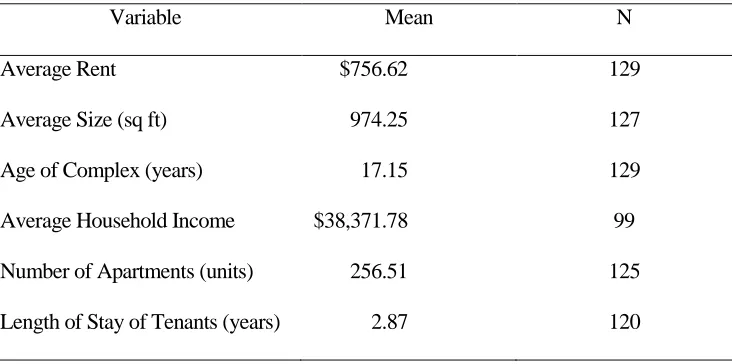
Participants were apartment property managers from large apartment complexes across North Carolina. Descriptive analyses of the demographic variables obtained from the survey revealed the following about the property manager respondents: the average age is approximately 37 years old, 88% are female, 33% rent and 21% live in an apartment on the apartment complex site, about half make $59,000 or less, the majority of respondents are Caucasian (89%), and the average length of time they have been in the industry is about 10 years. Table 1 illustrates the means for the variables in the study that measured information about the complexes. These represent the means of complex information provided by respondents.
Table 1. Apartment Complex Information from Respondents
Variable Mean N
Average Rent $756.62 129
Average Size (sq ft) 974.25 127
Age of Complex (years) 17.15 129
Average Household Income $38,371.78 99
Number of Apartments (units) 256.51 125
Length of Stay of Tenants (years) 2.87 120
Response Rate
Comparison of Respondents and Non-responders
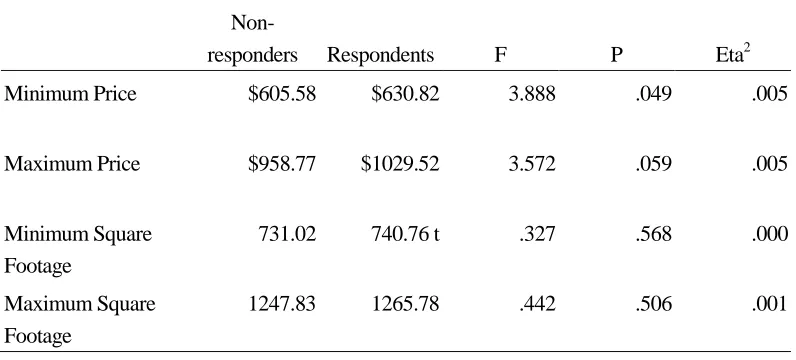
Four variables were used to compare the respondents to non-responders. Overall, the differences between these groups were minimal. These included minimum and maximum rent and square footage, each of which was obtained from the online apartment search engines used to obtain the sampling frame. Comparison across these variables found a significant difference between the respondents and the non-respondents on minimum price. The mean minimum price for respondents and non-respondents were 605.58 and 630.82, respectively. However, the effect size (eta2) of completing the survey was extremely small at .005. The difference between
respondents and non-respondents was not significant for the other three variables, which included maximum price, minimum square footage, and maximum square footage. The means for each of the three variables are listed in Table 2.
Table 2. Comparison of Means for Respondents and Non-respondents
Non-responders Respondents F P Eta2
Minimum Price $605.58 $630.82 3.888 .049 .005
Maximum Price $958.77 $1029.52 3.572 .059 .005
Minimum Square Footage
731.02 740.76 t .327 .568 .000
Maximum Square Footage
Procedure
A confidential internet survey was used to assess the community building activities of the property managers and the link between those activities and their perceptions of their residents. The survey and informed consent form were placed on a website. Typically, to increase response rate one would use Dillman‟s (2000) design which includes sending a prenotification letter, the survey, and at least two follow-ups. However, cost prohibited fully undertaking Dillman‟s design. In this study the techniques used to increase response rate was two follow-up letters, a follow-up phone call, and an incentive.
The following procedure was implemented for data collection:
1) A small group of apartment managers were asked to review the survey for clarity and readability. They were not asked to provide data.
2) A list of complexes with corresponding addresses and phone numbers was obtained from the online apartment search engines listed above. The searches yielded a total of
approximately 1200 apartment complexes for the sampling frame. A random sample of 800 complexes was drawn from this sampling frame.
4) Two weeks after the initial mailing, another mailing was sent to non-respondents. The letter was again addressed to “apartment property manager.” The letter reminded them of the survey and the incentive and provided the link to the informed consent form again. 5) While sending the letters, 19 were returned because of a wrong address. Nineteen more complexes were pulled from the original sampling frame to take the place of these with wrong address. Eighteen managers asked to be removed from the study.
6) A few weeks after the second mailing, all of the non-respondents, excluding those with wrong addresses and the refusals, were called. Phone calls were used to remind the managers of the survey and see if they had any questions about the study. Three attempts were made to either reach a person or leave a message. For those who were reached in person, the phone calls revealed that many of the managers didn‟t remember receiving either of the letters. They were asked if they would like another copy of the letter and were subsequently emailed or faxed the letter, whichever was the manager‟s preference. 7) Approximately two weeks after the phone calls were complete, all of the
non-respondents, excluding those with wrong addresses and the refusals were sent another follow-up letter.