ISSN(Online): 2320-9801 ISSN (Print) : 2320-9798
I
nternational
J
ournal of
I
nnovative
R
esearch in
C
omputer
and
C
ommunication
E
ngineering
(An ISO 3297: 2007 Certified Organization)
Vol. 4, Issue 2, February 2016
Comparative Analysis of Different Modulation
Techniques Used in Fiber Optical CATV
System
Chaithran V1, Pratheesh P2
PG Student [OEC], Dept. of ECE, TKM Institute of Technology, Kollam, Kerala, India1
Assistant Professor, Dept. of ECE, TKM Institute of Technology, Kollam, Kerala, India2
ABSTRACT: By the introduction of 1550 nm technology, fiber optic cable television (CATV) transport systems have
recently been enhanced. The signal can be directly or externally modulated. Directly modulated system is an economic method,but laser chirping issues limit the system performance. External modulation eliminates laser chirp by using an external modulator which increases the capital expenditure. In order to provide an economic structure with advanced transmission performance direct modulation method is often combined with some improvement techniques to obtain high performance and low cost CATV system. The split band technique is one of the improvement technique used for the CATV transmission. Comparison of direct, external and split band technique is done by using an electrical power meter visualizer.
KEYWORDS: Cable Television (CATV),Direct modulation, Electrical power meter visualizer, Laser chirp, Split band
technique
I. INTRODUCTION
Cable Television (CATV) initially introduced in rural areas that were beyond the range of broadcast transmissions and for those living in shadow zones in 1948.CATV transmission systems have promoted from coaxial cable based one way transmission to modern two ways hybrid fiber transmission.It originally stood for Community Access Television or Community Antenna Television, in areas where over-the-air reception was limited bydistance from transmitters or mountainous terrain. The first networks to include a fiber node type technology were built beginning in 1990. CATV networks today are built exclusively using Hybrid Fiber-Coaxial(HFC) design and older networks are being retrofitted to receive the benefits of HFC [1]. As a result, most CATV networks today are based on fiber node based architecture, but they also include elements of the older coaxial networks. The HFC network design helps reduce many of the amplification and attenuation issues and other issues associated with all coaxial cable plants. HFC cable networks can be extended significantly further than coaxial networks without the need for amplification. Because the signal travels over optical fiber, the physical distances between head end and subscriber can extend to more than 100 kilometres much further than in a coaxial based plant.
ISSN(Online): 2320-9801 ISSN (Print) : 2320-9798
I
nternational
J
ournal of
I
nnovative
R
esearch in
C
omputer
and
C
ommunication
E
ngineering
(An ISO 3297: 2007 Certified Organization)
Vol. 4, Issue 2, February 2016
II. RELATED WORK
In [4] authors proposed and experimentally demonstrated directly modulated fiber optical CATV system with split band technique employing side mode injection locked and semiconductor optical amplifier based optical single sideband modulation techniques. Excellent performances of carrier-to-noise ratio (CNR), composite second order (CSO), and composite triple beat (CTB) were achieved over single-mode fiber (SMF) transmission.
In [5] authors theoreticallyanalysed dispersion compensation effect of the chirped fiber grating (CFG) incable television (CATV) systems with directly andexternally modulated transmitters. Simulations aregiven for two kinds of modulations and for non-zero dispersion shift fiber (NZDSF)andstandard single mode fiber systems. It is proposed that directly modulated source can be used as atransmitter in CATV systems combined with tunable CFG dispersion compensator being adjusted precisely, whichis more costeffective than externally modulation technology.
III. SYSTEM MODELLING
In optical CATV systems, direct modulation method can provide an economic structure with advanced transmission performance as in external modulation system by combining it with other techniques.
A. Direct Modulation
Optical communication systems have been operating with direct modulation. That is, the input directly modulates the laser diode biasing current in order to produce a time varying output optical power. This method of modulation has proven satisfactory for low transmission rates [6]. The block diagram of a directly modulated CATV system is shown in Figure 1. Here the input signal from the signal generator is directly fed into laser source. An optical amplifier is placed after the laser source in order to amplify the modulated signal. Finally the amplified signal is received by the receiver. Direct modulation imposes limits to system performance because of laser diode non linearities and broader spectral line width. These two factors are very critical to high speed optical systems because they contribute to the undesirable pulse dispersion and the generation of relevant distortion products
.
Figure 1: Basic block diagram of a directly modulated CATV system
B.External Modulation
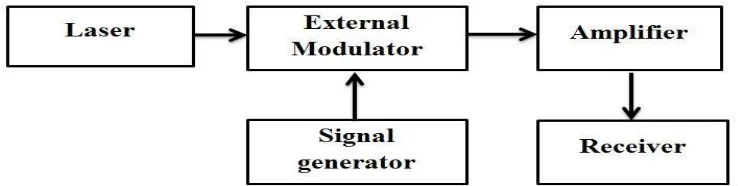
The external modulation scheme provides better outcomes by eliminating the laser chirping issue. Nevertheless, an expensive external modulated transmitter is required, which increases the capital expenditures. The block diagram of an externally modulated CATV system is shown in Figure 2. Laser source and information signal are fed to an external modulator. Interaction of laser with input signal lead to phase modulation and this phase modulation is converted to intensity modulation within the external modulator. So that the spectral linewidth is broadened causing reduced stimulated Brillouin scattering effect and also eliminates laser chirping issues [7].
ISSN(Online): 2320-9801 ISSN (Print) : 2320-9798
I
nternational
J
ournal of
I
nnovative
R
esearch in
C
omputer
and
C
ommunication
E
ngineering
(An ISO 3297: 2007 Certified Organization)
Vol. 4, Issue 2, February 2016
C. Split Band Technique
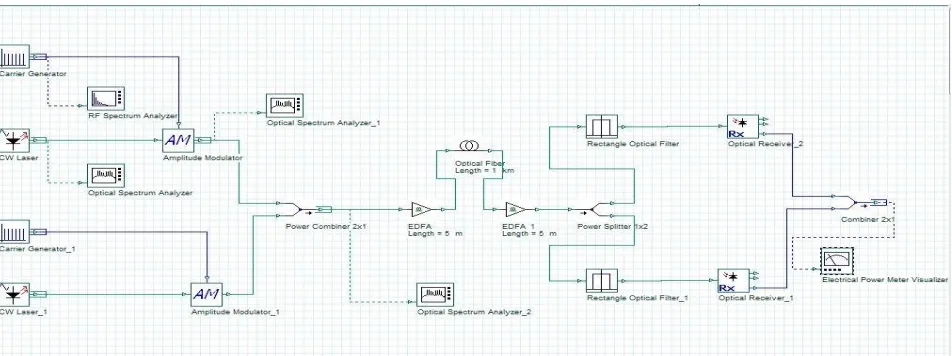
The split band technique is a powerful assistant for direct modulation CATV systems which is an improvement technique in direct modulation by eliminating the chirping issues. In this structure, the full channel loading is shared by additional laser diodes causing a wider optical line width to eliminate the Stimulated Brillouin Scattering (SBS)degradation.In split band technique, the full signal is shared by two lasers which broaden the spectral line width as shown in Figure 3. Then the signal from the lasers is amplified by an optical amplifier and the output is obtained from the optical receiver.
Figure 3: Block diagram of split band technique.
IV. DESIGN AND SIMULATION
Simulations of directly and externally modulatedCATV systems and the enhancement technique for direct modulation is executed by using OptiSystem software which is developed by Optiwave to perform complex optical communication simulation and also provides an easy user interface which is common to many other electrical engineering tools.
A. Direct Modulation
The input signal from the carrier generator which is a component which generatesa user-defined number of carriers and the output is a sum of sinusoidal electrical signals with constant amplitude. Carrier generator and Continuous Wave (CW) laser with 1550nm wavelength and power of 30dBm is given to amplitude modulator. After the signal is amplified by EDFA the signal passes through optical fiber and the optical signal is converted to electrical signals by optical receiver. Output power with different fiber length is obtained by the electrical power meter visualizer.
ISSN(Online): 2320-9801 ISSN (Print) : 2320-9798
I
nternational
J
ournal of
I
nnovative
R
esearch in
C
omputer
and
C
ommunication
E
ngineering
(An ISO 3297: 2007 Certified Organization)
Vol. 4, Issue 2, February 2016
B.External Modulation
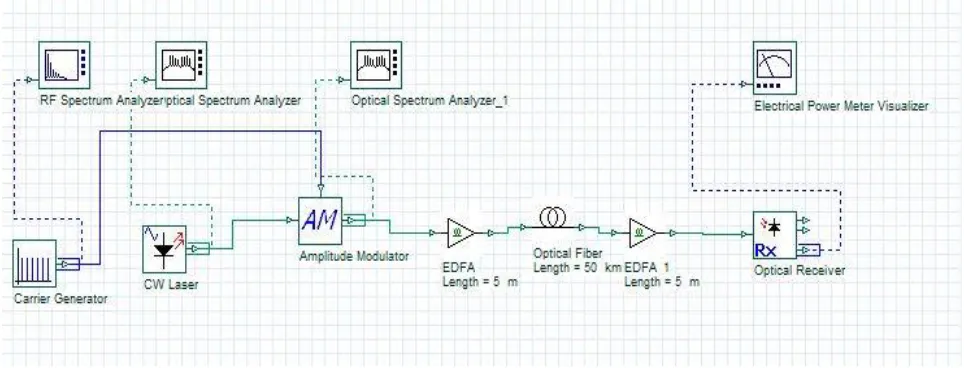
Carrier generator and CW laser with 1550nm wavelengthand power of 30dBm is given to the Mach Zehnder modulator. The interaction of the 1550 nm laser light and the RF-generated electric fields leads to a phase modulation via the electro optical effect [5]. The phase modulation was then converted to intensity modulation within the external modulator. EDFA is placed in order to amplify the signal and passes through optical fiber. Electrical output power from the optical receiver is visualized by means of the electrical power meter visualizer.
Figure 5: Simulation layout externally modulated CATV system.
C. Split Band Technique
Two directly modulated transmitter is used consisting of two carriergenerators, one with lower bands and other one with higher bands as shown in the simulation layout in Figure 6. The central wavelengths of the two CW laser diodes are 1550.5nm and 1555.7nm, respectively and both the lasers have 30dBm power. Then the power of these two signals is combined by a 2x1 power combiner passed through EDFA. Amplified signal passes through optical fiber and the signal is split by a power splitter and the signal is filtered by rectangular optical filter, then the optical signal is converted to an electrical signal by an optical receiver and the output power is visualized by the electrical power meter visualizer.
ISSN(Online): 2320-9801 ISSN (Print) : 2320-9798
I
nternational
J
ournal of
I
nnovative
R
esearch in
C
omputer
and
C
ommunication
E
ngineering
(An ISO 3297: 2007 Certified Organization)
Vol. 4, Issue 2, February 2016
V. RESULTS AND DISCUSSIONS
Output power is obtained by means of the electrical power meter visualizer. This visualizer allows the user to calculate and display the average power of electrical signals and the power iscalculated at different fiber lengths. Figure 7 shows the power output for direct modulation and is of about 526.761 mW at 1Km fiber length.
Figure 7. Electrical power output of CATV system with direct modulation.
Electrical power output of external modulation at 1km fiber length is shown in Figure 8.Power is calculated for different fiber length and the output power decreases with increase in fiber length. At 1km fiber length 573.259mW power is obtained which is greater than direct modulation.
Figure 8. Electrical power output of CATV system with external modulation.
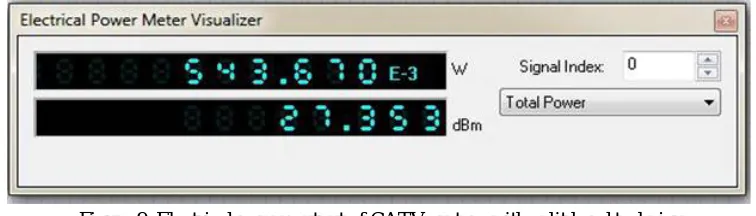
As the capital expenditure increases while using an external modulator, direct modulation is combined with split band technique in order to eliminate laser chirp. Split band technique with 1 Km fiber length is shown in Figure 9.
Figure 9. Electrical power output of CATV system with split band technique.
ISSN(Online): 2320-9801 ISSN (Print) : 2320-9798
I
nternational
J
ournal of
I
nnovative
R
esearch in
C
omputer
and
C
ommunication
E
ngineering
(An ISO 3297: 2007 Certified Organization)
Vol. 4, Issue 2, February 2016
Figure 10. Graphical representations for comparison of direct and external modulation
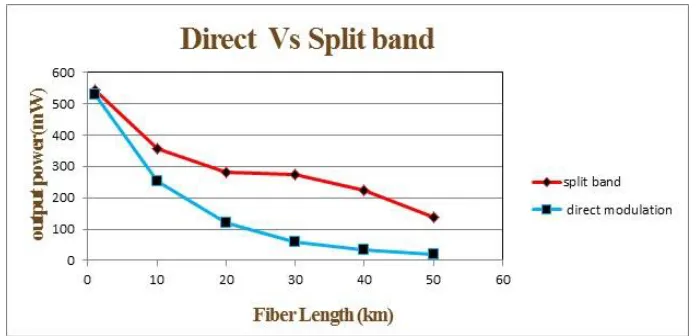
From Figure 11 it can be clearly seen that split band technique hasmuch higher output power than direct modulation as thefull signal is shared by two lasers which broadens the spectral line width. Here split band technique is indicatedby redanddirect modulation by blue.
Figure 11. Graphical representations for comparison of direct and split band technique
VI. CONCLUSION
ISSN(Online): 2320-9801 ISSN (Print) : 2320-9798
I
nternational
J
ournal of
I
nnovative
R
esearch in
C
omputer
and
C
ommunication
E
ngineering
(An ISO 3297: 2007 Certified Organization)
Vol. 4, Issue 2, February 2016
REFERENCES
1. Lidia Jordanova and Dobri Dobrev, “Improvement of the CATV Coaxial Distribution System Parameters”, International Journal of Computer Science and Network Security, volume. 12, May 2012.
2. Hai-Han Lu, Ching-Hung Chang and Peng-Chun Peng, “Improvement Scheme for Directly Modulated Fiber Optical CATV System Performances”, Frontiers in Guided Wave Optics and Optoelectronics, February 2010.
3. V. Germanov, “Calculating the CSO/CTB spectrum of CATV amplifiers and optical receivers”, IEEE transactions on broadcasting, volume: 44, September 1998.
4. W.-J. Ho, H.-H. Lu, C.-H. Chang, W.-Y. Lin, and H.-S. Su “Direct modulation with side-mode injection in optical catv transport systems”,Progress In Electromagnetics Research Letters, volume. 11, 2009
5. Qing Ye, Feng Liu, Ronghui Qu, Zujie Fang “Analysis of dispersion compensation by chirped fiber grating in directlyand externally modulated CATV systems”,Optics Communications, volume. 118, pp. 579-583.
6. Shah-Jye Tzeng,“CATV/radio-on-fiber transport system based on direct modulation”, Optics Communications, volume: 259, pp. 127−132, August 2005.
7. Larry C. Brown, “CATV Potential of Externally Modulated Lasers”, NCTA Technical Papers, September 1992.
BIOGRAPHY
Chaithran Vreceived his B.Tech degree in Electronics and Communication Engineering from
Cochin University of Science and Technology in 2014. He is currently pursuing second year M.Tech in Optoelectronics and Communication Systemsat TKM Institute of Technology.
Pratheesh Preceived his B.Tech degree in Electronics and Communication Engineering from