HIGHLIGHTED ARTICLE
| INVESTIGATION
Commonalities in Development of Pure Breeds and
Population Isolates Revealed in the Genome of the
Sardinian Fonni
’
s Dog
Dayna L. Dreger,* Brian W. Davis,* Raffaella Cocco,†Sara Sechi,†Alessandro Di Cerbo,‡Heidi G. Parker,* Michele Polli,§Stefano P. Marelli,§Paola Crepaldi,§and Elaine A. Ostrander*,1
*Cancer Genetics and Comparative Genomics Branch, National Human Genome Research Institute, National Institutes of Health, Bethesda, Maryland 20892;†Dipartimento di Medicina Veterinaria, Sezione Clinica Medica, Università degli Studi di Sassari, 07100, Italy;‡Dipartimento di Scienze Mediche, Orali e Biotecnologiche, Specializzazione Biochimica Clinica, Università degli Studi G. d’Annunzio Chieti Pescara, 66100, Italy; and§Dipartimento di Medicina Veterinaria, Università degli Studi di Milano, 20133, Italy
ABSTRACT The island inhabitants of Sardinia have long been a focus for studies of complex human traits due to their unique ancestral
background and population isolation reflecting geographic and cultural restriction. Population isolates share decreased genomic diversity,
increased linkage disequilibrium, and increased inbreeding coefficients. In many regions, dogs and humans have been exposed to the same
natural and artificial forces of environment, growth, and migration. Distinct dog breeds have arisen through human-driven selection of
characteristics to meet an ideal standard of appearance and function. The Fonni’s Dog, an endemic dog population on Sardinia, has not been subjected to an intensive system of artificial selection, but rather has developed alongside the human population of Sardinia, influenced by geographic isolation and unregulated selection based on its environmental adaptation and aptitude for owner-desired behaviors. Through analysis
of 28 dog breeds, represented with whole-genome sequences from 13 dogs and 170,000 genome-wide single nucleotide variants from
155 dogs, we have produced a genomic illustration of the Fonni’s Dog. Genomic patterns confirm within-breed similarity, while population and
demographic analyses provide spatial identity of Fonni’s Dog to other Mediterranean breeds. Investigation of admixture andfixation indices reveals insights into the involvement of Fonni’s Dogs in breed development throughout the Mediterranean. We describe how characteristics of population isolates are reflected in dog breeds that have undergone artificial selection, and are mirrored in the Fonni’s Dog through traditional isolating factors that affect human populations. Lastly, we show that the genetic history of Fonni’s Dog parallels demographic events in local human populations.
KEYWORDSdog; whole-genome sequence; demography; population structure
T
HE domestic dog has undergone intensive human-driven selective pressure in an effort to develop canines of a particular appearance or with a desired behavior pattern (Galibertet al.2011; Wayne and vonHoldt 2012). While con-siderable effort has gone into decoding the genetic basis of morphologic traits that vary within dog populations, such as body size or coat color, the challenge of identifying genomic features that distinguish breeds selected to support human survival is largely unmet (summarized in Boyko 2011;Rimbault and Ostrander 2012; Schoenebeck and Ostrander 2014). Breeds specifically suited to perform such tasks include those that excel at hunting, herding, and protection of prop-erty. An appeal to aesthetics and functional design has also resulted in selection of dogs with specific and uniform mor-phology. Since much of modern breed formation took place 100–300 years ago (Fogel 1995), restrictive geography and burgeoning industry have played a part in influencing the dis-tribution of genetic variation among isolated populations.
From a genetic viewpoint, dog breeds are defined as pop-ulations with human-induced or geographic barriers to gene flow, and fixed traits that will reliably reproduce selected characteristics through multiple generations. There are several organizations that recognize and register dog breeds. One of the largest, both in terms of breed recognition and geographic reach, is the Federation Cynologique Internationale (FCI), an
Copyright © 2016 by the Genetics Society of America doi: 10.1534/genetics.116.192427
Manuscript received June 8, 2016; accepted for publication August 10, 2016; published Early Online August 12, 2016.
Available freely online through the author-supported open access option.
1Corresponding author: National Human Genome Research Institute, National Institutes
international organization encompassing 91 member countries and recognizing 343 breeds ( http://www.fci.be/en/Presentation-of-our-organisation-4.html). The FCI, however, does not neces-sarily recognize regional varieties of dogs that exist worldwide, which are often acknowledged at only a local or niche level. Many of these dog populations have often undergone selection largely for functional purposes and behaviors that are dis-tinctly important to the humans in the region and, as such, they represent isolated and unique genetic histories.
The study of human island populations has been of consider-able interest to geneticists, as such populations often exhibit decreased genomic diversity (Sajantilaet al.1996; Capocasa et al.2014; Di Gaetanoet al. 2014), an increase in linkage disequilibrium (LD) (Bendjilaliet al.2014), and increased in-breeding coefficients (Zhaiet al.2016). These same popula-tion metrics have proven informative for the study of complex traits and heritable diseases, particularly in the context of relatively young populations that have experienced rapid growth, share a common environment and cultural practices, and frequently maintain detailed genealogical records (reviewed in Peltonenet al.2000). Populations can become genetically isolated through reproductive restraints imposed by cultural or religious practices, language, or industry. In these instances, societal restraints only influence the human gene pool, rather than other cohabitant organisms. Geo-graphic isolation, however, is an additional barrier that can affect both the human inhabitants of a region, as well as the endemic or introducedflora and fauna. The Italian island of Sardinia experiences both isolating mechanisms, providing a unique opportunity to investigate complex traits in a human population with low genetic diversity (Capocasaet al.2014; Di Gaetanoet al.2014), high frequency of private variants (Sidore et al.2015), and unique genomic ancestry (Fioritoet al.2015). The country of Italy is the site of origin for several in-ternationally recognized modern breeds such as the Cane Corso, Maltese, Neapolitan Mastiff, Spinone Italiano, Bracco Italiano, and Cirneco dell’Etna. Italy also stakes claim to a great number of regional varieties, including the Fonni’s Dog and the Mastino Abruzzese, both livestock guardians; the Cane Paratore, a herding breed; and the Levriero Meridio-nale, a sighthound. These breeds primarily exist as isolates surrounding their historic regions of origin, not having gained popularity outside local breed enthusiasts.
Among the most unique of the Italian varieties is the Fonni’s Dog, also known as the Cane Fonnese, Pastore Fonnese, or Sardinian Shepherd Dog. It is a large livestock and property guardian breed originating from the region surrounding the city of Fonni. Present in rough- and smooth-coated varieties and in varying colors, the unifying features of the breed include a char-acteristically intense facial expression and instinctive propensity toward guarding behaviors and wariness of strangers. Historical accounts portray dogsfitting this description residing in Fonni and the surrounding regions in the mid- to late-19th century (Tyndale 1849; Bresciani 1850; Cetti 1774; Edwardes 1889).
International breed recognition of the Fonni’s Dog is being pursued by a dedicated group of breeders and enthusiasts
(http://www.canefonnese.it/), with a goal of preserving the distinct heritage of this remarkable breed. Preliminary studies (Sechi et al.2016) have characterized the morpho-logical commonalities of the Fonni’s Dog, showing that they are consistent with features of a true-breeding population. Studies using a limited number of microsatellite markers sup-port this hypothesis (Sechiet al.2016).
In this study, we have used whole-genome sequence (WGS) at an average coverage of 423over 13 canids, together with SNP analysis of 173,662 variants across 155 canids, to characterize the genomic architecture of Fonni’s Dogs in the context of geo-graphically and historically proximate dog breeds (Figure 1). We investigate the similarities between human population iso-lates and dog breeds and, subsequently, breed development when driven by human-defined regulation of selection or when predominantly based on behavioral aptitude for guardian func-tions in the absence of aesthetic preference. We demonstrate the propensity for Fonni’s Dogs to display genomic characteristics equivalent to those of established and acknowledged breeds, providing a dynamic account of how geographic isolation and behavior-driven selection function to produce unique breed populations. Finally, we reveal parallelisms between the breed foundation of the Fonni’s Dog and the human population de-mographics of Sardinia, exposing an adroit consideration for investigations of population structure and the breadth of re-search application for dog breeds as population isolates.
Materials and Methods
Sample acquisition and genotyping
Blood samples were obtained and sent to the National Human Genome Research Institute (NHGRI) from six unrelated Fonni’s Dogs, one each from the Sardinian regions of Fonni, Ozieri, Cagliari, Sassari, Porto Torres, and Nuoro (Figure 1). Remain-ing dog breed samples were submitted by owners with a signed consent, in accordance with the NHGRI Animal Care and Use Committee. Genomic DNA was extracted from all blood sam-ples using a standard phenol chloroform method, aliquoted, and stored at 280° (Sambrook et al. 1989). Extractions of DNA from saliva collections were performed using the recom-mended Performagene protocol (DNA Genotek, Ottawa, ON). A set of 135 dogs representing 19 breeds (Table 1) were genotyped using the Illumina (San Diego, CA) CanineHD SNP chip, which has 173,662 potentially informative markers. Ge-notype calling was conducted in Illumina Genome Studio, with a protocol specifying a .90% call rate and GenTrain score of.0.4. Illumina Canine HD SNP genotypes for eight Maltese, two Komondors, two Spinone Italiano, and eight Bouvier des Flandres were obtained from a previous publication (Hayward et al.2016). We thus analyzed data from 155 SNP-genotyped dogs representing 23 breeds.
WGS alignment
a total of 12 dogs representing 12 breeds (Table 1). WGS from one Fonni’s Dog was produced for this study by the National Institutes of Health Intramural Sequencing Center
using the Illumina TruSeq DNA PCR-Free Protocol (Cat. #FC-121-3001). Data were aligned to the CanFam 3.1 reference genome (http://genome.ucsc.edu/cgi-bin/hgGateway?db=canFam3)
using Burrows-Wheeler Aligner 0.7.10 MEM (Li and Durbin 2009). SAMtools 0.1.10 (Liet al.2009) was used for sorting, and PicardTools 1.119 (https://github.com/broadinstitute/ picard) for screening for putative PCR duplicate reads. Local realignment was conducted with Genome Analysis Toolkit (GATK) 3.2-2 (DePristo et al. 2011) and based on docu-mented and novel indels (Axelssonet al.2013). Training sets of dbSNP and Illumina CanineHD chip positions were used for base quality recalibration. Single nucleotide variants were called with gVCF mode of HaplotypeCaller (Van der Auwera et al.2013) for each individual dog, and again jointly across all sequenced dogs. Variant quality score recalibration was con-ducted with GATK best practices and default parameters, and the initial alignment training sets. Resultant jointly called vari-ant call formats (VCFs) werefiltered for CpG islands, gaps, and repeats, based on CanFam 3.1 reference genome annotations (http://genome.ucsc.edu/cgi-bin/hgGateway?db=canFam3).
The previously unpublished WGS from the Fonni’s Dog has been uploaded to the Sequence Read Archive (http://www. ncbi.nlm.nih.gov/sra). Variants were annotated with SNPeff (Cingolaniet al.2012) based on CanFam 3.1.76 (Lindblad-Tohet al.2005).
Genomic characterization of breeds
Inbreeding coefficients and homozygosity were calculated from the SNP data using the“het”and“homozyg”functions of PLINK v.1.07 (Purcellet al.2007), respectively. Genome-wide length of homozygosity was measured using sliding windows of 5 Mb, allowing for one heterozygous call and a maximum offive missing genotypes per window. Individual regions of homozygosity were identified from SNP genotypes using PLINK v.1.07 software and the homozyg function, and required a minimum of 10 sequential SNPs with a heterozy-gous allowance of 1. Haplotypes were analyzed from regions that were shared by four of the six Fonni’s Dogs, and smaller homozygous regions of three or more sequential SNPs that were shared by all six Fonni’s Dogs were identified.
Principle components analysis (PCA) was calculated with Eigensoft v.6.0.1(Pattersonet al.2006; Priceet al.2006) and PCA plots were drawn using Partek Genomics Suite v.6.6 (Partek, St. Louis, MO). FastSTRUCTURE v.1.0 (Raj et al. 2014) was used to identify population structure from SNP data. Neighbor-joining phylogeny was constructed with Phy-lip v.3.696 (Felsenstein 1989) using a distance matrix from PLINK v.1.07 (Purcell et al. 2007) with 100 bootstrapped repetitions, and dendograms of the consensus tree were drawn in FigTree v.1.4.2 (Rambaut 2014). VCFtools v.0.1.14 (Danecek et al. 2011) was used to calculate Weir and Cockerham’s FSTfor every breed-to-breed pair. Effective population size (Ne) of each breed with greater than four dogs was estimated through SNP-based LD analysis with SNeP (Barbato et al.2015). Private variants were called for each individual dog, relative to the pool of 13 WGSs representing 13 breeds, using the“singletons”filter of VCFtools v.0.1.14 (Daneceket al.2011). These variants will be referred to as “individual”variants throughout, to distinguish them as unique to single dogs, though not necessarily indicative of breed-specific private variants.
Admixture for every breed-to-breed combination was assessed using the “three_pop” function of TreeMix v.1.12 (Pickrell and Pritchard 2012; Pickrellet al.2012) and Admix-Tools v.3.0 (Alexanderet al.2009) using the SNP data, and Analysis of Next Generation Sequencing Data (ANGSD) v.0.911 (Korneliussen et al. 2014) using the WGS data. Z scores obtained from Patterson’sDand f3 for introgressions involving Fonni’s Dog were compared across computational algorithms, and admixing events suggested by two or more programs were identified for further consideration. A critical Zvalue of |Z| = 3 was used to determine significance. The SNP data from the Mediterranean breeds was analyzed in TreeMix v.1.12 to produce phylogenies with the most likely introgression events, allowing for 1 through 10, 15, and 25 possible migrations.
Table 1 Type and number of dogs used in analyses
Breed Abbreviation Processa No. WGS source
Anatolian Shepherd ANAT SNP 6
Azawakh Hound AZWK SNP 5
Berger Picard BPIC WGS 1 SRR2016171
Bouvier des Flandres BOUV SNP 8
Cane Corso CANE WGS 1 SRR2747522
SNP 9
Cane Paratore CPAT SNP 2
Cirneco dell’Etna CIRN SNP 5
Fonni’s Dog FONN WGS 1 PRJNA318762
SNP 6
Great Pyrenees GPYR WGS 1 SAMN03801670
SNP 10
Ibizan Hound IBIZ SNP 10
Istrian Shorthaired Hound
ISHH WGS 1 SAMN02485584
Italian Greyhound ITGY WGS 1 SAMN03801673
SNP 10
Komondor KOMO SNP 2
Lagotto Romagnolo LAGO WGS 1 PRJNA318762 Levriero Meridionale LVMD SNP 2
Maltese MALT SNP 10
Mastino Abruzzese MAAB SNP 2
Neapolitan Mastiff NEAP SNP 6
Pharaoh Hound PHAR SNP 2
Portuguese Water Dog
PTWD WGS 1 PRJNA318762
SNP 10
Saluki SALU WGS 1 SAMN03801686
SNP 19
Sloughi SLOU WGS 1 PRJNA318762
SNP 5
Spanish Galgo GALG WGS 1 SAMN03168380
Spanish Water Dog SPWD WGS 1 PRJEB7903
Spinone Italiano SPIN SNP 2
Standard Schnauzer SSNZ SNP 10
Saint Bernard STBD WGS 1 PRJNA263947
SNP 10
Volpino Italiano VPIN SNP 4
SRA accession numbers are included for all WGS.
aThis column indicates individuals genotyped on the Illumina HD Canine SNP array
Data availability
WGS was produced for this study from a single Fonni’s Dog, submitted to the Sequence Read Archive (PRJNA318762) for release upon manuscript acceptance. Previously published WGS obtained from the Sequence Read Archive is listed in Table 1 with corresponding accession numbers. Genotype data from the Illumina CanineHD array has been submitted to Gene Expression Omnibus (GSE83160).
Results
A representative population of dog breeds originating in the Mediterranean
A selection of 28 dog breeds, originating from regions sur-rounding the Mediterranean Sea, was chosen for genomic population analysis (Figure 1). Numbers of dogs per breed ranged from 1 (Istrian Shorthaired Hound, Lagotto Romagnolo, Spanish Water Dog, Spanish Galgo) to 19 (Saluki). The Fonni’s Dog, Cane Paratore, Mastino Abruzzese, Volpino Italiano, Levriero Meridionale, and Cirneco dell’Etna were sampled from Italy; the Sloughi were collected from North Africa; and the Azawakh from Mali. The remaining breeds were pre-dominantly collected from the United States and are largely American Kennel Club-recognized breeds. The entirety of these breeds is referred to herein as the “Mediterranean group,”while a subset, consisting of those breeds with writ-ten or assumed history tracing to Italy (Cane Corso, Cane Paratore, Cirneco dell’Etna, Fonni’s Dog, Levriero Meridio-nale, Maltese, Mastino Abruzzese, Neapolitan Mastiff, Pha-raoh Hound, Spinone Italiano, and Volpino Italiano) (http:// www.enci.it/libro-genealogico/razze-italiane; http://www. bordercolliemuseum.org/BCCousins/EuropeWestern/Italy. html), are also classified specifically as the“Italian group.” While tracing its origin to Hungary, previous analyses (un-published data) have repeatedly shown shared genetic iden-tity between the Komondor breed and those in the Italian group. For the purposes of this study, the Komondor has been included in the Italian group. All of the above are termed “breeds”for the purposes of this study. Note, however, that a subset of breeds (Mastino Abruzzese, Cane Paratore, and Levriero Meridionale) is not officially recognized by any for-mal registry, while the remainder of the breeds have received national or international recognition.
SNP-based measures of homozygosity for Mediterranean breeds
Since decreased levels of genetic diversity can be indicative of selective breeding, founder effects, or population bottlenecks, and therefore breed formation, molecular analyses included measures of homozygosity and inbreeding coefficients for the Mediterranean breeds. The number of homozygous regions from the Mediterranean breeds (Figure 2, Table 2) with a minimum length of 1 Mb, ranged from a breed mean of 12 (Mastino Abruzzese) to 114 (Saint Bernard), with a mean of 67 across all breeds. The total length of homozygosity,
calculated as the sum of the lengths for each of the previously determined regions of homozygosity per dog and averaged across each breed, ranged from a breed mean of 101.8 Mb (Mastino Abruzzese) to 747.1 Mb (Pharaoh Hound), with a mean of 466.9 Mb across all dogs. The Fonni’s Dog had a breed range of 8–49 homozygous regions and 59.6–760.6 Mb total homozygosity, with within-breed means of 26 and 348.7 Mb, respectively (Table 2).
Individual inbreeding coefficients had a maximum within-breed mean of 0.39 (Pharaoh Hound) and a minimum of 0.03 (Mastino Abruzzese), with a mean of 0.22 across all breeds (Figure 2, Table 2). The Fonni’s Dog ranged from 0.01 to 0.30, and had a breed mean inbreeding coefficient of 0.13. Thus, the Fonni’s Dog presented homozygosity and inbreed-ing values within the range of equivalent values expressed by other Mediterranean dog breeds.
EstimatedNewas calculated for 15 breeds for which four or more dogs had SNP genotypes, over a timeframe of 13– 995 previous generations (Figure 3). The most recent Ne values, at13 generations ago, ranged from 71 (Neapolitan Mastiff) to 303 (Saluki), with an across-breed mean of 117. The Fonni’s Dog has a 13 generationNeof 113. Each breed presented a rapidly decreasingNewith a breed-specific mean
DNeranging from 81 (Saint Bernard) to 176 (Azawahk). The Fonni’s Dog displayed a comparable meanDNeof 153. Individual and expected breed range of individual variation in WGS
We next sought to compare the level of unique variation across individuals representative of the Mediterranean dog breeds to assess the distinctiveness of each breed. A substantially de-flated value of individual variation, relative to the levels in comparable breeds, would imply increased similarity to one or more of the other breeds. Individual variants were identified for each dog relative to a pool of 13 Mediterranean-breed dogs (Table 1). The resulting variants were classified as either the heterozygous or homozygous state by VCFtools. Variants found in the homozygous state in a single dog are considered representative of breed-specific variants with respect to the 13 Mediterranean breeds. However, variants identified in the heterozygous state in a single dog may represent breed-specific, though not breed-fixed, variants, or variants unique to the individual. The number of homozygous individual variants ranged from 6,776 (Spanish Water Dog) to 26,623 (Saluki) (Figure 2). The Saluki had the highest number of total individual variants (151,426) and the Istrian Short-haired Hound had the lowest number (59,838). The across-breed mean for all individual variants was 82,056, with a mean of 15,203 for the homozygous variants (Table 3). The Fonni’s Dog had 86,166 individual variants, with 9,224 present in the homozygous state.
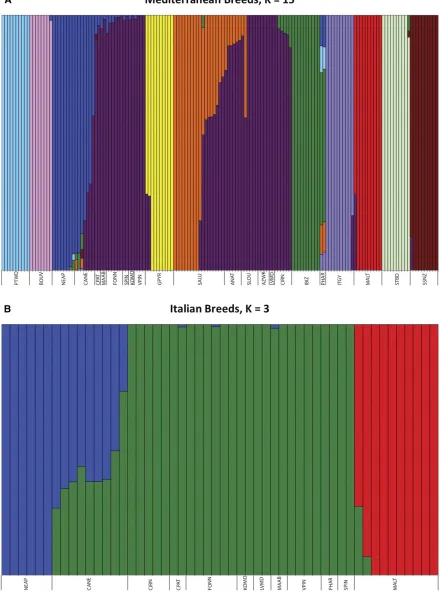
Underlying population structure of Mediterranean breeds
breeds, and 2 through 12 groupings for the Italian breeds. Maximum likelihood analyses identifiedK= 15 (marginal likeli-hood =21.00, variance = 1.2331024,DK14
–15=21.753 1023,DK15
–16= 1.9931023) andK= 3 (marginal likelihood =
21.05, variance = 1.8631025,DK2
–3=23.823 1024,
DK3–4= 4.8531024) as the statistically appropriate number of structural groupings for Mediterranean and Italian breeds, re-spectively (Figure 4). This analysis grouped the Mediterranean breeds, as well as the Portuguese Water Dog, Bouvier des Flan-dres, Neapolitan Mastiff, Great Pyrenees, Ibizan Hound, Italian Greyhound, Maltese, Saint Bernard, and Standard Schnauzer as distinct breed clusters. The Saluki primarily formed a single grouping (orange in Figure 4), with some individuals demon-strating variable levels of a common multi-breed signature (dark purple), presumably related to population substructure resulting from the region of sample collection. The Pharaoh Hound shared 59% identity with the Ibizan Hound (green), and 8–12% identity with each of Neapolitan Mastiff (dark blue), Portuguese Water Dog (pale blue), Italian Greyhound (pale purple), and Saluki. The common signature (dark purple) accounted for the majority of the Volpino Italiano, Komondor, Spinone Italiano, Fonni’s Dog, Mastino Abruzzese, Cane Paratore, Levriero Meridionale, Azawakh, and Sloughi. The Neapolitan Mastiff structure repre-sented 4–7% of the Cane Paratore; 2–5% of the Mastino Abruzz-ese; up to 7% of the Fonni’s Dog; and ,2% of the Spinone Italiano, Komondor, and Volpino Italiano. The common multi-breed signature appeared in individual dogs of otherwise distinct breeds at a rate of 13% (Standard Schnauzer) to 30% (Maltese and Great Pyrenees). While the Anatolian Shepherd and Sloughi were comprised of the Saluki (orange) signature at a level of
8–40%, the remaining identity was that of the common multi-breed cluster.
Within the Italian breeds (K= 3) the Maltese and Neapolitan Mastiff identify as single clusters, with the Cirneco dell’Etna, Cane Paratore, Fonni’s Dog, Komondor, Levriero Meridionale, Mastino Abruzzese, Volpino Italiano, Pharaoh Hound, and Spi-none Italiano combined to produce the third cluster. The Cane Corso was comprised of 27–73% of the Neapolitan Mastiff sig-nature, with the remainder being the multi-breed cluster. A total of 2 of the 10 Maltese demonstrated 7 or 27% identity with the multi-breed grouping.
Interbreed genome-wide FST values range from 0.0167 (Fonni’s Dog 3 Mastino Abruzzese) to a maximum of 0.2942 (Pharaoh Hound 3Neapolitan Mastiff) (Figure 5). Values closer to zero highlight populations that are compar-atively more genetically homogeneous, while values closer to one reflect populations with greater genetic divergence. In this analysis, the Fonni’s Dog is less diverged from the Mas-tino Abruzzese (FST= 0.0167) and the Cane Paratore (FST= 0.0284), compared to the Saint Bernard (FST= 0.1669) and the Neapolitan Mastiff (FST= 0.1591). The distance between the Fonni’s Dog and the Neapolitan Mastiff is unexpected due to the Italian heritage of both breeds.
Genetic breed variation visualized through PCA and phylogeny
PCA was conducted using two separate breed groupings: the Mediterranean and Italian groups. Analysis of thefirst four principal components (PCs) (PC1 = 5.54,P= 1.33310246; PC2 = 4.89, P= 5.68 310242; PC3 = 4.70,P = 5.683
Table 2 Inbreeding and homozygosity metrics from SNP-chip analyses, sorted by breed mean length of homozygosity
Breed No.
Inbreeding coefficient Regions of homozygosity Length of homozygosity (Mb)
Mean Min Max Mean Min Max Mean Min Max
MAAB 2 0.03 0.02 0.05 12.50 10 15 101.79 68.19 135.38
ANAT 6 0.08 0.05 0.15 14.17 7 26 124.00 387.46 301.20
VPIN 4 0.06 0.01 0.16 22.00 17 30 194.43 39.44 413.17
SLOU 5 0.12 0.02 0.19 33.00 6 61 213.91 16.29 371.94
CPAT 2 0.09 0.03 0.15 30.50 20 41 243.39 72.46 414.32
AZWK 5 0.18 0.13 0.36 36.40 26 52 268.91 91.20 644.37
SALU 19 0.18 0.02 0.37 45.32 4 83 316.90 9.24 729.28
FONN 6 0.13 0.01 0.30 26.17 8 49 348.71 59.55 760.59
MALT 10 0.20 0.10 0.34 69.50 38 96 397.53 208.98 748.85
LVMD 2 0.23 0.19 0.27 66.00 54 78 435.95 417.33 454.56
SPIN 2 0.22 0.20 0.24 56.50 51 62 436.80 381.50 492.11
CANE 9 0.16 0.02 0.42 50.67 16 75 443.81 32.00 1077.38
CIRN 5 0.20 0.08 0.38 53.60 34 85 451.72 133.27 906.52
KOMO 2 0.20 0.16 0.25 55.50 53 58 469.07 343.57 594.58
SSNZ 10 0.25 0.18 0.39 85.80 75 102 543.17 372.34 819.58
BOUV 8 0.26 0.14 0.47 76.75 57 89 554.60 257.60 1003.20
IBIZ 10 0.29 0.17 0.41 89.00 81 103 559.21 302.30 857.09
ITGY 10 0.29 0.20 0.42 91.10 69 104 607.67 411.60 884.78
PTWD 10 0.27 0.19 0.41 69.30 57 91 613.54 417.86 925.15
STBD 10 0.29 0.23 0.33 113.90 100 124 636.82 481.11 729.25
NEAP 6 0.30 0.26 0.36 105.67 98 119 637.51 507.46 818.94
GPYR 10 0.35 0.19 0.50 100.00 75 114 735.75 340.63 1096.51
PHAR 2 0.35 0.34 0.35 107.50 105 110 747.11 729.40 764.81
10251; PC4 = 4.49,P= 2.78310262) of the Mediterranean breeds (Figure 6, A and B) showed that the Saint Bernard, Italian Greyhound, and Great Pyrenees cluster as distinct breeds, independent of the others. The Neapolitan Mastiff and Cane Corso identify as separate, tightly clustered group-ings, as did the Standard Schnauzer and Portuguese Water Dog. The remaining Mediterranean breeds appeared to form loose breed clusters that were not readily distinguishable from one another. The Italian group subset improved resolu-tion between those breeds (PC1 = 3.84,P= 2.41310227; PC2 = 2.71, P= 1.40 310223; PC3 = 2.03,P= 1.83 3 10213; PC4 = 1.65, P= 1.88 3 10205) (Figure 6, C and D). The Cane Corso and Neapolitan Mastiff continued to form distinct clusters in close proximity to each other. The Maltese formed a clear cluster, and the Pharaoh Hound and Cirneco dell’Etna grouped together. However, the Cane Paratore, Fonni’s Dog, Komondor, Levriero Meridionale, Mastino Abruzzese, Spinone Italiano, and Volpino Italiano did not resolve into distinct breed clusters. Further reduction of these regional breeds (Figure 6, E and F) resolved PC1–3 into breed-specific clusters, though without statistically significant separation (PC1 = 1.51, P= 0.510; PC2 = 1.46,P = 0.319; PC3 = 1.40,P= 0.185). The Spinone Italiano and Levriero Meridionale were most divergent from the others. The Mastino Abruzzese, Cane Paratore, and Komondor breeds were distinct, yet closely related, groups. The Volpino Italiano and Fonni’s Dog, while also distinct groupings, were more diffuse.
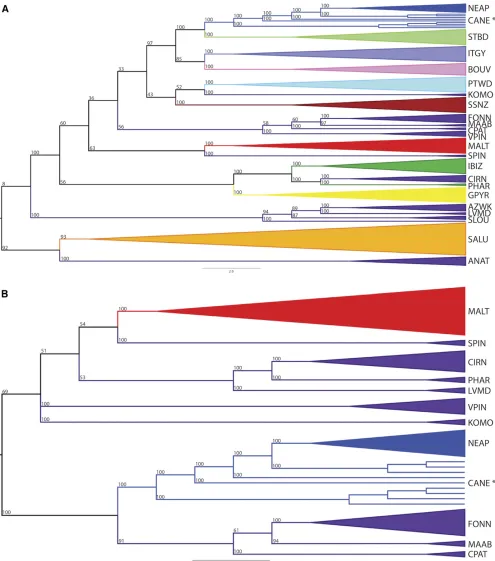
Similar phylogenetic relationships were also observed among the same dogs (Figure 7). As with the PCA, the clad-ograms indicated that the Cane Corso and Neapolitan Mas-tiff, and the Standard Schnauzer and Portuguese Water Dog, are closely related. However, the common structural
group-ing, visualized using analysis with the STRUCTURE program (purple in Figure 4), encompassing the Cane Paratore, Mas-tino Abruzzese, Fonni’s Dog, Spinone Italiano, Komondor, Volpino Italiano, Saluki, Anatolian Shepherd, Sloughi, Aza-wakh, Levriero Meridionale, and Cirneco dell’Etna, separated in the cladograms in a manner that best reflected the mor-phological or ancestral commonalities between breeds. For instance, the Cirneco dell’Etna, Pharaoh Hound, and Ibizan Hound, and the Sloughi, Levriero Meridionale, and Azawakh formed two monophyletic groups in putative sighthound clades. The Fonni’s Dog, Mastino Abruzzese, Cane Paratore, and Volpino Italiano, were monophyletic and branched im-mediately outside of the Portuguese Water Dog and Standard Schnauzer; breeds that reflect greater phenotypic similarity with each other than with either the sighthounds or the mas-tiffs (Neapolitan Mastiff, Cane Corso, and Saint Bernard).
Admixture between Fonni’s Dogs and Mediterranean breeds
We next focused on the Fonni’s Dog in terms of its historical involvement in breed development throughout the Mediter-ranean. Breed admixture with the Fonni’s Dog was calculated using three separate algorithms (Figure 8). Introgression of the Fonni’s Dog, Portuguese Water Dog, and Cane Paratore was identified within the SNP data by the TreeMix three_pop and AdmixTools software programs. TreeMix predicted a 17.43% contribution of Fonni’s Dog to the ancestor of the Portuguese Water Dog and Cane Paratore (P= 0.00723). Patterson’sDfrom AdmixTools replicated thesefindings for Fonni’s Dog and Portuguese Water Dog withD(O, Portuguese Water Dog; Fonni’s Dog, X) = 20.0139 to 20.1287, Z=23.737 to225.274,D(O, Fonni’s Dog; Portuguese Water
Dog,X) =20.0127 to 20.1309,Z=23.078 to225.797, andD(O, Fonni’s Dog;X, Portuguese Water Dog) = 0.0100 to 0.0767,Z= 3.016 to 22.189. Likewise, AdmixTools reiter-ated the introgression of Fonni’s Dog and Cane Paratore with D(O, Cane Paratore; Fonni’s Dog,X) =20.0104 to20.1317, Z=23.108 to226.025,D(O, Fonni’s Dog; Cane Paratore,X) = 20.0096 to20.1289,Z=23.055 to225.805, andD(O, Fonni’s Dog;X, Cane Paratore) = 0.0104–0.0811,Z= 3.643–22.974.
A second instance of introgression was identified between Fonni’s Dog and Komondor within the WGS dataset, with ANGSD-calculated significant D-statistics for D(O, Fonni’s Dog; Komondor, Cane Corso) = 0.039, Z = 4.366; and D (O, Komondor; Fonni’s Dog, Cane Corso) = 0.031, Z = 3.920; and with nonsignificant values ofD(O, Cane Corso; Komondor, Fonni’s Dog) = 0.008,Z= 1.028. This was con-firmed with AdmixTools, which revealed a significantDfrom SNP data:D(O, Fonni’s Dog; Komondor,X) =20.0116 to 20.1123; andD(O, Fonni’s Dog;X, Komondor) = 0.0116–0.1280, Z= 3.142–25.720.
Introgression between Fonni’s Dog and Saluki was also observed using ANGSD:D(O, Fonni’s Dog; Saluki, Cane Corso) = 0.033,Z= 3.893;D(O, Saluki; Fonni’s Dog, Cane Corso) = 0.040, Z= 5.075; andD(O, Cane Corso; Saluki, Fonni’s Dog) =20.007, Z=21.060. These results were replicated with SNP data using AdmixTools, resulting in D-statistics ofD(Saluki,X; Fonni’s Dog, Y) = 0.007–0.131,Z= 3.047–29.352.
Separately, TreeMix predicted phylogeny trees for the Mediterranean breeds with allowance for 1 through 10, 15, and 25 introgression events. The ln(likelihood), indicating the probability of the suggested relationships explaining the ge-nomic data, for the predicted phylogenies increased with additional allowed introgressions, from ln(likelihood)1= 1599.06 and ln(likelihood)25= 1888.17. With the inclusion of 25 introgression events there was not yet any indication of decreasing ln(likelihood) and none of the proposed intro-gressions involved the Fonni’s Dog (Figure 8).
Regions of homozygosity represent putative regions of selection
To identify regions of the genome potentially under selection in the Fonni’s Dog, we calculated SNP genotypes for each of
the six Fonni’s Dogs. This revealed 258 total regions of ho-mozygosity (range per dog = 25–61), each of which spanned a minimum of 10 sequential SNP-chip variants. Seven regions were shared across four of the six dogs. Analysis of SNP hap-lotypes across each shared region revealed 11 even shorter regions, defined by three or more sequential SNPs that were shared across all six Fonni’s Dogs (Table 4). Individual dog variants extracted from the WGS sequence werefiltered for the 11 SNP-based regions of shared homozygosity, resulting in 9 heterozygous and 1 homozygous variant within the selected regions. Each of these variants was located in a noncoding region and annotated as a modifier by SNPeff. (Cingolaniet al.2012).
Discussion
Genetic investigation of population isolates can provide in-sights into inheritance of both rare and complex traits. In humans, for instance, studies of Bedouin tribes have success-fully localized causal loci for single gene traits such as Bardet– Biedl Syndrome 3 (Farag and Teebi 1989; Sheffield et al. 1994; Chiang et al. 2004), nonsyndromic hearing loss (Scott et al.1996), and infantile nephronophthisis (Haider et al.1998). Studies of the Finnish population, by compari-son, have been more useful for studies of complex traits, re-vealing genes that increase susceptibility to various cancers (Nyström-Lahtiet al.1994; Kainuet al.2000; Sarantauset al. 2000; Baffoe-Bonnie et al. 2005; Hartikainen et al. 2005; Rokman et al.2005). Icelandic populations have also been used successfully to map risk alleles associated with a variety of complex traits and psychiatric conditions (Hicks et al. 2002; Thorgeirssonet al.2003; Karasonet al.2005; Arason et al.2010).
Studies of geographically or culturally restricted breeding in human populations have also informed our understanding of movement and growth of human populations and, with them, genes of interest. For instance, characterization of point mutations associated withb-thalassemia in Kurdistan Jewish populations have identified regional admixture and founder effects specific to isolated Kurdish subpopulations (Rund et al.1991). Geographically remote populations can likewise reveal historical human migration or settlement events, ex-emplified by the Pitcairn Island population which we now know has maternal Tahitian and paternal European lineages (Benton et al. 2015). Within-country cultures that restrict marriage outside the community have proven similarly infor-mative (Ginns et al. 1998; Stone et al. 1998; Hsueh et al. 2003; Seboun et al.2005; Simpson et al. 2009; Houet al. 2013; Georgi et al.2014; Kemberet al.2015). The success of using population isolates for mapping of complex and rare disorders lies predominantly in the common features of such isolates: decreased genomic diversity, (Sajantilaet al.1996; Capocasaet al.2014; Di Gaetanoet al.2014), increased LD (Bendjilali et al. 2014), and increased inbreeding values (Zhaiet al.2016). Dog breeds reflect these same character-istics, resulting in each breed forming a distinct population
Table 3 WGS individual variants for Mediterranean breed dogs
Dog Heterozygotes Homozygotes Total
Istrian Shorthaired Hound 49,078 10,760 59,838
Lagotto Romagnolo 53,820 11,733 65,553
Berger Picard 44,080 25,049 69,129
Italian Greyhound 53,206 16,827 70,033
Great Pyrenees 54,289 22,677 76,966
Standard Schnauzer 61,347 16,572 77,919
Spanish Galgo 61,434 17,335 78,769
Saint Bernard 65,669 13,884 79,553
Spanish Water Dog 75,597 6,776 82,373
Cane Corso 72,221 12,243 84,464
Portuguese Water Dog 76,602 7,939 84,541
Fonni’s Dog 76,942 9,224 86,166
isolate formed through human intervention and selection (reviewed in Boyko 2011; Schoenebeck and Ostrander 2014). Previous molecular analyses of the Fonni’s Dog of Sardinia provide strong evidence that this niche population meets the
formal definition of a breed (Sechi et al.2016). It appears genetically distinct from other breeds in the region as mea-sured by a small set of microsatellite-based polymorphic markers, and both physical and behavioral traits are retained
from generation to generation (Sechi et al. 2016). Histori-cally, microsatellite-based studies have proven effective for differentiating between dog breeds (Parkeret al.2004; Leroy
et al.2009; Mellanbyet al.2013), identifying varieties that inhabit a common insular region (Parra et al. 2008; Pribanova et al.2009; Suarezet al.2013), or identifying a
Figure 6 PCA of SNP-chip data for (A and B) Mediterranean breeds (PC1 = 5.54,P= 1.33310246; PC2 = 4.89,P= 5.68310242; PC3 = 4.70,P= 5.68310251; PC4 = 4.49,P= 2.78310262), (C and D) all Italian breeds (PC1 = 3.84,P= 2.41310227; PC2 = 2.71,P= 1.40310223; PC3 = 2.03,
subset of the component breeds that contributed to individ-ual mixed breed dogs (Parkeret al.2004). However, since microsatellites are multi-allelic and highly mutable, they are useful largely for family studies and not necessarily
popula-tion studies, providing informapopula-tion that reflects decades and not hundreds or thousands of years. When indels and copy number variants are also considered, it is clear that canine genetic studies are best served using dense SNP-chip analyses
combined with WGS. Such methods offer the ability to use bioinformatic tools developed for problems such as popula-tion structure, a common issue in dog breeds and one for which it is nearly impossible to correct for using microsatel-lites, thus providing a degree of confidence and precision not otherwise available (Ostrander et al.1993; Franciscoet al. 1996).
The Fonni’s Dog represents an unusual case study in that it maintains a standard appearance and well-defined behavior in the absence of an organized, human-directed breeding program. Such programs are the hallmark of most modern breeds and have been key to both the development and main-tenance of purebred dogs (American Kennel Club 2006). We chose, therefore, to further investigate the Fonni’s Dog as a means to understand how an isolated population can be developed through selection based solely on functional aptitude, without dilution from surrounding mating popula-tions, to meet environmental demands (Figure 1). We pro-posed to do this by assessing the historical development of the breed and the composition of modern canine genome structure using SNP and WGS analyses.
Accounts of the Fonni’s Dog from the late 1880s describe them as“. . .a very large and shaggy haired race, half-mastiff half-bloodhound . . .” (Tyndale 1849), and a combination of“. . .the greyhound with a big dog. . .where the opposite dimensions of the greyhound and the mastiff cancel each other out”(Cetti 1774). While there is the expected level of husbandry by breed enthusiasts, selection of dogs for breed-ing purposes is based predominantly on functional ability, and there has only been a very limited organized attempt
to direct the breed or to select on the basis of appearance. The modern standard description of the breed emphasizes the fundamental hostility of Fonni’s Dogs toward strangers, natural tendencies toward territoriality, and loyalty only to its charges, much as did early descriptions of the breed (Cetti 1774) (http://www.canedifonni.it/web/en/the-official-standard/). Thus, within the context of dog breeds existing in Italy 130 years ago, the Fonni’s Dog had a noteworthy, although limited, appeal that it retains today.
To accomplish our goals, we used data from our laboratory that tested correlations between SNP-derived homozygosity values; SNP-, WGS-, and pedigree-derived inbreeding coeffi -cients; and effective numbers of early breed ancestors in-clusive of several breeds (unpublished data). This data revealed that increases in either the number or length of homozygous regions within a breed, as measured from SNP-chip data, significantly correlate with an increase in inbreeding coefficients calculated from SNP and WGS data, and also correlate with a decrease in the effective number of breed ancestors as observed by pedigree analysis (unpub-lished data). Applying those principles to the present study, we found that the sum length of homozygous stretches in the genome of Fonni’s Dogs, the number of regions of homozy-gosity, and the inbreeding values for the Fonni’s Dog were intermediate to those defining the remaining Mediterranean breeds (Figure 2). The Mediterranean breeds with lower ho-mozygosity values than the Fonni’s Dog, suggestive of a more complex ancestral history, include the Saluki, Azawakh, Cane Paratore, Sloughi, Volpino Italiano, Anatolian Shepherd, and Mastino Abruzzese. The relative ranking of the Fonni’s Dog in
Z = 23.737 to225.274;D(O, Fonni’s Dog; Portuguese Water Dog,X) = 20.0127 to20.1309, Z=23.078 to225.797; D(O, Fonni’s Dog;X, Portuguese Water Dog) = 0.0100–0.0767, Z= 3.016–22.189; Cane Paratore ofD(O, Cane Paratore; Fonni’s Dog,X) = 20.0104 to 20.1317, Z=23.108 to226.025;D(O, Fonni’s Dog; Cane Paratore,X) =20.0096 to20.1289,Z=23.055 to225.805;D(O, Fonni’s Dog;X, Cane Paratore) = 0.0104–0.0811,Z= 3.643–22.974; Komondor ofD(O, Fonni’s Dog; Komondor,X) =20.0116 to20.1123;D(O, Fonni’s Dog;X, Komondor) = 0.0116– 0.1280,Z= 3.142–25.720; and Saluki ofD(Saluki,X; Fonni’s Dog,Y) = 0.007–0.131,Z= 3.047–29.352. TreeMix predicted phylogenies with (B) 1 or(C) 25 allowed introgression events, and corresponding standard error residuals for (D) 1 and (E) 25 introgressions.
Table 4 Regions of homozygosity shared by six Fonni’s Dogs, as identified from SNP-chip analysis
Region of homozygosity Length (bp) Personal variantsa Variant impactb Gene affected
chr6:2,942,512-2,998,885 56,373 None
chr7:551,194-675,969 124,775 None
chr7:733,453-914,233 180,780 chr7:742,610 Modifier LGR6
chr7:928,930-988,934 60,004 chr7:955,472 Modifier ELF3
chr7:1,027,580-1,298,049 207,469 chr7:1,179,044 Modifier NAV1
chr7:1,190,728 Modifier NAV1
chr7:1,221,667 Modifier NAV1
chr8:1,069,127-1,108,694 39,567 None
chr13:991,157-1,022,654 31,497 None
chr13:1,115,146-1,156,529 41,383 chr13:1,131,868 Modifier VPS13B
chr13:1,157,079 Modifier VPS13B
chr13:1,272,226-1,291,574 19,348 chr13:1,290,464 Modifier VPS13B
chr13:1,571,048-1,655,073 84,025 chr13:1,572305 Modifier VPS13B
chr22:2,578,384-2,618,437 40,053 chr13:2,584,594 Modifier FNDC3A
Chr, chromosome.
terms of homozygosity and inbreeding coefficients confirms preliminary data (Sechi et al. 2016), categorizing Fonni’s Dog as a distinctive dog breed compared to a dataset of dogs from the Mediterranean region. Additionally, the rate ofDNe demonstrates that the Fonni’s Dog obtained its breed status at a rate of population consolidation equivalent to breeds regulated by intensive selection systems.
We produced WGS from a single Fonni’s Dog, sampled from the Cagliari region of Sardinia, achieving a mean depth of 363. Assessment of WGS-derived individual variants in that dog, relative to a pool of 12 additional Mediterranean dogs, was undertaken to obtain a measure of individual variation for each dog compared to representatives of distinct breeds from the same geographic region. Specific to the Fonni’s Dog were 86,166 variants, of which 9,224 were in the heterozygous state and 76,942 were in the homozygous state (Table 3). The Saluki displayed the greatest number of indi-vidual variants (151,426), with 65,260 more variants than the dog with the second-highest number of individual vari-ants, the Fonni’s Dog. However, excluding the Saluki, the 12 remaining dogs with WGS presented numbers of individ-ual variation within a range of 26,328. Therefore, the level of individual variation in the Saluki is substantially greater than any of the other breeds. Populations that have experienced intensive natural or artificial selective pressures would be expected to have a lower number of individual variants in the heterozygous state than dogs from less well-defined breeds. Conversely, individual variants are more indicative of breed-specific, though not necessarily breed-fixed, privatization (Szpiechet al.2013; Marsdenet al.2016).
Combined consideration of breed-specific measures of homozygosity, inbreeding, Ne, and individual variation fur-ther confirms our designation of dog breeds as population isolates. While the precise degrees of population homogene-ity vary between other breeds, the Fonni’s Dog has not dem-onstrated any substantial deviation from this definition of breed relative to the other Mediterranean breeds. We next addressed the observation that, contrary to most modern breeds, the Fonni’s Dog has attained this breed status without the highly structured framework of selection toward a de-fined ideal.
To determine the foundational components of the Fonni’s Dog, several analyses were undertaken. Genotype data from
150,000 SNPs were processed through the program STRUCTURE, as well as used in PCA, neighbor-joining phy-logeny, and FSTcalculations. Each associated algorithm measures distinct population characteristics: model-based clustering is calculated from the program STRUCTURE, pop-ulation differentiation from FST, definition of variable corre-lation from PCA, and visualization of genetic distances via neighbor-joining phylogeny. We found that in each of the four analyses the Cane Paratore, Mastino Abruzzese, Komondor, and Volpino Italiano were most similar, as well as closest in genomic structure, to the Fonni’s Dog. The Sloughi, Anato-lian Shepherd, Cane Corso, and Saluki were also identified by STRUCTURE and FSTas sharing ancestral similarity with the
Fonni’s Dog. Like the Fonni’s Dog, the Cane Paratore, Mastino Abruzzese, Volpino Italiano, and Cane Corso are breeds with historical origins in Italy. As is suggested by the STRUCTURE output (Figure 4), a common genetic signature is shared across the regional Italian breeds (Cane Corso, Cane Para-tore, Fonni’s Dog, Mastino Abruzzese, Spinone Italiano, Vol-pino Italiano, Levriero Meridionale, and Cirneco dell’Etna) together with a group of breeds from the South or East Med-iterranean region (Komondor, Saluki, Anatolian Shepherd, Sloughi, and Azawakh). Phylogeny and PCA aid in the reso-lution of this genetic commonality. PCs distinguish breeds within the STRUCTURE-derived common cluster, isolating the Cane Paratore, Fonni’s Dog, Komondor, Levriero Meridio-nale, Mastino Abruzzese, Spinone Italiano, and Volpino Ital-iano as distinct from the Cirneco dell’Etna, Cane Corso, Saluki, Sloughi, Azawakh, and Anatolian Shepherd (Figure 6). Phylogenetic inference for the Italian breeds further sep-arates these breeds, identifying a monophyletic clade consist-ing of Fonni’s Dog, Mastino Abruzzese, and Cane Paratore; where each breed still maintains its individuality (Figure 7). These conclusions should be interpreted with caution as a small number of dogs were analyzed for certain breeds. It is unlikely, however, that the addition of more dogs would sig-nificantly restructure the PCAs as present separation of breeds is already well defined.
Our analyses also show that the early claims of both Tyndale (1849) and Cetti (1774), who hypothesized that the Fonni’s Dog was created through a combination of breeds that resembled sighthounds and molossers, is surprisingly accurate. Instead of a greyhound and a mastiff, however, knowledge of breed origins implicates a Saluki-like coursing hound and a Komondor-like molossoid livestock guardian. Indeed, even the more geographically available sighthound (Pharaoh Hound) and molosser (Neapolitan Mastiff) breeds from Italy are demoted as plausible ancestors through FST analysis in favor of the eastern breed-type equivalents. Ex-amination of breed introgression further supports the inter-twining of the Fonni’s Dog, Komondor, and Saluki.
require fine mapping, our homozygosity analyses demon-strate that such regions exist. A total of 11 genomic regions of putative selection integral for the Fonni’s Dog have been identified (Table 4). We hypothesize that future fine map-ping of these regions will reveal genes necessary for charac-teristic behaviors of the Fonni’s Dog.
The association of the Fonni’s Dog with sighthound and molossoid breeds from the Eastern and Southern Mediterra-nean, as defined by the present study, is particularly intrigu-ing in light of genetic analyses of modern day humans. Analysis of 300 Italian people against a background of 1272 European, Middle Eastern, and North African individ-uals revealed that the population of Sardinia shows greatest genetic identity with populations from Hungary, Egypt, Israel, and Jordan (Fioritoet al.2015). The populations from the peninsular regions of Italy, however, share greater simi-larity with European cultures to the west and north (Fiorito et al.2015). Conversely, human populations across Sardinia show no population stratification based on linguistic or geographic regions, as measured by FST, STRUCTURE, or PCA (Di Gaetano et al. 2014). This implies that Sardinia was primarily populated by Eastern Mediterranean and North African peoples who, theoretically, brought dogs from their homelands, thus populating the island of Sardinia with the makings of what would in time become the Fonni’s Dog. Once inhabited, the island maintained a distinctive genetic homogeneity, although geographic and linguistic barriers led to the development of various well-defined subpopulations on the island. The patterns of human population develop-ment on Sardinia are thus reflected in the Fonni’s Dog, pri-marily when considering its genetic similarity to breeds originating in the Middle East and North Africa (Komondor, Anatolian Shepherd, Sloughi, Saluki, and Azawakh) and its commonalities with other breeds subsequently developed in Italy (Cane Corso, Cane Paratore, Mastino Abruzzese, Spi-none Italiano, Volpino Italiano, Levriero Meridionale, and Cirneco dell’Etna).
Through application of GWS and SNP analyses, we have demonstrated that 28 Mediterranean dog breeds present the necessary characteristics of population isolates, the Fonni’s Dog has obtained equivalent characteristics through distinc-tive behaviorally-focused selecdistinc-tive forces, and the genomic infrastructure of the Fonni’s Dog mirrors the ancestral human demographic of its vicinity. In addition, the component breeds of the original Fonni’s Dog are reminiscent of the various peoples that populated the island; highlighting the value of studying other niche populations, particularly in areas of the world where humans and dogs have developed in parallel to garner skills necessary for survival.
Acknowledgments
The authors thank all the dog owners and their dogs for providing DNA samples. Special thanks to Sir Terence Clark, Mauricio Lima, and Robert Gennari for obtaining DNA samples from regional dog breeds from Italy, North Africa,
and the Middle East. D.L.D., E.A.O, B.W.D, and H.G.P. acknowledge support from the Intramural Program of the International Human Genome Research Institute. This study is part of an Italian study “Detection of morphological, ge-netic, and behavioral characteristics of Fonni’s Dog, aimed at selection and official recognition of this breed by ENCI”, funded in part by misura 3.13 del Programma Operativo Regione (P. O. R.) Sardegna 2006-2008 (Fondi Europep di Sviluppo Regionale (FESR)).
Literature Cited
Alexander, D. H., J. Novembre, and K. Lange, 2009 Fast model-based estimation of ancestry in unrelated individuals. Genome Res. 19: 1655–1664.
American Kennel Club, 2006 The Complete Dog Book. Ballantine Books, New York.
Arason, A., H. Gunnarsson, G. Johannesdottir, K. Jonasson, P. O. Bendahl et al., 2010 Genome-wide search for breast cancer linkage in large Icelandic non-BRCA1/2 families. Breast Cancer Res. 12: R50.
Axelsson, E., A. Ratnakumar, M. L. Arendt, K. Maqbool, M. T.
Web-steret al., 2013 The genomic signature of dog domestication
reveals adaptation to a starch-rich diet. Nature 495: 360–364. Baffoe-Bonnie, A. B., J. R. Smith, D. A. Stephan, J. Schleutker, J. D.
Carptenet al., 2005 A major locus for hereditary prostate can-cer in Finland: localization by linkage disequilibrium of a hap-lotype in the HPCX region. Hum. Genet. 117: 307–316. Barbato, M., P. Orozco-terWengel, M. Tapio, and M. W. Bruford,
2015 SNeP: a tool to estimate trends in recent effective pop-ulation size trajectories using genome-wide SNP data. Front. Genet. 6: 109.
Bendjilali, N., W. C. Hsueh, Q. He, D. C. Willcox, C. M. Nievergelt
et al., 2014 Who are the Okinawans? Ancestry, genome
diver-sity, and implications for the genetic study of human longevity from a geographically isolated population. J. Gerontol. A Biol. Sci. Med. Sci. 69: 1474–1484.
Benton, M. C., S. Stuart, C. Bellis, D. Macartney-Coxson, D. Eccles
et al., 2015 ‘Mutiny on the Bounty’: the genetic history of
Nor-folk Island reveals extreme gender-biased admixture. Investig. Genet. 6: 11.
Boyko, A. R., 2011 The domestic dog: man’s best friend in the genomic era. Genome Biol. 12: 216.
Bresciani, A., 1850 Dei costumi dell’isola di Sardegna comparati
cogli antichissimi popoli orientali: per Antonio Bresciani. Uffizio
della Civilita Cattolica, Naples, Italy.
Capocasa, M., P. Anagnostou, V. Bachis, C. Battaggia, S. Bertoncini
et al., 2014 Linguistic, geographic and genetic isolation: a
col-laborative study of Italian populations. J. Anthropol. Sci. 92: 201–231.
Cetti, F., 1774 I Quadrupedi di Sardegna. Kessinger Publishing, LLC.
Chiang, A. P., D. Nishimura, C. Searby, K. Elbedour, R. Carmiet al., 2004 Comparative genomic analysis identifies an ADP-ribosylation factor-like gene as the cause of Bardet-Biedl syndrome (BBS3). Am. J. Hum. Genet. 75: 475–484.
Cingolani, P., and A. Platts, L. le Wang, M. Coon, T. Nguyenet al., 2012 A program for annotating and predicting the effects of single nucleotide polymorphisms, SnpEff: SNPs in the genome of Drosophila melanogaster strain w1118; iso-2; iso-3. Fly (Aus-tin) 6: 80–92.
DePristo, M. A., E. Banks, R. Poplin, K. V. Garimella, J. R. Maguire
et al., 2011 A framework for variation discovery and
genotyp-ing usgenotyp-ing next-generation DNA sequencgenotyp-ing data. Nat. Genet. 43: 491–498.
Di Gaetano, C., G. Fiorito, M. F. Ortu, F. Rosa, S. Guarreraet al., 2014 Sardinians genetic background explained by runs of ho-mozygosity and genomic regions under positive selection. PLoS One 9: e91237.
Edwardes, C., 1889 Sardinia and the Sardes. Richard Bentley and Son, London.
Farag, T. I., and A. S. Teebi, 1989 High incidence of Bardet Biedl syndrome among the Bedouin. Clin. Genet. 36: 463–464. Felsenstein, J., 1989 PHYLIP: Phylogeny Inference Package.
Cladistics 5: 164–166.
Fiorito, G., C. Di Gaetano, S. Guarrera, F. Rosa, M. W. Feldman
et al., 2015 The Italian genome reflects the history of Europe
and the Mediterranean basin. Eur. J. Hum. Genet. 24: 1056– 1062.
Fogel, B., 1995 The Encyclopedia of the Dog. Dorling Kindersley, New York.
Francisco, L. V., A. A. Langston, C. S. Mellersh, C. L. Neal, and E. A. Ostrander, 1996 A class of highly polymorphic tetranucleotide repeats for canine genetic mapping. Mamm. Genome 7: 359–362. Galibert, F., P. Quignon, C. Hitte, and C. Andre, 2011 Toward understanding dog evolutionary and domestication history. C. R. Biol. 334: 190–196.
Georgi, B., D. Craig, R. L. Kember, W. Liu, I. Lindquist et al., 2014 Genomic view of bipolar disorder revealed by whole ge-nome sequencing in a genetic isolate. PLoS Genet. 10: e1004229. Ginns, E. I., P. St Jean, R. A. Philibert, M. Galdzicka, P. Dam-schroder-Williamset al., 1998 A genome-wide search for chro-mosomal loci linked to mental health wellness in relatives at high risk for bipolar affective disorder among the Old Order Amish. Proc. Natl. Acad. Sci. USA 95: 15531–15536.
Haider, N. B., R. Carmi, H. Shalev, V. C. Sheffield, and D. Landau, 1998 A Bedouin kindred with infantile nephronophthisis dem-onstrates linkage to chromosome 9 by homozygosity mapping. Am. J. Hum. Genet. 63: 1404–1410.
Hartikainen, J. M., H. Tuhkanen, V. Kataja, A. M. Dunning, A. Antoniouet al., 2005 An autosome-wide scan for linkage dis-equilibrium-based association in sporadic breast cancer cases in eastern Finland: three candidate regions found. Cancer Epide-miol. Biomarkers Prev. 14: 75–80.
Hayward, J. J., M. G. Castelhano, K. C. Oliveira, E. Corey, C. Balkman
et al., 2016 Complex disease and phenotype mapping in the
domestic dog. Nat. Commun. 7: 10460.
Hicks, A. A., H. Petursson, T. Jonsson, H. Stefansson, H. S. Johannsdottiret al., 2002 A susceptibility gene for late-onset idiopathic Parkinson’s disease. Ann. Neurol. 52: 549–555. Hou, L., G. Faraci, D. T. Chen, L. Kassem, T. G. Schulze et al.,
2013 Amish revisited: next-generation sequencing studies of psychiatric disorders among the Plain people. Trends Genet. 29: 412–418.
Hsueh, W. C., P. L. St Jean, B. D. Mitchell, T. I. Pollin, W. C. Knowleret al., 2003 Genome-wide andfine-mapping linkage studies of type 2 diabetes and glucose traits in the Old Order Amish: evidence for a new diabetes locus on chromosome 14q11 and confirmation of a locus on chromosome 1q21-q24. Diabetes 52: 550–557.
Kainu, T., S. H. Juo, R. Desper, A. A. Schaffer, E. Gillanderset al., 2000 Somatic deletions in hereditary breast cancers implicate 13q21 as a putative novel breast cancer susceptibility locus. Proc. Natl. Acad. Sci. USA 97: 9603–9608.
Karason, A., J. E. Gudjonsson, H. H. Jonsson, V. B. Hauksson, E. H. Runarsdottiret al., 2005 Genetics of psoriasis in Iceland: evi-dence for linkage of subphenotypes to distinct Loci. J. Invest. Dermatol. 124: 1177–1185.
Kember, R. L., B. Georgi, J. E. Bailey-Wilson, D. Stambolian, S. M.
Paulet al., 2015 Copy number variants encompassing
Mende-lian disease genes in a large multigenerational family segregat-ing bipolar disorder. BMC Genet. 16: 27.
Korneliussen, T. S., A. Albrechtsen, and R. Nielsen, 2014 ANGSD: Analysis of Next Generation Sequencing Data. BMC Bioinfor-matics 15: 356.
Leroy, G., E. Verrier, J. C. Meriaux, and X. Rognon, 2009 Genetic diversity of dog breeds: between-breed diversity, breed assigna-tion and conservaassigna-tion approaches. Anim. Genet. 40: 333–343. Li, H., and R. Durbin, 2009 Fast and accurate short read
align-ment with Burrows-Wheeler transform. Bioinformatics 25: 1754–1760.
Li, H., B. Handsaker, A. Wysoker, T. Fennell, J. Ruan et al., 2009 The sequence alignment/map format and SAMtools. Bi-oinformatics 25: 2078–2079.
Lindblad-Toh, K., C. M. Wade, T. S. Mikkelsen, E. K. Karlsson, D. B. Jaffe et al., 2005 Genome sequence, comparative analysis and haplotype structure of the domestic dog. Nature 438: 803–819.
Marsden, C. D., D. Ortega-Del Vecchyo, D. P. O’Brien, J. F. Taylor, O. Ramirezet al., 2016 Bottlenecks and selective sweeps dur-ing domestication have increased deleterious genetic variation in dogs. Proc. Natl. Acad. Sci. USA 113: 152–157.
Mellanby, R. J., R. Ogden, D. N. Clements, A. T. French, A. G. Gow
et al., 2013 Population structure and genetic heterogeneity in
popular dog breeds in the UK. Vet. J. 196: 92–97.
Nyström-Lahti, M., P. Sistonen, J. P. Mecklin, L. Pylkkanen, L. A. Aaltonen et al., 1994 Close linkage to chromosome 3p and conservation of ancestral founding haplotype in hereditary non-polyposis colorectal cancer families. Proc. Natl. Acad. Sci. USA 91: 6054–6058.
Ostrander, E. A., G. F. Sprague, Jr., and J. Rine, 1993 Identification and characterization of dinucleotide repeat (CA)n markers for genetic mapping in dog. Genomics 16: 207–213.
Parker, H. G., L. V. Kim, N. B. Sutter, S. Carlson, T. D. Lorentzen
et al., 2004 Genetic structure of the purebred domestic dog.
Science 304: 1160–1164.
Parra, D., S. Mendez, J. Canon, and S. Dunner, 2008 Genetic differentiation in pointing dog breeds inferred from microsatel-lites and mitochondrial DNA sequence. Anim. Genet. 39: 1–7. Patterson, N., A. L. Price, and D. Reich, 2006 Population structure
and eigenanalysis. PLoS Genet. 2: e190.
Peltonen, L., A. Palotie, and K. Lange, 2000 Use of population isolates for mapping complex traits. Nat. Rev. Genet. 1: 182– 190.
Pickrell, J. K., and J. K. Pritchard, 2012 Inference of population splits and mixtures from genome-wide allele frequency data. PLoS Genet. 8: e1002967.
Pickrell, J. K., N. Patterson, C. Barbieri, F. Berthold, L. Gerlach
et al., 2012 The genetic prehistory of southern Africa. Nat.
Commun. 3: 1143.
Pribanova, M., P. Horak, D. Schroffelova, T. Urban, R. Bechynova
et al., 2009 Analysis of genetic variability in the Czech
Dachs-hund population using microsatellite markers. J. Anim. Breed. Genet. 126: 311–318.
Price, A. L., N. J. Patterson, R. M. Plenge, M. E. Weinblatt, N. A. Shadicket al., 2006 Principal components analysis corrects for stratification in genome-wide association studies. Nat. Genet. 38: 904–909.
Purcell, S., B. Neale, K. Todd-Brown, L. Thomas, M. A. Ferreira
et al., 2007 PLINK: a tool set for whole-genome association
and population-based linkage analyses. Am. J. Hum. Genet. 81: 559–575.
Rambaut, A., 2014 FigTree, version July 2014. Edinburgh.http:// http://tree.bio.ed.ac.uk/software/figtree/.
Rimbault, M., and E. A. Ostrander, 2012 So many doggone traits: mapping genetics of multiple phenotypes in the domestic dog. Hum. Mol. Genet. 21: R52–R57.
Rokman, A., A. B. Baffoe-Bonnie, E. Gillanders, H. Fredriksson, V. Autioet al., 2005 Hereditary prostate cancer in Finland:fi ne-mapping validates 3p26 as a major predisposition locus. Hum. Genet. 116: 43–50.
Rund, D., T. Cohen, D. Filon, C. E. Dowling, T. C. Warren et al., 1991 Evolution of a genetic disease in an ethnic isolate: beta-thalassemia in the Jews of Kurdistan. Proc. Natl. Acad. Sci. USA 88: 310–314.
Sajantila, A., A. H. Salem, P. Savolainen, K. Bauer, C. Gieriget al., 1996 Paternal and maternal DNA lineages reveal a bottleneck in the founding of the Finnish population. Proc. Natl. Acad. Sci. USA 93: 12035–12039.
Sambrook, J., E. F. Fritsch, and T. Maniatis, 1989 Molecular
clon-ing: A laboratory manual. Cold Spring Harbor Laboratory Press,
Cold Spring Harbor, NY.
Sarantaus, L., P. Huusko, H. Eerola, V. Launonen, P. Vehmanen
et al., 2000 Multiple founder effects and geographical
cluster-ing of BRCA1 and BRCA2 families in Finland. Eur. J. Hum. Genet. 8: 757–763.
Schoenebeck, J. J., and E. A. Ostrander, 2014 Insights into mor-phology and disease from the dog genome project. Annu. Rev. Cell Dev. Biol. 30: 535–560.
Scott, D. A., R. Carmi, K. Elbedour, S. Yosefsberg, E. M. Stoneet al., 1996 An autosomal recessive nonsyndromic-hearing-loss locus identified by DNA pooling using two inbred Bedouin kindreds. Am. J. Hum. Genet. 59: 385–391.
Seboun, E., A. Lemainque, and C. E. Jackson, 2005 Amish brittle hair syndrome gene maps to 7p14.1. Am. J. Med. Genet. A. 134: 290–294.
Sechi, S., M. Polli, S. Marelli, A. Talenti, P. Crepaldi et al., 2016 Fonni’s Dog: morphological and genetic characteristics for a breed standard definition. Ital. J. Anim. Sci. (in press). Sheffield, V. C., R. Carmi, A. Kwitek-Black, T. Rokhlina, D.
Nishi-mura et al., 1994 Identification of a Bardet-Biedl syndrome
locus on chromosome 3 and evaluation of an efficient approach to homozygosity mapping. Hum. Mol. Genet. 3: 1331–1335. Sidore, C., F. Busonero, A. Maschio, E. Porcu, S. Naitza et al.,
2015 Genome sequencing elucidates Sardinian genetic archi-tecture and augments association analyses for lipid and blood inflammatory markers. Nat. Genet. 47: 1272–1281.
Simpson, M. A., H. E. Cross, L. Cross, M. Helmuth, and A. H. Crosby, 2009 Lethal cystic kidney disease in Amish neonates associ-ated with homozygous nonsense mutation of NPHP3. Am. J. Kidney Dis. 53: 790–795.
Stone, D. L., R. Agarwala, A. A. Schaffer, J. L. Weber, D. Vaskeet al., 1998 Genetic and physical mapping of the McKusick-Kaufman syndrome. Hum. Mol. Genet. 7: 475–481.
Suarez, N. M., E. Betancor, R. Fregel, and J. Pestano, 2013 Genetic characterization, at the mitochondrial and nuclear DNA levels, of
five Canary Island dog breeds. Anim. Genet. 44: 432–441. Szpiech, Z. A., J. Xu, T. J. Pemberton, W. Peng, S. Zollner et al.,
2013 Long runs of homozygosity are enriched for deleterious variation. Am. J. Hum. Genet. 93: 90–102.
Thorgeirsson, T. E., H. Oskarsson, N. Desnica, J. P. Kostic, J. G. Stefanssonet al., 2003 Anxiety with panic disorder linked to chromosome 9q in Iceland. Am. J. Hum. Genet. 72: 1221–1230. Tyndale, J. W., 1849 The Island of Sardinia,including pictures of
the manners and customs of the Sardinians, and notes on the
antiquities and modern objects of interest in the island: to which
is added some account of the House of Savoy. Richard Bentley,
New Burlington Street, London.
Van der Auwera, G. A., M. O. Carneiro, C. Hartl, R. Poplin, G. del Angelet al., 2013 From FastQ data to high confidence variant calls: the Genome Analysis Toolkit best practices pipeline. Curr Protoc Bioinformatics 43: 11.10.11–11.10.33.
Wayne, R. K., and B. M. vonHoldt, 2012 Evolutionary genomics of dog domestication. Mamm. Genome 23: 3–18.
Zhai, G., J. Zhou, M. O. Woods, J. S. Green, P. Parfrey et al., 2016 Genetic structure of the Newfoundland and Labrador population: founder effects modulate variability. Eur. J. Hum. Genet. 24: 1063–1070.