Embedded System in Automobiles
Sharmila S
1, Nirmal Raj S
1, Kowsika M
1, Radhika A
2U.G. Student, Department of Electrical and Electronics Engineering, Sri Krishna College of Engineering and
Technology, Coimbatore, Tamil Nadu, India1
Assistant Professor, Department of Electrical and Electronics Engineering, Sri Krishna College of Engineering and
Technology, Coimbatore, Tamil Nadu, India2
ABSTRACT: An embedded system is a combination of hardware and software, either fixed in capability or programmable,that is designed for a specific function or for specific functions within a larger system. This paper gives a brief report on how embedded system is used in automobiles. Whenever the particular automobile is met with an obstacle, it responds to the obstacle, in order to prevent from accident by giving LED indication and buzzer/horn to the driver to control the rest. In case, an accident occur vibration sensor detects it and emergency call to the required numbers is sent using GSM module and also location is indicated using GPS receiver. In this proposal, ATMEGA 328 controller is used to control the overall operation. The output from various sensors, given as input to the controller and it fetches the logic code to perform specific task. Thus the artificial intelligence embedded in automobiles, prevent and indicate accidents.
KEYWORDS: Arduino, ATMEGA 328, ultrasonic sensors, IR sensors, vibration sensors, GPS receiver and GSM modem.
I. INTRODUCTION
Embedded systems are computer systems that are part of larger systems and they perform some of the requirements of these systems. Some examples of such systems are auto mobile control systems, industrial processes control systems, mobile phones, or small sensor controllers (7). As per the statistics, there were nine road accidents that killed three people every 10 minutes in 2015, according to new national data, an increase of nine per cent over four years (1). Accidents are now a major threat that leads to death and causes serious injuries to human life. This condition is due to careless actions performed by drivers who drive the automobiles. To reduce this, artificial intelligence is to be embedded in such automobiles to alert the drivers as prevention from accidents and also to indicate immediately if accident occurs. The concept behind this is whenever the particular automobile is met with an obstacle, it responds to the obstacle accordingly in order to prevent from accident and if supposed to meet with accident emergency alerts are imposed. The major control of the operation is microcontroller which acts as the processing unit.
II. IR SENSORS AND ULTRASONIC SENSORS
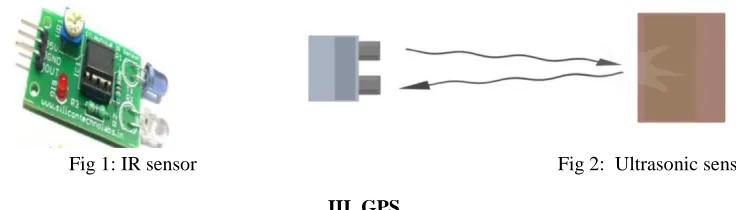
The human eye is an amazing piece of technology. To replicate the eye’s ability to see the world around it, an array of sensors including optical sensors, radars, and lasers. In this project IR sensors and ultrasonic sensors are used to analyze the obstacle nearing the vehicle.
An IR sensor, measures energy that could be emitted or reflected energy off an object that falls on the sensor "face": a thin film often made of pyroelectric material (material that generates energy when exposed to heat). The sensor essentially doesn't measure or detect heat, just the radiation coming from the object. Two LEDs, one is a transmitter (D1) emitting an IR pulse and the other a receiver (D2) of the reflected IR. An everyday example of this is found in TV
remote An Ultrasonic sensor is a device that can measure the distance to an object by using sound waves. It measures
recording the elapsed time between the sound wave being generated and the sound wave bouncing back, it is possible to calculate the distance between the sonar sensor and the object(2).
Fig 1: IR sensor Fig 2: Ultrasonic sensor
III. GPS
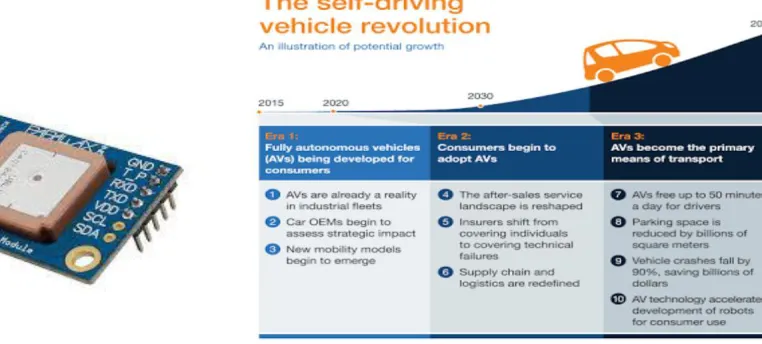
The Global Positioning System (GPS) is a popular technology which was developed by American Department of Defence (DOD) for military use. Later on it was available for civilian use. It can be utilized for wide range of applications such as location, direction, speed, timing, surveying, logistic traffic management, security etc. Nowadays, it became an integral part of a vehicle system for tracking and navigation speed (4). Each GPS satellite transmits data that indicates its location. All GPS satellites synchronize operations so that these repeating signals are transmitted at the same instant. The signals (moving at the speed of light) arrive at a GPS receiver at slightly different times because some satellites are further away than others. The distance to the GPS satellites can be determined by estimating the amount of time it takes for their signals to reach the receiver. When the receiver estimates the distance from at least four GPS satellites, it can calculate its position in three dimensions. In this system the GPS protocol National Marine Electronics Association (NMEA)-0183 is used. The sensor for the location detection is the GPS receiver. A very sensitive and accurate GPS signal acquiring device is required for the system (6).
IV. GSM MODEM
GSM modem is similar to mobile phone without any display, keypad and speakers. This accepts a SIM card, and operates over a subscription to a mobile operator. GSM modem can accept any GSM network operator SIM card and act just like a mobile phone. More than 690 mobile networks provides GSM services across 213 countries and GSM represents 82.4% of all global mobile connections (4). Besides the voice communication it also offers short messages services (SMS) and General packet radio services (GPRS) to transfer data. GSM digitizes and compresses data, then sends it down a channel with two other streams of user data, each in its own time slot. It operates at either the 900 MHz or 1800 MHz frequency band, in addition there are two others frequency bands but most common are mentioned above. The transmission rate of GSM is 270 kbps. The GSM modem utilized the GSM network to send the location of the accident.
The modem can be controlled by the microcontroller. The GSM modem has capacitors and resistors for their proper working and LEDs for indicating the network status. The network status pin does depict the status of accessing network right away when we turn the circuit “ON”. To represent it we used a green LED whose status will be that it will blink rapidly when like to acquire network and blink slowly after the assessment of network.
V. VIBRATION SENSORS
1. The product when it is not shock, vibrate switch is closed on-State, output is low level, the green indicator light is on.
2. When vibration, vibration switches disconnected moments, output line, the Green led is not lit.
3. The output can be directly connected to the microcontroller, by single-chip computer to detect high or low
level, to detect whether there is vibration, alarm function.
Fig 3: GSM module Fig 4: Vibration sensor
VI. WORKING
The controller used here is ATMEGA 328 which is 8-bit microcontroller that controls the overall operation. For prevention, the obstacle is identified using IR sensors and its distance is calculated using ultrasonic sensors, which is given as input to the controller. The operation is performed as per the logic coded and thus the automobile works with artificial intelligence to prevent accidents (5). In case if accident occurs, vibration sensors detects and gives the input to the controller which generates emergency call or message using GSM module (6) and location is defined by GPS (4).
VII. INDICATIONS
If the obstacle is nearing close along left/right side of the automobile then it turns to right/left accordingly with an LED indication to the driver so that he could control the rest. If the obstacle is in front automatic brake is enabled to reduce the speed with a led indication. In case the obstacle is behind the automobile it enables a buzzer horn.
If accident occurs the GSM modem makes a call or generates message to ambulance, police and required persons with the perfect location using GPS system. The buzzer horn indicates the accident to the passers in road.
VIII. ARDUINO AND SOFTWARE REQUIREMENTS
Arduino is an open-source electronics platform based on easy-to-use hardware and software. Arduino boards are able to read inputs - light on a sensor, a finger on a button, or a Twitter message - and turn it into an output - activating a motor, turning on an LED, publishing something online. You can tell your board what to do by sending a set of instructions to the microcontroller on the board. Arduino was born at the Ivrea Interaction Design Institute as an easy tool for fast prototyping, aimed at students without a background in electronics and programming. As soon as it reached a wider community, the Arduino board started changing to adapt to new needs and challenges, differentiating its offer from simple 8-bit boards to products for IOT applications, wearable, 3D printing, and embedded environments (3). All Arduino boards are completely open-source, empowering users to build them independentlt to their particular needs. The software, too, is open-source, and it is growing through the contributions of users worldwide.
Fig 5: Arduino board Fig 6: Report system
IX. ADVANTAGES
▪ It prevents both humans and automobiles from accidents.
▪ It acts as a pre-collision system by intimating driver and even automatically.
▪ It also detects and reports accident so the possibility of death is reduced.
▪
It can be implemented in self driving future generation cars.
Fig 7: GPS Module Fig 8: Evolution of Autonomous vehicle
X. CONCLUSION
the driver to prevent from accident. In case the accident occurs, Vibration sensors detect it and the information is given to the specific number using GSM module. ATMEGA 328, controller is used to control the overall operation. Thus this project reduces the rate of accident. So it can be employed in automobiles of the future generation with some improvements.
REFERENCES
1) http://www.newindianexpress.com/nation/2017/jan/09/three-people-die-every-10-minutes-in-road-accidents-in-india-1557786.html 2) Sensors and Transducers by D. PATRANABI, PHI Learning Pvt. Ltd., 01-Jan-2003.
3) Exploring Arduino: Tools and Techniques for Engineering Wizardry Paperback – 9 Aug 2013 by Jeremy Blum
4) Varma, S.K.C., Poornesh, Varma, T. and Harsha (2013) Automatic Vehicle Accident Detection and Messaging System Using GPS and GSM Modems. International Journal of Scientific & Engineering Research, 4.
5) Rana, U. Accident Prevention System. Department of Electrical Engineering, Lahore College for Women University.
6) Thakor, N., Vyas, T. and Shah, D. (2013) Automatic Vehicle Accident Detection System Based on ARM &GPS. International Journal for Research in Technological Studies, 1.