INVESTIGATION
The SWI/SNF Chromatin Remodeling Complex
Selectively Affects Multiple Aspects of Serotonergic
Neuron Differentiation
Peter Weinberg,* Nuria Flames,*,†Hitoshi Sawa,‡Gian Garriga,§and Oliver Hobert*,1 *Department of Biochemistry and Molecular Biophysics, Howard Hughes Medical Institute, Columbia University Medical Center, New York, New York 10032,†Instituto de Biomedicina de Valencia, Consejo Superior de Investigaciones Científicas, E-46010 Valencia, Spain,‡National Institute of Genetics, 411-8540 Mishima, Japan, and§Department of Molecular and Cell Biology, University of California, Berkeley, California 94720-3200
ABSTRACT Regulatory programs that control the specification of serotonergic neurons have been investigated by genetic mutant screens in the nematodeCaenorhabditis elegans. Loss of a previously uncloned gene,ham-3, affects migration and serotonin antibody staining of the hermaphrodite-specific neuron (HSN) pair. We characterize these defects here in more detail, showing that the defects in serotonin antibody staining are paralleled by a loss of the transcription of all genes involved in serotonin synthesis and transport. This loss is specific to the HSN class as other serotonergic neurons appear to differentiate normally inham-3null mutants. Besides failing to migrate appropriately, the HSNs also display axon pathfinding defects inham-3mutants. However, the HSNs are still generated and express a subset of their terminal differentiation features inham-3null mutants, demonstrating thatham-3is a specific regulator of select features of the HSNs. We show thatham-3codes for theC. elegansortholog of human BAF60,DrosophilaBap60, and yeast Swp73/Rsc6, which are subunits of the yeast SWI/SNF and vertebrate BAF chromatin remodeling complex. We show that the effect of ham-3on serotonergic fate can be explained byham-3regulating the expression of the Spalt/SALL-type Znfinger transcription factor sem-4, a previously identified regulator of serotonin expression in HSNs and of theham-2Zn transcription factor, a previously identified regulator of HSN migration and axon outgrowth. Ourfindings provide thefirst evidence for the involvement of the BAF complex in the acquisition of terminal neuronal identity and constitute genetic proof by germline knockout that a BAF complex component can have cell-type-specific roles during development.
N
EURONS that express the neurotransmitter serotonin fulfill a number of critical functions in all nervous sys-tems examined to date. In vertebrates, serotonergic neurons modulate anxiety, cognitive processes, mood, body temperature, sleep, sexual behavior, appetite, and metabolism, and their dys-function has been connected to a variety of human disorders (Muller and Jacobs 2010). In the hermaphroditicCaenorhabditis elegansnervous system, serotonin also controls a number of distinct behaviors (Schafer 2005; Chase and Koelle 2007). Serotonin is utilized as a neurotransmitter under normal con-ditions by seven neuron types, the sensory neuron ADF; theinterneurons AIM and RIH; the motor neurons hermaphrodite-specific neurons (HSNs), the ventral cord motor neurons VC4 and VC5; and the neurosecretory NSM cells (Schafer 2005; Chase and Koelle 2007). Under stress conditions, serotonin is used by an additional neuron type, ASG (Pocock and Hobert 2010). One of the serotonergic neurons, the hermaphrodite-specific motor neuron, HSN, utilizes seroto-nin to signal to vulval muscles to control egg-laying behavior (Schafer 2005). Unlike most other neurons in theC. elegans
nervous system, the two bilaterally symmetric HSNs undergo long-range migration. After terminating migration, they extend their axons postembryonically in a highly stereotyped pattern along the ventral nerve cord into the nerve ring (Whiteet al.
1986).
The ability to easily visualize HSN migration, morphology, serotonin expression, axon outgrowth, and functional output (i.e., egg laying) has prompted large-scale genetic mutant screens in which these features are disrupted (Trent et al.
Copyright © 2013 by the Genetics Society of America doi: 10.1534/genetics.112.148742
Manuscript received December 18, 2012; accepted for publication February 25, 2013 Supporting information is available online at www.genetics.org/lookup/suppl/ doi:10.1534/genetics.112.148742/-/DC1.
1983; Desaiet al.1988; Desai and Horvitz 1989). These mutant analyses revealed genes that are involved in controlling mul-tiple aspects of HSN development and function, and genes that control only a select number of HSN features (Desai
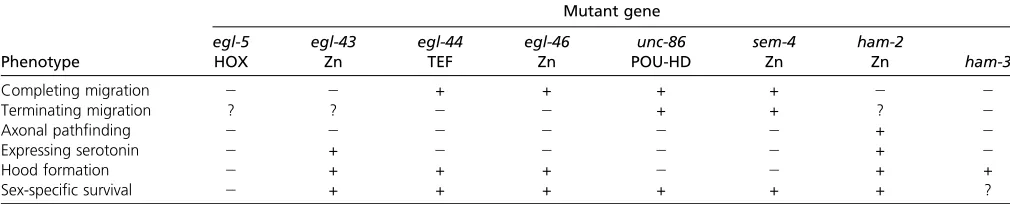
et al. 1988) (Table 1). For example, theegl-5HOX cluster gene controls all known aspects of HSN development and function, while the unc-86 POU homeobox and sem-4 Zn
finger transcription factor control serotonin expression and axon pathfinding, but not neuronal migration (Basson and Horvitz 1996; Sze et al. 2002). Conversely, the ham-2 Zn
finger transcription factor controls HSN migration, but not serotonin expression (Baum et al.1999). Migratory pheno-types can be further genetically separated. In animals lacking
ham-2oregl-43(another Znfinger transcription factor) (Garriga
et al.1993), the HSNs fail to reach their correct position in the midbody region, while in animals lackingegl-44(a TEF-type transcription factor) (Wuet al.2001) oregl-46(another Zn
finger transcription factor) (Wuet al.2001), HSNs migrate beyond their normal position.
ham-3mutants were retrieved from previous screens for mutants affecting HSN development but the molecular lesion in ham-3 mutants has not yet been molecularly identified (Desai et al.1988). ham-3 mutant animals show abnormal HSN migration (hence“ham”for HSN abnormal migration), an egg-laying defect and loss of serotonin antibody staining in the HSNs (Desai et al.1988). However, within their cell bodies HSNs still form a characteristic hood structure inham-3
mutants, a sign of morphological maturation (Desaiet al.1988). Axon pathfinding could not be examined due to the loss of serotonin staining (and resulting loss of the ability to visualize axons) in the HSNs. No other mutant isolated from previous screens showed a similar combination of phenotypes (Table 1), which prompted our interest in studyingham-3in more detail.
Phenotypic analysis of ham-3 mutants reveals neuronal defects
As afirst step to a more detailed analysis ofham-3(n1654)
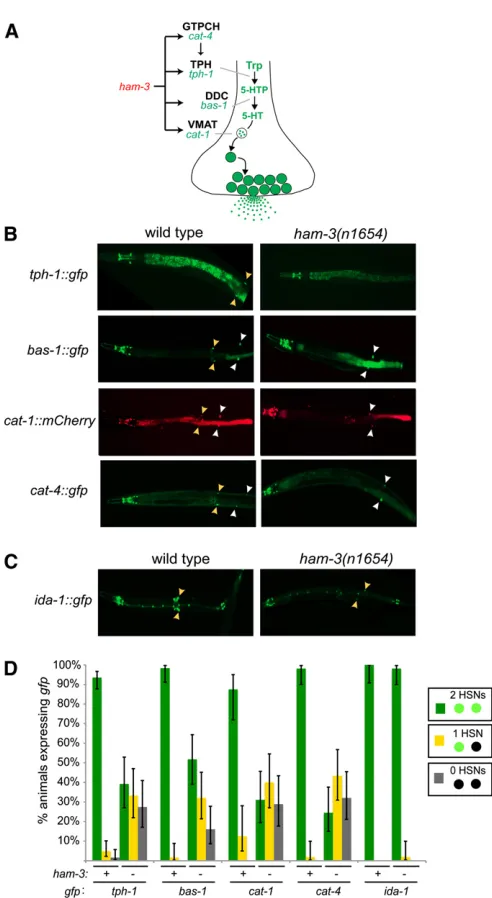
mutant animals, we focused on the lack of serotonin anti-body staining in the HSNs ofham-3mutants that has been previously reported (Desai et al. 1988). Such a phenotype could be due to loss of expression of the rate limiting enzyme in the biosynthesis of serotonin, tryptophan hydroxylase,
encoded by the tph-1locus in C. elegans(Sze et al.2000). We examined the expression of atph-1::gfpreporter gene in
ham-3mutant animals and foundtph-1::gfpexpression to be severely affected (Figure 1). Expression was affected only in the HSNs, not in any other tph-1-expressing cell.
We next examined whether the expression of other components of the pathway required for synthesis and trans-port of serotonin were also affected (this pathway is shown in Figure 1A). We examined the expression ofbas-1, which codes for the aromatic amino acid decarboxylase that converts the TPH-1product 5-hydroxytryptophan to serotonin (Hare and Loer 2004), the cat-4 gene, which is required to generate a co-factor forTPH-1, and the vesicular monoamine transporter encoded bycat-1 (Duerret al.1999) (note that the serotonin reuptake transportermod-5is not expressed in HSN) (Jafari
et al.2011). We found that expression of the entire serotonin pathway is strongly affected in the HSNs of ham-3(n1654)
mutants (Figure 1, B and D). Expression of these genes in other serotonergic neurons is not affected (Figure 1B).
Given the striking defects in neurotransmitter synthesis and transport, we next examined whether other signaling features not directly related to the serotonin pathway, such as components of the machinery required for neuropeptide signaling, are affected by ham-3. The HSNs are known to express several neuropeptides and the machinery involved in neuropeptide release (Li and Kim 2008). Specifically, we examined expression of theida-1gene, a phosphatase that is involved in neuropeptidergic dense core vesicle biology (Zahnet al.2001). We found thatida-1expression is largely unaffected in ham-3(n1654)mutants (Figure 1, C and D). This is not because there is residualham-3activity inn1654
animals;n1654is a null allele, as we will show below. We next examined the HSN migration defects inham-3
mutants. Abnormal HSN migration patterns are already ap-parent inham-3(n1654)animals that still maintain expression of serotonin pathway genes, as previously reported (Desai
et al.1988), but the migratory patterns of the cells not ex-pressing serotonin have not previously been examined. Since
ida-1 expression was unaffected inham-3mutant animals, we used ida-1::gfp-labeled animals to precisely score HSN migration. Wefind severe migration defects, with either one or both HSNs failing to migrate properly to theirfinal position Table 1 Comparing role of gene regulatory factors in hermaphrodite-specific neuron (HSN) development
Phenotype Mutant gene egl-5 HOX egl-43 Zn egl-44 TEF egl-46 Zn unc-86 POU-HD sem-4 Zn ham-2 Zn ham-3
Completing migration 2 2 + + + + 2 2
Terminating migration ? ? 2 2 + + ? 2
Axonal pathfinding 2 2 2 2 2 2 + 2
Expressing serotonin 2 + 2 2 2 2 + 2
Hood formation 2 + + + 2 2 + +
Sex-specific survival 2 + + + + + + ?
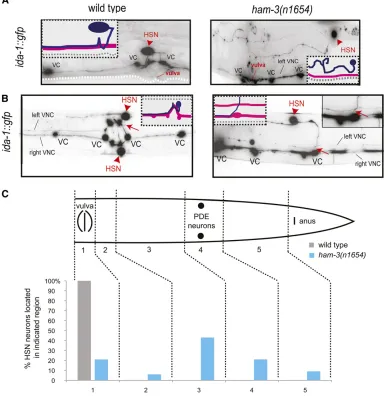
near the vulva. Mismigrated HSNs tend to stop in specific zones in the posterior of the animal, with the majority (40% of HSNs) prematurely terminating migration between the post-deirid and the vulva (Figure 2, A and C). Overall, 94% of mutant animals examined show a migration defect in at least one HSN (n= 70).
The intact expression of ida-1::gfp expression in ham-3
mutants also enabled us to score HSN axon pathfinding, a feature that has not previously been examined in ham-3
mutants. Wefind a number of distinct defects in axon migra-tion. In the most extreme cases, the axon appears to wander back and forth in search of the vulva, never reaching its tar-get. In other cases, the axon fails to proceed ventrally from the HSN cell body and does not synapse onto the vulval muscles, instead proceeding directly to the nerve ring. Over-all, wefind that 34% ofham-3(n1654)mutant animals pos-sess HSN axons that fail to reach their synaptic targets in the vulval muscles. Once in the ventral nerve cord, HSN axons make frequent errors in respecting the midline structure. A total of 30% of animals (n= 86) show axons that have aberrantly crossed the midline (Figure 2B). Cell migration and axonal defects are not obligatorily linked. Of the 47 cases where we found HSNs to have migrated correctly, seven HSNs still make axon pathfinding errors.
ida-1::gfp also labels the VC class of ventral cord motor neurons, two of which (VC4 and VC5) are serotonergic. A total of 43% of ham-3 mutant animals show fasciculation defects of the VC neurons (n= 141; wild-type animals never show this defect;n= 102). Axon guidance defects of ventral nerve cord interneurons have also been detected upon reduction ofham-3by RNAi in a chromosome-wide RNAi screen (Schmitz
et al.2007).
Three other neuronal cell types undergo long-range migra-tions inC. elegans, namely the CAN and ALM neurons (which migrate embryonically) and the Q neuroblasts (which migrate postembryonically). After terminating migration, the Q neu-roblasts will generate touch receptor neurons. Wefind that
ham-3affects CAN cell migration, as assessed with akal-1::
gfpreporter transgene. In 53% of animals, we observe CAN cells with overmigration defects, (n= 94) while only 12% of control animals show this defect (n = 107). This over-migration of the CAN is correlated with HSN misover-migration inham-3(n1654);kal-1::gfpanimals, but the converse is not necessarily true. While all of the scoreable animals with a CAN that migrate past the vulva also show defects in HSN migra-tion, only 80% (61/76) of animals with mismigrated HSNs also show CAN migration defects. In contrast to the embryonic CAN and HSN migration defects, the postembryonic migration of the Q neuroblasts is not affected, as assessed with amec-3::
gfpreporter transgene that visualizes the ALM and AVM and PVM, the touch neuron descendants of the Q neuroblasts.
We also examined whetherham-3may affect the develop-ment of the HSN sister cell, the PHB sensory neuron. The de-velopment of this neuron is affected in another hammutant,
ham-1, which is required for asymmetric cell division (Guenther and Garriga 1996). Through dye filling and examining the expression of ida-1::gfp, we find that PHB neurons appear normal inham-3mutants (n= 25).
ham-3 encodes an ortholog of the BAF60 subunit of the SWI/SNF chromatin remodeling complex
ham-3(n1654) was mapped by conventional three-factor mapping between unc-32 and dpy-18 on LGIII, which corre-sponds to a 2.5-Mb physical interval. Whole genome sequencing and ensuing sequence analysis using MAQGene (Bigelowet al. Figure 1 ham-3affects expression of the entire serotonin pathway. (A)
2009) revealed only two sequence variants in this interval that are predicted to change protein coding sequences, a non-sense mutation in ZK1128.5 (previously called tag-246 or
swsn-2.1) (Figure 3A), and a missense mutation in bbs-5. Animals carrying a deletion allele of ZK1128.5, tm3309
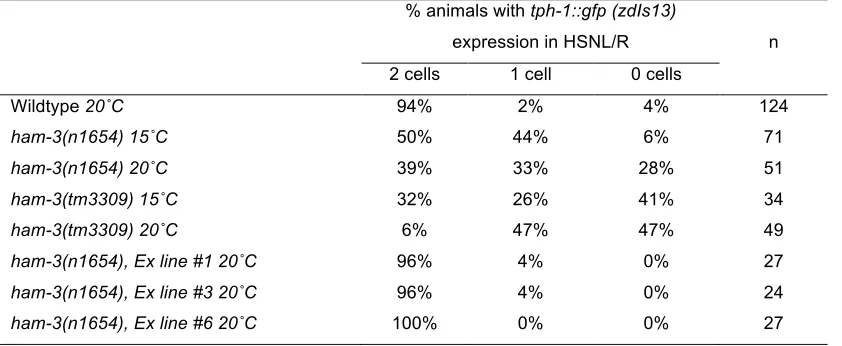
(kindly provided by Shohei Mitani, Tokyo Women’s Medical University School of Medicine, Tokyo, Japan), display a sim-ilar HSN phenotype asham-3(n1654)mutant animals (sup-porting information, Table S1). RNAi of ZK1128.5 also produced aham-3like phenotype (30% oftph-1::gfp-expressing animals show a migration defect, compared to 11% of wild-type controls;n= 33 and 124, respectively). Moreover, the sero-tonin-deficient phenotype ofham-3(n1654)mutant animals can be rescued with a fosmid, WRM0626dF04, that covers
ZK1128.5, but not bbs-5 (Table S1). We conclude that
ZK1128.5/tag-246/swsn-2.1corresponds toham-3.
ham-3is one of twoC. elegansorthologs of human BAF60 proteins (Figure 3B). Humans contain three BAF60 paralogs, BAF60a, -b, and -c. BAF60 proteins are a component of an ATP-dependent chromatin remodeling complex, called SWI/ SNF in yeast or BAF in vertebrates (Wanget al.1996; Yoo
and Crabtree 2009). This complex mobilizes nucleosomes both by sliding and by catalyzing the ejection and insertion of histone octamers (Wilson and Roberts 2011). A reconsti-tuted human complex lacking the BAF60 subunit shows full remodeling activity, suggesting that BAF60 is not essential for the core remodeling function of the BAF complex (Phelan
et al. 1999). Rather, based on its physical interaction with various transcription factors, the BAF60 subunit is thought to be involved in the recruitment of the BAF complex to spe-cific transcription factors (Sudarsanam and Winston 2000). In vertebrates, the three BAF60 homologs, BAF60a, BAF60b, and BAF60c, are each tissue-specifically expressed (Wang et al.
1996). No germline knockout of any BAF60 gene has been described in vertebrates, but RNAi of BAF60c affects heart development (Lickert et al.2004). The fly BAF60 ortholog Bap60 is a haploinsufficient, essential gene, since the elimi-nation a single copy of the locus results in lethality, but the cause of lethality is not known (Molleret al.2005).
The early stop codon ofham-3(n1654)animals suggests that the allele is a molecular null allele. At 15°and 20°, both
viable and display roughly similar HSN phenotypes (Table S1). However, wefind that when shifted to 25°at any time in their life cycle, bothham-3(n1654)andham-3(tm3309)
animals will die within a few hours for unknown reasons. This argues that ham-3is required for viability only under specific circumstances. In other words,ham-3somehow buf-fers animals from what is an apparently detrimental effect of elevated temperatures.
Like vertebrates, but unlikeflies, theC. elegansgenome con-tains more than one BAF60 ortholog (Figure 3B). The ham-3
paralog,swsn-2.2, is located on a different chromosome and its protein product is 66.8% identical in amino acid sequence to HAM-3. The degree of similarity between the ham-3 and
swsn-2.2paralogs is comparable to the similarity between hu-man BAF60 paralogs (BAF60avs. BAF60b: 59.8% identical; BAF60bvs.BAF60c: 60.4% identical). Theham-3andswsn-2.2
paralogs are not orthologs of specific BAF60 subunits but have duplicated independently of the duplication in the vertebrate lineage (Figure 3B).
There are two very distant relatives of theham-3and swsn-2.2genes in theC. elegansgenome. One is the uncharacterized
T24G10.2gene, which is the only other gene in theC. elegans
genome besidesham-3 andswsn-2.2 that contains a SWIB domain (for SWI/SNF complex B; IPR019835), an ancient chromatin-associated domain of unknown function. However,
T24G10.2has acquired an additional domain, a DEK–C-terminal domain (IPR014876) and this domain combination is unique to
flies and worms. The other distantham-3/swsn-2.2homolog is the K03B8.4 gene, which codes for small protein of 96 amino acids (HAM-3andSWSN-2.2are.400 amino acids) that shows high sequence homology to the C-terminal ends ofHAM-3andSWSN-2.2, past the respective SWIB domains. K03B8.4 orthologs cannot be found in other currently se-quenced nematode genome sequences and the gene may be a remnant of aC. elegans-specific partial gene duplication event. We conclude that based on sequence relationham-3
and swsn-2.2 are likely the only genes in the C. elegans
genome that act as BAF60-like BAF complex components.
The ham-3 paralog swsn-2.2 is an essential gene
The ham-3paralog swsn-2.2has not been characterized to date. We obtained a deletion allele of swsn-2.2, ok3161, from theC. elegansknockout consortium.ok3161eliminates most of the gene (Figure 3A). Animals carrying this allele are not homozygous viable. Theswsn-2.2(ok3161)lethality can be rescued with a segment of genomic DNA that con-tains exclusively the swsn-2.2locus (construct shown in
Figure 3A). Null mutant animals that have not received the extrachromosomal array from their parents arrest at thefirst larval stage for unknown reasons. The HSNs have normally migrated in these arrested animals. Since serotonin pathway genes are not normally expressed at this time point in the HSNs, we could not easily assess serotonergic differentiation of the HSNs in these mutant animals.swsn-2.2(RNAi)does not result in HSN phenotypes and swsn-2.2(RNAi) in a
ham-3(n1654) mutant background does not enhance the
ham-3(n1654)HSN phenotypes in a notable manner. The two BAF60 orthologs ham-3 and swsn-2.2 are broadly expressed
To compare ham-3 expression with the tissue-specific ex-pression pattern of BAF60 paralogs in vertebrates (Wang
et al.1996) and inflies, where Bap60 expression is restricted to the ventral nerve cord and the brain (Molleret al.2005), we generated reporter constructs forham-3and its paralog,
swsn-2.2. Both constructs are translational fusions in which the entire intergenic region and all exons and introns are fused to a gfpreporter (Figure 3A). Expression patterns of each reporter were similar over three independent lines. By crossing one line each intoham-3orswsn-2.2mutant back-grounds, respectively, we confirmed that each reporter line rescues the respective mutant phenotype.
ham-3::gfpanimals show broadgfpexpression starting at gastrulation and persisting through larval and adult stages (Figure 3C) in what appear to be all cells of the worm, in-cluding HSNs.swsn-2.2::mChOpti expression also commen-ces at gastrulation (Figure 3C), but its expression appears more restricted. In the first larval stage, expression can be observed in all tissues (including HSNs) with the prominent exception of the intestine (Figure 3C). Expression of swsn-2.2::mChOpti fades during larval stages and is no longer observed in adult animals (Figure 3C).
Comparing phenotypes of C. elegans SWI/SNF mutants
C. eleganshomologs of several core components of the SWI/ SNF complex were previously analyzed in C. elegans and shown to be required for asymmetric cell division, gonad and vulval development, and early embryonic morphogene-sis (Sawaet al.2000; Cuiet al.2004; Shibataet al.2012). Complete removal of core SWI/SNF complex components (psa-4/Brahma, psa-1/Moira/BAF155, snfc-5/BAF47, swsn-6/BAF53, swsn-3/BAF57) results in sterility or embryonic lethality. Viable, hypomorphic alleles of the Brahma/Brg1 homologpsa-4 or the BAF155/SRG3/Moira homologpsa-1
display HSN migration defects (22–26% penetrant;n.53), but no significant defects intph-1orcat-4expression (n.
53), possibly due to the hypomorphic activity of these genes.
swsn-7/BAF200 and let-526/BAF250 are defining compo-nents of two different types of BAF complexes, called the PBAF and BAF complexes, respectively (Hargreaves and Crabtree 2011). let-526/BAF250 null mutant animals die at the first larval stage, preventing the analysis of serotonergic phenotypes in the HSN (which is expressed only later in larval develop-ment). However, in 4/29let-526(gk816)arrested L1 larvae, we observed mismigrated HSNs (marker:kal-1::gfp) and in 15/29 animals we were not able to observe kal-1-expressing HSNs, either because the marker fails to be expressed or becausekal-1 -expressing HSNs have failed to migrate out of the tail region where they cannot be distinguished from otherkal-1 -express-ing neurons. We also examinedswsn-7(gk1041)homozygous deletion mutants derived from heterozygous parents. 27% of those animals (n= 44) show defects in HSN migration. Be-cause of potential issues of maternal rescue and the inability to score HSN in more detail in these mutants, a specific role of the BAFvs.the PBAF complexes in HSN development cannot yet befirmly concluded.
We next examined whether ham-3mutants display three specific non-HSN phenotypes shared by core BAF/psa hypo-morphic alleles—a phasmid socket absent (Psa) phenotype (Sawa et al.2000), a Pvlphenotype (Cuiet al.2004), and a gonad migration phenotype (Shibataet al.2012). Wefind that ham-3(n1654)animals only show a 1% penetrant Psa phenotype (n= 226; wild-type animals show no such phe-notype) (Sawaet al.2000). This is significantly less than core SWI/SNF components (e.g., even a hypomorphic allele of psa-1shows a 74% penetrant phenotype) (Sawaet al.2000). Like
psa-1andpsa-4mutants,ham-3(n1654)mutants also display aPvlphenotype (26%;n= 107), but again to a lesser degree (psa-1mutants display a 100% penetrantPvlphenotype; Cui
et al.2004). In addition,ham-3(n1654)mutants show abnor-mal folding and/or overmigration of the gonad arms (18 and 47%, respectively,n= 38; no such defect was observed in the wild type,n= 28). This is comparable in penetrance to the previously reported psa-1 phenotype (52% penetrant; Cui
et al.2004). However,ham-3(n1654)animals show no“ miss-ing gonad arm”phenotype previously observed upon loss of other SWI/SNF complex components (Shibata et al. 2012). The observation thatham-3null mutants do not phenocopy the complete spectrum of SWI/SNF complex components suggests that for specific cellular functionsham-3is not re-quired and that its paralogswsn-2.2may rather be a compo-nent of the SWI/SNF complex in such instances. Given the early larval arrest phenotype ofswsn-2.2mutants, we cannot readily assess these postembryonic phenotypes in swsn-2.2
mutants.
ham-3 regulates the expression of transcription factors known to be required for HSN development
To examine how ham-3may affect HSN development, we asked how its function relates to the function of other
tran-scription factors known to be involved in various aspects of HSN development (Table 1). We focused on transcription factors that have been previously shown to display either all or a subset of the ham-3 phenotypes (Table 1): unc-86, a Brn3-type POU homeobox gene (Finney et al. 1988);
sem-4, a Spalt/SALL-type Znfinger transcription factor (Bas-son and Horvitz 1996); andham-2, a member of a divergent C2H2 Zn finger family that expanded specifically in C.ele-gans (Baum et al. 1999; Zhang et al. 2011). unc-86 and
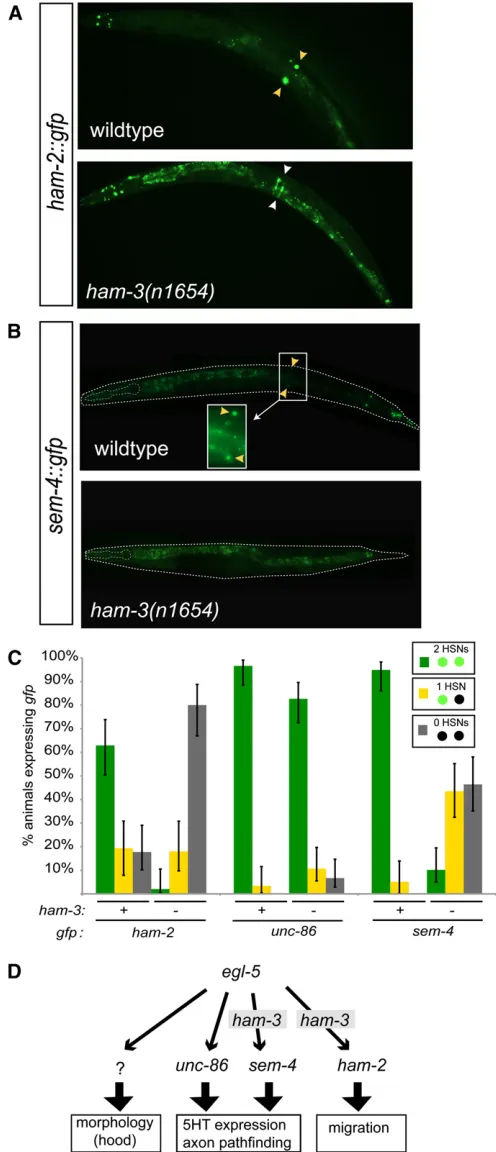
sem-4are known to be required for expression of serotonin in HSN, but not for HSN migration (Desaiet al.1988; Basson and Horvitz 1996; Szeet al.2002), andham-2is known to be required for HSN migration, but not serotonin pathway expression (Baumet al.1999). Wefind that the expression of sem-4and ham-2expression is strongly defective in the HSNs ofham-3(n1654)mutants, whileunc-86expression is barely affected (Figure 4, A–C). These results suggest that the specific phenotypes ofham-3mutants may be explained through the loss of expression of the two Znfinger transcrip-tion factorsham-2andsem-4.
BAF complexes are recruited to DNA via association with specific transcription factors. The respective BAF60 subunit present in the BAF complex appears to be a commonly employed recruiter via its direct interaction with specific transcription factors (Itoet al.2001; Hsiaoet al.2003; Debril
et al. 2004; Takeuchiet al. 2007; Li et al. 2008; Oh et al.
2008; Chen et al. 2012; Forcales et al. 2012; Gallagher
et al.2012). Such recruitment is thought to be a prerequisite to enable transcription or to allow access of additionaltrans -acting factors (Sudarsanam and Winston 2000). The loss of
sem-4 and ham-2 expression in ham-3 mutants could be explained byham-3cooperating with theegl-5homeodomain transcription factor, a known upstream regulator ofsem-4and
ham-2(Baumet al. 1999). Since the spectrum ofham-3 phe-notypes is more restricted than the spectrum ofegl-5mutants (e.g.,egl-5affects hood formation, butham-3does not; Table 1),ham-3may cooperate withegl-5to regulate only a subset of theegl-5targets, such assem-4andham-2, but not targets involved in, for example, hood formation (Figure 4D). We can also exclude the possibility thatham-3operates upstream of
egl-5 through our observation that egl-5 expression is unaf-fected inham-3mutants (data not shown).
Conclusions
in several distinct organisms that control serotonergic neu-ron fate (Flames and Hobert 2011; Deneris and Wyler 2012), but to our knowledge, no chromatin remodeling fac-tor has yet been implicated in serotonergic neuron develop-ment. The role of ham-3in HSN development is broad but not ubiquitous. Neurotransmitter phenotype, cell migration, and axon pathfinding are affected, but not some other signs of morphological differentiation. Moreover,ham-3does not affect the serotonergic neurotransmitter phenotype of any other serotonergic neuron class aside from HSN.
Our findings underscore the cell-type specificity of the function of the BAF nucleosome remodeling complex. The yeast version of the BAF complex (called SWI/SNF) is involved in the regulation of a relatively small number of genes (Sudarsanam and Winston 2000). In metazoans, the specificity of BAF complex function has further increased through the dynamic use of alternative BAF subunits (Yoo and Crabtree 2009; Hargreaves and Crabtree 2011). For ex-ample, in vertebrates, the BAF53 subunit is encoded by two distinct genes, BAF53a and BAF53b. During neuronal devel-opment, the BAF53a subunit is switched for the BAF53b sub-unit (Lessard et al. 2007). Knocking out BAF53b does not result in the lethality observed upon knocking out general subunits, but results in specific dendritic patterning defects (Wu et al. 2007). The BAF60 subunit paralogs BAF60a, BAF60b, and BAF60c also likely have cell-type-specific func-tions based on their distinctive expression patterns (Wang
et al.1996) and based on the cell-type-specific assembly of BAF complexes with different BAF60 subunits (Lickert et al.
2004; Hoet al.2009). However, ultimate proof for cell-type-specific functions of specific BAF60 paralogs in the form of germline knockout that results in cell-type-specific pheno-types has been lacking. RNAi-mediated knockdown of BAF60c results in muscle defects, but RNAi results only in an incomplete elimination of gene activity (Lickert et al.
2004). The fly BAF60 homolog (Bap60) has been knocked out (resulting in lethality) (Molleret al.2005), but this case is not informative due to the fact that unlike vertebrates and worms,flies only contain a single BAF60 ortholog.
Like vertebrates, C. elegans contains multiple BAF60-type subunits that display broad, but nevertheless distinct expres-sion patterns, pointing to tissue/time-specific function. More-over, the genetic analysis of null mutations in one of the homologs,ham-3, indeed demonstrates cell-type-specific func-tions of a BAF60 subunit. First, unlike loss of core BAF complex components (i.e.,psa-4orpsa-1, the Brg1/Brm and BAF155/ BAF170 orthologs, respectively), complete loss ofham-3does not affect viability under standard conditions (i.e., 15°or 20°)
and ham-3null mutant animals look morphologically grossly normal. On a cellular level,ham-3null mutants show defects in the differentiation of a specific subset of serotonergic neu-rons (HSNs), but not the differentiation of other serotonergic Figure 4 ham-3 affects expression of the transcription factorssem-4,
unc-86, andham-2. (A and B)sem-4,unc-86, andham-2reporter gene constructs expressed in wild-type and ham-3(n1654) mutant animals. Yellow arrowheads point to the HSN and white arrowheads point to ham-2 expression in the vulval epithelium. SeeFile S1 for information on transgenes. (C) Quantification of defects. Error bars are 95% confi -dence interval of the proportion. Sample sizes range fromn= 50 ton= 75. (D) Data summary depicting the relation ofham-3with transcriptional
neurons. On a molecular level,ham-3null mutants show se-lective effects on the expression of terminal differentiation markers of HSNs. While genes involved in serotonergic neuro-transmission are affected, a gene involved in neuropeptidergic signaling is not. The selective phenotype of ham-3 could be explained by ham-3 and its paralogswsn-2.2 having distinct functions (e.g., they could recruit the BAF complex to distinct transcription factors). Alternatively, they may act in a partially redundant manner. Since the expression ofham-3andswsn-2.2
do not overlap in all cells at all stages (e.g.,swsn-2.2fades in adults whileham-3does not), any redundancies in gene func-tion may be at most partial.
The overall importance of the BAF complex in humans is not only evidenced by mutations in the Snf5 subunit that lead to childhood tumors (Wilson and Roberts 2011), but also by the recent finding that haploinsufficiency of other BAF sub-units result in various neurological conditions, including non-syndromic intellectual disability, Coffin-Siris syndrome, and Nicolaides-Baraitser syndrome (Santen et al.2012). Under-standing basic features of the function of this complex, in-cluding its tissue-specific mode of action, is therefore an important future goal.
Acknowledgments
We thank Qi Chen for expert assistance in generating transgenic strains; Alexander Boyanov for whole genome sequencing; Erin Conlon for help with building strains; Pat Gordon, Min Han, and the Caenorhabditis elegansGenetics Center (CGC) for kindly providing strains; the Caenorhabdi-tis elegansReverse Genetics Core Facility at the University of British Columbia for theok3161,gk1041, andgk816alleles; and Shohei Mitani at Tokyo Women’s Medical University School of Medicine for the tm3309 allele. This work was funded by the National Institutes of Health (R01NS039996-05; R01NS050266-03). O.H. is an investigator of the Howard Hughes Medical Institute.
Literature Cited
Basson, M., and H. R. Horvitz, 1996 The Caenorhabditis elegans gene sem-4 controls neuronal and mesodermal cell develop-ment and encodes a zincfinger protein. Genes Dev. 10: 1953– 1965.
Baum, P. D., C. Guenther, C. A. Frank, B. V. Pham, and G. Garriga, 1999 The Caenorhabditis elegans gene ham-2 links Hox pattern-ing to migration of the HSN motor neuron. Genes Dev. 13: 472–483. Bigelow, H., M. Doitsidou, S. Sarin, and O. Hobert, 2009 MAQGene: software to facilitate C. elegans mutant genome sequence analysis. Nat. Methods 6: 549.
Chase, D. L., and M. R. Koelle, 2007 Biogenic amine neurotrans-mitters in C. elegans. Neuropeptides (February 20, 2007), WormBook, ed. TheC. elegansResearch Community WormBook, doi/10.1895/wormbook.1.132.1. http://www.wormbook.org. Chen, L., F. G. Fulcoli, R. Ferrentino, S. Martucciello, E. A. Illingworth
et al., 2012 Transcriptional control in cardiac progenitors: Tbx1 interacts with the BAF chromatin remodeling complex and regulates Wnt5a. PLoS Genet. 8: e1002571.
Clark, S. G., and C. Chiu, 2003 C. elegans ZAG-1, a Zn-fi nger-homeodomain protein, regulates axonal development and neu-ronal differentiation. Development 130: 3781–3794.
Cui, M., D. S. Fay, and M. Han, 2004 lin-35/Rb cooperates with the SWI/SNF complex to control Caenorhabditis elegans larval development. Genetics 167: 1177–1185.
de la Serna, I. L., Y. Ohkawa, and A. N. Imbalzano, 2006 Chromatin remodelling in mammalian differentiation: lessons from ATP-dependent remodellers. Nat. Rev. Genet. 7: 461–473.
Debril, M. B., L. Gelman, E. Fayard, J. S. Annicotte, S. Rocchiet al., 2004 Transcription factors and nuclear receptors interact with the SWI/SNF complex through the BAF60c subunit. J. Biol. Chem. 279: 16677–16686.
Deneris, E. S., and S. C. Wyler, 2012 Serotonergic transcriptional networks and potential importance to mental health. Nat. Neu-rosci. 15: 519–527.
Desai, C., G. Garriga, S. L. McIntire, and H. R. Horvitz, 1988 A genetic pathway for the development of the Caenorhabditis el-egans HSN motor neurons. Nature 336: 638–646.
Desai, C., and H. R. Horvitz, 1989 Caenorhabditis elegans mu-tants defective in the functioning of the motor neurons respon-sible for egg laying. Genetics 121: 703–721.
Duerr, J. S., D. L. Frisby, J. Gaskin, A. Duke, K. Asermely et al., 1999 The cat-1 gene of Caenorhabditis elegans encodes a ve-sicular monoamine transporter required for specific mono-amine-dependent behaviors. J. Neurosci. 19: 72–84.
Finney, M., G. Ruvkun, and H. R. Horvitz, 1988 The C. elegans cell lineage and differentiation gene unc-86 encodes a protein with a homeodomain and extended similarity to transcription factors. Cell 55: 757–769.
Flames, N., and O. Hobert, 2011 Transcriptional control of the terminal fate of monoaminergic neurons. Annu. Rev. Neurosci. 34: 153–184.
Forcales, S. V., S. Albini, L. Giordani, B. Malecova, L. Cignoloet al., 2012 Signal-dependent incorporation of MyoD-BAF60c into Brg1-based SWI/SNF chromatin-remodelling complex. EMBO J. 31: 301–316.
Gallagher, J. M., H. Komati, E. Roy, M. Nemer, and B. V. Latinkic, 2012 Dissociation of cardiogenic and postnatal myocardial ac-tivities of GATA4. Mol. Cell. Biol. 32: 2214–2223.
Garriga, G., C. Guenther, and H. R. Horvitz, 1993 Migrations of the Caenorhabditis elegans HSNs are regulated by egl-43, a gene encoding two zincfinger proteins. Genes Dev. 7: 2097–2109. Guenther, C., and G. Garriga, 1996 Asymmetric distribution of the
C. elegans HAM-1 protein in neuroblasts enables daughter cells to adopt distinct fates. Development 122: 3509–3518. Hare, E. E., and C. M. Loer, 2004 Function and evolution of the
serotonin-synthetic bas-1 gene and other aromatic amino acid decarboxylase genes in Caenorhabditis. BMC Evol. Biol. 4: 24. Hargreaves, D. C., and G. R. Crabtree, 2011 ATP-dependent
chro-matin remodeling: genetics, genomics and mechanisms. Cell Res. 21: 396–420.
Ho, L., R. Jothi, J. L. Ronan, K. Cui, K. Zhao et al., 2009 An embryonic stem cell chromatin remodeling complex, esBAF, is an essential component of the core pluripotency transcriptional network. Proc. Natl. Acad. Sci. USA 106: 5187–5191.
Hobert, O., 2002 PCR fusion-based approach to create reporter gene constructs for expression analysis in transgenic C. elegans. Biotechniques 32: 728–730.
Hsiao, P. W., C. J. Fryer, K. W. Trotter, W. Wang, and T. K. Archer, 2003 BAF60a mediates critical interactions between nuclear receptors and the BRG1 chromatin-remodeling complex for transactivation. Mol. Cell. Biol. 23: 6210–6220.
Jafari, G., Y. Xie, A. Kullyev, B. Liang, and J. Y. Sze, 2011 Regulation of extrasynaptic 5-HT by serotonin reuptake transporter func-tion in 5-HT-absorbing neurons underscores adaptafunc-tion behav-ior in Caenorhabditis elegans. J. Neurosci. 31: 8948–8957. Lessard, J., J. I. Wu, J. A. Ranish, M. Wan, M. M. Winslowet al.,
2007 An essential switch in subunit composition of a chroma-tin remodeling complex during neural development. Neuron 55: 201–215.
Li, C., and K. Kim, 2008 Neuropeptides (September 25, 2008), WormBook, ed. TheC. elegansResearch Community WormBook, doi/10.1895/wormbook.1.142.1. http://www.wormbook.org. Li, S., C. Liu, N. Li, T. Hao, T. Han et al., 2008 Genome-wide
coactivation analysis of PGC-1alpha identifies BAF60a as a reg-ulator of hepatic lipid metabolism. Cell Metab. 8: 105–117. Lickert, H., J. K. Takeuchi, I. Von Both, J. R. Walls, F. McAuliffeet al.,
2004 Baf60c is essential for function of BAF chromatin remod-elling complexes in heart development. Nature 432: 107–112. Moller, A., F. W. Avila, J. W. Erickson, and H. Jackle, 2005 Drosophila
BAP60 is an essential component of the Brahma complex, required for gene activation and repression. J. Mol. Biol. 352: 329–337. Muller, C. P., and B. L. Jacobs, 2010 Handbook of the Behavioral
Neurobiology of Serotonin, Academic Press, San Diego. Oh, J., D. H. Sohn, M. Ko, H. Chung, S. H. Jeonet al., 2008 BAF60a
interacts with p53 to recruit the SWI/SNF complex. J. Biol. Chem. 283: 11924–11934.
Phelan, M. L., S. Sif, G. J. Narlikar, and R. E. Kingston, 1999 Reconstitution of a core chromatin remodeling com-plex from SWI/SNF subunits. Mol. Cell 3: 247–253. Pocock, R., and O. Hobert, 2010 Hypoxia activates a latent circuit
for processing gustatory information in C. elegans. Nat. Neuro-sci. 13: 610–614.
Santen, G. W., M. Kriek, and H. van Attikum, 2012 SWI/SNF complex in disorder: SWItching from malignancies to intellec-tual disability. Epigenetics 7:1219–1224.
Sarin, S., V. Bertrand, H. Bigelow, A. Boyanov, M. Doitsidouet al., 2010 Analysis of multiple ethyl methanesulfonate-mutagenized caenorhabditis elegans strains by whole-genome sequencing. Genetics 185: 417–430.
Sawa, H., H. Kouike, and H. Okano, 2000 Components of the SWI/SNF complex are required for asymmetric cell division in C. elegans. Mol. Cell 6: 617–624.
Schafer, W. R., 2005 Egg-laying. (December 14, 2005), Worm-Book, ed. The C. elegans Research Community WormBook, doi/10.1895/wormbook.1.38.1. http://www.wormbook.org. Schmitz, C., P. Kinge, and H. Hutter, 2007 Axon guidance genes
iden-tified in a large-scale RNAi screen using the RNAi-hypersensitive Caenorhabditis elegans strain nre-1(hd20) lin-15b(hd126). Proc. Natl. Acad. Sci. USA 104: 834–839.
Shibata, Y., M. Uchida, H. Takeshita, K. Nishiwaki, and H. Sawa, 2012 Multiple functions of PBRM-1/Polybromo- and LET-526/ Osa-containing chromatin remodeling complexes in C. elegans development. Dev. Biol. 361: 349–357.
Sudarsanam, P., and F. Winston, 2000 The Swi/Snf family nucle-osome-remodeling complexes and transcriptional control. Trends Genet. 16: 345–351.
Sze, J. Y., M. Victor, C. Loer, Y. Shi, and G. Ruvkun, 2000 Food and metabolic signalling defects in a Caenorhabditis elegans serotonin-synthesis mutant. Nature 403: 560–564.
Sze, J. Y., S. Zhang, J. Li, and G. Ruvkun, 2002 The C. elegans POU-domain transcription factor UNC-86 regulates the tph-1 tryptophan hydroxylase gene and neurite outgrowth in specific serotonergic neurons. Development 129: 3901–3911.
Takeuchi, J. K., H. Lickert, B. W. Bisgrove, X. Sun, M. Yamamoto et al., 2007 Baf60c is a nuclear Notch signaling component required for the establishment of left-right asymmetry. Proc. Natl. Acad. Sci. USA 104: 846–851.
Trent, C., N. Tsuing, and H. R. Horvitz, 1983 Egg-laying defective mutants of the nematode Caenorhabditis elegans. Genetics 104: 619–647.
Wang, W., Y. Xue, S. Zhou, A. Kuo, B. R. Cairnset al., 1996 Diversity and specialization of mammalian SWI/SNF complexes. Genes Dev. 10: 2117–2130.
White, J. G., E. Southgate, J. N. Thomson, and S. Brenner, 1986 The structure of the nervous system of the nematode Caenorhabditis elegans. Philos. Trans. R. Soc. Lond. B Biol. Sci. 314: 1–340.
Wilson, B. G., and C. W. Roberts, 2011 SWI/SNF nucleosome remodellers and cancer. Nat. Rev. Cancer 11: 481–492. Wu, J., A. Duggan, and M. Chalfie, 2001 Inhibition of touch cell
fate by egl-44 and egl-46 in C. elegans. Genes Dev. 15: 789–802. Wu, J. I., J. Lessard, I. A. Olave, Z. Qiu, A. Ghoshet al., 2007 Regulation of dendritic development by neuron-specific chromatin remodel-ing complexes. Neuron 56: 94–108.
Yoo, A. S., and G. R. Crabtree, 2009 ATP-dependent chromatin remodeling in neural development. Curr. Opin. Neurobiol. 19: 120–126.
Zahn, T. R., M. A. Macmorris, W. Dong, R. Day, and J. C. Hutton, 2001 IDA-1, a caenorhabditis elegans homolog of the diabetic autoantigens IA- 2 and phogrin, is expressed in peptidergic neu-rons in the worm. J. Comp. Neurol. 429: 127–143.
Zhang, F., M. M. O’Meara, and O. Hobert, 2001 A left/right asym-metric neuronal differentiation program is controlled by the C. elegans LSY-27 Znfinger transcription factor. Genetics 188: 753–759.
GENETICS
Supporting Information
www.genetics.org/lookup/suppl/doi:10.1534/genetics.112.148742/-/DC1
The SWI/SNF Chromatin Remodeling Complex
Selectively Affects Multiple Aspects of Serotonergic
Neuron Differentiation
Peter Weinberg, Nuria Flames, Hitoshi Sawa, Gian Garriga, and Oliver Hobert
File S1
SUPPORTING MATERIAL AND METHODS
Mutant alleles
ham-‐3(n1654)III, ham-‐3(tm3309)III, swsn-‐2.2(ok3161) I/hT2[bli-‐4(e937) let-‐?(q782) qIs48](I;III), psa-‐1(os22)V, psa-‐ 4(os13)IV, swsn-‐7(gk1041)/mIn1[mIs14 dpy-‐10(e128)] II, let-‐526(gk816) I / hT2 (I;III)
Transgenes
zdIs13: Is[tph-‐1::gfp], otIs266: Is[cat-‐1::gfp], otIs225: Is[cat-‐4::gfp], otIs226: Is[bas-‐1::gfp], inIs179: Is[ida-‐1::gfp], uIs22: Is[mec-‐3::gfp], otIs33: Is[kal-‐1::gfp], otIs337: Is[unc-‐86 fosmid::yfp; ttx-‐3p::mCherry] (kind gift from Pat Gordon), kuIs34: Is[sem-‐4p::sem-‐4::gfp] (kindly provided by Min Han), NG2656: Ex[ham-‐2::gfp; rol-‐6], otEx5092, otEx5142, otEx5143: Ex[ham-‐3 rescuing fosmid (WRM0626dF04); rol-‐6(d)], otEx5093, otEx5145, otEx5146: Ex[ham-‐3::gfp; elt-‐2::dsRed], otEx5094, otEx5148, otEx5149: Ex[swsn-‐2.2::mChOpti; ttx-‐3::gfp]
Generation of transgenes
ham-‐3 and swsn-‐2.2 reporter constructs were generated by PCR fusion (HOBERT 2002). The ham-‐3 genomic locus was
fused to gfp and injected into N2 wildtype at 10 ng/µL with elt-‐2::dsRed at 5 ng/µL as an injection marker. The swsn-‐2.2
genomic locus was fused to mChOpti (a codon-‐optimized version of mCherry) and injected into N2 wildtype at 5 ng/µL with ttx-‐ 3::gfp at 5 ng/µL as an injection marker. For rescue experiments, the fosmid WRM0626dF04 was linearized and injected at 10
ng/µL with a linearized plasmid containing rol-‐6 at 5 ng/µL directly into OH9422, a strain containing the ham-‐3(n1654) mutation
as well as the transgene zdIs13, an integrated tph-‐1::gfp reporter. All arrays were generated as complex arrays with 100-‐125 ng/µl of sonicated bacterial genomic DNA.
Whole Genome Sequencing
Genomic DNA was prepared from ham-‐3(n1654) mutant animals as previously described (SARIN et al. 2010). DNA was sequenced using a Illumina Genome Analyzer II platform and sequence analysis was done using MAQGene (BIGELOW et al. 2009).
RNA interference
RNAi was performed using a bacterial feeding protocol in an nre-‐1 lin-‐15b mutant background (SCHMITZ et al. 2007).
Microscopy
Table S1 Effect of different ham-3 alleles on tph-1 expression
% animals with tph-1::gfp (zdIs13)
expression in HSNL/R n
2 cells 1 cell 0 cells
Wildtype 20˚C 94% 2% 4% 124
ham-3(n1654) 15˚C 50% 44% 6% 71
ham-3(n1654) 20˚C 39% 33% 28% 51
ham-3(tm3309) 15˚C 32% 26% 41% 34
ham-3(tm3309) 20˚C 6% 47% 47% 49
ham-3(n1654), Ex line #120˚C 96% 4% 0% 27 ham-3(n1654), Ex line #320˚C 96% 4% 0% 24 ham-3(n1654), Ex line #620˚C 100% 0% 0% 27
Ex lines indicate extrachromosomal arrays carrying the ham-3 containing fosmid WRM0626dF04(see Material and