INVESTIGATION
Origin and Diversi
fi
cation Dynamics
of Self-Incompatibility Haplotypes
Camille E. Gervais,* Vincent Castric,* Adrienne Ressayre,†and Sylvain Billiard*,1*Laboratoire de Génétique et Evolution des Populations Végétales, Université des Sciences et Techniques de Lille, Cité Scientifique, 59655 Villeneuve d'Ascq Cedex, France, and†INRA, UMR de Génétique Végétale, INRA/CNRS/Université Paris-Sud/AgroParistech, Ferme du Moulon, 91190 Gif/Yvette, France
ABSTRACTSelf-incompatibility (SI) is a genetic system found in some hermaphrodite plants. Recognition of pollen by pistils expressing cognate specificities at two linked genes leads to rejection of self pollen and pollen from close relatives,i.e., to avoidance of self-fertilization and inbred matings, and thus increased outcrossing. These genes generally have many alleles, yet the conditions allowing the evolution of new alleles remain mysterious. Evolutionary changes are clearly necessary in both genes, since any mutation affecting only one of them would result in a nonfunctional self-compatible haplotype. Here, we study diversification at the S-locus (i.e., a stable increase in the total number of SI haplotypes in the population, through the incorporation of new SI haplotypes), both deterministically (by investigating analytically the fate of mutations in an infinite population) and by simulations offinite populations. We show that the conditions allowing diversification are far less stringent infinite populations with recurrent mutations of the pollen and pistil genes, suggesting that diversification is possible in a panmictic population. Wefind that new SI haplotypes emerge fastest in populations with few SI haplotypes, and we discuss some implications for empirical data on S-alleles. However, allele numbers in our simulations never reach values as high as observed in plants whose SI systems have been studied, and we suggest extensions of our models that may reconcile the theory and data.
G
ENES involved in recognition systems, such as the major histocompatibility complex in vertebrates (Solberget al. 2008), mating types either in fungi (Billiard et al. 2011) or protists (Phadke and Zufall 2009), and self-incompatibility (SI) in plants (Lawrence 2000), typically show extraordinarily high levels of genetic diversity. SI is widespread in angiosperms [found in.100 families (Igicet al.2008)] and is highly multi-allelic [up to 200 SI haplotypes (Lawrence 2000)]. This system enables hermaphrodite plants to avoid selfing and mating with close relatives and is based on recognition and rejection of pollen by pistils if they express cognate SI specificities. In many species, SI specificity is controlled by a single genetic locus (the S-locus) composed of two linked genes, one ex-pressed in pollen and the other in styles (Takayama and Isogai 2005). The maintenance of high diversity in gameto-phytic self-incompatibility (GSI) is easily explained byneg-ative frequency-dependent selection, whereby individuals with a rare SI haplotype can fertilize more partners than individuals with a common SI haplotype. As a consequence, rare SI haplotypes are unlikely to be lost by drift, especially new SI haplotypes arising by mutation (Wright 1939). A major unsolved puzzle, though, is how new SI haplotypes appear, while it is a long-standing question (Lewis 1949; Fisher 1961). Some information exists about sequence changes affecting the specificity of the pollen or pistil pro-tein,e.g., in theSolanum chacoensepistil gene (Mattonet al. 1999) and the Brassica oleracea pollen gene (Chookajorn et al.2004). These investigations showed that the substitu-tion of just a few amino acids in the pollen or pistil sequences may be sufficient to alter specificity. Yet there is no plausible evolutionary scenario for the emergence of new SI haplo-types, because, to create a new functional SI haplotype, the two genes must both change appropriately. The large number of SI haplotypes typically found in SI species nevertheless shows that such diversification occurred repeatedly.
Three evolutionary models have so far been proposed to explain how new SI haplotypes can arise. Matton et al. (1999) proposed a verbal model on the basis of the obser-vation in experiments withS. chacoenseof a dual-specificity
Copyright © 2011 by the Genetics Society of America doi: 10.1534/genetics.111.127399
Manuscript received February 14, 2011; accepted for publication April 5, 2011 Supporting information is available online athttp://www.genetics.org/cgi/content/ full/genetics.111.127399/DC1.
1Corresponding author: FRE3268 Université de Lille 1, Bâtiment SN2, Laboratoire GEPV,
artificial chimeric S-RNase protein (produced by the style gene) able to reject two distinct pollen specificities. Their model considered a mutation in the style gene conferring dual specificity, recognizing a new pollen type, not yet pres-ent, as well as its initial pollen type. The pollen gene of this haplotype might then mutate to acquire the new specificity, and the ancestral pistil recognition type might be lost, result-ing in a new functional SI haplotype. This scenario was criticized because the new pollen allele would transiently be rejected by two different haplotypes, placing it at a selec-tive disadvantage when challenged against its ancestral nonmutated copy (Charlesworth 2000; Uyenoyama and Newbigin 2000), and is thus expected to be lost from the population. Furthermore, this scenario involves the unlikely occurrence of three consecutive mutations on the same hap-lotype (Charlesworth 2000).
A second verbal model is based on the observation that the B. oleraceapollen gene can tolerate several amino acid substi-tutions without affecting its binding affinity or specificity (Chookajornet al.2004). These authors proposed that nearly neutral standing variation exists within each functional allelic class. If, by chance, recognition became stronger among a sub-set of haplotypes within a class than with the other haplotypes of the same class, selection might reinforce this new interaction and reduce recognition of the remaining haplotypes in the class, eventually disrupting recognition between the two clas-ses. This model did not specify the selective force reinforcing interactions within nascent functional classes and did not con-sider inbreeding depression, the main evolutionary force main-taining and driving the evolution of SI. Self-compatible haplotypes can invade SI populations (Charlesworth and Char-lesworth 1979), but the conditions under which this model can generate new functional SI haplotypes are unclear.
The only population genetics model of new SI haplotypes involves self-compatible (SC) intermediates (Uyenoyama et al. 2001). SC pollen mutants expressing a new pollen specificity can invade populations and be stably maintained at intermediate frequencies along with functional SI haplo-types when inbreeding depression is high and the propor-tion of self-pollen is low to intermediate (Charlesworth and Charlesworth 1979; Uyenoyama et al. 2001). Long-term maintenance of pollen mutants was proposed to allow di-versification, with new SI haplotypes arising through a single compensatory mutation in the pistil gene of the haplotype carrying the pollen mutant. However, the haplotype in which the pollen mutant arose is almost always excluded at equilib-rium. Thus, even though new SI haplotypes eventually appear, this almost always involved loss of their ancestral haplotype, resulting in replacement of SI haplotypes rather than diversi-fication, suggesting that an increased number of SI haplotypes is almost impossible in a panmictic population. The authors therefore suggested that diversification might occur in subdi-vided populations, but did not model subdivision.
We extend the analytical model of Uyenoyama et al. (2001) by studying the conditions for the evolution of new SI haplotypes and also by simulations. We first study the
conditions under which diversification at the S-locus is expected to occur in an infinite population, in terms of the proportion of self-pollen deposited and the inbreeding depression, and then investigate the effect of genetic drift using simulations including recurrent mutations for new pol-len and pistil specificities.
Models
We assumed GSI, i.e., pollen specificities determined by the pollen's haploid genome, and style specificities determined codominantly by the diploid genome of the style. Pollinations are compatible if the pollen specificity of the donor differs from both specificities expressed by the style of the recipient (de Nettancourt 2001). Following Uyenoyama et al.(2001), we assumed two completely linked genes,Adetermining the style type andBthe pollen specificity. AllelesAiandBjsegregate at
theAandBgenes and express specificitiesiandj. Functionally self-incompatible haplotypes carry identical specificities at the two genes,e.g.,AiBi, and we denote haplotypes bySi(Table 1
gives our notation). Under these assumptions, a new SI hap-lotypeAuBurequires two mutations, one in each gene.
Infinite population model
In the infinite population model, the starting population had equal frequencies of n Sihaplotypes (1#i#n). We
mod-eled inbreeding depression by assuming that each plant re-ceived a proportion a of self-pollen (rate of self-pollen
deposition) and that selfed offspring have a probability 1–
dof reaching maturity, relative to outcrossed offspring. The
averagefitness of the population was thus
W512dX
uv
suvxuv; (1)
withxuvthe frequency of genotypeSuSv(see Table 1) andsuv
its selfing rate. We sequentially introduced different mu-tants and followed their fate in the population. Because Uyenoyama et al. (2001) showed that diversification can proceed only through pollen-part mutants, we give only the results when the first mutation affects the pollen type.
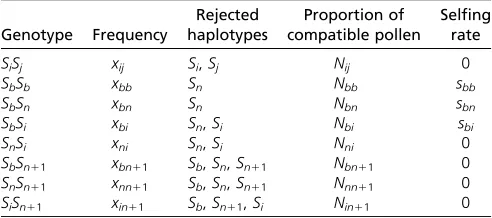
Table 1 Genotypes and associated phenotypes produced in a population composed of n 2 1 SI haplotypes Si, the ancestral
haplotypeSn, and the different studied mutants (the pollen-part
mutantSband the compensated mutantSn11)
Genotype Frequency
Rejected haplotypes
Proportion of compatible pollen
Selfing rate
SiSj xij Si,Sj Nij 0
SbSb xbb Sn Nbb sbb
SbSn xbn Sn Nbn sbn
SbSi xbi Sn,Si Nbi sbi
SnSi xni Sn,Si Nni 0
SbSn11 xbn11 Sb,Sn,Sn11 Nbn11 0
SnSn11 xnn11 Sb,Sn,Sn11 Nnn11 0
artificial chimeric S-RNase protein (produced by the style gene) able to reject two distinct pollen specificities. Their model considered a mutation in the style gene conferring dual specificity, recognizing a new pollen type, not yet pres-ent, as well as its initial pollen type. The pollen gene of this haplotype might then mutate to acquire the new specificity, and the ancestral pistil recognition type might be lost, result-ing in a new functional SI haplotype. This scenario was criticized because the new pollen allele would transiently be rejected by two different haplotypes, placing it at a selec-tive disadvantage when challenged against its ancestral nonmutated copy (Charlesworth 2000; Uyenoyama and Newbigin 2000), and is thus expected to be lost from the population. Furthermore, this scenario involves the unlikely occurrence of three consecutive mutations on the same hap-lotype (Charlesworth 2000).
A second verbal model is based on the observation that the B. oleraceapollen gene can tolerate several amino acid substi-tutions without affecting its binding affinity or specificity (Chookajornet al.2004). These authors proposed that nearly neutral standing variation exists within each functional allelic class. If, by chance, recognition became stronger among a sub-set of haplotypes within a class than with the other haplotypes of the same class, selection might reinforce this new interaction and reduce recognition of the remaining haplotypes in the class, eventually disrupting recognition between the two clas-ses. This model did not specify the selective force reinforcing interactions within nascent functional classes and did not con-sider inbreeding depression, the main evolutionary force main-taining and driving the evolution of SI. Self-compatible haplotypes can invade SI populations (Charlesworth and Char-lesworth 1979), but the conditions under which this model can generate new functional SI haplotypes are unclear.
The only population genetics model of new SI haplotypes involves self-compatible (SC) intermediates (Uyenoyama et al. 2001). SC pollen mutants expressing a new pollen specificity can invade populations and be stably maintained at intermediate frequencies along with functional SI haplo-types when inbreeding depression is high and the propor-tion of self-pollen is low to intermediate (Charlesworth and Charlesworth 1979; Uyenoyama et al. 2001). Long-term maintenance of pollen mutants was proposed to allow di-versification, with new SI haplotypes arising through a single compensatory mutation in the pistil gene of the haplotype carrying the pollen mutant. However, the haplotype in which the pollen mutant arose is almost always excluded at equilib-rium. Thus, even though new SI haplotypes eventually appear, this almost always involved loss of their ancestral haplotype, resulting in replacement of SI haplotypes rather than diversi-fication, suggesting that an increased number of SI haplotypes is almost impossible in a panmictic population. The authors therefore suggested that diversification might occur in subdi-vided populations, but did not model subdivision.
We extend the analytical model of Uyenoyama et al. (2001) by studying the conditions for the evolution of new SI haplotypes and also by simulations. We first study the
conditions under which diversification at the S-locus is expected to occur in an infinite population, in terms of the proportion of self-pollen deposited and the inbreeding depression, and then investigate the effect of genetic drift using simulations including recurrent mutations for new pol-len and pistil specificities.
Models
We assumed GSI,i.e., pollen specificities determined by the pollen's haploid genome, and style specificities determined codominantly by the diploid genome of the style. Pollinations are compatible if the pollen specificity of the donor differs from both specificities expressed by the style of the recipient (de Nettancourt 2001). Following Uyenoyama et al.(2001), we assumed two completely linked genes,Adetermining the style type andBthe pollen specificity. AllelesAiandBjsegregate at
theAandBgenes and express specificitiesiandj. Functionally self-incompatible haplotypes carry identical specificities at the two genes,e.g.,AiBi, and we denote haplotypes bySi(Table 1
gives our notation). Under these assumptions, a new SI hap-lotypeAuBurequires two mutations, one in each gene.
Infinite population model
In the infinite population model, the starting population had equal frequencies ofn Sihaplotypes (1#i#n). We
mod-eled inbreeding depression by assuming that each plant re-ceived a proportion a of self-pollen (rate of self-pollen
deposition) and that selfed offspring have a probability 1–
dof reaching maturity, relative to outcrossed offspring. The
averagefitness of the population was thus
W512dX
uv
suvxuv; (1)
withxuvthe frequency of genotypeSuSv(see Table 1) andsuv
its selfing rate. We sequentially introduced different mu-tants and followed their fate in the population. Because Uyenoyama et al. (2001) showed that diversification can proceed only through pollen-part mutants, we give only the results when thefirst mutation affects the pollen type.
Table 1 Genotypes and associated phenotypes produced in a population composed ofn 2 1 SI haplotypes Si, the ancestral
haplotypeSn, and the different studied mutants (the pollen-part
mutantSband the compensated mutantSn11)
Genotype Frequency
Rejected haplotypes
Proportion of compatible pollen
Selfing rate
SiSj xij Si,Sj Nij 0
SbSb xbb Sn Nbb sbb
SbSn xbn Sn Nbn sbn
SbSi xbi Sn,Si Nbi sbi
SnSi xni Sn,Si Nni 0
SbSn11 xbn11 Sb,Sn,Sn11 Nbn11 0
SnSn11 xnn11 Sb,Sn,Sn11 Nnn11 0
SiSn11 xin11 Sb,Sn11,Si Nin11 0
Pollen-part mutation (first mutation):Using Mathematica 7.0 (Wolfram Research 2008), wefirst investigated the fate of a mutation in the pollen component of haplotype Sn, generating haplotypeSb¼AnBn11. Following the introduc-tion of one such mutaintroduc-tion, the populaintroduc-tion hasn11 distinct haplotypes:n21 unaffected haplotypesSi(1#i,n), the ancestral haplotypeSn, and the pollen-part mutantSb, with respective frequencies in the pollen poolp,pn, andpb. The population hasn(n21)/21n11 diploid genotypes, then (n21)/2SiSjgenotypes (fully SI when 1#i,j#n), then SiSbgenotypes (partially self-compatible when 1#i#n), and theSbSbgenotype (which can self-fertilize, but rejectsSn pollen). Assuming equal pollen production among diploid genotypes and given the haplotypes rejected by each geno-type (Table 1), the proportions of compatible pollen re-ceived by each genotype are
Nij5122p
Nbb5Nbn512pn
Nbi5Nni512pn2p;
(2)
where the double subscripts indicate the diploid genotypes
(SiSj,SbSb,SbSn,. . .).
Hence, the selfing rates of SC genotypes are
sbb5a1ð1a2aÞNbb sbn5a12ð1a2aÞNbn
sbi5a12ð1a2aÞNbi:
(3)
The factor of 2 in the denominators of sbn and sbi arises because only half of the pollen of SC heterozygotes is self-compatible.
Using Equations 1–3, we computed the recursion
equa-tions describing the genotypic frequency change in a gener-ation, which allowed us to investigate the evolutionary fate of all haplotypes in the population, in particular the pollen-part mutantSb. The resulting recursion equations are given inAppendix A1. Pollen-part mutation.
Compensatory (second) mutation: We next introduced a mutation in the pistil gene of the pollen-part mutantSb, generating a fully functional new SI haplotype, denoted by Sn11¼An11Bn11. Letpn11be the frequency ofSn11in the pollen pool. In the population,n(n11)/2 1n1111 diploid genotypes can now be formed, then(n11)/2SiSj genotypes (fully SI if 1#i,j#n11), thenpartially self-compatible SiSb genotypes (1 # i # n), the genotype SbSn11 (which is fully self-incompatible and rejects the three haplotypesSn,Sb, andSn11), and theSbSbgenotype, which can self but rejects Sn pollen. The proportions of compatible pollen for each genotype are
Nij5122p
Nbb5Nbn512pn
Nbi5Nni512pn2p
Nbn115Nnn11512pb2pn2pn11 Nin11512pb2pn112p:
(4)
The selfing ratessbb,sbn, and sbi defined in Equation 3 re-main unchanged, and the recursion equations needed to investigate the evolutionary fate of the compensated haplo-typeSn11and its SC ancestralSbare given inAppendix A2. Compensatory mutation.
Evolution of the system: For diversification to occur, four conditions are clearly necessary (Uyenoyamaet al.2001): i. The pollen-part mutant Sb must increase in frequency
when rare.
ii. Sb must not fix (i.e., a functional SI system must be retained).
iii. Sn (the ancestral allele from the pollen-part mutant arises) must not be excluded by the introduction ofSb. iv. The mutation in the pistil gene that creates the new fully
functional SI haplotype,Sn11, must increase in frequency when bothSbandSnare present in the population. We determined parameter values under which these conditions were jointly satisfied. Conditions i and ii were investigated using local stability analysis. For condition i, we studied invasion of a population withn Sihaplotypes bySb, and for condition ii we studied the stability of the equilib-rium with Sb fixed. We could not use this approach to in-vestigate conditions iii and iv because we found no tractable analytical solution for the equilibrium whenn21SiandSb were all present in the population. We therefore used re-cursion equations in Appendixes A1 and A2 to numerically approximate the parameter values satisfying these condi-tions. For each of 5 to 10 values of the self-pollen deposition parameter (a), we varied inbreeding depression (d) values in steps of 1023 and followed the population for 10,000 generations. Haplotypes with frequencies,1025were con-sidered lost from the population. Specifically, for condition iii we introducedSbat low frequency (xbi¼2·1025;i.e.,pb ¼1025) into an initially isoplethic population (with all func-tional SI haplotypes equally frequent) and determined the value ofdfor whichSnwas not eliminated whenSbspread. For condition iv, we started with a population at equilibrium withn Sihaplotypes plusSb, as obtained under condition iii, and introduced theSn11haplotype at low frequency (xin11
¼ 2 · 1025; i.e., pn11 ¼ 1025) to determine the critical
d-value forSn11 to increase in frequency.
Finite populations simulation
We assumed a population ofNdiploid individuals in which all adults died after zygote production. The initial popula-tion contained n different SI haplotypes Si ¼ Sii in equal frequencies. We assumed a maximum ofkdifferent specificities (1#i #k). The life cycle included three steps: mutation, fertilization during which selection on S-alleles during pol-lination plays, and viability selection through inbreeding depression.
with parameter 4Nm, wheremis the mutation rate per gene per generation. The factor 4 arises because mutations arise in both the pollen and the pistil genes of the 2N chromo-somes in the population. U chromosomes were randomly drawn with replacement in the population. For each chro-mosome, the pollen or pistil gene was mutated with equal probability, and the specificity was randomly changed to one of the remainingk21 specificities. Hence, unlike the infi n-ite population model, the order of mutations is not constrained.
Pollination: Plants were assumed to produce infinite numbers of pollen grains and ovules. Hence we assume no pollen limitation. Diploid individuals were randomly drawn with replacement as maternal plants. Let us consider a plant with genotype SijSgh that expresses specificities i and g in pistil andjandhin pollen, with {g,h,i,j}2〚1;k〛4. The probability for this plant to self-fertilize was
sij;gh5
a�gijggj1gghgih�
a�gijggj1gghgih�12ð12aÞPm;npmnginggn; (5)
whereais the proportion of self pollen received,pmnis the frequency of theSmnhaplotype in the population, andgijis an indicator variable such thatgij¼0 ifi¼j(i.e.,Bjpollen is rejected byAipistils) andgij¼1 ifi6¼j(compatible mating). If the plant self-fertilizes, it could be fertilized bySijwith probability fij¼gijggj/(gijggj1gghgih) or bySghwith prob-ability fgh ¼12 fij. Otherwise, the probability that it was fertilized by a pollen with haplotypeSuvwas
fuv5P puvgivggv
m;npmnginggn: (6)
Inbreeding depression:Finally, to form the zygote genotype, a maternal chromosome was drawn randomly with probabil-ity 1/2. Selfed seeds survived with probabilprobabil-ity 12d.N indi-viduals were generated.
Diversification, loss, or maintenance of SI: We first simulated an initial population ofn¼5 different SI haplo-types in equal frequencies and k¼ 20. We simulated four population sizes (N¼50, 500, 5000, and 50,000) andfive mutation rates (m¼5·1027, 5·1026, 5·1025, 5·1024, and 5·1023). We defined four possible differentfinal states of the population:
1. Loss of SI: Only SC haplotypes were present in the population.
2. Maintenance of SI: No SC haplotypes were present and the number of SI haplotypes remained stable or de-creased (n#5).
3. Polymorphism: Both SI and SC haplotypes were present at equilibrium.
4. Diversification: n . 5 SI haplotypes and no SC haplo-types were present.
One hundred runs were performed for each set of param-eters. The simulations were stopped when either diversifi -cation occurred (more than five SI haplotypes and no SC haplotypes in high frequencies) or all SI haplotypes were lost. Otherwise (no new SI haplotypes and/or presence of SC haplotypes at high frequencies), the system was run for 105generations. Since we were interested in thefinal state of the population, and since SC and SI haplotypes could arise by mutation at any time, we then arbitrarily character-ized the state of the system on the basis of haplotypes pres-ent at frequencies .0.01 (0.05 forN¼50).
Dynamics of diversification: In the previous section we
were interested only in the final evolutionary outcome. To investigate the numbers of SI haplotypes over time, and the times between successive diversification events, we per-formed further simulations for 106 generations with N ¼ 5000, m¼5·1025,d¼0.9, anda-values of 0.2 and 0.4. Runs were started at isoplethy with three SI haplotypes, and we studied threekvalues, 20, 100, and 200. One hundred runs were performed for each set of parameters.
To investigate the detailed dynamics of SI haplotype gains and losses, we also tracked the genotypes in the population for 150,000 generations for 20 replicates, sampling genotypic frequencies every 1000 generations, using the following ap-proximations. Since new SI haplotypes necessarily arise through SC intermediates, their rate of gain should be approximated by the population's total frequency of SC haplotypes. Similarly, since in our model the loss of haplotypes is caused by genetic drift of low-frequency haplotypes, and all functional SI haplo-types in GSI systems have equal expected equilibrium frequen-cies, the rate of loss should be approximated by the average frequency of SI haplotypes.
Results
Infinite populations
with parameter 4Nm, wheremis the mutation rate per gene per generation. The factor 4 arises because mutations arise in both the pollen and the pistil genes of the 2N chromo-somes in the population. U chromosomes were randomly drawn with replacement in the population. For each chro-mosome, the pollen or pistil gene was mutated with equal probability, and the specificity was randomly changed to one of the remainingk21 specificities. Hence, unlike the infi n-ite population model, the order of mutations is not constrained.
Pollination: Plants were assumed to produce infinite numbers of pollen grains and ovules. Hence we assume no pollen limitation. Diploid individuals were randomly drawn with replacement as maternal plants. Let us consider a plant with genotype SijSgh that expresses specificities i and g in pistil andjandhin pollen, with {g,h,i,j}2〚1;k〛4. The probability for this plant to self-fertilize was
sij;gh5
a�gijggj1gghgih�
a�gijggj1gghgih�12ð12aÞPm;npmnginggn; (5)
whereais the proportion of self pollen received,pmnis the frequency of theSmnhaplotype in the population, andgijis an indicator variable such thatgij¼0 ifi¼j(i.e.,Bjpollen is rejected byAipistils) andgij¼1 ifi6¼j(compatible mating). If the plant self-fertilizes, it could be fertilized bySijwith probability fij¼gijggj/(gijggj1gghgih) or by Sghwith prob-ability fgh ¼12 fij. Otherwise, the probability that it was fertilized by a pollen with haplotypeSuvwas
fuv5P puvgivggv
m;npmnginggn: (6)
Inbreeding depression:Finally, to form the zygote genotype, a maternal chromosome was drawn randomly with probabil-ity 1/2. Selfed seeds survived with probabilprobabil-ity 12d.N indi-viduals were generated.
Diversification, loss, or maintenance of SI: We first simulated an initial population ofn¼5 different SI haplo-types in equal frequencies and k¼ 20. We simulated four population sizes (N¼50, 500, 5000, and 50,000) andfive mutation rates (m¼5·1027, 5·1026, 5·1025, 5·1024, and 5·1023). We defined four possible differentfinal states of the population:
1. Loss of SI: Only SC haplotypes were present in the population.
2. Maintenance of SI: No SC haplotypes were present and the number of SI haplotypes remained stable or de-creased (n#5).
3. Polymorphism: Both SI and SC haplotypes were present at equilibrium.
4. Diversification: n . 5 SI haplotypes and no SC haplo-types were present.
One hundred runs were performed for each set of param-eters. The simulations were stopped when either diversifi -cation occurred (more than five SI haplotypes and no SC haplotypes in high frequencies) or all SI haplotypes were lost. Otherwise (no new SI haplotypes and/or presence of SC haplotypes at high frequencies), the system was run for 105generations. Since we were interested in thefinal state of the population, and since SC and SI haplotypes could arise by mutation at any time, we then arbitrarily character-ized the state of the system on the basis of haplotypes pres-ent at frequencies.0.01 (0.05 forN¼50).
Dynamics of diversification: In the previous section we
were interested only in thefinal evolutionary outcome. To investigate the numbers of SI haplotypes over time, and the times between successive diversification events, we per-formed further simulations for 106 generations with N ¼ 5000,m¼5·1025,d¼0.9, anda-values of 0.2 and 0.4. Runs were started at isoplethy with three SI haplotypes, and we studied threekvalues, 20, 100, and 200. One hundred runs were performed for each set of parameters.
To investigate the detailed dynamics of SI haplotype gains and losses, we also tracked the genotypes in the population for 150,000 generations for 20 replicates, sampling genotypic frequencies every 1000 generations, using the following ap-proximations. Since new SI haplotypes necessarily arise through SC intermediates, their rate of gain should be approximated by the population's total frequency of SC haplotypes. Similarly, since in our model the loss of haplotypes is caused by genetic drift of low-frequency haplotypes, and all functional SI haplo-types in GSI systems have equal expected equilibrium frequen-cies, the rate of loss should be approximated by the average frequency of SI haplotypes.
Results
Infinite populations
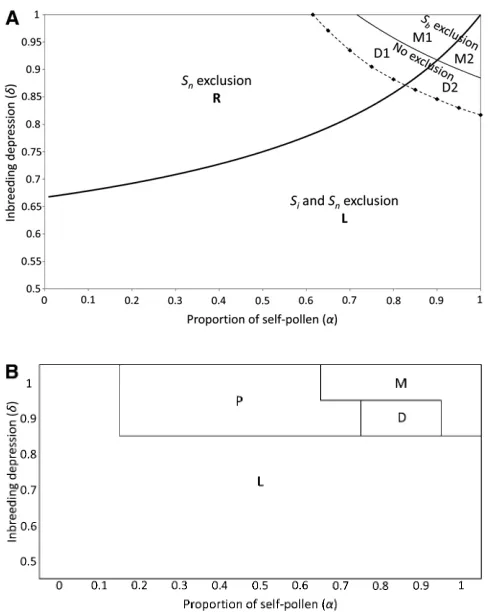
Evolutionary outcomes:Extending the stability analysis of the Uyenoyamaet al.(2001) model (Appendix A3. Stability analysis) allowed us to divide the parameter space into six regions (L, M1, M2, R, D1, and D2; see Figure 1A), instead of the four originally described (Table 2). Uyenoyamaet al.’s (2001) four regions were defined only on the basis of the frequency change of the pollen-part mutantSbwhen rare or frequent. Our inclusion of the fate of the ancestral SI hap-lotype Sn splits two of the regions where Sb increases in frequency when rare, depending on whether rare Sn (com-pensating) mutations increase or decrease. The six resulting regions correspond to four qualitatively different evolution-ary patterns for Sb,Sn, andSn11 haplotypes. Three evolu-tionary outcomes were identified by Uyenoyama et al. (2001): in region L, the SI system was lost, whereas it was maintained unaltered in regions M1 and M2, or haplotypes were replaced (region R). Our analysis identifies additional regions D1 and D2 in which new SI haplotypes evolve. We next describe these regions in detail.
Low inbreeding depression yields outcomes in region L (unconditional increase in the frequency of Sb, to fixation excluding all functional haplotypes, with loss of SI). With high inbreeding depression and a high proportion of self-pollen deposition, regions M1 and M2 result (Sbdoes not increase in frequency when introduced at low initial frequency and an unaltered SI is maintained; the two regions differ in the be-havior of Sb near fixation, effectively fixing in M2, but de-creasing in frequency in M1). When inbreeding depression is high and self-pollen deposition low to intermediate, region
R results. In this region of parameter space, Sb establishes a polymorphism along with the preexisting Si haplotypes, but this is always accompanied by the exclusion of the ances-tral Sn haplotype. Subsequent introduction ofSn11leads to the exclusion ofSb, resulting in a fully SI population with the n21 initialSihaplotypes and the new haplotypeSn11 replac-ingSn, with no increase in the number of SI haplotypes.
Finally, for intermediate to high values of both danda, diversification is possible. Such situations yield regions D1
and D2, in whichSbalso establishes a polymorphism at equi-librium (like region R), but without loss of Sn (Sb fixes in region D2, but in D1 it decreases in frequency when initially present at high frequency). The frequency ofSbhas one stable equilibrium in region D1 and two equilibria, one stable and one unstable, in D2 (Table 2); the stable equilibrium in D2 has a lowerSbfrequency than the unstable one. BecauseSnis also maintained in regions D1 and D2, the compensatory pistil mutationSn11can produce an increase the number of SI haplotypes. Indeed, the Sn11mutation always led to the exclusion ofSb(see condition iv inAppendix A3).
The relative sizes of the different regions depended on the initial number of SI haplotypes (n), with an increase of the M regions and a decrease of the R and D regions as n increases (Figure 2). This relates to the possibility of poly-morphism for pollen-part mutation until n becomes large (Charlesworth and Charlesworth 1979).
Finite population simulations
Our simulations starting with n¼5 support the analytical predictions, but genetic drift and recurrent pollen-part and compensatory pistil mutation can increase the parameter space where diversification can occur. Figure 1B shows
four different evolutionary outcomes: region L, where SC haplotypes became fixed; M, where SI was maintained;
a polymorphism region (P), where both SC and SI haplo-types are present; and a diversification region (D), where
thefinal population contained more than the initial number
of SI haplotypes and no SC haplotypes. Note that Figure 1B is a simplified representation of the results forN¼ 5000,
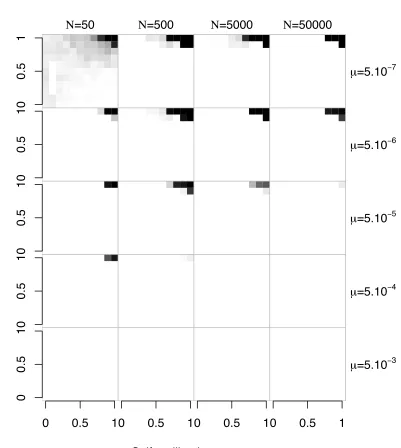
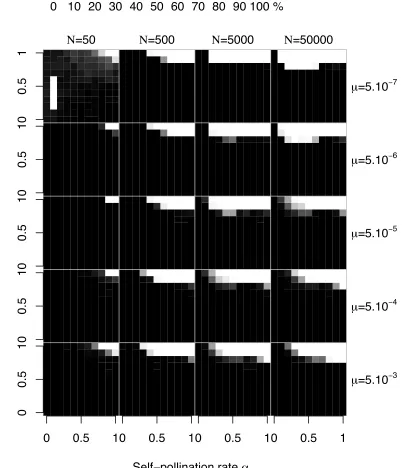
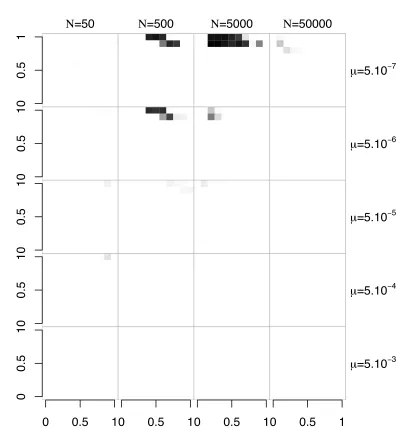
m ¼5 ·1027, and k ¼20 (detailed results are shown in Figure 3 andsupporting information,Figure S1,Figure S2, andFigure S3).
Table 2 Evolution of the frequency ofSbnearfixation and ofSb,Sn andSn11near exclusion, in the six described regions
Sbfrequent Sbrare Snrare Sn11rare
L 1 1 2 2
R 2 1 2 1
M1 2 2 1 1
M2 1 2 1 1
D1 2 1 1 1
D2 1 1 1 1
“1”indicates that the frequency increases. “2”indicates that the frequency decreases. Regions M1, M2, R1D1, and L1D2 correspond, respectively, to the regions E, D, P, and S described in Uyenoyamaet al.(2001).
Figure 1Limits of the regions where the different evolutionary outcomes are observed, for an initial number of S haplotypesn¼5. (A) In an infinite population: solid lines are the results of the stability analysis (thick line, fate of the pollen-part mutantSbwhen it is frequent; thin line, evolutionary
outcome whenSbis rare; see text for further details). The dashed line limit
was obtained through numerical iterations and delimits the region where haplotypeSnwas not excluded after the introduction of the pollen-part
mutantSb. Diamonds refer to the parameters that we investigated to
approx-imate this limit. We define four regions according to which haplotypes are excluded whenSbis introduced at low frequency in the population. These four
regions are the loss region (L), when the pollen-part mutantSbgoes tofixation;
the replacement region (R), when onlySnis excluded; the maintenance regions
(M11M2), whenSbalone is excluded; and the diversification regions (D11
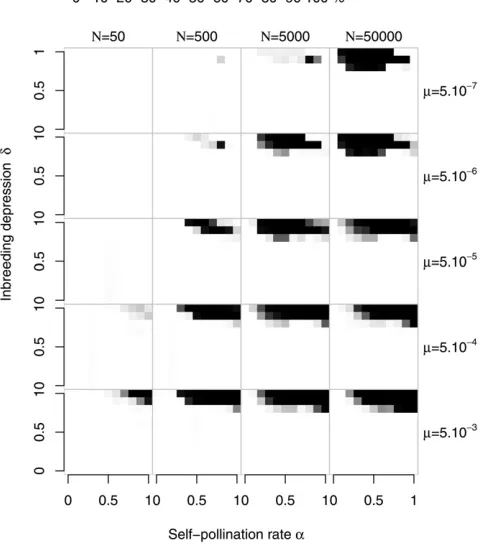
Whereas the relative positions of these different zones are largely independent of the parameter values, their sizes depend strongly on the population size and mutation rate. Except when the values ofmandNwere both low, region D was considerably larger than in the analytical model (Figure 3), extending over much of the R region determined for an infinite population. Indeed, for highNm, diversification
oc-curred even with high inbreeding depression and self-pollen deposition (whereas, with low Nm, the system was main-tained, as in an infinite population; see Figure S1). The
parameter values for which SI was lost were similar to those for an infinite population (Figure S2), except for high
in-breeding depression and low self-pollen deposition where SI is lost in finite populations whereas replacement is
expected in an infinite population. As expected from the fact
that a compensated mutant Sn11 always excludes its SC ancestor Sb, coexistence of SI and SC haplotypes was very rare, observed mainly with low mutation rates and interme-diateN(Figure S3).
Dynamics of diversification:Withn¼3 in the initial pop-ulation, there was generally loss of some SI haplotypes in the early generations, since, with such low numbers of SI haplotypes, anSbpollen-part mutant is expected to exclude its ancestral SI haplotype Sn(see Figure 2). However, the populations rapidly returned to n . 3. For the parameter values investigated (N¼5000,m¼5·1025,d¼0.9, and a¼0.2 and 0.4), the numbers of SI haplotypes in the pop-ulations increased from 3 to between 7 and 18 within 106 generations (Figure 4). For a ¼ 0.2, the population had apparently reached a stationary number of haplotypes.
Di-versification always proceeded through pollen-part mutants
followed by compensatory mutations in the pistil gene,
con-firming forfinite populations this prediction from the
ana-lytical model (Uyenoyama et al.2001).
The mean waiting time between successive diversification
events (seeModelsfor the approximations used to study this) increased withn, with two distinct phases. Haplotype num-bers first increased rapidly and then suddenly either
stabi-lized or increased much more slowly. In the initial fast diversification, the overall frequency of SC haplotypes was
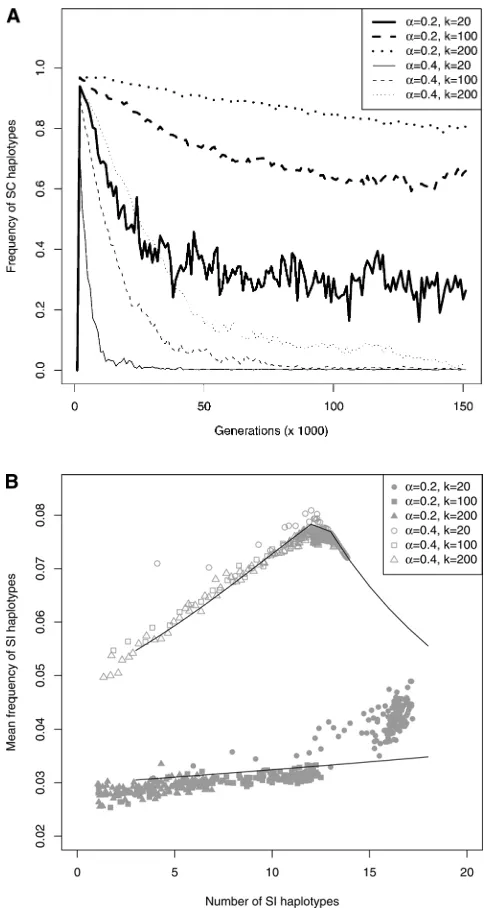
very high (Figure 5A), implying a high birth rate of SI hap-lotypes, but the overall frequency of SC haplotypes then decreased, thus slowing down diversification asnincreased
(Figure 5A). Interestingly, during the same time, the rate of loss of functional SI also decreased (as estimated from the increased mean frequency of SI haplotypes, see Models) (Figure 5B). This suggests that the decrease of the birth rate more than outweighs the decreased death rate and therefore that the slowdown of diversification is due to the decreased
birth rate. This is consistent with the fact that the ability of pollen-part mutations to invade decreases whennis high.
Figure 2Effect of the initial number of specificities (n) on the different evolutionary outcomes in an infinite population. Solid and dashed lines define the limits of each region (L, R, M1, M2, D1, and D2; see Figure 1 legend). The diversification region is indicated at the top for the different
n’s. Note that some diversification regions are overlapping. The area of the diversification region decreased whennincreased, except forn¼3 andn¼4. The diversification region was also displaced toward smaller values ofdandawhennincreased. Stars indicate the values ofdanda that were chosen to investigate the diversification dynamics across 106 generations in Figure 4.
Figure 3 The diversification region in afinite population for different population sizes and mutation rates, with an initial number of specificities
n¼5. Grid cells arefigured in shades of gray that are proportional to the number of simulations where diversification was observed (n.5 at the end of the simulation), with black squares corresponding to sets of parameters under which the evolutionary outcome was only diversifi ca-tion and white squares corresponding to cases under which no diversifi -cation was observed. One hundred replicate runs were performed for each combination of parameter values (population sizeN, mutation ratem).k¼
Whereas the relative positions of these different zones are largely independent of the parameter values, their sizes depend strongly on the population size and mutation rate. Except when the values ofmandNwere both low, region D was considerably larger than in the analytical model (Figure 3), extending over much of the R region determined for an infinite population. Indeed, for high Nm, diversification
oc-curred even with high inbreeding depression and self-pollen deposition (whereas, with low Nm, the system was main-tained, as in an infinite population; see Figure S1). The
parameter values for which SI was lost were similar to those for an infinite population (Figure S2), except for high
in-breeding depression and low self-pollen deposition where SI is lost in finite populations whereas replacement is
expected in an infinite population. As expected from the fact
that a compensated mutant Sn11 always excludes its SC ancestor Sb, coexistence of SI and SC haplotypes was very rare, observed mainly with low mutation rates and interme-diateN(Figure S3).
Dynamics of diversification:Withn¼3 in the initial pop-ulation, there was generally loss of some SI haplotypes in the early generations, since, with such low numbers of SI haplotypes, anSbpollen-part mutant is expected to exclude its ancestral SI haplotype Sn(see Figure 2). However, the populations rapidly returned to n . 3. For the parameter values investigated (N¼5000,m¼5·1025,d¼0.9, and a¼0.2 and 0.4), the numbers of SI haplotypes in the pop-ulations increased from 3 to between 7 and 18 within 106 generations (Figure 4). For a ¼ 0.2, the population had apparently reached a stationary number of haplotypes.
Di-versification always proceeded through pollen-part mutants
followed by compensatory mutations in the pistil gene,
con-firming forfinite populations this prediction from the
ana-lytical model (Uyenoyamaet al.2001).
The mean waiting time between successive diversification
events (seeModelsfor the approximations used to study this) increased withn, with two distinct phases. Haplotype num-bersfirst increased rapidly and then suddenly either
stabi-lized or increased much more slowly. In the initial fast diversification, the overall frequency of SC haplotypes was
very high (Figure 5A), implying a high birth rate of SI hap-lotypes, but the overall frequency of SC haplotypes then decreased, thus slowing down diversification asnincreased
(Figure 5A). Interestingly, during the same time, the rate of loss of functional SI also decreased (as estimated from the increased mean frequency of SI haplotypes, see Models) (Figure 5B). This suggests that the decrease of the birth rate more than outweighs the decreased death rate and therefore that the slowdown of diversification is due to the decreased
birth rate. This is consistent with the fact that the ability of pollen-part mutations to invade decreases whennis high.
Figure 2Effect of the initial number of specificities (n) on the different evolutionary outcomes in an infinite population. Solid and dashed lines define the limits of each region (L, R, M1, M2, D1, and D2; see Figure 1 legend). The diversification region is indicated at the top for the different
n’s. Note that some diversification regions are overlapping. The area of the diversification region decreased whennincreased, except forn¼3 andn¼4. The diversification region was also displaced toward smaller values ofdandawhennincreased. Stars indicate the values ofdanda that were chosen to investigate the diversification dynamics across 106 generations in Figure 4.
Figure 3The diversification region in afinite population for different population sizes and mutation rates, with an initial number of specificities
n¼5. Grid cells arefigured in shades of gray that are proportional to the number of simulations where diversification was observed (n.5 at the end of the simulation), with black squares corresponding to sets of parameters under which the evolutionary outcome was only diversifi ca-tion and white squares corresponding to cases under which no diversifi -cation was observed. One hundred replicate runs were performed for each combination of parameter values (population sizeN, mutation ratem).k¼
20 for all simulations.
SI haplotype diversification rate increased with
decreas-ingk, especially during thefirst phase (Figure 4), which
ex-plains the lower number of SI haplotypes at a given time. We
interpret this in terms of the increased probability 1/(k21)
that compensatory mutations can occur as k decreases.
However, the value of k should not affect diversification
probability for given values ofaandd. In other words, we
do not expect that the parameter space for diversification
(Figure 3) would shrink askincreases. The detailed
dynam-ics depend on the level of self-pollen deposition. With high
self-pollen deposition (a¼0.4), the overall frequency of SC
haplotypes was near zero (Figure 5A), implying a very low rate of gain of new SI haplotypes, and the frequency of SI haplotypes was high (Figure 5B), suggesting a low
probabil-ity of haplotype loss by genetic drift. Diversification
there-fore occurred with slow haplotype turnover, with both birth and death rates that were low. For lower proportions of
self-pollen (a¼ 0.2), however, SC haplotypes were at higher
frequency (Figure 5A) but SI haplotypes were less frequent
(Figure 5B);i.e., diversification occurred with fast haplotype
turnover and high birth and death rates. This is consistent with the observation of more stochastic variation in the number of haplotypes in the population for the lower a-value (Figure 4) and with additional simulations with
larger population size, up toN¼10,000 (data not shown),
which did not detectably affect thefinal number of
haplo-types whena¼0.4 (i.e., there was no effect of genetic drift
on the dynamics of diversification) but did increase thefinal
number of haplotypes fora¼0.2.
Figure 4Diversification dynamics infinite populations across 106 gen-erations. The number of SI haplotypes in the population was averaged over 100 replicates. Simulations were performed withN¼5000,m¼5·
1025,d¼0.9, the initial number of SI haplotypesn¼3, and for three different values of the maximum number of specificities (k) and two values of the proportion of self-pollen (a). Thick line,a¼0.2; thin line,
a¼0.4. For a givena, curves correspond tok¼20, 100, and 200 from top to bottom.
Discussion
Importance of genetic drift and recurrent mutations
Allelic diversification is clearly possible in an infinite,
un-divided population, and the region of parameter space where it can occur can be large, especially when the number of SI haplotypes in the population is fewer than six. Our
simu-lations show that, in finite populations, diversification is
generally possible under a larger set of parameter values than
in an infinite population (with the exception of very small
populations and/or very low mutation rates). The difference was largely dependent on the proportion of self-pollen deposition, low values of which can greatly extend the lower
limit of the diversification region, so that it could cover most
of the region where replacement of SI haplotypes, without
diversification, is expected in an infinite population. In
contrast, the critical inbreeding depression allowing
diversi-fication infinite populations never extended beyond that for
an infinite population, for the parameter space we explored
(even for the largest population sizes and mutation rates). Hence, while stochastic processes are generally associated
with reduced genetic diversity within small, finite
popula-tions, our results show that diversification of SI halotypes
behaves in the opposite way and that the forces promoting
diversification can outweigh stochastic loss of SI haplotypes,
which becomes strongly limited due to frequency-dependent selection under conditions when SI is favored.
The role of inbreeding depression
Our results support previous conclusions that diversification
requires high inbreeding depression (Charlesworth and Charlesworth 1979; Uyenoyama 1988a,b). However, these
conclusions were based on a fixed inbreeding depression
parameter, ignoring its evolution as the outcrossing rate changes. Porcher and Lande (2005) showed that, for high inbreeding depression due to deleterious mutations, and
high selfing rates, mutations may be efficiently purged,
eventually leading to the loss of SI. Our study again treated
inbreeding depression as a fixed parameter, even though
clearly invasion of a population by an Sb allele may allow
purging of deleterious mutations, making the conditions for
diversification increasingly stringent. However, Porcher and
Lande (2005, Figure 2) also showed, in single-locus models for S-alleles, that SC haplotypes can be maintained in co-existence with SI haplotypes under a wide range of
param-eter values, especially when the selfing rate is low or when
there is a sheltered load. Moreover, our results showed that
inbreeding depression must be high for diversification to
occur, while the self-pollination rate may be moderate to high. This should now be added to further studies of two-gene models for S-allele evolution.
Dynamics of diversification
The observed increase in the time between successive
di-versification events may be due to the fact that, for a given
combination of self-pollen deposition and inbreeding de-pression, the expected frequency of pollen-part intermediates
decreases as nincreases, which decreases the probability of
a compensatory (pistil) mutation occurring in the intermedi-ate haplotype before it is lost by drift. The prediction that
diversification is not constant through time may explain some
otherwise puzzling features of SI systems, including cases of
rapid S-allele diversification, and the unexpectedly long
ter-minal branches typically observed at SI genes.
S-allele numbers and the shape of phylogenies
The observation that all SI haplotypes in Physalis and Witheringia belong to only three ancestral lineages (Paape et al.2008; see also Milleret al.2008 for the genus Lycium) was interpreted by these authors in terms of rapid S-allele
diversification after demographic bottlenecks (when the
number of SI haplotypes will tend to be small). Further, Castric and Vekemans (2007) estimated much stronger pos-itive selection among Brassica SI haplotypes than among the more anciently diverged SI haplotypes of Arabidopsis
spe-cies. This might suggest rapid and recent diversification of
Brassica SI haplotypes from just two ancestral lineages.
The parameter space where diversification is expected to
occur in an infinite population shrinks rapidly with
in-creasedn, and the D region is also displaced toward lower
self-pollen deposition rates and inbreeding depression.
Ini-tially rapid diversification becomes slow as SI haplotype
number increases, eventually stopping almost completely,
yielding a threshold value of n that allows diversification.
Fora¼0.2, haplotype turnover was rapid during diversifi
-cation, and the overall frequency of SC haplotypes remained
high when diversification ceased.
Our simulations yield many fewer SI haplotypes than are typically observed in natural populations, where the number
of SI haplotypes commonly reaches 50–100 in species-wide
range samples (Lawrence 2000). This is probably not due to the low effective population size assumed in our simulations,
because, at least for high proportions of self-pollen (a¼0.4),
the SI haplotype number maintained was apparently inde-pendent of population size (results not shown). Moreover,
under the classical single-gene mutation–drift–selection
the-oretical framework where a single mutation gives rise to new functional SI haplotypes, only a very low mutation rate is needed to yield high equilibrium numbers of SI haplotypes in a population of 5000 plants. In such models, to yield as few as 17 SI haplotypes at equilibrium (the maximum number of SI haplotypes we observed in our simulations), an
unrealisti-cally low mutation rate of 10220must be assumed (Vekemans
and Slatkin 1994). Thus, although our model can generate
diversification, it does not fully explain S-allele
polymor-phism, suggesting that other factors, such as population struc-ture, are probably needed to explain the diversity observed,
as proposed by Uyenoyamaet al.(2001).
Discussion
Importance of genetic drift and recurrent mutations
Allelic diversification is clearly possible in an infinite,
un-divided population, and the region of parameter space where it can occur can be large, especially when the number of SI haplotypes in the population is fewer than six. Our
simu-lations show that, in finite populations, diversification is
generally possible under a larger set of parameter values than
in an infinite population (with the exception of very small
populations and/or very low mutation rates). The difference was largely dependent on the proportion of self-pollen deposition, low values of which can greatly extend the lower
limit of the diversification region, so that it could cover most
of the region where replacement of SI haplotypes, without
diversification, is expected in an infinite population. In
contrast, the critical inbreeding depression allowing
diversi-fication infinite populations never extended beyond that for
an infinite population, for the parameter space we explored
(even for the largest population sizes and mutation rates). Hence, while stochastic processes are generally associated
with reduced genetic diversity within small, finite
popula-tions, our results show that diversification of SI halotypes
behaves in the opposite way and that the forces promoting
diversification can outweigh stochastic loss of SI haplotypes,
which becomes strongly limited due to frequency-dependent selection under conditions when SI is favored.
The role of inbreeding depression
Our results support previous conclusions that diversification
requires high inbreeding depression (Charlesworth and Charlesworth 1979; Uyenoyama 1988a,b). However, these
conclusions were based on a fixed inbreeding depression
parameter, ignoring its evolution as the outcrossing rate changes. Porcher and Lande (2005) showed that, for high inbreeding depression due to deleterious mutations, and
high selfing rates, mutations may be efficiently purged,
eventually leading to the loss of SI. Our study again treated
inbreeding depression as a fixed parameter, even though
clearly invasion of a population by an Sballele may allow
purging of deleterious mutations, making the conditions for
diversification increasingly stringent. However, Porcher and
Lande (2005, Figure 2) also showed, in single-locus models for S-alleles, that SC haplotypes can be maintained in co-existence with SI haplotypes under a wide range of
param-eter values, especially when the selfing rate is low or when
there is a sheltered load. Moreover, our results showed that
inbreeding depression must be high for diversification to
occur, while the self-pollination rate may be moderate to high. This should now be added to further studies of two-gene models for S-allele evolution.
Dynamics of diversification
The observed increase in the time between successive
di-versification events may be due to the fact that, for a given
combination of self-pollen deposition and inbreeding de-pression, the expected frequency of pollen-part intermediates
decreases asnincreases, which decreases the probability of
a compensatory (pistil) mutation occurring in the intermedi-ate haplotype before it is lost by drift. The prediction that
diversification is not constant through time may explain some
otherwise puzzling features of SI systems, including cases of
rapid S-allele diversification, and the unexpectedly long
ter-minal branches typically observed at SI genes.
S-allele numbers and the shape of phylogenies
The observation that all SI haplotypes in Physalis and Witheringia belong to only three ancestral lineages (Paape et al.2008; see also Milleret al.2008 for the genus Lycium) was interpreted by these authors in terms of rapid S-allele
diversification after demographic bottlenecks (when the
number of SI haplotypes will tend to be small). Further, Castric and Vekemans (2007) estimated much stronger pos-itive selection among Brassica SI haplotypes than among the more anciently diverged SI haplotypes of Arabidopsis
spe-cies. This might suggest rapid and recent diversification of
Brassica SI haplotypes from just two ancestral lineages.
The parameter space where diversification is expected to
occur in an infinite population shrinks rapidly with
in-creased n, and the D region is also displaced toward lower
self-pollen deposition rates and inbreeding depression.
Ini-tially rapid diversification becomes slow as SI haplotype
number increases, eventually stopping almost completely,
yielding a threshold value of n that allows diversification.
Fora¼0.2, haplotype turnover was rapid during diversifi
-cation, and the overall frequency of SC haplotypes remained
high when diversification ceased.
Our simulations yield many fewer SI haplotypes than are typically observed in natural populations, where the number
of SI haplotypes commonly reaches 50–100 in species-wide
range samples (Lawrence 2000). This is probably not due to the low effective population size assumed in our simulations,
because, at least for high proportions of self-pollen (a¼0.4),
the SI haplotype number maintained was apparently inde-pendent of population size (results not shown). Moreover,
under the classical single-gene mutation–drift–selection
the-oretical framework where a single mutation gives rise to new functional SI haplotypes, only a very low mutation rate is needed to yield high equilibrium numbers of SI haplotypes in a population of 5000 plants. In such models, to yield as few as 17 SI haplotypes at equilibrium (the maximum number of SI haplotypes we observed in our simulations), an
unrealisti-cally low mutation rate of 10220must be assumed (Vekemans
and Slatkin 1994). Thus, although our model can generate
diversification, it does not fully explain S-allele
polymor-phism, suggesting that other factors, such as population struc-ture, are probably needed to explain the diversity observed,
as proposed by Uyenoyamaet al.(2001).
Allelic genealogies of genes under balancing selection extend deep in the evolutionary past and thus can reveal
ancient evolutionary processes such as the number of breeding individuals in the species as a whole across its evolutionary history or the strength of balancing selection, but these
evolu-tionary inferences assume a constant diversification rate (e.g.,
Takahata 1990; Vekemans and Slatkin 1994). Our results
sug-gest that this assumption may be violated, since the diversifi
ca-tion rate decreases with the number of funcca-tional SI haplotypes
in the population. The diversification rate will not be constant if
the equilibrium number of SI haplotypes has only recently been reached and the turnover rate is slow. In contrast, if turnover is fast enough and/or haplotype number stopped increasing a
suf-ficiently long time ago, the rate can be considered constant.
Our results are consistent with thefinding that terminal
branches in the phylogenies of SI haplotypes are longer than expected by models that assume that balancing selection simply extends the lengths of branches of the coalescent tree, relative to a neutral model (Takahata 1990; Uyenoyama 1997). Two main hypotheses have been proposed to explain this. First, Uyenoyama (1997) proposed the accumulation of deleterious mutations linked to individual SI haplotypes (called sheltered load); a new SI haplotype would then share linked mutations with its ancestral copy and would thus be excluded from the population. There is some evi-dence for existence of sheltered load (Stone 2004; Llaurens et al. 2009). Second, Schierup et al.(2001) proposed that recombination could explain long terminal branches, by cre-ating haplotypes whose sequences are composed of fragments with different evolutionary histories, thus homogenizing se-quence divergence among them. Recombination may occur
among SI haplotypes in Arabidopsis (Castricet al.2010),
Pe-tunia inflata(Wanget al.2001),Prunus dulcis(Ortegaet al.
2006), and other Solanaceae and Rosaceae (Vieira et al.
2003). Our results here suggest that long terminal branches
could simply be an intrinsic property of the diversification
process, through the slowing down of the S-allele diversifi
ca-tion process as SI haplotype numbers increase. Furthermore, it
is striking that such a slowing down of diversification is
ap-parently encountered in very different mechanisms such as the
appearance of mating types in fungi (May et al.1999) and
speciation (e.g., Morlon et al. 2010; Quental and Marshall
2010). We might thus speculate the intriguing possibility that such a phenomenon is a general pattern.
The mutation process
Our hypothesis for the molecular mechanism responsible for
recognition between pollen and pistil is oversimplified,
particularly the limited number of possible allelic states (k-allele model) and the strict recognition reactions between
pollen and pistils with cognate specificities. The pollen and
pistil genes differ in size and function (Takayama and Isogai 2005) and in the numbers of amino acid sites evolving under positive selection. Estimates of this number are between 13 and 31 in the pistil gene S-RNase of Solanaceae (Takebaya-shiet al.2003; Savage and Miller 2006; Igicet al.2007),vs.
23 in the pollen gene SFB in Prunus (Nuneset al.2006). In
Brassica, estimates are between 26 and 44 in the pistil gene
SRK and 47 in the pollen-S gene SCR (Takebayashiet al.
2003; Sainudiin et al.2005; Castric and Vekemans 2007).
Mutagenesis experiments suggest that several mutations are
generally required to shift specificities [at least four amino
acids inS. chacoenseS-RNases (Mattonet al.1999) and four
amino acids in B. oleracea SCR (Chookajorn et al. 2004)].
Compensatory mutations may thus require several
muta-tional steps, possibly making coevolution and diversification
more difficult than in our model.
Now that Arabidopsis thaliana has been established as
a model plant for mechanistic studies of SI (Nasrallahet al.
2002; Tsuchimatsuet al.2010), it will be feasible to study in
detail the steps required for allele diversification, at least in
this plant.
Acknowledgments
We thank Xavier Vekemans, Denis Roze, Emmanuelle Porcher, and Chi Viet Tran for discussions, Camille Roux for technical help on graphics and Marcy Uyenoyama, Deborah Charles-worth, and an anonymous reviewer for their helpful com-ments on the manuscript.
Literature Cited
Billiard, S., M. Lopez-Villavicencio, B. Devier, M. Hood, C. Fairhead, and T. Giraud, 2011 Having sex, yes, but with whom? Infer-ences from fungi on the evolution of anisogamy and mating types. Biol. Rev. 86: 421–442.
Castric, V., and X. Vekemans, 2007 Evolution under strong bal-ancing selection: how many codons determine specificity at the female self-incompatibility gene SRK in Brassicaceae. BMC Evol. Biol. 7: 132.
Castric, V., J. S. Bechsgaard, S. Grenier, R. Noureddine, M. H. Schierupet al., 2010 Molecular evolution within and between self-incompatibility specificities. Mol. Biol. Evol. 27: 11–20. Charlesworth, D., 2000 How can two-gene models of
self-incompatibility generate new specificities? Plant Cell 12: 309–310. Charlesworth, D., and B. Charlesworth, 1979 Evolution and
breakdown of S-allele systems. Heredity 43: 41–55.
Chookajorn, T., A. Kachroo, D. Ripoll, A. Clark, and J. Nasrallah, 2004 Specificity determinants and diversification of the Bras-sicaself-incompatibility pollen ligand. Proc. Natl. Acad. Sci. USA 101: 911–917.
de Nettancourt, D., 2001 Incompatibility and Incongruity in Wild
and Cultivated Plants.Springer-Verlag, Berlin.
Fisher, R. A., 1961 A model for the generation of self-sterility alleles. J. Theor. Biol. 1: 411–414.
Igic, B., W. A. Smith, K. A. Robertson, B. A. Schaal, and J. R. Kohn, 2007 Studies of self-incompatibility in wild tomatoes: I. S-allele diversity in Solanum chilense (Dun.) Reiche (Solanaceae). Heredity 99: 562.
Igic, B., R. Lande, and J. R. Kohn, 2008 Loss of self-incompatibility and its evolutionary consequences. Int. J. Plant Sci. 169: 93–104. Lawrence, M., 2000 Population genetics of the homomorphic self-incompatibility polymorphisms in flowering plants. Ann. Bot. 85: 221–226.
Llaurens, V., L. Gonthier, and S. Billiard, 2009 The sheltered genetic load linked to the S locus in plants: new insights from theoretical and empirical approaches in sporophytic self-incompatibility. Genetics 183: 1105–1118.
Matton, D., D. Luu, Q. Xike, G. Laublin, M. O’Brien et al.,
1999 Production of an S RNase with dual specificity suggests a novel hypothesis for the generation of new S alleles. Plant Cell 11: 2087–2097.
May, G., F. Shaw, H. Badrane, and X. Vekemans, 1999 The signa-ture of balancing selection: fungal mating compatibility gene evolution. Proc. Natl. Acad. Sci. USA 96: 9172–9177.
Miller, J. S., R. A. Levin, and N. M. Feliciano, 2008 A tale of two continents: Baker’s rule and the maintenance of
self-incompatibility inLycium(Solanaceae). Evolution 62: 1052–1065. Morlon, H., M. D. Potts, and J. B. Plotkin, 2010 Inferring the dynamics of diversification: a coalescent approach. PLoS Biol. 8: e1000493.
Nasrallah, M., P. Liu, and J. Nasrallah, 2002 Generation of self-incompatible Arabidopsis thaliana by transfer of two S locus genes fromA. lyrata. Science 297: 247–249.
Nunes, M. D. S., R. A. M. Santos, S. M. Ferreira, J. Vieira, and C. P. Vieira, 2006 Variability patterns and positively selected sites at the gametophytic self-incompatibility pollen SFB gene in a wild self-incompatible Prunus spinosa (Rosaceae) population. New Phytol. 172: 577–587.
Ortega, E., R. I. Boskovic, D. J. Sargent, and K. R. Tobutt, 2006 Analysis of S-RNase alleles of almond (Prunus dulcis): characterization of new sequences, resolution of synonyms and evidence of intragenic recombination. Mol. Genet. Ge-nomics 276: 577.
Paape, T., B. Igic, S. D. Smith, R. Olmstead, L. Bohset al., 2008 A 15-Myr-old genetic bottleneck. Mol. Biol. Evol. 25: 655–663. Phadke, S. S., and R. A. Zufall, 2009 Rapid diversification of
mat-ing systems in ciliates. Biol. J. Linn. Soc. 98: 187–197. Porcher, E.,, and R. Lande, 2005 Loss of gametophytic
self-incompatibility with evolution of inbreeding depression. Evolu-tion 59: 46–60.
Quental, T. B., and C. R. Marshall, 2010 Diversity dynamics: mo-lecular phylogenies need the fossil record. Trends Ecol. Evol. 25: 434–441.
Sainudiin, R., W. Wong, K. Yogeeswaran, J. Nasrallah, Z. Yang
et al., 2005 Detecting site-specific physicochemical selective
pressures: applications to the class-I HLA of the human major histocompatibility complex and the SRK of the plant sporophytic self-incompatibility system. J. Mol. Evol. 60: 315–326. Savage, A., and J. Miller, 2006 Gametophytic self-incompatibility
in Lycium parishii (Solanaceae): allelic diversity, genealogical
structure, and patterns of molecular evolution at the S-RNase locus. Heredity 96: 434–444.
Schierup, M., A. Mikkelsen, and J. Hein, 2001 Recombination, bal-ancing selection and phylogenies in MHC and self-incompatibility genes. Genetics 159: 1833–1844.
Solberg, O. D., S. J. Mack, A. K. Lancastera, R. M. Single, Y. Tsai et al., 2008 Balancing selection and heterogeneity across the classical human leukocyte antigen loci: a meta-analytic review of 497 population studies. Hum. Immunol. 69: 443–464. Stone, J., 2004 Sheltered load associated with S-alleles in
Sola-num carolinense. Heredity 92: 335–342.
Takahata, N., 1990 A simple genealogical structure of strongly balanced allelic lines and transspecies evolution of polymor-phism. Proc. Natl. Acad. Sci. USA 87: 2419–2423.
Takayama, S., and A. Isogai, 2005 Self-incompatibility in plants. Annu. Rev. Plant Biol. 56: 467–489.
Takebayashi, N., P. Brewer, E. Newbigin, and M. Uyenoyama, 2003 Patterns of variation within self-incompatibility loci. Mol. Biol. Evol. 20: 1778–1794.
Tsuchimatsu, T., K. Suwabe, R. Shimizu-Inatsugi, S. Isokawa, P. Pavlidiset al., 2010 Evolution of self-compatibility by a muta-tion in the male specificity gene. Nature 464: 1342–1346. Uyenoyama, M., 1988a On the evolution of genetic
incompati-bility systems 2. Initial increase of strong gametophytic self-incompatibility under partial selfing and half-sib mating. Am. Nat. 131: 700–722.
Uyenoyama, M., 1988b On the evolution of genetic incompatibility systems 3. Introduction of weak gametophytic self-incompatibility under partial inbreeding. Theor. Popul. Biol. 34: 47–91. Uyenoyama, M., 1997 Genealogical structure among alleles
reg-ulating self-incompatibility in natural populations offlowering plants. Genetics 147: 1389–1400.
Uyenoyama, M., and E. Newbigin, 2000 Evolutionary dynamics of dual-specificity self-incompatibility alleles. Plant Cell 12: 310–312. Uyenoyama, M., Y. Zhang, and E. Newbigin, 2001 On the origin of incompatibility haplotypes: transition through self-compatible intermediates. Genetics 157: 1805–1817.
Vekemans, X., and M. Slatkin, 1994 Gene and allelic genealogies at a gametophytic self-incompatibility locus. Genetics 137: 1157–1165. Vieira, C., D. Charlesworth, and J. Vieira, 2003 Evidence for rare recombination at the gametophytic self-incompatibility locus. Heredity 91: 262–267.
Wang, X., A. Hughes, T. Tsukamoto, T. Ando, and T. Kao, 2001 Evidence that intragenic recombination contributes to allelic diversity of the S-RNase gene at the self-incompatibility (S) locus inPetunia inflata. Plant Physiol. 125: 1012–1022. Wolfram Research, 2008 Mathematica Edition: Version 7.0.
Wol-fram Research. http://www.wolWol-fram.com/.
Wright, S., 1939 The distribution of self-sterility alleles in popu-lations. Genetics 24: 538–552.