IR-Seluge: Interference-Resilient Code Dissemination in Wireless Sensor
Networks
∗Sangwon Hyun, Peng Ning, An Liu
Department of Computer Science
North Carolina State University, Raleigh, NC 27695
{
shyun2, pning, aliu3
}
@ncsu.edu
Abstract
Code dissemination, which refers to the process of prop-agating a new code image to deployed sensor nodes through wireless links, is an essential service for wireless sensor networks. It must guarantee that every node in a network correctly receives a complete code image. Several methods have been developed for reliable and efficient code dissem-ination in wireless sensor networks. However, none of them considers the negative impact of environmental and unin-tentional wireless interference. In particular, all existing approaches will fail if severe interference exists in a single channel (e.g., control channel). To address this problem, we present an interference-resilient code dissemination system named IR-Seluge for wireless sensor networks. IR-Seluge has been implemented in nesC on TinyOS and evaluated through a substantial set of experiments in a wireless sensor testbed, which consists of 73 MicaZ motes. The experimen-tal results indicate that IR-Seluge effectively and efficiently mitigates the problem of wireless interference.
Keywords: Wireless Sensor Networks, Code Dissemination,
Wireless Interference, Resilience, Reliability
1. Introduction
A wireless sensor network is expected to consist of a po-tentially large number of low-cost, low-power, and multi-functional sensor nodes that communicate over short dis-tances through wireless links. Due to their potential to pro-vide fine-grained sensing and actuation at a reasonable cost, wireless sensor networks are considered ideal candidates for a wide range of applications, such as industry monitoring, data acquisition in hazardous environments, and military
∗The material contained in this paper has been cleared through the
au-thors’ affiliation. Submission category:DCCS (regular paper), approximate word count:7,800, contact author:Sangwon Hyun
operations.
It is desirable and sometimes necessary to reprogram sensor nodes through wireless links after they are deployed, due to, for example, the need of removing bugs and adding new functionalities. The process of propagating a new code image to the nodes in a network is commonly referred to as code dissemination. Code dissemination must ensure complete reliability, which means that every node in a net-work correctly receives a complete code image. Other-wise, the regions where the new code image does not reach cannot perform the intended tasks in the new code image. Moreover, unexpected inconsistency on the code images in the network may cause serious consequences due to unin-tended, wrong interactions between the different images.
Several code dissemination protocols (e.g., [5, 8, 20, 10, 18, 16]) have been developed to propagate code images to all sensor nodes using the ad-hoc network formed by the nodes themselves. In particular, Deluge [8], which uses an epidemic protocol [12] for meta data advertisement and spa-tial multiplexing for efficient propagation of code images, has been included in recent TinyOS distributions and widely used. Moreover, a few approaches have been proposed re-cently to extend Deluge for secure code dissemination in wireless sensor networks (e.g., [6, 7, 11, 9]).
However, none of these approaches considers the prob-lems of environmental wireless interference. For example, if severe interference exists on the channel for code dissem-ination, none of these approaches would be able to complete code dissemination. It is natural to consider using multiple channels to mitigate the impact of wireless interference. In-deed, several protocols [22, 19, 21, 13] have been developed to improve code dissemination by exploiting multiple chan-nels available on current sensor platforms (e.g., MicaZ [1], TelosB [2]). Unfortunately, all these approaches use a sin-gle, fixed control channel for communicating control mes-sages; they will fail if there is serious wireless interference on the control channel.
solution to enhance the reliability of code dissemination in the presence of wireless interference.
In this paper, we present the design, development, and evaluation of an interference-resilient code dissemination system named Interference-Resilient-Seluge, or simply IR-Seluge, for wireless sensor networks. IR-Seluge is an ex-tension to Seluge [9], which is a secure code dissemination system based on Deluge [8] for wireless sensor networks. Seluge provides various security protections while preserv-ing efficient dissemination mechanisms in Deluge. In addi-tion to the security protecaddi-tion offered by Seluge, IR-Seluge provides additional resilient properties against wireless in-terference. Code dissemination in IR-Seluge may be con-currently performed in multiple dissemination flows using different channels, without relying on any specific chan-nel (e.g., a control chanchan-nel). The impact of interference on a single channel is limited to only the nodes staying in that channel. Moreover, if a channel becomes unavail-able, nodes using the channel will migrate to other available channels. Thus, as long as not all channels are disabled in a region under wireless interference, IR-Seluge can still prop-agate code images in that region.
Our contribution in this paper is three-fold: Our first and most important contribution is the development of the IR-Seluge protocol, which provides efficient and strong inter-ference resilience properties in code dissemination. (To the best of our knowledge, this paper is the first that considers wireless interference problem in code dissemination.) In particular, we make an original contribution in the design of multi-channel protocol mechanisms that allow nodes to notify their own status to their neighbor nodes on differ-ent channels and to switch channels to communicate with their neighbor nodes. Second, we extend the code base of Seluge to develop a readily available software package for interference-resilient code dissemination in wireless sensor networks. Finally, we provide a careful evaluation of IR-Seluge through both theoretical analysis and experimental evaluation, which demonstrate the nice properties and real-world performance of IR-Seluge.
The rest of this paper is organized as follows. Section 2 clarifies our assumptions and interference model. Section 3 gives a brief overview of Seluge. Section 4 presents the protocol design of IR-Seluge. Section 5 provides a quali-tative analysis of IR-Seluge’s interference resilience prop-erty. Section 6 and Section 7 describe the implementation and the experimental evaluation of IR-Seluge in a network of 73 MicaZ motes. Section 8 discusses related work, and Section 9 concludes this paper and points out the future re-search direction.
2. Assumptions and Interference Model
Assumptions: We assume that a sensor node can switch
its radio frequency at run time. This is in fact true on most current sensor platforms (e.g., Mica2 [4], MicaZ [1], TelosB [2]). For instance, a MicaZ mote has 16 different channels with 5MHz spacing.
We assume Seluge as the underlying code dissemination system. Accordingly, we inherit the assumptions made by Seluge [9]. These include: (1) the source of the code im-ages, i.e., the base station, is a powerful node with suffi-cient energy supply (e.g., a laptop PC); (2) sensor nodes are resource constrained in terms of computational power, communication capability, storage capacity, and energy; (3) each node has enough memory (i.e., external flash) to store the disseminated code image; (4) the base station has a pri-vate and public key pair, and each sensor node in the net-work is pre-configured with the base station’s public key.
Interference Model: In this paper, we consider
envi-ronmental and unintentional wireless interference. Wireless sensor networks frequently experience high loss rates and dynamic link quality changes [23]. Moreover, due to its use of open spectrum, a wireless sensor network will be highly likely to co-exist with different networks using the same fre-quency bandwidth, then the limited frefre-quency bandwidth can be congested [24]. In addition, it is well known that electronic appliances like microwave oven cause strong in-terference to wireless sensor networks.
We assume that wireless interference may exist in com-munication channels potentially used for code dissemina-tion. The affected area(s) may be the entire region or multi-ple subregions of the network. We assume that in different regions interference on different channels can exist. In a single region, multiple channels can be unavailable due to interference at the same time.
Note that if there is serious interference on all available channels in a region at the same time, IR-Seluge will fail in that region. Indeed, there is no solution with the radio transceivers on the current sensor platforms in such case. However, unlike other previous solutions, which will fail if severe interference on the channel for code dissemination or the control channel, IR-Seluge can disseminate code images as long as (any) one channel is available.
3. Background: Seluge Overview
Seluge is a secure code dissemination system for wire-less sensor networks [9]. Seluge relies on Deluge [8] for efficient propagation of code images, and at the same time provides security protection to ensure the integrity of dis-seminated code images and defend against various DoS at-tacks at the dissemination protocol level.
receiv-ing every packet in the previous page. Seluge uses a digital signature to bootstrap the authentication of a new code im-age, and uses cryptographic hash functions to authenticate the actual dissemination packets. For the second to the last page, the hash image of every packet is included in the cor-responding packet of the previous page. As a result, the authentication of a page allows the authentication of every packet in the next page. Seluge uses Merkle hash tree [15] to authenticate the hash images of the packets in the first page, while the root of the Merkle tree is authenticated by the bootstrapping signature. Along with the page-by-page dissemination strategy, the packet structure of Seluge pro-vides immediate authentication of every code dissemination packet.
Seluge prevents DoS attacks exploiting the epidemic propagation and suppression mechanisms of Deluge. The root cause of these vulnerabilities is the lack of authentica-tion of advertisement and request packets. Seluge provides local broadcast authentication using cluster key, which al-lows each node to immediately authenticate an advertise-ment or data request packet upon receipt.
Finally, Seluge provides resistance to DoS attacks against bootstrapping signatures. By broadcasting a large number of packets with bogus signatures, the adversary can force all the receivers to perform expensive signature verifi-cations and eventually exhaust their limited battery. To deal with such threats, Seluge uses Message Specific Puzzle [17] to effectively filter out forged signatures.
4. IR-Seluge Protocol
The basic idea of IR-Seluge is to fall back to alterna-tive channels when the main channel for code dissemina-tion is under severe wireless interference. Unlike previous approaches that also use multiple channels for code dissem-ination, IR-Seluge does not rely on any fixed control chan-nel.
For the sake of presentation, we first clarify a few terms. The primary channel for a sensor node is a channel where the node uses to transmit and receive code dissemination packets. Each sensor node stays in the primary channel for at least the channel switching period. All the remain-ing channels except for the primary channel are called sec-ondary channels. A node has an active task if it is trans-mitting/receiving, or scheduled to transmit/receive code dis-semination packets. A node can have an active task only in the primary channel, and such a node cannot leave the pri-mary channel before finishing the active task.
We now present the overall behavior of the IR-Seluge protocol. As in Seluge [9] and Deluge [8], IR-Seluge uses the epidemic protocol Trickle [12] for sensor nodes to ex-change their state information related to code dissemina-tion. To notify its current state related to a code image to its
neighbors, each node periodically advertises the image ver-sion number, the number of received pages, its current pri-mary channel number, and its remaining channel switching period. Since its neighbor nodes may be using any chan-nel, the node chooses a channel randomly (based on certain distribution) to transmit the advertisement packet.
If a node discovers that a neighbor node in its primary channel is in a different state, the node follows the Seluge protocol to start transmitting or receiving code dissemina-tion packets (i.e., start an active task) in the primary chan-nel. Otherwise, the node analyzes advertisements from the neighbor nodes with different primary channels to figure out if there is any potential active task in one of its secondary channels. If yes, the node switches its primary channel to that secondary channel. However, if the answer is no, the node randomly selects a secondary channel and switch its primary channel there.
When a node finishes an active task (either sending or receiving), it resets its channel switching period. In other words, the node needs to stay in its current primary channel longer, since there is work to do.
Intuitively, when the primary channel of a node is un-der serious interference, the node will receive almost no message in the primary channel. Thus, after the channel switching period, the node will move to a different chan-nel. If there is no severe interference in the new primary channel, the node will overhear advertisements from nodes either in the primary channel or other secondary channels. In either case, the node will find new active tasks in the primary channel or a secondary channel, and code dissemi-nation can continue there.
In the following, we describe the IR-Seluge protocol in detail. Similar to the Seluge and Deluge protocols, there are three protocol states for each node: M aintenance,
Receiving, andT ransmitting. We describe the protocol behaviors for them separately.
4.1. Maintenance State
The main task of a node in M aintenance(M T) state is to maintain a consistent view with its neighbor nodes (i.e., nodes within the signal range) on their program im-ages. A node in M T state periodically broadcasts adver-tisement packets in both primary and secondary channels. Intuitively, such advertising allows the node to notify its neighbor nodes about its current status and detect any dis-crepancy from the neighbors.
over the neighborhood. At the end of each advertisement period, based on its observation, the node decides whether it transmits or suppresses the current advertisement, and if transmitting, the channel it will advertise in. After the cur-rent advertisement period, the node repeats the same proce-dure for the next advertisement period. We will present how to select a channel to advertise later in this section.
Our protocol follows Trickle [12] in adjusting the moni-toring period (betweenM PminandM Pmax) to control its
advertising frequency. If a node overhears an advertisement about a different version or a different number of pages dur-ing the current advertisement period, it sets the duration of the next monitoring period toM Pmin. Otherwise, the node
decides whether to increase it or not. Before increasing the monitoring period, the node checks if there is data it needs to download from its neighbors. If yes, it does not increase its monitoring period, since there is still on-going code dis-semination. Otherwise, it doubles the next monitoring pe-riod unless it exceedsM Pmax. This approach allows rapid
propagation of a new program image, while consuming lit-tle resources in steady state.
4.1.1 How to Select Advertisement Channel
Since each node performs active tasks only in the primary channel, notifying each other among the neighbors using the same primary channel is very important. In addition, it is also important to have nodes using different primary channels communicate with each other. In IR-Seluge, each node advertises in the primary channel every n advertise-ment periods. For all the remaining periods, each node selects one of its secondary channels and advertises there. Moreover, if a node detects a potential active task in the pri-mary channel but nothing different in the secondary chan-nels, the node increases the frequency of advertisements in the primary channel. If a node has already overheard the same advertisement in the primary channel enough times, it advertises in a secondary channel instead of the primary one.
When selecting a secondary channel to advertise, a node gives higher priority to those where there are more nodes with smaller portion than itself. This is to maximize the possibility that more nodes will benefit from this advertise-ment (by, e.g., switching to this channel). But if these nodes already have a potential sender in their primary channel, we exclude the corresponding channel, because those nodes can receive the data from other potential sender there.
Now let us present the detailed procedure. If the current advertisement period is the turn to advertise in the primary channel and the node has not overheard at leastkcopies of the same advertisement from the primary channel during the current period, the node advertises in the primary channel. Otherwise, the node checks whether there is a secondary
channel it needs to advertise in. For this checking proce-dure, we use the following two searches. In both searches, if there are multiple candidates meeting the condition, we randomly choose one of them.
• Search 1 looks for the secondary channel where there are the nodes with the oldest version or the fewest number of pages in the current version. Intuitively, Search 1 is to find a secondary channel where there are nodes this node can help.
• Search 2 looks for the secondary channel where there are the nodes with the most number of pages. Intu-itively, Search 2 is to find a secondary channel where there are nodes from which this node can get help.
We need to consider three cases. In the first case, a node currently has something to receive in the primary channel. The node only performs Search 1. Since the node already has a potential sender in the primary channel, it does not need to perform Search 2 to find a potential sender in a secondary channel for itself. In the second case, a node has potential receivers in the primary channel. The node first performs Search 1, and if it finds no channel, it fur-ther performs Search 2. In both cases, after the node finds a secondary channel, it switches its radio to that channel, advertises there, and switches back to the primary channel. Through advertising in that channel, the node tries to attract to its primary channel potential senders as well as receivers from its secondary channels. If the node cannot find any secondary channel through the two searches, it advertises in the primary channel or suppresses the current advertise-ment.
In the third case, the node has nothing to send or receive in the primary channel so far. The node then tries to select a secondary channel by Search 1 and then Search 2. If no channel is found, the node randomly selects a secondary channel for advertisement.
4.1.2 How to Switch Primary Channel
The ability to switch the primary channel is critical for ro-bustness against interference. It allows nodes to evade the channel under serious interference and continues code dis-semination in other available channels.
Based on its observation of the current primary channel, a node inM Tstate considers switching its primary channel in the following three cases:
1. The node overhears an advertisement from a neighbor in a secondary channel with a different version num-ber or different numnum-ber of pages with the same version number for the disseminated code image.
3. The node completes a page.
Consider the first case. Intuitively, this case represents the situation where a node realizes that it can help oth-ers or get help from othoth-ers if it switches its primary chan-nel. LetXdenote the node that considers switching its pri-mary channel andY the neighbor that triggeredX’s chan-nel switch. LetCXandCY beX’s andY’s current primary
channel, respectively. FromY’s point of view,CXis a
sec-ondary channel. Similarly,CY isX’s secondary channel.
IfY has a later version thanX,X changes its primary channel to CY right away, because updating to the latest
version is more important than any active task in the cur-rent primary channel. Otherwise,X needs to examine its primary channel CX further to determine whether it will
switch toCY. First, ifX currently has a neighbor inCX
with more pages in the current version, it does not switch to
CY becauseXstill needs to receive inCX. In other words,
the receiving active task in the primary channel has higher priority than potential active tasks in secondary channels. Next, supposeX only has neighbors with fewer pages in
CX. In this case, ifX currently has at least one neighbor
with the same number of pages as itself inCX, it switches
toCY with a certain probabilityp1(0< p1<1), since the
node with the same number of pages will possibly serve those neighbors instead of X. Finally, if X has discov-ered no neighbors in CX with different number of pages,
it switches toCY right away.
Now consider the last two cases. Both of them are mo-tivated by potential wireless interference. Consider the fol-lowing two scenarios: (1)Xis inside the region, where se-vere interference exists onCX, and (2)X is on the
bound-ary of the region (i.e., with its current primbound-ary channelX
cannot communicate with neighbors on CX inside the
re-gion, but can communicate with neighbors onCX outside
the region). In the former scenario,X has to escapeCXas
soon as possible. In our protocol, ifX has discovered no neighbors from any channel for the channel switching pe-riod, it randomly selects a secondary channel and switches its primary channel there. (Note that the node would have renewed the channel switching period or switched to an-other primary channel if it receives packets from an-other nodes.)
In the latter scenario, X cannot communicate with the neighbors onCX inside the region with severe interference
onCXbut can communicate with those onCX outside the
region. To communicate with the neighbors affected by the interference,Xhas to leaveCX. At the same time, ifXhas
something to receive from the unaffected neighbors onCX,
it would be good forXto stay inCX.
To deal with this problem, wheneverX finishes receiv-ing a page, X decides whether it will leave CX or not
based on the current circumstances inCX. First, suppose
X still has a neighbor with more pages in CX. ThenX
can still receive data from the neighbor using CX, but at
the same time it may need to leaveCX for potential
neigh-bors under serious interference withCX. In our protocol,X
moves to a random secondary channel with probabilityp2
(0< p2<1). Second, supposeXdoes not have neighbors with more pages but neighbors with fewer pages inCX. In
this case, ifX currently has at least one neighbor with the same number of pages as itself inCX, it moves to a
ran-dom secondary channel with probabilityp1(0 < p1 < 1), since the node with the same number of pages will possibly serve those neighbors with fewer pages. Finally, ifX has only discovered neighbors with the same number of pages inCX, it moves to a random secondary channel right away.
4.2. Receiving State
IR-Seluge adapts the Deluge protocol [8] in the
Receiving (RX) state. If a node overhears an advertise-ment of more pages in the same version from a neighbor with the same primary channel, it transitions its state toRX
to request those pages. While in RX state, a node never changes its primary channel and never broadcasts an adver-tisement.
LetRdenote a node which transitions toRXstate and
S denote a neighbor that triggeredR’s state transition. In order to receive the newly discovered data, R sends a re-quest toS (with a random backoff to avoid collisions due to simultaneous requests). Each request message includes the destination, image version, index of the requested page within the image, and requested packets in that page. For each request, only the destination node has the responsi-bility to transmit the requested packets. After sending the request,R waits for a fixed period of time. Whenever re-ceiving a requested packet,Rreinitiates this time period. If
Rreceives no requested packet during the time period orR
has completely received all the requested packets,R transi-tions back toM T state.
Our protocol uses the following suppression rules to re-duce redundant transmissions. IfRoverhears an advertise-ment from a neighbor that uses the same primary channel and has fewer number of pages than itself,Rsuppresses its current request and transitions back toM T state, since that neighbor has higher priority to get served. However, this rule does not apply to advertisements from secondary chan-nels, since the advertising node may find a potential sender in its own primary or a secondary channel different from
current working page after the data transmission,Rsends a request for those packets.
4.3. Transmitting State
IR-Seluge also adapts the Deluge protocol [8] in the
T ransmitting(T X) state. If a node receives a request des-tined to itself, it verifies whether it has the requested data, and if yes, it transitions to T X state to serve the request. Similar toRXstate, a node inT X state never changes its primary channel and never broadcasts an advertisement.
Each node inT X state remembers the index of the re-quested page and the rere-quested data packets in that page us-ing a bit vector. The node starts broadcastus-ing the requested packets as soon as it receives the request. When new re-quests for the same page are received during the transmis-sion, the node aggregates the requested packets and trans-mits them in a round robin fashion, until all requested pack-ets are transmitted. After broadcasting all the requested packets, the node transitions back toM T state.
Several suppression rules are also used in T X state to reduce redundant transmissions. LetSdenote a node which just transitions to T X state. IfS overhears an advertise-ment from a neighbor in the same primary channel with lower page index than the oneS is about to broadcast, S
suppresses its data transmission, since the neighbor is likely to request that page, which has higher priority.Sthen tran-sitions back to M T state. Similarly, when overhearing a request or a data packet for a page with lower index than the pageSis about to broadcast,Salso suppresses the data transmission and transitions back toM T state.
5. Analysis
In this section, we provide a qualitative analysis of IR-Seluge’s interference resilience property. An quantitative evaluation through experiments in a sensor testbed is given in Section 7.
In the following analysis, we assume that each noise source is randomly located in the network and generates strong interference in a single, random channel over its life-time, which makes the channel unavailable. Sensor nodes are randomly distributed over the entire network region.
We use the following notation. Chi represents the ith
channel in the system. NC His represents the sth noise
source, which interferes withChi. SE andSA denote the
area of the entire network region and nodeA’s signal range, respectively. xrepresents the total number of channels in the system. ti(1 ≤ i ≤ x)denotes the number of noise
sources in the system that interfere withChi.
Lemma 1. The probability that any two nodes in the same
neighborhood have at least one common available channel is greater than or equal to
x
X
i=1
(
ti Y
s=1
(1−SNCHis SE
))2 (1)
Proof. Letn1andn2denote two nodes in the same neigh-borhood. There aretinoise sources that interfere withChi
in the network: NC Hi1, NC Hi2, . . . , NC Hiti. In order for
Chito be available to each node, it must be outside the
sig-nal ranges of alltinoise sources. The probability that both
n1 and n2 are not in the signal ranges of any ofti noise
sources is(Qti
s=1(1− SNCHis
SE ))
2(a). Since there may be
in-tersections between the signal ranges oftinoise sources, the
probability is actually greater than or equal to (a). Because there arexchannels in total, the probability thatn1andn2
have at least one common available channel is greater than or equal toPxi=1(Qti
s=1(1− SNCHis
SE )) 2.
Let us divide the time line into a series of unit time peri-ods. For simplicity, we assume that each node switches to an independent channel across time periods.
Lemma 2. The probability that any two nodes in the same
neighborhood meet inChiin any one ofltime periods is
1−(1−(1 x)
2)l
(2)
Proof. The probability that both n1andn2 are inChi in
any single time period is(1
x)2. Then the probability thatn1
andn2do not meet each other inChi forltime periods is
(1−(1
x)2) l
. Therefore, the probability thatn1andn2meet inChiin any one ofltime periods is1−(1−(1x)2)l.
Lemma 3. The probability that any two nodes in the same
neighborhood meet in a channel available to both of them in any one ofltime periods is greater than or equal to
(1−(1−(1 x)
2)l
)
x
X
i=1
(
ti Y
s=1
(1−SNCHis SE
))2 (3)
Proof. The probability thatn1andn2meet inChi in any
one ofl time periods andChiis available to both of them
is greater than or equal to (1−(1−(1
x)2) l)(Qti
s=1(1− SNCHis
SE ))
2. Since there arexchannels in the system, the
probability thatn1 andn2 meet in a channel available to
both of them in any one ofltime periods is greater than or equal to(1−(1−(1
x)2) l
)Pxi=1(
Qti
s=1(1− SNCHis
SE )) 2.
As time goes on,(1−(1−(1
x)2) l
)in (3) converges to 1 becauseliml→∞(1−(1−(1x)2)
l) = 1. Then the probability
that any two neighbor nodes meet in a channel available to both of them in any one ofltime periods becomes greater than or equal to Pxi=1(Qti
s=1(1− SNCHis
SE ))
exactly equal to the probability in Lemma 1. This implies if one node has a new code image that the other node in the same neighborhood needs, and they have at least one common available channel, then the new code image can be eventually propagated to the latter node in IR-Seluge.
6. Implementation
We have implemented IR-Seluge as an extension to Seluge [9], a secure remote programming system based on Deluge [8] for wireless sensor networks. On the base station side, IR-Seluge needs no additional func-tionality compared to Seluge. On the sensor side, we added two modules, IRSelugeChTracker and
IRSelugeChManager, into the Seluge code base.
IRSelugeChTrackeris responsible for maintaining the statistics about the primary and secondary channels based on received advertisement, request, and data pack-ets. IRSelugeChManagerincludes all the functionali-ties related to managing the channels, such as managing the primary channel and the channel switching period, channel selection for advertisement packets, and channel switching for transmitting advertisement in a secondary channel.
Table 1. Code size (bytes) on MicaZ. ROM RAM
Deluge 22,226 1,123
Seluge 45,258 2,278
IR-Seluge 49,236 2,481
TinyECC in Seluge/IR-Seluge 13,044 426
Table 1 shows the ROM and RAM usage of Seluge and IR-Seluge on MicaZ motes. The code sizes of Deluge and TinyECC are also included for reference purposes. It is easy to see that IR-Seluge just slightly increases the ROM and RAM consumption compared with Seluge. Seluge and IR-Seluge do significantly increase both the ROM and RAM consumption compared with Deluge, and a significant por-tion of the ROM increase is due to TinyECC.
7. Experimental Evaluation
In this section, we report the experimental evaluation of IR-Seluge in a wireless sensor testbed. We first compare the performance overhead of our scheme with Seluge with-out and with strong noise, and then further evaluate the in-terference resilience of IR-Seluge in different inin-terference scenarios.
In order to emulate serious wireless interference, we use several nodes in the testbed as noise sources. For the noise sources, we modify the CC2420 Radio module in TinyOS so that a noise source keeps sending packets without clear
channel assessment (CCA). With this program, each noise source continuously injects noise into a specific channel throughout each experiment.
Evaluation Metrics: We use two metrics in our
evalua-tion: average completion time and communication over-head. The average completion time is the average time required for all nodes to receive a disseminated code im-age. The communication overhead is measured as the total number of packets transmitted by all the nodes during code dissemination. For communication overhead, we show the number of request and data packets and the number of ad-vertisements separately.
Testbed: We perform the experiments using 73 MicaZ
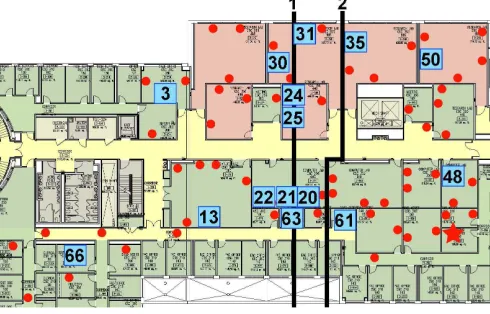
motes in the WiSeNet sensor testbed for our experiments. Figure 1 shows the layout of the testbed. The sensor nodes are deployed on the second floor of Engineering Building II at North Carolina State University. The testbed area in-cludes offices, labs, server rooms, and corridors, covering an area of 152.5 feet×97 feet. We equip each node with an Ethernet programming board, which provides remote ac-cess to the node. We only use the programming boards to gather evaluation results from the sensor nodes; they do not interfere with the radio communication between sensor nodes at all. We set the transmission power level of the Mi-caZ radio module (CC2420) as0dBm. The square-shaped nodes with numbers are used as noise sources.
Figure 1. The WiSeNet testbed (73 MicaZ motes; 152.5 feet×97 feet).
Experiment Setup: For our scheme, we run all the
with random and fixed initial primary channel IR-Seluge-RandomInitPCh and IR-Seluge-FixedInitPCh, respectively. We use channel 26 for Seluge, which does not overlap with 802.11 [3]. Likewise, we use channel 26 for the ini-tial primary channel in IR-Seluge-FixedInitPCh. We set the channel switching period to 8 advertisement periods. A node tries to advertise in the primary channel for every 3 advertisement periods. We setp1= 0.3andp2 = 0.1. We follow the same settings in Seluge (and also Deluge) to set the lower and the upper bounds of the advertisement period to 512ms and 70 minutes, respectively. As in Seluge, we put 17ms interval between each data packet transmission to accommodate the time required by Seluge’s verification op-eration. In each experiment, the dissemination starts from the star-shaped node located at the bottom-right corner in Figure 1. For each test case, we perform the same set of experiments 10 times and take the average over them. We also show 95% confidence intervals.
7.1. Scenario 1—No Interference
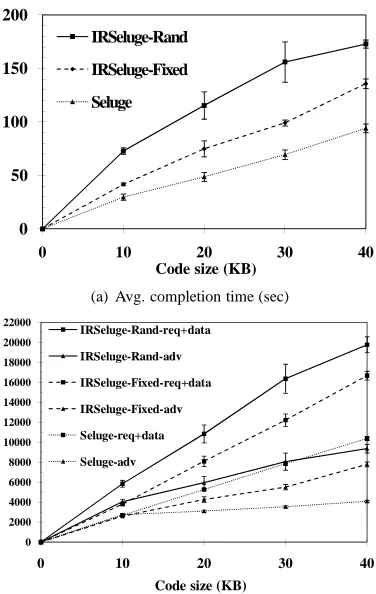
We first compare the performance of IR-Seluge and Sel-uge when there is no noise source. To see the impact of code image size on performance, we use four different sizes: 10K bytes, 20K bytes, 30K bytes, and 40K bytes. Figures 2(a) and 2(b) show the average completion time and communi-cation overhead in the experiments, respectively.
Let us first compare IR-Seluge-RandomInitPCh and Seluge. The average completion time of IR-Seluge-RandomInitPCh is about 80% to 145% longer than that of Seluge. Over all the experiments, the overhead for request and data packets of IR-Seluge-RandomInitPCh is about 100% larger than that of Seluge, and IR-Seluge-RandomInitPCh introduces about 99% more advertisement packets than Seluge.
In IR-Seluge-RandomInitPCh, since every node ran-domly selects its initial primary channel, the nodes stay in all 16 different channels when dissemination begins. Thus, it takes some time for each node to find neighbors in dif-ferent channels that have data it needs. In addition, when a node broadcasts data in response to a request from a neigh-bor using the same primary channel, some neighneigh-bors that also need the same data may be in its secondary channels and thus cannot utilize overhearing as effectively as Seluge. IR-Seluge-FixedInitPCh shows better performance than RandomInitPCh. In all experiments, IR-Seluge-FixedInitPCh introduces on average 45% longer average completion time, 53% more request and data packets, and 45% more advertisement packets than Seluge. In IR-Seluge-FixedInitPCh, every node stays in the same ini-tial primary channel when dissemination begins. There-fore, the overhead is closer to Seluge than IR-Seluge-RandomInitPCh.
0 50 100 150 200
0 10 20 30 40
Code size (KB)
IRSeluge-Rand
IRSeluge-Fixed
Seluge
(a) Avg. completion time (sec)
0 2000 4000 6000 8000 10000 12000 14000 16000 18000 20000 22000
0 10 20 30 40
Code size (KB) IRSeluge-Rand-req+data
IRSeluge-Rand-adv
IRSeluge-Fixed-req+data
IRSeluge-Fixed-adv
Seluge-req+data
Seluge-adv
(b) Number of message transmissions
Figure 2. Average completion time and com-munication overhead of IR-Seluge and Sel-uge in scenario 1.
These results indicate that IR-Seluge degrades the per-formance of Seluge when there is no noise source. How-ever, the next evaluation will show that IR-Seluge can effec-tively survive severe interference that completely disables Seluge.
7.2. Scenario 2—Interference on a Single
Channel
In this scenario, we compare Seluge and IR-Seluge when a single channel is under severe interference. We use four nodes (nodes 21, 24, 31, and 63) close to line 1 in Fig-ure 1 as noise sources, which divides our testbed into two halves. Every noise source interferes with channel26. We first run Seluge for one hour to see how far the dissemina-tion flow can reach. As expected, Seluge’s disseminadissemina-tion flow is completely blocked by the noise sources. Only the nodes to the right of line2in Figure 1 finish receiving the entire code image, but no nodes to the left of line2receive even a single page.
and every node in the testbed completely receives the en-tire code image. Table 2 shows the performance overhead of our scheme in this scenario. IR-Seluge-FixedInitPCh introduces more overhead compared to the case of no noise sources. IR-Seluge-FixedInitPCh introduces about 1.4 times more delay, 0.8 times more request and data pack-ets, and 1.2 times more advertisements than in the case of no noise sources. However, IR-Seluge-RandomInitPCh over-comes such interference without introducing extra overhead compared with the case of no noise sources.
Table 2. Average completion time and com-munication overhead of IR-Seluge in sce-nario 2 (Seluge is unable to disseminate be-yond line2in Figure 1.).
IR-Seluge- IR-Seluge-RandomInitPCh FixedInitPCh Avg. completion
time (sec) 147.62 235.51
Total number of
request and data 15485.63 21512.45
packet transmissions Total number of
advertisement packet 7462 12341.67
transmissions
IR-Seluge-RandomInitPCh shows less performance overhead than IR-Seluge-FixedInitPCh in this scenario. This is because with IR-Seluge-FixedInitPCh the initial pri-mary channels of all nodes are not available for the interfer-ence and it takes some efforts for these nodes to realize the unavailability of the primary channel and migrate to other channels. In contrast, given 16 channels, with IR-Seluge-RandomInitPCh only about 1/16 of the nodes have been af-fected by the interference on their initial primary channels.
7.3. Scenario 3—Interference on Multiple
Channels
In this scenario, we examine the performance of IR-Seluge when there is severe interference on multiple chan-nels in a region of the network. We place 2 to 8 noise sources close to line1in Figure 1, and perform experiments in four cases: (1) nodes 21 and 24 as 2 noise sources; (2) nodes 21, 24, 31 and 63 as 4 noise sources; (3) nodes 21, 24, 31, 63, 20, and 25 as 6 noise sources; and (4) nodes 21, 24, 31, 63, 20, 25, 22, and 30 as 8 noise sources. Different from scenario 2, each noise source interferes with a different channel ranging from channel(26−#noisesources+ 1)
to26. We use 30K code image in the experiments.
Figures 3(a) and 3(b) show the average completion time, the number of advertisement packets, and the num-ber of request and data packets sent in all the experiments.
0 100 200 300
0 2 4 6 8
Number of noise sources(on the line 1)
IR-Seluge-Rand
IR-Seluge-Fixed
(a) Avg. completion time (sec)
0 5000 10000 15000 20000 25000 30000
0 2 4 6 8
Number of noise sources(on the line 1) IRSeluge-Rand-req + data IRSeluge-Rand-adv IRSeluge-Fixed-req + data IRSeluge-Fixed-adv
(b) Number of message transmissions
Figure 3. Average completion time and com-munication overhead of IR-Seluge in sce-nario 3.
In both figures, IR-Seluge-RandomInitPCh shows slightly increasing overhead as the number of noise sources in-creases. In the worst case of 8 noise sources, IR-Seluge-RandomInitPCh introduces about 29% longer average com-pletion time, 3% more request and data packets, and 19% more advertisement packets than the case of no noise sources.
7.4. Scenario 4—Interference on Multiple
Channels in Multiple Regions
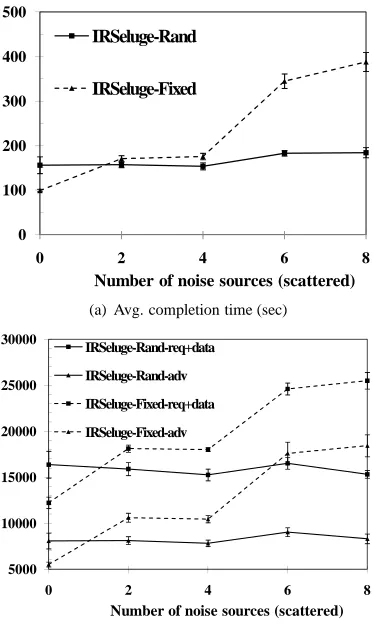
In this scenario, we evaluate the performance of IR-Seluge when there is serious interference on multiple chan-nels in multiple regions. We scatter 2 to 8 noise sources in various regions of the entire testbed, and perform the exper-iments in the following four cases: (1) nodes 13 and 50 as 2 noise sources; (2) nodes 13, 50, 3, and 48 as 4 noise sources; (3) nodes 13, 50, 3, 48, 24, and 61 as 6 noise sources; and (4) nodes 13, 50, 3, 48, 24, 61, 35, and 66 as 8 noise sources. Every noise source interferes with a different channel rang-ing from channel(26−#noisesources+ 1)to26. As in scenario 3, we use the 30K code image.
0 100 200 300 400 500
0 2 4 6 8
Number of noise sources (scattered)
IRSeluge-Rand
IRSeluge-Fixed
(a) Avg. completion time (sec)
5000 10000 15000 20000 25000 30000
0 2 4 6 8
Number of noise sources (scattered)
IRSeluge-Rand-req+data
IRSeluge-Rand-adv
IRSeluge-Fixed-req+data
IRSeluge-Fixed-adv
(b) Number of message transmissions
Figure 4. Average completion time and com-munication overhead of IR-Seluge in sce-nario 4.
Figures 4(a) and 4(b) show the average completion time and communication overhead in these experiments. In all cases, IR-Seluge-RandomInitPCh requires almost no extra overhead compared to the case of no noise sources. In the most severe case of 8 noise sources, the average completion time is only 18% longer than the case of no noise sources. The overhead for advertisement packets and that for request
and data packets are almost same as in the case of no noise sources.
However, IR-Seluge-FixedInitPCh shows larger over-head than IR-Seluge-RandomInitPCh when there are noise sources. The average completion time of FixedInitPCh is about 56% longer than that of Seluge-RandomInitPCh. In terms of communication overhead, IR-Seluge-FixedInitPCh introduces on average 37% more re-quest and data packets and 70% more advertisement packets than IR-Seluge-RandomInitPCh.
Based on the experimental evaluation, we can conclude that IR-Seluge can effectively mitigate the effects of radio interference. In contrast, Seluge fails when its dissemi-nation channel is under serious interference. Among the two variations, having a random initial primary channel per-forms better than having a fixed initial primary channel, par-ticularly when serious interference exists in the initial pri-mary channel. However, when there is no severe interfer-ence, IR-Seluge does introduce higher overhead than Sel-uge.
8. Related Work
Code dissemination is a critical issue to enable efficient tasking of wireless sensor networks. Several code dissem-ination protocols (e.g., [5, 8, 20, 10, 18, 16]) have been developed to propagate new code images using the ad-hoc wireless network formed by sensor nodes. Among these op-tions, Deluge [8] has been widely used after being included in recent TinyOS distributions.
The integrity and availability of code dissemination are crucial in ensuring the success of code dissemination. Sev-eral groups of researchers have developed a number of schemes and systems to address these issues. Examples in-clude Sluice [11], Secure Deluge [7], the approach in [6], and Seluge [9], all of which are secure extensions to Del-uge. In particular, Seluge provides not only integrity protec-tion of disseminated code images, but also resilience against DoS attacks that exploit the code dissemination protocol. In addition, Seluge does not harm any efficient dissemination mechanisms in Deluge. For such reasons, Seluge has been used as the foundation of the work presented in this paper.
Several protocols (e.g., [22, 19, 21, 13]) have been de-veloped to improve the performance of code dissemination by exploiting the channel diversity available on the current sensor platforms. The objective of these protocols is to im-prove the efficiency of code dissemination, through a ded-icated control channel and multiple concurrent dissemina-tion channels.
wireless interference.
9. Conclusion
In this paper, we presented the design, development, and evaluation of an interference-resilient code dissemination system named Seluge for wireless sensor networks. IR-Seluge is developed as an interference-resilient extension to Seluge [9]. Besides the security protections provided by Seluge, IR-Seluge offers additional resilience proper-ties against wireless interference: As long as one or more channels are available, IR-Seluge can still propagate code images to the nodes in a region where severe wireless inter-ference exists.
Our future research will be focused on optimizing the channel switching strategy so that IR-Seluge can offer the same interference resilience with lower overhead.
References
[1] MICAz: Wireless measurement system. http: //www.xbow.com/Products/Product_pdf_ files/Wireless_pdf/MICAz_Datasheet.pdf. [2] TelosB mote platform. http://www.xbow.com/
Products/Product_pdf_files/Wireless_ pdf/TelosB_Datasheet.pdf.
[3] Crossbow. Tinyos getting started guide. http: //www.xbow.com/support/support_pdf_ files/getting_started_guide.pdf. [4] Crossbow Technology Inc. MICA2 data sheet.
[5] Crossbow Technology Inc. Mote in-network programming user reference, 2003.
[6] J. Deng, R. Han, and S. Mishra. Secure code distribution in dynamically programmable wireless sensor networks. In Proceedings of the Fifth International Conference on Infor-mation Processing in Sensor Networks (IPSN ’06), April 2006.
[7] P. K. Dutta, J. W. Hui, D. C. Chu, and D. E. Culler. Securing the deluge network programming system. In Proceedings of the Fifth International Conference on Information Process-ing in Sensor Networks (IPSN ’06), April 2006.
[8] J. W. Hui and D. Culler. The dynamic behavior of a data dissemination protocol for network programming at scale. In Proceedings of the 2nd International Conference on Em-bedded Networked Sensor Systems (SenSys ’04), November 2004.
[9] S. Hyun, P. Ning, A. Liu, and W. Du. Seluge: Secure and dos-resistant code dissemination in wireless sensor net-works. In Proceedings of the Seventh International Confer-ence on Information Processing in Sensor Networks (IPSN ’08), pages 445–456, April 2008.
[10] S. Kulkarni and L. Wang. MNP: multihop network repro-gramming service for sensor networks. In Proceedings of the 25th International Conference on Distributed Comput-ing Systems (ICDCS ’05), pages 7–16, June 2005.
[11] P. Lanigan, R. Gandhi, and P. Narasimhan. Sluice: Se-cure dissemination of code updates in sensor networks. In Proceedings of the 26th International Conference on Dis-tributed Computing Systems (ICDCS ’06), July 2006. [12] P. Levis, N. Patel, D. Culler, and S. Shenker. Trickle: A
self-regulating algorithm for code propagation and mainte-nance in wireless sensor networks. In Proceedings of the 1st Symposium on Network System Design and Implementation (NSDI ’04), March 2004.
[13] C. M. Liang, R. Musaloiu-E, and A. Terzis. Typhoon: A reliable data dissemination protocol for wireless sensor net-works. In Proceedings of the Fifth European conference on Distributed Computing in Sensor Systems (EWSN ’08), Jan-uary 2008.
[14] A. Liu, P. Ning, and C. Wang. Lightweight remote image management for secure code dissemination in wireless sen-sor networks. In Proceedings of 2009 IEEE INFOCOM, April 2009.
[15] R. Merkle. Protocols for public key cryptosystems. In Pro-ceedings of the IEEE Symposium on Research in Security and Privacy, Apr 1980.
[16] V. Naik, A. Arora, P. Sinha, and H. Zhang. Sprinkler: A reliable and scalable data dissemination service for wireless embedded devices. In Proceedings IEEE International Real-Time Systems Symposium, pages 277–286, December 2005. [17] P. Ning, A. Liu, and W. Du. Mitigating DoS attacks against broadcast authentication in wireless sensor net-works. ACM Transactions on Sensor Networks, 4(1):1–35, February 2008.
[18] N. Reijers and K. Langendoen. Efficient code distribution in wireless sensor networks. In Proceedings of the 2nd ACM International Conference on Wireless Sensor Networks and Applications (WSNA ’03), pages 60–67, September 2003. [19] R. Simon, L. Huang, E. Farrugia, and S. Setia. Using
multi-ple communication channels for efficient data dissemination in wireless sensor networks. In Proceedings of the Second International Conference on Mobile Ad-hoc and Sensor Net-works (MASS ’05), November 2005.
[20] T. Stathopoulos, J. Heidemann, and D. Estrin. A remote code update mechanism for wireless sensor networks. Tech-nical Report CENS-TR-30, UCLA, Center for Embedded Networked Computing, November 2003.
[21] L. Wang and S. S. Kulkarni. Gappa: Gossip based multi-channel reprogramming for sensor networks. In Proceed-ings of the Second International Conference on Distributed Computing in Sensor Systems (DCOSS ’06), June 2006. [22] W. Xiao and D. Starobinski. Poster abstract: Exploiting
multi-channel diversity to speed up over-the-air program-ming of wireless sensor. In Proceedings of the Third ACM Conference on Embedded Networked Sensor Systems (Sen-Sys ’05), November 2005.
[23] J. Zhao and R. Govindan. Understanding packet delivery performance in dense wireless sensor networks. In Proceed-ings of the First ACM Conference on Embedded Networked Sensor Systems (SenSys ’03), pages 1–13, Nov 2003. [24] G. Zhou, J. Stankovic, and S. Son. The crowded spectrum