Performance Analysis of 4 Bit & 8 Bit
Vedic Multiplier for Signal Processing
Vaithiyanathan Gurumoorthy1, Dr.S.Sumathi2
PG Scholar, Department of VLSI Design, Adhiyamaan College of Eng, Hosur, Tamilnadu, India1
Professor, Department of ECE, Adhiyamaan College of Eng, Hosur, Tamilnadu, India2
ABSTRACT: Vedic multiplier is hinged on the ancient algorithms This work is based on all the sutras(formula) in vedic mathematics. This formula is meant for faster mental calculation than normal multiplication. In general though the simulation is faster even it implemented in hardware, it consumes more power. This paper presents a technique to modify the architecture of the Vedic multiplier by using some existing methods in order to reduce power and improve signal processing application . Here different bits encoded for Vedic multiplier Verilog HDL and Synthesized using Synopsys Design Compiler. The performance is compared in terms of area, data arrival time and power with earlier existing architecture of Vedic multiplier. Signal Processing involves lot of multiplications which consumes more time can be negligible by the new algorithms. This paper proposes an approach for signal processing using Vedic Mathematics which performs faster multiplication compared to the conventional algorithms such as Booth and Array Multiplication Algorithm. Time required by the algorithms for processing signals are then compared using the experimental results.
KEYWORDS: Fast Multiplication,Nikhilam sutra, Signal processing,Vedic multiplier.
1. INTRODUCTION
Multipliers are important component in today’s image signal and other digital signal processing applications. Technological advancement in brought to design multipliers which makes design with high speed, low power consumption, less area or even combination of them in one multiplier thus making them suitable for various
high speed, low power and compact VLSI implementation
Thus,integratingVedicmathematicsforthemultiplierdesignwillimprovethespeedofmultiplication operation in
multiplier.Asimpledigitalvedicmultiplier architecture basedontheUrdhvaTriyakbhyamSutraisused.
Thisformula(sutra)wasusedinancientIndiaforthe multiplicationoftwodecimalnumbersinrelativelylesstime. The multiplier architecture is based on UrdhvaTiryagbhyam(vertical and cross-wise algorithm) sutra The4x4multiplicationhasbeenperformedinasinglestepinUrdhvaTiryagbhyamsutra[1],whereasinshiftandadd
(conventional) method,fourpartialproductshavetobeaddedtogettheresult.Thus,byusingUrdhvaTiryagbhyam
Sutrainbinarymultiplication,thenumberofstepsrequiredcalculatingthefinalproductwillbereducedandhence thereisa reductionincomputationaltimeandincreasein speedofthemultiplier. Two prominent measurements are associated with multiplication algorithms that are latency and throughput of system. The Latency is defined as the real time delay of a computation and the measure of computations can be done during given processing time. The execution time in DSP systems are dependent on multipliers so we need supreme multipliers. The mathematical operations using, Vedic Method is efficient and has requirement, this can be used to improve the computational speed of processors.
II.ALGORITHM
These algorithms which can be applied to various branches of engineering such as computing and digital signal processing[2]. Implementation of Multiplier Using Vedic Algorithm based on the natural principles on which the human mind works effectively than normal mathematical calculation which implied in technology gives better speed to the processor.
TheseSutrasalongwiththeirbriefmeaningsareenlisted belowalphabetically.
1) (Anurupye)Shunyamanyat-Ifoneisinratio,theotheriszero. 2) ChalanaKalanabyham-Differencesandsimilarities. 3) EkadhikinaPurvena-ByonemorethanthepreviousOne. 4) EkanyunenaPurvena-Byonelessthantheprevious one.
5) Gunakasamuchyah-Factorsofthesumisequaltothe sumoffactors. 6) Gunitasamuchyah-Theproductofsumisequaltosum oftheproduct. 7) NikhilamNavatashcaramamDashatah-Allfrom9and lastfrom10. 8) ParaavartyaYojayet-Transposeandadjust.
9) Puranapuranabyham-By the completion or noncompletion. 10) Sankalana- vyavakalanabhyam-By addition and by subtraction. 11) ShesanyankenaCharamena-The remaindersbythelast digit. 12) ShunyamSaamyasamuccaye-Whenthesumissame thensumiszero. 13) Sopaantyadvayamantyam-Theultimateandtwicethe penultimate. 14) Urdhva-tiryakbhyam-Verticallyandcrosswise.
15) Vyashtisamanstih-PartandWhole.
16) Yaavadunam-Whatevertheextentofitsdeficiency. 7) Theremainderremainsconstant
8) The firstbythefirstandthelastbythelast
III.MULTIPLIER ARCHITECTURE
A. Architecture of Vedic multiplier
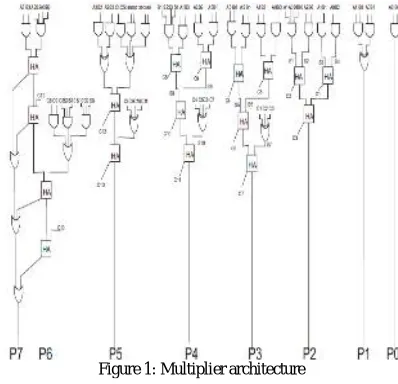
Figure 1: Multiplier architecture
B. Partial Products Equations
Considertwo4-bitbinarynumbersa3a2a1a0andb3b2b1b0.Thepartialproducts[5](P7P6P5P4P3P2P1P0)generatedare givenbythefollowingequations:
i. P0=a0b0 ii. P1=a0b1+ a1b0
iii. P2= a0b2+ a1b1+ a2b0+P1 iv. P3=a0b3+ a1b2+ a2b1+ a3b0+P2 v. P4= a1b3+ a2b2+ a3b1+P3 vi. P5= a1b2+ a2b1+P4 vii. P6= a3b3+P5 viii. P7= carryofP6
UrdhvaTiryakbhyam Sutra is a general multiplication formula applicable to all cases of multiplication [4]. It literally means “Vertically and Crosswise”. The square is divided into rows and columns where each row/column corresponds to one of the digit of either a multiplier or a multiplicand. Thus, each digit of the multiplier has a small box common to a digit of the multiplicand [5]. Each digit of the multiplier is then independently multiplied with every digit. In this paper, image processing operations using Field Programmable Gate Arrays (FPGA). The architecture of 2x2 and 4x4 bit Vedic multiplier modules such that “Urdhva-Tiryakbhyam” (Vertically and Crosswise) sutra(formula) is used to construct an architecture for the multiplication of two binary numbers(any bit). The impact of Vedic multiplier is partial product generation and additions are execute concurrently. Hence, this is well adapted to parallel processing. This feature makes it more effective for binary multiplications. This in turn increase speed and reduces delay.
IV. RESULTS AND DISCUSSION
delay ( nanoseconds). The combinational path delay obtained for the proposed 4x4 bit Vedic multiplier is 5.32 ns whereas the result of other multiplier are more time consumed than proposed one. Corresponding results of simulation and synthesis have shown below
Figure 2: Result of 4-bit multiplier
-Figure 3: Report of 4-bit multiplier
Synthesis result shows that for 4-bit multiplication maximum combinational path delay 5.352 ns.
Figure 4: Result of 8-bit multiplier
Synthesis result shows that for 8-bit multiplication maximum combinational path delay 8.751 ns.
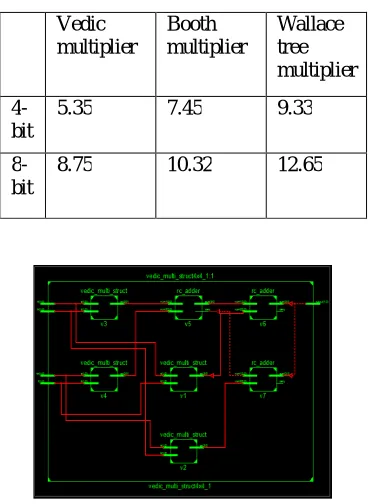
Table 1: Comparison of multiplier results
Vedic multiplier
Booth multiplier
Wallace tree multiplier
4-bit
5.35 7.45 9.33
8-bit
8.75 10.32 12.65
Figure 6, RTL schematic of 4x4 bit Vedic Multiplier
The RTL (Register Transfer Level) of the 4x4 bit Vedic multiplier contains four 2x2 bit Vedic multiplier as vedic_multi_struct v1, v2, v3, v4 and three 4-bit Ripple Carry Adder as rc_adde v5, v6, v7 is shown in Figure 6 , the simulated results obtained from the figure shown for verification. In behavioral simulation we tested for input bits: -Input value of “0100” (in decimal number system 4) and “0100” (decimal number system 4) as and we get “00001000” as output (decimal number system 8). The inputs of 4-bits are converted into the input of 2-bits. The input for MSB (Most Significant Bit) & LSB (Least Significant Bit) of multiplicand are kh=01 and kl=00, when the input for MSB (Most Significant Bit) & LSB (Least Significant Bit) of multiplier are lh=00 and ll=01. Finally, the output1=00010000, gives the final 8-bit result. However the rest signals establish the intermediate results like partial products (sum & carry).
Vedic Algorithm For Signal Processing Application
V. CONCLUSION
Vedic formulae are based on the fundamentals. It can be used for many applications in Engineering and Technology. This interesting field presents some effective algorithms which can be applied to design of Digital filters. The potential of this field can be used efficiently to solve the real world problems. With use of Vedic multiplier it is possible to reduce area, increase speed, decrease power consumption and to reduce complexity of digital FIR and IIR filters. It is possible to carry out research work on uses of Vedic mathematical algorithms over traditional (existing) methods in FIR and IIR filters that will provide effective results for de-noising of biomedical Signals. FIR and IIR filtering consists of operations like multiplication, addition. By using Vedic sutras fundamental entities of FIR and IIR filters can be implemented to achieve merits like reduced area, fast speed etc.
REFERENCES
[1]A High-Performance FIR Filter Architecture For Fixed And Reconfigurable ApplicationsMohanty, B.K.; Meher, P.K.Very Large Scale Integration (VLSI) Systems, IEEE Transactions OnYear: 2016, Volume: 24, Issue: 2Pages: 444 - 452, DOI:
10.1109/TVLSI.2015.2412556IEEE Journals & Magazines.
[2]Jagadguru Swami Sri BharatiKrisnaTirthaji Maharaja, Vedic Mathematics: Sixteen Simplemathematical Formulae From The Veda. Delhi(1965). Discover Of Vedic Mathematics.
[3]Implementation Of Image Processing Lab Using Xilinx System Generator Kanna Anil Kumar, M Vijayakumar, Society For Science And Education, United Kingdom
[4]An Efficient Floating Point Multiplier Design For High Speed Applications Using KaratsubaAlgorithm And Urdhva-TiryagbhyamAlgorithmArish, S.; Sharma, R.K.Signal Processing And Communication (ICSC), 2015 International Conference OnYear: 2015Pages: 303 - 308, DOI: 10.1109/Icspcom.2015.7150666IEEE Conference Publications
[5]Novel Vedic Mathematics Based ALU Using Application Specific ReversibilityJadhav, K.; Vibhute, A.; Iyer, S.; Dhanabal, R.Intelligent Systems And Control (ISCO), 2015 IEEE 9th International Conference OnYear: 2015Pages: 1 - 5, DOI: 10.1109/ISCO.2015.7282231IEEE Conference Publications
[6]Simulation And Implementation Of Vedic Multiplier Using VHDL Code” By Gvaithiyanathan, K.Venkatesan, S.Sivaramakrishnan, S.Siva, S.Jayakumar. International Journal Of Science & Engineering Research Volume4,Issue1,January 2013 ISSN 2229-5518 IJSER 2013.
[7]Shen-Fu Hsiao, Jun-Hong Zhang Jian,And Ming-Chin Chen “ Low Cost Fir Filter Designs Based On Faithfully Truncated Multiple Constant Multiplication/Accumulation” IEEE Transactions On Circuits And Systems-Ii: Express Briefs,Vol.60,No.5,May 2013.
[8]FIR Filter Design Based On Retiming Automation Using VLSI Design MetricsYagain, D.; Vijaya, K.A.Technology, Informatics, Management, Engineering, And Environment (TIME-E), 2013 International Conference OnYear: 2013Pages: 17 - 22, DOI: 10.1109/TIME-E.2013.6611956IEEE Conference Publications