Vol. 7, Issue 12, December 2018
Survey Paper on Image Compressor using
Discrete Wavelet Transform and Block Based
Image Coding
Priyanka Chouksay1, Prof. Neha Rathore2
M. Tech. Scholar, Department of Electronics and Communication, TIT, (Excellence), Bhopal, India1
Professor, Department of Electronics and Communication, TIT, (Excellence), Bhopal, India2
ABSTRACT: In the present era of multimedia, the requirement of image/video storage and transmission for video conferencing, image and video retrieval, video playback, etc. are increasing exponentially. As a result, the need for better compression technology is always in demand. Modern applications, in addition to high compression ratio, also demand for efficient encoding and decoding processes, so that computational constraint of many real-time applications is satisfied.Two widely used spatial domain compression techniques are discrete wavelet transform and multi-level block truncation coding (BTC). DWT method is used to stationary and non-stationary images and applied to all average pixel value of image. Muli-level BTC is a type of lossy image compression technique for greyscale images. It divides the original images into blocks and then uses a quantizer to reduce the number of grey levels in each block whilst maintaining the same mean and standard deviation. In this paper is studied of Multi-level BTCand DWT technique for for gray and color image.
KEYWORDS: Discrete Wavelet Transform, Multi-level, Block Truncation Code (BTC), PSNR MSE, Compression
Ratio
I. INTRODUCTION
The rising multimedia technology and growth of GUIbased software have made digital image data an inherent part of modern life. When a 2-D light intensity function issampled and quantized to create a digital image, the amountof data generated may be large in volume that it results intremendous storage, processing and communicationrequirements. Therefore, the theory of data compressionbecomes more and more important for reducing the dataredundancy to save more hardware space and transmissionbandwidth.
In computer science and information theory,data compression is the process of encoding informationusing less number of bits or some other information bearingunits. Compression is useful as it helps to reduce the consumption of expensive resources such as hard disk spaceor transmission bandwidth [1] [2]. BTC is a simple and fast lossy compression technique for gray scale images. The basic idea of BTC [3] is to perform moment preserving quantization for blocks of pixels. The input image is divided into non-overlapping blocks of pixels of sizes 4×4, 8×8 and so on. Mean and standard deviation ofthe blocks are calculated. Mean is considered as thethreshold and reconstruction values are determined usingmean and standard deviation.
To improve the quality of the reconstructedimage and for the better compression efficiency severalvariants of BTC have been developed during the last manyyears.Absolute Moment Block Truncation Coding (AMBTC)[4] preserves the higher mean and lower mean of each block and use this quantity to quantize output. AMBTC provides better image quality than image compression using BTC. Moreover, the AMBTC is quite faster compared to BTC. The algorithm is computationally faster because it involves simple analytical formulae to compute the parameters of the edge feature in an image block. Reconstructed images are of good quality in accordance with human perceptual experience. The algorithm represents the image in terms of its binary edge map, mean information, and the intensity information on both sides of the edges.
II. LITERATURE SURVEY
Shuyuan Zhu et al. [2018],transform domain downward conversion (TDDC)for image coding is usually implemented
by discarding somehigh-frequency components from each transformed block. Asa result, a block of fewer coefficients is formed and a lowercompression cost is achieved due to the coding of only a
few low-frequency coefficients. In this paper, we focus on the design of a new TDDC-based coding method by using our proposed interpolation-compression directed filtering (ICDF) and error-compensated scalar quantization (ECSQ), leading to the compression-dependent TDDC (CDTDDC) based coding. More specifically, ICDF is first used to convert each 16×16 macroblock into an 8_8 coefficient block. Then, this coefficient block is compressed with ECSQ, resulting in a smaller compression
distortion for those pixels that locate at some specific positions of a macro-block. We select these positions according to the 4:1 uniform sub-sampling lattice and use the pixels locating at them to reconstruct the whole macro-block through an interpolation.
The proposed CDTDDC-based coding can be applied to compress both grayscale and color images. More importantly, when it is used in the color image compression, it offers not only a new solution to reduce the data-size of chrominance components but also a higher compression efficiency. Experimental results demonstrate that applying our proposed CDTDDC-based coding to compress still images can achieve a significant quality gain over the existing compression methods.
Shih-Lun Chenet al. [2017], color and multispectral image compression using Enhance block truncation code is proposed [1]. These techniques are based on standard deviation and mean. This technique is applied to satellite image and reshapes the satellite image. The satellite image is divided into various sub-blocks. After calculate mean values, all number of pixel in sub-block are compared to the mean and according to the mean all pixel value is replaced by binary number. Finally MSE, PSNR and compression ratio are calculated for the Enhance block truncation code for satellite image.
Sunwoong Kim et al. [2016], with the continuing growth of modern communication technologies, demand for image
data compression is increasing rapidly. Techniques for achieving data compression can be divided into two basic approaches: spatial coding and Transform coding. This research paper presents a proposed method for the compression of digital images using hybrid compression method based on Block Truncation Coding (BTC) and Walsh Hadamard Transform (WHT). The objective of this hybrid approach is to achieve higher compression ratio by applying BTC and WHT. Several grayscale test images are used to evaluate the coding efficency and performance of the hybrid method and compared with the BTC and WHT respectively. It is generally shown that the proposed method gives better results.Processing dependency in the conventional algorithm is removed by partitioning the input image and modifying neighboring reference pixel configuration. Experimental results show that the parallel implementation drastically reduce processing time by 6~7 times with significant visual quality improvement.
C.Senthilkumar et al. [2016],In this paper, image compression plays vital role in saving memory storage space and
saving time while transmission
using the parameters such as MSE, SNR and PSNR. The proposed method is implemented through standard color and multispectral images using MATLAB Version 8.1 R2013a.
Jing-Ming Guo et al. [2014], Block truncation committal to writing (BTC) has been thought of extremely economical
compression technique for many years. Moreover, this method can provide excellent processing efficiency by exploiting the nature parallelism advantage of the dot diffusion, and excellent image quality can also be offered through co-optimizing the class matrix and diffused matrix of the dot diffusion. According to the experimental results, the proposed DDBTC is superior to the former error-diffused BTC in terms of various objective image quality assessment methods as well as processing efficiency.
A modified Block Truncation Coding using max-min quantizer (MBTC) is proposed in this paper to overcome the above mentioned drawbacks. In the conventional BTC, quantization is done based on the mean and standard deviation of the pixel values in each block. In the proposed method, instead of using the mean and standard deviation, an average value of the maximum, minimum and mean of the blocks of pixels is taken as the threshold for quantization.
Jayamol Mathews et al. [2013], with the emerging multimedia technology, image data has been generated at high volume. It is thus important to reduce the image file sizes for storage and effective communication. Block Truncation Coding (BTC) is a lossy image compression technique which uses moment preserving quantization method for compressing digital gray level images. Even though this method retains the visual quality of the reconstructed image with good compression ratio, it shows some artifacts like staircase effect, raggedness, etc. near the edges. A set of advanced BTC variants reported in literature were studied and it was found that though the compression efficiency is good, the quality of the image has to be improved. A modified Block Truncation Coding using max-min quantizer (MBTC) is proposed in this paper to overcome the above mentioned drawbacks. In the conventional BTC, quantization is done based on the mean and standard deviation of the pixel values in each block. In the proposed method, instead of using the mean and standard deviation, an average value of the maximum, minimum and mean of the blocks of pixels is taken as the threshold for quantization. Experimental analysis shows an improvement in the visual quality of the reconstructed image by reducing the mean square error between the original and the reconstructed image. Since this method involves less number of simple computations, the time taken by this algorithm is also very less when compared with BTC.
Table 1: Summary of Literature Review
Title Publicati
on and Year
Methodology Parameter
Compressio n-dependent Transform Domain Downward Conversion for Block-based Image Coding IEEE Trancatio n, 2018 Image compression using CDTDDC based codingto compress both gray and color image.
PSNR = 38.7 dB for Lena, PSNR = 37.4 dB for flower, PSNR = 37.3 dB for butterfly image A Cost and
Power Efficient Image Compressor VLSI Design with Fuzzy Decision IEEE Trancatio n, 2017 Image compression using fuzzy decision based plockprtition technique
PSNR = 35.81 for Lena, PSNR = 36.02 dB for
and Block Partition for Wireless Sensor Networks image RGBW Image Compressio n by Low-Complexity Adaptive Multi-Level Block Truncation Coding IEEE Trancatio n, 2016 Image compression using adaptive multi-level BTC technique
PSNR = 34.04 for Lena, PSNR = 33.89 dB for Pepper, PSNR = 32.78 dB for Baboon image Color and Multispectra l Image Compressio n using Enhanced Block Truncation Coding [E-BTC] Scheme IEEE Conferen ce, 2016 PSNR = 32.81 for Lena, PSNR = 31.72 dB for Airplane, PSNR = 30.78 dB for Peppers image Improved Block Truncation Coding Using Optimized Dot Diffusion IEEE Trancatio n, 2014 PSNR = 28.90 for Lena, PSNR = 31.22 dB for Pirate mage Modified BTC Algorithm for Gray Scale Images using max-min Quantizer IEEE Conferen ce, 2013 PSNR = 28.03.81 for Lena, PSNR = 29.42 dB for Pepper Image
III. PREVIOUS DESIGN
solution to reduce the data-size of color images but also a high compression efficiency.
Figure 1: Previous Design
IV. METHODOLOGY
Discrete Wavelet Transform
Wavelets are signals which are local in time and scale and generally have an irregular shape. A wavelet is a waveform of effectively limited duration that has an average value of zero. The term ‘wavelet’ comes from the fact that they integrate to zero; they wave up and down across the axis. Many wavelets also display a property ideal for compact signal representation: orthogonality. This property ensures that data is not over represented. A signal can be decomposed into many shifted and scaled representations of the original mother wavelet. A wavelet transform can be used to decompose a signal into component wavelets. Once this is done the coefficients of the wavelets can be decimated to remove some of the details. Wavelets have the great advantage of being able to separate the fine details in a signal. Very small wavelets can be used to isolate very fine details in a signal, while very large wavelets can identify coarse details. In addition, there are many different wavelets to choose from. Various types of wavelets are: Morlet, Daubechies, etc. [6].
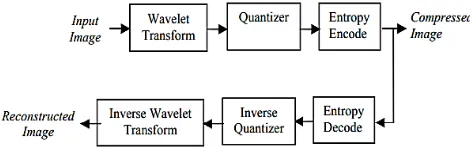
This technique first decomposes an image into coefficients called sub-bands and then the resulting coefficients are compared with a threshold. Coefficients below the threshold are set to zero. Finally, the coefficients above the threshold value are encoded with a loss less compression technique. The compression features of a given wavelet basis are primarily linked to the relative scarceness of the wavelet domain representation for the signal. The notion behind compression is based on the concept that the regular signal component can be accurately approximated using the following elements: a small number of approximation coefficients (at a suitably chosen level) and some of the detail coefficients.
Figure 2: The structure of the wavelet transform based compression.
The steps of compression algorithm based on DWT are described below:
I. Decompose Choose a wavelet; choose a level N. Compute the wavelet. Decompose the signals at level N. II. Threshold detail coefficients For each level from 1 to N, a threshold is selected and hard thresholding is applied
to the detail coefficients.
III. Reconstruct Compute wavelet reconstruction using the original approximation coefficients of level N and the modified detail coefficients of levels from 1 to N.
Multi-level Block Truncation Code
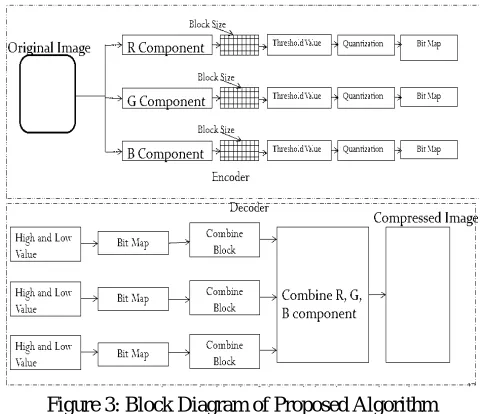
component. Each R, G, B component of the image is divided into non overlapping block of equal size and threshold value for each block size is being calculated.
Threshold value means the average of the maximum value (max) of ‘k × k’ pixels block, minimum value (min) of ‘k × k’ pixels block and
m
1 is the mean value of ‘k × k’ pixels block. Where k represents block size of the color image. So threshold value is:(1)
Each threshold value is passing through the quantization block. Quantization is the process of mapping a set of input fractional values to a whole number. Suppose the fractional value is less than 0.5, then the quantization is replaced by previous whole number and if the fractional value is greater than 0.5, then the quantization is replaced by next whole number.
Figure 3: Block Diagram of Proposed Algorithm
Each quantization value is passing through the bit map block. Bit map means each block is represented by ‘0’ and ‘1’ bit map. If the Threshold value is less than or equal to the input image value then the pixel value of the image is represent by ‘0’ and if the threshold value is greater than the input image value then the pixel value of the image is represented by ‘1’.
Bit map is directly connected to the high and low component of the proposed decoder multi-level BTC algorithm. High (H) and low (L) component is directly connected to the bit map, bitmap converted the ‘1’ and ‘0’ pixel value to high and low pixel value and arrange the entire block.
(2)
(3)
Wirepresent the input color image block, q is the number of zeros in the bit plane, p is the number of ones in the bit
plane. In the combine block of decoder, the values obtained from the pattern fitting block of individual R, G,B
3
min
max
m
1T
T
W
W
q
L
p
i
i i
1
1
T
W
W
p
H
p
i
i i
1
components are combined after that all the individual combined block are merged into a single block . Finally compressed image and all the parameter relative to that image will be obtained.
Error-compensated scalar quantization
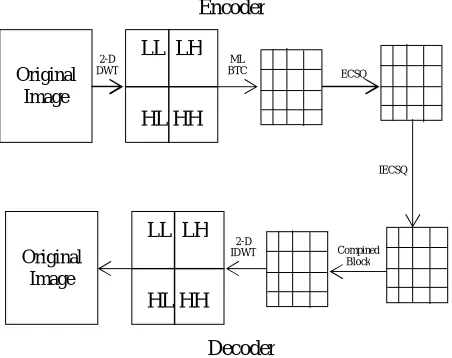
The application of ICDF in the TDDC-based coding aims ata better interpolation and a lower compression cost. However, when the compression happens, the interpolation efficiency as well as the coding efficiency will be limited by the distortion occurring on those filtered pixels (denoted as ~x) that will be used for interpolation. To solve this problem, we purpose to reduce the sum of square error (SSE) distortion of ~xas much as possible via controlling the quantization error of the transformed macro-block based on an error-compensated scalar quantization (ECSQ).
V. PROPOSED METHODOLOGY
Transmission and storage of raw images require huge quantity of disk space. Hence, there is an urgent need to reduce the size of image before sending or storing. The best possible solution to the problem is to use compression methods where the compression of data on digital images are made to reduce irrelevance and redundancy of the image data to be able to efficiently store or transmit data. Most of the existing compression techniques employed have their negatives and an enhanced technique which is faster, effective and memory efficient can definitely satisfy the requirements of the user.
Figure 4: Proposed Methodology
Image compression thrives to store or transmit the data in a proficient mode as well as to offer a best image quality at a specified bit-rate. Image compression can be done in lossy or lossless mode. Lossless compression is preferred for archival objectives and mainly used in medical imaging, technical drawings, clip art, or comics. This is due to the introduction of compression artifacts, low bit rates and also because the resources cannot be considerably saved by using image compression method. Lossy methods are especially suitable for natural images such as photographs in applications where negligible loss of fidelity is tolerable to attain a considerable reduction in bit rate. Here conciliated ensuing image quality devoid of much perception by the viewer is achieved.
VI. CONCLUSION
Such method is suitable in situations where image or image is compressed once but decoded frequently. It is clear that the decoding time due to spatial domain based compression is much less than that of the sub-band compression techniques. In his paper the study of discrete wavelet transform, mult-level block truncation code and error-compensated scalar quantization technique.Further work of this paper is to implement proposed algorithm in MATLAB software and compare result in base paper.
Encoder
IECSQ
Original Image
2-D IDWT LL LH
HL HH
Compined Block 2-D
DWT
Original Image
ML BTC LL LH
HL HH
ECSQ
REFERENCES
[1] Shuyuan Zhu, Zhiying He, XiandongMeng, Jiantao Zhou and Bing Zeng, “Compression-dependent Transform Domain Downward Conversion for Block-based Image Coding”, IEEE Transactions on Image Processing, Volume: 27, Issue: 6, June 2018.
[2] Shih-Lun Chen and Guei-Shian Wu, “A Cost and Power Efficient Image Compressor VLSI Design with Fuzzy Decision and Block Partition for Wireless Sensor Networks”, IEEE Sensors Journal, Volume: 17, Issue: 15, Aug.1, 1 2017.
[3] Sunwoong Kim and Hyuk-Jae Lee, “RGBW Image Compression by Low-Complexity Adaptive Multi-Level Block Truncation Coding”, IEEE Transactions on Consumer Electronics, Vol. 62, No. 4, November 2016.
[4] C. Senthilkumar, “Color and Multispectral Image Compression using Enhanced Block Truncation Coding [E-BTC] Scheme”, accepted to be presented at the IEEE WiSPNET, PP. 01-06, 2016 IEEE.
[5] Jing-Ming Guo, Senior Member, IEEE, and Yun-Fu Liu, Member, IEEE, “Improved Block Truncation Coding Using Optimized Dot Diffusion”, IEEE Transactions on Image Processing, Vol. 23, No. 3, March 2014.
[6] Jayamol Mathews, Madhu S. Nair, “Modified BTC Algorithm for Gray Scale Images using max-min Quantizer”, 978-1-4673-5090-7/13/$31.00 ©2013 IEEE.
[7] M. Brunig and W. Niehsen. Fast full search block matching. IEEE Transactions on Circuits and Systems for Video Technology, 11:241 – 247, 2001.
[8] K. W. Chan and K. L. Chan. Optimisation of multi-level block truncation coding. Signal Processing: Image Communication, 16:445 – 459, 2001.
[9] Ki-Won Oh and Kang-Sun Choi, “Parallel Implementation of Hybrid Vector Quantizerbased Block Truncation Coding for Mobile Display Stream Compression”, IEEE ISCE 2014 1569954165.
[10] Seddeq E. Ghrare and Ahmed R. Khobaiz, “Digital Image Compression using Block Truncation Coding and Walsh Hadamard Transform Hybrid Technique”, 2014 IEEE 2014 International Conference on Computer, Communication, and Control Technology (I4CT 2014), September 2 - 4, 2014 - Langkawi, Kedah, Malaysia.
[11] C. C. Chang and T. S. Chen. New tree-structured vector quantization with closed-coupled multipath searching method. Optical Engineering, 36:1713 – 1720, 1997.