Experimental Study on Performance of Recycled
Coarse Aggregate as Natural Aggregate and Fly
Ash as Fractional Replacement for Cement with
Water Binding Ratio.
S.Sidhardhan1, M.Mohamed Younus2, M.Prabu3
Associate Professor, Dept. of CIVIL, Government College of Engineering, Tirunelveli, India1
Assistant Professor, Dept. of CIVIL, Government College of Engineering, Tirunelveli, India2
M.E Scholar, Dept. of CIVIL, Government College of Engineering, Tirunelveli, India3
ABSTRACT: In the current study, experimental investigation is conducted to study the properties of concrete, when the Natural Coarse Aggregate (NCA) is replaced with 30% Recycled Coarse Aggregate (RCA) and fly ash as a fractional replacement for cement in the range of 10%, 20% and 30% with different W/B ratio as 0.38, 0.40 and 0.42. Specimens are prepared with natural, recycled coarse aggregate and to be tested after a curing period of 7, 14, 28, 56, days. The investigation was carried for workability, Compressive strength, split tensile strength. The investigation deals with the flexural behaviour of beams using fly ash at various cement replacement levels of 10 %, 20% and 30% with W/B ratio of 0.38, 0.40 and 0.42. The use of recycled aggregates in concrete creates a lot of possibilities in the reuse of materials in the building industry.
KEYWORDS: Natural coarse aggregate, Reused coarse aggregate, Water Binding ratio, Fly ash, Compressive strength,Tensile strength.
I. INTRODUCTION
Concrete is the premier construction material used widely across the world in all types of engineering works, it plays an important role in shaping our environment and sustainability of construction industry. Sustainable construction is widely used concept now. In addition to the 1.5 billion tons of cement used worldwide, the concrete industry is consuming 10 billion tons of sand and rocks and 1 billion tons of water mixing is annually used. It’s the world’s most widely used construction materials but it is not eco-friendly materials too.
In latest years, the potential for recyclable construction and demolition waste has made it a target of interest and the main focus of waste management policies on encouraging minimization, reuse, recycling and valorisation of waste as opposed to its final disposal in landfills. It is important to encourage the use of waste from the construction sites, in the case of recycled aggregate. There are various Efforts to improve the properties of concrete are made continuously by many researchers. In the last two decade, construction industry has been conducted various research on the utilization of waste products from concrete.
II. LITERATUREREVIEW
percentages of replacement will be 0%, 50% and 100%. The test and design are done with reference to Indian standard code. The concrete cubes are designed for M30 as per Indian standard codes. The cubes are already made in the lab. They are broken by manual means. Then they are taken from the chunks in the sizes of 20 mm. then various tests are performed like impact test, abrasion test compressive test on 100% recycled coarse aggregates, 100% natural aggregates and 50% natural aggregates+50% recycled coarse aggregates. This is done to see and verify the various patterns. After getting sufficient values a mix design is prepared for 0% 50% and 100% recycled coarse aggregates. IS 10262 code is used for Mix design. The aggregate are placed as per volume in the cubes but the specific gravity of N.C.A. & R.C.A. are different. Thus we can’t replace recycled coarse aggregate (R.C.A.) directly with the same amount of natural coarse aggregate (N.C.A.). We know the fact that volume of both aggregates should be equal.
U.Sridhar, B.Karthickhas conducted an investigation on recycled concrete aggregate and m-sand as aggregate replacement in concrete to study the properties of concrete with replacement of 50% of nature sand by m-sand and coarse aggregates by altered proportions with recycled coarse aggregates (RCA). A mix proportion for M20 grade concrete is referred from IS codes. RCA was fractionally replaced by coarse aggregate in the proportions of 10%, 20%, 30% and 40%and fine aggregate by M-sand for 50% as constant. Finally it showed that RCA reduces the workability of concrete. But that can be easily avoided with plasticizers. The new property of fresh and hardened part of concrete was studied and compared with conventional concrete. The compressive strength RCA is found to be higher than that of conventional concrete when fractioned by up to a 50 %. Finally conclude that the RCA fractioned up to 50 % can be used for obtaining good concrete.
Dr S L Pati1, J N Kale, S Sumanhasconducted a technical analysis for compressive strength of fly ash concrete. Fly ash is a by-product waste generated from thermal power plants is as such a big ecology concern. This investigation report state that the use of fly ash in cement concrete as a partial replacement of cement as well as an chemical so as to provide an eco-friendly consistent way of its disposal and reuse. This work is a case study fromdeep thermal power plant of Jalgaon District. The cement in concrete matrix is exchanged from 5% to 25% by step in steps of 5%. It is observed that exchange of cement in any proportion reducesthe compressive strength of concrete as wellas delays its hardening. This puts an eco-friendly method of Deep Nagar fly ash disposal. Hence recycled coarse aggregate can be used as partial replacement for coarse aggregate.
T.G.S Kiran, M.K.M.V Ratnamhas conducted on study of partial replacement fly ash by cement in concrete and durability study of fly ash in acidic sulphuric environment. Cement production gives rise to CO2emissions generated by the calcinations of CaCo3 and by the fossil, being responsible for about 5% of the Co2 emissions in the world. This can be substantially reduced if cement replacement materials such as a fly ash are used within the frame work of a comprehensive research concerning this residual of coal industries, gives some strength characteristics of concretes made with Fly ash. In this project report the results of the tests carried out on Sulphate attack on concrete cubes in water with H2SO4 solution. Also, targeting the use of fly-ash as the exchange for cement. The current experimental examination were carried on fly ash and has been chemically and physically characterized, and partially replaced in the ratio of 0%, 5%, 10%, 15%, 20% by weight of cement in concrete. Fresh concrete tests like compaction factor test was hardened concrete tests like compressive Strength at the age of 28 days, 60 days, 90days was obtained and also durability aspect of fly ash concrete for sulphates occurrence was tested. This result gives that fly ash improves concrete strength.
III.MATERIALUSED
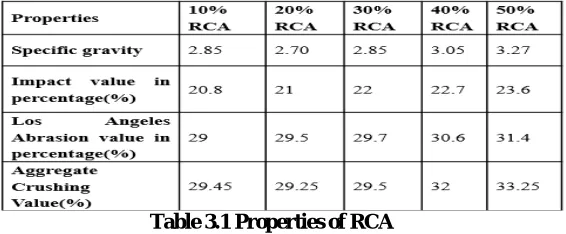
Recycled coarse aggregate:Unwanted concrete and brickwork can get by arranging, crushing and separating into recycled aggregate. Aggregates normally constituent up to 55% to 70% of the capacity of a concrete mixture. The managing of growing considerable amount of demolition’s rubble waste, lack of dumping spots, rise in shipping and clearance cost. But most of the industries companies are still not aware of this environmental dangerous wastages and its recycling.
Table 3.1 Properties of RCA
Fly ash: Fly ash particles are almost totally spherical in shape, allowing them to flow and blend freely in mixtures. These materials greatly improve the strength of concrete through control of high thermal gradients, pore refinement, depletion of cement alkalis, resistance to chloride and sulphate penetration, and continued micro through a long-term hydration and pozzolanicreaction. The use of by-products as the fractional replacement of cement has important economical, environmental and technical benefits such as the reduced amount of waste materials, cleaner environment, reduced energy requirement.
Chemical Properties IS:3812-1981 Fly ash
SiO2+Al2O3+Fe2O3 min% by mass 70.0 90.5
SiO2min% by mass 35.0 58
CaO max% by mass 5.0 3.6
SO3 max% by mass 2.75 1.8
Na2O max% by mass 1.5 2
L.O.I max% by mass 12.0 2
MgO max% by mass 5.0 1.91
Table 3.2 Properties of Fly ash
Cement: Cement used in this investigation was 53 grade ordinary Portland cement confirming IS: 12269: 1987.
S.No Test Particulars Result obtained From IS8112-1989
1 Specific gravity 3.15 3.15
2 Normal Consistency 32 30-35
3 Initial Setting time (min) 40 >30
4 Final Setting time (min) 590 <600
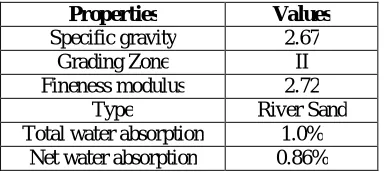
Fine aggregate specification:The fine aggregate used was obtained from our college campus. The fine aggregate conforming to zone II according to IS: 383-1970 was used for this study.
Properties Values
Specific gravity 2.67
Grading Zone II
Fineness modulus 2.72
Type River Sand
Total water absorption 1.0%
Net water absorption 0.86%
Table 3.4 Properties of Fine aggregate
Super Plasticizer:
Properties Description
Colour Brown
Specific gravity 1.220 to 1.225 at 300C
Air Entrainment Approximately 1% additional air is entrained
Table 3.5 Properties of Super Plasticizer
Natural Coarse Aggregate:The coarse aggregate is according to IS: 383-1970 was used. Locally available aggregate from quarries in Tirunelveli were used in this study. Single size aggregate of 20 mm size was used for the entire investigation.
Property Values
Specific gravity 2.76
Fineness Modulus 6.81
Type Crushed
Total water absorption 0.5%
Moisture content Nil
Table 3.6 Property of NCA
Mix Design
IV.EXPERIMENTALINVESTIGATIONANDRESULTANALYSIS Comparison of Compressive Strength in different mix proportion:
% Fly ash 0% 10% 20% 30%
MIX I (N/mm2) 47.77 48.8 48.9 47.2
MIX II (N/mm2) 42.65 42.8 42.9 41
MIXIII (N/mm2) 41.12 41.22 41.25 38.36
Table 5.1 Comparison of Compressive Strength in different mix proportion
Graph for comparison of compressive strength in different mix proportion
The above Figure shows the compressive strength of 28days result observed for30% of RCA and different % of fly ash in various mix proportion of concrete. The above result 28 days result observed the optimum percentage of compressive strength. This result higher than the control mix I result.
Comparisons of Split Tensile strength of various mix proportions:
Graph for split tensile test in various mix proportion
The above Figure shows the split tensile strength of 28 days result observed for30% of RCA and different % of fly ash in various mix proportion of concrete. The above result 28 days result observed the optimum percentage of split tensile strength. This result higher than the control mix I days result.
V.CONCLUSION
In cube compressive strength of the optimum level of RCA replacement with natural coarse aggregate was found to be 30%. In cube compressive strength the Optimum level of cement replacement was found to be 20 % of Fly ash. In cylinder, strength of the Optimum level of cement replacement was found to be 20 % of Fly ash.From the test results natural coarse aggregate can replaced by recycled concrete aggregate up to 30 % and cement can be replaced up to 20 % by Fly ash. By replacing NAC by RAC economy can be achieved and also to certain extend environmental pollution can be reduced.
REFERENCES
[1].F.Buyle-Bodin, R. Hadjieva-Zaharieva “Influence of industrially produced recycled aggregates on flow properties of concrete” (2002), Materials journal, Vol-35, pp- 504-509.
[2]. L. Javier Malvar and LaryR.Lenke “Efficiency of Fly Ash in Mitigating Alkali-Silica Reaction Based on Chemical Composition” (2006), Materials journal, Vol- 103, No.5, pp- 319-326.
[3]. IS: 383-1970, “Specification for coarse and fine aggregate from natural sources for concrete”, Bureau of Indian Standards, New Delhi. [4]. IS: 456 – 2000 “Code of Practice for plain reinforced Concrete”, Bureau of Indian Standards”, New Delhi.
[5]. IS 516-1959 “Method of test for strength of concrete” Bureau of Indian Standards. New Delhi. [6]. IS 12330-1988 “Specification for sulphate resisting Portland cement” Bureau of Indian Standards.
[7]. New Delhi. Nik. D. Oikonomou “Recycled concrete aggregates” (2005), Cement and Concrete Research, Vol 27, pp-315-318.
[8]. Salomon M. Levy and Paulo Helene “Durability of recycled aggregates concrete: a safe way to sustainable development” (2004) Cementand Concrete Research, Vol 34, No.10, pp-1975-1980.
[9]. Shetty, M.S(2001) “Concrete technology theory and practice”,S.Chand and Company.