Workflow Scheduling Using Hybrid Discrete
Particle Swarm Optimization (HDPSO)
In Cloud Computing Environment
Purnima Devi
1, Mala kalra
21PG Scholar, Dept. of Computer Science and Engineering, NITTTR, Panjab University, Chandigarh, India
2
Assistant Professor, Dept. of Computer Science and Engineering, NITTTR, Panjab University, Chandigarh, India
ABSTRACT: Most of the scientific applications nowadays are represented in the form of workflows. The tasks in these workflows require lot of computation power and communication between tasks. Cloud Computing is the most recent technology which provides different computing resources dynamically based on Pay-Per-Use model. So cloud is an ideal platform for executing these workflows. As the mapping of workflow tasks to resources is an NP-hard problem, workflow scheduling is quite challenging in this environment. So, the objective of this research is effective scheduling of workflows in cloud environment. Particle Swarm Optimization has been extensively used in literature survey for solving many optimization problems. Particle Swarm Optimization algorithm gives quicker convergence and obtains closer solutions. To get better performance further, we have used Min-Min algorithm to create initial population. So this research proposes a hybrid of PSO and min-min algorithm for solving workflow scheduling problem in cloud environment focusing on makespan.
KEYWORDS: Cloud Computing, Workflow Scheduling, Hybrid DPSO, Makespan.
I. INTRODUCTION
Cloud computing is a model for enabling ubiquitous, convenient, on-demand network access to a shared pool of configurable computing resources (e.g., networks, servers, storage, applications, and services) that can be rapidly provisioned and released with minimal management effort or service provider interaction. Cloud Computing includes computational and storage services as pay-as-you-go model. In Cloud computing hardware and software are managed by third party and these services can be used by individuals or for businesses. Cloud Computing is very fascinating to business holders as it eliminates the overhead of provisioning and permits the businesses to begin from small and expand their resources only if there is a huge rise in demand of services [1][2]. Cloud computing is an expansion of parallel computing, distributed computing and grid computing. A cloud system can be deployed using models known as public [4], private [3], and community cloud and Hybrid clouds.
A. Workflow Scheduling
(a) (b) Figure 1 DAG of Montage (a) and Inspiral (b) Workflows [6]
II. RELATED WORK
Scheduling dependent tasks in a workflow application also become very difficult as mapping of the tasks is done by considering the precedence constraints between various tasks [7].This is done to make execution faster, reduce the cost for the customers and make full utilization of compute resources. Research work in [8] discussed an algorithm to reduce the expectation time for searching targets. A traditional PSO algorithm with a random factor tackle premature convergence problem, and achieve a significant improvement in multi-robot system. Results demonstrate the feasibility, robustness, and scalability of proposed method than previous methods. Total time taken to complete the tasks is less and stable than traditional PSO-based method which results in low power consumption. Author in [9] introduced a new algorithm called DVFS-MODPSO for workflow scheduling in distributed environments such as cloud computing infrastructures. DVFS-MODPSO simultaneously optimizes several conflicting objectives namely, the makespan, cost and energy in a discrete space. Abdi et al. [10] proposed a Modified Particle Swarm Optimization (MPSO) in which they generated initial population using SJFP to improve its performance. The performance of proposed work is illustrated using different QoS parameters computation cost and makespan. Authors in [11] used PSO for scheduling tasks in cloud environment. This process reduced execution time and improves resource utilization. Ant-colony optimization [12] is combined with min-min to perform scheduling in grid environment focusing on makspan. Authors proposed a hybrid approach by combining DPSO and min-min to perform task scheduling in grid environment, which reduce makespan and flow time [13]. The authors proposed GHPSO [14] by combining crossover and mutation of genetic algorithm with PSO, which helped in achieving better performance than standard PSO in terms of cost and makespan.
III. PROPOSED WORK
Workflow scheduling is a major challenging issue in cloud computing. Formally, a workflow is represented by a directed acyclic graph (DAG), G (T, E), where T represents finite set of tasks of workflow and E denotes the edges between the tasks of the workflow. The main aim of the cloud workflow scheduling process is to map each task to a suitable resource with an objective of optimizing the makespan of the workflow. Since it is not possible to find all possible mappings in a reasonable time, we try to reach near the best solution. Cloud workflow scheduling with an optimum makespan is an N-P complete problem. Therefore, the purpose of workflow scheduling process is reformulated to discover the task-to-resource mappings for each task of a workflow by approximating the solution.
Algorithm HDPSO
1. Inputs : Any Workflow 2. Output : Execution Schedule
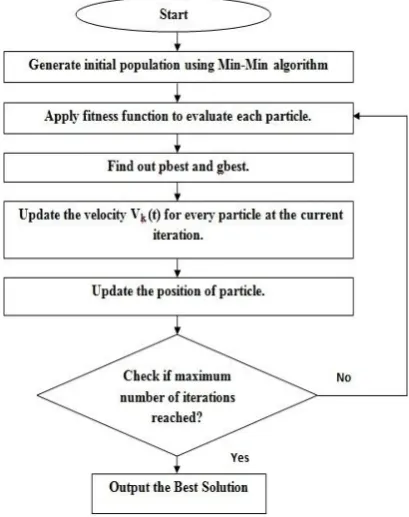
3. Generate initial population using Min-Min algorithm.
4. Apply fitness function to evaluate each particle in initial population.
5. Find out best position of each particle and global best position of particles, pbest and gbest respectively for the initial population.
6. Update the velocities Vk(t) for every particle at the current iteration according to Eq. 1.
Vk (t+1) = w*Vk (t) + r1.c1.[Pbest,k(t) - Xk(t)] + r2.c2[Gbest(t) -Xk(t)] k=1,2,3….n (1)
Where k is the number of particles, Pbest,k(t) is the position of the particle with the best fitness value at the previous
iteration, Xk(t) is the position of particle at the previous iteration and Gbest(t) is global best position among all the
particles, c1 and c2 are constant values, r1 and r2 are random values between 0 and 1.
7. Update the position of particle according to Eq. 2.
Xk(t+1) = Xk(t)+ Vk(t) k=1,2,3….n (2)
8. Stop if maximum number of iterations is reached and output best solution else goes to step 4.
Figure 2 Proposed Algorithm
The Flow chart of proposed algorithm is shown in Figure 3.
A. Fitness Function
In this research, the fitness function is based on makespan, i.e. the completion time of last task. For each machine we add execution time of all tasks assigned to that particular machine and the largest runtime of all machines will represent makespan .Makespan = max{Fi} where Fi is the finish time of the last task.
IV. SIMULATION EXPERIMENTS
A. Experimental Environment and Parameter Settings
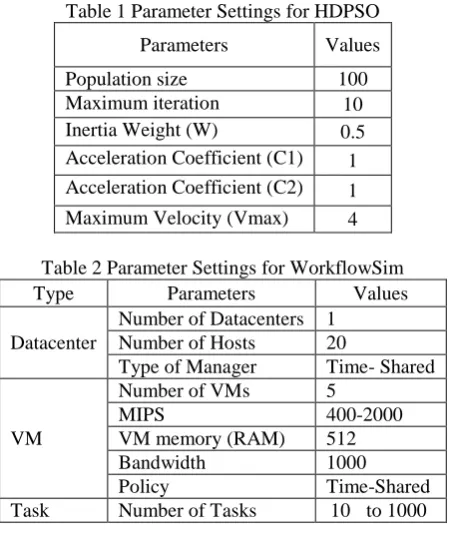
In this section, we will discuss the experimental setup for evaluating the performance of proposed algorithm. The experiment is performed in a simulated environment using workflowSim simulator [16] with Eclipse IDE. For simulation we need to set some parameters for WorkflowSim and HDPSO, Table 1 shows the parameters setting for HDPSO and Table 2 shows parameters settings for WorkflowSim toolkit. Table 3 shows the specification of VMs.
Table 1 Parameter Settings for HDPSO
Parameters Values
Population size 100
Maximum iteration 10
Inertia Weight (W) 0.5
Acceleration Coefficient (C1) 1 Acceleration Coefficient (C2) 1
Maximum Velocity (Vmax) 4
Table 2 Parameter Settings for WorkflowSim
Type Parameters Values
Datacenter
Number of Datacenters 1
Number of Hosts 20
Type of Manager Time- Shared
VM
Number of VMs 5
MIPS 400-2000
VM memory (RAM) 512
Bandwidth 1000
Policy Time-Shared
Task Number of Tasks 10 to 1000
B. Result Analysis
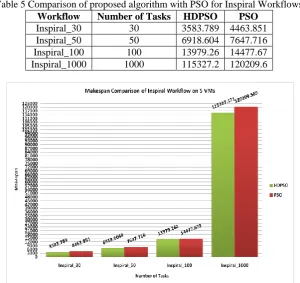
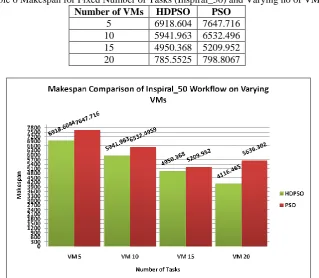
We consider Montage and Inspiral real workflows for performance analysis of proposed algorithm. The proposed algorithm is compared with PSO in terms of makespan. Table 4 and 5 shows the results for montage and inspiral workflow respectively. Figure 4 and 5 shows the graphical representation of achieved results for montage and inspiral workflow respectively. Table 6 shows the result of varying number of VMs and keeping number of tasks constant, its graphical representation is shown in Figure 6.
Table 3 Specification of VMs (5)
VMs(5) Processing Speed (MIPS)
VM1 400
VM2 800
VM3 1200
VM4 1600
Table 4 Comparison of proposed algorithm with Discrete PSO for Montage Workflows
Workflow Number of Tasks HDPSO PSO
Montage_25 25 140.208 152.349
Montage_50 50 257.442 275.561
Montage_100 100 586.786 664.601
Montage_1000 1000 6017.119 6299.851
Figure 4 Performance Analysis of HDPSO and PSO for Montage Workflow with 5 VMs
Table 5 Comparison of proposed algorithm with PSO for Inspiral Workflows Workflow Number of Tasks HDPSO PSO
Inspiral_30 30 3583.789 4463.851
Inspiral_50 50 6918.604 7647.716
Inspiral_100 100 13979.26 14477.67
Inspiral_1000 1000 115327.2 120209.6
Table 6 Makespan for Fixed Number of Tasks (Inspiral_50) and Varying no of VMs. Number of VMs HDPSO PSO
5 6918.604 7647.716
10 5941.963 6532.496
15 4950.368 5209.952
20 785.5525 798.8067
Figure 6 Performance Analysis of HDPSO and PSO for Inspiral_50 Workflow varying number of VMs
Simulation results show that HDPSO gives lesser makespan as compared to PSO. From the above Tables and Graphs we can observe that HDPSO performs better then PSO in all three cases, (i) when considering Montage Workflow (ii) when using Inspiral workflow (iii) when varying VMs for Inspiral workflow keeping number of tasks constant. PSO has a drawback that its local search capability is not good which is overcome in propose work by combining Min-Min with PSO.
V. CONCLUSION AND FUTURE WORK
Cloud workflow scheduling with an optimum makespan is an N-P complete problem. Therefore, the purpose of workflow scheduling process is to reformulate the task-to-resource mappings for each task of a workflow by approximating the solution. This research work presents a workflow scheduling algorithm based on hybrid of DPSO and Min-Min to minimize the total makespan of the tasks in workflow submitted to the cloud computing environment. Simulation results show that HDPSO gives lesser makespan as compared to PSO. From the results we can observe that performance of HDPSO is better than PSO.
We focused on only one QoS parameter that is makespan. This research work can be extended by adding more QoS parameters such as cost, load balancing and reliability etc. Moreover we used simulation environment for performing experiments, in future this work can be implemented on real cloud.
REFERENCES
[1] Q. Zhang, L. Cheng, and R. Boutaba, “Cloud computing: state-of-the-art and research challenges,” Journal of Internet Services and Applications, Springer, pp. 7-18, April 2010.
[2] M. D. Dikaiakos, D. Katsaros, P. Mehra, G. Pallis, and A.Vakali, “Cloud Computing: Distributed Internet Computing for IT and Scientific Research,” Journal of Internet Computing, IEEE, Volume 13, No. 5, pp. 10-13,
[3] L. Savu, “Cloud Computing: Deployment Models, Delivery Models, Risks and Research Challenges,” International Conference on Computer and Management (CAMAN), pp. 1-4, May 2011.
[5] Y. H. Lee, S. Leu, and R. S. Chang, “Improving Job Scheduling Algorithms in a Grid Environment,” Future Generation Computer Systems, Elsevier, Volume 27, No. 8, pp. 991–998, October 2011.
[6] https://confluence.pegasus.isi.edu/display/pegasus/ WorkflowGenerator-/(Last accessed on: 15.04.2015)
[7] L. Liu, M. Zhang, Y. Lin, L. Qin, “A Survey on Workflow Management and Scheduling in Cloud Computing”, IEEE/ACM International Symposium on Cluster, Cloud and Grid Computing, pp. 838-846, 2014.
[8] Y. Cai, Z. Chen, and H. Min, “Improving Particle Swarm Optimization Algorithm for Distributed Sensing and Search,” IEEE International Conference on P2P, Parallel, Grid, Cloud and Internet Computing, pp. 373 - 379, October 2013.
[9] S. Yassa, R. Chelouah, H. Kadima, and B. Granado, “Multi-Objective Approach for Energy-Aware Workflow Scheduling in Cloud Computing Environments,” Hindawi Publishing Corporation The Scientific World Journal, Volume 2013, pp. 1-13,September 2013.
[10] S. Abdi, S. A. Motamedi and S. Sharifian, “Task Scheduling using Modified PSO Algorithm in Cloud Computing Environment,” International Conference on Machine Learning, Electrical and Mechanical Engineering, Dubai (UAE), pp. 37-41, January 2014.
[11] G. Zhao, “Cost - Aware Scheduling Algorithm Based on PSO in Cloud Computing Environment,” International Journal of Grid and Distributed Computing, Volume 7, No.1, pp. 33-42, March 2014.
[12] D. Kaur, and S. Singh, “An Efficient Job Scheduling Algorithm using Min-Min and Ant Colony Concept for Grid Computing,” International Journal Of Engineering And Computer Science, Volume 03, No. 07 , pp. 6943-6949 , July 2014.
[13] M. Karimi, and H. Motameni , “Tasks Scheduling in Computational Grid using a Hybrid Discrete Particle Swarm Optimization,” International Journal of Grid Distribution Computing, Volume 6, No.2, pp. 29-38, April 2013.
[14] S. J. Xue, and W. Wu, “Scheduling Workflow in Cloud Computing Based on Hybrid Particle Swarm Algorithm,” Indonesian Journal of Electrical Engineering, TELKOMNIKA Volume 10, No. 7, pp. 1560-1566, November 2012.
[15] K. Vivekanandan, and D. Ramyachitra, “A study on scheduling in grid”, International Journal on Computer Science and Engineering,” Volume 3, No. 2, pp. 571-584, February 2011.