Running head: CALENDRICAL CALCULATION
Calendrical Calculation and Intelligence
Neil O’Connor, Richard Cowan, and Katerina Samella Institute of Education University of London
Published in Intelligence, 2000, 28 (1), 31-48.
Author Notes
Neil O’Connor, Psychology and Special Needs; Richard Cowan, Katerina Samella, Child Development and Learning.
Tragically, Neil O’Connor died during the writing of this paper. We miss his intellectual leadership and unfailing good humor.
The sample of calculators came from the pool built up over several years by Dr O’ Connor and Dr Beate Hermelin. We thank Dr Hermelin and Dr Lisa Heavey for introducing us to two more. We thank an anonymous benefactor, the University of London Central Research Fund, and the University of London Tregaskis Bequest for financial support. We thank the calculators, their families and carers for their co-operation.
Correspondence and requests for reprints should be addressed to Dr Richard Cowan, Child Development and Learning, Institute of Education University of London, 20 Bedford Way, London WC1H 0AL, UK. Electronic mail may be sent via Internet to
Abstract
Calendrical Calculation and Intelligence
Calendrical calculation is the talent of naming days of the week corresponding to dates in the past, present and future. It is puzzling why anyone should develop it, as it has no
obvious purpose or value. Remarkably, most reported cases are individuals with below average intelligence. Among these are several whose exceptional level of skill marks them as prodigious savants (Treffert, 1989). They can accurately answer date-questions over a large range of years, i.e., 50 years or more, taking less than 10 seconds for each question.
Modular theories of intelligence have invoked savants to refute the notion of general intelligence proposed by Spearman (1927). The existence of calendrical calculation skill and other savant talents such as art and music has been taken to show the independence of various forms of intelligence (Gardner, 1983). This is open to question on three counts. Gardner's (1983) description of different abilities as intelligences violates the ordinary use of the term 'intelligence' to refer to general adaptive capacity (Nettelbeck & Young, 1996; Young & Nettelbeck, 1994). Secondly, Spearman (1927) did not claim that general intelligence determined performance on every cognitive task to the same extent. Thirdly, while general intelligence may only set a lower limit on who might develop the ability to calculate dates, differences in general intelligence may determine how far such ability develops (Nettelbeck & Young, 1996; O’Connor & Hermelin, 1988).
years. Hermelin and O’Connor (1986) found calculators with higher Wechsler Intelligence Test IQs were more accurate and could answer questions about future dates. While Young and Nettelbeck (1994) did not confirm these results, they only had data for three calculators whose Wechsler IQs were similar, i.e., ranging from 65 to 76.
Latency of date calculation should vary with general intelligence given the association between intelligence level and response latency (Eysenck, 1967; Hunt, 1980; Jensen, 1981; Jensen & Munro, 1979; Nettelbeck & Kirby, 1983). O’Connor and Hermelin (1984) found no significant correlation between IQ and calculation latency (r = - .40) but their sample was only eight and they acknowledged that this made the results inconclusive. The basic latency of calendrical calculators in calculating contemporary dates ranges from 1 to 10 seconds.
Hermelin and O’Connor (1986) assigned a major role in developing date calculation skill to the discovery of calendrical rules. Some calendrical rules concern months in the same year, e.g., dates in April fall on the same day as corresponding dates in July. Others concern dates in different years, such as that dates separated by 28 years fall on the same day, if the 28-year period comprises 21 non-leap 28-years and 7 leap 28-years. Spitz (1995) suggested people with limited general intellectual abilities who studied calendars extensively might learn patterns and regularities without awareness. He pointed out that implicit learning depends less than explicit learning on IQ.
analogy to noncalendrical material. Hermelin and O’Connor (1986) proposed that both the use of regularities as shortcuts in date calculation and their verbal formulation might depend on general intelligence.
Mixed evidence of use of calendrical regularities emerged from Young and
Nettelbeck’s (1994) investigation of three calendrical calculators. These calculators knew which years in the 20th century were identical in structure and were faster when the
researchers presented dates in blocks of identical years. However, despite their knowledge of month regularities, they did not show consistent benefits in calculating dates paired with corresponding months.
Therefore, although extraction of calendrical regularities may underlie many savants’ date -calculation, only some may exploit these regularities to improve their date-calculation further or do other tasks requiring knowledge of calendrical regularities. One such task is the judgement of calendrical similarities of dates in the same year and of different years. Another is the ability to answer questions such as ‘In what years will 9th October be a Wednesday?’ that has occasionally been reported (Howe & Smith, 1988).
Apart from the paradox of exceptional skill in a person with low general intellectual ability, another reason for interest in savant skills is their association with autism. Hill (1977) estimated about 1 in 2000 people with intellectual disabilities were savants. He did consider this might be an underestimate as institutions that had savants may have been less willing to respond to his survey. However, this estimate contrasts markedly with Rimland’s (1978) claim that as many as 1 in 10 autistic people had a savant skill.
of calendrical regularities by people with limited general intelligence. Obsessive
preoccupations have long been considered a cardinal symptom of autism (Frith, 1989). O’Connor and Hermelin (1991) found that both autistic and nonautistic savants showed more obsessional and repetitive behavior than controls matched for IQ and diagnosis.
The second hypothesis is that the development of savant skills may be aided by weak central coherence, a cognitive processing style characteristic of autistic people (Frith, 1989). Weak central coherence refers to a piecemeal processing style that focuses on local features at the expense of global features, perceptual forms or meaning. Weak central coherence is proposed to explain the characteristically uneven profiles of autistic people on Wechsler Intelligence Scales, with a peak on the Block Design subscale of the performance tasks and a trough on the Comprehension subscale (Happé, 1994). Block Design requires the analysis of graphic designs with a strong gestalt into components corresponding to blocks and the use of these blocks to reconstruct the design. Successful analysis depends on the ability to resist the pull of the overall design. Another task where weak central coherence is an advantage is the Children’s Embedded Figures Test (Witkin, Oltman, Raskin, & Karp, 1971), which requires identification of geometric forms in pictures of familiar objects. Weak central
coherence enables concentration on the graphic components without distraction by the subject of the picture, for example being able to see a triangle in a drawing without distraction by recognizing that the drawing denotes a pram. Shah and Frith (1983) showed that a group of autistic children were more successful on this task than groups of normal children matched for mental age and of mildly mentally retarded children matched for mental and chronological age.
faster on a block design task than controls matched for mental age and diagnosis. In discussing other savant skills, they suggested that weak central coherence might favor absolute pitch, which is common in musical savants (Miller, 1989) and might plausibly aid their reproduction of music. Heavey (1997) has also proposed that weak central coherence may help the
development of skill in calendrical calculation. In her view, the first step in developing date calculation skill is the learning of individual day-date combinations that weak central
coherence may favor. The set of dates learnt provides the input for the process of unconscious regularity detection and reconstitution of calendrical knowledge suggested by Spitz (1995) and, using a connectionist framework, Norris (1990).
The primary aim of this study is to find whether differences in the talents of calendrical calculators correspond to differences in their general intelligence. Specifically we seek to establish whether differences in general intelligence, as measured by full scale IQ, vary with range, accuracy and latency of date calculation, and performance on other calendrical tasks. The secondary aims are to examine the subscale profiles of a group of calendrical calculators and the relation between the specific abilities the subscales assess and calendrical performance. If weak central coherence is important for calendrical calculation, then calendrical calculators should show the characteristic peak on Block Design, irrespective of diagnosis. Furthermore, differences in Block Design performance may vary with calendrical skill.
Other specific abilities that might influence calendrical calculation are Arithmetic and Digit Span that are part of Verbal IQ and the Digit Symbol task from the Performance IQ Scales. Differences in arithmetic ability might vary with calendrical calculation talent,
LaFontaine (1973) found that savants’ digit spans fell within the normal range, despite their low IQs, and were markedly higher than a comparison group with low IQs. However, Heavey (1997) found no difference in digit spans between a group of calendrical calculators and a group of controls matched for verbal IQ, chronological age, and diagnosis. Finally, the Digit Symbol task is a coding exercise that measures latency of recall reference. It is the only component of the WAIS that is directly related to latency. If latency of date calculation reflects general latency of processing, then differences in Digit Symbol performance might be associated with differences in date calculation ability.
Method
Participants
We found 10 subjects talented in date calculation and varying in measured intelligence between severe intellectual disability and average intelligence. Eight were male and 2 were female (JB and BL). Their ages ranged from 17 to 49 years (X = 36 years, SD = 11 years). All but JB and PM had received a diagnosis of autism. Four of the calculators (BL, JB, DK, and GC) had previously participated in the study by O’Connor and Hermelin (1984) and O’Connor and Hermelin (1992) had reported MW’s performance as a child.
Procedure
Testing occurred over several sessions at the calculators’ homes or day care centers. Most sessions lasted about an hour unless the calculator was unwilling to continue.
Psychometric Intelligence. Intelligence was assessed with the UK standardization of the Wechsler Adult Intelligence Scale.
2170. For these dates, we discouraged calculators from using paper and pencil. Beyond this range, we used periods with sets of five dates and let the calculators use paper and pencil if they wished. The periods sampled were as follows: 1772-77, 1828-36, 1912-19, 1940-47, 1968-76, 1992-97, 2017-24, 2072-80, 2157-65, 2363-67, 2791-95, 3574-78, 5191-95, 8374-78, 12819-23, 51275-79, 204830-33, and 819202-06. We presented the dates over five sessions. The first session comprised the dates from the 20th century, the second session dates from the 19th and earlier part of the 21st, and the third session included dates from the 18th, 22nd and later part of the 21st century. The fourth session featured the dates from 2363 to 8378, and the fifth session contained the rest. Within each session, we randomly ordered years with the constraint that no two years from the same period were adjacent. We randomly
assigned day-month combinations to years with two constraints: within each period assessed in the first three sessions at least one date was the calculator’s birthday, and, apart from these, we included no dates from January or February. We incorporated the savants’ birthdays to see if these would be calculated faster than other dates in the period. We omitted dates in January and February unless the calculator was born in one of these months, because some calculators might consider years as beginning on 1st March, thus making the leap day occur at the end of the year. This has the advantage of reducing the number of basic year patterns to seven, according to the day of the week on which the first day of March falls.
Knowledge of Calendrical Regularities. We further assessed calendrical knowledge with a priming task, a similarity test and a task requiring nomination of corresponding years. The priming task required date calculations of 20 pairs of dates. Each pair differed only in the years. All pairs consisted of years either 6 or 11 years apart. Years separated by 6 years are calendrically identical if the intervening period includes a single leap year. Years 11 years apart are calendrically identical if the intervening period contains three leap years. In 10 pairs, the years were calendrically identical and so the day was the same for both dates, e.g., 19th July 1981 and 19th July 1987 were both Sundays. In the other 10 pairs, the years were
calendrically different and so the days varied, e.g., 17th March 1987 was a Tuesday but 17th March 1993 was a Wednesday. The set of pairs took account of how latency varies with remoteness from the present (O’Connor & Hermelin, 1984). Every year that appeared following a corresponding year was also the second member of a noncorresponding pair. We wanted to see whether the calculators would benefit by being primed with a calendrically identical year, as Hermelin and O’Connor (1986) had found with months, and whether such benefit might vary with general intelligence.
fall on the same day of the week. One subtest assessed knowledge of similarities between dates in matching months, such as March and November, the other, similarities between dates in noncorresponding months. All pairs of day-month combinations differed in the day number, e.g., 4th March and 26th November. For each version, making 9 or 10 correct judgments has a chance probability of less than .02.
In the nomination task, we asked the calculators to name years with certain features in common. Two types of item were used. The first, identical years, requires the nomination of years in which a particular date falls on a specified day of the week (e.g., In 1995, 1st March was a Wednesday. Can you tell me any other years with 1st March on a Wednesday?). To answer this, the calculator must retrieve, or calculate, years corresponding to the given year. This involves identifying years that are identical, and years that are the same after the last day in February whether it is the 28th or the 29th. There are 14 patterns of the calendar, 7 for leap years and 7 for nonleap years. These are used in perpetual calendars and reference books. All calculators studied by Young and Nettelbeck (1994) could classify years according to pattern. In answering our questions, a very inflexible calculator might only nominate years with the same pattern as the target year.
The second type of item, heterogeneous years, asks for years with a similar feature (e.g., In 1997, there are five Wednesdays in July. Can you tell me any other years with five Wednesdays in July?). The years that meet this criterion are more heterogeneous: years in which 1st July is a Monday, a Tuesday or a Wednesday will do. To retrieve the wider range of years meeting this criterion might require a more flexible search than the identical years items.
Results
--- Insert Table 1 about here
---
subjects. In the group, 3 were both retarded and autistic (BL, DM, JG), 2 were retarded but not autistic (JB, PM), and the other 5 were autistic but not retarded, although DK was
borderline. Four of the autistic cases (JG, DK, MW, PE) had Verbal IQs markedly lower than their Performance IQs, which would be characteristic of the autistic pattern, but DM showed the reverse pattern and the others (BL, HP, GC) showed no marked difference. Both PE and JB showed extreme differences between Verbal and Performance IQs. The significance of these discrepancies is unclear. They are however broadly consistent with the estimates of their Verbal and Nonverbal IQs that Heavey (1997) made using the Peabody Picture Vocabulary Test for Verbal IQ and the Raven’s Progressive Matrices test for the Nonverbal IQ. She found PE had a Verbal IQ of 78 and a Nonverbal IQ of 108, and JB had a Verbal IQ of 59 and a Nonverbal IQ of 48.
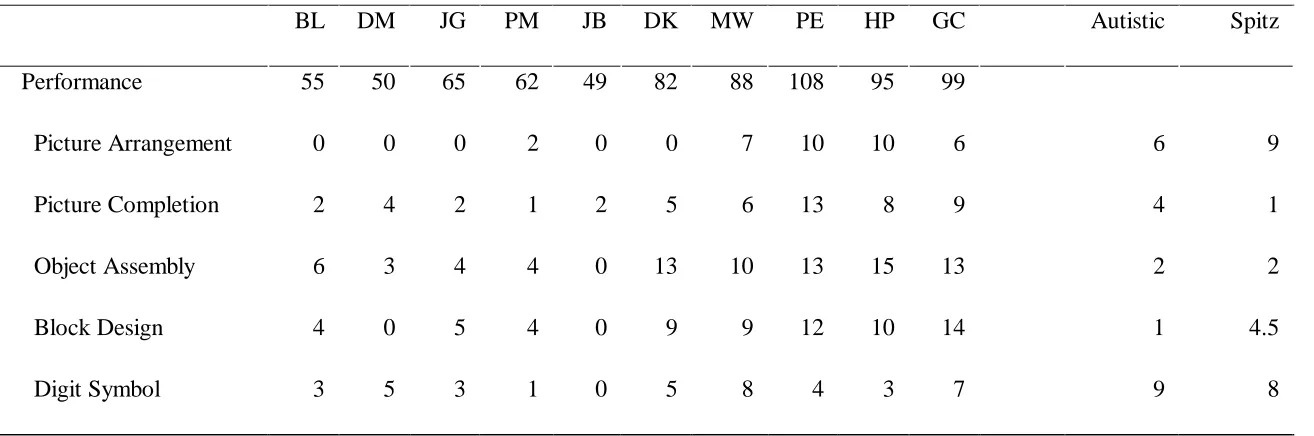
Included in Table 1 are the scaled scores for the subtests. There are several scale scores of zero. However, only half (9/18) resulted from raw scores of zero and so might signify either failure to comprehend the task or noncompliance. Raw scores of zero were obtained on the Information subscale by BL, on the Similarities test by DM, JG, and PM, on the Picture Arrangement test by BL and DM, on the Block Design task by DM and JB, and on the Digit Symbol task by JB. Overall, we had little difficulty in explaining the tasks or eliciting cooperation from the sample.
were within the normal range of scaled scores with forward digit spans of between 6 and 9 and backward digit spans between 2 and 5. MW was above average with forward and backward spans of 8. PM had a forward digit span of 6 and a backward span of 2. JG only managed a forward span of 3 but was unable to comply with the instructions for a backward digit span.
On the performance subscales, our sample partially replicates previous studies of autistic people’s performance on the Block Design task. For all the autistic subjects except DM, Block Design scores were either the highest or second highest performance subscale scores with Object Assembly being higher. Thus, it was a relative strength. Our low IQ autistic subjects (BL, DM, and JG), however, were all below average on Block Design, in contrast to Shah and Frith (1993). Furthermore the nonretarded autistic calculators did not do
exceptionally well, only GC is above average. Block Design was a relative strength but not an absolute one.
For comparison, Table 1 includes the rankings of Wechsler subscales derived from Spitz’s (1988) aggregation of WAIS data from retarded and borderline groups and a rank order derived from the studies summarized by Happé (1994), including her own, of autistic children and adults using the WAIS, WISC or WISC-R. We excluded data from studies using the WAIS-R as Spitz (1988) found no statistically reliable correlation between the rankings for the WAIS and the WAIS-R subscales. The rankings relate to the overall means. We derived the overall means by combining the means from different studies having weighted them
according to sample size. Comparing the ranking for autistic subjects with that for the retarded and borderline groups suggests two notable differences. On the verbal subscales, autistic people typically do better on Digit Span while the retarded and borderline groups do better on Comprehension. On the performance scales, autistic people do best on Block Design while the others do best on Picture Completion.
scored higher on Digit Span than on Comprehension. However, differences on the
performance subscales were not so large or so consistent: most obtained higher scaled scores on Block Design than on Picture Completion. To find the correspondence between the individual profiles and the modal autistic and retarded patterns, we conducted Spearman rank order correlation tests. These revealed substantial matches with the autistic profile for only some autistic calculators and neither nonautistic calculator (BL, r = .70, p <. 02; DM, r = .00, ns; JG, r = .41, ns; PM, r = .26, ns; JB, r = .24, ns; DK, r = .67, p <. 03; MW, r = .67, p <. 03; PE, r = .90, p <. 01; HP, r = .47, ns; GC, r = .78, p <. 01. No calculator showed a significant match with the nonautistic profile (rs between -.05 and .51).
Table 2 summarizes the correlations between full scale IQ and the subscales selected as assessing abilities that might be important for calendrical calculation.
--- Insert Table 2 about here
---
order correlation tests indicated associations between the --- Insert Table 3 about here
---
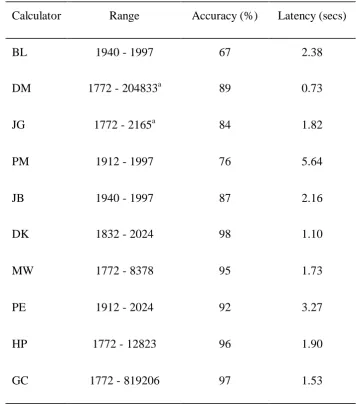
different aspects of performance. Calculators who could answer questions over a greater range of years tended to be more accurate and faster; Range and Accuracy, r = .62, p < .1, Range and Median Time, r = - .72, p < .05, Accuracy and Median Time, r = - .60, p < .1. The same relationships with median time are found if error latencies are included as few calculators made any errors on dates in the period and error latencies do not differ appreciably from latencies for correct answers.
To find out whether calendrical calculation skill varied with intelligence, measures of association between aspects of calendrical skill and intelligence were conducted. The results are summarized in Table 4. The only clear relation between overall IQ and aspects of
calendrical calculation was with accuracy. Tests of the associations between calendrical calculation and the selected subscales showed that differences in Arithmetic scores were unrelated to any aspect. Block Design scores were related to accuracy, but the correlation was no greater than with overall IQ. Variation in Digit Symbol scores was related to latency, range and ability to answer questions about the future. Digit Symbol score was also related to accuracy despite the lack of relation between this subtest and IQ. Calculators who could answer questions about dates in the future tended also to have higher Block Design scores.
--- Insert Table 4 about here
---
standard deviations for the similar period of years from the first of the sessions establishing range. Inspection of the latencies suggests varying patterns of performance. Some appear to benefit from priming by being faster when primed by either type of date (DM, PE, GC), and MW was notably faster when primed by dates from corresponding years. Another group appeared unaffected by priming (BL, PM, HP). A third group has longer latencies when primed by a date from a noncorresponding year (JG, JB, and DK) as if it interfered with their date calculation. Indeed as well as being slower, JB also made four errors on this type of date. The only other calculators to make errors on either date type were BL (one error) and PM (two errors).
To establish the reliability of the differences in times, the three sets of correct answer latencies for each calculator were ranked and these ranks were entered in separate one-way analyses of variance. Each calculator in the first group showed significant variation overall but only the differences between dates primed by corresponding years and the first session dates were confirmed by post-hoc Newman-Keuls tests (ps < .05): DM, F (2,44) = 7.23, p < .01, PE, F (2,42) = 4.70, p < .02, GC, F (2,45) = 5.48, p < .01. MW’s times for dates primed by corresponding years were reliably faster than both the other types of date, F (2,45) = 20.75, p < .01. The times for BL, PM, and HP did not vary with type of date; BL, F (2,38) = 0.24, PM, F (2,37) = 0.35, HP, F (2,45) = 0.10. Of those who appeared distracted by dates from a noncorresponding year, only JB showed a reliable difference in times; JG, F (2,41) = 0.51, JB, F (2,36) = 4.33, p < .05, DK, F (2,44) = 2.89, p < .1. Including latencies for erroneous
answers makes no difference.
Benefit from priming was unrelated to full scale IQ (r = .36) but was associated with higher Digit Symbol scores, r = .76, p < .02, and Digit Span scores, r = .68, p. < .05. There was no relationship with either Arithmetic, r = .32, or Block Design, r = .36.
Insert Table 5 about here ---
In answering the similarity tests, GC insisted on saying how different the dissimilar items were, e.g., that dates in 1993 were one day earlier than dates in 1955. Latencies for DKs judgments of years items were not obtained due to recording problems. Separate latencies for each item on a subtest are not available as only the intervals between the presentation of the first item and the response to the last item were recorded. Deriving separate latency measures for correct and incorrect answers is thus not possible. Table 6 shows scores and mean latencies per item for each similarity test. On the years tests, some calculators were both accurate and fast, suggesting that they were either retrieving the answers from their knowledge of calendrical similarities or calculating the difference between the years. JG was fast but inaccurate. When later asked to solve the problems through
calculating dates in the different years he was correct. BL and JB were slow and inaccurate. PM was accurate and very slow. Observation suggested he was answering the questions by calculating dates in specific years.
--- Insert Table 6 about here
---
Most calculators were above chance level for each test but JB was above chance level only for the matching months test, and BL and JG were at chance level for all tests.
Performance was related to intelligence according to a correlation test between a composite score for all similarity tests and overall IQ (r = .78, p < .01). No subscale showed a greater association (Arithmetic, r = .70, p < .05; Block Design, r = .65, p < .05; Digit Span, r = .71, p < .05; Digit Symbol, r = .38, ns). To examine the relation between latency and
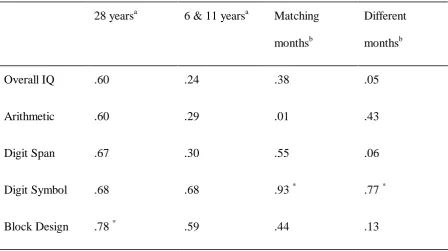
latency for each test showed little relation to intelligence but marked associations with some subtest measures, most consistently to Digit Symbol. Table 7 summarizes the results.
--- Insert Table 7 about here
---
All the calculators responded to both items of the identical years nomination test. As Table 8 shows, the number of years they suggested differed markedly and some made errors. Usually they produced more years in the past than the future. GC gave up nominating years on the second item saying that there were many between the ones he had suggested which were 28 years apart. All except BL and PM nominated years from different patterns in answering the questions.
Explaining the heterogeneous years nomination items to the savants proved harder. Neither BL nor JB understood what was required. GC was reluctant to specify years after announcing the 28-year rule. We therefore asked him a series of questions about individual years from different patterns and to supply others. Every year he produced differed from the specified years by a multiple of 28 and thus was the same pattern. Years from six patterns are correct for the first question, and four patterns are correct for the second question. Table 8 shows the numbers of correct nominations and the number of different patterns represented in correct answers for both questions. Again, calculators nominated more past years than future years.
--- Insert Table 8 about here
---
varied with IQ; Nominations, r = .73, p < .05, Patterns, r = .79, p < .05. The correlations with Block Design were even higher; Nominations, r = .84, p < .01, Patterns, r = .92, p < .01. Correlations with the other subscales were weaker or insignificant, rs between .44 and .68.
Discussion
This study explored the unusual talent of calendrical calculation in a sample of people varying in measured intelligence. Everyone in the sample possesses this skill to a remarkable level, but they differ in their proficiency. In both latency and range, they equal or surpass the achievements of many previously reported cases. In common with previous studies, our calculators include several with low measured intelligence. Our results suggest that, although low intelligence does not prevent people from developing skill in calendrical calculation, the talent depend on general intelligence. We found relationships between full scale IQ and
accuracy in calendrical calculation and accuracy on two of the three further tests of calendrical knowledge. Any relationship between general intelligence and degree of savant skill is a challenge to Gardner’s (1983) proposal that general intelligence is irrelevant to savant talent. However, some aspects of calendrical calculation did not show marked relationships with general intelligence. The range of years over which savants could answer date-questions showed a moderate but unreliable correlation with general intelligence and general intelligence did not predict latency in date-calculation or other tests of calendrical knowledge.
rule and whether they can learn to adapt their date-calculation accordingly.
Calculation latency is not related to general intelligence as measured by full scale IQ. This is surprising in view of the association between intelligence level and latency. The lack of relationship with general intelligence is common to latencies for date-calculation periods apart from the recent past and to latencies for the other calendrical tasks, except the 28-year subtest of the similarity task. The calculators differed markedly in latency so insufficient variability cannot be the explanation. A trade-off between latency and accuracy can also be discounted as latency was negatively related to accuracy. Another plausible explanation is that latency may be more directly affected by experience such as practice. Practice might be associated with age. However, our sample shows no association between any aspect of date-calculation and age (rs less than .23). The notion that variation in calculation latency is completely talent-specific is, however, challenged by its relation to performance on the Digit-Symbol subscale.
The consistent association between Digit Symbol scores and various measures of calendrical performance including latency is a striking feature of our results. In this task, one must use an arbitrary system associating numbers with symbols and write as many symbols under the right numbers as one can in a limited time. Success on this task might depend in part on the ability to retain an arbitrary list of associations. This would reduce the need to check which symbol goes with a particular digit. As such, it might reflect visuo-spatial retention. Also involved is latency of processing in reading the digits and writing the corresponding symbols. Either the visuo-spatial component or the processing latency component might underlie the common variation in this task with date-calculation ability. Further research using tasks that separately assess these components should clarify their importance. Anderson’s (1992) proposal that Inspection Time measures may discriminate between levels of performance by calendrical calculators would be well worth investigating.
other subscales we considered might be relevant were generally unimpressive. Calendrical calculation might be a matter of arithmetic, but WAIS Arithmetic showed little relationship with performance. Our calculators vary considerably in their WAIS Arithmetic scale scores and so the lack of relationship cannot be due to ceiling or reduced range effects. Previous case studies of calendrical calculators have often reported deficiencies in the calculator’s arithmetic ability and this has been used to argue that calendrical calculation does not depend on
arithmetic (Hill, 1975; Nettelbeck & Young, 1996). However, the WAIS subscale may not accurately assess the arithmetic ability of calendrical calculators because its items embed arithmetical sums in story problems. Ho et al. (1991) report that Kit, an extremely
accomplished calculator, performed poorly on the Arithmetic subtest of the WAIS. Kit was much better on the problems in the Stanford Diagnostic Mathematical Test. The Stanford test simply requires manipulations of numbers. We have also assessed the calendrical calculators’ arithmetical abilities with various tests including the Graded Difficulty of Arithmetic test (Jackson & Warrington, 1986). The Graded Difficulty of Arithmetic test consists of mental addition and subtraction problems ranging in difficulty from easy (e.g., 15 + 13, 19 - 7) to very difficult (e.g., 244 + 129, 246 - 179). Several (DM, MW, PE, HP) performed at an extremely high or ceiling level. However, their WAIS Arithmetic scores are unexceptional, and indeed DM’s score is particularly low. All in our sample can add and subtract at the level necessary for the method of calendrical calculation we propose. Arithmetical ability is related to date-calculation range (Cowan, O’Connor, & Samella, 1998).
(Baddeley, 1986). So if calendrical calculation involves mental arithmetic, a clearer
relationship might be expected. However, several explanations can be proposed. Calculators may have developed processing abilities specific to calendrical calculation that they cannot readily deploy on Digit Span tasks. They may be like the child expert chess players who show superior spans for recall of chess patterns compared with adults but whose digit spans are lower (Chi, 1978). If this were a relevant analogy, we should expect to find a calendrical memory span task that would show a closer relation to date-calculation performance. This is plausible in the light of research by Heavey (1997). She found calendrical calculators exhibit a highly efficient, talent-specific memory ability. In comparison with controls matched for age, Verbal IQ and diagnosis, they recalled more calendar-related items, but the groups did not differ in their short or long-term recall of more general material unrelated to the calendar. While she established group differences, she did not examine the relation between differences in calendrical calculation within the group and differences in memory.
latency increased but accuracy was unaffected.
We expected Block Design performance to be informative. Absolute strength in Block Design is a consistent finding in studies of autistic people (Happé, 1994) and most of our sample are autistic. Strength in Block Design is an indicator of weak central coherence, which is argued to be beneficial for the development of savant skills including calendrical calculation (Pring et al., 1995). However, none of our sample showed levels of performance as discrepant from their IQs as those in the sample of autistic subjects studied by Shah and Frith (1993). Indeed, while most of our sample resembled autistic people in being more successful on the Digit Span subtest than on Comprehension, Block Design was not even a consistent relative strength in the Performance subtests. The presence of unusual strength in Block Design is an indicator of weak central coherence, and so weak central coherence may not be as important for date-calculation as for other savant skills. From a different perspective, Anderson (1992) argues that calendrical calculation is unlike other savant skills. While Block Design scores did relate to some aspects of calendrical performance, it was never the only subscale showing an association. In both measures of flexibility and in latency in judging the 28-year similarity items, it showed the highest relation. These findings are puzzling. They may be artifactual.
References
Anderson, M. (1992). Intelligence and development: A cognitive theory. Oxford: Blackwell.
Baddeley, A. (1986). Working memory. Oxford: Clarendon.
Chi, M. T. H. (1978). Knowledge structures and memory development. In R. S. Siegler (Ed.), Children's thinking: What develops?. Hillsdale, NJ: Erlbaum.
Cowan, R., O'Connor, N., & Samella, K. (1998). The arithmetical abilities of savant calendrical calculators. Manuscript submitted for publication.
Dorman, C. (1991). Exceptional calendar calculation ability after early left hemispherectomy. Brain and Cognition, 15, 26-36.
Eysenck, H. J. (1967). Intelligence assessment: A theoretical and experimental approach. British Journal of Educational Psychology, 37, 81-98.
Frith, U. (1989). Autism: Explaining the enigma. Oxford: Blackwell.
Gardner, H. (1983). Frames of mind: The theory of multiple intelligences. London: Heinemann.
Happé, F. G. E. (1994). Wechsler IQ profile and theory of mind in autism: A research note. Journal of Child Psychology and Psychiatry, 35, 1461-1471.
Hatano, G., & Osawa, K. (1983). Digit memory of grand experts in abacus-derived mental calculation. Cognition, 15, 95-110.
Heavey, L. J. (1997). Memory in the calendar calculating savant. Unpublished doctoral dissertation, Goldsmiths College University of London.
Hermelin, B., & O'Connor, N. (1986). Idiot savant calendrical calculators: Rules and regularities. Psychological Medicine, 16, 885-893.
Hill, A. L. (1977). Idiot savants: Rate of incidence. Perceptual and Motor Skills, 44, 161-162.
Hitch, G. J. (1978). The role of short-term working memory in mental arithmetic. Cognitive Psychology, 10, 302-323.
Ho, E. D. F., Tsang, A. K. T., & Ho, D. Y. F. (1991). An investigation of the calendar calculation ability of a Chinese calendar savant. Journal of Autism and Developmental
Disorders, 21, 315-327.
Horwitz, W. A., Deming, W. E., & Winter, R. F. (1969). A further account of the idiots savants, experts with the calendar. American Journal of Psychiatry, 126, 412-415.
Horwitz, W. A., Kestenbaum, C., Person, E., & Jarvik, L. (1965). Identical twin -"idiot savants"- calendar calculators. American Journal of Psychiatry, 121, 1075-1079.
Howe, M. J., & Smith, J. (1988). Calendar calculating in "idiots savants": How do they do it? British Journal of Psychology, 79, 371-386.
Hunt, E. B. (1980). Intelligence as an information-processing concept. British Journal of Psychology, 71, 449-474.
Jackson, M., & Warrington, E. K. (1986). Arithmetic skills in patients with unilateral cerebral lesions. Cortex, 22, 611-620.
Jensen, A. R. (1981). Reaction time and intelligence. In M. P. Friedman, J. P. Das, & N. O'Connor (Eds.), Intelligence and learning. New York: Plenum.
Jensen, A. R., & Munro, E. (1979). Reaction time, movement time and intelligence. Intelligence, 3, 121-126.
Miller, L. K. (1989). Musical savants: Exceptional skill in the mentally retarded. Hilllsdale, NJ: Erlbaum.
Nettelbeck, T., & Young, R. (1996). Intelligence and savant syndrome: Is the whole greater than the sum of the fragments ? Intelligence, 22, 49-67.
Norris, D. (1990). How to build a connectionist idiot (savant). Cognition, 35, 277-291. O'Connor, N., & Hermelin, B. (1984). Idiot savant calendrical calculators: Maths or memory? Psychological Medicine, 14, 801-806.
O'Connor, N., & Hermelin, B. (1988). Low intelligence and special abilities. Journal of Child Psychology and Psychiatry, 29, 391-396.
O'Connor, N., & Hermelin, B. (1991). Talents and preoccupations in idiot-savants. Psychological Medicine, 21, 959-964.
O'Connor, N., & Hermelin, B. (1992). Do young calendrical calculators improve with age? Journal of Child Psychology and Psychiatry, 33, 907-912.
Pring, L., Hermelin, B., & Heavey, L. (1995). Savants, segments, art, and autism. Journal of Child Psychology and Psychiatry, 36, 1065-1076.
Rimland, B. (1978). Savant capabilities of autistic children and their cognitive
implications. In G. Serban (Ed.) Cognitive deficits in the development of mental illness. New York: Brunner/Mazel.
Roberts, A. D. (1945). Case history of a so-called idiot savant. Journal of Genetic Psychology, 66, 259-265.
Shah, A., & Frith, U. (1983). An islet of ability in autistic children: A research note. Journal of Child Psychology and Psychiatry, 24, 613-620.
Shah, A., & Frith, U. (1993). Why do autistic individuals show superior performance on the block design task? Journal of Child Psychology and Psychiatry, 34, 1351-1364.
Spearman, C. (1927). The abilities of man: Their nature and measurement. London: Macmillan.
relationship to g and to estimates of heritability. Intelligence, 12, 279-297.
Spitz, H. H. (1995). Calendar calculating idiots savants and the smart unconscious. New Ideas in Psychology, 13, 167-182.
Spitz, H. H., & LaFontaine, L. (1973). The digit span of idiots savants. American Journal of Mental Deficiency, 77, 757-759.
Treffert, D. A. (1989). Extraordinary people. London: Bantam.
Wechsler, D. (1955). Wechsler Adult Intelligence Scale. New York: The Psychological Corporation.
Witkin, H. A., Oltman, P. K., Raskin, E., & Karp, S. (1971). A manual for the embedded figures test. Palo Alto, CA: Consulting Psychologists Press.
Table 1 Individual WAIS Scaled Scores and IQs of Calculators with Rank Orders of Subscales for Autistic People (n =157) and Spitz’s (1988) Aggregation of WAIS Data for Retarded and Borderline Groups (n = 895)
BL DM JG PM JB DK MW PE HP GC Autistic Spitz
Full Scale 50 52 54 58 60 74 82 94 96 97
Verbal 51 59 50 60 72 70 79 84 97 94
Information 0 3 4 2 6 4 9 6 12 8 7 4.5
Similarities 2 0 0 0 4 10 8 10 9 10 5 7
Arithmetic 2 2 3 3 4 1 8 9 13 12 8 11
Vocabulary 0 2 0 2 2 4 6 5 9 7 10 10
Comprehension 0 2 0 4 5 4 1 4 4 6 11 3
Table 1 continued
BL DM JG PM JB DK MW PE HP GC Autistic Spitz
Performance 55 50 65 62 49 82 88 108 95 99
Picture Arrangement 0 0 0 2 0 0 7 10 10 6 6 9
Picture Completion 2 4 2 1 2 5 6 13 8 9 4 1
Object Assembly 6 3 4 4 0 13 10 13 15 13 2 2
Block Design 4 0 5 4 0 9 9 12 10 14 1 4.5
Table 2 Correlations between Full Scale Intelligence and Subscales
Arithmetic Digit Span Digit Symbol Block Design
IQ .80 * * .73 * .38 .84 * *
Arithmetic .70 * .07 .63
Digit Span .59 .53
Digit Symbol .51
*
Table 3 Date Calculation Ranges, Accuracies, and Median Latencies for Dates from 1968 to 1997
Calculator Range Accuracy (%) Latency (secs)
BL 1940 - 1997 67 2.38
DM 1772 - 204833a 89 0.73
JG 1772 - 2165a 84 1.82
PM 1912 - 1997 76 5.64
JB 1940 - 1997 87 2.16
DK 1832 - 2024 98 1.10
MW 1772 - 8378 95 1.73
PE 1912 - 2024 92 3.27
HP 1772 - 12823 96 1.90
GC 1772 - 819206 97 1.53
a
Table 4 Spearman Rank Order Correlations between Measures of Calendrical Calculation, WAIS IQ and Subscales
Calendrical calculation
WAIS Measure Future Range Accuracy Latency
IQ .49 .46 .78 * * - .08
Arithmetic .27 .36 .33 - .23
Digit Span .42 .51 .60 - .25
Digit Symbol .73 * .69 * .65 * - .69 *
Block Design .61 .45 .67 * - .25
*
Table 5 Mean Latencies in Seconds for Dates Primed by Corresponding and Noncorresponding Years and for Dates in 1968 - 1997 during First Session
Corresponding Years
Noncorresponding Years
First Session
Calculator M SD M SD M SD
BL 3.30 2.31 3.20 3.48 2.94 2.30
DM 0.53 0.13 0.82 0.45 1.05 0.82
JG 2.16 0.71 3.74 5.35 1.95 0.97
PM 6.46 3.64 6.87 2.64 6.60 4.54
JB 3.69 3.76 7.89 3.59 3.45 3.07
DK 1.11 0.63 1.74 0.67 1.31 0.68
MW 0.70 0.21 1.81 0.92 1.86 0.63
PE 1.74 0.89 3.08 2.13 6.17 6.07
HP 2.43 1.82 2.68 2.63 3.05 3.95
Table 6 Scores (out of 10) and Times per Item (in seconds) on Similarity Tests
Calculator 28 Years 6 & 11 Years Matching Months
Different Months
Score Time Score Time Score Time Score Time
BL 7 14.0 7 13.4 6 12.7 5 9.2
DM 10 4.5 10 3.3 9 3.9 10 3.0
JG 6 7.6 5 2.5 5 5.2 5 3.8
PM 9 21.6 10 20.7 10 46.9 10 27.8
JB 8 45.9 6 32.5 10 31.9 5 24.9
DK 9 - 10 - 10 3.2 9 2.5
MW 9 3.4 10 2.5 10 3.0 10 3.8
PE 10 2.9 10 3.3 10 5.0 10 10.3
HP 10 2.4 10 3.1 10 4.1 10 6.2
Table 7 Relation between Latency in Similarity Tests and Intelligence
28 yearsa 6 & 11 yearsa Matching monthsb
Different monthsb
Overall IQ .60 .24 .38 .05
Arithmetic .60 .29 .01 .43
Digit Span .67 .30 .55 .06
Digit Symbol .68 .68 .93 * .77 *
Block Design .78 * .59 .44 .13
Note. Minus signs omitted. All correlations negative apart from those between overall IQ and arithmetic and different months, and between arithmetic and matching months.
a
n = 8
b
n = 9
*
Table 8 Correct Nominations According to Type of Year, Pattern and Errors in Response to Flexibility Questions
Calculator 1st March a Wednesday 1st September a Sunday
Five Wednesdays in July Five Thursdays in June
Past Future Errors Past Future Pattern Errors
BL 3 0 1 0 0 - -
DM 12 5 0 1 0 1 4
JG 15 5 2 7 2 2 3
PM 5 0 0 2 0 1 2
JB 1 1 5 0 0 - -
DK 17 11 0 5 2 4 0
MW 33 16 2 22 14 4 1
PE 21 5 0 16 0 7 0
HP 28 3 0 11 6 4 0